
Have you ever paused while writing an email, essay, or social media post because you weren’t sure whether to use Quaff or Coif? These two words look unusual, sound a little alike, and often confuse writers. If you’ve seen them in a crossword, a novel, or an English test, you might wonder if they can be used in the same way.
The truth is that they have completely different meanings. One is about drinking, while the other is about hair. Mixing them up can change the meaning of your sentence and make your writing look careless.
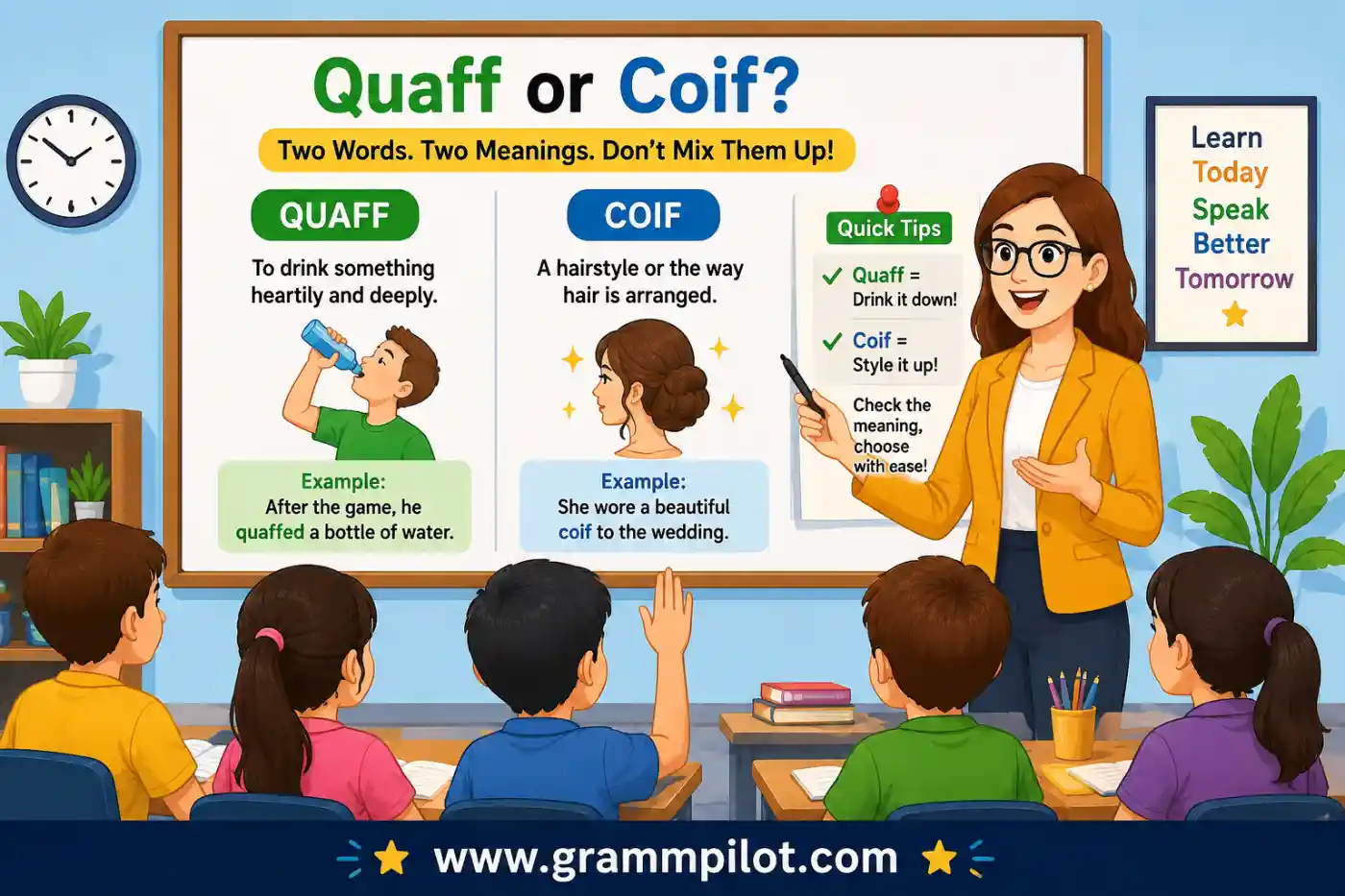
Quick Answer: Quaff means to drink something heartily or in large gulps. Coif means a hairstyle, to arrange someone’s hair, or a close-fitting cap. They are not synonyms and should never replace each other.
In this guide, you’ll learn the meaning of each word, where they came from, when to use them, common mistakes to avoid, helpful comparisons, dozens of related words, and real-life examples that make the difference easy to remember.
If you often mix up similar words, check out our guide to [Annual vs Yearly vs Every Year].
What Does “Quaff or Coif” Mean?
Although people often search for Quaff or Coif, they are actually comparing two unrelated English words.
| Word | Meaning | Used For |
|---|---|---|
| Quaff | To drink deeply or eagerly | Drinks and beverages |
| Coif | A hairstyle, to arrange hair, or a fitted cap | Hair and clothing |
Think of it this way:
- Quaff = Drink
- Coif = Hair
Once you remember this simple idea, it’s much harder to confuse them.
Why Do People Confuse Quaff or Coif?
The confusion happens for a few reasons.
- Both words are short.
- They are uncommon in everyday conversation.
- They appear in older books, literature, and crossword puzzles.
- Their spellings look somewhat similar.
- Many people hear them before seeing them written.
Even native English speakers sometimes need to stop and think before using one of these words.

Quaff or Coif: Where Do These Words Come From?
Many articles explain only the definitions. Knowing the history of the words makes them much easier to remember.
Origin of “Quaff”
The word quaff comes from old Germanic languages. It entered English several hundred years ago and originally meant to drink with enthusiasm or in large gulps.
It often appeared in poems, songs, and stories where people celebrated with wine or ale.
Older example:
The travelers quaffed warm cider around the fire.
Today, the word is less common in everyday speech but still appears in books, magazines, fantasy novels, restaurant reviews, and creative writing.
Origin of “Coif”
The word coif comes from Old French.
Long ago, a coif was a snug cap worn by men, women, and children. Over time, the meaning expanded.
Today, coif can refer to:
- a hairstyle
- the act of styling hair
- a close-fitting cap (mainly historical)
Example:
She admired her elegant coif before the wedding ceremony.
Because hairstyles became closely connected with fashion, the word developed its modern meaning.
What Does “Quaff” Really Mean?
In plain English, quaff means:
To drink something eagerly, deeply, or in large mouthfuls.
It usually suggests enjoyment rather than simply taking a sip.
Examples:
- They quaffed lemonade after the soccer game.
- He quaffed a cold glass of water after mowing the lawn.
- The hikers quaffed hot chocolate beside the cabin.
- Friends quaffed coffee while catching up.
- The sailors quaffed ale after returning to shore.
Notice that quaff usually describes a drink you enjoy rather than medicine or something unpleasant.
When Should You Use “Quaff”?
Use quaff when you want your writing to sound:
- vivid
- descriptive
- literary
- humorous
- dramatic
Instead of saying:
He drank the juice.
You could write:
He quaffed the juice after finishing the race.
The second sentence paints a clearer picture.
What Does “Coif” Really Mean?
In modern English, coif most often refers to:
- a hairstyle
- styled hair
- arranging someone’s hair
Examples:
- The actress debuted a stylish coif.
- His neat coif matched his formal suit.
- The stylist carefully coiffed the bride’s hair.
- Her elegant coif attracted everyone’s attention.
The historical meaning—a close-fitting cap—is still correct but is mostly found in history books and museums.
When Should You Use “Coif”?
Use coif when talking about:
- hairstyles
- beauty
- fashion
- salons
- historical clothing
For example:
Instead of:
She had beautiful hair.
You could write:
She wore a beautifully crafted coif.
This sounds more formal and descriptive.
Can You Ever Use Quaff Instead of Coif?
No.
These words are never interchangeable because they describe completely different things.
| Wrong Sentence | Correct Sentence |
|---|---|
| She quaffed her hair before the party. | She coiffed her hair before the party. |
| He coifed a glass of lemonade. | He quaffed a glass of lemonade. |
| The stylist quaffed the bride’s hairstyle. | The stylist coiffed the bride’s hairstyle. |
| The athlete coifed water after the race. | The athlete quaffed water after the race. |
Remember:
- Drinks → quaff
- Hair → coif
Quaff or Coif: What Part of Speech Are They?
Understanding grammar also helps you choose the right word.
| Word | Noun | Verb | Adjective |
|---|---|---|---|
| Quaff | Rare | ✔ Yes | No |
| Coif | ✔ Yes | ✔ Yes (coif/coiffed) | Rare |
Examples:
Quaff as a Verb
- They quaffed iced tea.
- We quaffed fresh lemonade.
- She quaffed sparkling water.
Coif as a Noun
- Her coif looked elegant.
- The magazine praised his classic coif.
Coif as a Verb
- The stylist coiffed the model’s hair.
- She coiffed her daughter’s hair for graduation.
Master Synonym List of “Quaff or Coif”
Many websites list only a handful of related words. The lists below group them by everyday use, formal writing, and casual speech so you can choose the best fit for your sentence.
Simple and Everyday Synonyms for Quaff
| Word | Meaning | Tone | Example |
|---|---|---|---|
| Drink | Take liquid into your mouth | Neutral | Drink plenty of water. |
| Sip | Drink slowly | Gentle | She sipped her tea. |
| Gulp | Drink quickly | Casual | He gulped the juice. |
| Swallow | Let liquid pass down your throat | Neutral | Swallow the medicine. |
| Taste | Try a small amount | Neutral | Taste the soup first. |
| Have | Consume a drink | Everyday | I’ll have coffee. |
| Enjoy | Drink with pleasure | Friendly | Enjoy your lemonade. |
| Refresh | Drink to cool down | Informal | They refreshed themselves with water. |
Formal and Literary Synonyms for Quaff
| Word | Meaning | Tone | Example |
|---|---|---|---|
| Imbibe | Drink liquids | Formal | Guests imbibed wine during dinner. |
| Consume | Eat or drink | Formal | Consumers should consume enough water daily. |
| Partake | Share food or drink | Formal | Visitors partook in the celebration. |
| Drain | Finish every drop | Literary | He drained the mug. |
| Down | Drink quickly | Informal | She downed the smoothie. |
| Chug | Drink continuously | Casual | They chugged sports drinks after practice. |
| Swig | Take a large drink | Casual | He took a swig of lemonade. |
| Lap up | Drink eagerly | Informal | The puppy lapped up the milk. |
Everyday Synonyms for Coif
| Word | Meaning | Tone | Example |
|---|---|---|---|
| Hairstyle | Arrangement of hair | Neutral | She changed her hairstyle. |
| Hairdo | Styled hair | Casual | I like your new hairdo. |
| Style | Hair arrangement | Everyday | His style looked neat. |
| Cut | Haircut | Everyday | She got a fresh cut. |
| Look | Overall appearance | Casual | Her new look impressed everyone. |
| Trim | Hair shortening | Neutral | He booked a trim today. |
| Blowout | Salon hairstyle | Casual | She scheduled a blowout before the event. |
| Waves | Hair texture | Neutral | Soft waves framed her face. |
Formal Synonyms for Coif
| Word | Meaning | Tone | Example |
|---|---|---|---|
| Hair arrangement | Styled hair | Formal | The hair arrangement matched the dress. |
| Hair styling | Styling process | Formal | Professional hair styling takes time. |
| Grooming | Personal appearance | Formal | Good grooming builds confidence. |
| Arrangement | Hair placement | Literary | The arrangement was carefully planned. |
| Tresses | Hair | Literary | Her long tresses flowed gracefully. |
| Locks | Strands of hair | Literary | His curly locks caught the light. |
| Mane | Thick hair | Informal | She has a beautiful mane. |
| Crown | Hair on the head | Poetic | Her crown of curls looked stunning. |
Synonyms of “Quaff or Coif” by Intensity (Mild → Strong)
Choosing the right word often depends on how much action or emotion you want to show. Some words sound gentle, while others create a much stronger image.
Words Related to Quaff
| Intensity | Word | Meaning | Example |
|---|---|---|---|
| Very Mild | Taste | Try a small amount | She tasted the juice first. |
| Mild | Sip | Drink slowly | He sipped his coffee during the meeting. |
| Mild | Drink | Consume a beverage | They drank cold water after lunch. |
| Medium | Swallow | Let liquid pass down the throat | She swallowed the last mouthful. |
| Medium | Enjoy | Drink with pleasure | We enjoyed fresh lemonade on the porch. |
| Medium | Swig | Take a large drink | He took a swig from the bottle. |
| Strong | Gulp | Drink quickly in large mouthfuls | She gulped the sports drink after practice. |
| Strong | Chug | Drink continuously without stopping | The runners chugged water after the race. |
| Very Strong | Down | Finish a drink quickly | He downed the glass in seconds. |
| Strongest | Quaff | Drink deeply and with enjoyment | They quaffed apple cider around the campfire. |
Notice that quaff usually suggests both enthusiasm and enjoyment. It isn’t simply about drinking fast.
Words Related to Coif
Unlike quaff, the word coif doesn’t describe intensity. Instead, related words vary by style and formality.
| Style | Word | Meaning | Example |
|---|---|---|---|
| Everyday | Hair | General term | Her hair looked healthy. |
| Everyday | Hairstyle | Hair arrangement | I like your hairstyle. |
| Casual | Hairdo | Styled hair | That’s a fun hairdo. |
| Neutral | Cut | Haircut | He got a fresh cut. |
| Neutral | Style | Hair arrangement | Her style suits her face. |
| Professional | Grooming | Personal appearance | Good grooming creates a neat impression. |
| Formal | Coif | Styled hair | Her elegant coif matched the evening gown. |
| Literary | Tresses | Long strands of hair | Her tresses shined in the sunlight. |
| Literary | Locks | Hair strands | His curly locks framed his face. |
| Poetic | Mane | Thick hair | She has a beautiful mane of curls. |
More Helpful Synonyms Of “Quaff or Coif” You Should Know
The following table expands your vocabulary beyond the common choices. These words may not replace quaff or coif directly in every sentence, but they are closely related and useful in similar situations.
| Word | Meaning | Tone | Example |
|---|---|---|---|
| Beverage | A drink | Formal | The restaurant serves cold beverages. |
| Refreshment | Food or drink | Neutral | Refreshments were available after the event. |
| Potion | A magical or special drink | Literary | The wizard mixed a potion. |
| Brew | A prepared drink | Casual | He enjoyed a fresh brew. |
| Ale | Traditional beer | Literary | Travelers shared ale at the inn. |
| Cider | Fruit-based drink | Neutral | We drank warm cider in winter. |
| Barber | Hair professional | Neutral | The barber suggested a new style. |
| Hairdresser | Person who styles hair | Neutral | My hairdresser recommended shorter layers. |
| Salon | Hair styling business | Neutral | She visited the salon before the wedding. |
| Bangs | Hair over the forehead | Neutral | She decided to cut bangs. |
| Curl | Curved hair | Neutral | One curl fell across her face. |
| Fringe | British word for bangs | UK English | Her fringe needed trimming. |
Together with the earlier tables, you now have more than 30 related words that cover everyday conversation, formal writing, creative storytelling, and professional communication.
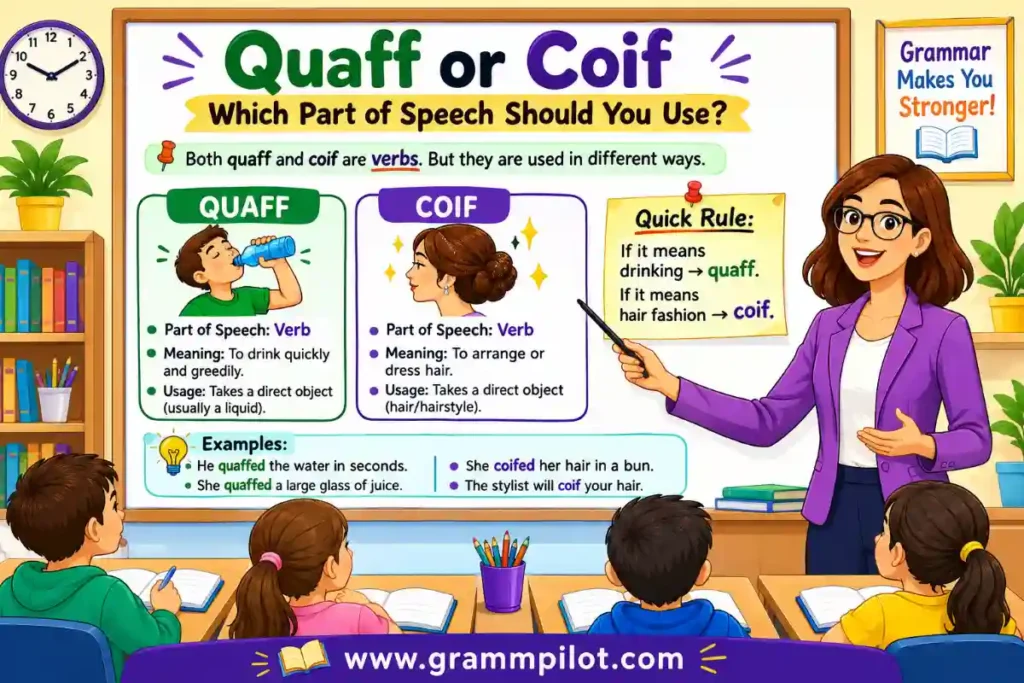
“Quaff or Coif” Which Part of Speech Should You Use?
Understanding grammar makes it much easier to choose the correct word.
Quaff as a Verb
This is by far the most common use.
Examples:
- The hikers quaffed cold water after reaching the top.
- We quaffed fresh orange juice at breakfast.
- They quaffed hot chocolate during the snowstorm.
Quaff as a Noun
This use is rare but still correct.
Example:
- He took one long quaff before leaving.
You’ll mostly see this in novels or older writing.
Coif as a Noun
When used as a noun, it refers to a hairstyle or, less commonly, a close-fitting cap.
Examples:
- Her coif looked perfect for the ceremony.
- The painting showed a woman wearing a medieval coif.
Coif as a Verb
The verb form means to arrange or style someone’s hair.
Examples:
- The stylist coiffed the bride’s hair.
- She carefully coiffed her daughter’s curls.
Is “Coiff” a Real Word?
Many learners accidentally write coiff because they’ve seen words like coiffure or coiffed.
Here’s the correct spelling:
| Incorrect | Correct |
|---|---|
| coiff | ❌ |
| coif | ✅ |
| coiffed | ✅ |
| coiffure | ✅ |
Remember:
- Coif is the base word.
- Coiffed is the past tense.
- Coiffure is a French-inspired word meaning hairstyle.
Is There a Difference Between US and UK English?
For quaff, there is almost no difference.
Both American and British English use the word to mean drinking something eagerly.
The main difference is frequency.
- British writers tend to use quaff a little more often, especially in stories about pubs, ale, or traditional celebrations.
- American writers usually prefer everyday words like drink, gulp, or chug, although quaff still appears in novels, magazines, and food writing.
For coif, the meaning is also the same in both countries.
However, everyday speakers in the United States and the United Kingdom usually say:
- hairstyle
- haircut
- hairdo
The word coif sounds more formal, literary, or fashion-focused in both regions.
“Quaff or Coif” Which Word Works Best in Different Situations?
The best choice depends on where you’re writing. A word that sounds great in a novel may sound odd in a business email.
Best Word for a Resume
Avoid both quaff and coif unless they directly relate to your work. A resume should use simple, professional language.
If you’re applying for a salon position, use clear words like:
Best Word for an Essay
An essay gives you more freedom. If you’re describing a scene or analyzing literature, quaff and coif can add variety and precision.
Example: The king quaffed wine as musicians played in the great hall.
Example: The queen’s elegant coif reflected the fashion of the time.
These words work well because they create vivid images without sounding overly complicated.
Best Word for an Email
Business and personal emails usually benefit from simple vocabulary.
Instead of writing: We quaffed coffee before the meeting.
Write: We had coffee before the meeting.
Likewise, instead of saying: I admired your coif.
Most people would naturally write: I like your hairstyle.
Simple language is easier for everyone to understand.
Best Word for Text Messages
Texting is informal, so everyday words are almost always the better choice.
Instead of: Let’s quaff some lemonade.
Most people would say: Let’s grab a drink.
Instead of: Nice coif!
A friend would probably text: Love your hair!
Using familiar language makes your message sound natural and friendly.
Quaff or Coif: Best Word for Speaking
In everyday conversation, most people rarely say quaff or coif.
Natural choices include:
- drink
- sip
- grab a coffee
- hairstyle
- haircut
- hair
Save quaff and coif for situations where you want a more colorful or descriptive style, such as storytelling, creative writing, or discussions about fashion or literature.
Real-Life Example Sentences on “Quaff or Coif”
The best way to remember the difference between these words is to see them used in everyday situations. These examples cover school, work, travel, family life, and creative writing.
Examples with Quaff
- After finishing the marathon, the runners quaffed bottles of cold water.
- We quaffed fresh lemonade while sitting on the porch during the summer afternoon.
- The travelers quaffed hot chocolate after hiking through the snowy mountains.
- He quaffed his morning coffee before catching the first train to work.
- The knights gathered in the hall to quaff ale after returning from battle.
- Everyone quaffed fruit punch during the birthday celebration.
- She laughed as she quaffed her favorite iced tea on the beach.
- The campers quaffed warm soup to stay comfortable on the cold evening.
- They quaffed sparkling cider while celebrating their graduation.
- The exhausted gardener quaffed a glass of water before getting back to work.
Examples with Coif
- The stylist created an elegant coif for the bride.
- His neat coif made him look ready for the interview.
- She admired her carefully styled coif in the mirror.
- The actress appeared on the red carpet with a classic coif.
- The hairdresser spent nearly an hour creating the perfect coif.
- The magazine praised the singer’s modern coif.
- Every guest complimented her beautiful coif at the wedding.
- The model’s coif matched the designer’s latest fashion collection.
- She decided to coif her hair before attending the family reunion.
- The stylist coiffed the client’s hair into soft curls for the evening event.
What Are the Closest Synonyms for “Quaff”?
Several words have meanings similar to quaff, but each one creates a slightly different picture.
Quaff vs. Drink
| Quaff | Drink |
|---|---|
| Suggests enthusiasm and enjoyment | General word for consuming liquids |
| Often used in stories or descriptive writing | Used in everyday conversation |
| Sounds more colorful | Sounds simple and direct |
Example:
- He drank a glass of water.
- He quaffed a glass of water after the long hike.
Both sentences are correct, but the second helps readers imagine someone drinking eagerly.
Quaff vs. Gulp
| Quaff | Gulp |
|---|---|
| Focuses on enjoyment | Focuses on speed |
| May describe drinking deeply | Usually means swallowing quickly |
| Often literary | Common in everyday speech |
Example:
- She gulped the juice because she was late.
- She quaffed fresh juice while relaxing on the patio.
The first sentence emphasizes hurry. The second emphasizes pleasure.
What Are the Closest Synonyms for “Coif”?
Coif vs. Hairstyle
| Coif | Hairstyle |
|---|---|
| More formal and literary | Everyday word |
| Often used in fashion writing | Used by almost everyone |
| Sounds elegant | Sounds natural |
Example:
- Her hairstyle looked beautiful.
- Her elegant coif completed the evening look.
Both are correct, but coif adds a touch of sophistication.
Coif vs. Hairdo
| Coif | Hairdo |
|---|---|
| Formal | Casual |
| Common in magazines and literature | Common in conversation |
| Stylish tone | Friendly tone |
Example:
- Nice hairdo!
- Her formal coif matched the black evening dress.
Choose the word that matches the tone of your writing.
Quaff or Coif: Which Word Should You Choose?
If you’re still unsure, use this quick guide.
| Situation | Best Choice |
|---|---|
| Talking about drinking | Quaff |
| Talking about hair | Coif |
| Everyday conversation | Drink / Hairstyle |
| Creative writing | Quaff / Coif |
| School essays | Depends on the context |
| Business writing | Simple alternatives are usually better |
A good writer doesn’t always choose the fanciest word. The best word is the one your readers understand immediately.
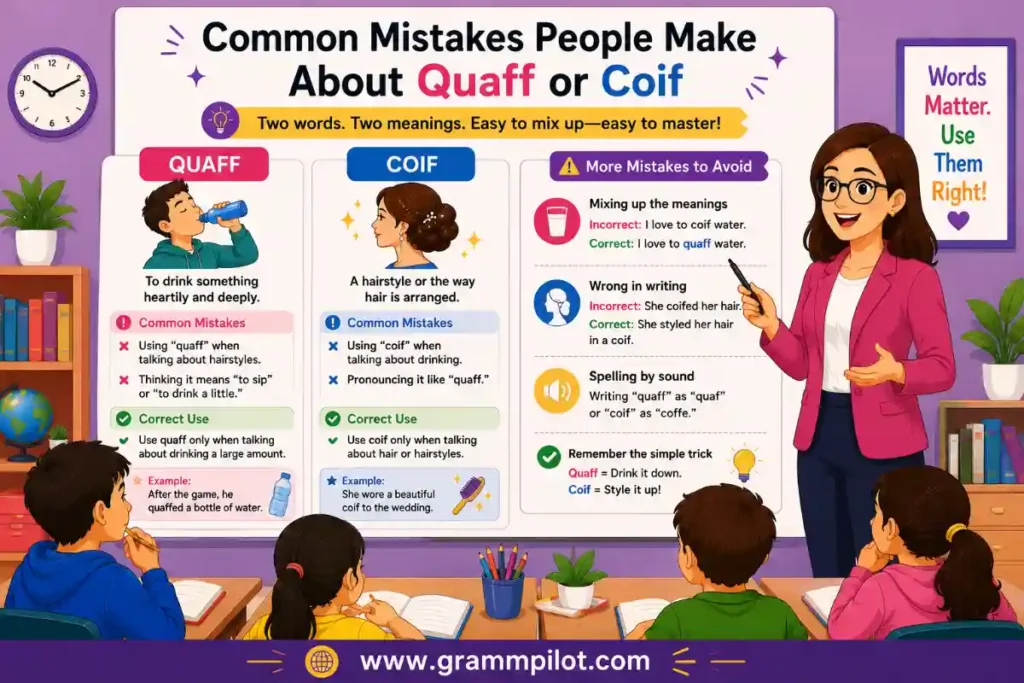
Common Mistakes People Make About “Quaff or Coif”
Many English learners—and even native speakers—make the same mistakes with these words. Learning them now will save you from awkward writing later.
Mistake 1: Thinking the Words Are Synonyms
This is the biggest mistake.
Incorrect: She quaffed her hair before dinner.
Correct: She coiffed her hair before dinner.
Mistake 2: Using “Quaff” for Every Drink
Quaff usually suggests drinking eagerly or with enjoyment.
Natural: They quaffed lemonade after the soccer game.
Less natural: She quaffed a tiny sip of cough medicine.
Medicine is normally swallowed, not quaffed.
Mistake 3: Using “Coif” in Casual Conversation
Although coif is correct, it sounds formal.
Instead of saying: I like your coif.
Most people simply say: I like your hair or I like your hairstyle.
Mistake 4: Misspelling the Words
Common spelling mistakes include:
- quaf ❌
- quoff ❌
- coiff ❌
- quoff ❌
Correct spellings:
- quaff ✅
- coif ✅
- coiffed ✅
- coiffure ✅
Mistake 5: Forgetting the Context
Always ask yourself one question.
Am I talking about a drink or about hair?
If it’s a drink, choose quaff.
If it’s hair, choose coif.
That simple question prevents almost every mistake.
Quaff or Coif: When Should You Avoid These Words?
Even though both words are correct, they aren’t always the best choice.
Avoid quaff when:
- Writing instructions
- Writing business reports
- Creating technical documents
- Giving medical advice
- Speaking casually with people unfamiliar with the word
Instead, use:
- drink
- sip
- have
- consume
Avoid coif when:
- Writing everyday emails
- Sending text messages
- Talking with young children
- Giving simple directions
Instead, use:
- hair
- hairstyle
- haircut
- hairdo
Simple words are often stronger because everyone understands them.
What Are the Antonyms?
Neither word has one perfect opposite, but several antonyms work depending on the situation.
Antonyms of Quaff
| Word | Why It’s Opposite |
|---|---|
| Fast | Avoid drinking |
| Abstain | Choose not to drink |
| Refuse | Decline a beverage |
| Reject | Turn down a drink |
| Leave | Not finish the drink |
Example: Instead of quaffing the lemonade, he refused it politely.
Antonyms of Coif
| Word | Why It’s Opposite |
|---|---|
| Mess | Make hair untidy |
| Ruffle | Disturb neatly arranged hair |
| Tousle | Leave hair messy |
| Disarrange | Undo careful styling |
| Unkempt | Not neat or groomed |
Example: The strong wind tousled her hair just after the stylist had coiffed it.

Quick Tips for Choosing the Right Word “Quaff or Coif”
Keep these simple tips in mind whenever you’re writing.
- Quaff always relates to drinking.
- Coif relates to hair or hairstyling.
- Don’t use either word just to sound smarter.
- Choose simple alternatives in everyday writing.
- Use quaff mainly in stories, descriptive writing, or creative content.
- Use coif when discussing fashion, beauty, hairstyles, or historical clothing.
- If your readers might not know the word, consider using a more familiar alternative.
- Read your sentence aloud. If it sounds unnatural, a simpler word is probably the better choice.
- Remember the easy trick: Quaff = beverage. Coif = hairstyle.
These habits will make your writing clearer and more natural while helping you avoid one of the most common vocabulary mix-ups involving Quaff or Coif.
Conclusion
Understanding Quaff or Coif is much easier once you know that the two words have completely different meanings. Quaff refers to drinking something eagerly or in large mouthfuls, while coif refers to a hairstyle or the act of arranging hair. They may look somewhat alike, but they should never be used interchangeably. Keeping this simple difference in mind will help you choose the right word every time.
The best vocabulary isn’t always the most unusual—it’s the one that fits your message. If you’re writing a story, novel, or descriptive essay, these words can add color and precision. In everyday emails, texts, and conversations, simpler alternatives like drink, hairstyle, or hair are usually the better choice. The more you read and practice, the more naturally these words will become part of your vocabulary.
Frequently Asked Questions
1. Is Quaff or Coif the same thing?
No. Quaff or Coif refers to two completely different words. Quaff means to drink deeply or eagerly, while coif refers to a hairstyle, styled hair, or arranging someone’s hair.
2. Which word means “to drink eagerly”?
Quaff is the correct word. It describes drinking something with enthusiasm, often in large mouthfuls.
Example: The hikers quaffed cold water after climbing the hill.
3. Which word refers to a hairstyle?
Coif is the correct word. It can mean a hairstyle or the act of styling someone’s hair.
Example: The stylist created a beautiful coif for the wedding.
4. What’s another way to say “quaff”?
Some common alternatives include:
- Drink
- Sip
- Gulp
- Swig
- Chug
- Down
- Imbibe
- Consume
Choose the word that best matches the tone of your writing.
5. Can I use “quaff” in formal writing?
Yes, but only when it fits the context. Quaff often appears in literature, food writing, travel articles, and creative essays. In business documents or academic reports, simpler words like drink or consume are usually more appropriate.
6. Is “coif” still used today?
Yes, although it’s much less common than hairstyle or hairdo. You’ll often find coif in fashion magazines, beauty articles, historical writing, and novels.
7. How can I remember the difference between quaff or coif?
A simple memory trick is:
- Quaff = Beverage
- Coif = Hair
If your sentence is about drinking, choose quaff. If it’s about hair or hairstyling, choose coif.