
Have you ever been writing an essay, email, birthday card, or even a quick text and realized that the word smile sounded too plain? Similes for Smile can make your writing warmer, more colorful, and easier for readers to imagine. A good comparison turns an ordinary sentence into one that stays in someone’s mind. A genuine smile can show happiness, kindness, confidence, relief, love, or excitement. That’s why writers often compare a smile to sunshine, flowers, stars, or other familiar images. Using Similes for Smile helps you express those feelings without repeating the same words over and over.
Answer Box
Similes for Smile compare a smile to another object or idea using words like as or like. They help readers picture the expression more clearly and make writing more vivid.
In this guide, you’ll learn the meaning of Similes for Smile, where the word comes from, the best comparisons, when to use them, common mistakes, practical examples, and much more.
If you’re building a collection of useful similes and comparisons, don’t miss [Similes for Confident].
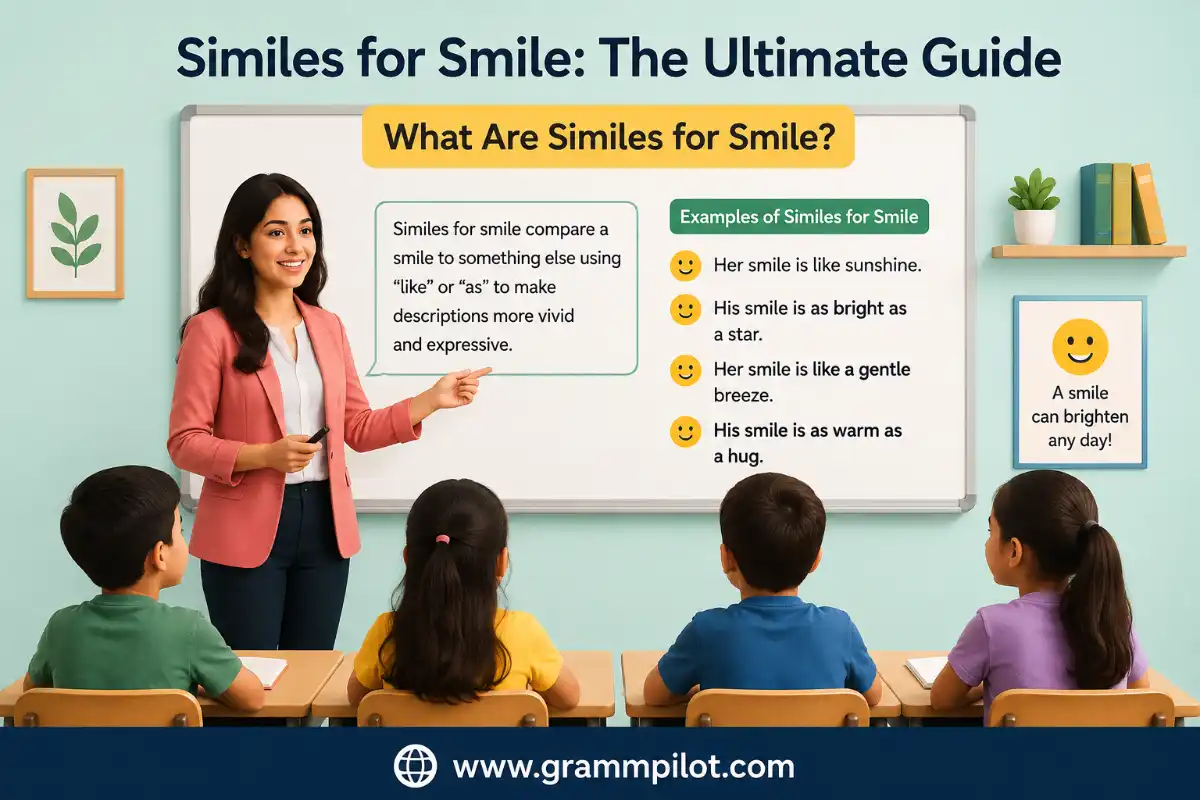
What Are Similes for Smile?
Similes for Smile are figures of speech that compare a smile with something else by using like or as. Instead of simply saying someone smiled, a simile creates a picture in the reader’s mind.
For example:
- Her smile was as bright as the morning sun.
- He smiled like a child opening a birthday gift.
- Her smile was as warm as a summer afternoon.
- His grin spread like sunshine after rain.
These comparisons make the description feel more alive.
Compare these two sentences.
Simple: She smiled.
Better: She smiled like the first ray of sunshine after a storm.
The second sentence helps readers imagine both the smile and the emotion behind it.
What Does “Smile” Mean?
Before learning different Similes for Smile, it’s useful to understand what the word itself means. A smile is a happy or friendly expression made by turning the corners of the mouth upward. People smile for many reasons.
They may smile because they are:
- Happy
- Proud
- Excited
- Relaxed
- Grateful
- Amused
- Friendly
- Encouraging
- Hopeful
- In love
Not every smile looks the same. Some smiles are gentle. Others are wide and joyful. A few are shy. Some are playful. Because smiles express many emotions, different similes fit different situations.
Where Does the Word “Smile” Come From?
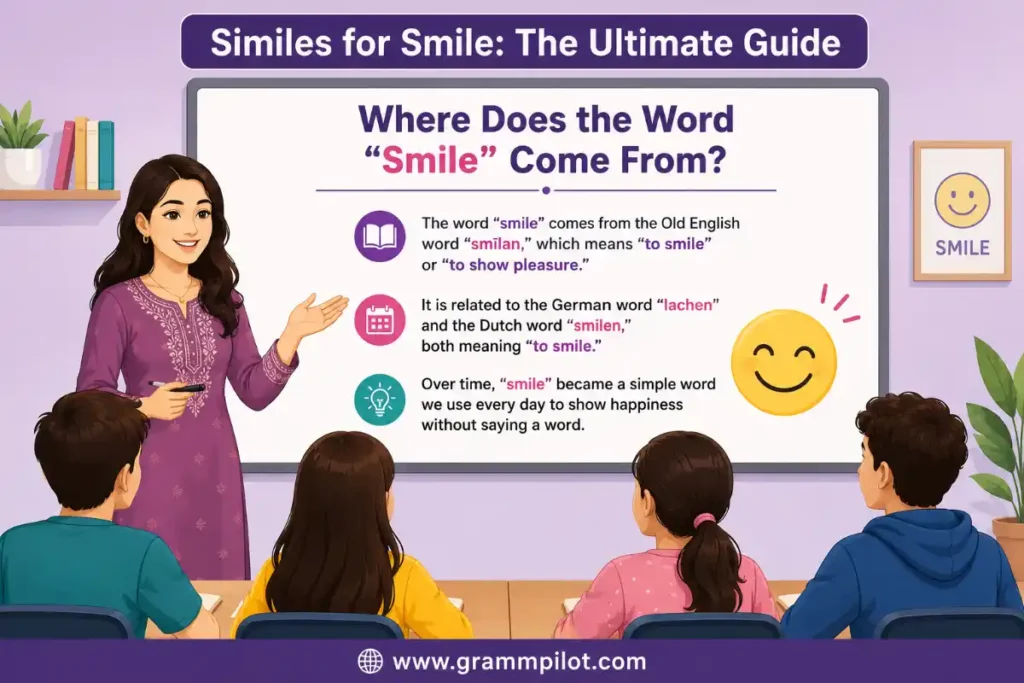
Many articles list examples of Similes for Smile, but very few explain where the word began The English word smile comes from the Old English word smīlan, which meant to laugh softly or show pleasure with the face. Its roots reach even further into early Germanic languages, where similar words described expressions of happiness, friendliness, or quiet amusement. Unlike loud laughter, a smile has always suggested gentle emotion. Over hundreds of years, English speakers continued using the word to describe more than happiness.
Today, a smile can also express:
- Kindness
- Relief
- Confidence
- Pride
- Hope
- Love
- Gratitude
- Surprise
That rich history explains why writers have created so many Similes for Smile throughout literature.
Why Do Writers Use Similes for Smile?
A smile tells readers something. A simile helps readers feel it. Instead of stating that someone smiled, writers compare the smile with something familiar.
Look at these examples.
Plain
She gave me a smile.
Better
She gave me a smile like warm sunshine on a cold morning.
Now compare another pair.
Plain
The child smiled.
Better
The child smiled like a flower opening to the morning light. The second version creates a much stronger image. Readers can almost picture the scene. That’s why novels, poems, speeches, and even advertisements often use Similes for Smile.
When Should You Use Similes for Smile?
You can use Similes for Smile whenever you want your writing to sound more descriptive.
They work especially well in:
- School essays
- Short stories
- Novels
- Poems
- Speeches
- Wedding cards
- Birthday messages
- Personal emails
- Social media captions
- Children’s stories
Even one well-placed comparison can improve an ordinary paragraph.
For example:
Instead of writing: She had a beautiful smile.
Try: She had a smile as bright as the sunrise.
Instead of writing: He smiled happily.
Try: He smiled like someone who had finally found home.
The meaning becomes much richer without making the sentence difficult.
What Makes Good Similes for Smile?
Not every comparison sounds natural. The best Similes for Smile share a few important qualities.
They Create a Clear Picture
Readers should imagine the smile immediately.
Good examples include:
- As bright as sunshine
- Like a blooming flower
- As warm as a summer morning
- Like a shining star
Each comparison creates a simple mental image.
They Match the Emotion
Different emotions need different comparisons. A shy smile shouldn’t be compared with fireworks.
Instead, it might be:
- Like the first flower of spring
- Like a gentle sunrise
- Like soft candlelight
A joyful smile, however, could be:
- As bright as the sun
- Like a rainbow after rain
- Like fireworks in the night sky
Choosing the right image makes your writing feel believable.
They Sound Natural
Readers shouldn’t stop to figure out the comparison. Easy images usually work best.
Examples include:
- Like sunshine
- Like fresh flowers
- Like a star
- Like golden light
- Like morning sunshine
Simple language often creates the strongest writing.
They Add Meaning
A simile should do more than decorate a sentence. It should reveal something about the person or situation. Compare these examples.
Weak
Her smile was nice.
Better
Her smile was like sunshine breaking through dark clouds.
The second sentence tells readers more than just appearance. It also suggests hope and comfort.
Different Types of Similes for Smile
Not every smile expresses the same feeling. That’s why writers choose different comparisons depending on the situation.
Happy Smiles
These comparisons express joy and excitement.
Examples:
- Like sunshine after rain
- As bright as the morning sun
- Like fireworks lighting the sky
- Like birds singing at dawn
Gentle Smiles
These create a calm and peaceful feeling.
Examples:
- Like a soft breeze
- Like candlelight
- Like a quiet sunrise
- Like fresh spring flowers
Loving Smiles
These comparisons show affection and warmth.
Examples:
- Like warm sunshine
- Like a glowing heart
- Like a favorite memory
- Like a comforting hug
Confident Smiles
These suggest strength and self-belief.
Examples:
- Like a lighthouse in the distance
- As steady as the sunrise
- Like a mountain standing tall
- Like a guiding star
Hopeful Smiles
Some smiles encourage others.
Good comparisons include:
- Like the first light of dawn
- Like rain ending after a storm
- Like spring returning after winter
- Like the first rainbow of the season
Choosing the right comparison helps readers understand the emotion behind the smile.
Why Similes for Smile Make Writing Better
Readers remember vivid images much longer than simple descriptions. Instead of repeating beautiful smile or happy smile, Similes for Smile help you express personality, emotion, and mood with just a few carefully chosen words.
They also make writing:
- More descriptive
- More emotional
- Easier to imagine
- More enjoyable to read
- More memorable
- Less repetitive
Professional writers rarely rely on plain descriptions alone. They use comparisons to bring characters and scenes to life. Even one thoughtful simile can turn an ordinary sentence into one readers remember long after they finish the page.
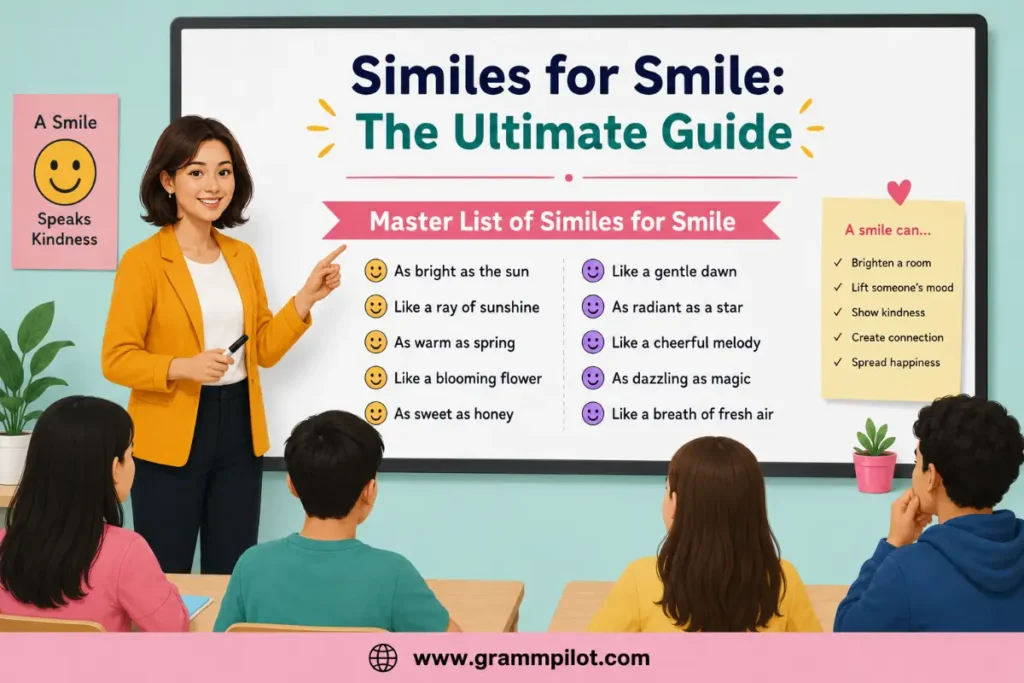
Master List of Similes for Smile
The best Similes for Smile help readers picture an expression instead of simply reading about it. Some comparisons sound warm and friendly. Others are poetic, formal, or playful.
The table below includes more than 30 useful similes you can use in essays, stories, speeches, and everyday writing.
| Simile | Meaning | Tone | Example |
|---|---|---|---|
| As bright as the sun | A joyful, glowing smile | Everyday | Her smile was as bright as the sun. |
| As warm as sunshine | Friendly and comforting | Everyday | His smile was as warm as sunshine. |
| Like a blooming flower | Beautiful and fresh | Creative | She smiled like a blooming flower. |
| Like a shining star | Noticeably beautiful | Everyday | Her smile sparkled like a shining star. |
| Like the morning sun | Full of warmth | Creative | His smile was like the morning sun. |
| Like golden sunlight | Warm and cheerful | Everyday | His smile spread like golden sunlight. |
| Like the first sunrise | New hope | Literary | His smile arrived like the first sunrise. |
| Like sparkling water | Fresh and lively | Everyday | His smile danced like sparkling water. |
| Like a ray of hope | Encouraging | Emotional | His smile came like a ray of hope. |
| Like soft candlelight | Quiet kindness | Literary | Her smile resembled soft candlelight. |
| Like a warm blanket | Comforting | Informal | His smile felt like a warm blanket. |
| Like spring after winter | New beginnings | Emotional | Her smile felt like spring after winter. |
These Similes for Smile cover many emotions, making it easier to choose the perfect comparison for your writing.
Similes for Smile by Emotion
Not every smile means the same thing. Some express excitement. Others show comfort, confidence, or affection. Choosing the right comparison helps readers understand the exact feeling.
Happy Similes for Smile
Use these when describing joyful moments.
- Like sunshine after rain
- As bright as the sun
- Like sparkling water
- Like birds singing at dawn
- Like a rainbow after a storm
- Like fresh flowers in spring
Example: The children greeted their teacher with smiles like sunshine after rain.
Gentle Similes for Smile
These work well for peaceful scenes.
- As gentle as a spring breeze
- Like soft candlelight
- Like moonlight on a quiet lake
- As fresh as morning dew
- Like a blooming flower
Example: Grandmother welcomed everyone with a smile as gentle as a spring breeze.
Loving Similes for Smile
These comparisons show affection.
- As comforting as home
- Like a warm blanket
- Like golden sunlight
- Like a glowing candle
- Like a favorite memory
Example: Her smile felt as comforting as home after a difficult day.
Hopeful Similes for Smile
Perfect for emotional stories.
- Like spring after winter
- Like the first sunrise
- Like a lighthouse in the dark
- Like a ray of hope
- Like sunshine through clouds
Example: The doctor’s reassuring smile arrived like a ray of hope.
Similes for Smile by Intensity
Some smiles are small. Others completely light up a room. Use the right level of intensity for the situation.
| Intensity | Simile | Best Use |
|---|---|---|
| Very Gentle | Like soft candlelight | Peaceful moments |
| Very Gentle | As fresh as morning dew | Nature writing |
| Gentle | Like a blooming flower | Friendly scenes |
| Gentle | As gentle as a spring breeze | Family stories |
| Medium | Like golden sunlight | Everyday descriptions |
| Medium | Like sparkling water | Casual writing |
| Medium | Like sunshine through clouds | Emotional writing |
| Strong | As bright as a diamond | Dramatic descriptions |
| Strong | Like a shining star | Celebrations |
| Strong | Like a rainbow after a storm | Inspirational writing |
| Very Strong | As bright as the sun | Powerful happiness |
| Very Strong | Like the first sunrise | Emotional storytelling |
Changing the intensity keeps your descriptions fresh instead of repetitive.
Similes for Smile by Part of Speech
A smile is a noun.
Most Similes for Smile describe that noun by acting as adjective phrases.
Describing a Person’s Smile
Examples:
- Her smile was as bright as the sun.
- His smile was like golden sunlight.
- Their smiles were like blooming flowers.
Describing an Expression
Examples:
- The welcoming smile felt like sunshine after rain.
- Her confident smile stood like a lighthouse.
- His grateful smile appeared like the first sunrise.
Describing a Mood
Sometimes the comparison describes the atmosphere created by the smile.
Examples:
- Her smile filled the room like warm sunshine.
- His smile spread like light across the morning sky.
- Their smiles grew like flowers after spring rain.
Are Similes for Smile Different in American and British English?
Most Similes for Smile are common in both American and British English.
Expressions such as these are widely understood:
- Like sunshine after rain
- As bright as the sun
- Like a blooming flower
- Like a shining star
- Like a warm blanket
The difference usually comes from culture rather than grammar.
An American writer may compare a smile to fireworks during Independence Day.
A British writer might compare it to a peaceful country sunrise or a garden in spring.
The meaning stays the same. Only the imagery changes.
Which Similes for Smile Sound Most Natural Today?
Some older comparisons appear mainly in classic literature. Modern English usually prefers clear, familiar images.
These sound natural in conversations and writing today:
- As bright as the sun
- Like sunshine after rain
- Like a blooming flower
- Like golden sunlight
- Like a shining star
- Like a warm blanket
- As sweet as honey
- Like a ray of hope
- Like fresh flowers in spring
- As welcoming as an open door
These comparisons are easy to understand and fit naturally into everyday English.
Best Similes for Smile for Different Writing Situations
The best Similes for Smile depend on where you’re using them. A comparison that sounds perfect in a poem may feel too dramatic in a business email. Choosing the right one makes your writing natural and engaging.
Similes for Smile in Essays
School essays usually need clear and meaningful comparisons.
These options work well:
- Like sunshine after rain
- As bright as the morning sun
- Like a blooming flower
- As warm as sunshine
- Like a ray of hope
Examples:
- Her smile was like sunshine after rain, bringing comfort to everyone around her.
- The young volunteer greeted visitors with a smile as warm as sunshine.
- His encouraging smile was like a ray of hope during difficult times.
Similes for Smile in Stories
Creative writing gives you more freedom.
You can use richer comparisons that help readers imagine emotions.
Good choices include:
- Like the first sunrise
- Like moonlight on a quiet lake
- Like a glowing lantern
- Like stars in the night sky
- Like spring after winter
Examples:
- Her smile appeared like the first sunrise after a long winter.
- The old sailor smiled like a glowing lantern guiding ships home.
- His smile sparkled like stars in the night sky.
Similes for Smile in Emails
Professional writing should stay simple.
Natural comparisons work best.
Examples:
- Your welcoming smile was like sunshine after rain during the meeting.
- Your smile is as warm as sunshine, making every customer feel comfortable.
Similes for Smile in Text Messages
Friends usually prefer casual language.
Examples:
- Your smile is as bright as the sun.
- You always smile like sunshine after rain.
- Your picture made me smile like a happy child.
These comparisons sound friendly without feeling overly formal.
Similes for Smile in Speeches
Public speaking benefits from memorable imagery.
Good choices include:
- Like a lighthouse
- Like the first sunrise
- Like a ray of hope
- Like sunshine through clouds
Example:
One genuine smile can spread like sunshine through clouds, giving people the courage to keep moving forward.
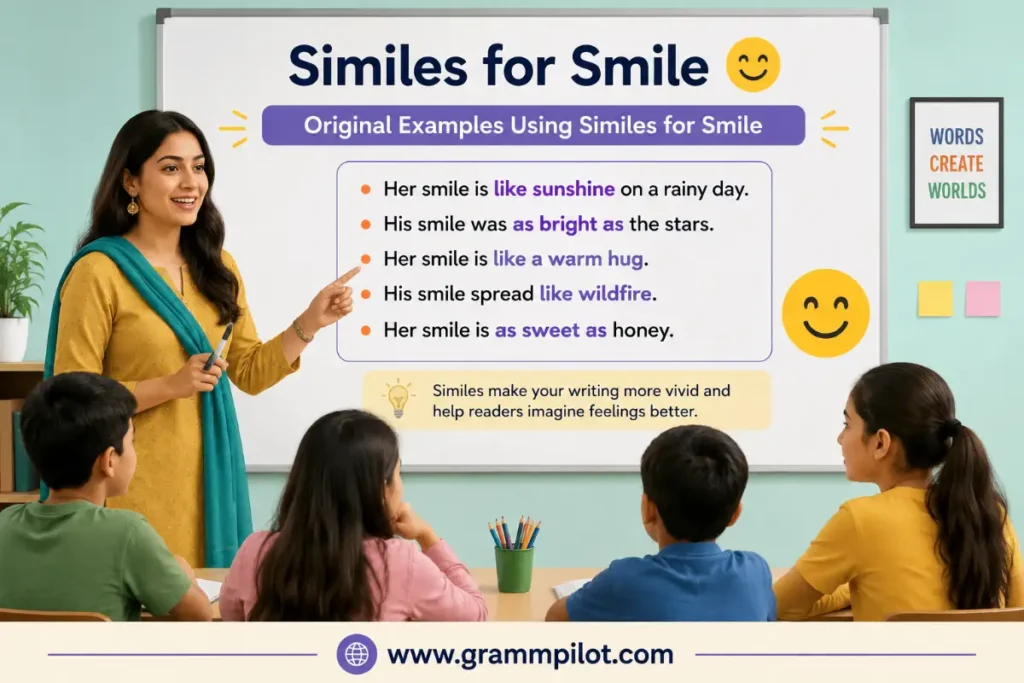
Original Examples Using Similes for Smile
Reading complete sentences helps you understand how Similes for Smile fit naturally into everyday English.
Here are original examples from different situations.
- The little girl’s smile was as bright as the morning sun.
- His smile spread like sunshine after rain.
- Grandma welcomed us with a smile as warm as sunshine.
- The bride smiled like a blooming flower as she walked down the aisle.
- The baby smiled like a tiny star lighting the night.
- His confident smile stood like a lighthouse during a storm.
- The teacher smiled like a proud parent watching success.
- Her smile felt as comforting as home after a stressful week.
- The young athlete smiled like someone who had reached the finish line.
- The doctor greeted nervous patients with a smile like a ray of hope.
- His smile sparkled like fresh snow under the winter sun.
- The singer smiled like golden sunlight filling the room.
- Her thankful smile appeared like spring after a long winter.
- The old man’s smile was as gentle as a spring breeze.
- Their smiles filled the room like music on a peaceful evening.
These examples show that Similes for Smile can express happiness, kindness, confidence, comfort, excitement, gratitude, and hope.
Similes for Smile vs. Smile Metaphors
Many students confuse similes with metaphors.
The difference is simple.
A simile uses like or as.
A metaphor makes a direct comparison without those words.
| Simile | Metaphor |
|---|---|
| Her smile was like sunshine after rain. | Her smile was sunshine. |
| His smile was as bright as the sun. | His smile was the sun. |
| Her smile sparkled like a diamond. | Her smile was a diamond. |
If your sentence contains like or as, it’s a simile.
Similes for Smile vs. Grin
These words are related, but they aren’t exactly the same.
| Smile | Grin |
|---|---|
| Can be small or large | Usually wide |
| May express many emotions | Often shows excitement or amusement |
| Suitable in formal writing | More casual |
| Common in every situation | Best for relaxed conversations |
Examples:
She gave a polite smile.
He wore a wide grin after winning the game.
A grin is always a type of smile, but not every smile is a grin.
Similes for Smile vs. Beam
People also confuse smile and beam.
| Smile | Beam |
|---|---|
| General facial expression | Very happy smile |
| Can be gentle | Usually broad and joyful |
| Neutral meaning | Strong positive emotion |
Examples:
She smiled politely.
He beamed with pride after hearing the good news.
Use beam when happiness is obvious.
Choose smile for everyday situations.
Common Mistakes When Using Similes for Smile
Learning what to avoid makes your writing stronger.
Using Too Many Comparisons
One or two similes improve a paragraph.
Several in one sentence become distracting.
Poor
Her smile was like sunshine, like a rainbow, like fireworks, like stars, and like gold.
Better
Her smile was like sunshine after rain.
Choosing the Wrong Image
The comparison should match the emotion.
Less Natural
His nervous smile was like fireworks.
Better
His nervous smile was like the first light before sunrise.
Mixing Different Images
Stay with one clear picture.
Confusing
Her smile was like sunshine and swam across the room like a fish.
Those images don’t work together.
Choose one comparison instead.
Repeating the Same Simile
Many writers overuse as bright as the sun.
Instead, vary your language.
Try:
- Like a blooming flower
- Like golden sunlight
- Like a ray of hope
- Like a glowing lantern
- Like a shining star
- Like moonlight on a quiet lake
Readers enjoy fresh comparisons.
Antonyms Related to Smile
Sometimes you need the opposite idea.
Here are useful antonyms.
| Word | Meaning |
|---|---|
| Frown | Facial expression showing sadness or anger |
| Scowl | Angry expression |
| Grimace | Twisted expression showing pain or dislike |
| Sneer | Unfriendly smile showing disrespect |
| Glare | Angry look |
| Gloom | Feeling of sadness |
| Misery | Deep unhappiness |
| Sorrow | Great sadness |
| Unhappiness | Lack of joy |
| Melancholy | Quiet sadness |
Examples:
- Her smile quickly turned into a frown.
- His cheerful face became gloomy after the bad news.
- The child stopped smiling and began to scowl.
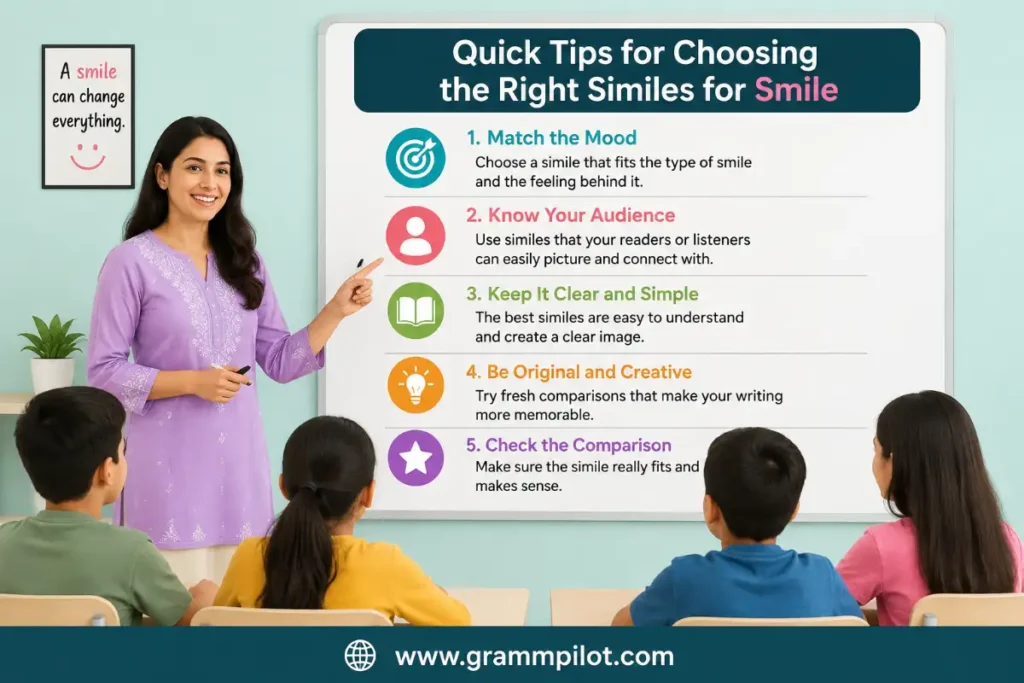
Quick Tips for Choosing the Right Similes for Smile
Choosing effective Similes for Smile becomes much easier with practice.
Keep these simple tips in mind.
- Match the comparison to the emotion.
- Use familiar images readers recognize.
- Avoid forcing unusual comparisons.
- Keep business writing simple.
- Save creative images for stories and poems.
- Don’t repeat the same simile throughout an article.
- Read your sentence aloud to check its flow.
- Choose comparisons that create clear mental pictures.
- Keep your writing natural instead of overly dramatic.
- Let the simile support your message rather than distract from it.
Strong writing doesn’t depend on difficult words.
It depends on choosing comparisons that readers understand, remember, and enjoy.
Conclusion
Similes for Smile can turn a simple description into something readers can clearly picture. Whether you’re writing a school essay, a short story, a speech, or a heartfelt message, the right comparison adds warmth, personality, and emotion. Instead of repeating the word smile, use a simile that matches the feeling you want to express, whether it’s joy, kindness, hope, confidence, or love.
As you practice writing, try different Similes for Smile in real situations. Read books, notice how experienced writers describe expressions, and experiment with your own comparisons. Over time, choosing vivid and natural similes will become easier, helping your writing sound more engaging without becoming complicated.
Frequently Asked Questions
1. What are Similes for Smile?
Similes for Smile are comparisons that use like or as to describe a smile by comparing it with something familiar. They help readers imagine emotions and expressions more clearly.
2. What are some common Similes for Smile?
Some popular Similes for Smile include:
- As bright as the sun
- Like sunshine after rain
- Like a blooming flower
- As warm as sunshine
- Like a shining star
- Like a ray of hope
- Like golden sunlight
- Like the first sunrise
- Like a glowing lantern
- As sweet as honey
These comparisons work well in essays, stories, speeches, and everyday conversations.
3. What’s another way to describe a beautiful smile?
You can describe a beautiful smile as radiant, warm, gentle, cheerful, welcoming, glowing, bright, friendly, or heartwarming. A well-chosen simile can make the description even more memorable.
4. Can I use Similes for Smile in school essays?
Yes. Similes for Smile are excellent for descriptive and creative writing because they make people and emotions easier to picture. Use them naturally instead of filling every sentence with comparisons.
5. What’s the difference between a smile and a grin?
A smile can be gentle, polite, or joyful, while a grin is usually wider and shows stronger happiness, excitement, or amusement. Both describe positive expressions, but a grin is generally more noticeable.
6. Which Similes for Smile work best in creative writing?
Creative writing often uses comparisons such as like a blooming flower, like moonlight on a quiet lake, like the first sunrise, like a glowing lantern, and like stars in the night sky because they create vivid mental images.
7. How do I choose the right simile for a smile?
Think about the emotion you want to show first. A joyful smile may be like sunshine after rain, while a gentle smile may be as soft as a spring breeze. Matching the comparison to the feeling makes your writing more natural and effective.