
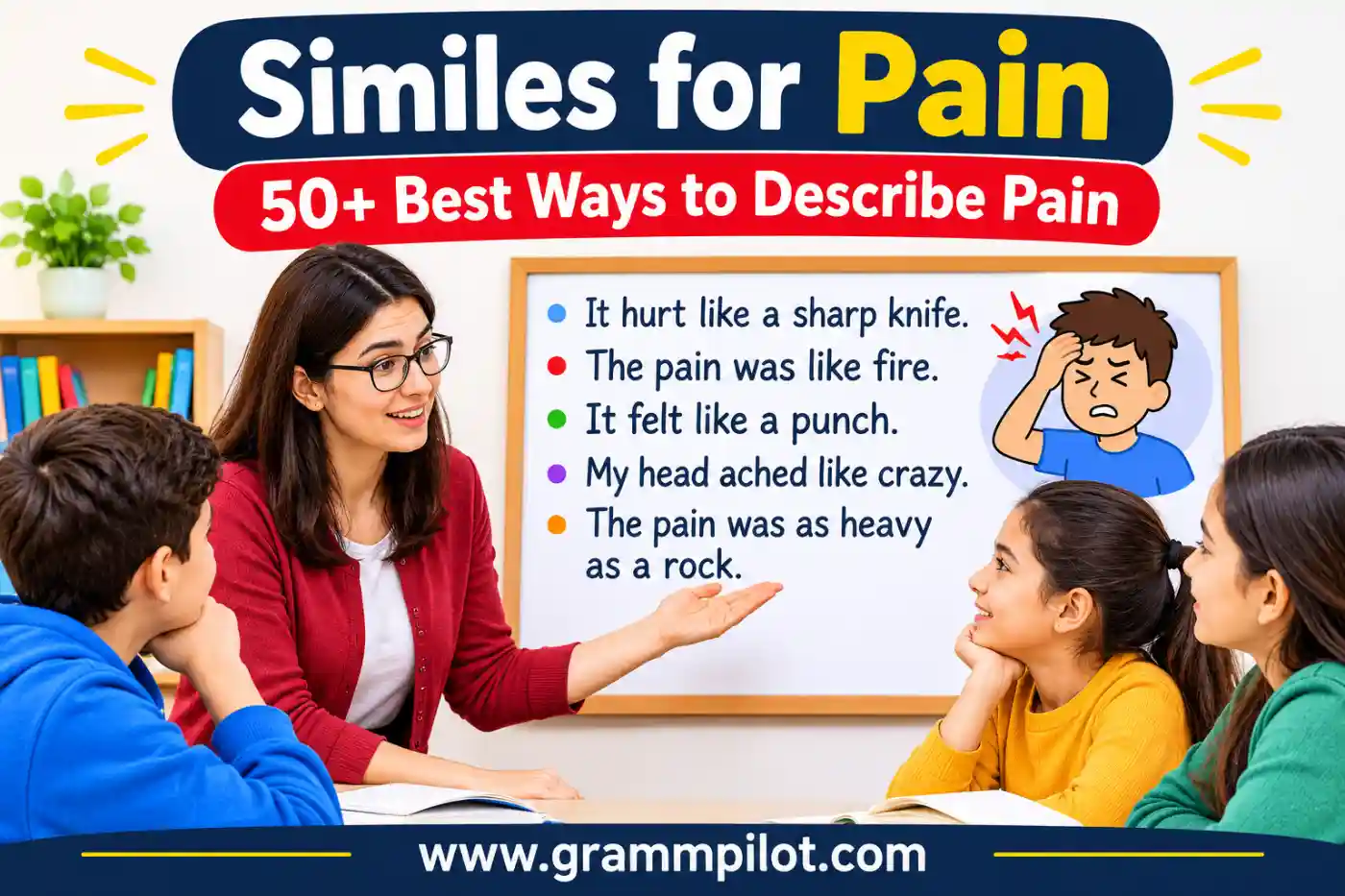
Pain is not always easy to describe. Imagine writing an essay about an injured character, sending a message about a painful experience, or explaining how someone feels after an accident. Simply writing “it hurt” may not help readers understand the feeling. That is where Similes for Pain become useful. They compare physical or emotional suffering to familiar things, making descriptions more powerful, natural, and memorable. A person might say, “The headache felt like a hammer pounding against my skull” or “Her heartbreak was like a knife twisting in her chest.” These comparisons help readers imagine the experience instead of simply reading about it.
What are similes for pain? They are comparisons that describe physical discomfort or emotional suffering by using words such as like or as. They make painful experiences easier to picture and understand. In this guide, you’ll discover more than 50 creative comparisons, their meanings, different levels of intensity, useful synonyms, real-life examples, and tips for choosing the right expression in writing and everyday conversation.For more examples that bring writing to life, check out Similes for Freedom.
What Does Pain Mean in Simple English?
Pain is an unpleasant physical or emotional feeling that happens when someone experiences injury, illness, loss, disappointment, or suffering. In simple words, pain is what we feel when something hurts our body or our emotions. There are two main types of pain.
1. Physical Pain
Physical pain affects the body. It can happen because of an injury, illness, accident, or medical condition.
Examples include:
- A sharp pain in your back.
- A burning feeling after touching something hot.
- A throbbing headache.
- A painful toothache.
- A sore muscle after exercise.
2. Emotional Pain
Emotional pain affects the heart and mind. It often comes from sadness, rejection, grief, loneliness, or disappointment.
Examples include:
- Losing someone you love.
- Feeling rejected by a close friend.
- Experiencing a painful breakup.
- Being disappointed by someone you trust.
- Remembering a difficult experience.
Both types can be described through creative comparisons.
Where Does the Word Pain Come From?
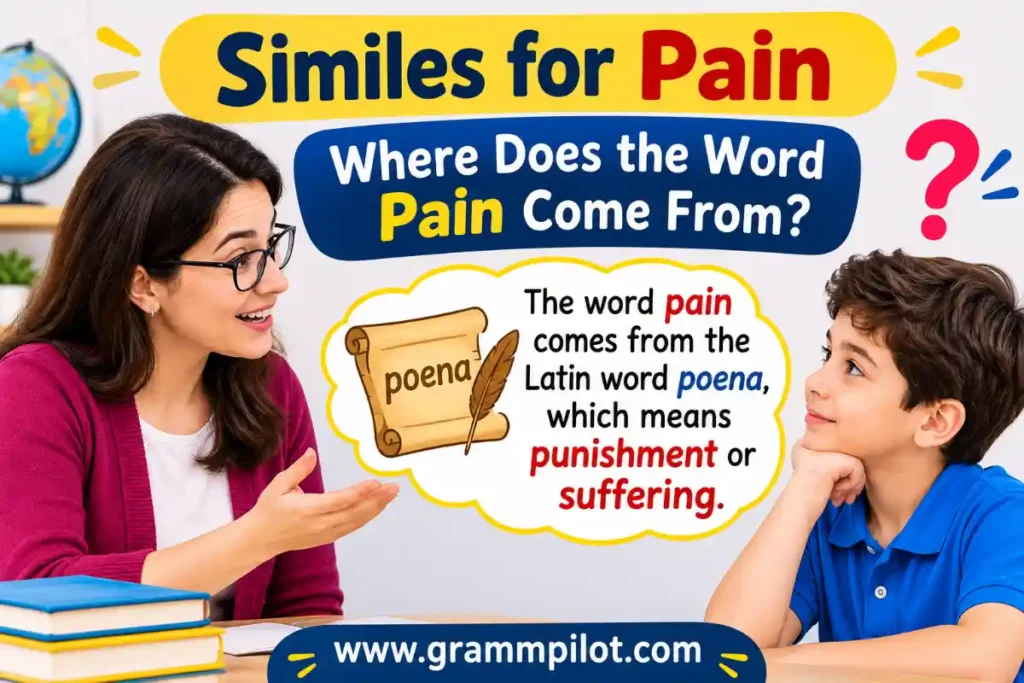
The word pain has an interesting history. It comes from the Old French word peine, which meant suffering, punishment, or hardship. This word developed from the Latin poena, meaning penalty or punishment. Over time, the meaning expanded to include physical discomfort and emotional suffering. Today, we use pain in many situations:
- Physical: The fall caused pain in his shoulder.
- Emotional: Her words caused me great pain.
- Figurative: The team felt the pain of losing the final match.
Understanding the word’s meaning helps us choose comparisons that fit different situations.
55+ Best Similes for Pain With Meanings
Here are creative comparisons for describing different kinds of suffering. Some focus on physical injuries, while others express sadness, heartbreak, and emotional struggles.
Similes for Physical Pain
- Like a hammer pounding against a nail – Describes strong, repeated pain.
- Like a thousand needles piercing the skin – Suggests sharp, prickling discomfort.
- Like fire burning through the flesh – Describes an intense burning sensation.
- Like a knife cutting through butter – Suggests a sharp, cutting feeling.
- Like electricity shooting through the body – Describes sudden, shocking pain.
- Like a drum beating inside the skull – Explains a pounding headache.
- Like glass breaking beneath the skin – Suggests sharp, uncomfortable pain.
- Like a rope tightening around the chest – Describes a feeling of pressure or tightness.
- Like a hot iron touching the skin – Describes burning discomfort.
- Like a thousand tiny cuts – Suggests repeated, irritating pain.
- Like a thorn stuck in the flesh – Describes constant, localized discomfort.
- Like a heavy stone pressing against the body – Suggests pressure and aching.
- Like a sharp blade twisting in a wound – Describes severe, stabbing pain.
- Like a tooth being pulled without warning – Suggests sudden and intense discomfort.
- Like a tight knot refusing to loosen – Describes persistent muscular discomfort.
Similes for Emotional Pain
- Like a knife through the heart – Describes deep emotional hurt.
- Like a storm breaking inside the soul – Suggests overwhelming sadness.
- Like a wound that never heals – Describes lasting emotional suffering.
- Like a thousand tears falling at once – Expresses overwhelming sadness.
- Like carrying a mountain on your shoulders – Describes emotional heaviness.
- Like a candle slowly burning out – Suggests losing hope or happiness.
- Like a heart trapped in winter – Describes loneliness and emotional coldness.
- Like drowning in an ocean of sorrow – Expresses overwhelming grief.
- Like a broken mirror reflecting sadness – Suggests emotional damage.
- Like an empty room filled with memories – Describes loneliness after losing someone.
- Like a shadow following every step – Describes pain that refuses to disappear.
- Like a flower crushed beneath a stone – Suggests emotional damage and helplessness.
- Like a silent scream trapped inside – Describes suffering that cannot be expressed.
- Like rain falling on an already flooded street – Suggests one disappointment after another.
- Like a door closing on every hope – Describes disappointment and lost opportunities.
For Deep and Unbearable Pain
- Like a thousand knives stabbing at once – Suggests extremely intense suffering.
- Like a volcano exploding inside the chest – Describes overwhelming emotional or physical intensity.
- Like being crushed beneath a mountain – Suggests unbearable pressure.
- Like a fire spreading through a dry forest – Describes rapidly increasing discomfort.
- Like a storm tearing through a peaceful village – Suggests destructive suffering.
- Like a wound being opened again and again – Describes pain that repeatedly returns.
- Like a scream echoing through an empty tunnel – Expresses deep suffering and helplessness.
- Like being trapped in a burning building – Suggests an overwhelming and frightening experience.
- Like a sharp arrow piercing the heart – Describes sudden, intense emotional hurt.
- Like walking barefoot over broken glass – Suggests repeated painful experiences.
For Mild or Lasting Pain
- Like a small stone inside a shoe – Describes minor but irritating discomfort.
- Like a quiet drum beating in the distance – Suggests a mild, recurring ache.
- Like a tiny thorn beneath the skin – Describes a small but noticeable irritation.
- Like a dull pencil pressing against paper – Suggests a persistent, dull ache.
- Like a slow-burning candle – Describes pain that continues over time.
- Like a bruise touched too often – Suggests discomfort that returns when disturbed.
- Like a heavy cloud hanging overhead – Describes sadness that stays for a while.
- Like a distant bell ringing repeatedly – Suggests recurring discomfort.
- Like a slow leak in a water pipe – Describes a problem that gradually wears someone down.
- Like a fading echo in an empty hall – Suggests pain that slowly disappears.
Creative Similes for Pain in Poetry and Stories
- Like winter entering a warm home – Describes happiness being replaced by sadness.
- Like a cracked violin playing a sad melody – Expresses emotional suffering.
- Like waves crashing against a lonely shore – Describes repeated emotional struggles.
- Like a dark cloud covering the morning sun – Suggests happiness being hidden by sadness.
- Like a bird with a broken wing – Describes vulnerability and helplessness.
What Are the Best Words to Describe Pain?
Sometimes, a single descriptive word works better than a complete comparison. The right word depends on the type and intensity of suffering.
Here are 30 useful alternatives grouped by tone.
| Word | Meaning | Tone | Example |
|---|---|---|---|
| Hurt | Feeling discomfort | Simple | My arm hurts. |
| Ache | A lasting dull pain | Everyday | My back has an ache. |
| Sore | Tender or uncomfortable | Everyday | My feet are sore. |
| Sting | Sharp, brief pain | Everyday | The cut began to sting. |
| Throb | Repeated pounding pain | Everyday | My head began to throb. |
| Pained | Showing or feeling hurt | Formal | He gave a pained smile. |
| Harrowing | Extremely distressing | Formal | It was a harrowing experience. |
| Raw | Emotionally sensitive | Everyday | Her grief still felt raw. |
| Banged up | Physically injured | Slang | I got banged up playing football. |
| Beat up | Hurt or bruised | Slang | He felt beat up after the match. |
| Killing me | Causing great discomfort | Slang | My feet are killing me. |
| Rough | Difficult or unpleasant | Slang | Yesterday was rough. |
| Stinging | Causing sharp hurt | Everyday | His comment was stinging. |
How Do You Describe Pain From Mild to Severe?
Not all pain has the same intensity. A small scratch and a serious injury should not be described in the same way. Choosing the right expression helps readers understand how much suffering someone is experiencing.
Mild Pain
Use these words for minor discomfort:
- Slight ache
- Tenderness
- Mild soreness
- Little sting
- Small twinge
- Minor irritation
Example: My shoulder felt like a small stone was pressing against it.
Moderate Pain
Use these expressions when the discomfort is noticeable and affects daily activities:
- Throbbing
- Persistent ache
- Sharp discomfort
- Burning sensation
- Strong soreness
- Repeated cramps
Example: The pain felt like a tight rope pulling around my waist.
Severe Pain
Use stronger words when describing intense suffering:
- Excruciating
- Agonizing
- Unbearable
- Blinding
- Piercing
- Intense
Example: Every movement felt like walking across a floor covered in broken glass.
Writing tip: Don’t use words such as unbearable or excruciating for every painful situation. Strong words become less effective when they’re overused.

Which Parts of Speech Can Describe Pain?
Pain-related vocabulary includes nouns, verbs, and adjectives. Knowing the difference helps you build grammatically correct sentences.
Pain-Related Nouns
Nouns name a feeling or condition.
- Pain
- Ache
- Agony
- Misery
- Anguish
- Suffering
- Discomfort
- Torment
Example: His emotional anguish was difficult to hide.
Pain-Related Verbs
Verbs describe the action or experience of hurting.
- Hurt
- Ache
- Sting
- Throb
- Burn
- Suffer
- Injure
- Wound
Example: Her injured knee throbbed throughout the night.
Pain-Related Adjectives
Adjectives describe the nature or intensity of a painful experience.
- Painful
- Sore
- Tender
- Agonizing
- Excruciating
- Unbearable
- Harrowing
- Distressing
Example: It was an agonizing experience for the entire family.
Pain-Related Adverbs
Adverbs explain how something happens or how strongly it affects someone.
- Painfully
- Deeply
- Severely
- Intensely
- Agonizingly
Example: His shoulder hurt severely after the accident.
Which Similes for Pain Work Best in Different Situations?
The best comparison depends on what you’re writing. A resume, academic essay, text message, and fictional story all require different language.
What Words Describe Pain in a Resume?
A resume should focus on professional language rather than emotional descriptions. If you’re describing a difficult experience, use words such as:
- Challenging
- Demanding
- Difficult
- Physically strenuous
- Emotionally demanding
Example: I successfully managed a demanding workload while recovering from a difficult personal experience. Avoid dramatic comparisons in professional documents.
What Are Good Descriptions of Pain in an Essay?
Essays benefit from clear and meaningful comparisons. Useful expressions include:
- Like a hammer striking metal.
- Like a wound reopening.
- Like carrying a heavy stone.
- Like a storm gathering inside the heart.
Example: The character’s grief felt like a storm that refused to pass. For academic essays, explain the comparison instead of relying only on emotional language.
How Do You Describe Pain in a Text Message?
Text messages usually need short, natural expressions.
Try these:
- My head is pounding.
- My back feels like it’s on fire.
- That really hurt.
- My legs feel like they’re made of stone.
- I’m feeling pretty rough today.
Example: My feet feel like I’ve been walking over broken glass all day!
What Are Good Pain Descriptions for Emails?
Emails should use polite, clear language.
Useful expressions include:
- Experiencing discomfort
- Dealing with an injury
- Feeling unwell
- Experiencing significant pain
- Recovering from a painful condition
Example: I’m experiencing significant discomfort today and may need to reschedule our meeting.
How Do You Describe Pain While Speaking?
In everyday conversations, simple words are often best.
Examples:
- It feels like someone is pressing a heavy object against my back.
- My head is pounding.
- My muscles ache like I’ve been carrying heavy boxes all day.
- That comment really stung.
Choose words that sound natural rather than overly poetic.
15+ Original Sentences Using Pain Comparisons
Here are examples from everyday life, storytelling, school, relationships, and other situations.
1. After running five miles, my legs felt like two heavy bags filled with stones.
2. The sudden headache was like a hammer pounding against the inside of my skull.
3. Her disappointment felt like a dark cloud covering every happy memory.
4. The injured athlete described his ankle pain as thousands of needles piercing his skin.
5. His harsh words were like a knife cutting through her confidence.
6. After the long journey, my feet felt like they were walking on broken glass.
7. The little boy cried because the scrape on his knee stung like fire.
8. Losing her closest friend felt like watching a beautiful garden disappear in winter.
9. The toothache throbbed like a drum playing loudly inside his head.
10. His loneliness was like sitting alone in a crowded room.
11. The heavy backpack made her shoulders feel like they were carrying mountains.
12. Every step after the football match felt like a thorn pressing into his foot.
13. Her painful memories followed her like a shadow on a sunny afternoon.
14. The rejection hit him like a sudden storm on a peaceful day.
15. His injured hand burned like it was touching a hot iron.
16. The sadness after saying goodbye felt like a door closing forever.
These sentences show how comparisons can make ordinary descriptions more expressive.
What Is the Difference Between Similar Pain Words?
Some words seem interchangeable, but they describe different experiences. Understanding these differences helps you choose more accurate language.
Ache vs. Throb: What’s the Difference?
| Ache | Throb |
|---|---|
| Usually describes dull, lasting discomfort. | Describes repeated, pulsing discomfort. |
| Can remain steady for a long time. | Often feels like repeated beats. |
| Example: My back aches. | Example: My head throbs. |
Remember: An ache is often steady, while a throbbing sensation comes in repeated pulses.
Agony vs. Anguish: What’s the Difference?
| Agony | Anguish |
|---|---|
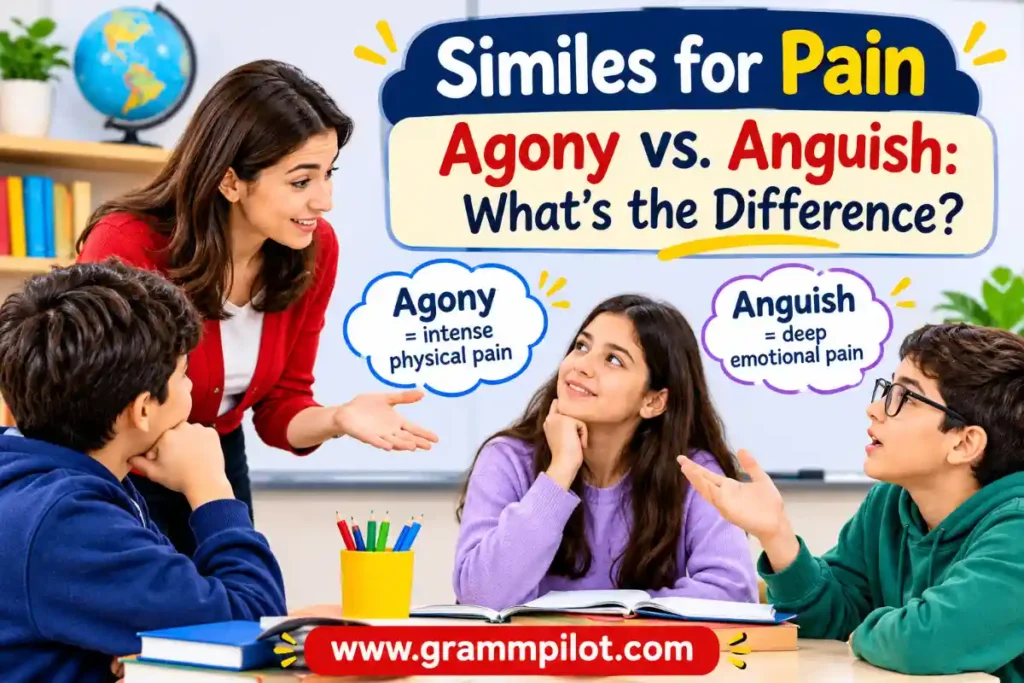
| Often describes extreme physical or emotional suffering. | Usually emphasizes deep emotional suffering. |
| Can describe severe bodily pain. | Often describes grief, fear, or distress. |
| Example: He screamed in agony. | Example: She watched in anguish. |
Remember: Agony often emphasizes the intensity of suffering, while anguish highlights deep emotional distress.
Hurt vs. Wound: What’s the Difference?
| Hurt | Wound |
|---|---|
| Can describe physical or emotional discomfort. | Usually refers to an injury or a deep emotional injury. |
| Common in everyday speech. | Often sounds more specific or serious. |
| Example: Your words hurt me. | Example: His betrayal left an emotional wound. |
Sorrow vs. Misery: What’s the Difference?
| Sorrow | Misery |
|---|---|
| A feeling of sadness, often connected to loss. | A state of deep unhappiness or suffering. |
| Can be quiet and reflective. | Often suggests more intense or lasting distress. |
| Example: She felt sorrow after the farewell. | Example: He lived in misery after losing his home. |
Are There Differences Between American and British English?
Most pain-related words and comparisons are understood in both American and British English.
However, a few everyday expressions and spellings differ.
| American English | British English | Meaning |
|---|---|---|
| Band-Aid | Plaster | Adhesive dressing for a small wound |
| Ouch! | Ouch! | Expression of sudden pain |
| Painkiller | Painkiller | Medicine used to relieve pain |
| Hurt | Hurt | Experience discomfort |
| Sore | Sore | Tender or painful |
A few useful points:
- Ouch is commonly used in both countries.
- Painkiller is understood in both varieties.
- Plaster is more commonly used in British English for a small adhesive dressing.
- Band-Aid is a familiar American brand name often used informally for this type of dressing.
Creative comparisons such as “like a knife through the heart” work naturally in both varieties.
What Are the Opposite Words of Pain?
Antonyms are words that express the opposite meaning.
While pain describes discomfort or suffering, its opposites describe comfort, happiness, and relief.
| Antonym | Meaning | Example |
|---|---|---|
| Comfort | A feeling of ease | Her words brought comfort. |
| Relief | Freedom from discomfort | The medicine brought relief. |
| Pleasure | A feeling of enjoyment | The holiday gave him pleasure. |
| Happiness | A positive emotional state | Happiness returned to her life. |
| Joy | Great happiness | The news filled them with joy. |
| Ease | Freedom from difficulty | She moved with ease. |
| Peace | A calm state | He finally found peace. |
| Healing | Recovery from injury or distress | Time helped with emotional healing. |
These words can help create a contrast between suffering and recovery.
Common Mistakes When Describing Pain
Creative writing is useful, but not every comparison works in every situation. Here are some mistakes to avoid.
1. Using the Same Comparison Too Often
Repeating “like a knife through the heart” in every paragraph makes writing predictable. Instead, choose different images that match the situation.
For example:
- For heartbreak: Like a flower losing its petals.
- For a headache: Like a hammer pounding against the skull.
- For loneliness: Like an empty house in winter.
2. Confusing Physical and Emotional Pain
Physical pain affects the body, while emotional pain affects feelings and mental well-being.
Incorrect: His broken arm felt like a lonely winter.
Better: His broken arm throbbed like a drum beating inside his body.
The first comparison might work in poetry, but the second is clearer for physical discomfort.
3. Using Overly Dramatic Language
Not every small injury needs a comparison involving a thousand knives.
Incorrect: A tiny paper cut felt like being crushed beneath a mountain.
Better: The paper cut stung like a tiny needle.
Match the intensity of your words to the actual experience.
4. Forgetting the Words “Like” and “As”
A simile directly compares two different things using like or as.
Simile: Her sadness was like a dark cloud.
Metaphor: Her sadness was a dark cloud.
Both are useful literary devices, but they are not the same.
5. Choosing a Comparison That Confuses Readers
A comparison should help readers understand the feeling. Avoid unusual descriptions that have no clear connection to the experience. Instead, use familiar images such as fire, storms, needles, broken glass, heavy stones, or dark clouds.
Quick Tips for Choosing the Best Pain Comparison
Use these simple tips to make your writing more effective.
- Identify the type: Decide whether you’re describing physical discomfort or emotional suffering.
- Check the intensity: Choose mild, moderate, or strong expressions.
- Think about the situation: A poem may need imaginative language, while an email needs direct wording.
- Use familiar images: Compare suffering to things readers can easily picture.
- Avoid repetition: Change your comparisons throughout the article or story.
- Keep sentences natural: Don’t force complicated vocabulary into simple situations.
- Show the experience: Instead of saying someone is sad, describe how the sadness affects their actions.
- Use sensory details: Mention burning, pressure, sharpness, heaviness, or repeated movement when appropriate.
- Don’t exaggerate: Make sure the comparison fits the situation.
- Read it aloud: If the sentence sounds unnatural, choose a simpler expression.
Final Teacher Explanation: How Can You Describe Pain More Clearly?
The best descriptions don’t simply tell readers that something hurts. They help readers imagine the feeling. For example, instead of writing, “His head hurt badly,” you could write, “His headache felt like a hammer pounding against his skull.” Similarly, instead of saying, “She was heartbroken,” you might write, “Her sadness was like a flower losing its petals in winter.” The secret is to match your comparison with the experience. Use familiar images for everyday writing and more imaginative language for poetry or storytelling. A small ache needs a different description from unbearable suffering. Good writing doesn’t require complicated vocabulary. It requires clear ideas, suitable words, and meaningful comparisons.
Conclusion: How Can You Make Pain Descriptions More Powerful?
Describing suffering becomes easier when you choose words and comparisons that match the experience. Physical discomfort may feel like needles piercing the skin, while emotional heartbreak may resemble a storm destroying everything in its path. The best Similes for Pain give readers a clear picture of what someone is experiencing. They also make essays, poems, stories, and everyday conversations more expressive. Remember that not every painful experience needs dramatic language. Sometimes a simple comparison communicates more than a complicated sentence. Think about the type of suffering, choose an image that readers understand, and keep your description natural. With the right comparisons, you can turn ordinary sentences into meaningful descriptions that readers remember.
Frequently Asked Questions
1. What are the best similes for pain?
Some effective examples include “like a thousand needles piercing the skin,” “like a hammer pounding against the skull,” and “like a knife through the heart.” Each describes a different kind of suffering.
2. What’s another way to say something hurts?
You can say it aches, stings, throbs, burns, or causes discomfort. For emotional suffering, words such as anguish, misery, heartbreak, and distress are useful.
3. What is a simile for emotional pain?
“Emotional pain is like a wound that never heals” is a powerful example. It describes sadness or heartbreak that continues over time.
4. What is a simile for extreme physical pain?
“Extreme pain feels like a thousand knives stabbing at once” describes severe discomfort through an intense comparison.
5. What is a simile for heartbreak?
“Heartbreak is like a storm destroying a beautiful garden” expresses how losing someone can disturb a person’s happiness and peace.
6. How do you describe pain creatively in a story?
Use sensory details and familiar comparisons. For example, describe a headache as a drum beating inside the skull or grief as a dark cloud covering the sunshine.
7. What is the difference between a simile and a metaphor for pain?
A simile uses like or as to compare two things, such as “Her grief was like a storm.” A metaphor makes a direct comparison, such as “Her grief was a storm.”