
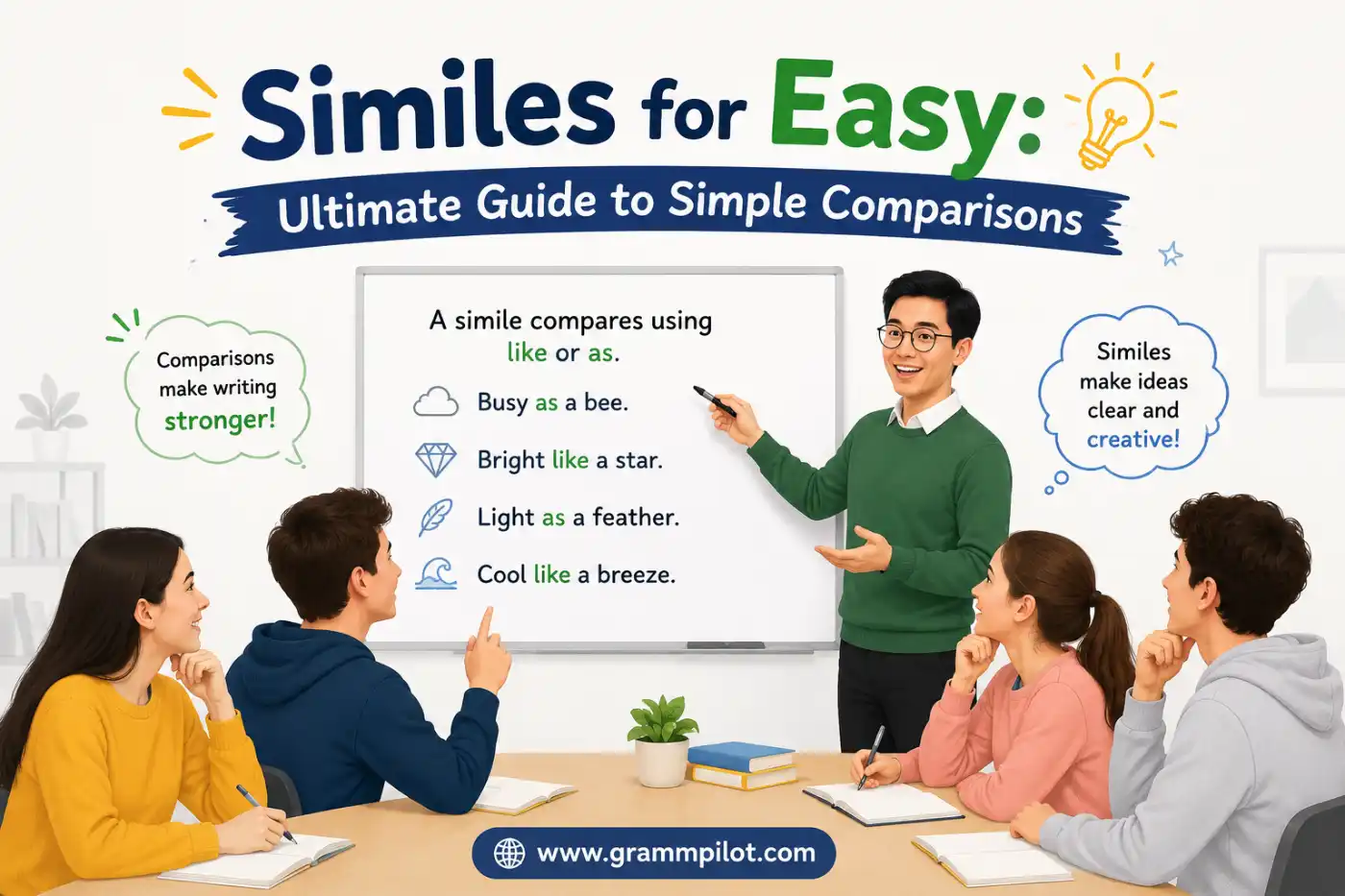
Similes for Easy can make that idea more vivid. You can compare an easy task to a walk in the park, a piece of cake, a gentle breeze, or opening an unlocked door. Each comparison gives “easy” a slightly different feeling.
Answer box: A simile for “easy” compares something simple or effortless to a familiar experience, such as “as easy as pie” or “like taking a walk in the park.”
When you’re writing an essay, poem, story, caption, or even a quick text, you may need a creative way to describe something that isn’t difficult. Saying “the task was easy” is clear, but it doesn’t give the reader much to imagine. The best comparison depends on what you mean by easy. A school question may be simple, a physical task may require little effort, and a person’s behavior may feel natural or effortless. This guide covers all of those meanings, along with creative examples, intensity levels, synonyms, common mistakes, and choices for essays, resumes, texts, emails, and everyday speech.
Looking for more guidance on English plurals? Explo [World Class vs World-Class].
What does “easy” mean in a simile?
The word easy has several meanings, so a good simile should match the specific meaning you want.
Something can be easy because:
- It isn’t difficult to understand.
- It takes little effort.
- It requires little skill.
- It doesn’t take much time.
- It causes little stress.
- It feels natural.
- It happens smoothly.
- It has few obstacles.
- It requires little physical strength.
- It is simple to complete.
For example: The homework was as easy as counting to three.
Here, easy means the homework wasn’t difficult.
Now consider: The old door opened like a curtain in a gentle breeze.
Here, the comparison suggests that opening the door required very little effort.
Another example: She solved the puzzle as easily as a bird finds the sky.
This focuses more on natural ability. Understanding the exact meaning helps you choose a much stronger comparison.
What is a good simile for easy?
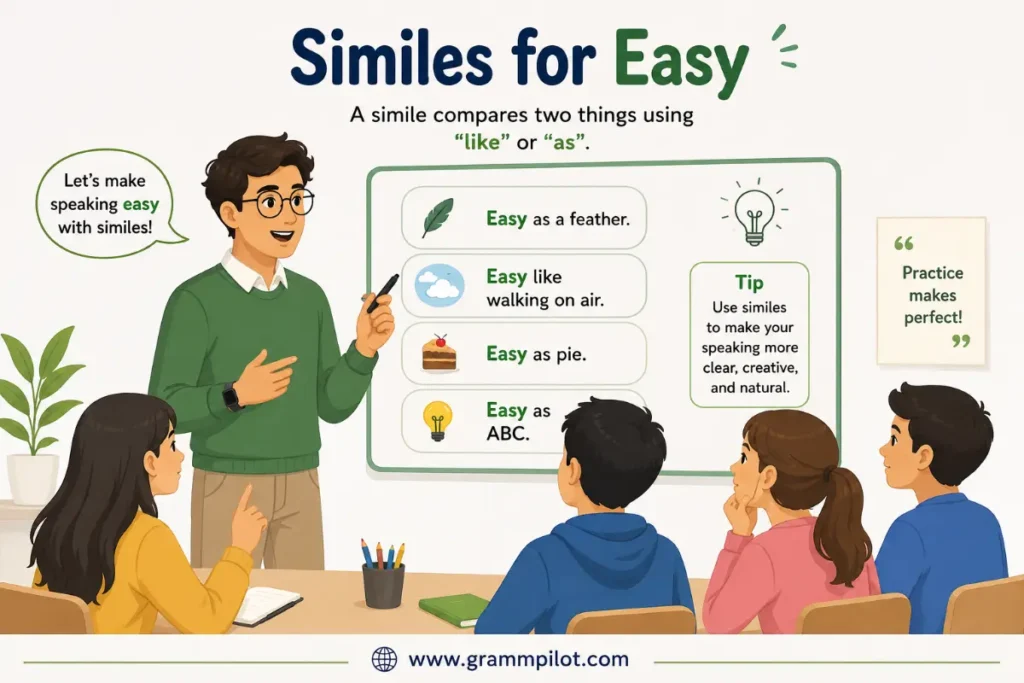
One of the most familiar choices is: “As easy as pie.”
Other useful comparisons include:
- as easy as ABC
- as easy as counting to three
- as easy as taking a walk
- like a walk in the park
- like opening an unlocked door
- like a gentle breeze
- like floating on water
- as simple as tying a shoelace
- as effortless as breathing
- like following a straight road
- as smooth as glass
- like picking fruit from a low branch
Some are playful and familiar, while others are more creative. For formal writing, a fresh comparison may work better than a common cliché.
Why use a simile instead of simply saying “easy”?
The sentence “The test was easy” tells the reader what happened. A simile can show how easy it felt.
Compare:
The test was easy.
The test was as easy as counting to three.
The second sentence creates a stronger impression. You can also make the comparison fit the situation:
The instructions were as easy to follow as a straight road.
Opening the box was like lifting a feather.
Solving the puzzle was as easy as matching two pieces together.
The reader gets a clearer sense of the experience.
The word origin and plain-English meaning of easy
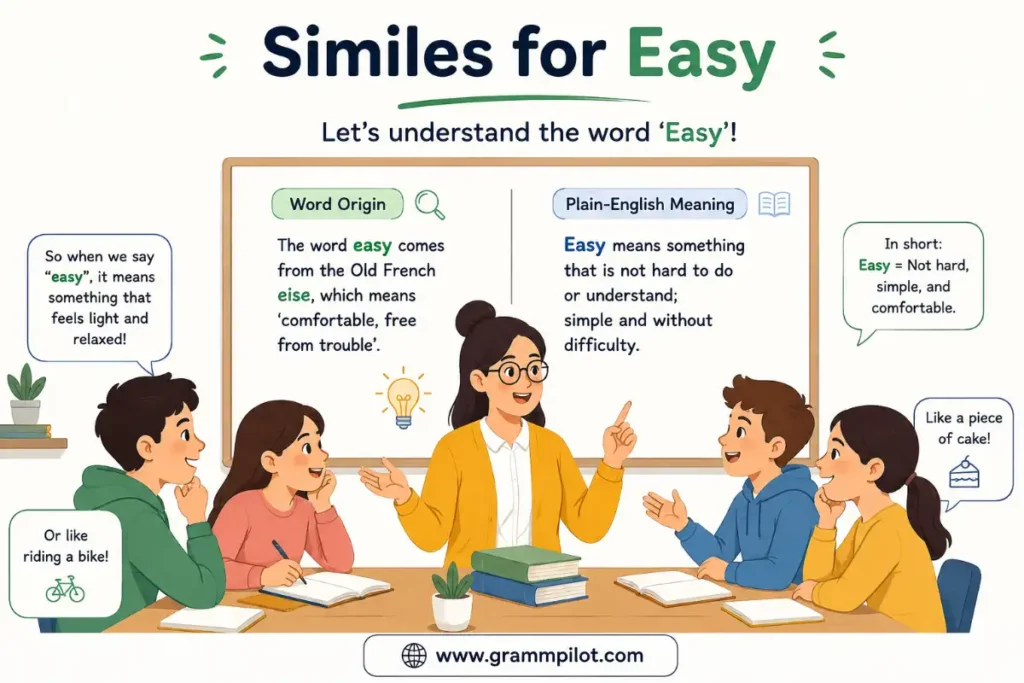
The word easy comes from Old French aisé, meaning something that is comfortable, convenient, or not difficult. Over time, English developed several related meanings. Today, easy can describe difficulty, effort, comfort, behavior, or conditions.
Consider these meanings:
using easy to do:
“The repair was easy.”
Easy physically:
“The bag was easy to carry”
Easy in appearance:
“She made the difficult task look easy.”
This explains why there isn’t just one accurate simile for easy. The comparison should match the meaning.
Master synonym list for easy
The following words and phrases aren’t accurate replacements in every sentence. Some describe simplicity, some describe low effort, and others describe a relaxed or comfortable quality.
Simple alternatives
| Word | Meaning | Tone | Example |
|---|---|---|---|
| Simple | Not complicated | Neutral | “The process is simple.” |
| Easy | Not difficult | Neutral | “The task was easy.” |
| Basic | Not advanced | Neutral | “These are basic instructions.” |
| Clear | Easy to understand | Neutral | “The explanation was clear.” |
| Straightforward | Simple to understand or do | Neutral | “The process is straightforward.” |
| Plain | Easy to understand | Neutral | “She gave a plain explanation.” |
| Effortless | Requiring almost no effort | Strong | “The movement looked effortless.” |
| Manageable | Possible to handle | Neutral | “The workload is manageable.” |
Everyday alternatives
| Word | Meaning | Tone | Example |
|---|---|---|---|
| Painless | Causing little trouble | Casual | “The change was painless.” |
| Smooth | Happening without problems | Everyday | “The move went smoothly.” |
| Light | Requiring little effort | Casual | “It was a light workout.” |
| Relaxed | Not stressful | Everyday | “The conversation was relaxed.” |
| Natural | Easy because it feels normal | Everyday | “The answer came naturally.” |
| Quick | Taking little time | Everyday | “It was a quick job.” |
| Convenient | Easy to use or arrange | Everyday | “The new system is convenient.” |
| Comfortable | Not difficult or stressful | Everyday | “She felt comfortable with the task.” |
Formal alternatives
| Word | Meaning | Tone | Example |
|---|---|---|---|
| Uncomplicated | Without complex parts | Formal | “The procedure is uncomplicated.” |
| Feasible | Possible to accomplish | Formal | “The plan is feasible.” |
| Attainable | Possible to achieve | Formal | “The goal is attainable.” |
| Accessible | Easy to understand or use | Formal | “The material is accessible.” |
| Practical | Easy to apply or accomplish | Formal | “This is a practical solution.” |
| Manageable | Reasonably possible to handle | Formal | “The workload remains manageable.” |
| Expedient | Convenient and practical | Formal | “The method is expedient.” |
| Unchallenging | Not demanding | Formal | “The assignment was unchallenging.” |
Casual expressions
| Word or phrase | Meaning | Tone | Example |
|---|---|---|---|
| A piece of cake | Very easy | Casual | “The quiz was a piece of cake.” |
| A walk in the park | Very easy | Casual | “The job was a walk in the park.” |
| No sweat | No difficulty | Very casual | “No sweat—I can fix it.” |
| A breeze | Very easy | Casual | “The test was a breeze.” |
| Child’s play | Extremely easy | Casual | “The puzzle was child’s play.” |
| Easy as ABC | Very easy | Casual | “The instructions were easy as ABC.” |
| Easy as pie | Very easy | Casual | “The recipe was as easy as pie.” |
| A cinch | Very easy | Casual | “The repair was a cinch.” |
Similes for easy by intensity
Not every situation requires the same level of comparison. Sometimes something is only mildly easy. Other times, it is almost unbelievably effortless.
Mildly easy
Use these when something requires some attention but isn’t difficult.
- like following a familiar path
- like opening a book
- like tying a shoelace
- like walking on a flat road
- like following simple directions
- like putting together familiar pieces
Example: The instructions were like following a familiar path.
This suggests the task is simple but still requires some action.
Clearly easy
These comparisons show that very little difficulty is involved.
- as easy as counting to three
- as easy as ABC
- like taking a walk in the park
- like opening an unlocked door
- like picking a low-hanging fruit
- like following a straight road
Example: The assignment was as easy as counting to three.
Extremely easy
Use stronger comparisons when something requires almost no effort.
- as effortless as breathing
- like floating on calm water
- like a feather drifting downward
- like sliding across smooth ice
- like turning a loose page
- like picking up an empty box
Example: The solution came as effortlessly as breathing.
Almost effortless
These comparisons focus on natural movement rather than simply low difficulty.
- like a leaf carried by the wind
- like water flowing downhill
- like a bird gliding through the air
- like sunlight passing through a window
- like a ball rolling down a gentle slope
Example: The words came to her like water flowing downhill.
Similes for an easy task
When you need to describe a task that isn’t difficult, these comparisons work well:
- The task was as easy as counting to three.
- The job was like taking a walk in the park.
- The assignment was as simple as tying a shoelace.
- The repair was like fitting two puzzle pieces together.
- The instructions were as easy as following a straight road.
- The project was like putting books on a shelf.
- The chore was as simple as opening a drawer.
- The problem was like finding a familiar street.
- The activity was as easy as tossing a ball.
- The work felt like arranging flowers in a vase.
These comparisons work especially well in school writing because they’re clear and easy to understand.
Similes for an easy test
Tests can feel different depending on the student and the subject. If the test is extremely simple, use a comparison that shows confidence.
Examples:
- The test was as easy as ABC.
- The quiz was like a walk in the park.
- The questions were as simple as counting to three.
- The exam felt like answering questions I’d seen before.
- The math problems were as easy as putting numbers in order.
- The test was like following a familiar recipe.
- The questions came as naturally as words in a conversation.
- The exam felt like a gentle warm-up.
- The quiz was as effortless as remembering my own name.
- The assignment was like solving a puzzle with all the pieces already visible.
For academic writing, avoid overly casual expressions such as “the test was a piece of cake” unless you’re writing dialogue or an informal reflection.
Similes for an easy question
An easy question can be compared to something obvious.
- The question was as easy as knowing your own name.
- The answer was like finding a book on a labeled shelf.
- The problem was as simple as adding two and two.
- The question was like spotting a bright star in a clear sky.
- The answer stood out like a red apple in a basket of green fruit.
- Solving it was as easy as remembering your birthday.
- The solution was like finding a key in an open drawer.
- The answer came as naturally as a smile.
These comparisons suggest that the answer was easy to recognize or remember.
Similes for an easy decision
Some decisions are easy because one option clearly stands out.
Try:
- The decision was as easy as choosing your favorite color.
- Picking the winner was like choosing the brightest star in the sky.
- The choice was as simple as taking the shortest road home.
- Deciding was like reaching for the nearest book.
- The answer was as obvious as sunlight through a clear window.
- Choosing her was as easy as picking the ripest apple.
- The decision came like a natural first thought.
- Selecting the best option was like following a sign pointing straight ahead.
These work well in essays about choices, stories, and personal experiences.
Similes for easy work
When work feels effortless, you can compare it to natural movement.
Examples:
- The work flowed like water down a stream.
- The task was as easy as arranging pieces on a table.
- The project moved forward like a bicycle rolling downhill.
- The work felt like turning pages in a familiar book.
- The assignment went as smoothly as a boat drifting across calm water.
- The job was like following a well-marked trail.
- The work came as naturally as walking.
- The process was like fitting a key into the right lock.
- The task felt as light as carrying an empty bag.
- The project was like putting together a simple puzzle.
Similes for an easy life
Here, easy can mean comfortable, peaceful, or free from major problems.
Examples:
- His life seemed as peaceful as a lake at sunrise.
- Her days were like floating on calm water.
- The routine felt as comfortable as an old chair.
- Their life seemed as smooth as a quiet river.
- The summer passed like a gentle breeze.
- His days moved like clouds drifting across a clear sky.
- Life felt as calm as a quiet morning.
- The peaceful routine was like walking along a familiar path.
- Their simple life was as comfortable as a warm blanket.
- The days passed like leaves floating on still water.
These don’t mean “easy” in the academic sense. They suggest comfort, calm, and few difficulties.
Similes for an easy person to talk to
Sometimes easy describes someone’s personality.
For example, someone may be easy to talk to because they’re friendly, relaxed, or welcoming.
Try:
- She was as approachable as a friendly neighbor.
- He was like an open book.
- Talking to her was as comfortable as talking to an old friend.
- He listened like a calm lake reflecting everything around it.
- Conversation with her flowed like a quiet stream.
- He was as relaxed as someone sitting beside a warm fire.
- Talking to him felt like chatting with a longtime friend.
- Her kindness made conversation as natural as breathing.
These comparisons describe social ease rather than difficulty.
Similes for an easygoing person
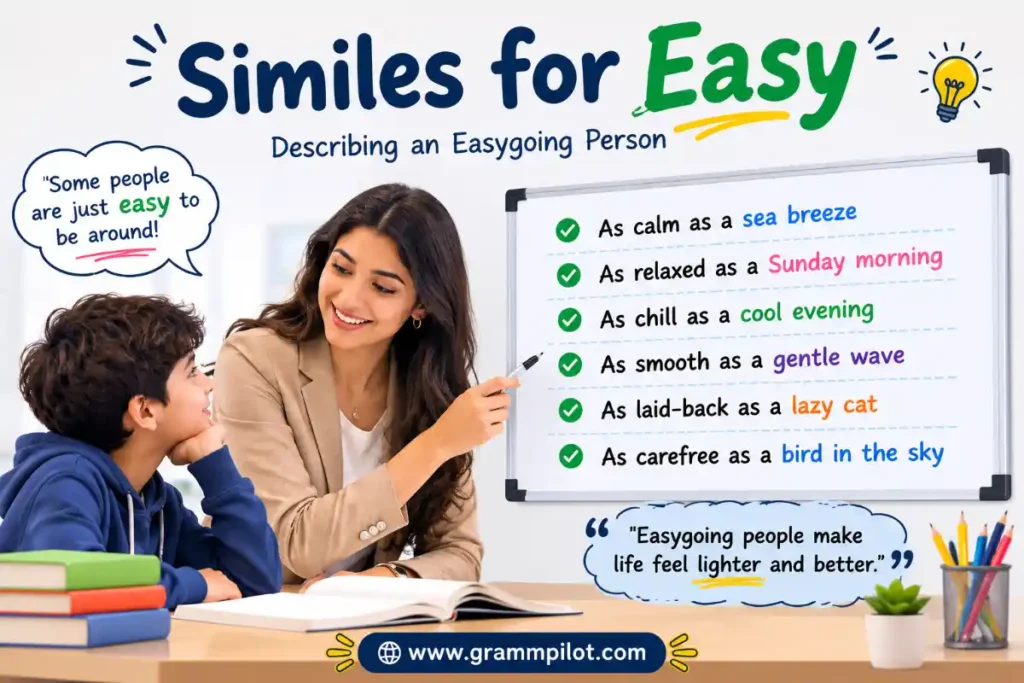
Easygoing means relaxed and not easily upset.
Examples:
- He was as relaxed as a cat sleeping in the sun.
- She was like a calm breeze on a summer afternoon.
- His personality was as gentle as a quiet stream.
- She handled problems like water flowing around a stone.
- He was as calm as a lake without a ripple.
- Her mood was like sunshine through an open window.
- He stayed relaxed like a bird gliding on warm air.
- She was as peaceful as a garden at dawn.
These are useful when “easy” describes temperament instead of difficulty.
Similes for easy movement
Movement can be easy because there is little resistance.
Examples:
- The door opened like a curtain in a breeze.
- The drawer slid out like ice across a smooth table.
- The boat moved like a leaf floating downstream.
- The bicycle rolled like a ball down a gentle hill.
- The dancer moved as smoothly as water.
- The bird glided like a feather carried by the wind.
- The car moved as smoothly as a train on a straight track.
- The skater crossed the ice like a leaf sliding across a frozen pond.
These comparisons show effortless physical movement.
Similes for easy learning
Learning can feel easy when information makes sense quickly.
Examples:
- The lesson was as easy as following a recipe.
- Learning the pattern was like connecting matching puzzle pieces.
- The new skill came as naturally as learning a familiar song.
- The instructions were like a map with every road clearly marked.
- Understanding the idea was as easy as turning on a light.
- The concept clicked like the final piece of a puzzle.
- Memorizing the words was like learning the chorus of a favorite song.
- The lesson felt like walking along a well-known path.
These are especially useful for education-related writing.
Similes for easy understanding
When something is easy to understand, focus on clarity.
Examples:
- The explanation was as clear as a window on a sunny day.
- The instructions were like a road with bright signs at every turn.
- The concept was as simple as reading a labeled map.
- Her explanation was like opening a curtain and letting in the light.
- The lesson became as clear as a picture after the fog lifted.
- The instructions were like a straight line from one point to another.
- The idea was as easy to grasp as a ball placed in your hand.
These comparisons show that the information is understandable rather than physically effortless.
Similes for easy money
Be careful with this phrase because “easy money” can have different meanings. If you’re describing money that is easy to earn or obtain, you can use:
- The money came like rain after a long drought.
- The payment arrived as easily as a message on a phone.
- The extra income felt like finding coins in an old coat.
- The bonus was like an unexpected gift.
- Earning the amount was as easy as completing a familiar task.
For serious financial writing, direct language is usually clearer than a colorful comparison.
Similes for easy breathing
When describing something that requires very little effort, breathing is a useful comparison.
Examples:
- The task was as easy as breathing.
- The movement came as naturally as breathing.
- Solving the problem felt like taking a normal breath.
- The routine was as effortless as breathing in fresh air.
- The process happened as naturally as a breath.
This type of comparison is powerful because breathing is automatic for most people.
Similes for easy as pie and similar expressions
Some expressions are so common that they function almost like idioms.
As easy as pie
“The recipe was as easy as pie.”
This means the recipe was very simple.
Easy as ABC
“Learning the first three steps was as easy as ABC.”
This suggests something is extremely simple.
A piece of cake
“The assignment was a piece of cake.”
This is a common informal expression meaning very easy.
A walk in the park
“The interview was a walk in the park.”
This suggests the experience was easy and comfortable.
No sweat
“No sweat. I can finish it tonight.”
This is casual and means the task won’t be a problem.
Child’s play
“The puzzle was child’s play.”
This means the puzzle was extremely easy.
These expressions are useful in conversation but may be too casual for formal academic writing.
Similes for easy in formal writing
If you’re writing a formal essay, report, or professional document, avoid stuffing your writing with clichés.
Instead of: The process was a piece of cake.
Try: The process was as straightforward as following a clearly marked path.
Instead of: The assignment was a walk in the park.
Try: The assignment required little effort because the instructions were clear.
Or, if you want a simile: The assignment was like following a familiar set of instructions.
Formal writing doesn’t mean your comparisons have to be boring. They simply need to fit the tone.
Similes for easy in a school essay
Students often need comparisons that are creative but still easy to understand.
Good choices include:
- The task was as easy as tying a shoelace.
- The lesson was like following a simple recipe.
- The answer was as obvious as a bright star.
- The test was as easy as counting to three.
- The instructions were like a map with clear directions.
- The project was like putting together a small puzzle.
- The decision was as simple as choosing your favorite color.
- Learning the skill was like riding a bicycle after practice.
These examples sound natural without using overly complicated vocabulary.
Similes for easy in a resume
A resume usually shouldn’t rely heavily on figurative language. Employers want clear evidence of your skills.
Still, if you’re writing a personal statement or profile, a comparison can work.
For example: I make complex information as easy to understand as a clearly labeled map.
Or: I approach new systems like a traveler following a well-marked path.
However, direct professional wording is often stronger: I simplify complex information for clients and team members.
Use similes sparingly in resumes.
Similes for easy in an email
Emails should usually be clear and direct.
If you’re writing casually: “The setup was as easy as pie.”
For a professional email: “The setup was as straightforward as following the provided instructions.”
If you’re writing to a friend: “The whole thing was a breeze.”
Match the comparison to your relationship with the reader.
Similes for easy in texting
Texting allows more playful expressions.
Try:
- “That test was a piece of cake.”
- “The job was a breeze.”
- “Fixing it was like opening a door.”
- “The instructions were as easy as ABC.”
- “No sweat—it was super simple.”
- “The answer was as obvious as the sun.”
For texting, natural language matters more than formal style.
Similes for easy in speaking
In everyday speech, familiar comparisons sound the most natural.
Common choices include:
- as easy as pie
- as easy as ABC
- a piece of cake
- a walk in the park
- a breeze
- no sweat
- child’s play
Example: “The interview was a breeze.”
This sounds natural in conversation.
A more creative comparison can work too: “The whole process was like following a road with signs everywhere.”
20 short similes for easy
If you need quick ideas, this list gives you simple options:
- As easy as ABC
- As easy as pie
- As easy as counting to three
- Like a walk in the park
- Like a gentle breeze
- Like opening an unlocked door
- Like following a straight road
- Like floating on calm water
- Like breathing
- Like turning a page
- Like fitting a key into a lock
- Like putting together a simple puzzle
- Like following a recipe
- Like walking a familiar path
- Like picking fruit from a low branch
- Like sliding across smooth ice
- Like water flowing downhill
- Like a leaf drifting in the wind
- Like finding a familiar street
- Like opening a well-labeled box
20 creative similes for easy
For more original writing, try these:
- The task was like following a trail marked with bright arrows.
- The solution came like sunlight through an open window.
- The answer appeared like a star in a cloudless sky.
- The process moved like water flowing down a gentle slope.
- The lesson unfolded like a map opening to a familiar road.
- The repair was like fitting the final piece into a simple puzzle.
- The instructions were like stepping stones across a shallow stream.
- The work felt like carrying an empty basket.
- The decision was like reaching for the closest book on a shelf.
- The movement was like a feather carried by the wind.
- The task flowed like a quiet river.
- The answer was like a key waiting in the lock.
- The project felt like arranging flowers in a vase.
- The lesson was like turning on a lamp in a dark room.
- The solution arrived like a familiar song returning to memory.
- The instructions were like a road with every turn clearly marked.
- The work moved like a boat drifting across still water.
- The decision was like choosing the brightest light in a dark room.
- The task felt like opening a box with no lid.
- The skill came like a natural step in a familiar dance.
Easy vs effortless: what’s the difference?
These words are related, but they aren’t identical.
Easy means something doesn’t require much difficulty.
Effortless means something appears to require almost no effort.
Compare:
The test was easy.
The test wasn’t difficult.
She solved the test effortlessly.
This emphasizes how little effort she seemed to use.
A useful pair of similes would be:
The test was as easy as counting to three.
She answered the questions as effortlessly as breathing.
The first focuses on difficulty. The second focuses on effort.
Easy vs simple: what’s the difference?
Simple usually means something isn’t complicated.
Easy usually means something isn’t difficult.
Something can be simple but not easy.
For example: The instructions were simple, but the physical task was difficult.
The instructions themselves weren’t complicated, but completing the task still required strength.
Likewise, something can be complicated but easy for an expert.
For example: The software was complicated, but the experienced technician found it easy to use.
This distinction is useful when choosing a simile.
If you’re emphasizing a lack of complexity, use comparisons such as: The explanation was like a clear map.
If you’re emphasizing low effort, try: The task was like lifting an empty box.
Easy vs effortless: side-by-side comparison
| Easy | Effortless |
|---|---|
| Not difficult | Requires almost no effort |
| Focuses on difficulty | Focuses on effort |
| “The test was easy.” | “She solved it effortlessly.” |
| “Like a walk in the park.” | “Like a feather floating on air.” |
| Can still require work | Suggests very little work |
Easy vs convenient: what’s the difference?
this word describes difficulty.
Convenient describes how practical or useful something is.
For example: The instructions were easy to follow.
This means they weren’t difficult.
The online form was convenient.
This means it was practical to use.
A convenient thing isn’t always easy, and an easy thing isn’t always convenient.
For a simile:
The task was as easy as tying a shoelace.
The online service was as convenient as having a store at your doorstep.
Common mistakes when writing similes for easy
Mistake 1: Comparing easy with something difficult
A comparison should support the meaning.
Weak: The task was as easy as climbing a mountain.
Unless you’re deliberately being sarcastic, climbing a mountain usually suggests difficulty.
Better: The task was as easy as walking across a flat room.
Mistake 2: Using a comparison that doesn’t show effort
Weak: The test was like a red apple.
The reader doesn’t know why the apple represents ease.
Better: The test was as easy as picking an apple from a low branch.
Now the comparison clearly shows little effort.
Mistake 3: Making every comparison about food
“Piece of cake” and “easy as pie” are popular, but using food every time gets repetitive.
Mix them with:
- Nature
- Movement
- Everyday actions
- Light
- Water
- Roads
- Objects
- Familiar experiences
Mistake 4: Overexplaining a simple simile
If you write: The task was as easy as opening an unlocked door, because opening an unlocked door requires no key and therefore very little effort…
the explanation becomes longer than the idea.
Usually, the comparison can stand on its own.
Mistake 5: Using too many similes in one sentence
Avoid: The task was like a breeze, a feather, a walk in the park, and a piece of cake.
Choose the strongest one: The task was as light and easy as a gentle breeze.
How to make an easy simile more creative
A common simile can become more original with one specific detail.
Basic: The leaves fell like snow.
More specific: The golden leaves fell like slow-motion snow beneath the maple trees.
Basic: The work was like a walk in the park.
More specific: The work was like walking along a familiar park path with every turn already known.
Basic: The answer was easy to find.
More vivid: The answer stood out like a bright lantern in a dark room.
Specific details give your comparison more personality.
How to choose the right simile for your writing
Start by asking what kind of “easy” you mean.
If you mean not difficult
Use:
- counting to three
- ABC
- a simple puzzle
- a walk in the park
- a familiar path
If you mean requiring little effort
Use:
- breathing
- floating
- a feather
- lifting an empty box
- water flowing downhill
If you mean easy to understand
Use:
- a clear map
- an open window
- a bright light
- a straight road
- a labeled diagram
If you mean comfortable
Use:
- an old sweater
- a warm blanket
- a calm lake
- a quiet morning
- a familiar chair
If you mean easygoing
Use:
- a gentle breeze
- a calm lake
- a relaxed cat
- a quiet stream
- sunshine through a window
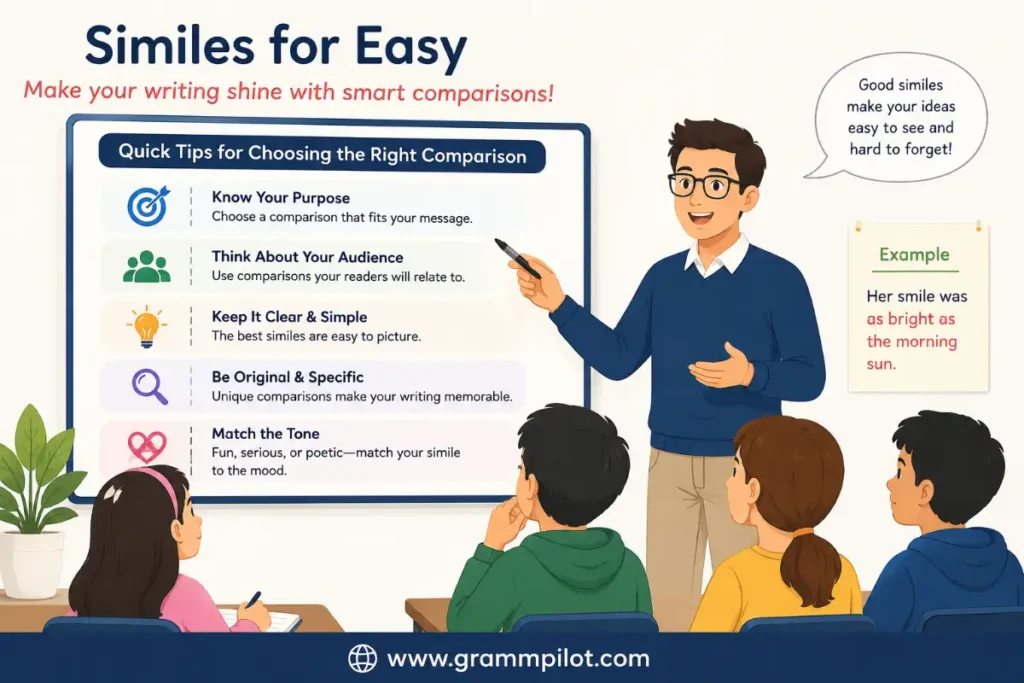
Quick tips for choosing the right comparison
1. Decide what “easy” means first.
Difficulty, effort, understanding, comfort, and personality aren’t exactly the same.
2. Use a familiar image.
Readers should understand the comparison quickly.
3. Match the mood.
A playful piece of cake works differently from a peaceful lake.
4. Avoid forced comparisons.
The reader should understand why the two things are connected.
5. Don’t rely only on clichés.
Try fresh comparisons such as “like following a road with every turn marked.”
6. Use sensory details.
A comparison involving touch, movement, sound, or sight can feel more vivid.
7. Keep the sentence natural.
A simile shouldn’t make the sentence awkward.
8. Don’t overuse figurative language.
One strong comparison is better than several weak ones.
9. Match the audience.
A classroom essay and a casual text don’t need the same style.
10. Read it aloud.
If the sentence sounds unnatural, simplify it.
Final teacher explanation
The strongest comparisons for easy don’t simply repeat the word. They show the reader what that ease feels like. If a task requires almost no effort, compare it with something naturally effortless, such as breathing, floating, or water flowing downhill.
If something is easy to understand, compare it with a clear map, an open window, or a straight road. if something feels comfortable, comparisons involving warm blankets, calm lakes, or familiar places work better. Familiar expressions such as “as easy as pie,” “as easy as ABC,” and “a piece of cake” are useful, especially in casual writing. But original comparisons can make your work stand out. Instead of always saying something is “a piece of cake,” you might write, “The task was like following a trail with bright arrows pointing the way.”
The goal is simple: choose a comparison that shows exactly why something feels easy.
Conclusion
Similes for Easy can make ordinary descriptions more vivid by showing what simplicity, comfort, or effortless action actually feels like. A difficult idea can become clearer when you compare it with something familiar, such as a straight road or an open door. A task requiring little effort might be compared to breathing, floating, or a leaf drifting on the wind.
The best simile depends on your meaning and audience. Familiar expressions such as “a piece of cake” work well in casual speech, while fresh comparisons often fit essays and creative writing better. Don’t force a complicated image when a simple one works. Choose a comparison that naturally connects with the quality you want readers to notice, and your writing will sound clearer, more expressive, and more memorable.
Frequently Asked Questions
1. What is a good simile for easy?
A good example is “as easy as counting to three.” Other choices include “like a walk in the park,” “as easy as ABC,” and “like opening an unlocked door.”
2. What is a creative simile for something easy?
A creative option is “The task was like following a trail with bright arrows pointing the way.” It suggests that the task has very few obstacles or confusing steps.
3. What’s another way to say something is very easy?
You can say it is a piece of cake, a breeze, child’s play, as easy as ABC, effortless, straightforward, or like a walk in the park. The best choice depends on how formal your writing is.
4. What is a simile for an easy task?
“The task was as easy as tying a shoelace.” This comparison works because tying a shoelace is familiar and usually requires little thought or effort.
5. What is a good simile for easy learning?
Try “Learning the skill was like fitting matching pieces into a puzzle.” It suggests that each new part makes the overall idea easier to understand.
6. Can I use “piece of cake” in a school essay?
Yes, but it is informal. For a formal essay, a comparison such as “The assignment was as straightforward as following a clear set of instructions” may fit better.
7. How do I write a simile for easy?
Choose something familiar that requires little difficulty or effort, then connect it with like or as. For example: “The repair was as easy as fitting the final piece into a puzzle.”