
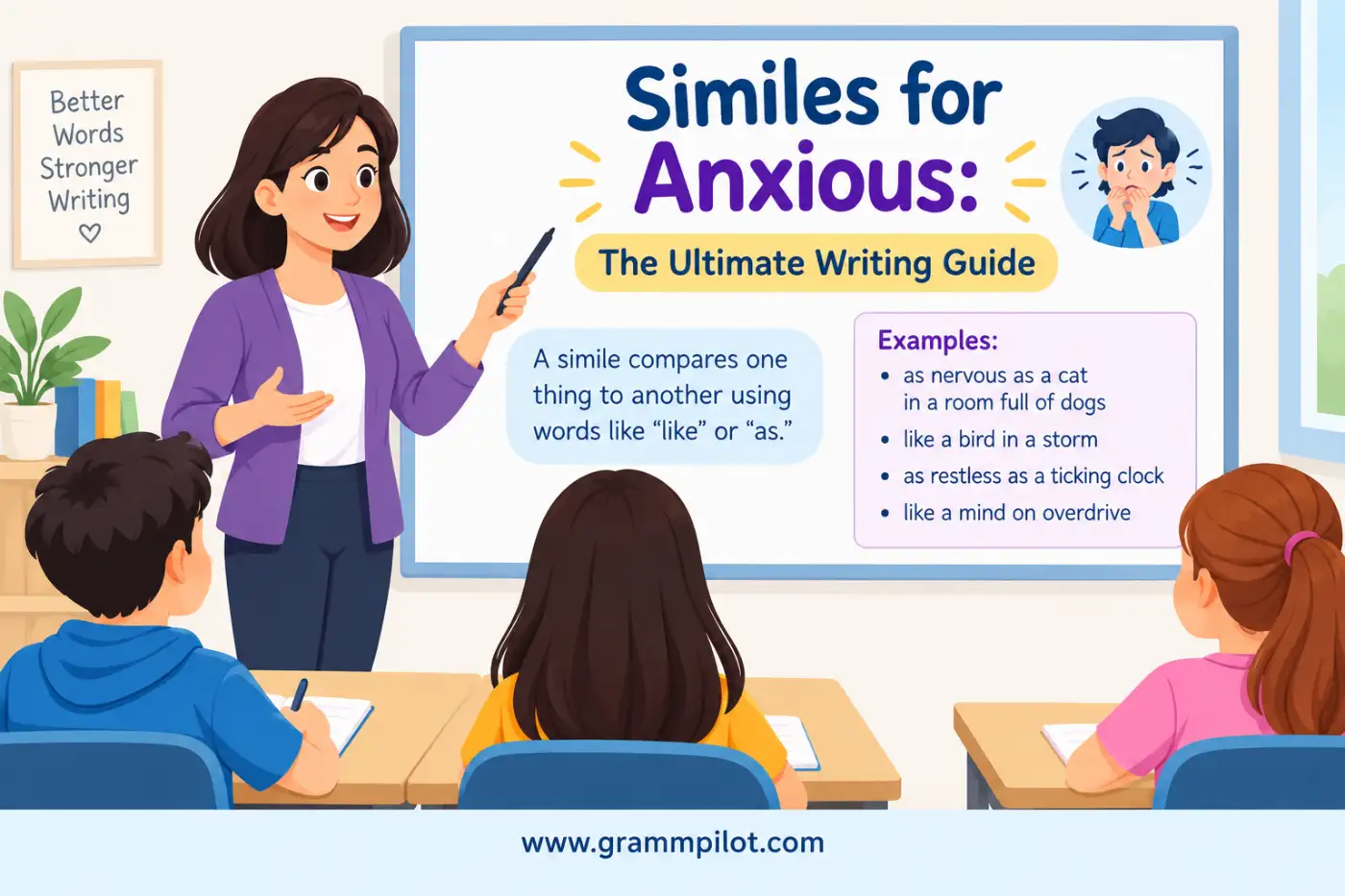
When you’re writing an essay, story, email, or text, you may want to show that someone feels worried without simply writing, “She was anxious.” Similes for Anxious can make that feeling easier to picture. A strong comparison lets readers sense the nervousness through an image, sound, movement, or physical reaction.
Answer box: The best similes for anxious feelings compare nervousness to something tense, restless, shaky, trapped, or uncertain, such as “as nervous as a rabbit in an open field.”
Instead of naming an emotion, a simile gives it shape. You might describe a character’s thoughts as “buzzing like a trapped bee” or say their hands were “as shaky as leaves in a storm.” Those images help readers experience the feeling rather than simply being told about it. The right comparison also depends on the level of anxiety you want to show. Mild worry needs a softer image, while intense fear calls for something much stronger. This guide covers original comparisons, meanings, intensity levels, synonyms, sentence examples, context-specific choices, common mistakes, and subtle differences between words such as anxious, nervous, worried, uneasy, and terrified.
Want to strengthen your grammar skills? Explore [May or Might].
What does anxious mean in simple English?
Anxious usually means worried, nervous, uneasy, or afraid about something that may happen. The feeling often comes from uncertainty.
Someone might feel anxious before:
- A job interview
- An important exam
- A first date
- A difficult conversation
- A medical appointment
- A public speech
- A competition
- An important decision
- An unfamiliar experience
- Waiting for unexpected news
Anxiety can affect both thoughts and the body.
A person may:
- Think about the same problem repeatedly
- Have trouble sitting still
- Speak quickly
- Shake or fidget
- Sweat
- Feel tense
- Have a racing heartbeat
- Struggle to concentrate
- Expect something to go wrong
That gives writers many details to turn into comparisons.
For example: Her thoughts buzzed like bees trapped inside a jar.
The sentence doesn’t simply announce that she was anxious. It shows mental restlessness.
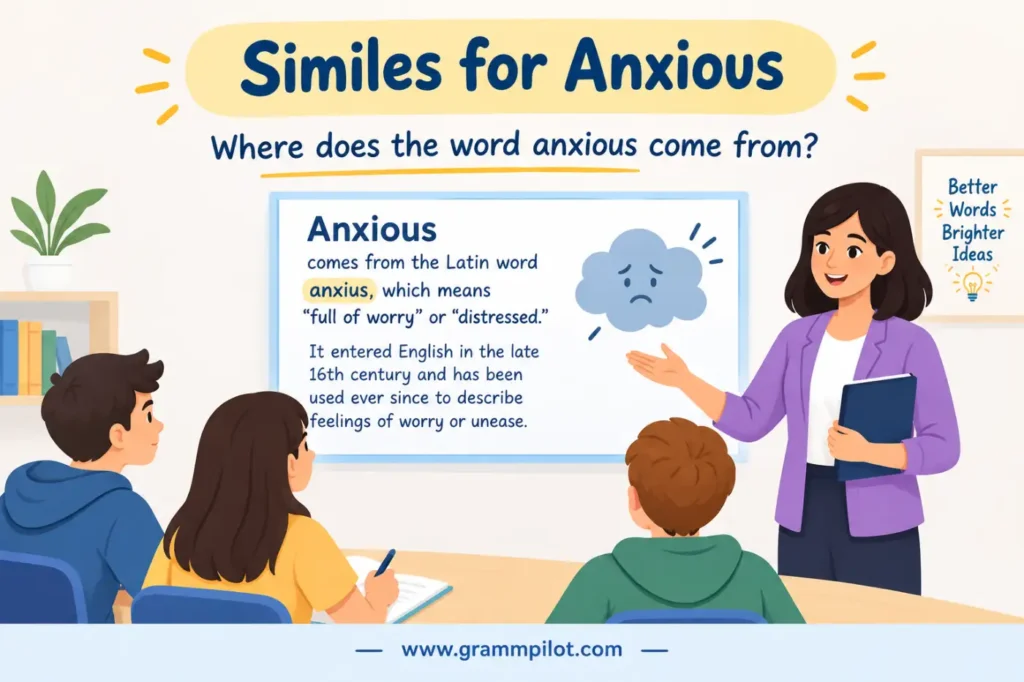
Where does the word anxious come from?
Anxious comes from Latin roots connected with distress, trouble, and uneasiness. English developed the word through French before it became established in its modern form. The word has long been connected with a troubled or worried state of mind. Its history also helps explain why anxious can describe more than ordinary nervousness. The word often suggests concern about an uncertain outcome.
Consider the difference: He was nervous before the speech.
This sounds like a normal reaction to performing. He was anxious about the results.
Context determines how strong the emotion feels.
What makes a good comparison for anxiety?
A useful simile should do more than attach like or as to a random object. It should reveal something about the feeling.
A strong comparison might show:
- Restlessness
- Fear
- Uncertainty
- Physical tension
- Racing thoughts
- Lack of control
- Anticipation
- Vulnerability
- Pressure
- A desire to escape
Compare these two sentences: She was anxious like a bird.
The image is too vague.
Now consider: She was as restless as a bird trapped inside a room.
The second version gives the reader something specific to imagine. A good comparison creates a connection between the emotion and a recognizable experience.
Similes for Anxious: What are the best similes for anxious feelings?
Here are some original options for different situations:
- As nervous as a rabbit in an open field
- Like a bird fluttering inside a closed room
- As tense as a wire pulled too tight
- Like a bee trapped inside a jar
- As restless as a clock that won’t stop ticking
- Like a storm gathering behind her eyes
- As shaky as leaves in a strong wind
- Like a candle flickering in a draft
- As uneasy as a cat hearing a strange noise
- Like a knot tightening inside his chest
- As jumpy as a deer near a busy road
- Like footsteps following close behind
- As uncertain as a boat drifting without an anchor
- Like a door waiting to be pushed open
- As jittery as a phone vibrating on a table
- Like a race running through her thoughts
- As trapped as a fly beneath a glass
- Like a bird afraid to leave its branch
Each image emphasizes a slightly different part of anxiety.
How can you describe mild anxiety with a simile?
Mild anxiety doesn’t need dramatic imagery. If a character is slightly worried, choose comparisons that suggest discomfort, uncertainty, or restlessness without making the situation sound terrifying.
Try these:
- As uneasy as someone waiting for a late reply
- Like a small stone sitting in his shoe
- As restless as a child waiting for a surprise
- Like a question quietly tapping at the back of her mind
- As uncertain as a traveler reading an unfamiliar map
- Like a cloud passing slowly over the sun
- As distracted as someone expecting a phone call
- Like a loose thread catching on every thought
These images work well for everyday situations.
For instance: He felt as uneasy as someone waiting for a late reply.
The comparison suggests concern, but it doesn’t imply extreme fear.
Similes for Anxious: Which similes show moderate nervousness?
A stronger level of worry needs more movement or tension. These comparisons can fit interviews, exams, competitions, confrontations, or important decisions:
- As tense as a string pulled too tight
- Like a bird fluttering against a window
- As jumpy as a deer hearing a sudden sound
- Like a drum beating faster and faster
- As restless as waves before a storm
- Like a clock ticking during a difficult test
- As shaky as a leaf in a strong breeze
- Like electricity running through his fingertips
- As alert as a guard hearing footsteps
- Like a storm gathering overhead
Example:Before the interview, Maya was as tense as a string pulled too tight.
The comparison suggests that she is under significant pressure.
Similes for Anxious: Which comparisons show intense anxiety?
When anxiety becomes overwhelming, the image should feel more powerful.
Consider:
- Like being trapped in a room with no visible door
- As frantic as a bird caught in a net
- Like thunder trapped inside his chest
- As helpless as a swimmer caught in a strong current
- Like a siren screaming inside her thoughts
- As desperate as someone searching for an exit in the dark
- Like a storm tearing through an empty house
- As shaken as glass beneath a hammer
- Like standing on the edge of a cliff in heavy fog
- As restless as waves crashing against rocks
These are useful for fiction, dramatic storytelling, and descriptions of overwhelming fear.
Use them carefully. If every anxious character sounds as though they’re trapped in a storm, the imagery loses its effect.
What are the best similes for anxious characters?
Character-focused comparisons should connect anxiety with behavior.
A nervous character might:
- Fidget
- Avoid eye contact
- Speak too quickly
- Look around repeatedly
- Bite their lip
- Clench their hands
- Pace
- Freeze
- Check their phone
- Rehearse what they want to say
You can turn these actions into imagery.
Her fingers moved like tiny birds searching for somewhere to land.
He paced like a caged animal waiting for a door to open.
She checked the clock like a traveler afraid of missing the last train.
His eyes darted around like a rabbit searching for cover.
He rehearsed his answer like an actor afraid of forgetting his only line.
These examples show anxiety through behavior instead of naming the emotion repeatedly.
How can you describe anxious thoughts?
Anxiety often happens inside the mind, so mental imagery can be especially effective.
Try comparisons such as:
Her thoughts spun like clothes inside a washing machine.
His mind buzzed like a room full of electric wires.
Uncertainty followed him like a shadow.
The same question returned like a song stuck in his head.
These examples are useful because anxiety isn’t always visible from the outside.
A person can sit perfectly still while their thoughts feel chaotic.
How can you describe an anxious body?
Physical reactions often provide some of the strongest writing details. Instead of repeatedly writing “She was anxious,” describe what anxiety does to her body.
For example:
Her hands shook like leaves caught in a storm.
His heart hammered like a fist against a locked door.
Her stomach twisted like a towel being wrung out.
His shoulders felt as tight as ropes pulled from opposite ends.
These comparisons give the reader physical clues.
How can you use similes for anxious in creative writing?
Creative writing gives you more freedom to build an emotional scene.
Suppose a character is waiting outside a principal’s office.
A simple version might say: Lena was anxious while she waited.
A stronger version could show the experience: Lena sat outside the office, her thoughts buzzing like bees inside a jar. Every few seconds, she glanced at the clock. The ticking sounded like footsteps coming closer.
The emotion develops through several details. Notice that the writer doesn’t need to say anxious in every sentence. One strong comparison can carry much of the emotional weight.
What comparisons fit job interview anxiety?
A job interview often combines hope, pressure, and uncertainty.
Useful examples include:
His thoughts bounced around like coins in a jar.
Her prepared answers felt as fragile as paper in the rain.
His heartbeat thudded like a drum behind a closed door.
The comparison should support the situation rather than overwhelm it.
What similes fit social anxiety?
For a character who feels uncomfortable around other people, comparisons can focus on exposure and self-consciousness.
She felt like a spotlight had suddenly turned toward her.
His confidence was as small as a match flame in the wind.
Entering the crowded room felt like stepping onto a stage without a script.
These images emphasize the feeling of being watched or exposed.
What similes work for waiting anxiously?
Waiting creates a special kind of nervousness because the person has little control over what happens next.
Try:
The minutes crawled like snails across a sidewalk.
Her phone sat on the table like a locked box holding an answer.
He watched the door like a guard waiting for a signal.
These comparisons are useful in stories involving phone calls, test results, messages, or important decisions.
What are good similes for anxious children?
For younger characters, simple and familiar images work best.
Examples:
His stomach felt like a washing machine.
Her hands shook like leaves.
He felt like a rabbit hiding from a fox.
The dark hallway looked like a tunnel with no end.
Her thoughts buzzed like a swarm of bees.
His heart beat like a drum.
Children’s writing often benefits from concrete imagery rather than abstract comparisons.
What are good similes for anxious adults?
Adult characters may experience anxiety through responsibility, uncertainty, or pressure.
Examples:
Her worries stacked up like bills on a kitchen table.
His thoughts ran like a computer with too many programs open.
The decision sat on his mind like a heavy suitcase.
She felt like a driver approaching a road hidden by fog.
His unfinished tasks crowded his thoughts like people waiting at a station.
These images can connect anxiety with everyday adult experiences.
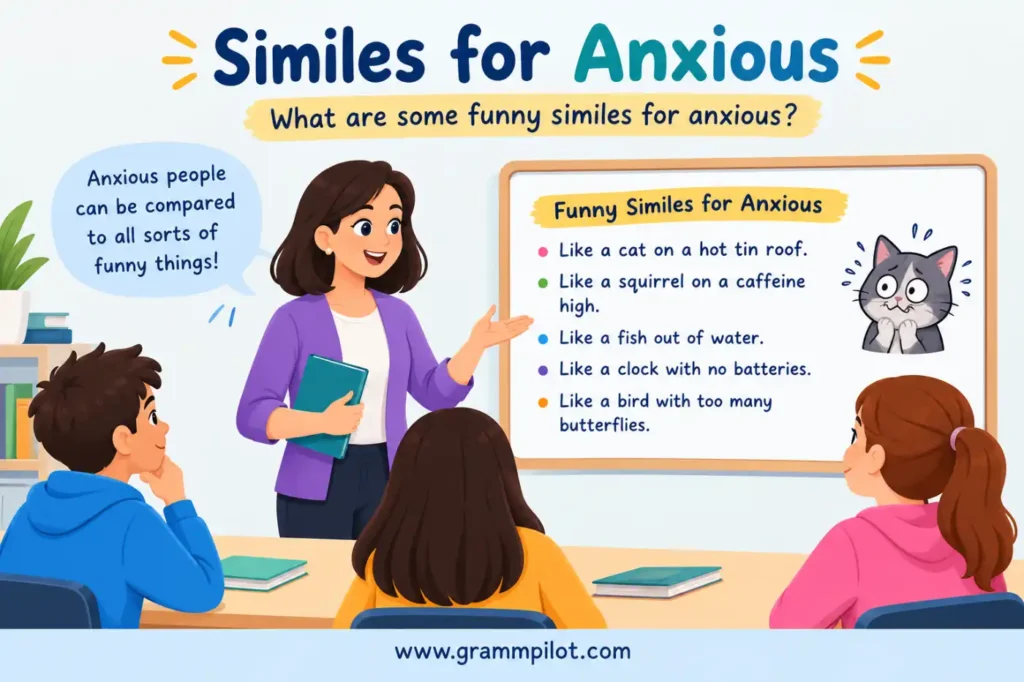
What are some funny similes for anxious?
Not every anxious scene has to be dark.
Humorous comparisons can make nervousness relatable:
He was as nervous as a cat at a vacuum cleaner convention.
Her thoughts bounced around like popcorn in a hot pan.
He looked like a squirrel trying to remember where it buried everything.
Her confidence disappeared like ice cream on a hot sidewalk.
His words came out like socks tumbling from an overstuffed dryer.
She was as jumpy as a phone on a vibrating table.
Humor works especially well in casual stories, children’s writing, social posts, and light fiction.
What are some poetic similes for anxious?
Poetic writing benefits from unusual but understandable images.
Her anxiety moved through her like fog beneath a closed door.
His thoughts were birds beating against an invisible sky.
Fear curled around her like winter smoke.
Uncertainty followed him like a moonlit shadow.
Poetic comparisons don’t need to explain everything. The image should leave enough room for the reader’s imagination.
Which synonyms describe an anxious person?
There are many choices, and each carries a slightly different shade of meaning.
| Nervous | Worried or uneasy | Everyday | She felt nervous before the interview. |
| Worried | Concerned about something | Everyday | He was worried about the result. |
| Uneasy | Uncomfortable or uncertain | Mild | I felt uneasy about the plan. |
| Tense | Physically or mentally strained | Neutral | He looked tense before the meeting. |
| Restless | Unable to relax or stay still | Neutral | She grew restless while waiting. |
| Troubled | Deeply disturbed or concerned | Serious | She looked troubled by the news. |
| Agitated | Very restless or upset | Strong | He became visibly agitated. |
| Jittery | Nervous and physically restless | Casual | I felt jittery before the presentation. |
| Edgy | Tense and easily irritated | Casual | Everyone seemed edgy before the announcement. |
| Alarmed | Suddenly worried by danger | Strong | He looked alarmed by the noise. |
| Frantic | Extremely anxious and rushed | Very strong | The frantic search lasted an hour. |
| Distressed | Deeply upset | Serious | He appeared distressed by the news. |
| Agitated | Highly unsettled | Strong | The crowd became agitated. |
| Insecure | Lacking confidence or certainty | Contextual | He felt insecure about his decision. |
| Unsettled | Unable to feel comfortable or calm | Neutral | She remained unsettled after the incident. |
| Nervy | Nervous or tense | Informal | It was a nervy final minute. |
| Shaky | Physically or emotionally uncertain | Casual | He felt shaky before going onstage. |
| On edge | Very tense or alert | Informal | She had been on edge all morning. |
Some of these words describe the person, while others describe the state or behavior.
How do anxious, nervous, and worried differ?
These three words overlap, but their focus isn’t identical.
| Word | Main idea | Typical strength |
|---|---|---|
| Anxious | Uneasy about uncertainty or what may happen | Mild to strong |
| Nervous | Tense or worried, often before an event | Mild to moderate |
| Worried | Concerned about a possible problem | Mild to strong |
Consider these examples: I was nervous before the speech.
The event caused temporary tension.
I was anxious about the results.
The uncertain outcome is central.
I was worried that we would miss the deadline.
A specific possible problem is causing concern. The distinctions aren’t absolute. Native speakers often use these words interchangeably.
How do anxious and uneasy differ?
Uneasy often suggests a vague feeling that something isn’t right.
Example: I felt uneasy when the lights went out.
The person may not know exactly what is wrong.
Anxious can involve stronger concern about an uncertain future.
Example: She felt anxious about the upcoming decision.
The emotion is tied more clearly to what might happen. For subtle writing, uneasy can create quiet tension, while anxious can make the concern more obvious.
How do anxious and restless differ?
Anxious focuses on worry or unease.
Restless focuses on an inability to relax or remain still.
A person can be restless without being anxious.
For example: He was restless because he had too much energy.
That doesn’t necessarily involve fear. Someone can also be anxious while sitting completely still. Therefore, choose restless when movement or lack of calm is the main feature.
How do anxious and apprehensive differ?
Apprehensive is more formal than anxious. It often describes concern about something that may happen.
Example: He was apprehensive about moving to a new city.
The word works well in essays and formal prose. In casual conversation, most people would probably say: He was nervous about moving to a new city. Both are useful. The difference is mainly tone and context.
Similes for Anxious: Which words are strongest for anxiety?
A rough intensity scale might look like this: uneasy → concerned → nervous → anxious → tense → apprehensive → distressed → alarmed → panicked → frantic → terrified
This isn’t a strict dictionary scale.
The words can overlap depending on context. For example, apprehensive may sound more serious than nervous because it often suggests concern about an upcoming event. Likewise, distressed can describe emotional suffering without necessarily involving fear.
Use intensity deliberately.
A children’s story might say: He was as nervous as a rabbit near a fox.
A dramatic scene might say: Her fear was like a storm breaking through a locked window.
The imagery should match the situation.
Similes for Anxious: What parts of speech relate to anxious?
Understanding related forms can help you avoid awkward repetition.
Adjective
Anxious
Example: She felt anxious before the announcement.
Noun
Anxiety
Example: His anxiety grew as the clock moved closer to noon.
Adverb
Anxiously
Example: She waited anxiously for the message.
Related adjective
Anxious-looking
Example: The anxious-looking student checked the clock again.
You can vary the form when writing a longer piece.
Instead of repeating: She was anxious. She was anxious.
show the emotion through behavior and imagery.
US vs UK notes for anxious
The word anxious is common in both American and British English.
The spelling is the same: anxious
The related noun is also spelled: anxiety
The word functions naturally in both varieties. One point worth remembering is that anxious can sometimes mean eager in addition to worried, especially in formal or older usage.
For example: She was anxious to begin the project.
Depending on context, this can mean she was eager to begin rather than worried about beginning.
Modern readers usually understand anxious as worry-related when it is followed by about: She was anxious about the project.
That construction clearly signals concern.
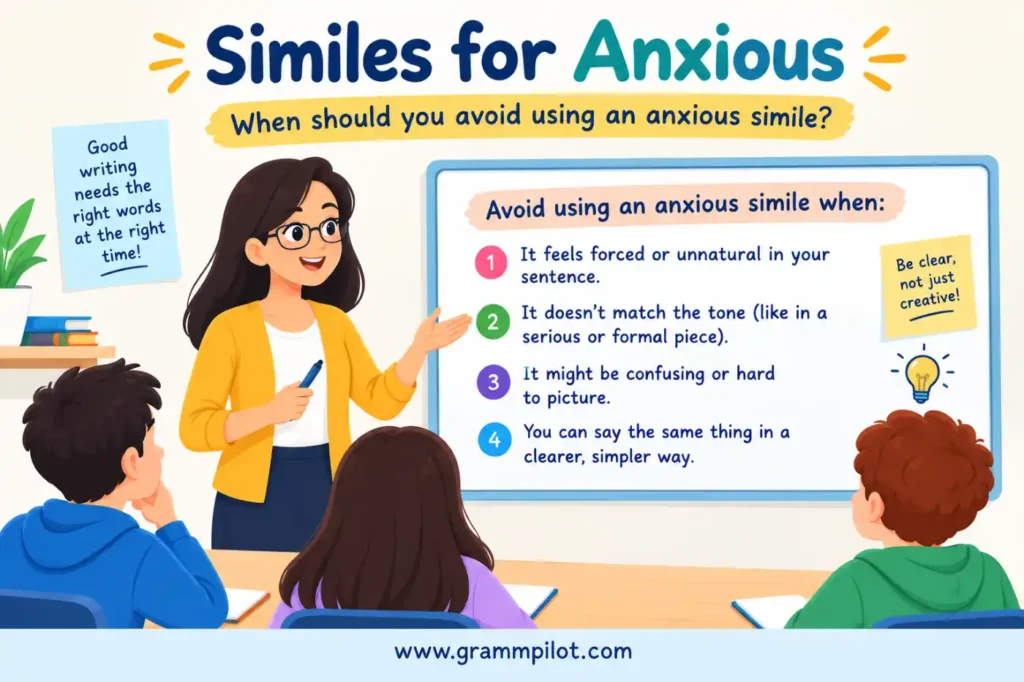
When should you avoid using an anxious simile?
A simile isn’t automatically better than a plain adjective.
Avoid one when:
- The comparison doesn’t add meaning.
- The image feels forced.
- The sentence becomes harder to understand.
- The same type of image has already appeared several times.
- The scene requires a quick, direct statement.
- The emotion is already obvious from the surrounding action.
- The comparison sounds too dramatic for the situation.
- The image doesn’t fit the character’s age or personality.
For example, a simple sentence may be stronger: He was nervous before signing the contract.
You don’t always need: He was as nervous as a sailor facing a hurricane before signing the contract.
The second image may be far too dramatic for a routine business decision. Good writing isn’t about adding comparisons everywhere. It’s about using them where they sharpen the picture.
Similes for Anxious: What are common mistakes when writing anxiety similes?
Using the same image repeatedly
If every anxious character has a racing heart, trembling hands, and buzzing thoughts, the writing becomes predictable.
Mix physical, mental, visual, and environmental imagery.
Choosing a weak comparison
A vague image doesn’t help much.
She was anxious like something nervous.
The reader learns almost nothing.
Make the comparison concrete.
Her thoughts buzzed like bees inside a jar.
Making mild anxiety sound extreme
A student waiting for a routine test probably doesn’t need to feel like they’re trapped in a burning building. Match the image to the situation.
Explaining the simile too much
If you write: His thoughts raced like horses, which means he was thinking many things very quickly because he was nervous, worried, and unable to relax.
the explanation weakens the image.
Let the comparison do some of the work.
Mixing incompatible images
Avoid sentences such as: Her anxiety was like a roaring whispering storm of frozen fire.
Too many conflicting images make the sentence confusing.
One clear comparison is usually stronger.
Similes for Anxious: What are the antonyms of anxious?
Common opposites include:
- Calm
- Relaxed
- Peaceful
- Confident
- Secure
- Assured
- Composed
- Untroubled
- Carefree
- Content
- Serene
Examples:
Anxious: She worried about the interview.
Calm: She felt ready and relaxed.
Anxious: He expected something to go wrong.
Confident: He trusted his preparation.
The best antonym depends on the type of anxiety being described.
Which simile is best for a school essay?
For an essay, choose an image that is clear and not overly dramatic.
Good options include:
Her thoughts raced like runners at the starting line.
He felt as tense as a string pulled too tight.
The uncertainty hung over her like a cloud.
His hands shook like leaves in the wind.
These examples are easy to understand while still adding imagery.
Which comparison works best for a story?
Stories allow more creativity.
Try matching the comparison to the setting.
A stormy setting might support:
His anxiety gathered like thunder behind dark clouds.
A crowded city could inspire:
Her thoughts rushed like traffic through a crowded intersection.
A quiet forest might support:
Every unfamiliar sound felt like a warning hidden among the trees.
The setting can become part of the emotional imagery.
Which option works best for texting?
Texting favors short and recognizable comparisons.
Examples:
“I was nervous like crazy.”
“My stomach felt like a washing machine.”
Not every text needs a literary simile.
A casual comparison can feel more natural than an elaborate one.
Which wording works best in an email?
Professional emails usually benefit from restraint.
Instead of using a dramatic comparison, choose a mild image when one is needed.
I was a little uneasy about the delay, like anyone waiting without an update.
In many business emails, however, direct language is even better:
I was concerned because we hadn’t received an update.
The right choice depends on the relationship and purpose of the message.
Which wording works best in speaking?
Everyday speech favors familiar images.
You might say:
“I was shaking like a leaf.”
“My heart was pounding like a drum.”
“I felt like a cat in a room full of dogs.”
“My thoughts were all over the place.”
These expressions sound natural because listeners understand them quickly.
Quick reference: 30 useful comparisons
| Feeling or situation | Useful comparison |
|---|---|
| Mild worry | Like a stone in a shoe |
| Waiting | Like watching an empty road |
| Nervous speech | Like words tumbling down stairs |
| Racing thoughts | Like bees in a jar |
| Shaking | Like leaves in a storm |
| Physical tension | Like a wire pulled tight |
| Fear of failure | Like standing before a locked door |
| Uncertainty | Like walking through fog |
| Restlessness | Like a clock that won’t stop |
| Feeling trapped | Like a bird behind glass |
| Social discomfort | Like standing under a spotlight |
| Anticipation | Like waiting for thunder |
| Exam nerves | Like a race about to begin |
| Interview nerves | Like standing backstage |
| Waiting for news | Like watching a silent phone |
| Strong fear | Like a storm breaking overhead |
| Panic | Like being caught in a rushing current |
| Nervous energy | Like sparks jumping from a fire |
| Uneasiness | Like hearing footsteps behind you |
| Mental pressure | Like carrying a heavy backpack |
| Uncertainty | Like a boat without an anchor |
| Emotional tension | Like a rope pulled from both ends |
| Shaky confidence | Like a candle in a draft |
| Persistent worry | Like a shadow that follows |
| Busy thoughts | Like traffic at rush hour |
| Sudden fear | Like a fire alarm in the dark |
| Vulnerability | Like glass near the edge of a table |
| Waiting anxiously | Like a traveler watching the clock |
| Nervous anticipation | Like a drum before a performance |
| Overwhelming worry | Like waves crashing against rocks |
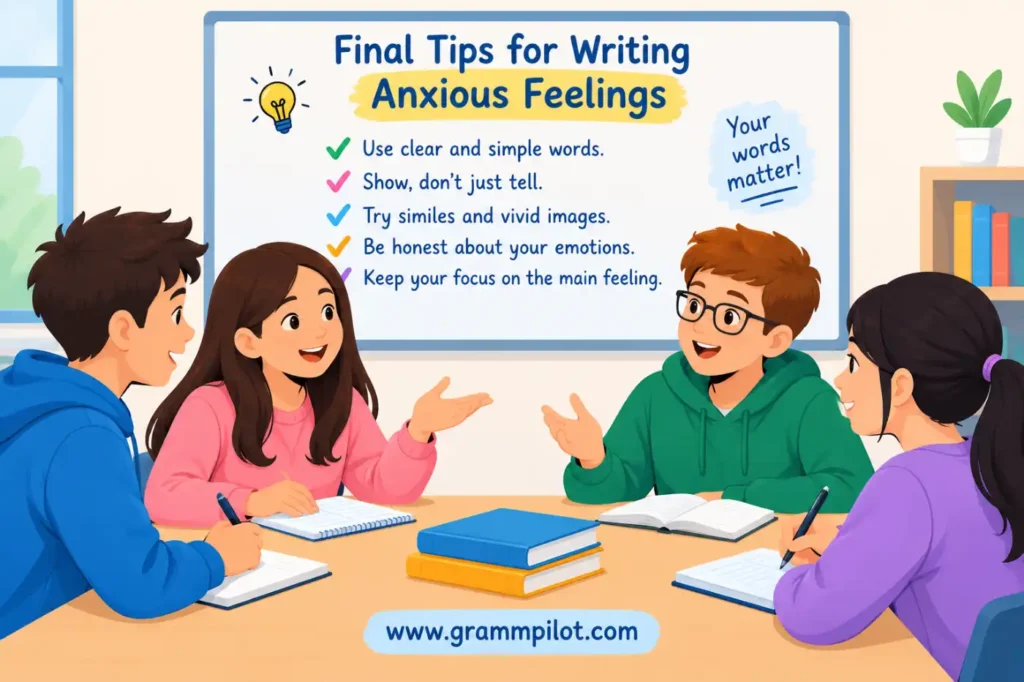
Final tips for writing anxious feelings
A memorable emotional description usually starts with a specific observation.
Don’t ask only, “What simile means anxious?”
Ask: What does this person’s anxiety feel like?
Maybe their hands won’t stop moving. Maybe they keep checking the clock. Perhaps their thoughts circle the same question. Their stomach could feel tight, while their voice stays calm. Those details give you better material than a generic synonym list. Choose images your reader can recognize quickly. A buzzing bee, shaking leaf, tight rope, or storm cloud works because the physical experience is familiar. Keep the emotional scale believable. Mild worry and overwhelming panic shouldn’t sound identical. Most importantly, let the comparison serve the scene. A simile should make the writing clearer, more vivid, or more memorable. If it doesn’t do one of those jobs, a simple sentence may be the better choice.
Conclusion
The strongest Similes for Anxious feelings don’t merely replace the word anxious. They reveal what the emotion looks, sounds, or feels like. A nervous student might have thoughts that buzz like bees in a jar, while someone waiting for important news may feel as though the minutes are crawling like snails. The comparison should match the situation and the intensity of the emotion.
For mild worry, choose gentle images such as fog, a loose thread, or a quiet tapping sound. Stronger fear can support imagery involving storms, trapped animals, rushing water, or warning signals. Avoid forcing a comparison into every sentence. One fresh, well-matched image can often do more than several predictable ones.
Frequently Asked Questions
What are good similes for anxious?
Good comparisons include “as tense as a wire pulled too tight,” “like a bird trapped inside a room,” and “like bees buzzing inside a jar.” Choose an image that matches the intensity of the emotion.
What is a simile for someone who is very nervous?
A strong option is “He was as nervous as a rabbit in an open field.” The comparison suggests alertness, vulnerability, and fear without directly repeating the word nervous.
What’s another way to say someone is anxious?
You can describe someone as nervous, uneasy, worried, tense, apprehensive, restless, jittery, unsettled, or on edge. The best alternative depends on how strong the feeling is.
What is a simile for anxious thoughts?
“Her thoughts buzzed like bees trapped inside a jar” is a useful comparison for restless, repetitive thinking. It suggests mental noise and a feeling of being unable to escape the thoughts.
Are anxious and nervous the same thing?
They overlap, but nervous often describes temporary tension before an event, while anxious can emphasize deeper worry or uncertainty about what may happen.
What is a strong simile for extreme anxiety?
“His fear was like a storm tearing through an empty house” creates a strong image of overwhelming emotion. Use dramatic comparisons like this only when the scene supports that level of intensity.
Can similes make emotional writing better?
Yes, when they add a clear and relevant image. A well-chosen comparison helps readers experience an emotion instead of simply being told that a character feels it.