
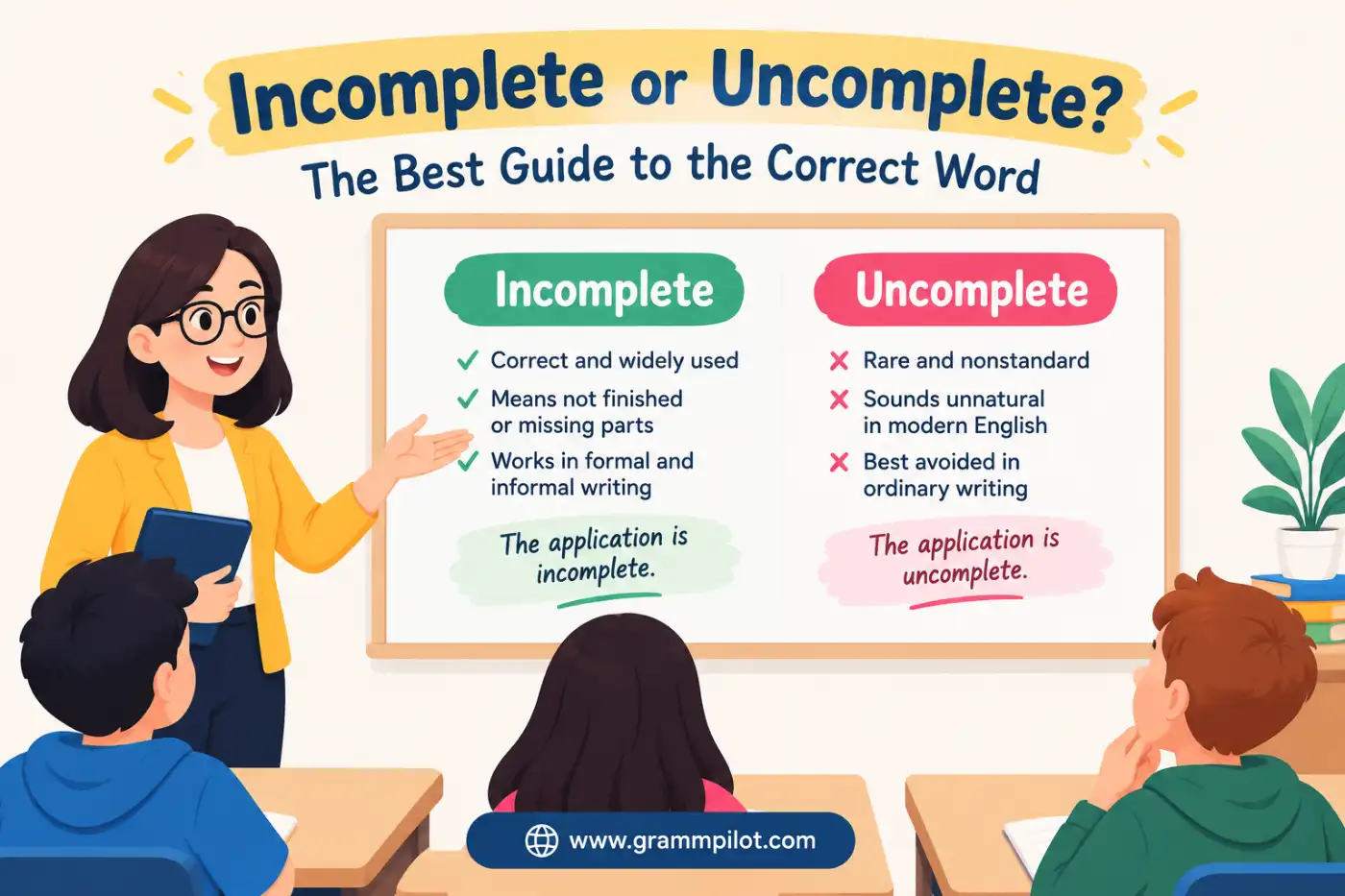
You’re writing an email to a teacher, finishing a school assignment, or updating your resume when you need to explain that something isn’t finished. You might wonder about to write “incomplete” or “uncomplete.” Both words seem possible, but only one is the normal choice in modern English. Incomplete is the correct and widely accepted word for something that is unfinished, missing parts, or not fully completed. Uncomplete is uncommon and generally not used in standard modern English. Choosing the right word helps your writing sound natural and professional. It also prevents confusion when you describe unfinished work, missing information, or tasks that still need attention. In this guide, you’ll learn the meaning and origin of the words, explore useful synonyms, compare similar terms, and discover which expressions work best in emails, essays, resumes, conversations, and everyday messages.
For more examples that bring writing to life, check out Sad Similes.
What Is the Difference Between Incomplete and Uncomplete?
The main difference is that incomplete is the standard English adjective, while uncomplete is a rare, nonstandard, or unusual form in modern usage.
Use incomplete when something lacks a necessary part or has not reached its finished state.
Examples:
- The application is incomplete because you forgot to sign it.
- My homework is incomplete because I haven’t answered the last three questions.
- The report contains incomplete information about the project.
- Her resume is incomplete and needs a few more details.
In each sentence, the word describes something that is not finished or does not contain everything required. Although uncomplete may look logical because English often uses the prefix un- to create opposites, it isn’t the normal choice for this meaning. Readers may understand what you intend, but the word can make your writing sound awkward.
| Word | Standard usage | Main meaning |
|---|---|---|
| Incomplete | Correct and widely used | Not finished or not containing everything needed |
| Uncomplete | Rare and generally avoided | An uncommon alternative that usually sounds unnatural |
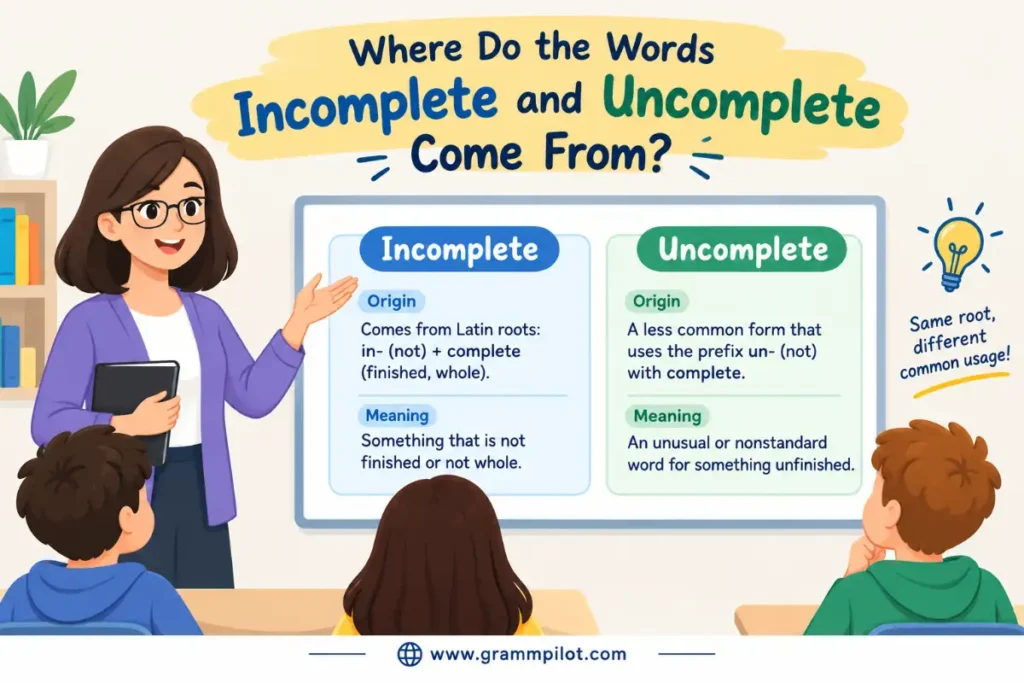
Where Do the Words Incomplete and Uncomplete Come From?
Understanding word origins can make spelling and vocabulary choices easier to remember.
What Is the Origin of Incomplete?
The word incomplete comes from Latin roots that convey the idea of something not being finished. It combines the negative prefix in-, meaning “not,” with a form related to complete, which means finished or brought to an end. The basic meaning is straightforward: something that is incomplete is not complete. Over time, the word became a normal part of English. Today, it appears in education, business, technology, science, administration, and everyday conversation.
Examples include:
- An incomplete assignment.
- An incomplete application.
- An incomplete sentence.
- An incomplete set of instructions.
- An incomplete record.
The word works in both formal and casual situations because its meaning is clear and widely understood.
Why Does Uncomplete Sound Possible?
English has many words that use un- to express the opposite of an adjective or action.
For example:
- Unfinished means not finished.
- Unclear means not clear.
- Unfair means not fair.
- Uncertain means not certain.
- Unusual means not usual.
Because of these patterns, someone might assume that uncomplete should be just as common as incomplete. However, English doesn’t build every word by following one simple rule. Historical usage, convention, and established meaning affect which forms become standard. Uncomplete can appear in unusual, historical, or specialized contexts, but it is not the ordinary modern English adjective for something unfinished. In everyday writing, incomplete is the safer and more natural choice.
How Can You Remember the Correct Word?
Use this simple memory trick: Incomplete = not complete.
Imagine a puzzle with three missing pieces. The puzzle is incomplete because you cannot see the whole picture. You wouldn’t normally describe it as an “uncomplete puzzle.” You would say that it is incomplete. Remember the familiar pair complete and incomplete. This makes the correct form easier to recall when writing quickly.
What Does Incomplete Mean in Plain English?
Incomplete means that something is not finished, not whole, or missing one or more necessary parts. The exact meaning depends on the situation.
1. Something Has Not Been Finished
Use the word when a task, project, or activity still needs work.
Examples:
- The science project is incomplete.
- I left my assignment incomplete because I ran out of time.
- The building remains incomplete after several months of construction.
2. Something Is Missing Information
An item can look finished but still lack important details.
Examples:
- Your registration form is incomplete.
- The report is incomplete because it doesn’t include the final results.
- We received incomplete information about the event.
3. Something Is Not Whole
The word can also describe an object or collection that lacks some of its parts.
Examples:
- The museum received an incomplete collection of historical letters.
- This chess set is incomplete because two pieces are missing.
- The instructions provide an incomplete picture of the process.
4. Something Is Not Fully Developed
In academic, technical, and professional settings, the word may describe work that has not reached the required level of development.
Examples:
- The research remains incomplete.
- The proposal is incomplete without a budget.
- The investigation is incomplete until all the evidence has been reviewed.
These meanings share one idea: something necessary is still missing, or the expected finished state has not been reached.
What Are the Best Synonyms for Incomplete?
The best synonym depends on what you want to describe. A missing form, a half-finished project, and a weak explanation don’t always need the same word. The following list includes 30 useful alternatives grouped by tone and situation.
Simple Synonyms for Incomplete
These words work well in schoolwork, basic explanations, and everyday writing.
| Word | Meaning | Tone | Example |
|---|---|---|---|
| Unfinished | Not finished yet | Neutral | My homework is unfinished. |
| Partial | Only a part of the whole | Neutral | We received a partial payment. |
| Missing | Not present or included | Direct | Two pages are missing. |
| Unfinished-looking | Appearing not fully done | Informal | The wall looks unfinished. |
| Half-done | Only partly completed | Casual | The cleaning is half-done. |
| Unfilled | Not filled in | Neutral | Three fields are unfilled. |
| Inadequate | Not good or sufficient enough | Neutral | The explanation is inadequate. |
| Fragmentary | Existing only in pieces | Neutral to formal | The notes are fragmentary. |
Unfinished is often the closest everyday alternative. Partial works better when you have received or completed only a portion of something.
Everyday Synonyms for Incomplete
These options help you explain what remains to be done without sounding overly formal.
| Word | Meaning | Tone | Example |
|---|---|---|---|
| Pending | Waiting to be completed or decided | Neutral | Your payment is pending. |
| Unresolved | Not settled or answered | Neutral | The issue remains unresolved. |
| Unsettled | Not yet decided or finalized | Neutral | The final date is unsettled. |
| Outstanding | Still needing attention | Professional | Three tasks are outstanding. |
| Unfinished-up | An informal, uncommon construction | Informal | Avoid this phrasing in standard writing. |
| Unpolished | Not yet refined | Neutral | The draft is unpolished. |
| Rough | Not in its final form | Casual | Here’s a rough version of the plan. |
| In progress | Currently being worked on | Neutral | The repair is in progress. |
Some of these terms describe a particular stage rather than a missing part. For instance, pending suggests that an action is awaiting completion, while unpolished suggests that a draft needs improvement.
Formal Synonyms for Incomplete
These terms are useful in reports, academic writing, business documents, and official communication.
| Word | Meaning | Tone | Example |
|---|---|---|---|
| Deficient | Lacking something necessary | Formal | The file is deficient in supporting evidence. |
| Insufficient | Not enough to meet a need | Formal | The evidence is insufficient. |
| Fragmented | Broken into disconnected parts | Formal | The records are fragmented. |
| Provisional | Temporary and subject to change | Formal | We submitted a provisional report. |
| Preliminary | Early and not final | Formal | The preliminary findings are available. |
| Unverified | Not yet confirmed | Formal | The information remains unverified. |
| Inconclusive | Not producing a definite answer | Formal | The results are inconclusive. |
| Inaccurate | Not complete or without flaws | Neutral to formal | The record is inaccurate. |
| Nonexhaustive | Not covering everything | Formal | This is a nonexhaustive list. |
Choose these words carefully. Insufficient means not enough, while inconclusive means that the available evidence does not establish a clear result. Neither is a universal replacement.
Casual and Informal Alternatives
These expressions fit friendly conversations and relaxed messages. They may not suit official documents.
| Word or phrase | Meaning | Tone | Example |
|---|---|---|---|
| Half-finished | Finished only in part | Casual | My drawing is half-finished. |
| Not done | Still unfinished | Casual | The laundry is not done. |
| Not ready | Not prepared for use | Casual | The presentation isn’t ready. |
| Still working on it | Work is continuing | Conversational | I’m still working on it. |
| Missing a few things | Lacking some parts | Conversational | The draft is missing a few things. |
| Needs work | Requires further improvement | Informal | This section still needs work. |
These phrases are often more natural than a formal adjective. In a text message, “I’m still working on it” may communicate the situation more clearly than “The task is incomplete.”
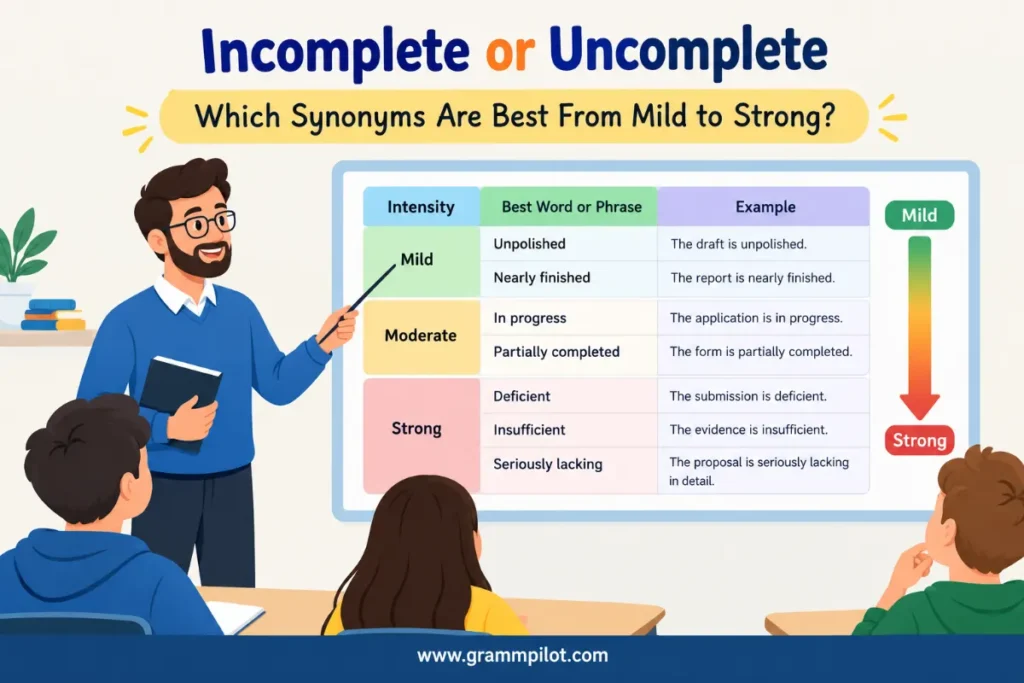
Which Synonyms Are Best From Mild to Strong?
Not all unfinished work has the same level of seriousness. A small missing detail is different from a document that cannot be used.
Choose a word that matches the actual problem rather than making it sound more serious than it is.
| Intensity | Best word or phrase | When to use it | Example |
|---|---|---|---|
| Mild | Unpolished | Needs minor editing | The draft is unpolished. |
| Mild | Nearly finished | Only a little work remains | The report is nearly finished. |
| Moderate | In progress | Work is continuing | The application is in progress. |
| Moderate | Partially completed | Some sections are finished | The form is partially completed. |
| Moderate | Incomplete | Necessary parts are missing | The file is incomplete. |
| Strong | Deficient | Required elements are lacking | The submission is deficient. |
| Strong | Insufficient | The amount or evidence is not enough | The evidence is insufficient. |
| Strong | Seriously lacking | Important elements are missing | The proposal is seriously lacking in detail. |
A useful distinction is that incomplete is usually neutral. It doesn’t automatically mean that something is poor or unacceptable.
For example, an incomplete draft may be excellent so far. It simply isn’t finished.
By contrast, a deficient application may fail to meet a requirement. Use deficient when you need to communicate that stronger judgment.
Which Part of Speech Is Incomplete?
Incomplete is an adjective. It describes a noun by explaining its condition.
Examples:
- The incomplete form needs another signature.
- We submitted an incomplete report.
- Several incomplete applications were returned.
The word doesn’t usually function as a verb or noun in standard everyday English. Related forms can help you express the same idea in different sentence structures.
| Part of speech | Word or phrase | Example |
|---|---|---|
| Adjective | Incomplete | The assignment is incomplete. |
| Verb | Complete | Please complete the assignment. |
| Noun | Incompleteness | The incompleteness of the record caused confusion. |
| Adverbial phrase | Not completely | The task was not completely finished. |
| Verb phrase | Leave unfinished | Don’t leave the application unfinished. |
The noun incompleteness is correct but less common in everyday conversation. Most readers will find “the report is incomplete” clearer than “the incompleteness of the report is a problem.”
Is Incomplete Used Differently in the US and UK?
The word incomplete is standard in both American and British English. There is no important regional difference in its basic meaning.
| Situation | American English | British English |
|---|---|---|
| Unfinished schoolwork | The assignment is incomplete. | The assignment is incomplete. |
| Missing application details | The application is incomplete. | The application is incomplete. |
| Work still being done | The project is in progress. | The project is in progress. |
| Casual explanation | It’s not finished yet. | It’s not finished yet. |
The same core spelling and meaning apply across both varieties. Regional differences may affect other words in the sentence, but they don’t make uncomplete the preferred alternative in either variety. In both countries, choose incomplete when you mean that something is unfinished or missing necessary parts.
What Word Should You Use Instead of Incomplete in Different Situations?
The best choice depends on your audience, purpose, and the specific reason something isn’t finished.
What Should You Write on a Resume?
A resume should present your skills and experience clearly. If you’re describing a project that hasn’t reached its final stage, choose wording that explains the work accurately.
Good examples:
- Developed a preliminary version of the customer database.
- Assisted with an ongoing website redesign.
- Prepared an initial draft of the training manual.
- Contributed to a partially completed research project.
Avoid calling your work incomplete unless that fact is relevant. On a resume, the word can draw attention to an unfinished result without explaining your contribution. If the project is still active, ongoing or in progress may be more useful.
What Word Works Best in an Essay?
In academic writing, choose the term that explains exactly what is missing.
Examples:
- The argument is incomplete because it ignores the opposing view.
- The evidence is insufficient to support the conclusion.
- The explanation is partial because it covers only one cause.
- The analysis remains unfinished and requires further research.
Use incomplete for missing parts, insufficient for inadequate evidence, and partial for an account that covers only some aspects of a topic. These distinctions make an essay more precise.
What Should You Say in an Email?
In professional emails, it helps to identify the problem and explain what needs to happen next.
Examples:
- Your application is incomplete because the signature is missing.
- The report is missing two sections.
- The document needs a few additional details before submission.
- Your registration is not complete yet.
If you’re contacting someone about their work, be polite and specific. Instead of writing “Your work is incomplete,” explain what needs attention.
For example: “Your report is nearly ready. Please add the budget section before sending the final version.” This wording tells the reader what to do without sounding unnecessarily critical.
What Word Sounds Natural in a Text Message?
In casual messages, simple expressions usually sound best.
Examples:
- “I’m not done yet.”
- “The assignment is half-finished.”
- “I’m still working on it.”
- “It’s almost ready.”
- “I need to finish a few things.”
You can use incomplete in a text, but it may sound formal depending on the conversation. For example, “My application is incomplete” works well when discussing an official form. “I’m not done yet” sounds more natural when telling a friend about homework.
What Should You Say When Speaking?
In conversation, use the shortest expression that communicates the situation clearly.
Examples:
- “The job isn’t finished yet.”
- “A few details are missing.”
- “The list isn’t complete.”
- “We still need to finish the last part.”
- “The project is nearly done.”
If you’re explaining a formal or technical issue, incomplete is accurately natural.
For example: “The records are incomplete, so we need to check the missing dates.” The goal is not to use the most impressive word. It’s to help the listener understand what is missing or unfinished.
What Are Some Real-Life Examples of Incomplete?
Examples make the meaning easier to apply. Here are situations from school, work, technology, travel, and daily life.
1. School assignment: My English assignment is incomplete because I haven’t written the conclusion.
2. Job application: The employer returned my incomplete application because I forgot to attach my resume.
3. Email: The email contains incomplete information about the meeting location.
4. Business report: The manager requested additional sales figures because the report was incomplete.
5. Website development: The checkout page is incomplete, so customers cannot place orders yet.
6. Travel planning: Our travel itinerary is incomplete because we haven’t booked the return flight.
7. Cooking: The recipe instructions were incomplete, so I wasn’t sure when to add the spices.
8. Home repair: The renovation remains incomplete because the new flooring hasn’t arrived.
9. Research: The study is incomplete until the researchers examine the final group of results.
10. Personal project: My photo album is incomplete because I haven’t added pictures from last summer.
11. Online registration: Your profile is incomplete until you enter your contact information.
12. Group assignment: Our presentation is incomplete because one team member hasn’t submitted their slides.
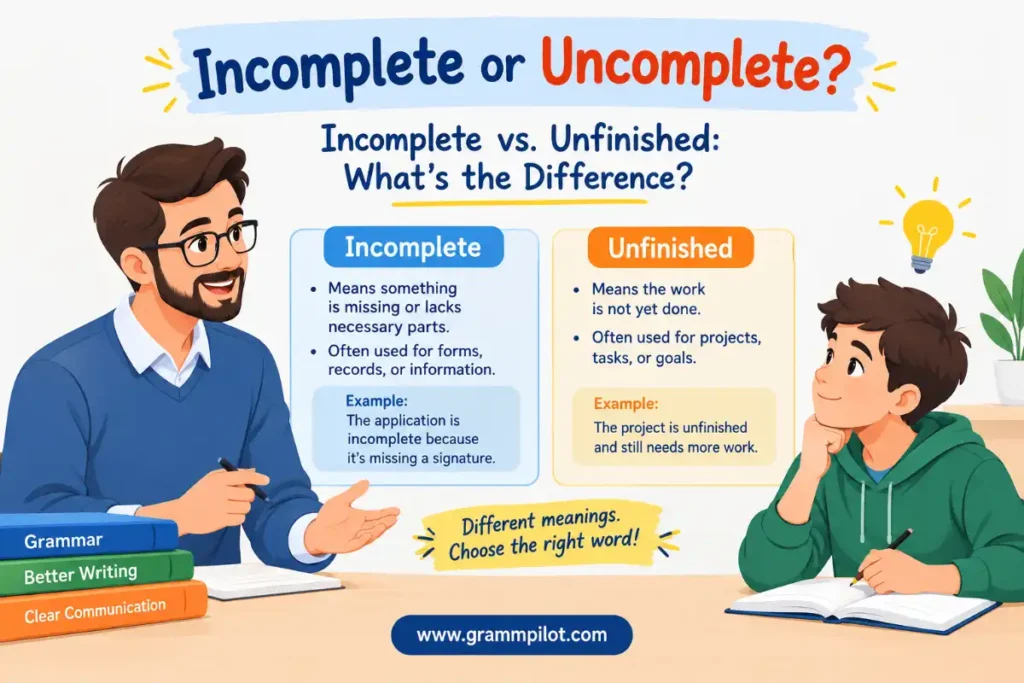
Incomplete vs. Unfinished: What’s the Difference?
Both words describe something that isn’t finished, but they don’t always emphasize the same thing.
| Incomplete | Unfinished |
|---|---|
| Often emphasizes missing parts or information | Often emphasizes work that hasn’t been completed |
| Common for forms, records, sets, and reports | Common for tasks, projects, artwork, and buildings |
| Can describe a document that lacks required details | Can describe work that is still being done |
Compare these examples:
- “The application is incomplete because the address field is blank.”
- “The application is unfinished because I haven’t completed the remaining sections.”
The first sentence highlights a missing requirement. The second highlights the process of completing the application.
In many situations, both words are correct. Choose incomplete when missing elements matter most and unfinished when the remaining work is the main point.
Incomplete vs. Partial: Which Word Is More Accurate?
Partial and incomplete overlap, but they focus on slightly different ideas.
Partial often means that something represents only a portion of a larger whole. Incomplete means that something lacks parts needed to be considered whole or finished.
| Incomplete | Partial |
|---|---|
| Emphasizes missing or unfinished elements | Emphasizes a portion rather than the whole |
| The report is incomplete. | We received a partial report. |
| The set is incomplete because two pieces are missing. | We received a partial set of the documents. |
| The application lacks required information. | Only part of the application was submitted. |
A partial payment isn’t necessarily a problem. It may be an agreed payment toward a larger amount. An incomplete payment record, however, may lack information needed to understand the transaction. This is why choosing a synonym requires more than finding a word with a similar dictionary meaning.
Incomplete vs. Insufficient: What Is the Difference?
These words are related, but they aren’t interchangeable in every sentence.
Incomplete means that something is not whole or finished. Insufficient means that something is not enough for a particular purpose.
Examples:
- The application is incomplete because the applicant forgot a required document.
- The evidence is insufficient because it doesn’t support the claim.
- The explanation is incomplete because it skips an important step.
- The explanation is insufficient because it doesn’t provide enough detail to answer the question.
A document can be complete but still insufficient.
For example, “a report may contain every required section but provide too little evidence to support its conclusion“. Likewise, a report may contain strong evidence but remain incomplete because a required section is missing. Choose the word based on if the problem is missing parts or a lack of enough information, evidence, or resources.
What Are the Common Mistakes When Using Incomplete?
Even though the word is simple, writers sometimes use it in ways that make their meaning unclear.
Mistake 1: Using Uncomplete in Standard Writing
Incorrect or unnatural: “My homework is uncomplete.”
Better: “My homework is incomplete.”
The second sentence uses the established modern English form.
Mistake 2: Treating Incomplete and Incorrect as the Same
An incomplete answer lacks something. An incorrect answer contains a mistake.
Compare:
- Incomplete: “The capital of France is…” The answer stops before giving the city.
- Incorrect: “The capital of France is Rome.”
The first answer is unfinished. The second gives the wrong information.
Mistake 3: Using Incomplete When You Mean Unavailable
An incomplete file exists but lacks necessary parts. An unavailable file cannot be accessed or obtained.
For example:
- “The file is incomplete because page four is missing.”
- “The file is unavailable because the server is offline.”
Use the term that matches the actual situation.
Mistake 4: Confusing Incomplete With Imperfect
An incomplete task lacks something or hasn’t been finished. An imperfect task may be finished but still contain flaws.
For example: “The essay is complete, but the wording is imperfect.”
The essay has reached its final state, even though it could be improved.
Mistake 5: Using Incomplete Without Explaining What Is Missing
Saying “The form is incomplete” may be correct, but it doesn’t always give the reader enough information.
A clearer version is: “The form is incomplete because the emergency contact section is blank.”
Whenever possible, explain the missing part or the next step.
Mistake 6: Calling Work Incomplete When It Is Still in Progress
A task can be actively progressing toward completion. Depending on the situation, in progress may sound more constructive than incomplete.
Compare:
- “The website is incomplete.”
- “The website is in progress, and the payment page is the next feature to be finished.”
The second sentence gives more useful information about the project’s status.
What Are the Antonyms of Incomplete?
An antonym expresses the opposite meaning. The best opposite of incomplete is usually complete.
| Antonym | Meaning | Example |
|---|---|---|
| Complete | Having all necessary parts | The application is complete. |
| Completed | Finished | The task has been completed. |
| Finished | No further work is needed | The report is finished. |
| Whole | Containing all parts | We received the whole set. |
| Full | Containing everything expected in a particular context | The file contains a full list of names. |
| Comprehensive | Covering a wide range of relevant details | The guide provides a comprehensive explanation. |
| Finalized | Made final or settled | The schedule has been finalized. |
These words aren’t accurate substitutes in every sentence. A comprehensive report covers a subject in depth, while a complete report contains all the required parts. A document may be complete without being comprehensive.
What Are the Best Quick Tips for Choosing the Right Word?
Use these practical rules whenever you’re unsure which term to choose.
- Choose incomplete when something is missing necessary parts or details.
- Choose unfinished when work hasn’t reached the end.
- Choose partial when you mean only a portion of a whole.
- Choose insufficient when there isn’t enough evidence, money, time, or information.
- Choose deficient when something fails to meet a requirement or standard.
- Choose pending when an action or decision is waiting to happen.
- Choose unpolished when a draft needs editing or refinement.
- Choose in progress when work is continuing.
- Choose complete when all necessary parts are present.
- Avoid uncomplete in ordinary modern English unless you’re discussing a specific historical or unusual use.
Before you finish writing, ask yourself one question: Is something missing, or is there simply more work to do?
If something necessary is missing, incomplete may be the best choice. If the work is continuing, unfinished or in progress may communicate the situation more clearly.
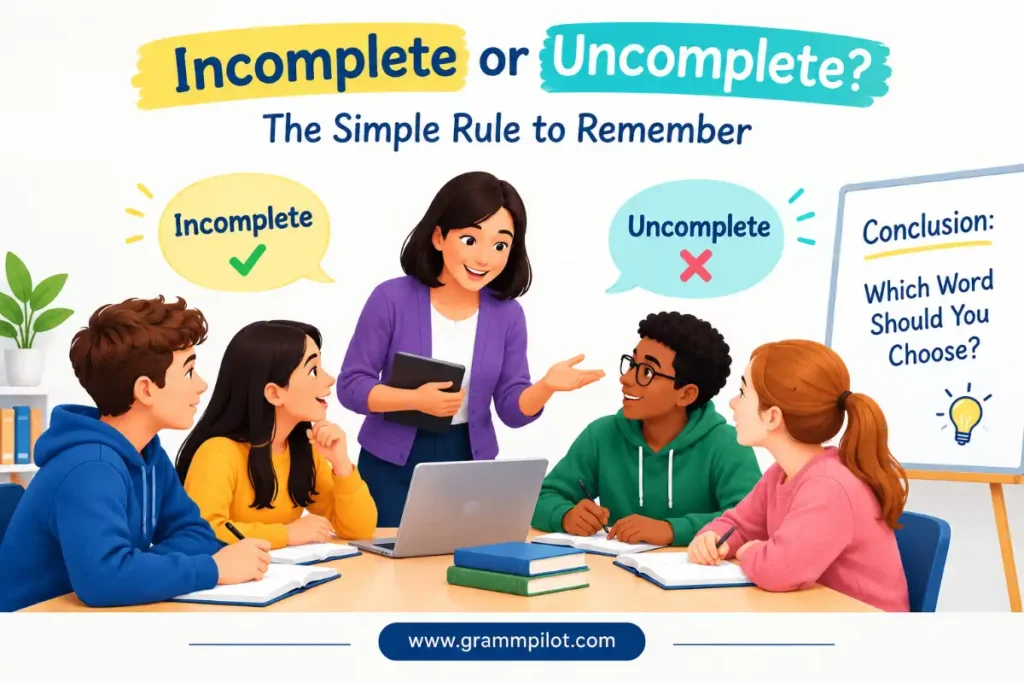
Conclusion: Which Word Should You Choose?
When deciding between Incomplete or Uncomplete, remember that standard modern English strongly favors incomplete. Use it for assignments, forms, reports, records, projects, and other things that lack necessary parts or haven’t reached their finished state. You can also choose a more specific alternative when it better describes the situation. Unfinished emphasizes remaining work, partial describes a portion of a whole, and insufficient means that something isn’t enough for its purpose. These distinctions make your writing more accurate and easier to understand. Although uncomplete may seem logical, it isn’t the usual modern English choice. You don’t need to memorize a complicated grammar rule to get this right. Remember the familiar expression “not complete,” and write incomplete whenever you mean that something is unfinished or missing parts.
Frequently Asked Questions
1. Is incomplete or uncomplete the correct word?
Incomplete is the correct and widely accepted word in standard modern English. Use it to describe something that isn’t finished or lacks necessary parts.
2. What does incomplete mean in simple English?
Incomplete means that something isn’t finished or doesn’t contain everything needed. An assignment with unanswered questions is one example.
3. Is uncomplete a real English word?
Uncomplete has appeared in rare or unusual uses, but it isn’t the normal modern English word for something unfinished. In standard writing, use incomplete.
4. What’s another way to say incomplete?
You can say unfinished, partial, in progress, not finished, or missing details, depending on the situation. Choose the expression that explains the problem most clearly.
5. Is incomplete formal or informal?
Incomplete works in both formal and informal English. It is appropriate for business reports, school assignments, emails, and everyday conversations.
6. What is the opposite of incomplete?
The most direct opposite is complete. Other options include finished, completed, and whole, depending on the sentence.
7. Should I write incomplete application or uncomplete application?
Write incomplete application. This is the standard expression when an application is missing required information, documents, or signatures.