
Have you ever stopped while writing an email, school assignment, text, or work message and wondered whether to write impatient or inpatient? The two words look almost identical, but they have completely different meanings. Choosing the wrong one can change your entire sentence.
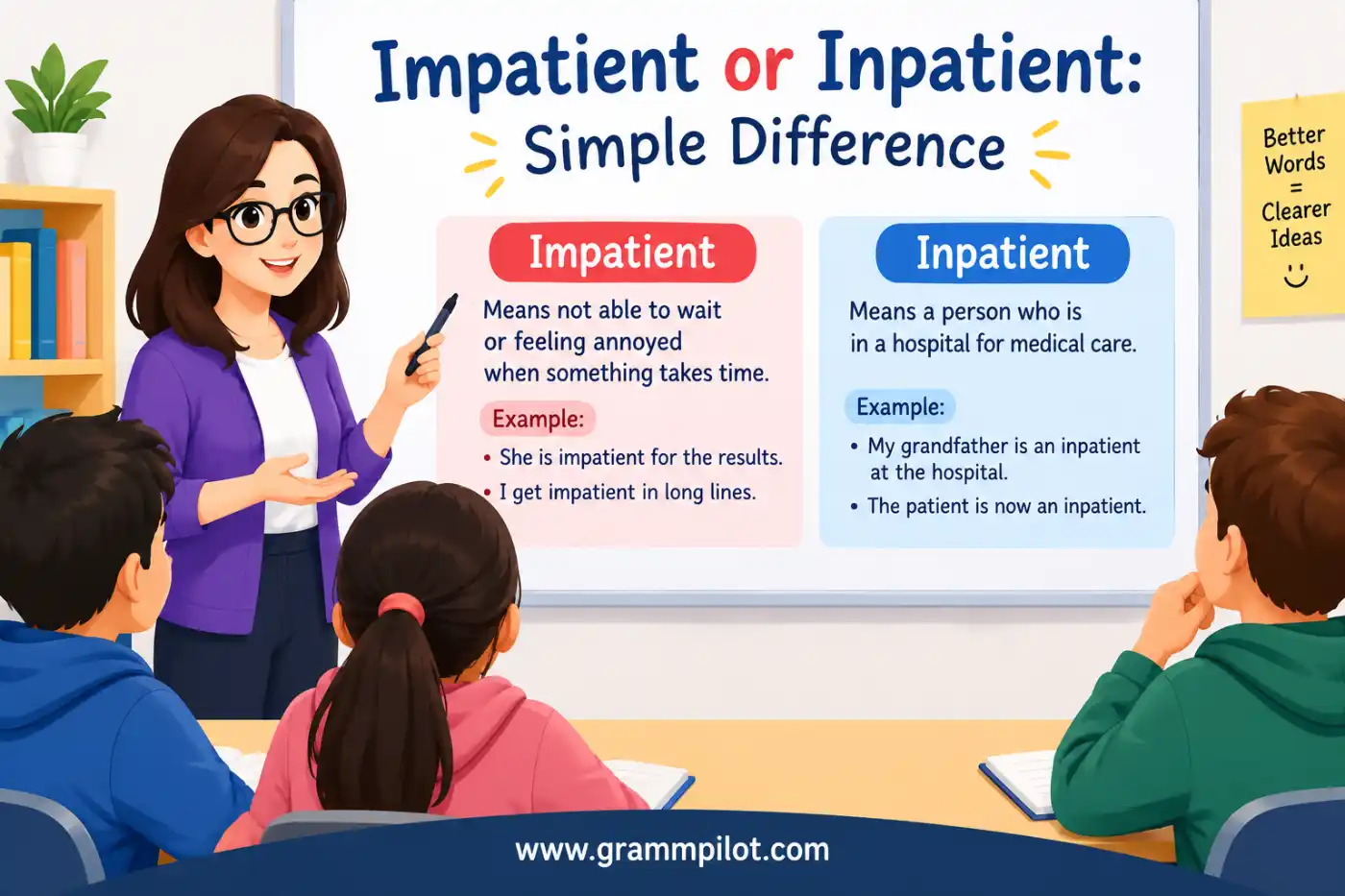
Impatient or inpatient is a common word-choice question because both words are spelled correctly and sound similar. However, impatient describes a person’s lack of patience, while inpatient usually refers to someone receiving medical care while staying in a hospital or other healthcare facility. The easiest way to remember the difference is this: impatient = unable or unwilling to wait calmly; inpatient = a person who stays in a hospital for medical treatment.
This guide explains the meanings, origins, pronunciation, grammar, synonyms, examples, common mistakes, regional usage, and the best word to choose in emails, essays, texts, resumes, and everyday conversations.
To avoid similar grammar mistakes, check out [What Happen or What Happened].
What Is the Difference Between Impatient and Inpatient?
The main difference is meaning.
Impatient is an adjective that describes someone who does not want to wait or who becomes annoyed when something takes too long.
Inpatient is mainly a noun referring to a person who stays in a hospital or healthcare facility while receiving treatment. It can also be used as an adjective to describe medical care provided to such patients.
Compare these examples:
- I became impatient because the bus was late.
- The hospital admitted the patient as an inpatient.
- She was impatient to hear the results.
- The doctor works with inpatient and outpatient cases.
These words should not be switched.
If you’re talking about someone’s attitude toward waiting, use impatient.
If you’re talking about someone staying in a healthcare facility for treatment, use inpatient.
Is “Impatient” or “Inpatient” Correct?
Both are correct words, but they are correct in different situations.
| Word | Part of Speech | Meaning | Example |
|---|---|---|---|
| Impatient | Adjective | Not willing to wait calmly | He became impatient during the delay. |
| Inpatient | Noun | A person staying in a hospital for treatment | The inpatient received medication. |
| Inpatient | Adjective | Related to treatment requiring a hospital stay | She received inpatient care. |
The spelling difference is small:
impatient → about waiting or tolerance
inpatient → about staying inside a healthcare facility
A useful memory trick is to connect inpatient with in. An inpatient is someone who is “in” the hospital for treatment.
What Does “Impatient” Mean?
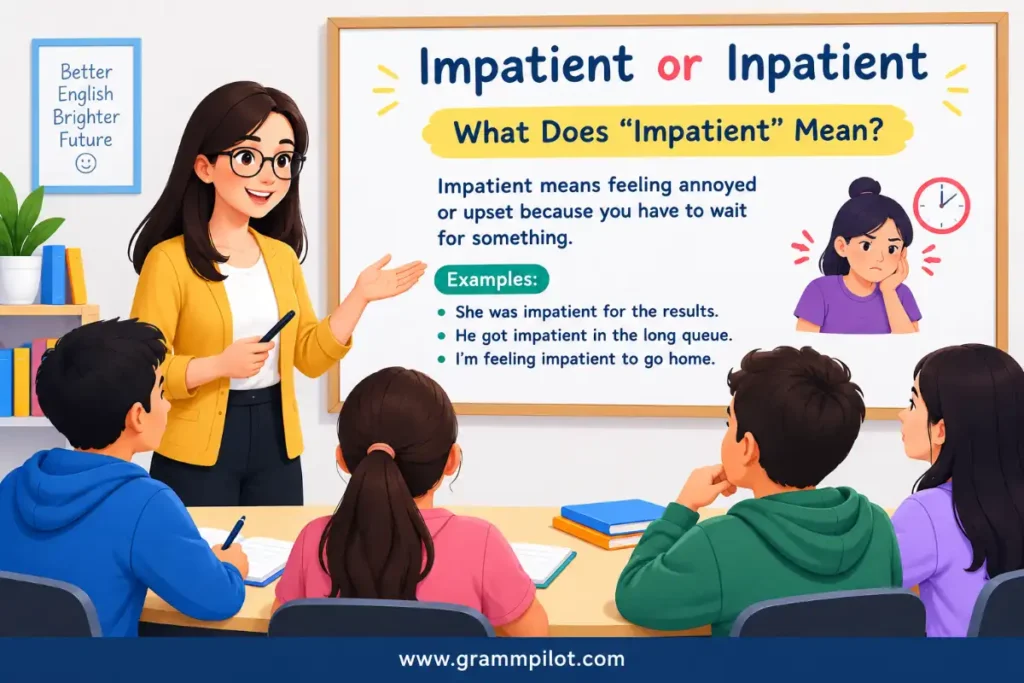
Impatient describes someone who becomes annoyed, restless, eager, or uncomfortable when waiting.
It can describe a person who wants something to happen quickly.
Examples:
- The children became impatient while waiting for dinner.
- She was impatient for the results.
- He grew impatient after waiting for an hour.
- Don’t be impatient; your turn will come soon.
- The customer sounded impatient on the phone.
The word can describe more than physical waiting.
You can be impatient with:
- Delays
- Slow people
- Long explanations
- Repeated questions
- Bureaucracy
- Traffic
- Technology
- Progress
- Uncertainty
For example:
She was impatient with his constant excuses.
Here, she isn’t necessarily waiting in a line. She is annoyed because she has little tolerance for the excuses.
What Does “Inpatient” Mean?
Inpatient usually refers to a person who stays at a hospital or healthcare facility for treatment.
For example:
- The hospital has 200 inpatient beds.
- The patient became an inpatient after surgery.
- The doctor reviewed the inpatient’s medical records.
- Inpatient care can involve overnight monitoring.
- The facility provides inpatient services.
In healthcare, inpatient is commonly contrasted with outpatient.
An inpatient stays at the facility for treatment.
An outpatient receives care without being admitted for an overnight or extended stay.
| Term | Meaning | Example |
|---|---|---|
| Inpatient | Receives treatment while admitted to a facility | The patient was admitted as an inpatient. |
| Outpatient | Receives treatment without being admitted | She had an outpatient procedure. |
This distinction is especially common in hospitals, insurance documents, medical records, and healthcare administration.
Where Does “Impatient” Come From?
The word impatient comes from Latin roots connected with the idea of suffering or enduring.
The prefix im- can mean “not,” while patient comes from a Latin root associated with enduring or suffering.
In modern English, patient has two important meanings.
It can describe someone receiving medical treatment.
It can also describe someone who can wait calmly without becoming annoyed.
That second meaning gives us impatient, meaning not patient or not willing to wait calmly.
Examples:
- patient → able to wait calmly
- impatient → not willing to wait calmly
This connection makes the spelling easier to remember.
Where Does “Inpatient” Come From?
Inpatient is formed from in + patient and developed as a healthcare term.
The word literally suggests a patient who is “in” a healthcare facility.
Its opposite is outpatient, referring to someone who receives medical services without being admitted as an inpatient.
This gives you a useful word pair:
inpatient ↔ outpatient
The spelling is therefore closely connected with location and healthcare status rather than someone’s personality.
How Do You Pronounce the Two Words?
In standard English, the two words are pronounced differently.
Impatient is generally pronounced like:
im-PAY-shunt
Inpatient is generally pronounced like:
IN-pay-shunt
The first syllable helps distinguish them when speaking.
However, in fast conversation, the difference may not always be obvious. That is one reason people sometimes confuse the words when writing.
When you’re unsure, look at the meaning rather than relying only on sound.
Why Do People Confuse These Words?
There are several reasons.
First, both words contain patient.
Second, their prefixes are only slightly different.
Third, they can sound similar when spoken quickly.
Fourth, patient itself has more than one meaning.
Consider:
The patient was impatient.
This sentence is completely correct.
The first patient is a noun meaning a person receiving medical care.
The second impatient is an adjective describing the person’s attitude.
For example:
The inpatient became impatient while waiting for the doctor.
Here, the person is an inpatient because of their medical status and impatient because they don’t want to wait.
This example shows exactly why the words must be understood separately.
What Are the Main Synonyms for “Impatient”?
The best synonym depends on the kind of impatience you’re describing.
| Synonym | Meaning | Tone | Example |
|---|---|---|---|
| Restless | Unable to relax or wait comfortably | Everyday | The children became restless. |
| Eager | Very interested in something happening | Usually Positive | She was eager to hear the news. |
| Anxious | Worried or strongly concerned | Neutral | He was anxious for an answer. |
| Hasty | Acting too quickly | Negative | Don’t make a hasty decision. |
| Hurried | Done quickly because of limited time | Neutral | She gave a hurried reply. |
| Irritated | Slightly angry or annoyed | Negative | He sounded irritated. |
| Annoyed | Bothered by something | Everyday | She was annoyed by the delay. |
| Frustrated | Upset because something isn’t working | Everyday | He felt frustrated by the slow website. |
| Agitated | Emotionally disturbed or restless | Strong | The crowd became agitated. |
| Fidgety | Unable to sit still | Casual | The students became fidgety. |
| Impetuous | Acting suddenly without enough thought | Formal | His impetuous decision caused problems. |
| Hasty | Too quick and insufficiently considered | Formal | Her hasty response was regrettable. |
| Restive | Unable to remain still or calm | Formal | The audience became restive. |
| Urgent | Requiring immediate attention | Neutral | The situation is urgent. |
| Intolerant | Unwilling to accept something patiently | Strong | He was intolerant of delays. |
| Short-tempered | Easily annoyed or angered | Everyday | She can be short-tempered when tired. |
| Edgy | Nervous or tense | Informal | Everyone felt edgy before the announcement. |
| Restless | Unable to remain calm or still | Everyday | He had a restless night. |
| Keen | Very eager or enthusiastic | British/Commonwealth | She was keen to start. |
| Hurrying | Moving or acting quickly | Neutral | He was hurrying to catch the train. |
| Agitated | Very uneasy or upset | Strong | The patient appeared agitated. |
| Frantic | Extremely anxious or hurried | Strong | They made a frantic search. |
| Fidgety | Physically unable to stay still | Casual | The child became fidgety. |
Not every synonym means exactly the same thing.
For example, eager can be positive. If you’re eager to start a new job, you’re excited rather than annoyed.
Frustrated usually involves a problem preventing you from getting what you want.
Restless often describes physical or mental difficulty staying still.
Hasty focuses more on acting too quickly than waiting impatiently.
What Are Synonyms for “Inpatient”?
Because inpatient is a healthcare term, it has fewer natural synonyms.
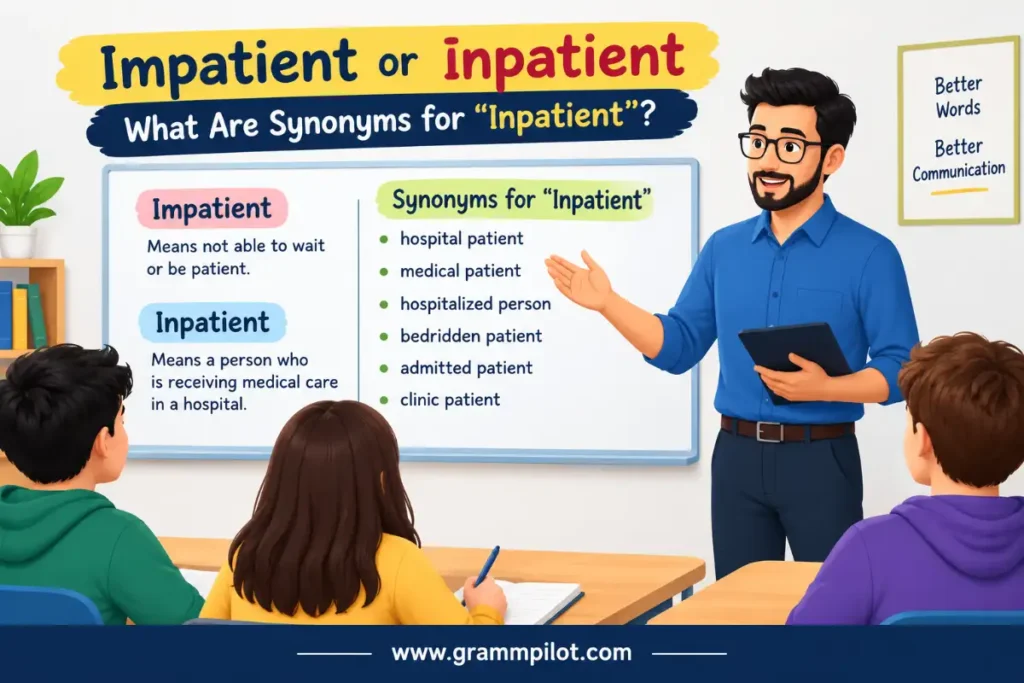
Depending on the context, you may see:
- Hospital patient
- Admitted patient
- Hospitalized patient
- Resident patient
- Patient receiving inpatient care
- Admitted individual
- Hospitalized person
Examples:
The hospital treated several admitted patients overnight.
She was hospitalized for observation.
The doctor reviewed the records of patients receiving inpatient care.
In formal healthcare writing, however, inpatient is often the clearest and most precise term.
Don’t replace it with a general word such as “patient” if the distinction between inpatient and outpatient matters.
What Are the Antonyms?
The main opposite of impatient is patient.
Examples:
- She was impatient with the delay.
- She was patient with the delay.
Other related opposites include:
- Calm
- Tolerant
- Relaxed
- Understanding
- Unhurried
- Composed
For inpatient, the most important contrasting term is outpatient.
| Word | Meaning |
|---|---|
| Impatient | Not willing to wait calmly |
| Patient | Able to wait calmly |
| Inpatient | Person receiving admitted medical care |
| Outpatient | Person receiving care without being admitted |
What Should You Use in an Essay?
The correct choice depends entirely on your subject.
For a personal or descriptive essay:
I became impatient while waiting for the results.
For a healthcare essay:
The hospital provides inpatient and outpatient services.
For literature:
The character becomes impatient when his plans are delayed.
For a medical report:
The inpatient was monitored throughout the night.
Always identify if you’re describing behavior or medical status.
What Should You Use in an Email?
In a normal personal or professional email, impatient is usually the relevant word if you’re discussing someone’s attitude.
Example:
I don’t want to sound impatient, but could you let me know when the report will be ready?
This is a polite way to acknowledge that you’re following up.
For healthcare communication:
The patient has been transferred to the inpatient unit.
Here, inpatient refers to the medical setting.
What Should You Use in a Text Message?
Casual texting usually uses impatient when you’re talking about waiting.
Examples:
I’m getting impatient. How much longer?
The kids are getting impatient.
I’m impatient to see the results!
Inpatient would normally appear in a medical context:
The doctor said he’ll be staying as an inpatient.
The hospital admitted her as an inpatient.
What Should You Use in Everyday Speech?
Use impatient for ordinary conversations about waiting, frustration, or eagerness.
Examples:
- Don’t get impatient.
- I’m getting impatient.
- He was impatient with the delay.
- She gets impatient in traffic.
- The kids are impatient for summer vacation.
Use inpatient when talking about healthcare:
- He became an inpatient after surgery.
- She’s receiving inpatient treatment.
- The hospital has a separate inpatient unit.
Can “Impatient” Mean Eager?
Yes. Impatient can sometimes mean extremely eager for something to happen.
For example:
She was impatient to see her family.
This doesn’t necessarily mean she was angry. It can mean she was very eager and found waiting difficult.
However, eager is often more positive.
Compare:
I am eager to start my new job.
I am impatient to start my new job.
Both can be grammatical, but the first sounds more positive and enthusiastic. The second may suggest that waiting is frustrating.
This distinction matters in professional writing.
“Impatient” vs. “Restless”: What’s the Difference?
These words overlap, but they aren’t identical.
Impatient focuses on waiting or tolerance.
She became impatient because the meeting was taking too long.
Restless focuses more on difficulty staying still or calm.
The children became restless during the long meeting.
Someone can be restless without being impatient.
A person may feel restless because they are bored, uncomfortable, nervous, or full of energy.
“Impatient” vs. “Frustrated”: What’s the Difference?
Impatient means you don’t want to wait.
Frustrated means you’re upset because something is preventing you from achieving what you want.
Compare:
I became impatient while waiting for the bus.
I became frustrated when the bus driver skipped my stop.
The first sentence focuses on waiting.
The second focuses on a problem.
You can experience both at the same time:
I was frustrated and impatient after the bus was delayed for an hour.
“Impatient” vs. “Eager”: What’s the Difference?
These words can both describe strong anticipation.
Eager is usually positive.
She was eager to begin her new job.
Impatient can suggest that waiting feels difficult or annoying.
She was impatient to begin her new job.
If you’re writing a professional email or resume, eager is usually safer when you want a positive tone.
“Inpatient” vs. “Outpatient”: What’s the Difference?
This is one of the most important healthcare distinctions.
An inpatient is admitted to a healthcare facility and stays there for treatment.
An outpatient receives treatment without being admitted as an inpatient.
Examples:
The hospital admitted him as an inpatient.
She visited the clinic as an outpatient.
An outpatient may still receive significant medical treatment. The difference is mainly related to the person who is admitted to the facility for ongoing care.
Can “Inpatient” Be an Adjective?
Yes.
Although inpatient commonly appears as a noun, it can also work as an adjective.
Examples:
- inpatient care
- inpatient treatment
- inpatient unit
- inpatient services
- inpatient facility
- inpatient admission
In these phrases, the word describes something related to admitted patients or hospital-based care.
For example:
The hospital expanded its inpatient services.
Here, inpatient is an adjective modifying “services.”
Can “Impatient” Be a Noun?
Usually, no.
Impatient is normally an adjective.
Correct:
She is impatient.
Incorrect:
She is an impatient.
If you need a noun, use a phrase such as:
- An impatient person
- Someone who is impatient
- A person with little patience
For example:
He is an impatient person.
This is more natural than trying to use impatient as a noun.
What Are Common Mistakes?
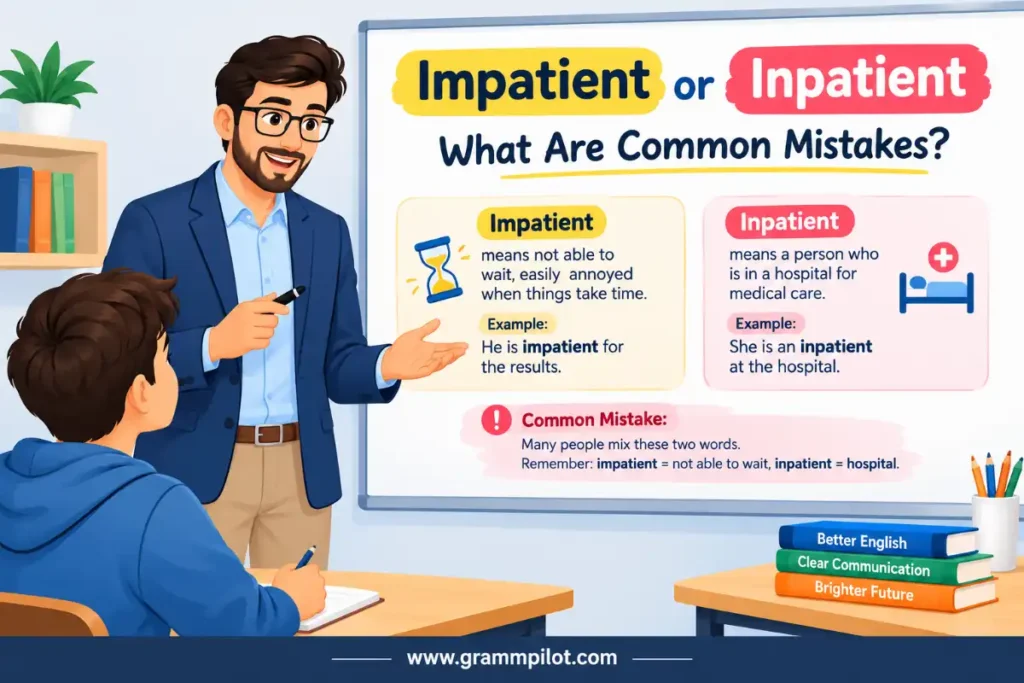
Mistake 1: Using “Inpatient” for Someone Who Can’t Wait
Incorrect:
I became inpatient because the food took too long.
Correct:
I became impatient because the food took too long.
The situation involves waiting, not medical care.
Mistake 2: Using “Impatient” for a Hospital Patient
Incorrect:
The impatient was moved to another room.
Correct:
The inpatient was moved to another room.
Here, you need the healthcare term.
Mistake 3: Confusing “Inpatient” With “In Patient”
In most healthcare contexts, inpatient is written as one word.
Correct:
The hospital admitted the patient for inpatient treatment.
Mistake 4: Assuming “Impatient” Always Means Angry
Impatience can involve irritation, but it can also mean strong eagerness.
She was impatient to see her family.
This can express longing or eagerness rather than anger.
Mistake 5: Using “Impatient” When “Eager” Sounds Better
I am impatient to join the team.
This is possible, but:
I am eager to join the team.
usually sounds more positive in professional communication.
What Are 15 More Example Sentences?
- The students became impatient after waiting outside for thirty minutes.
- She was impatient to open her birthday present.
- The customer sounded impatient during the phone call.
- Don’t become impatient just because the process is slow.
- He gets impatient when people repeat the same question.
- The driver grew impatient in heavy traffic.
- We were impatient for the concert to begin.
- The child became restless and impatient while waiting for lunch.
- The hospital admitted the patient as an inpatient.
- The doctor reviewed the inpatient’s medical chart.
- The facility offers both inpatient and outpatient services.
- She received inpatient treatment after the procedure.
- The inpatient unit was located on the third floor.
- The hospital increased the number of inpatient beds.
- The patient was discharged after completing inpatient care.
Notice how the context makes the meaning clear. The first eight sentences concern waiting, behavior, or eagerness. The last seven concern healthcare.
How Can You Remember the Difference Easily?
Use this simple trick:
Impatient = “I Can’t Wait”
Think:
impatient → I can’t wait
If someone is annoyed because something is taking too long, use impatient.
Example:
I’m impatient because the train is late.
Inpatient = “In the Hospital”
Think:
inpatient → in
If someone is staying in a healthcare facility for treatment, use inpatient.
Example:
The patient is an inpatient at the hospital.
This memory trick is simple but effective.
What Are the Best Alternatives for Different Situations?
| Situation | Best Word | Example |
|---|---|---|
| Waiting too long | Impatient | She became impatient. |
| Excited for something | Eager | He is eager to begin. |
| Unable to sit still | Restless | The child became restless. |
| Upset by a problem | Frustrated | She felt frustrated. |
| Slightly angry | Annoyed | He was annoyed by the delay. |
| Hospital admission | Inpatient | He is an inpatient. |
| Hospital treatment | Inpatient | She needs inpatient care. |
| Care without admission | Outpatient | She received outpatient treatment. |
| Acting too quickly | Hasty | He made a hasty decision. |
| Extremely rushed | Frantic | They made a frantic search. |
This table is especially useful when you know the general idea but aren’t sure which word sounds most natural.
Are These Words Used Differently in American and British English?
The distinction between impatient and inpatient is essentially the same in American and British English.
Both varieties use impatient for someone who lacks patience.
Both use inpatient in healthcare contexts.
The major difference may come from healthcare terminology, since medical systems and administrative terms can vary by country.
For example, hospitals in both the US and UK commonly distinguish between inpatient and outpatient care, although the exact healthcare process and terminology may differ.
The spelling of these two words does not normally change between American and British English.
Can You Use “Impatient” in a Positive Way?
Sometimes.
When it means very eager for something, the word can have a positive or neutral emotional context.
Example:
The children were impatient to see the fireworks.
However, it can still suggest that they found waiting difficult.
Compare:
The children were eager to see the fireworks.
This sounds clearly positive.
The children were impatient to see the fireworks.
This emphasizes their inability or unwillingness to wait.
If you want to avoid any negative suggestion, eager is usually the better choice.
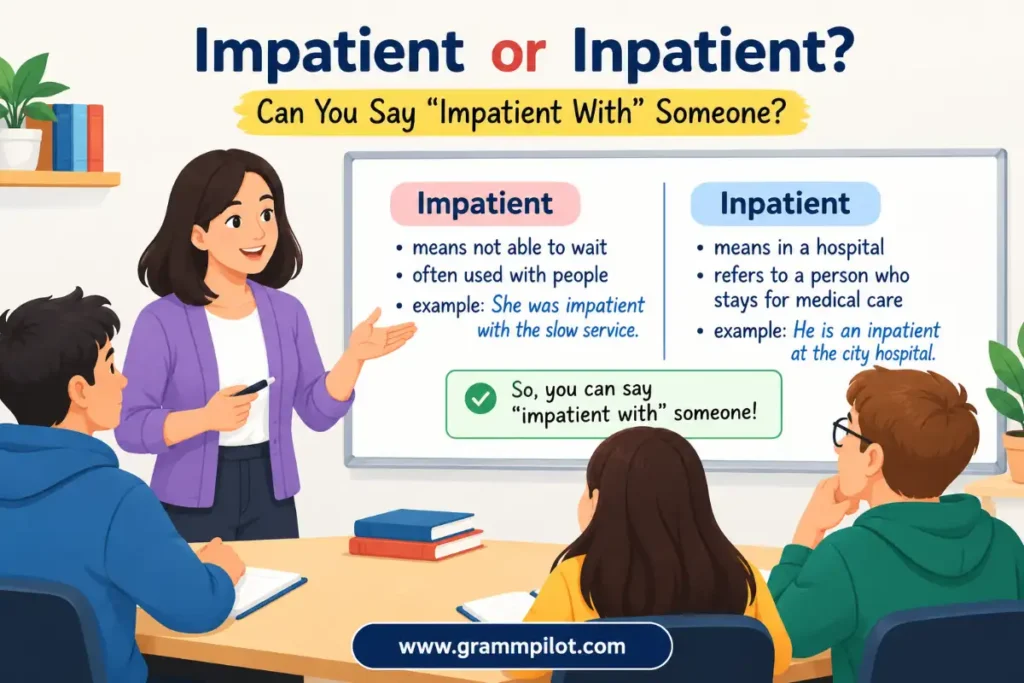
Can You Say “Impatient With” Someone?
Yes.
Impatient with is a common grammatical structure.
Examples:
She was impatient with her brother.
The teacher became impatient with the repeated interruptions.
He is impatient with slow service.
The phrase means that someone has little tolerance for another person’s behavior or for a situation.
You can also say:
impatient for
Example:
They were impatient for the results.
And:
impatient to
Example:
She was impatient to leave.
The preposition depends on the structure and meaning.
Can You Say “Inpatient With” Someone?
Usually, no, if you mean a person’s attitude.
You wouldn’t normally say:
He was inpatient with his friend.
If you mean that he was annoyed or lacked patience, the correct sentence is:
He was impatient with his friend.
Inpatient is a healthcare term, not a synonym for impatient.
How Do You Choose the Right Word in Five Seconds?
Ask yourself one question:
Am I talking about waiting or healthcare?
If the answer is waiting, choose impatient.
If the answer is healthcare admission, choose inpatient.
Examples:
I can’t wait anymore.
→ Impatient
The person is staying in the hospital.
→ Inpatient
The customer is annoyed by the delay.
→ Impatient
The patient is receiving admitted care.
→ Inpatient
This quick test solves most mistakes immediately.
Why Does Context Matter So Much?
Consider this sentence:
The patient was impatient.
It means the medical patient was becoming frustrated or unwilling to wait.
Now change one letter:
The inpatient was patient.
This means the hospitalized person was calm and willing to wait.
These examples show that a tiny spelling difference can change the grammatical role and meaning of a sentence.
Good proofreading therefore requires more than checking if a word is spelled correctly. You also need to ask if it fits the meaning.
Quick Editing Checklist
Before publishing your sentence, ask:
- Am I describing someone’s attitude?
- Is the person having trouble waiting?
- Am I describing medical treatment?
- Is the person admitted to a healthcare facility?
- Would “eager” be more positive?
- Would “restless” be more accurate?
- Am I talking about an inpatient or outpatient?
- Does the sentence make sense without the word?
If the sentence concerns patience, waiting, frustration, or eagerness, impatient is probably the word you need.
If it concerns hospital admission or medical care, inpatient is probably correct.
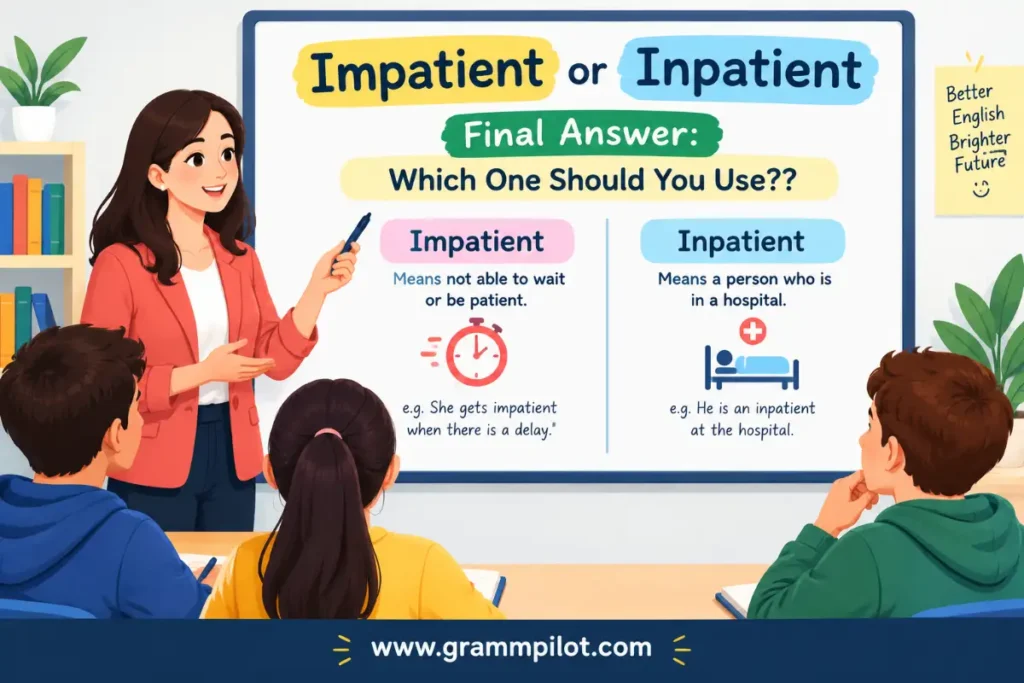
Final Answer: Which One Should You Use?
Use impatient when someone doesn’t want to wait, becomes annoyed by delays, or is extremely eager for something to happen.
Use inpatient when referring to a person admitted to a hospital or healthcare facility, or to care associated with such patients.
The easiest memory trick is:
Impatient = I can’t wait.
Inpatient = in the hospital.
Once you connect the prefixes with their meanings, the difference becomes much easier to remember. When you’re writing, don’t focus only on how similar the words look. Ask what your sentence is actually trying to say.
Conclusion
The difference between Impatient or Inpatient is simple once you focus on meaning. Impatient describes a lack of patience, irritation with waiting, or strong eagerness. Inpatient belongs mainly to healthcare and describes someone who has been admitted for medical treatment or something related to that type of care.
Remember the quick rule: impatient means “I can’t wait,” while inpatient means someone who is “in” a healthcare facility. If you’re discussing a delay, frustration, or eagerness, choose the first word. If you’re discussing hospital admission or medical services, choose the second.
A small spelling difference can prevent a big misunderstanding. Check the context, choose the word that matches it, and your sentence will be clear.
Frequently Asked Questions
1. What is the difference between impatient and inpatient?
Impatient means unable or unwilling to wait calmly, while inpatient refers to someone admitted to a hospital or healthcare facility. They have different meanings despite their similar spelling.
2. Is it “impatient” or “inpatient” when you can’t wait?
The correct word is impatient. For example, “I became impatient because the bus was late.”
3. What does inpatient mean in a hospital?
An inpatient is someone who has been admitted to a healthcare facility and stays there while receiving treatment. The term can also describe care or services provided to admitted patients.
4. Can impatient mean eager?
Yes, impatient can mean very eager for something to happen. However, “eager” usually sounds more positive because it doesn’t suggest irritation with waiting.
5. What’s another word for impatient?
Common alternatives include restless, eager, frustrated, annoyed, agitated, hasty, and intolerant. The best synonym depends on whether you mean eagerness, irritation, restlessness, or rushing.
6. Is an inpatient the same as an outpatient?
No. An inpatient is admitted to a healthcare facility, while an outpatient receives medical care without being admitted as an inpatient.
7. How can I remember the difference between impatient and inpatient?
Think “I can’t wait” for impatient and “in the hospital” for inpatient. This quick association helps separate the two words.