
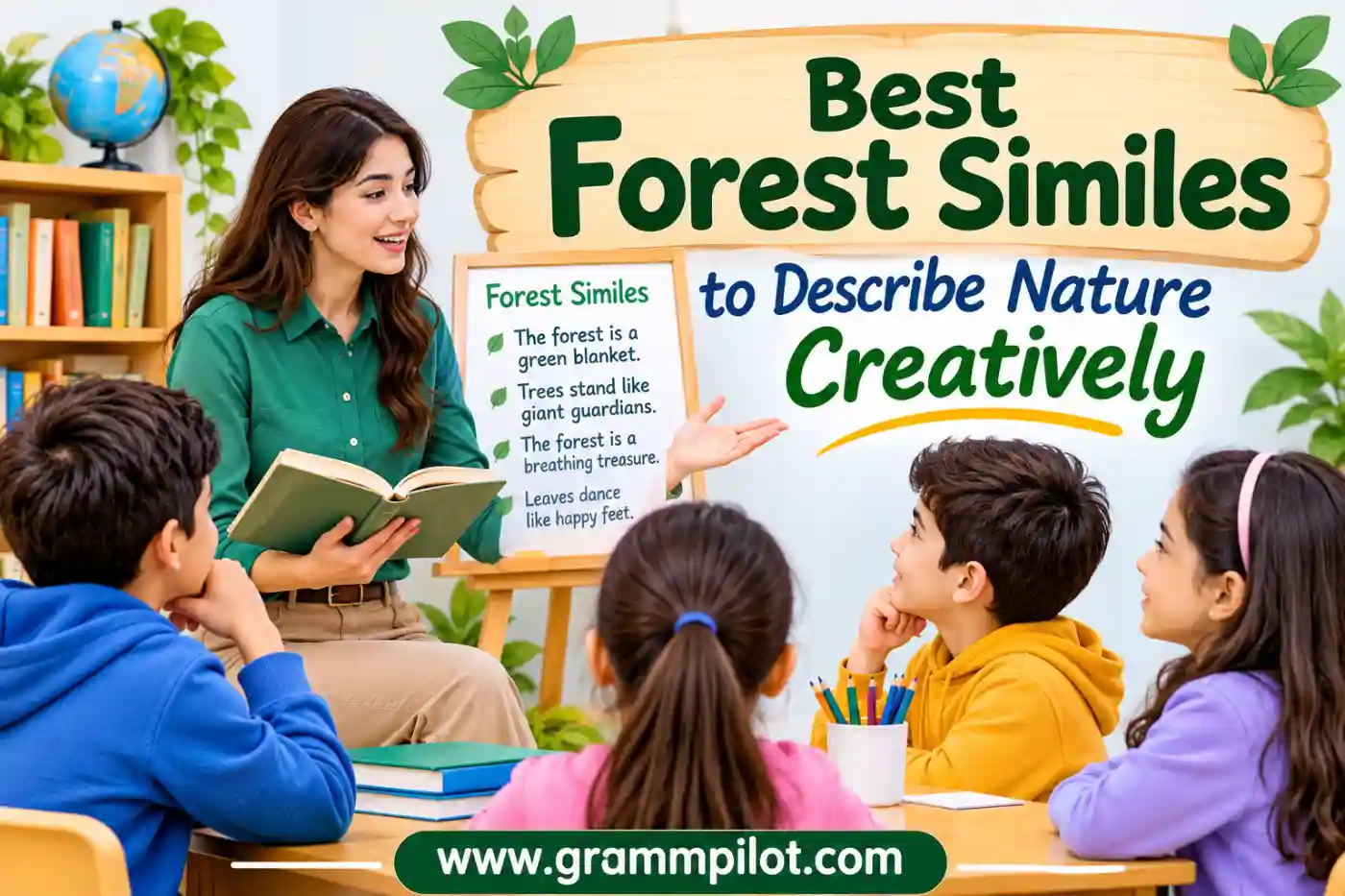
Imagine writing an essay about a peaceful forest. You want readers to picture tall trees, colorful leaves, winding paths, and sunlight shining through branches. But using the words beautiful, green, and quiet again and again can make your writing feel dull. This is where Forest Similes can help. A good simile compares one thing with another using words such as like or as. It helps readers imagine the sights, sounds, feelings, and atmosphere of a forest. For example, saying “The forest was as quiet as a sleeping village” creates a clearer picture than simply saying “The forest was quiet.” Forest similes are creative comparisons that describe woodland scenes, trees, animals, sounds, and natural surroundings by showing how they resemble something familiar.
If you’re writing a school assignment, a nature poem, a short story, or a personal message, these comparisons can make your descriptions more interesting. In this guide, you’ll discover the meaning and origin of similes, more than 50 original forest comparisons, useful vocabulary, examples for different situations, common mistakes, and tips for choosing the right expression.Another useful figurative-language technique is explained in Similes for the Beach.
What Is a Forest Simile?
A forest simile is a figure of speech that compares something in a forest with another familiar object, feeling, place, or experience. It uses comparison words such as:
- Like
- As
- As … as
- Resembles
For example: “The trees stood like silent guards around the path.” This sentence compares trees with guards. It suggests that the trees are tall, still, and standing together as if protecting something. Here are a few more examples:
- The forest was as green as an emerald.
- The wind moved through the leaves like a gentle whisper.
- The branches twisted like the fingers of an old giant.
- The sunlight fell through the trees like golden ribbons.
Each comparison gives readers a different way to imagine the natural world.
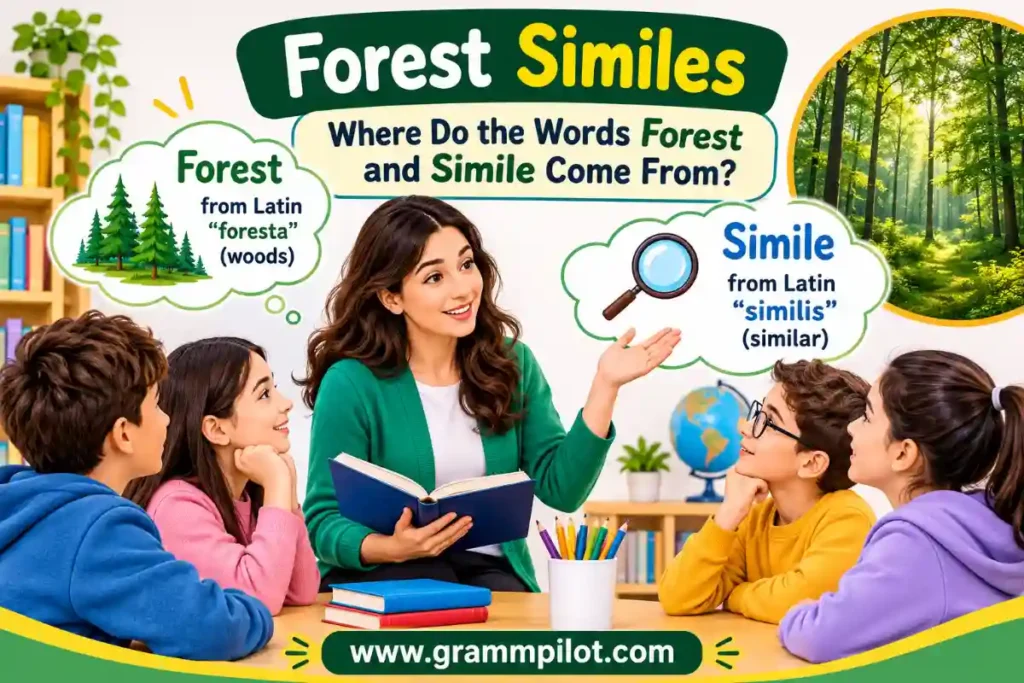
Where Do the Words Forest and Simile Come From?
Understanding word origins can make language more interesting.
Origin of the Word Forest
The word forest comes through Old French forest, which developed from Medieval Latin forestis. It originally referred to land set aside for hunting or belonging to an outside wooded area. Today, a forest means a large area covered mainly with trees and other plants. Forests also provide homes for birds, insects, mammals, and countless other living things.
Origin of the Word Simile
The word simile comes from the Latin word similis, meaning similar or like. A simile shows a connection between two different things through a comparison. For example: “The forest was like a green ocean.” A forest isn’t actually an ocean. However, the comparison helps readers imagine a huge area of green stretching in every direction.
55 Best Forest Similes and Their Meanings
Here are original comparisons for describing forest scenery, trees, wildlife, sounds, and feelings.
Similes for the Beauty of a Forest
1. The forest was as beautiful as a painted paradise.
Meaning: The woodland looked colorful and wonderful.
2. The trees sparkled like emerald jewels.
Meaning: Their green leaves looked bright and attractive.
3. The forest stretched like a green ocean.
Meaning: Trees covered a huge area.
4. The sunlight danced like golden butterflies.
Meaning: Sunlight moved playfully through the branches.
5. The flowers scattered across the forest floor like colorful stars.
Meaning: Flowers added beauty to the ground.
6. The forest looked like a living painting.
Meaning: The natural scenery appeared artistic and beautiful.
7. The morning mist floated like a silver blanket.
Meaning: Fog covered the woodland softly.
Similes for Tall and Strong Trees
8. The trees stood like ancient giants.
Meaning: The trees were extremely tall and impressive.
9. The branches stretched like welcoming arms.
Meaning: The branches spread outward.
10. The old tree was as strong as an iron tower.
Meaning: The tree appeared powerful and sturdy.
11. The roots spread like giant fingers beneath the earth.
Meaning: The roots reached in different directions.
12. The trees stood like soldiers guarding the forest.
Meaning: They formed a protective-looking line.
13. The tall pines rose like pillars of a natural palace.
Meaning: The trees looked tall and majestic.
14. The branches twisted like tangled ropes.
Meaning: The branches were bent and intertwined.
Similes for a Peaceful Forest
15. The forest was as peaceful as a sleeping village.
Meaning: Everything felt calm and undisturbed.
16. The breeze moved like a mother’s gentle touch.
Meaning: The wind felt soft and comforting.
17. The river flowed like a quiet conversation.
Meaning: Its sound was gentle and relaxing.
18. The leaves whispered like old friends sharing secrets.
Meaning: Their movement created a soft sound.
19. The forest rested like a tired child.
Meaning: The woodland seemed completely still.
20. The birds sang like a beautiful morning choir.
Meaning: Their songs created a pleasant natural melody.
21. The woodland was as calm as a sleeping baby.
Meaning: There was almost no disturbance.
Similes for a Dark and Mysterious Forest
22. The forest was as dark as a moonless night.
Meaning: Very little light reached the ground.
23. The shadows stretched like black fingers.
Meaning: Dark shapes appeared to reach across the path.
24. The trees looked like silent monsters.
Meaning: Their shapes seemed frightening.
25. The mist curled like a ghostly ribbon.
Meaning: Fog moved through the trees in unusual shapes.
26. The forest swallowed the path like a hungry giant.
Meaning: Thick trees made the path disappear from sight.
27. The branches hung like crooked claws.
Meaning: The branches looked frightening and twisted.
28. The darkness covered the woodland like a heavy curtain.
Meaning: Darkness surrounded everything.
Similes for Forest Sounds
29. The wind howled like a hungry wolf.
Meaning: The wind made a loud, frightening sound.
30. The leaves rustled like pages in an old book.
Meaning: Moving leaves created a dry, gentle sound.
31. The woodpecker tapped like a little drummer.
Meaning: Its beak made repeated knocking sounds.
32. The waterfall roared like a powerful lion.
Meaning: The water produced a loud noise.
33. The rain fell like thousands of tiny footsteps.
Meaning: Raindrops made repeated tapping sounds.
34. The owl called like a lonely night singer.
Meaning: Its sound echoed through the woodland.
Similes for Forest Animals
35. The deer moved like a graceful dancer.
Meaning: It walked lightly and elegantly.
36. The squirrel jumped like a tiny acrobat.
Meaning: It moved quickly between branches.
37. The rabbit ran like a speeding arrow.
Meaning: It moved extremely fast.
38. The butterfly floated like a colorful feather.
Meaning: It moved gently through the air.
39. The fox crept like a silent shadow.
Meaning: It moved quietly and carefully.
40. The owl watched like a wise old teacher.
Meaning: It appeared observant and alert.
Similes for Forest Weather and Seasons
41. The autumn leaves fell like golden rain.
Meaning: Leaves covered the ground as they dropped.
42. The snow covered the forest like a white blanket.
Meaning: Everything looked white and snowy.
43. The spring forest bloomed like a colorful garden.
Meaning: Flowers and fresh leaves appeared everywhere.
44. The summer sunlight burned like a golden flame.
Meaning: The sunlight felt strong and bright.
45. The raindrops glittered like tiny diamonds.
Meaning: Water droplets reflected the light.
46. The cold wind bit like a hungry wolf.
Meaning: The wind felt painfully cold.
Similes for a Magical Forest
47. The forest glowed like an enchanted kingdom.
Meaning: The woodland looked magical.
48. The fireflies shone like floating stars.
Meaning: Their lights appeared across the darkness.
49. The moonlight spread like silver paint.
Meaning: Moonlight covered the trees and ground.
50. The flowers opened like tiny fairy doors.
Meaning: The flowers looked delicate and magical.
51. The forest sparkled like a kingdom of diamonds.
Meaning: The woodland appeared full of shining details.
Similes for a Wild and Untouched Forest
52. The wilderness spread like an endless green kingdom.
Meaning: The forest seemed enormous and natural.
53. The vines wrapped around the trees like climbing snakes.
Meaning: Vines twisted around tree trunks.
54. The undergrowth grew like a tangled green carpet.
Meaning: Plants covered the forest floor.
55. The forest stood like a fortress untouched by time.
Meaning: The woodland appeared ancient and undisturbed.
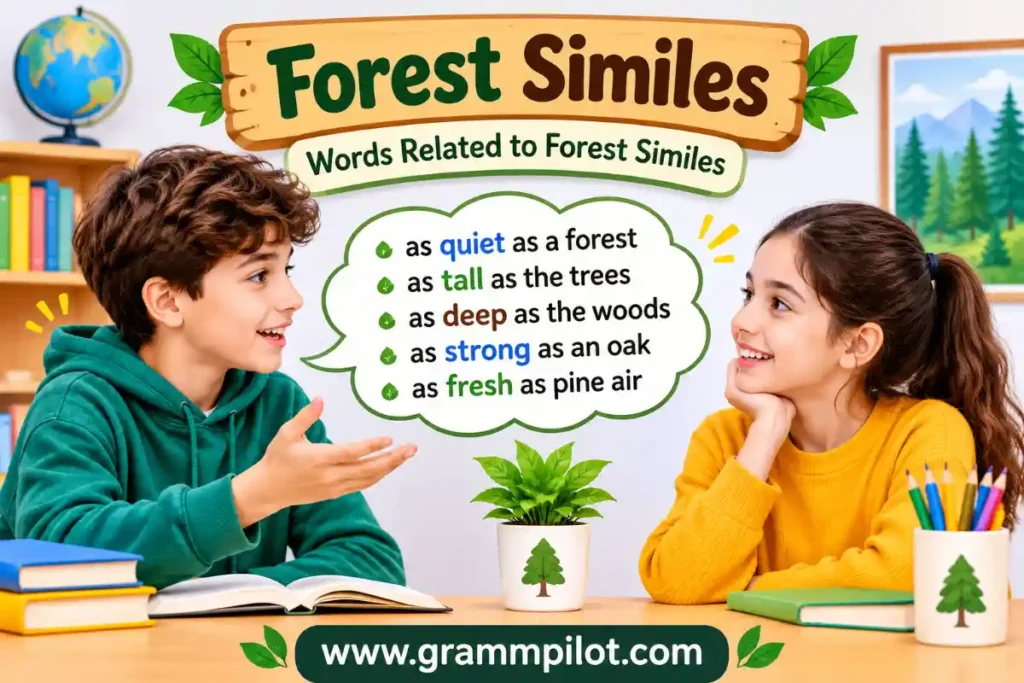
Words Related to Forest Similes
Choosing the right descriptive vocabulary can make your comparisons stronger. Instead of repeating beautiful, green, or quiet, try words from these groups.
| Group | Word | Meaning | Tone | Example |
|---|---|---|---|---|
| Simple | Green | Covered with green plants | Neutral | Green woodland |
| Simple | Dark | Having little light | Neutral | Dark forest |
| Simple | Bright | Full of light | Positive | Bright leaves |
| Everyday | Lush | Rich in green plants | Positive | Lush forest |
| Everyday | Misty | Covered with mist | Atmospheric | Misty morning |
| Everyday | Graceful | Moving beautifully | Positive | Graceful deer |
| Everyday | Mysterious | Difficult to understand | Dramatic | Mysterious woods |
| Formal | Verdant | Green with vegetation | Formal | Verdant landscape |
| Formal | Serene | Very peaceful | Formal | Serene woodland |
| Formal | Majestic | Grand and impressive | Formal | Majestic trees |
| Formal | Tranquil | Calm and quiet | Formal | Tranquil setting |
| Formal | Picturesque | Visually attractive | Formal | Picturesque forest |
| Slang | Spooky | Frightening or strange | Informal | Spooky woods |
| Slang | Vibe | A particular feeling | Casual | Peaceful forest vibe |
| Slang | Creepy | Unpleasant or scary | Informal | Creepy woodland |
Forest Similes From Mild to Strong
Not every description needs powerful language. Sometimes a gentle comparison works better than a dramatic one.
Mild Comparisons
Use these for ordinary descriptions and peaceful scenes.
- Like a quiet garden
- As soft as morning mist
- Like a gentle breeze
- As green as fresh grass
- Like a sleeping village
Example: The forest was as peaceful as a sleeping village.
Medium Comparisons
These create stronger images without making the writing too dramatic.
- Like a green ocean
- As tall as ancient towers
- Like a golden paradise
- As thick as a woven carpet
- Like a natural palace
Example: The trees stood like ancient towers along the winding path.
Strong Comparisons
Use these when writing fantasy, adventure, or frightening scenes.
- Like a kingdom of shadows
- As dark as a bottomless cave
- Like a giant’s mysterious fortress
- As wild as an untamed beast
- Like a maze without an end
Example: The dark forest stretched like a mysterious kingdom of shadows.
Forest Similes by Part of Speech
Understanding grammar helps you place comparisons correctly in your sentences.
Similes Used With Nouns
These describe people, places, animals, and objects.
- A forest like a green ocean.
- Trees like ancient giants.
- Leaves like golden coins.
- A path like a silver ribbon.
Similes Used With Verbs
These explain how something moves or behaves.
- The branches swayed like dancers.
- The river rushed like a racing horse.
- The leaves fluttered like butterflies.
- The deer leaped like a spring.
Similes Used With Adjectives
These describe qualities such as beauty, darkness, and peacefulness.
- As peaceful as a sleeping baby.
- As dark as midnight.
- As beautiful as a painting.
- As green as an emerald.
Remember that a simile is a figure of speech, not a separate part of speech. It can work with different grammatical structures.
US vs. UK English: Are Forest Descriptions Different?
The basic meaning of a simile stays the same in American and British English. However, some nature-related vocabulary differs.
| American English | British English | Meaning |
|---|---|---|
| Forest | Forest / woodland | Tree-covered area |
| Fall | Autumn | Season after summer |
| Sidewalk | Pavement | Walking path |
| Trail | Footpath | Path through nature |
| Vacation | Holiday | Time away from work |
For example:
American English: The autumn leaves covered the forest trail like a golden blanket.
British English: The autumn leaves covered the woodland footpath like a golden blanket.
Both sentences are natural. The main difference is the vocabulary used for the audience.
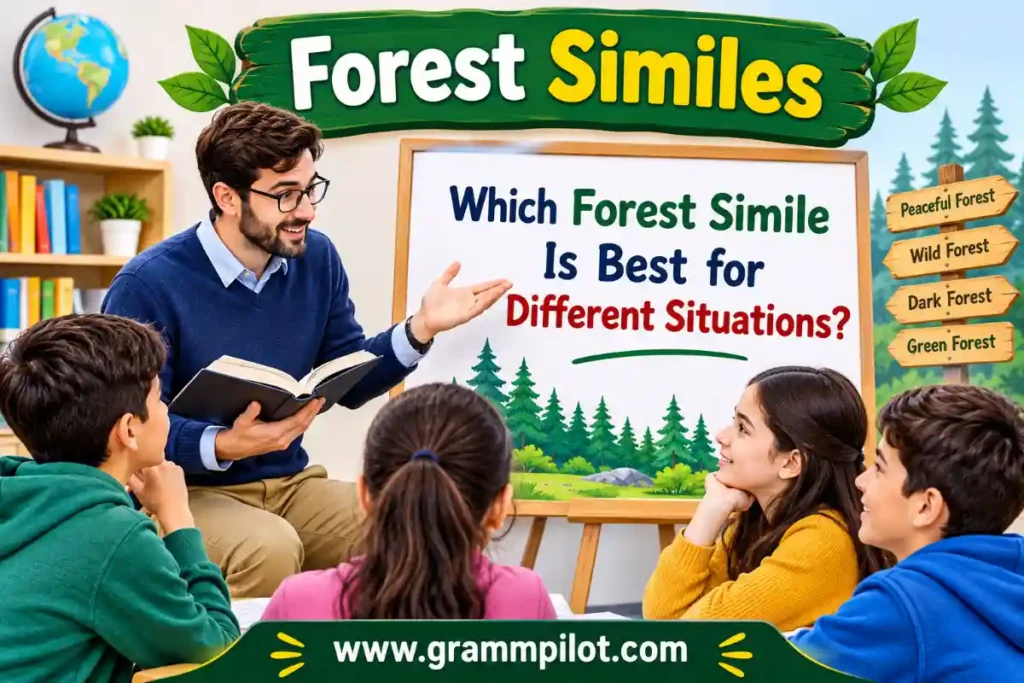
Which Forest Simile Is Best for Different Situations?
The right comparison depends on what you’re writing and the feeling you want to create.
1. For a Resume
A resume usually doesn’t need poetic comparisons. Use clear, professional vocabulary to describe outdoor experience or environmental work.
Example: “Managed conservation activities in a diverse woodland environment.“
2. For an Essay
Choose clear and descriptive comparisons that help readers understand the scene.
Example: “The forest stretched like a green ocean, providing shelter to countless animals.”
3. For Texting
Casual comparisons are suitable for friendly messages and social media.
Example: “That forest looked like a magical paradise!”
4. For an Email
Keep the description polite and natural, especially in educational or professional communication.
Example: “The woodland was as peaceful as a quiet garden, making it an ideal location for our nature study.“
5. For Speaking
Choose comparisons that are easy to understand and remember.
Example: “The trees were as tall as giant towers.”
12 Original Forest Simile Sentences for Everyday Situations
Here are more examples showing how comparisons work in real writing.
1. School essay: The forest looked like a green blanket covering the mountains.
2. Nature description: The morning sunlight shone through the leaves like golden threads.
3. Adventure story: The narrow path disappeared into the trees like a road leading to another world.
4. Poem: The wind sang through the branches like a lonely musician.
5. Travel writing: The woodland was as beautiful as a picture on a postcard.
6. Animal story: The little squirrel moved like a gymnast across the branches.
7. Rainy weather: Raindrops hit the leaves like tiny silver beads.
8. Fantasy story: The ancient forest stood like a forgotten kingdom.
9. Night description: The fireflies glowed like stars scattered across the ground.
10. Descriptive paragraph: The fallen leaves covered the pathway like a colorful carpet.
11. Environmental writing: The trees stood like guardians protecting the earth.
12. Personal reflection: Walking through the forest felt like entering a peaceful dream.
Forest vs. Woodland: What’s the Difference?
Although these words are closely related, they aren’t always interchangeable.
| Forest | Woodland |
|---|---|
| Usually refers to a large tree-covered area | Often describes an area of trees, sometimes smaller or more open |
| Can suggest extensive natural scenery | Can suggest a more intimate natural setting |
| Common in scientific and everyday writing | Common in British English and nature writing |
Examples:
- The forest stretched across the mountain like a green ocean.
- The woodland looked like a peaceful garden.
Both words describe tree-covered places, but the image they create can be slightly different.
Simile vs. Metaphor: What’s the Difference?
A simile and a metaphor both compare two things, but they do it differently.
| Simile | Metaphor |
|---|---|
| Uses like or as | Makes a direct comparison |
| The forest was like a green ocean. | The forest was a green ocean. |
| Makes the comparison clear | Presents one thing as another |
When should you use a simile?
Use a simile when you want to make your comparison clear and easy to understand.
When should you use a metaphor?
Use a metaphor when you want a stronger, more direct image.
Common Mistakes When Writing Forest Comparisons
Even creative writing needs correct grammar and sensible comparisons.
1. Confusing Similes With Metaphors
Incorrect explanation: “The forest was a green ocean” is a simile.
Correction: This is a metaphor because it doesn’t use like or as.
2. Using Too Many Comparisons
Writing several similes in every sentence can make a paragraph difficult to read.
Instead of writing three or four comparisons together, choose one strong image.
3. Choosing Unrelated Comparisons
A comparison should help readers understand the subject.
For example, describing a peaceful forest as a battlefield may confuse readers unless you’re deliberately creating a contrast.
4. Repeating the Same Words
Using beautiful, green, and peaceful repeatedly makes descriptions predictable.
Try alternatives such as lush, tranquil, verdant, graceful, and picturesque.
5. Forgetting the Meaning of the Comparison
A simile should make sense in context.
For example, “The forest was as bright as the sun” may be unsuitable for a dark woodland scene.
Antonyms of Forest-Related Descriptive Words
Antonyms help you describe the opposite atmosphere.
| Word | Antonym |
|---|---|
| Peaceful | Disturbed |
| Bright | Dark |
| Beautiful | Ugly |
| Green | Barren |
| Dense | Sparse |
| Fresh | Stale |
| Quiet | Noisy |
| Wild | Tame |
| Lush | Dry |
| Warm | Cold |
| Safe | Dangerous |
| Calm | Chaotic |
These words are useful when describing damaged forests, dry landscapes, storms, or frightening woodland scenes.
Quick Tips for Choosing the Best Forest Simile
- Think about the scene: Is the forest peaceful, frightening, colorful, or mysterious?
- Choose familiar objects: Compare trees with towers, leaves with coins, or mist with blankets.
- Use sensory details: Describe what someone might see, hear, or feel.
- Avoid unnecessary complexity: Simple comparisons are often more effective.
- Match the mood: Use gentle images for peaceful scenes and darker images for scary stories.
- Read your sentence aloud: If it sounds unnatural, try another comparison.
- Don’t overuse similes: One memorable comparison can be stronger than five ordinary ones.
Antonyms and Other Ways to Describe a Forest
Sometimes a direct adjective works better than a comparison. Here are useful alternatives for different woodland settings.
| Description | Useful words |
|---|---|
| Beautiful forest | Picturesque, lush, magnificent |
| Peaceful forest | Serene, tranquil, quiet |
| Dark forest | Shadowy, gloomy, mysterious |
| Thick forest | Dense, overgrown, tangled |
| Magical forest | Enchanted, dreamy, mystical |
| Dangerous forest | Wild, threatening, unpredictable |
| Colorful forest | Vibrant, bright, vivid |
| Ancient forest | Old-growth, historic, timeless |
Use these descriptions alongside comparisons to create more natural and varied writing.
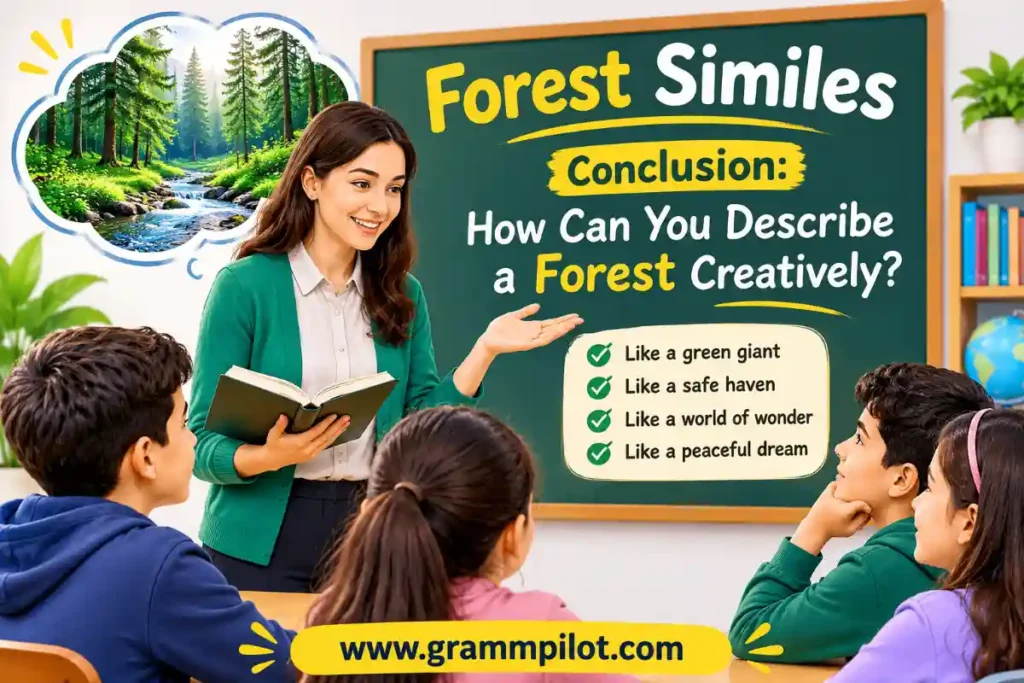
Conclusion: How Can You Describe a Forest Creatively?
A forest is more than a collection of trees. It is a place filled with movement, color, sounds, wildlife, and natural beauty. The right comparison helps readers experience these details through their imagination. The best Forest Similes don’t simply make sentences longer. They give ordinary descriptions a clearer meaning. Comparing trees to ancient giants, leaves to golden coins, or a woodland to a green ocean helps readers picture a scene more easily. When writing your next essay, story, or poem, think about the feeling you want to create. Choose words that match the setting, use comparisons naturally, and avoid repeating the same expressions. Even a simple sentence can become memorable when it creates a strong picture in the reader’s mind.
Frequently Asked Questions
1. What are forest similes?
Forest similes are comparisons that describe forests, trees, animals, and natural surroundings using like or as. For example, “The forest was like a green ocean.”
2. What is a good simile for a beautiful forest?
“The forest sparkled like a kingdom of emeralds” is a good comparison for a beautiful forest. It highlights the richness and brightness of the green scenery.
3. What are some similes for tall trees?
Tall trees can be compared to ancient giants, towering castles, or natural pillars. For example, “The trees stood like giant towers reaching toward the sky.”
4. What’s another way to describe a peaceful forest?
You can describe a peaceful forest as being as calm as a sleeping village. Other useful expressions include a quiet paradise, a gentle garden, and a tranquil haven.
5. How do you describe a dark forest in a story?
Use comparisons that create mystery and suspense. For example, “The forest was as dark as a moonless night.”
6. What are some examples of forest similes for students?
Students can use simple comparisons such as “The leaves fell like golden rain” and “The trees stood like soldiers.” These examples are easy to understand and suitable for school essays.
7. What is the difference between a forest simile and a metaphor?
A simile uses like or as to compare two things, while a metaphor makes a direct comparison. “The forest was like an ocean” is a simile, whereas “The forest was an ocean” is a metaphor.