
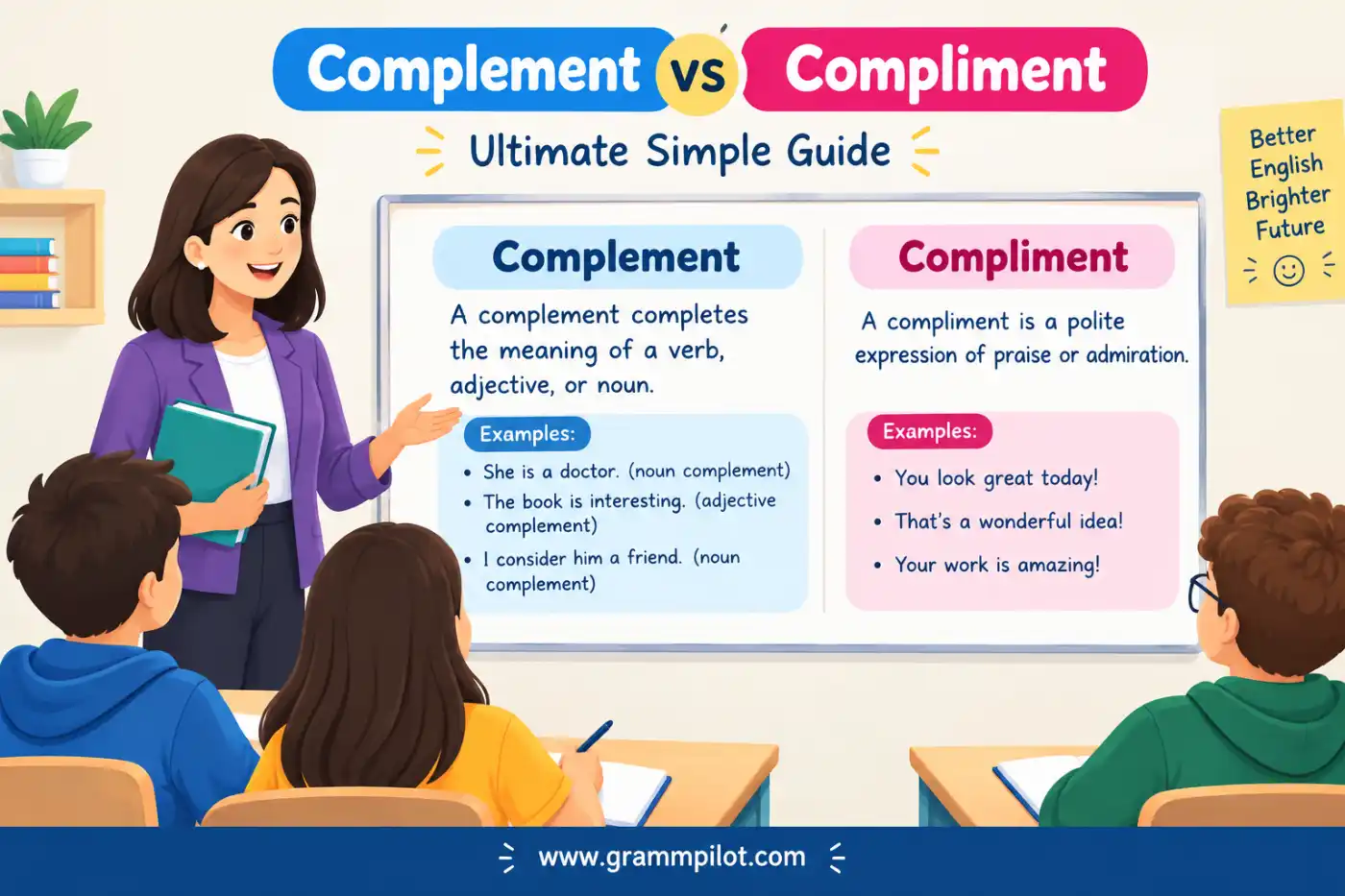
Have you ever been writing an email, essay, resume, or text and stopped because you couldn’t remember whether you needed complement vs compliment? You’re not alone. These words sound alike, which makes the spelling easy to mix up. Their meanings, however, are different. Complement vs Compliment comes down to one simple distinction: compliment is connected to praise, while complement is connected to completing, matching, or enhancing something.
Quick answer: Use compliment when you mean praise or a positive remark. Use complement when you mean something that completes, matches, balances, or improves something else.
The difference becomes much clearer when you look at real sentences. This guide covers the word origins, meanings, synonyms, common mistakes, related forms such as complimentary and complementary, context-specific examples, and quick tricks for choosing the right spelling.
Another commonly confused pair worth knowing is [ Discreet vs Discrete ]
What is the difference between complement and compliment?
The two words are pronounced alike in most varieties of English, but they have different meanings and spellings.
| Word | Main meaning | Example |
|---|---|---|
| Compliment | Praise or a positive remark | She gave me a compliment about my presentation. |
| Complement | Something that completes, matches, or enhances something else | The blue curtains complement the gray walls. |
A simple way to remember them is:
Compliment = praise
Complement = complete, match, or enhance
Consider these two sentences:
The manager complimented my work.
The manager praised your work.
My communication skills complement my technical skills.
The two skills work well together. The meanings are completely different even though the words sound the same.
Why are these words so easy to confuse?
The pronunciation creates the problem. When you hear someone say either word, you usually can’t tell which spelling they mean from sound alone. You need to understand the context.
For example: “She gave me a compliment.”
Someone praised you.
“The colors complement each other.”
The colors work well together.
When you’re speaking, this distinction happens naturally through context. When you’re writing, you have to choose the correct spelling.
What does compliment mean in plain English?
A compliment is something positive that you say about someone or something.
It can show:
- praise
- admiration
- approval
- appreciation
- respect
- encouragement
For example: Your presentation was excellent.
That sentence is a compliment.
You can compliment someone on their:
- appearance
- work
- skills
- personality
- ideas
- performance
- achievement
- behavior
Examples:
She complimented me on my new haircut.
The teacher complimented Jake on his essay.
The customer complimented the staff on their service.
He gave his colleague a sincere compliment.
How is compliment used as a noun?
As a noun, compliment refers to the praise itself.
Examples:
She gave me a compliment.
I appreciated your compliment.
That was a nice compliment.
He received several compliments after his speech.
The plural form is compliments.
How is compliment used as a verb?
As a verb, compliment means to praise someone or something.
Examples:
She complimented my dress.
The manager complimented him on his leadership.
A common pattern is: compliment + someone + on + something
For example: She complimented me on my presentation.
You can also simply say:He complimented her.
The meaning is still praise.
What does complement mean in plain English?
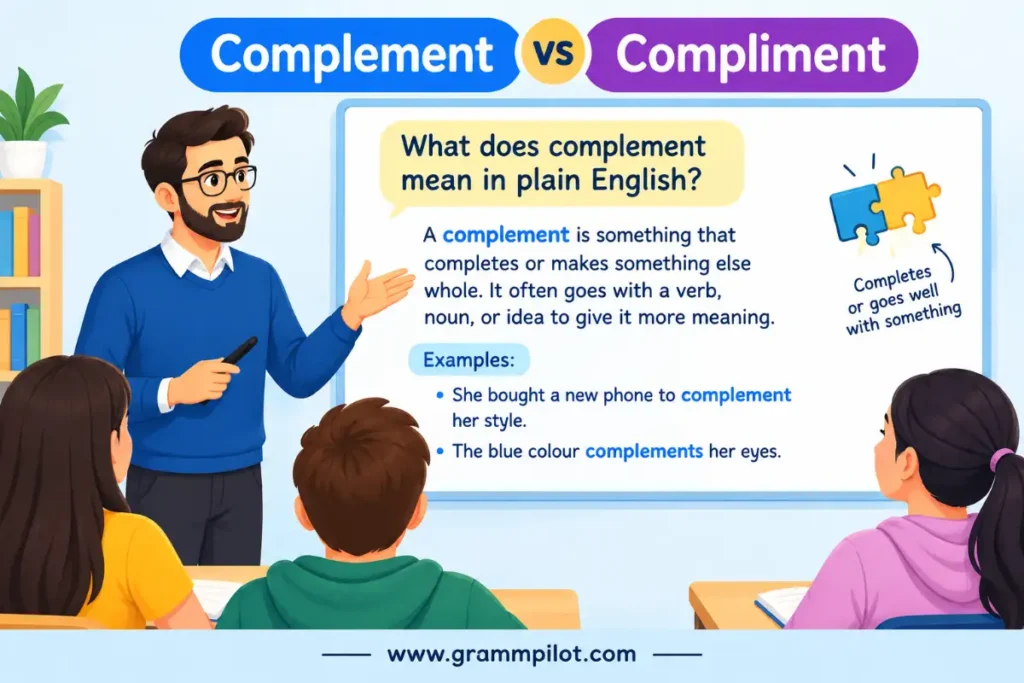
A complement is something that completes, matches, balances, or improves another thing.
For example:
The blue curtains complement the furniture.
The curtains work well with the furniture.
Her experience complements his technical knowledge.
Their different strengths work well together.
The sauce complements the fish.
The sauce enhances the dish.
The word doesn’t necessarily mean that the two things are identical. They simply work well together or make each other better.
How is complement used as a noun?
As a noun, complement can refer to something that completes or enhances another thing.
Examples:
The sauce is a perfect complement to the meal.
The necklace was a beautiful complement to her outfit.
The final chapter is an important complement to the book.
The noun is less common in casual conversation than the verb, but it is useful in formal and descriptive writing.
How is complement used as a verb?
As a verb, complement means to complete, enhance, balance, or work well with something.
Examples:
The colors complement each other.
Her skills complement his experience.
The new design complements the existing website.
The herbs complement the flavor of the soup.
This is one of the most useful forms to learn.
Where did compliment come from?
Compliment entered English through French and has roots associated with polite expressions and courtesy. Over time, its meaning became closely connected with expressions of praise or admiration. That history fits its modern use. When you give someone a compliment, you’re expressing a favorable opinion about them or something they have done.
For example: The coach complimented the player on her effort.
The coach praised her.
The related word complimentary can also mean expressing praise:
He was very complimentary about her work.
It can also mean something is provided free of charge:
The hotel offers complimentary breakfast.
That second meaning is important because it can cause another spelling mix-up.
Where did complement come from?
Complement comes through French from Latin roots connected with the idea of filling up, completing, or making something whole. That basic idea still appears in modern English. When one thing complements another, it adds something that makes the combination more complete or effective. For example: The final section complements the introduction.
The section adds something that works with the introduction. The word also developed specialized meanings in grammar, mathematics, and other fields. However, the everyday meaning remains easy to remember: Complement = something that completes or enhances another thing.
What are the main uses of compliment?
How do you use compliment for someone’s appearance?
Use compliment when you praise someone’s appearance.
Examples:
She complimented me on my jacket.
He complimented her hairstyle.
I received a compliment about my shoes.
Your new haircut looks great.
That final sentence is also a compliment even though it doesn’t contain the word compliment.
How do you use compliment for someone’s work?
You can compliment someone on a job well done.
Examples:
My supervisor complimented me on the report.
The teacher complimented the student on her research.
The client complimented our team on the presentation.
Everyone complimented him on his excellent speech.
Here, the word clearly means praise.
How do you use compliment for someone’s skills?
Examples:
The coach complimented her on her leadership skills.
My manager complimented me on my communication skills.
The interviewer complimented him on his confidence.
She complimented her colleague on his problem-solving ability.
These sentences all describe positive comments.
What are the main uses of complement?
How do you use complement for colors?
Complement is common when two colors look good together.
Examples:
The blue walls complement the white furniture.
The gold details complement the dark wood.
The two colors complement each other.
This does not necessarily mean the colors are identical. A complementary combination can involve contrast as long as the elements work well together.
How do you use complement for clothing?
Examples:
The scarf complements her coat.
Those shoes complement your outfit.
The necklace complements the dress.
Here, one item adds to the appearance of another.
How do you use complement for skills?
This use is especially helpful in resumes and professional writing.
Examples:
Her creativity complements his analytical ability.
My technical skills complement my communication skills.
The idea is that the skills work together effectively.
How do you use complement for food?
Food provides many natural examples.
The sauce complements the chicken.
The herbs complement the soup.
The food items don’t praise one another. They enhance or balance one another.
What is the master synonym list for complement and compliment?
The two target words have different synonym groups. The following list gives a broad range of alternatives rather than treating every word as a perfect replacement.
| Word | Meaning | Tone | Example |
|---|---|---|---|
| Praise | Express approval or admiration | Neutral | The teacher praised her work. |
| Approval | Positive judgment | Neutral | The plan received approval. |
| Appreciation | Recognition of value | Neutral | She showed appreciation for his help. |
| Recognition | Notice of achievement or value | Formal | Her work earned recognition. |
| Acclaim | Strong public praise | Formal | The film received critical acclaim. |
| Applause | Public approval | Neutral | Her speech earned applause. |
| Credit | Recognition for an achievement | Neutral | She deserves credit for the idea. |
| Praise | Positive judgment | Neutral | The team received praise. |
| Salute | Expression of respect | Formal | The award was a salute to her service. |
| Nice words | Pleasant comments | Everyday | She had nice words for the staff. |
| Enhance | Improve or add value | Neutral/Formal | The lighting enhances the room. |
| Improve | Make something better | Neutral | The update improved the design. |
| Complete | Make whole | Neutral | The final piece completes the set. |
| Balance | Create harmony | Neutral | The flavors balance each other. |
| Enrich | Add value or depth | Formal | The examples enrich the lesson. |
| Harmonize | Work together pleasingly | Formal | The colors harmonize well. |
| Blend | Combine smoothly | Neutral | The colors blend together. |
| Pair with | Work well alongside | Everyday | This sauce pairs with fish. |
| Round out | Complete or improve | Informal | The final section rounds out the book. |
These alternatives aren’t interchangeable in every sentence.
For instance, kudos works well in a casual message but sounds out of place in a formal academic paper. Acclaim suggests strong or widespread praise, while kind words is much softer. Likewise, match is useful when discussing appearance, while enhance focuses more strongly on improvement.
What are synonyms by intensity from mild to strong?
Not every positive expression has the same force.
What words describe mild praise?
For gentle approval, you can use:
- nice
- kind
- positive
- favorable
- pleasant
- encouraging
Example: She made a kind comment about my work.
What words describe moderate praise?
For clearer approval, consider:
- praise
- appreciation
- admiration
- recognition
- approval
- credit
Example: The employee received praise for her careful work.
What words describe strong praise?
For very strong or public approval, use:
- acclaim
- high praise
- commendation
- tribute
- outstanding recognition
Example: The scientist received widespread acclaim for her discovery.
What are the related parts of speech?
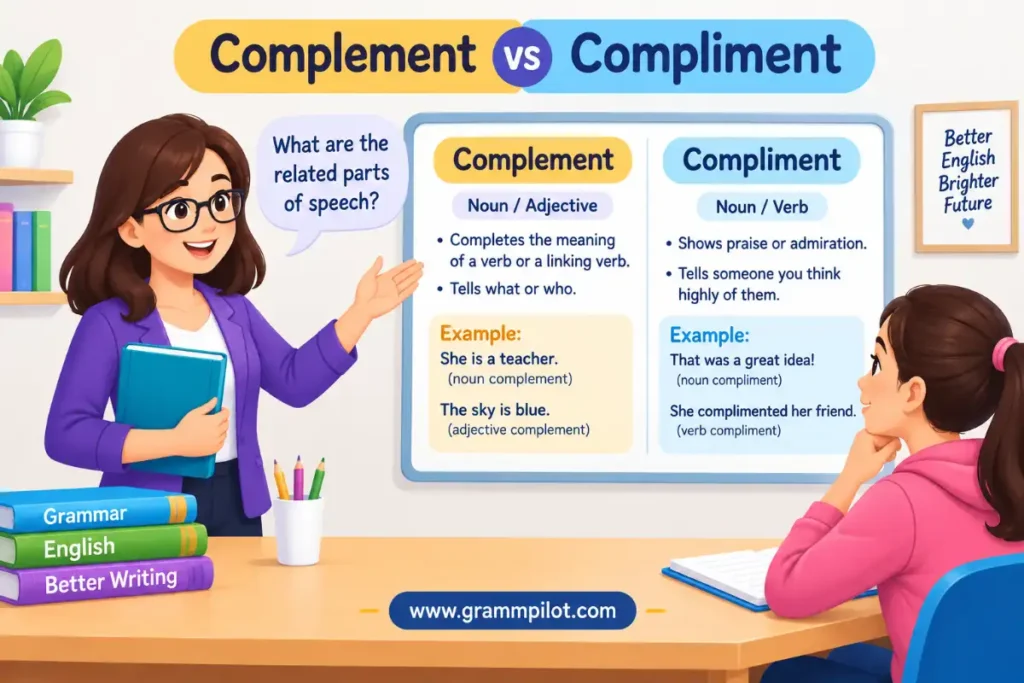
Both words can function as nouns and verbs.
| Word | Part of Speech | Example |
|---|---|---|
| Compliment | Noun | She gave me a compliment. |
| Compliment | Verb | She complimented my work. |
| Complement | Noun | The sauce is a complement to the meal. |
| Complement | Verb | The sauce complements the meal. |
| Complimentary | Adjective | The hotel offers complimentary breakfast. |
| Complementary | Adjective | The colors are complementary. |
The two adjectives are especially important.
Complimentary can mean praising or free.
Complementary means completing, matching, or working well together.
What is the difference between complimentary and complementary?
These two adjectives create another common spelling problem.
What does complimentary mean?
Complimentary can mean expressing praise.
Example: She was complimentary about my presentation.
It can also mean provided free of charge.
Example: The hotel offers complimentary breakfast.
Here, complimentary means free.
What does complementary mean?
Complementary means completing, matching, balancing, or enhancing another thing.
Examples:
The colors are complementary.
Their skills are complementary.
The two flavors are complementary.
A useful shortcut is:
complimentary = praise or free
complementary = works well together.
What is the difference between complement and match?
Match often means that two things are similar or visually suitable together. Complement can mean that two things work well together even when they aren’t identical.
Compare:
The blue shoes match the blue dress.
The colors are similar.
The silver shoes complement the blue dress.
The shoes enhance the overall appearance. So match can suggest similarity, while complement often suggests harmony or enhancement.
What is the difference between complement and enhance?
These words are close, but enhance focuses more strongly on improvement.
The necklace complements her dress.
The necklace works well with the dress.
The lighting enhances the room.
The lighting makes the room look better.
A complement may enhance something, but the emphasis can be on the relationship between the two things.
What is the difference between compliment and praise?
Compliment often refers to a specific positive remark.
Praise is broader.
Compare:
She complimented my shoes.
This describes one specific positive comment.
The manager praised my performance.
This suggests broader approval of the quality of the work.
A compliment can be a form of praise, but praise doesn’t always take the form of a single compliment.
What is the difference between compliment and flattery?
A compliment can be sincere and genuine.
Flattery often suggests excessive, strategic, or insincere praise.
Compare:
She complimented my presentation.
This sounds neutral and sincere.
He used flattery to persuade his boss.
This suggests that his praise may have had another purpose. Because of this negative suggestion, flattery isn’t always a good replacement for compliment.
What are common mistakes with these words?
Mistake 1: Using compliment for matching
Incorrect:
The curtains compliment the sofa.
If you mean the curtains work well with the sofa, write:
The curtains complement the sofa.
Mistake 2: Using complement for praise
Incorrect: She gave me a complement on my dress.
Correct: She gave me a compliment on my dress.
She praised the dress.
Mistake 3: Confusing complimentary and complementary
Incorrect: The hotel provides complementary breakfast.
If the breakfast is free, write: The hotel provides complimentary breakfast.
Mistake 4: Assuming complement means exactly the same as complete
The words are related, but complement doesn’t always mean “finish.”
For example: The necklace complements her outfit.
The necklace doesn’t literally finish the outfit. It enhances or improves its overall appearance.
Mistake 5: Thinking people always take compliments and things always complement
This can be a useful memory trick, but it isn’t a grammar rule.
Consider: The reviewer complimented the book.
A person praised a thing.
You can also say: The book complemented the course.
A thing worked well with another thing. Focus on the meaning, not simply whether you’re talking about a person or object.
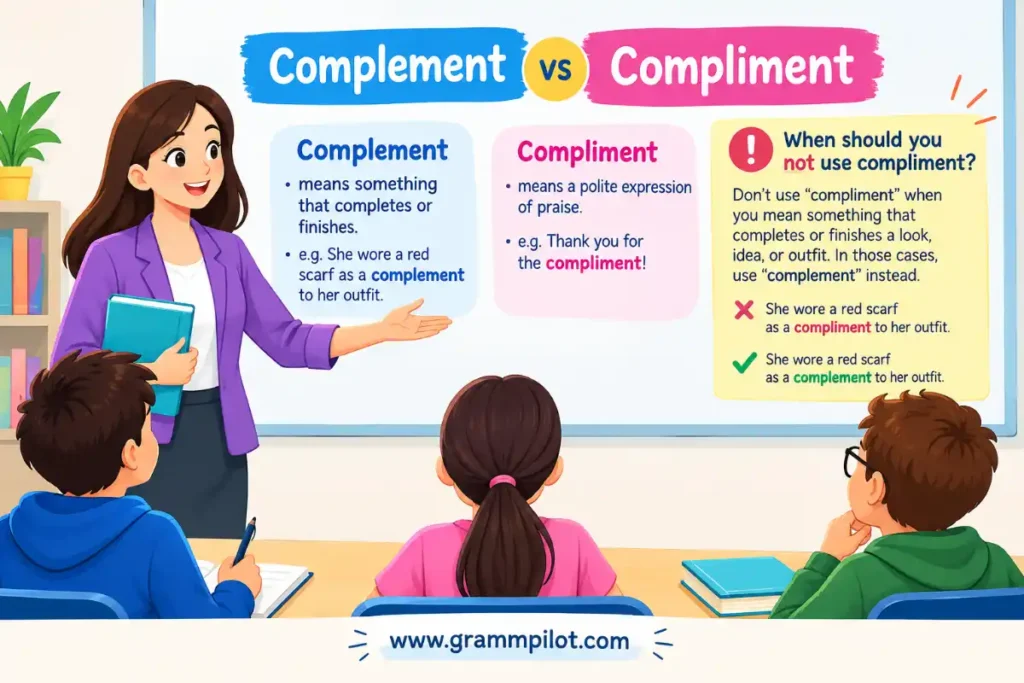
When should you not use compliment?
Don’t use compliment when you’re describing compatibility, balance, or enhancement.
For example: The sauce complimented the fish.
If you mean the sauce tasted good with the fish, use: The sauce complemented the fish.
Use compliment when someone or something is being praised.
When should you not use complement?
Don’t use complement when you mean praise.
Incorrect: My teacher gave me a complement on my essay.
Correct: My teacher gave me a compliment on my essay.
The teacher praised your essay.
What are the US and UK differences?
There is no major spelling difference between American and British English for these words.
Both varieties use:
compliment = praise
complement = complete, match, or enhance
The same distinction applies to:
complimentary
and
complementary
The pronunciation can vary slightly among speakers, but the spelling and basic meanings remain the same.
Which word should you use in a resume?
In a resume, compliment is appropriate when describing praise you received.
Example: Received compliments from clients for clear communication.
However, stronger professional writing may use a more precise phrase: Received consistent praise from clients for clear communication.
Complement is useful when describing skills that work together.
Example: My analytical and communication skills complement each other.
You can make that even more action-focused: Combined analytical and communication skills to improve client service.
Choose the wording that describes your actual achievement.
Which word should you use in an essay?
Both words can work well in essays.
Use compliment when discussing praise:
The author received compliments from several reviewers.
Use complement when explaining how ideas, parts, or elements work together:
The final section complements the argument developed earlier.
In academic writing, complement is particularly useful when discussing related concepts.
Which word should you use in texting?
In a text, compliment is common when you’re talking about praise.
Examples:
“Thanks for the compliment!”
“She complimented your outfit.”
“That was such a nice compliment.”
Use complement when you’re discussing things that work well together:
“Those shoes complement your dress.”
“The colors complement each other.”
Because the words sound identical, spelling is especially important in written messages.
Which word should you use in an email?
For professional emails, choose compliment when discussing praise.
Example: The client complimented your presentation.
Use complement when describing how something fits with another element.
Example: The new design complements our existing branding.
A quick test is to replace the word mentally.
If praise works, choose compliment.
If enhance, match, or complete works, choose complement.
Which word should you use when speaking?
In speech, both words generally sound the same, so the listener relies on context.
For example:
I complimented her.
The meaning is clear because people can understand that you praised her.
The colors complement each other.
The context shows that the colors work together. When speaking, don’t worry about the spelling. When writing, check the meaning before choosing the spelling.
What are real-life examples of complement and compliment?
Here are examples from different situations.
- My teacher complimented me on my improved writing.
- The blue curtains complement the white walls.
- The customer complimented the restaurant’s friendly staff.
- The sauce complements the grilled chicken.
- She received a compliment about her new hairstyle.
- His technical knowledge complements her creative skills.
- The manager complimented the team on its hard work.
- The final chapter complements the rest of the book.
- He gave me a sincere compliment after my speech.
- The silver necklace complements her black dress.
- The coach complimented the players on their effort.
- The fresh herbs complement the flavor of the soup.
- My supervisor complimented my attention to detail.
- The new feature complements the existing software.
- She was pleased by the compliment.
- The two designers have complementary skills.
- The reviewer complimented the author on the clear writing.
- The lighting complements the room’s modern design.
- He complimented his colleague on her successful presentation.
- The final paragraph complements the main argument.
- The hotel guest complimented the staff on their service.
- The warm colors complement the natural wood.
What are the antonyms of compliment?
The clearest opposite of compliment is often insult.
Other possible opposites include:
- criticism
- disapproval
- condemnation
- disparagement
- blame
For example:
compliment ↔ insult
praise ↔ criticism
The exact opposite depends on the sentence.
A compliment is positive, while an insult is deliberately negative.
What are the antonyms of complement?
The opposite of complement depends on its meaning.
Possible contrasts include:
- clash
- mismatch
- conflict
- disrupt
- weaken
- detract from
- interfere with
For example: The colors complement each other.
The opposite idea could be: The colors clash with each other.
When discussing skills: Their skills complement each other.
A contrasting idea could be: Their skills conflict with each other.
How can you choose the right word quickly?
Use these questions when you’re unsure.
Is someone saying something positive?
Use compliment.
She complimented my presentation.
Is one thing working well with another?
Use complement.
The chart complements the report.
Does the word mean praise?
Use compliment.
Does it mean complete or enhance?
Use complement.
Are you talking about a free service?
Use complimentary.
The hotel provides complimentary breakfast.
What is the easiest way to remember complement vs compliment?
Think of two short formulas:
Compliment = praise
Complement = complete
Then test the sentence.
She said something nice about me.
→ compliment
The colors look good together.
→ complement
The manager praised my work.
→ compliment
Her skills work well with his.
→ complement
The hotel gave us a free breakfast.
→ complimentary
The colors work well together.
→ complementary
Once these connections become familiar, the spelling choice becomes much faster.
Why does the spelling matter?
Because using the wrong word can change the meaning of the sentence.
Consider:
The designer complimented the colors.
The designer praised the colors.
Now compare:
The designer complemented the colors.
The designer’s work went well with or enhanced the colors.
Both sentences can be grammatical, but they communicate different ideas.
Another example:
The teacher complimented the student.
The teacher praised the student.
The teacher’s lesson complemented the textbook.
The lesson worked well with the textbook.
A single letter changes the meaning.
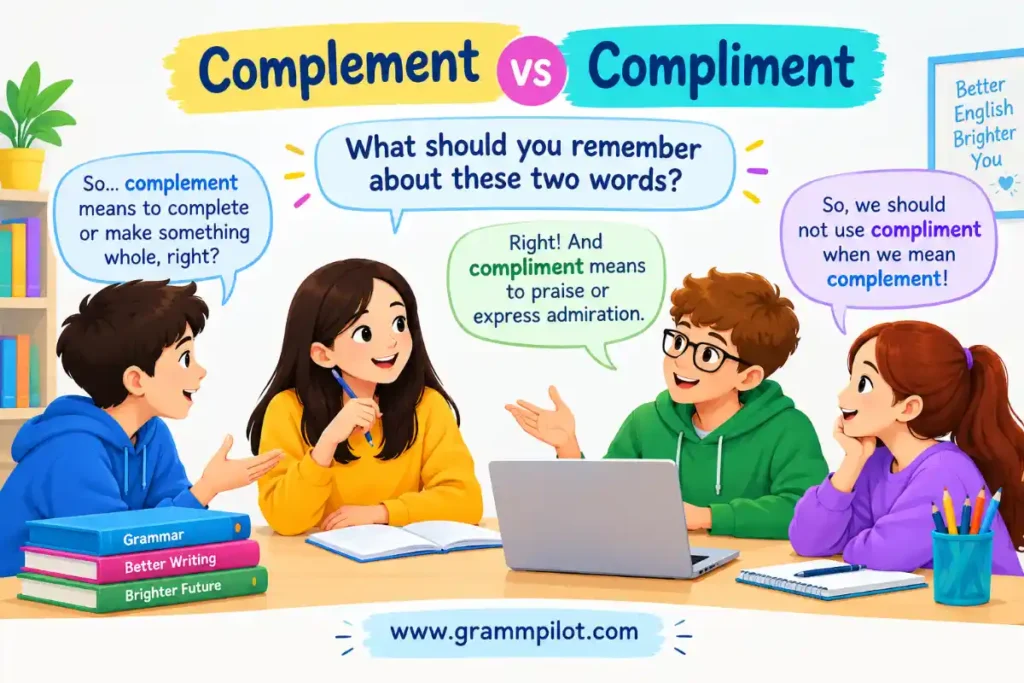
What should you remember about these two words?
The most useful rule is simple:
Compliment means praise.
Complement means complete, match, balance, or enhance.
Don’t depend on pronunciation because the words sound alike. Instead, look at the meaning of the sentence.
If someone says, “You did a great job,” that’s a compliment.
when two colors look good together, they complement each other.
If a hotel gives you breakfast for free, it’s complimentary.
These connections cover most everyday uses and make the spelling much easier to remember.
Conclusion
Complement vs Compliment is a spelling difference with two distinct meanings. Compliment refers to praise, approval, or a positive remark, while complement describes something that completes, matches, balances, or enhances something else. The quickest memory trick is to connect compliment with praise and complement with complete. The same idea helps with their related forms: complimentary can mean free or praising, while complementary means working well together. When you’re unsure, ask what the sentence means. If someone is saying something positive, choose compliment. If two things fit together or improve one another, choose complement. With that simple check, you’ll be able to choose the correct word confidently.
Frequently Asked Questions
1. What is the difference between complement and compliment?
Compliment means praise or a positive remark, while complement means something that completes, matches, balances, or enhances something else. For example, you can compliment someone’s work, while one color can complement another.
2. How can I remember complement and compliment?
Remember compliment = praise and complement = complete. If the sentence is about saying something nice, choose compliment; if it’s about things working well together, choose complement.
3. What’s another way to say compliment?
Another way to say compliment is praise, admiration, appreciation, approval, or kudos, depending on the situation. “Kudos” is informal, while “commendation” is more formal.
4. Is complimentary breakfast the correct spelling?
Yes, complimentary breakfast is correct when the breakfast is provided free of charge. Complementary means completing, matching, or working well with something else.
5. Should I say colors complement or compliment each other?
Say “colors complement each other” when you mean that the colors work well together. Compliment would mean that someone is praising the colors.
6. Can complement and compliment both be verbs?
Yes. Compliment as a verb means to praise, while complement as a verb means to complete, enhance, balance, or work well with something.
7. Is complement the same as complete?
Not exactly. Complement can mean to complete something, but it can also mean to enhance, balance, or work well with something, so the two words are not interchangeable in every sentence.
Meta Description: Complement vs Compliment: Learn the simple difference with clear examples, memory tricks, common mistakes, and easy rules you’ll remember.