
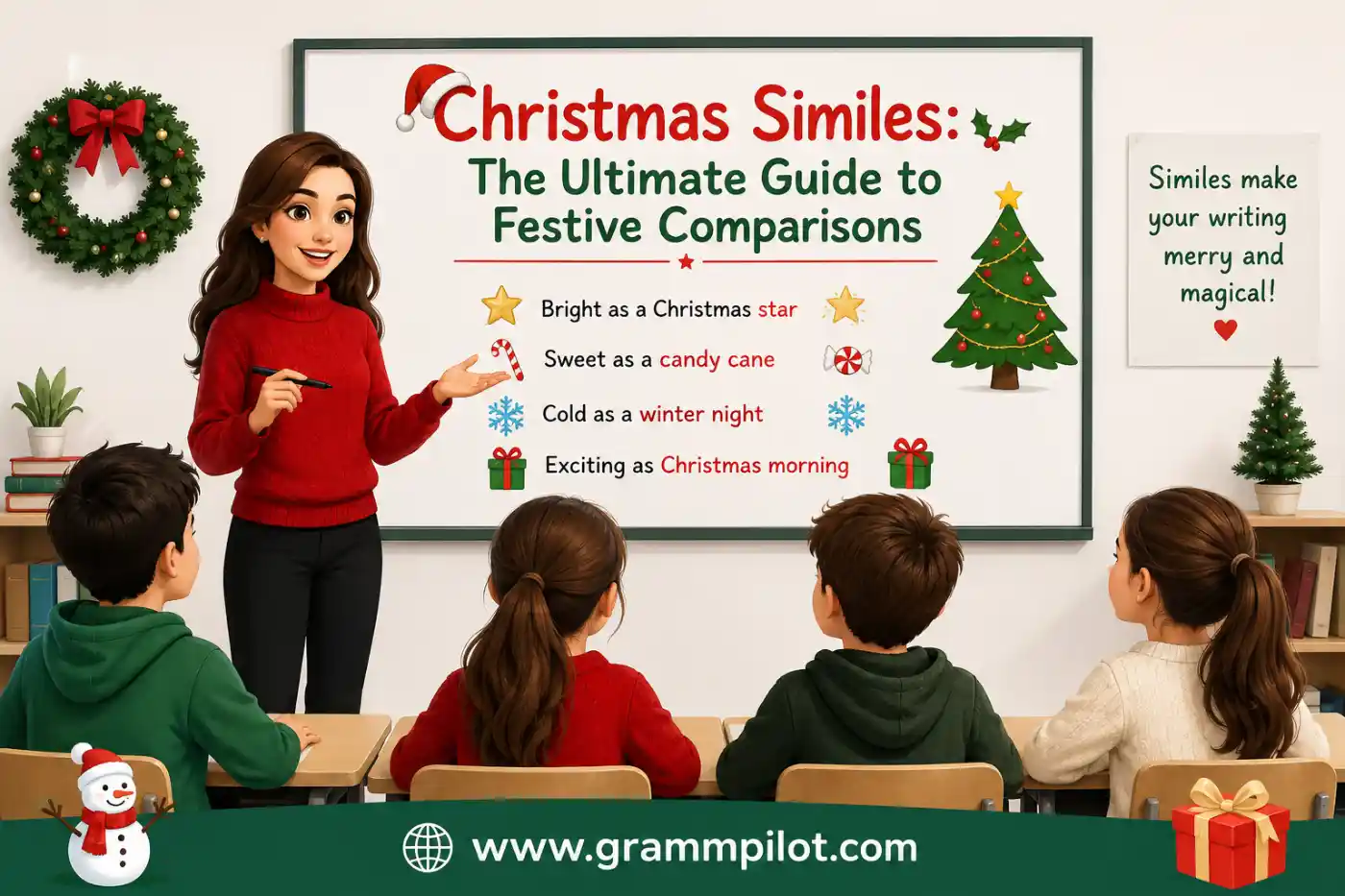
Christmas Similes are comparisons that use words such as “like” or “as” to make holiday descriptions clearer, more vivid, and easier to picture. For example, “The lights twinkled like stars” gives the reader a stronger image than simply saying the lights were bright. Christmas writing often starts with a simple moment. You may be writing a school essay about Christmas morning, creating a short story, adding a line to a greeting card, or trying to make a text message sound more cheerful.
You know what you want to describe, but “The lights were pretty” or “The snow was white” feels too plain. A well-chosen comparison can bring that scene to life. The best comparisons don’t need fancy vocabulary. A familiar image can be more effective than an unusual one. Snow might look like a soft blanket, bells might sound like silver drops, and a warm kitchen might feel like a cozy shelter on a cold evening.
This guide explains where the word simile comes from, how these comparisons work, which related words fit different situations, and how to choose stronger alternatives. You’ll also find practical examples, intensity levels, synonym tables, common mistakes, and answers to questions people often ask about festive comparisons.
For a deeper look at a similar grammar issue, read [That’s Mean vs That Means].
What Does “Simile” Mean in Plain English?
A simile is a figure of speech that compares two different things by using a connecting word, usually like or as.
For example:
- The snow fell like feathers.
- The tree was as bright as a star.
- The children raced downstairs like little rockets.
- The fireplace glowed like a golden lamp.
The comparison isn’t meant to be taken literally. Snow isn’t actually made of feathers. A Christmas tree isn’t really a star. The comparison simply points out a shared quality. In the first example, snow and feathers are both light and capable of floating downward. In the second, the tree and a star share brightness. This makes a simile different from an ordinary description. Instead of only telling readers what something is like, it gives them a familiar image they can connect with.
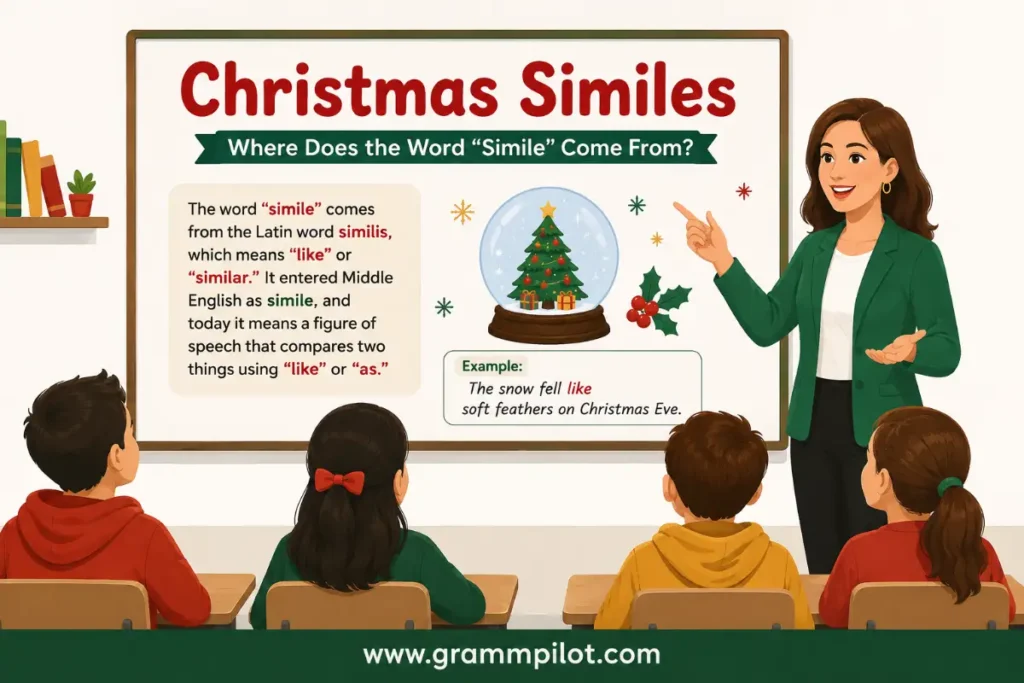
Christmas Similes: Where Does the Word “Simile” Come From?
The word simile comes from the Latin word similis, meaning “like” or “similar.” That origin makes sense because the entire purpose of a simile is to show a similarity between two things. The literary device has been used for centuries in poetry, storytelling, speeches, religious writing, and everyday language. Writers use comparisons because people often understand an unfamiliar idea more easily when it is connected to something familiar.
The basic principle has stayed simple: Thing being described + comparison word + familiar image
For example: The snow + is as white as + fresh cotton.
That structure is easy enough for a young student to use, but it can also produce sophisticated writing when the comparison is carefully chosen.
Christmas Similes: Why Do Writers Use Festive Comparisons?
Comparisons make descriptions more concrete. They allow readers to picture a scene instead of simply receiving information. Compare these sentences: The Christmas lights were beautiful and The Christmas lights shimmered like tiny stars against the dark windows. The first sentence gives an opinion. The second gives the reader something to see. Comparisons can also create mood. A gentle comparison can make a scene feel peaceful, while a stronger image can make the same scene exciting or dramatic.
For example:
- The snow fell like soft feathers.
This sounds calm and delicate. - The wind rushed through the trees like a wild animal.
This feels stronger and more dramatic.
The subject hasn’t changed. The comparison has changed the feeling.
What Words Can Replace or Relate to “Simile”?
There isn’t one perfect synonym for simile. Some words describe the same literary idea, while others describe related forms of figurative or descriptive language.
| Word | Meaning | Tone | Example |
|---|---|---|---|
| Analogy | A comparison used to explain an idea | Formal | The teacher made an analogy between winter and rest. |
| Image | A word picture created in the reader’s mind | Everyday | The writer creates a bright winter image. |
| Description | Words that explain how something looks or feels | Simple | The description makes the room vivid. |
| Parallel | A similarity between two things | Formal | The writer draws a parallel between light and hope. |
| Similarity | A quality shared by two things | Simple | The similarity is easy to understand. |
| Association | An idea linked with another idea | Formal | Snow has an association with winter holidays. |
| Literary device | A technique used in writing | Formal | A simile is a common literary device. |
| Vivid description | Description that creates a strong mental picture | Everyday | The writer uses vivid description. |
| Poetic comparison | A creative comparison often used in poetry | Literary | The poem contains a poetic comparison. |
| Figurative expression | A nonliteral way of expressing an idea | Formal | The line is a figurative expression. |
| Creative comparison | An original comparison made for effect | Everyday | The student created a creative comparison. |
| Sensory image | A description connected to sight, sound, smell, taste, or touch | Formal | The line creates a sensory image of winter. |
| Word picture | A verbal image that helps readers visualize something | Simple | The writer paints a word picture of Christmas morning. |
Some of these terms are close, but they should not be treated as exact substitutes. For example, metaphor and simile are both forms of figurative language, but their structures differ.
Which Related Words Sound Simple or Formal?
Your word choice should match your audience.
For everyday writing, comparison, description, image, and expression are easy to understand.
For school or academic writing, figurative language, imagery, analogy, and literary device may be more suitable.
- “That’s a comparison.”
- “It sounds like a metaphor.”
- “That creates a strong image.”
- “It gives me a picture of the scene.”
They are less likely to use a technical phrase such as symbolic comparison unless they are discussing literature.
How Strong Can a Comparison Be?
Comparisons can range from mild and simple to vivid and dramatic. The right level depends on the mood.
Mild
Mild comparisons are quiet and easy to understand.
- The snow was like a soft blanket.
- The lights were like tiny stars.
- Her voice was as gentle as a whisper.
These work well in school assignments and simple descriptions.
Moderate
Moderate comparisons create a stronger picture.
- The lights stretched across the house like a sparkling necklace.
- The children rushed into the room like a wave of excitement.
- The winter wind moved through the trees like a restless visitor.
These add more personality without becoming too dramatic.
Strong
Strong comparisons create a striking image.
- The storm crashed through the night like a roaring army.
- The Christmas crowd moved through the market like a rushing river.
- The bells exploded through the silence like a burst of silver thunder.
These comparisons can be effective in fiction and poetry, but they should fit the scene. A quiet family dinner doesn’t need an image that sounds like a battle.
Christmas Similes: Which Related Words Sound Simple or Formal?
The word simile itself is a noun. Other related terms can serve different grammatical roles.
| Part of speech | Useful word | Example |
|---|---|---|
| Noun | comparison | The comparison makes the scene vivid. |
| Noun | metaphor | The metaphor creates a warm image. |
| Noun | imagery | The poem uses winter imagery. |
| Noun | resemblance | The resemblance is easy to see. |
| Adjective | figurative | The writer uses figurative language. |
| Adjective | descriptive | The paragraph contains descriptive details. |
| Adjective | poetic | The line has a poetic quality. |
| Verb | compare | The writer compares snow with feathers. |
| Verb | describe | The sentence describes the lights vividly. |
| Verb | illustrate | The example illustrates the character’s happiness. |
Understanding these forms helps you avoid awkward wording.
For instance, you can say: The author compares the snow to feathers.
You wouldn’t normally say: The author similes the snow to feathers.
The noun simile doesn’t work as a regular verb in that sentence.
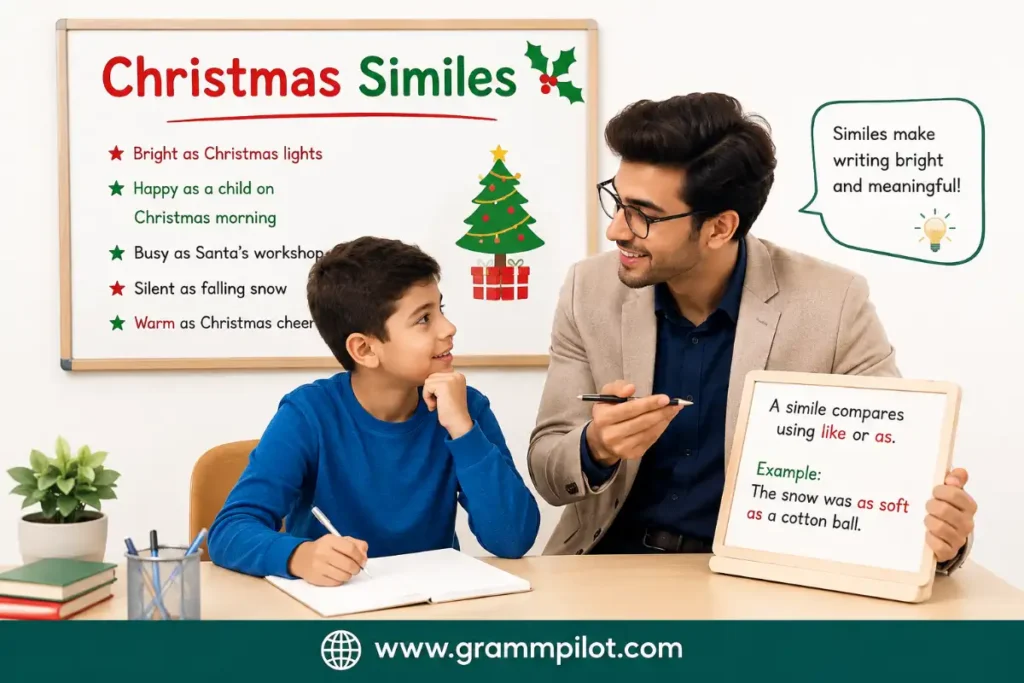
What Works Best in a School Essay?
For an essay, choose clear comparisons that support your main point. Don’t add figurative language simply because you think an essay needs it. For example: The snow covered the playground like a clean white blanket, making the familiar space look completely new. This works because the comparison supports the description.
A weak version might be: The snow was like a blanket and the sky was like something blue and the trees were like things in winter.
The comparisons are vague and don’t add much. When writing for school, clarity should come before cleverness.
What Works Best in a Resume?
A resume usually isn’t the right place for festive comparisons. Professional documents should be direct and factual.
Instead of: I worked like a Christmas elf to finish every project.
write: Completed multiple projects ahead of deadline while maintaining accuracy.
A comparison may sound playful, but a resume needs measurable information. The exception would be a creative profession where figurative language is deliberately part of the personal brand.
What Works Best in an Email?
The answer depends on the email.
A professional email should normally use direct language: Thank you for your thoughtful message. I hope you have a wonderful holiday season.
A personal email can be warmer: The house feels as cozy as a little winter cabin tonight.
If you’re writing to a client, coworker, teacher, or manager, keep comparisons brief and natural. One warm image can work. A paragraph filled with poetic comparisons may feel out of place.
What Works Best in a Text Message?
Text messages allow more freedom.
You might write: The lights outside look like a whole sky of stars!
Or: This hot chocolate is as cozy as Christmas morning.
Casual messages can use playful comparisons because the goal is often to express emotion quickly. You can even bend normal sentence structure slightly for effect, as long as the meaning remains clear.
What Works Best When Speaking?
Spoken language usually benefits from short comparisons.
For example: It was cold like an icebox outside.
Or: The kids were running around like little rockets.
A comparison that sounds natural when spoken is usually easier to understand. Long literary comparisons can sound awkward in ordinary conversation.
Christmas Similes: What Are Some Strong Real-Life Examples?
Here are original examples across different situations:
- The Christmas lights reflected in the window like a river of colored stars.
- Snowflakes landed on Maya’s coat like tiny pieces of lace.
- The kitchen smelled like a warm bakery as the cookies came out of the oven.
- The children gathered around the tree like curious explorers around a hidden treasure.
- The old wooden house looked as cozy as a cabin in a winter story.
- The bells rang through the street like bright drops of silver.
- His smile appeared like sunlight breaking through clouds when he opened the gift.
- The fireplace glowed like a small golden sun in the dark room.
- The wrapping paper sounded like dry leaves as everyone opened their presents.
- The family laughter spread through the house like warm music.
- The frozen sidewalk glittered like glass beneath the morning light.
- The children waited for Christmas morning like travelers waiting for the first train.
These examples work because each comparison focuses on a recognizable quality.
What Is the Difference Between a Simile and a Metaphor?
A simile uses an explicit comparison word.
Simile: The snow was like a blanket.
A metaphor makes the comparison directly.
Metaphor: The snow was a blanket.
Both sentences create a similar image, but their grammar is different. This distinction matters in school assignments. If the instructions specifically ask for similes, use like or as when appropriate.
Simile vs. Metaphor: Quick Comparison
| Feature | Simile | Metaphor |
|---|---|---|
| Main purpose | Compare two things | Make a direct comparison |
| Common signal | Like, as | Usually no comparison word |
| Example | The lights shine like stars. | The lights are stars. |
| Style | Often clear and direct | Can sound stronger or more poetic |
| Best use | Easy description | Creative or compressed imagery |
Neither device is automatically better. The choice depends on what you want the sentence to do.
Christmas Similes: What Is the Difference Between a Simile and an Analogy?
A simile usually makes a brief comparison for description or effect.
An analogy often explains an idea by showing how one situation is similar to another.
For example: The snow looked like cotton.
That’s a simple simile.
An analogy might be: Preparing for a large family gathering is like preparing for a long journey: both require planning, patience, and careful timing.
The analogy explains a broader idea. The simile mainly creates an image.
What Is the Difference Between Imagery and a Simile?
A simile is one specific literary technique. Imagery is a broader term for language that creates sensory or mental pictures.
A sentence can contain imagery without a simile: The cinnamon scent filled the warm kitchen.
It can also contain both: The cinnamon scent drifted through the kitchen like a warm cloud.
The second sentence uses a comparison to strengthen the imagery. So, imagery is the bigger category, while a simile is one tool that can create it.
Common Mistakes to Avoid “Christmas Similes”
Using “like” without making a real comparison
Not every sentence containing like is a simile.
I like Christmas cookies.
Here, like is a verb expressing preference.
But: The cookies were warm like little pillows.
Here, like introduces a comparison.
Using “as” incorrectly
The structure as + adjective + as is common: The snow was as white as cotton. However, not every use of as creates a comparison. As the snow fell, we went inside. That sentence uses as to show time, not similarity.
Mixing two comparisons
A sentence can become confusing when it combines unrelated images. The tree sparkled like stars and roared like a lion.Unless the writer has a very unusual reason for both comparisons, the sentence feels disconnected. Choose one strong image or make the relationship between the images clear.
Choosing a comparison that doesn’t fit
A cheerful Christmas scene shouldn’t suddenly include an image associated with danger unless you want to change the mood. Always ask whether the comparison supports the feeling you want.
Overusing comparisons
A paragraph packed with comparisons can become tiring. Good descriptive writing has variety. Mix figurative language with plain, direct sentences.
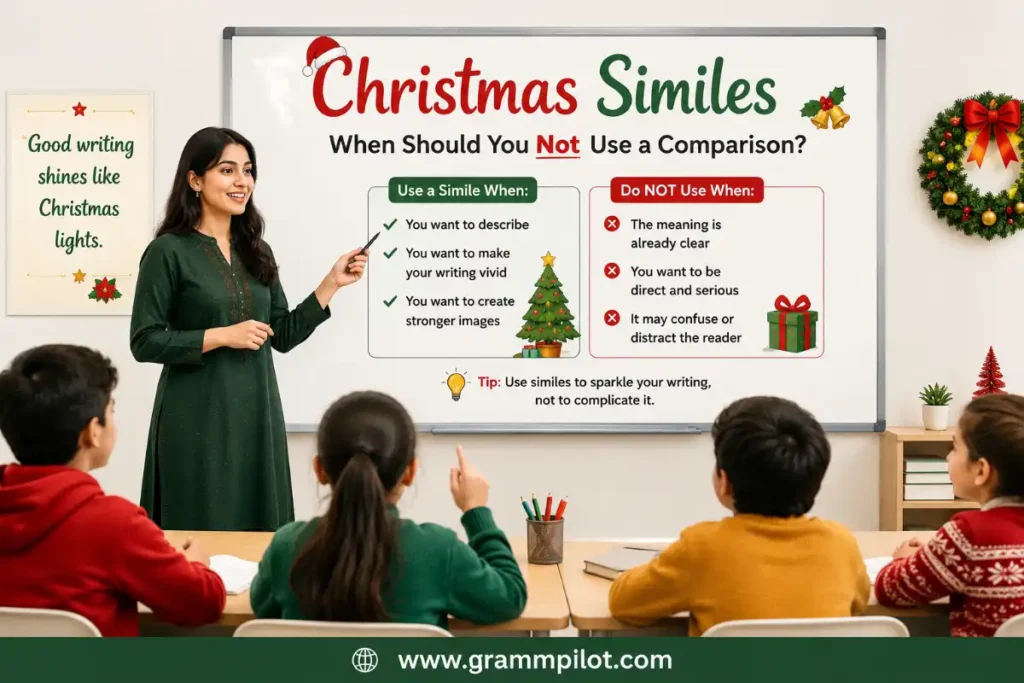
Christmas Similes: When Should You Not Use a Comparison?
Avoid a comparison when the sentence needs to be precise rather than imaginative.
This is especially important in:
- instructions
- business reports
- legal writing
- scientific writing
- resumes
- formal applications
- technical explanations
For example: The machine worked like a hungry Christmas elf.
That may be fun in a story, but it doesn’t belong in a technical report. In creative writing, however, figurative language can be useful because the goal is often to create mood and imagery.
What Are the Antonyms of “Simile”?
Because simile is a literary device rather than a quality such as happy or large, it doesn’t have a true antonym.
However, when discussing writing style, useful contrasts include:
- literal language
- direct statement
- plain description
- factual wording
- nonfigurative language
For example: The snow was white.
This is literal. The snow was as white as fresh cotton. This is figurative. Neither is wrong. They simply serve different purposes.
Christmas Similes: How Do You Choose the Right Comparison?
Start by deciding what you want readers to notice. If the object is bright, choose something bright. If it is soft, choose something soft. when it is peaceful, choose something that suggests calm. Then consider your audience. A young student’s story may benefit from simple comparisons such as stars, blankets, clouds, or sunshine. A poem for older readers can use more unusual imagery. Finally, consider tone. A funny comparison should sound playful. A serious comparison should support the emotional weight of the scene.
Christmas Similes: Quick Tips for Better Christmas Comparisons
- Choose familiar images when clarity matters.
- Describe one strong quality at a time.
- Use like or as correctly.
- Read the sentence aloud.
- Avoid comparisons that explain nothing.
- Don’t force a comparison into every sentence.
- Match the image to the mood.
- Use fresh comparisons when common ones feel dull.
- Keep school writing clear rather than overly dramatic.
- Let the surrounding sentence provide context.
- Prefer one memorable image over three weak ones.
- Check whether the comparison actually adds meaning.
A useful test is simple: If you remove the comparison, does the sentence become weaker? If the answer is no, you may not need it.
How Can You Make Common Comparisons More Original?
You don’t always need to invent something completely new. You can take a familiar idea and make it more specific.
Instead of: The lights were like stars.
try: The lights shimmered like stars caught in a glass window.
Instead of: The snow was like a blanket.
try: Snow covered the quiet yard like a thick wool blanket.
The second versions add details that fit the setting. The comparison becomes part of the scene rather than a generic decoration. Specificity is often more useful than complexity.
Why Do Simple Comparisons Work So Well?
Readers already understand familiar objects. They don’t need an explanation of what a blanket feels like or what stars look like. That makes simple comparisons efficient. A few words can communicate several qualities at once.
For example, a blanket can suggest softness, warmth, comfort, and coverage. A star can suggest brightness, beauty, distance, and darkness around it.
This is why Christmas Similes can make short writing feel richer without requiring long descriptions. The trick is choosing an image that naturally carries the quality you want.
Christmas Similes: How Can Teachers Help Students Use Them?
Teachers can start with a simple exercise.
Write a holiday subject on the board: snow
Then ask students for qualities:
- white
- cold
- soft
- quiet
- bright
- falling
Next, ask students to name objects connected with those qualities:
- cotton
- ice
- feathers
- clouds
- diamonds
- paper
Finally, students can create sentences:
The snow was white like cotton.
The snowflakes fell like feathers.
The snow glittered like diamonds.
This method teaches students how comparisons are built instead of asking them to memorize lists. It also encourages original thinking.
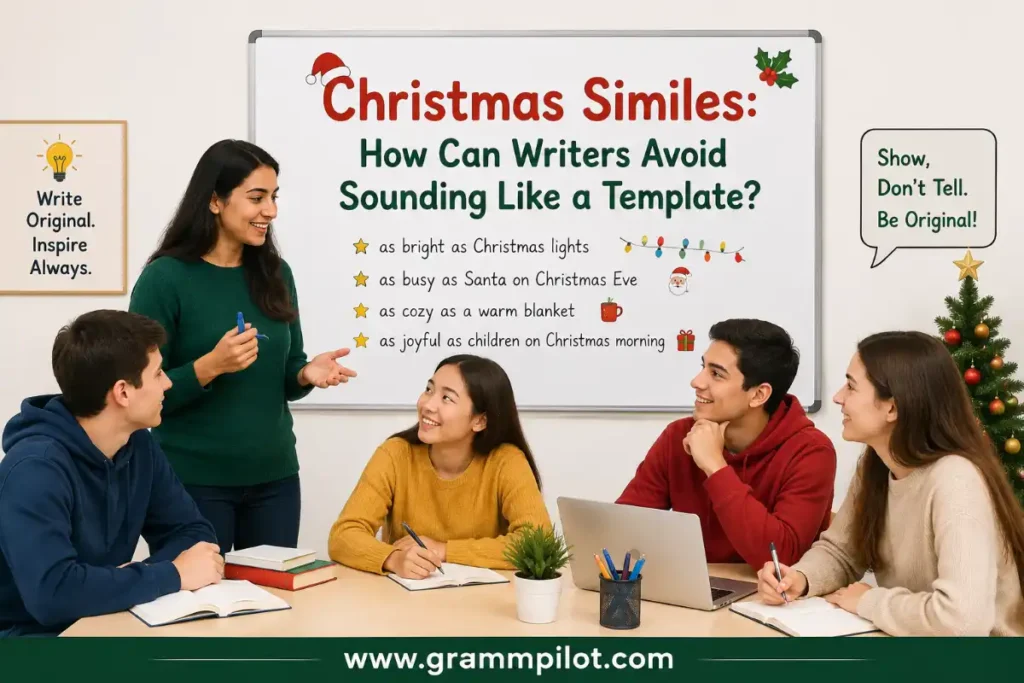
Christmas Similes: How Can Writers Avoid Sounding Like a Template?
The easiest way is to describe the actual scene. Instead of collecting generic holiday phrases, notice what is happening. Maybe the tree has one crooked branch or the lights reflect in a puddle. or is nervous about opening a strange package. Maybe the kitchen smells of cinnamon and orange peel. Specific details make comparisons feel personal.
For example: The single gold ornament trembled like a tiny moon whenever the door opened.
That sentence feels more individual than a basic line about a beautiful tree. Original writing often comes from observation rather than complicated vocabulary.
Conclusion
Christmas Similes can turn ordinary holiday descriptions into clear mental pictures. They compare one thing with another, often using like or as, so readers can see, hear, feel, or understand a scene more easily.
The best comparison depends on the purpose. A school essay needs clarity, a story may need atmosphere, a poem may need strong imagery, and a text message can be playful. Related terms such as metaphor, imagery, analogy, and comparison are useful, but they aren’t exact replacements in every situation.
Choose an image that matches the quality you want to show. Keep it natural. Don’t force figurative language into every sentence. One specific, well-chosen comparison can do more than a paragraph full of weak ones.
Frequently Asked Questions
1. What are Christmas Similes?
Christmas Similes are comparisons that connect a holiday subject with another image, usually with like or as. They make descriptions more vivid and easier to imagine.
2. What’s another way to say “simile”?
A close alternative is comparison, although it is broader than simile. Other related terms include figurative language, imagery, and literary comparison, depending on the context.
3. What is an easy example of a Christmas simile?
“The Christmas lights twinkled like stars” is an easy example. It compares the lights with stars to show their brightness and beauty.
4. Are a simile and a metaphor the same thing?
No. A simile normally uses like or as, while a metaphor makes a direct comparison without those words.
5. Can I use these comparisons in a school essay?
Yes, as long as they support your description and don’t make the writing unclear. A few relevant comparisons can make a descriptive essay more vivid.
6. What is the difference between a simile and imagery?
A simile is one type of figurative language, while imagery is a broader term for language that creates mental or sensory pictures. A simile can be used to create imagery.
7. Should every Christmas sentence contain a comparison?
No. Too many comparisons can make writing feel crowded. Mix vivid figurative language with simple, direct sentences for a more natural style.