

When writing an email, school announcement, or workplace message, you might pause over a simple question: Should you write busing or bussing? Both spellings look correct, but choosing the right one can depend on what you mean and the writing style you’re following. The confusion comes from the word bus. When you add the ending -ing, the spelling can change depending on the spelling convention and the context. This is why writers sometimes use one S and others use two.
The short answer: Both busing and bussing are accepted English spellings. However, busing is especially common in American English when referring to transporting students or passengers, while bussing is also widely used, particularly when referring to clearing tables in restaurants.
Understanding the difference will help you avoid spelling mistakes and choose the most natural form. This guide covers their meanings, origins, synonyms, grammar, regional usage, practical examples, and common questions.
What Do Busing and Bussing Mean in English?
Both spellings come from the verb bus. The word has two main uses:
- Transporting people: Taking passengers or students from one place to another in a bus.
- Clearing restaurant tables: Removing used plates, glasses, and other items after customers finish eating.
The spelling doesn’t change the basic meaning. Both forms can describe these actions.
Meaning of Busing
Busing is the practice of transporting people by bus. In the United States, the term is often connected with school transportation.
For example:
- The school district arranged busing for students who lived far away.
- The city introduced a new busing service for employees.
- Busing helped students reach schools in different neighborhoods.
It can also refer to transporting passengers between locations, such as an airport terminal and an aircraft.
Meaning of Bussing
Bussing has the same basic meaning when it refers to transportation. However, it is also commonly used in restaurants to describe removing dirty dishes and preparing tables for new customers.
For example:
- The restaurant hired two workers for bussing tables.
- She spent the evening bussing dishes in a busy café.
- Bussing is an important part of restaurant service.
Remember: Neither spelling is automatically incorrect. The best choice depends on your audience, meaning, and preferred style guide.
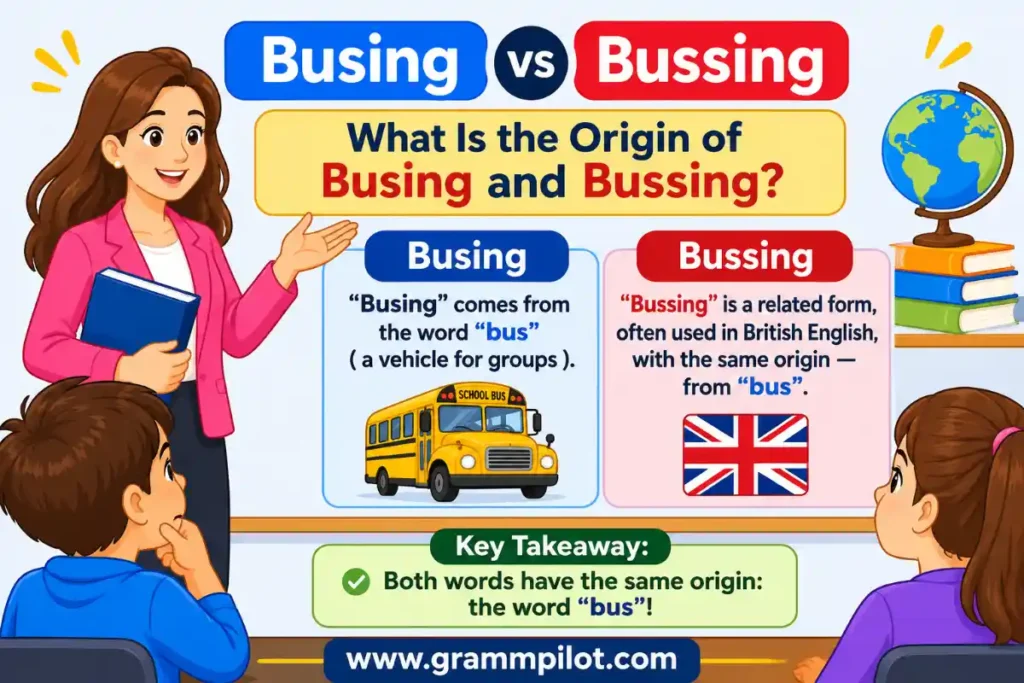
What Is the Origin of Busing and Bussing?
The history of these spellings begins with the word bus. The noun bus comes from the Latin word omnibus, meaning “for all.” It originally referred to a public vehicle that carried several passengers. Over time, English speakers shortened omnibus to bus. Eventually, the word became a verb meaning to transport people by bus. The verb later developed another meaning in restaurant settings: removing used dishes from tables. The ending -ing is added to show an ongoing action or to create a noun describing an activity.
This created two accepted spellings:
- Bus + ing = Busing
- Bus + s + ing = Bussing
The single-S spelling became especially established in American English. Collins traces the noun busing to around 1885–1890. The spelling may have developed partly to distinguish it from the older word buss, meaning a kiss. Collins English Dictionary+1
Why Does One Spelling Have Two S’s?
English has a spelling rule called the consonant-doubling rule. When a short word ends in a consonant after a short vowel, the final consonant is often doubled before adding certain endings.
Examples include:
| Base word | With -ing |
|---|---|
| Run | Running |
| Sit | Sitting |
| Stop | Stopping |
| Plan | Planning |
| Bus | Bussing |
This explains why bussing looks natural. However, English spelling has exceptions. American English commonly uses busing instead. Both forms appear in established dictionaries, so you don’t need to treat the double-S spelling as a mistake. dictionary.com+1
Is Busing or Bussing More Common in American English?
In American English, busing is generally the preferred spelling, particularly in formal writing about student transportation.
For example:
- The district approved a new busing plan.
- Parents attended a meeting about school busing.
- The city expanded its public transportation services.
However, bussing is also accepted. Restaurant writing often uses bussing tables, especially in job descriptions and workplace communication. Consider these examples:
| Situation | Recommended spelling |
|---|---|
| School transportation | Busing |
| Public transportation | Busing |
| Airport passenger transfers | Busing |
| Restaurant table service | Bussing or busing |
| Formal American report | Busing |
| Restaurant job description | Bussing is common |
The important point is that the two spellings aren’t completely separate words with unrelated meanings.
What Are the Best Synonyms and Related Words for Busing?
There isn’t one perfect synonym for every use of this word. A transportation-related synonym won’t always work when you’re talking about restaurant cleaning. The following list groups useful alternatives by tone and situation. These are related expressions, not interchangeable dictionary synonyms in every sentence.
Simple Words and Expressions
| Word | Meaning | Tone | Example |
|---|---|---|---|
| Transporting | Moving people | Simple | Transporting students takes planning. |
| Moving | Taking something somewhere | Simple | Moving passengers safely is important. |
| Carrying | Taking people from one place to another | Simple | The bus is carrying students. |
| Taking | Bringing someone to a destination | Simple | The driver is taking children to school. |
| Driving | Operating a vehicle | Everyday | He is driving students to school. |
| Cleaning | Removing dirt and mess | Simple | Cleaning tables is part of the job. |
| Clearing | Removing unwanted items | Simple | Clearing dishes keeps the restaurant organized. |
| Helping | Providing assistance | Simple | She is helping with table service. |
Everyday Words and Expressions
| Word | Meaning | Tone | Example |
|---|---|---|---|
| Shuttling | Moving people between locations | Everyday | The company is shuttling workers. |
| Commuting | Traveling regularly between home and work | Everyday | Employees are commuting by bus. |
| Picking up | Collecting passengers | Everyday | The driver is picking up students. |
| Dropping off | Taking passengers to a destination | Everyday | Parents are dropping off children. |
| Transferring | Moving passengers between services | Everyday | Staff are transferring passengers. |
| Serving | Helping restaurant customers | Everyday | He is serving customers. |
| Clearing tables | Removing used dishes | Everyday | She is clearing tables after lunch. |
| Resetting | Preparing a table for another customer | Everyday | The worker is resetting tables. |
Formal Words and Expressions
| Word | Meaning | Tone | Example |
|---|---|---|---|
| Transportation | Movement of people | Formal | Transportation is available for all students. |
| Transit | Public movement from place to place | Formal | The transit service operates daily. |
| Conveyance | The act of carrying people or goods | Formal | Safe conveyance is a priority. |
| Passenger transfer | Moving passengers between locations | Formal | Passenger transfers are provided at the airport. |
| School transportation | Transport services for students | Formal | School transportation begins in August. |
| Student relocation | Moving students to another location | Formal | Student relocation requires planning. |
| Table maintenance | Keeping tables ready for use | Formal | Table maintenance is part of the role. |
| Sanitation | Maintaining cleanliness and hygiene | Formal | Restaurant sanitation must meet safety standards. |
Informal Words and Expressions
| Word | Meaning | Tone | Example |
|---|---|---|---|
| Bus ride | A journey by bus | Casual | The children enjoyed their bus ride. |
| Bus run | A scheduled bus journey | Casual | The morning bus run starts early. |
| Shuttle run | A repeated passenger transfer | Casual | The hotel operates a shuttle run. |
| Table clearing | Removing used dishes | Casual | Table clearing gets busy at dinner. |
| Dish clearing | Collecting dirty dishes | Casual | Dish clearing is part of his shift. |
| Busser | A worker who clears restaurant tables | Informal | The busser cleaned the dining area. |
These expressions help you avoid repeating the same word in every paragraph. Choose one that describes the actual action rather than replacing it with a word that only sounds similar.
What Are the Different Forms of Bus?
Understanding the different grammatical forms makes spelling much easier.
The word bus can function as both a noun and a verb.
Bus as a Noun
As a noun, it refers to a vehicle that carries passengers.
Examples:
- The bus arrived ten minutes late.
- We waited for the school bus.
- The city purchased five new buses.
The standard plural spelling is buses.
Bus as a Verb
As a verb, it means transporting people by bus or clearing tables in a restaurant.
Examples:
- The school will bus students to the museum.
- The restaurant will bus customers’ tables.
- The company buses employees to the factory.
Busing and Bussing as Present Participles
These forms describe an action happening now or an ongoing activity.
Examples:
- The school is busing students to another building.
- The restaurant is bussing tables during lunch.
- The airline is busing passengers to the terminal.
Bused and Bussed as Past Forms
Both spellings are accepted.
| Form | Single-S spelling | Double-S spelling |
|---|---|---|
| Present | Bus | Bus |
| Present participle | Busing | Bussing |
| Past tense | Bused | Bussed |
| Past participle | Bused | Bussed |
| Third-person singular | Buses | Busses |
The single-S forms are particularly common in American English. The double-S forms are also established, especially in British usage. TKG English Learner’s Dictionary+2
What Is the Difference Between Busing and Bussing by Intensity?
Unlike emotional adjectives such as happy, angry, or furious, these words don’t describe different levels of intensity. However, the actions they describe can involve different amounts of work or distance.
Here is a useful way to describe those differences.
| Level | Expression | Meaning | Example |
|---|---|---|---|
| Mild | Local transport | Moving people nearby | The school arranged local transport. |
| Moderate | Daily transportation | Regular passenger movement | Daily transportation is available. |
| Extended | Long-distance transport | Moving people over longer distances | The company provides long-distance transport. |
| Large-scale | Mass transportation | Moving many passengers | Mass transportation serves the city. |
| Specialized | School busing | Transporting students | School busing begins next week. |
| Intensive | Continuous table clearing | Repeated restaurant cleaning | Continuous table clearing is required during busy hours. |
The level of intensity depends on the work, not the spelling.

Is Busing or Bussing Used Differently in British and American English?
Yes. Regional spelling preferences are one of the main reasons people become confused.
American English
American English generally prefers busing for transportation.
Examples:
- The school district introduced a busing program.
- Students need busing to reach the new school.
- The airport provides busing between terminals.
The double-S spelling is also accepted, particularly in restaurant contexts.
British English
British English commonly uses bussing as an alternative spelling.
Examples:
- The workers were bussing passengers between locations.
- Restaurant staff were bussing tables.
- The company arranged bussing for its employees.
Oxford identifies bussing as a British and North American alternative to busing. Oxford Learner’s Dictionaries+1
Canadian and Australian English
Canadian usage often follows the American preference for busing and bused. Australian English also uses both spelling patterns, with regional and editorial preferences affecting which form appears.
Which Spelling Should International Writers Choose?
If you’re writing for an international audience, consistency matters more than trying to use every regional variation.
Use these guidelines:
- Choose busing for general American English.
- Use bussing when following a British publication’s preferred spelling.
- Follow your employer’s or school’s style guide.
- Don’t switch between spellings in the same article without a reason.
Which Word Should You Use in Different Situations?
The best spelling depends on what you’re writing and who will read it.
Busing or Bussing in a Resume
When writing a resume, use clear action words that describe your responsibilities.
If you worked in a restaurant, you can write:
- Responsible for bussing tables and maintaining dining-area cleanliness.
- Assisted servers with clearing dishes and resetting tables.
- Supported daily restaurant operations during busy shifts.
If your work involved passenger transportation, write:
- Assisted with busing passengers between airport terminals.
- Coordinated student transportation for school events.
- Helped organize daily transportation services.
A resume should focus on your actual duties rather than simply repeating the same word.
Busing or Bussing in an Essay
For an academic essay in American English, busing is usually the safer choice when discussing student transportation. Example: “School busing became an important issue in discussions about educational integration.” You can also use related terms such as:
- Student transportation
- School transportation programs
- Public transit
- Educational access
- Passenger transportation
Choose the term that accurately represents your argument.
Busing or Bussing in Texting
In casual messages, either spelling can work.
Examples:
- Are they busing students to the event?
- I’m bussing tables tonight.
- Is there busing available after the concert?
Your reader will understand both forms.
Busing or Bussing in an Email
For professional emails, use the spelling that matches your organization’s preferred style.
Example:
“Hello,
Could you please confirm if busing will be available for students attending the school event?
Thank you.”
For a restaurant workplace: “Please make sure bussing is completed before the next group of customers arrives.”
Both examples are natural.
Busing or Bussing in Speaking
There is no pronunciation difference between these two spellings in ordinary English usage. Both are pronounced with the same sounds. The difference is written, not spoken. Therefore, listeners won’t know which spelling you intended unless they see it written.
What Are 15+ Original Examples of Busing and Bussing?
Examples make it easier to understand how each form works in real situations.
Here are examples from schools, workplaces, restaurants, travel, and everyday life.
Examples Related to Schools
1. The school arranged busing for children who lived outside the neighborhood.
2. Parents attended a meeting to discuss the new busing schedule.
3. The district introduced a busing program for students with transportation difficulties.
4. Busing allowed children from different communities to attend the same school.
5. The principal explained why student busing was necessary during construction.
Examples Related to Restaurants
6. The restaurant manager asked the staff to finish bussing tables before closing.
7. She learned bussing duties during her first week at the café.
8. The restaurant hired another busser to manage the busy dinner service.
9. Bussing tables quickly helped the restaurant serve more customers.
10. He was responsible for bussing dishes and resetting tables.
Examples Related to Travel
11. The airport arranged busing for passengers traveling between terminals.
12. The tour company provided busing for visitors attending the festival.
13. Passengers waited outside while the airport staff organized transportation.
14. The hotel offered a shuttle service for guests arriving at the station.
15. The event organizers arranged busing for people who didn’t have cars.
Examples Related to Work and Daily Life
16. The company provides busing for employees who work night shifts.
17. The transportation department is reviewing its busing arrangements.
18. The restaurant’s new employee received training in bussing and customer service.
19. The city is considering a new transportation plan for local residents.
20. The workers completed bussing duties before preparing the dining room for the evening.
These sentences demonstrate how context determines the best spelling and expression.
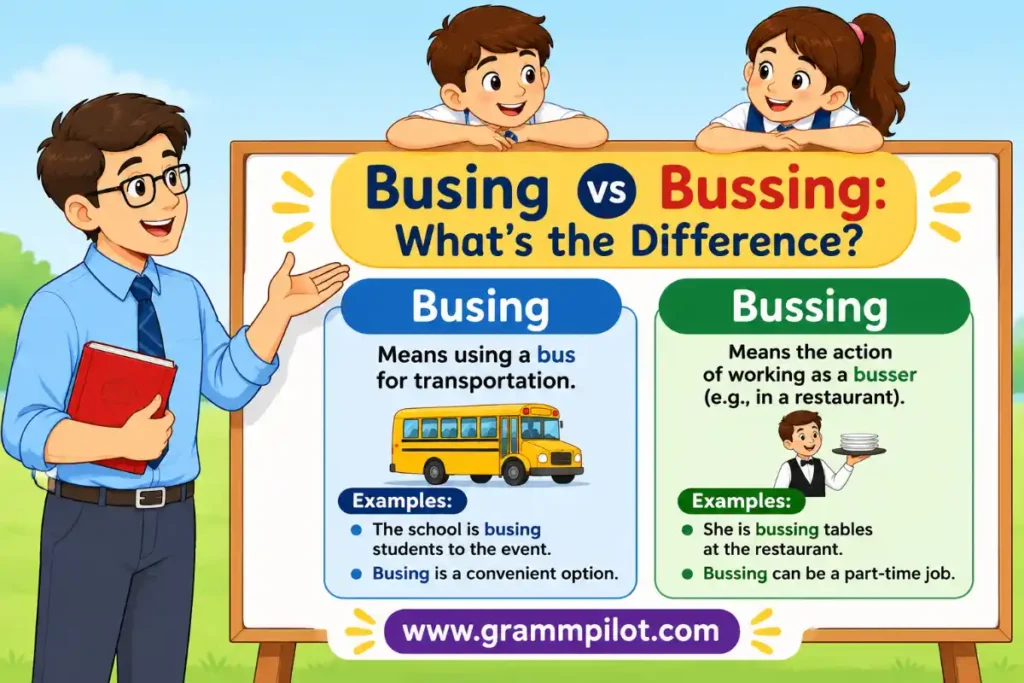
Busing vs. Bussing: What’s the Difference?
The main difference is spelling preference, not meaning.
| Feature | Busing | Bussing |
|---|---|---|
| Number of S’s | One | Two |
| Basic meaning | Transporting people or clearing tables | Transporting people or clearing tables |
| American English | Preferred in many contexts | Accepted alternative |
| British English | Accepted | Common alternative |
| Restaurant usage | Accepted | Common |
| Formal American writing | Usually preferred | Less preferred |
Example:
- The school is busing students to the sports center.
- The restaurant is bussing tables after lunch.
Both sentences are correct.
Busing vs. Busser: What’s the Difference?
These words are related but have different grammatical functions.
Busing describes the activity of transporting people or clearing restaurant tables.
Busser refers to a person who clears tables in a restaurant.
Examples:
- Busing students requires careful planning.
- The busser removed the dirty plates.
- The restaurant is hiring a new busser.
Don’t use busing when you mean the person performing the job.
Busing vs. Busy: What’s the Difference?
These words look somewhat similar but have different meanings.
| Busing | Busy |
|---|---|
| Related to transporting people or clearing tables | Having a lot of work or activity |
| Verb form or noun | Adjective |
| The school is busing students. | The school is busy today. |
Examples:
- The restaurant is bussing tables.
- The restaurant is busy tonight.
The first sentence describes an action. The second describes how active the restaurant is.
What Are the Common Mistakes When Using Busing or Bussing?
Even though both spellings are accepted, writers can still make mistakes when using them.
Mistake 1: Assuming Bussing Is Always Incorrect
Some people believe the double-S spelling is never correct.
Incorrect understanding: Bussing is always a spelling mistake.
Correct understanding: Bussing is an accepted alternative spelling of the verb bus.
Mistake 2: Assuming Busing Is Incorrect
The opposite mistake happens too.
Some writers double the S because they believe every short word must follow the consonant-doubling rule.
However, busing is an established spelling, particularly in American English.
Mistake 3: Confusing Busing With Bussing Tables
Both forms can describe restaurant table clearing, but writers sometimes forget to explain the context.
For example:
“The company introduced bussing.”
This sentence doesn’t tell readers if the company is transporting passengers or discussing restaurant work.
A clearer version would be:
“The company introduced a new system for bussing restaurant tables.”
Mistake 4: Writing Busses When You Mean Buses
The plural of the vehicle is normally buses.
Correct: Several buses arrived at the station.
Incorrect for standard general writing: Several busses arrived at the station.
Although busses exists as a less common plural spelling, buses is the standard choice.
Mistake 5: Mixing Different Spelling Styles
Switching between busing, bussing, bused, and bussed without a consistent style can make an article look poorly edited.
Choose one spelling system and use it consistently.
When Should You NOT Use Busing or Bussing?
These words aren’t suitable for every kind of transportation or cleaning activity. Avoid using them in situations where another expression communicates the meaning more clearly.
| Situation | Better expression |
|---|---|
| Driving your own car | Driving |
| Walking to school | Walking |
| Taking a train | Rail transportation |
| Moving furniture | Moving |
| Cleaning an entire house | Housekeeping |
| Washing dirty plates | Dishwashing |
| Serving food | Food service |
| Taking a taxi | Taxi transportation |
For example, don’t write: “The children were busing to school” if they were actually walking.
Write: “The children were walking to school.”
Good writing means selecting the word that describes the real action.
What Are the Antonyms of Busing and Bussing?
There isn’t one exact opposite for these words because their meanings depend on the situation.
However, several expressions can communicate an opposing action.
| Word or expression | Opposite idea |
|---|---|
| Walking | Not traveling by bus |
| Staying | Remaining in one location |
| Remaining | Not moving elsewhere |
| Keeping | Not removing items |
| Leaving dishes | Not clearing a table |
| Accumulating | Allowing items to collect |
| Remaining seated | Not traveling or moving |
For example:
- Instead of busing students, the school allowed them to walk.
- Instead of bussing tables, the restaurant left the dishes in place temporarily.
These aren’t strict dictionary antonyms, but they express contrasting actions.
What Are the Quick Tips for Choosing the Correct Spelling?
If you still feel unsure about these two spellings, use the following practical tips.
1. Think about your audience: American readers generally expect busing in formal transportation writing.
2. Check the meaning: Decide if you’re describing passenger transportation or restaurant work.
3. Follow a style guide: Your school, company, or publication may have a preferred spelling.
4. Remember the alternatives: Both spellings are accepted for the verb.
5. Keep your writing consistent: Don’t change between single-S and double-S forms without a reason.
6. Learn the related forms: Remember bused, bussed, busing, and bussing.
7. Don’t confuse the noun and verb: The vehicle is a bus, while transporting people is to bus them.
8. Use clear expressions: When a sentence might confuse readers, write student transportation or table clearing instead.
9. Don’t rely only on spelling rules: English has exceptions, and dictionaries help confirm accepted forms.
10. Read the sentence aloud: Check if the word communicates the action you intend.
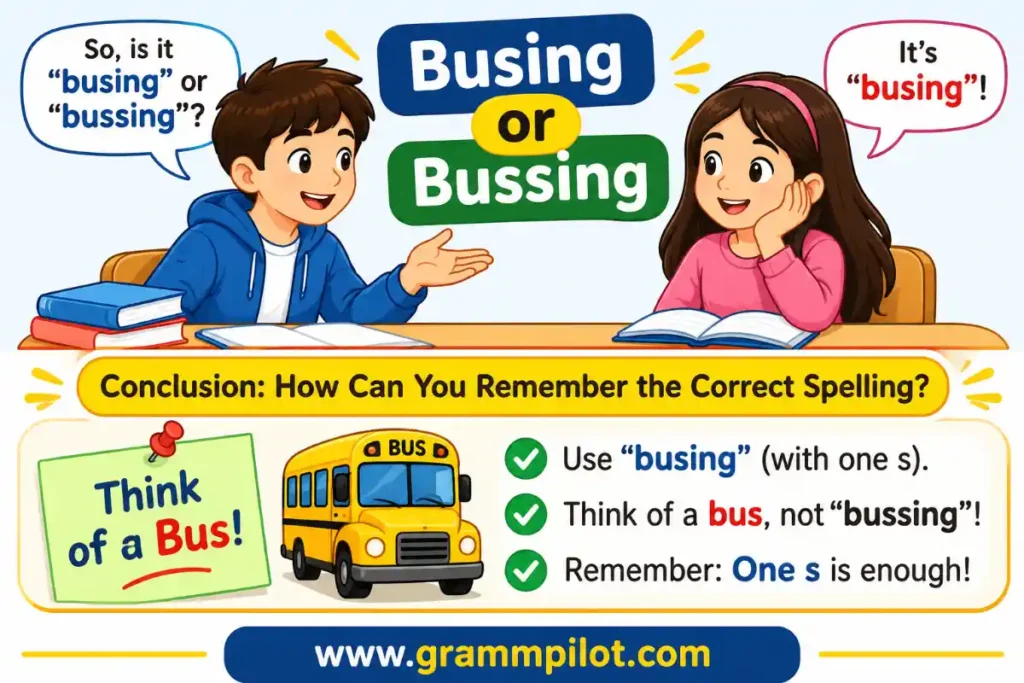
Conclusion: How Can You Remember the Correct Spelling?
Choosing between these two spellings doesn’t have to be difficult. Both forms are accepted, and the difference mainly comes from regional preferences and writing conventions. American English generally favors busing, especially when discussing school or passenger transportation. Meanwhile, bussing is a familiar alternative and appears frequently in restaurant-related writing. The most useful lesson is to understand the action before choosing the spelling. If you’re discussing student transportation, busing is a reliable choice for an American audience. If you’re describing restaurant duties, bussing tables is perfectly understandable. When writing professionally, follow your preferred dictionary or style guide and stay consistent. Once you understand these simple rules, you’ll feel more confident using either spelling in your everyday writing.
Frequently Asked Questions
1. Is busing or bussing the correct spelling?
Both spellings are correct. Busing is generally preferred in American English, while bussing is also an accepted alternative.
2. Is bussing with two S’s grammatically correct?
Yes, bussing is grammatically correct. It is an accepted form of the verb bus, particularly in British English and restaurant-related writing.
3. Why do Americans spell it busing?
American English generally uses one S in this word. The spelling became established in transportation and school-related writing.
4. Is busing the same as transporting students?
Yes, in school-related contexts, busing means transporting students by bus, sometimes to schools outside their neighborhoods.
5. What’s another way to say bussing tables?
You can say clearing tables, removing dishes, clearing away plates, or resetting tables. The best expression depends on the specific restaurant duty.
6. Is bussing tables or busing tables correct?
Both are correct. Bussing tables is a common spelling in restaurant settings, while busing tables is also accepted.
7. Is busing or bussing more common in British English?
Bussing is a common British spelling, although busing is also recognized. Both forms are understood by English speakers.