
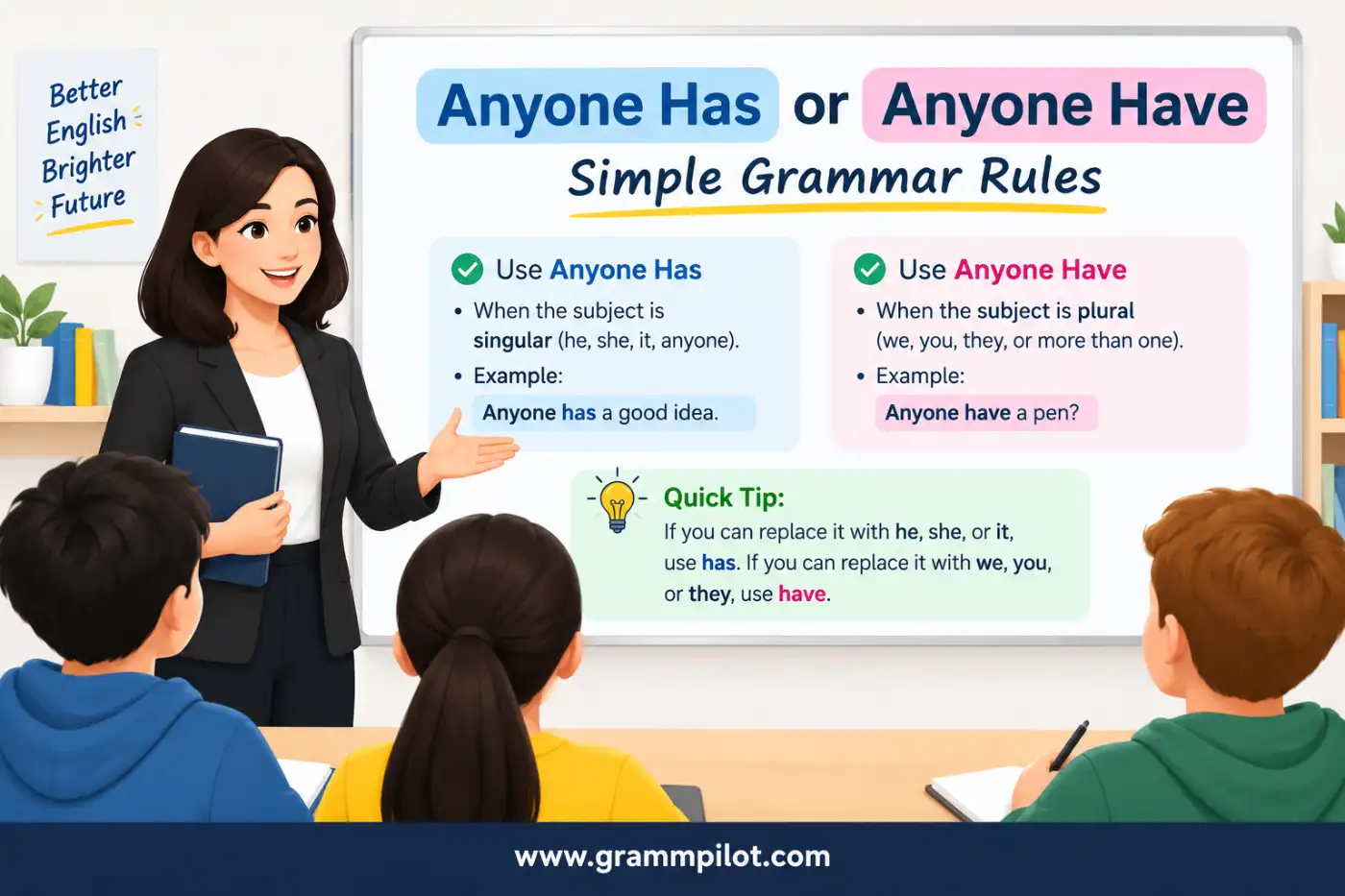
Have you ever been writing an email, text, question, or school assignment and suddenly stopped to wonder whether you should write “anyone has” or “anyone have”? This small grammar question causes a surprising amount of confusion. The reason is easy to understand. The word anyone can refer to any person in a group, so it may seem plural. But grammatically, anyone is singular. That affects the verb you use with it.
Quick Answer: Use has when anyone is the subject of a simple present statement. Use have after does or another helping verb. For example, “Anyone who qualifies has a chance,” but “Does anyone have a question?”
Once you understand how helping verbs work, this rule becomes much easier. This guide explains the difference, gives real examples, compares similar structures, and shows how to avoid common mistakes.
Is Anyone Singular or Plural?
Anyone is grammatically singular.
Even though anyone can refer to any person within a group, English treats the word as singular.
For example:
- Anyone has the right to ask.
- Anyone is welcome.
- Anyone knows the basic rule.
- Anyone can participate.
The same rule applies to other indefinite pronouns, such as:
- Someone
- Somebody
- Everyone
- Everybody
- Nobody
- No one
- Anybody
- Anyone
Consider these examples:
- Someone has my book.
- Everyone is ready.
- Nobody knows the answer.
- Anyone can join.
So, when anyone is used in a normal statement, a singular verb is generally required.
When Should You Use “Anyone Has”?
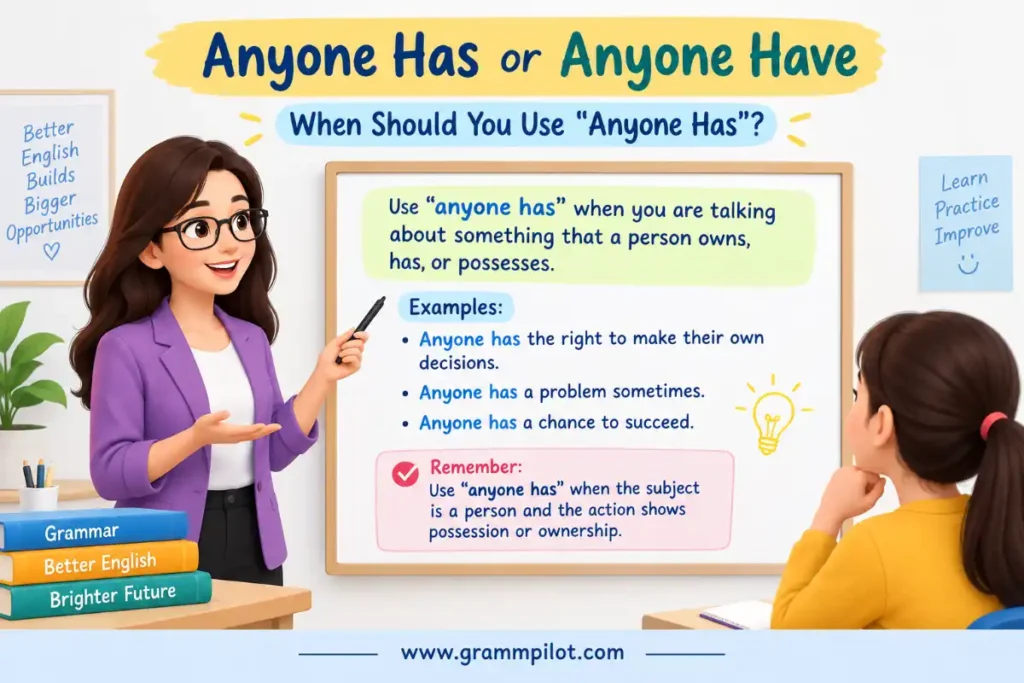
Use has when anyone is the subject of a simple present statement and there is no helping verb before the main verb.
Examples:
- Anyone has the right to express an opinion.
- Anyone with a ticket has permission to enter.
- Anyone who meets the requirements has a chance to apply.
- Anyone who owns a car has certain responsibilities.
- Anyone who wants to participate has to register.
However, there is an important point about natural English. Although anyone has can be grammatically correct, it is not always the most natural phrase by itself.
For example: Anyone has a chance to win.
This sentence is possible in a particular context, but a native speaker might prefer: Anyone can win.
Or: Anyone who enters has a chance to win.
The second version clearly establishes the condition and sounds more natural.
When Should You Use “Anyone Have”?
Use have after a helping verb.
Common helping verbs include:
- Does
- Can
- Could
- Will
- Would
- May
- Might
- Should
- Must
Examples:
- Does anyone have a question?
- Can anyone have access to this file?
- Will anyone have time tomorrow?
- Could anyone have a spare pen?
- Might anyone have the answer?
- Should anyone have concerns, please contact us.
The helping verb carries the grammatical information, so the main verb stays in its basic form.
This is especially important with does.
Does Anyone Have or Does Anyone Has?
The correct form is: Does anyone have?
Not: Does anyone has?
Why? Because does already marks the third-person singular form. Look at the statement: Anyone has a question.
When you turn it into a question, does takes the singular marking: Does anyone have a question? The main verb returns to its base form.
The same pattern appears with other subjects:
- She has a car.
- Does she have a car?
- He likes coffee.
- Does he like coffee?
- Anyone has a question.
- Does anyone have a question?
This is a general English grammar rule, not a special rule only for anyone.
Anyone Have a Question: Is It Correct?
Yes, but it depends on the context.
Anyone have a question?
is a common shortened question in informal spoken English.
The complete version is: Does anyone have a question?
You may hear the shortened version in:
- Classrooms
- Meetings
- Team discussions
- Group chats
- Casual conversations
- Presentations
For example, a teacher may finish explaining a lesson and ask: Anyone have a question?
That sounds natural in conversation.
For formal writing, however, it is better to use: Does anyone have a question?
The difference is not about the word have. The difference is that the casual version leaves out does.
Anyone Has or Anyone Have in an Email
Professional emails usually benefit from the complete form.
For example: Does anyone have any questions about the report?
This sounds clear and professional.
Another common structure is: If anyone has any questions, please let me know.
Notice the difference:Does anyone have…?
but: If anyone has…?
Both are correct because the sentence structures are different.
Example 1: Question
Does anyone have the updated schedule?
Example 2: Conditional Statement
If anyone has the updated schedule, please send it to me.
In the first sentence, does requires have.
In the second sentence, there is no helping verb before has, so the singular form has is correct.
Anyone Has or Anyone Have in an Essay
In academic writing, use the standard sentence structure.
Correct: If anyone has concerns about the policy, they should contact the office.
Correct: Does anyone have the authority to change the rule?
Avoid using the shortened conversational form in formal writing: Anyone have the authority to change the rule? It may be understandable, but it sounds conversational rather than academic. Clear, complete sentences are usually the better choice in essays.
Anyone Has or Anyone Have in a Resume
You may not need either form very often on a resume.
However, if you are describing a scheduling, management, or customer-service role, you could write:
Managed appointments and helped clients select available time slots.
Or:
Answered questions from anyone who had concerns about the service.
Notice that had is used in the second sentence because the sentence is in the past tense.
A resume should focus on clear descriptions of your skills rather than forcing a particular grammar structure.
Examples of Anyone Has
Here are natural examples showing has in different structures:
- Anyone who completes the course has access to the final exam.
- Anyone with a valid ticket has permission to enter.
- Anyone who meets the requirements has a chance to apply.
- Anyone who breaks the rules has to accept the consequences.
- Anyone in this group has the right to speak.
- Anyone who owns the property has certain responsibilities.
- Anyone with enough experience has an advantage.
- Anyone who joins the program has access to the materials.
- Anyone who qualifies has an opportunity to compete.
- Anyone who wants a copy has to request one.
Notice how often anyone who has appears.
This structure is especially natural because it describes a particular condition or group of people without changing the grammatical number of anyone.
Examples of Does Anyone Have?
Here are common question patterns:
- Does anyone have a question?
- Does anyone have a pen?
- Does anyone have the meeting notes?
- Does anyone have a better idea?
- Does anyone have the answer?
- Does anyone have experience with this software?
- Does anyone have a copy of the document?
- Does anyone have time to help?
- Does anyone have an extra chair?
- Does anyone have the manager’s number?
- Does anyone have a suggestion?
- Does anyone have information about the event?
- Does anyone have a charger?
- Does anyone have the latest version?
- Does anyone have any concerns?
These examples all follow the same pattern: Does + anyone + have
Once you recognize that pattern, the choice becomes much easier.
Anyone Has or Anyone Have After Modal Verbs
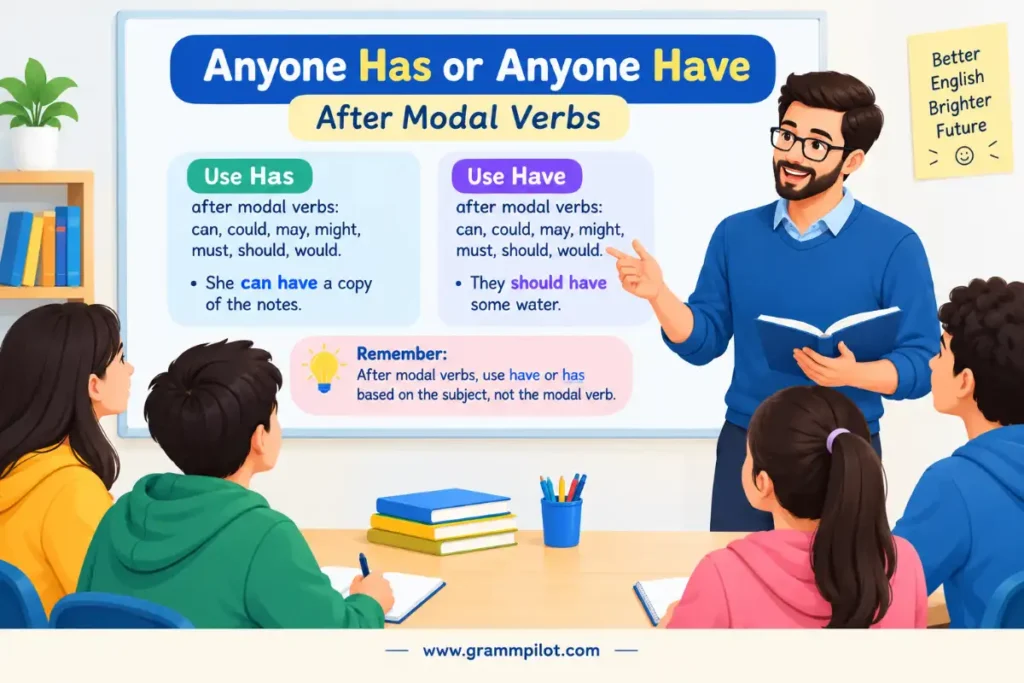
Modal verbs are helping verbs that express ability, possibility, permission, advice, or necessity.
Common examples include:
- Can
- Could
- May
- Might
- Should
- Will
- Would
- Must
After these verbs, use have, not has.
Examples:
- Anyone can have an opinion.
- Anyone could have the answer.
- Anyone may have access.
- Anyone might have the key.
- Anyone should have enough time.
- Anyone will have an opportunity.
- Anyone would have the same problem.
- Anyone must have permission.
Do not write: Anyone can has an opinion.
Write: Anyone can have an opinion.
The modal verb controls the verb form that follows it.
Anyone Has or Anyone Have After “If”
Use has after if anyone when the sentence is in the present tense.
Examples:
- If anyone has a question, please ask.
- If anyone has concerns, contact me.
- If anyone has information, let us know.
- If anyone has experience, we would like to hear from them.
- If anyone has a problem, report it immediately.
This structure is extremely common in emails and workplace communication.
For example: If anyone has questions about the new schedule, please contact the office.
That sentence is correct because anyone is singular and there is no helping verb such as does directly before the verb.
Anyone vs Anybody: Is the Grammar the Same?
Yes.
Anyone and anybody generally follow the same grammar rules.
Examples:
- Anyone has the right to ask.
- Anybody has the right to ask.
- Does anyone have a question?
- Does anybody have a question?
- If anyone has a problem, let me know.
- If anybody has a problem, let me know.
The choice between anyone and anybody is often about style and tone rather than grammar.
Anyone can sound slightly more neutral.
Anybody can sound a little more conversational.
Both are widely used.
Anyone Has vs Anyone Have: Common Mistakes
Mistake 1: Does Anyone Has
Incorrect: Does anyone has a question?
Correct: Does anyone have a question?
The reason is simple: does already carries the singular form.
Mistake 2: Anyone Have in a Standard Statement
Incorrect: Anyone have the right to enter.
Correct: Anyone has the right to enter.
However, remember that Anyone have…? can be a shortened informal question.
For example: Anyone have a pen?
That is acceptable in casual conversation.
Mistake 3: Anyone Who Have
Incorrect: Anyone who have experience can apply.
Correct: Anyone who has experience can apply.
Mistake 4: Anyone Are
Incorrect: Anyone are welcome.
Correct: Anyone is welcome.
Mistake 5: Anyone Know in Formal Writing
In casual speech, you may hear: Anyone know the answer?
The full question is: Does anyone know the answer?
For formal writing, use the complete version.
Why Does “Anyone Have” Sound Right Sometimes?
This happens because you probably hear the shortened conversational structure frequently.
For example:
Anyone have a charger?
The speaker has simply omitted does.
The full sentence is:
Does anyone have a charger?
So, when you hear anyone have, do not assume that have always follows anyone.
Check whether the sentence is actually a shortened question.
Compare:
Statement: Anyone has a charger.
Complete question: Does anyone have a charger?
Informal shortened question: Anyone have a charger?
The same basic idea appears in many conversations.
What Happens After “Doesn’t Anyone”?
The same rule applies to doesn’t.
Use have.
Correct: Doesn’t anyone have a question?
Incorrect: Doesn’t anyone has a question?
Why?
Because doesn’t is short for does not, and the verb after it must be in its base form.
Other examples:
- Doesn’t anyone have the key?
- Doesn’t anyone know the answer?
- Doesn’t anyone want to help?
- Doesn’t anyone understand the problem?
The pattern remains consistent.
What Happens After “Did Anyone”?
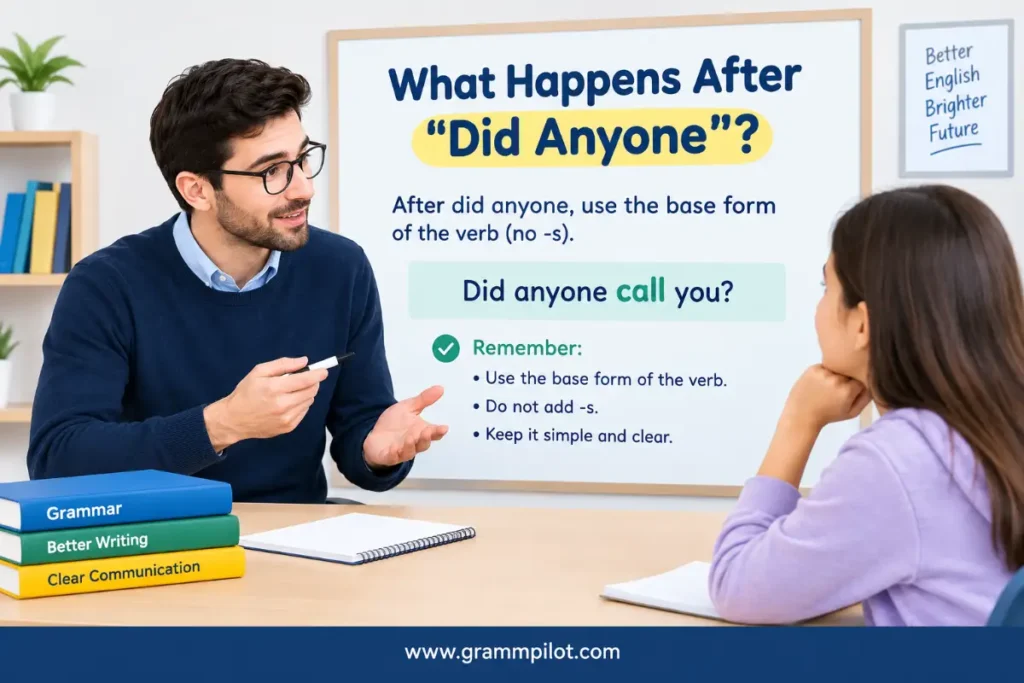
When you use did, the main verb also stays in its base form.
Correct: Did anyone have a question?
Not: Did anyone had a question?
This is the past-tense version of the same rule.
Compare:
Present statement: Anyone has a question.
Present question: Does anyone have a question?
Past statement: Anyone had a question.
Past question: Did anyone have a question?
The helping verb did carries the past tense, so the main verb returns to have.
What About “Has Anyone”?
This structure is different again.
When has comes before the subject, it may be functioning as an auxiliary verb in the present perfect.
For example:
Has anyone seen my phone?
Has anyone finished the assignmentHas anyone called the office?
Here, has is the helping verb.
The main verb is:
- seen
- finished
- called
So do not confuse: Anyone has…
with: Has anyone…
These are different grammatical structures.
Anyone Has or Has Anyone?
Compare these sentences carefully.
Anyone Has
Anyone has the opportunity to apply.
Here, anyone is the subject.
Has Anyone
Has anyone applied?
Here, has is the helping verb.
The second structure is especially common in present-perfect questions.
Examples:
- Has anyone called?
- Has anyone arrived?
- Has anyone finished?
- Has anyone seen my keys?
- Has anyone spoken to the manager?
This distinction can help prevent confusion when reading or writing questions.
How Can You Remember the Rule Quickly?
Use a simple three-step method.
Step 1: Find “Anyone”
Identify whether anyone is the subject.
Step 2: Look for a Helping Verb
If you see does, can, could, will, might, should, or another helping verb, use the base verb have.
Example: Does anyone have a question?
Step 3: Check the Sentence Structure
If there is no helping verb and the sentence is a simple present statement, use has.
Example: Anyone has the right to speak.
If the sentence begins with if anyone or anyone who, use has in the present tense.
Examples: If anyone has a question, ask me.
Anyone who has experience can apply.
Quick Reference Chart
| Pattern | Example |
|---|---|
| Anyone + has | Anyone has a chance. |
| Does anyone + have | Does anyone have a chance? |
| If anyone + has | If anyone has a question, ask me. |
| Anyone who + has | Anyone who has experience can apply. |
| Anyone can + have | Anyone can have an opinion. |
| Anyone might + have | Anyone might have the answer. |
| Anyone should + have | Anyone should have access. |
| Anyone + have? | Anyone have a question? (Informal) |
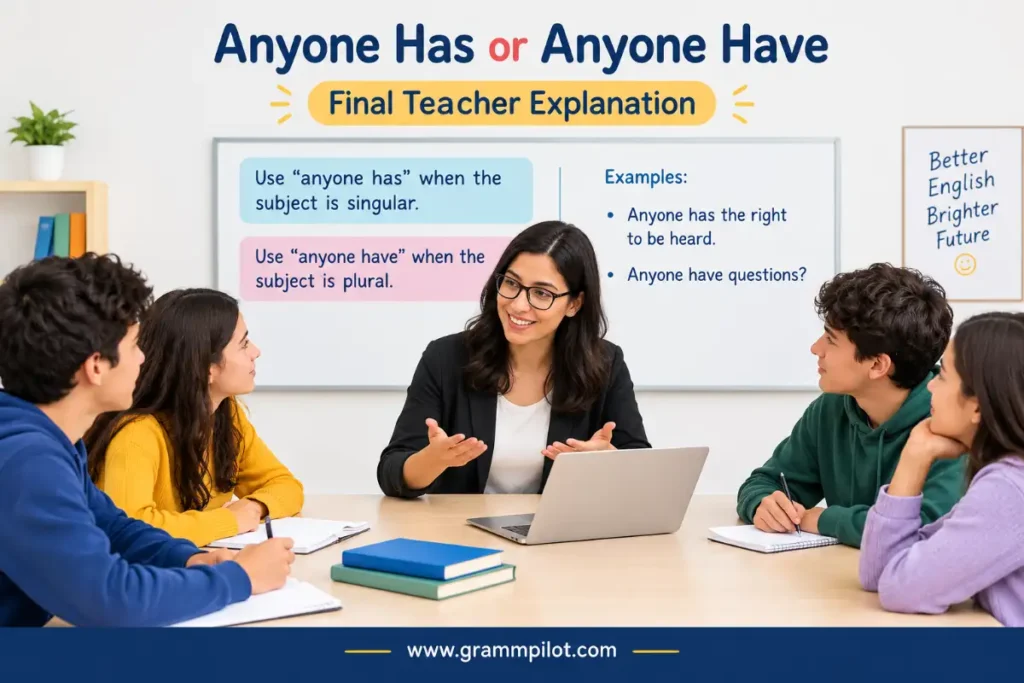
Final Teacher Explanation
The grammar behind Anyone Has or Anyone Have is easier than it first appears.
Anyone is singular, so use has in a simple present statement.
Example: Anyone who qualifies has a chance.
But when does is used to form a question, the main verb changes to its base form.
Example: Does anyone have a question?
The same base-form rule applies after modal verbs:
Anyone can have an opinion. You should also remember that Anyone have…? is common as a shortened informal question. In formal writing, use the complete form with does.
The most useful rule to memorize is:Anyone has in a simple statement. Does anyone have in a question.
Once you recognize the helping verb, choosing the correct form becomes much easier.
Conclusion
The difference between Anyone Has or Anyone Have comes down to sentence structure, not the number of people the word anyone might refer to. Grammatically, anyone is singular, so has is used in simple present statements and structures such as “If anyone has a question.” However, when does is used to form a question, the main verb must return to its base form: “Does anyone have a question?” The same principle applies after modal verbs such as can, could, and might. In casual speech, “Anyone have a question?” is also common as a shortened version of the full question. Remembering these patterns will help you write clearer emails, essays, messages, and everyday questions.
Frequently Asked Questions
1. Is it “anyone has” or “anyone have”?
Use anyone has in a simple present statement because anyone is grammatically singular. For example, “Anyone who qualifies has a chance.”
2. Is it “does anyone have” or “does anyone has”?
The correct form is does anyone have. After does, the main verb stays in its base form.
3. Why do we say “does anyone have”?
We say does anyone have because does already carries the third-person singular marking. The main verb therefore remains have.
4. Can I say “anyone have a question”?
Yes, in informal conversation. Anyone have a question? is a shortened version of Does anyone have a question?
5. Is anyone singular or plural?
Anyone is grammatically singular. It takes singular forms such as has and is in simple statements.
6. Is “if anyone has” correct?
Yes. If anyone has is correct because anyone is singular and no helping verb such as does comes before the main verb.
7. What’s the easiest way to remember anyone has or anyone have?
Remember this simple pattern: anyone has in a statement, but does anyone have in a question. After does, always use have, not has.