
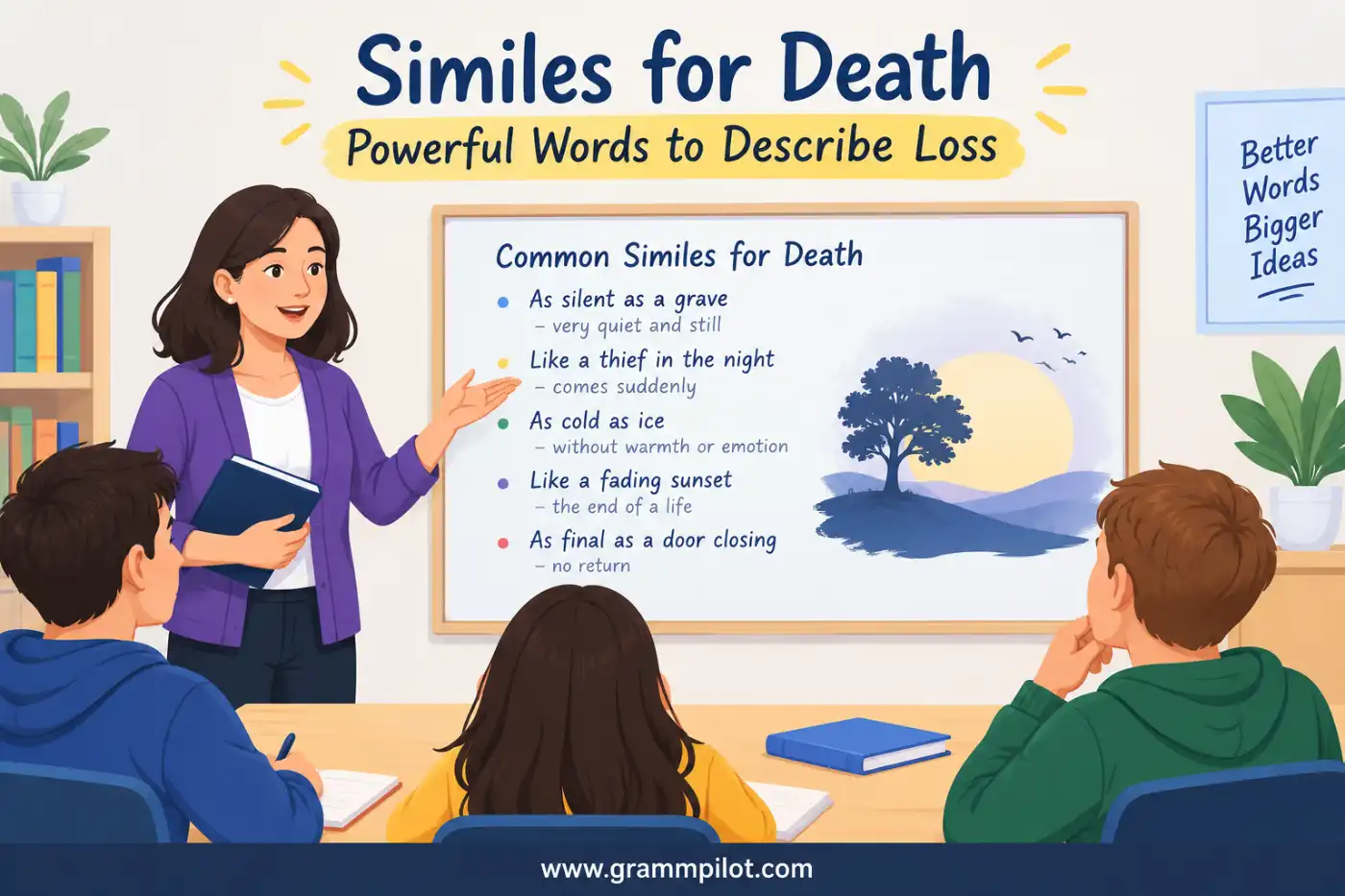
Death is one of the hardest subjects to describe. When writing a poem, story, speech, essay, or personal reflection, simple words can sometimes feel too plain for such a powerful experience. A well-chosen simile can help readers understand the sadness, silence, fear, finality, or mystery surrounding death.
Similes for Death compare death or the feelings surrounding it to something familiar, such as a fading light, a quiet winter, a closing door, or a long sleep. These comparisons don’t explain death literally. Instead, they create an image that helps readers feel its emotional weight.
The best comparison depends on the mood you want. A peaceful scene may call for gentle imagery, while a horror story may need darker language. This guide explores different types of comparisons, from peaceful and poetic to sad, frightening, mysterious, and powerful. You’ll also find examples, writing tips, common mistakes, and ideas for choosing the right image.
If you’re looking for more creative comparisons, see [Grass Similes].
What is a simile for death?
A simile is a comparison that uses words such as like or as to connect two different things.
For example:
- His death was like a candle going out in the wind.
- She became as still as a sleeping child.
- The loss felt like winter settling over the house.
These comparisons don’t mean that death literally is a candle, winter, or sleep. They create a mental picture. A strong simile can communicate an emotion without naming it directly. Instead of saying, “Everyone was deeply sad,” a writer might say: The room felt like a garden after the first frost.
The reader can imagine the cold, emptiness, and loss.
Why use comparisons when writing about death?
Death can be difficult to describe because it carries many meanings at once.
It can represent:
- Loss
- Grief
- Silence
- Finality
- Peace
- Fear
- Mystery
- Separation
- Change
- The end of a journey
- The beginning of mourning
A direct statement may tell readers what happened, but figurative language can show them how it felt.
Compare:
Direct:
Her grandfather died, and the family was sad.
Figurative:
Her grandfather’s passing was like a warm light disappearing from the house.
The second sentence gives readers an image. They can imagine the house becoming darker and understand that someone important is no longer there.
What makes a good death simile?
A strong comparison usually has three qualities.
It creates a clear image
Readers should be able to picture what you’re describing.
Weak: His death was like something bad.
Stronger: His death was like a storm that left the village silent.
The second image is specific.
It matches the mood
A peaceful death should not automatically be compared to an explosion. A frightening scene may need darker imagery.
Think about the emotion first:
- Peaceful
- Sad
- Terrifying
- Mysterious
- Angry
- Empty
- Reflective
Then choose an image that supports that feeling.
It adds meaning
Don’t use a comparison simply because it sounds poetic.
Ask: What does this image tell the reader about the death or the loss?
A fading candle suggests an ending.
A closing door suggests separation.
Winter suggests coldness or absence.
A storm suggests emotional chaos.
The image should do some work.
Peaceful similes for death
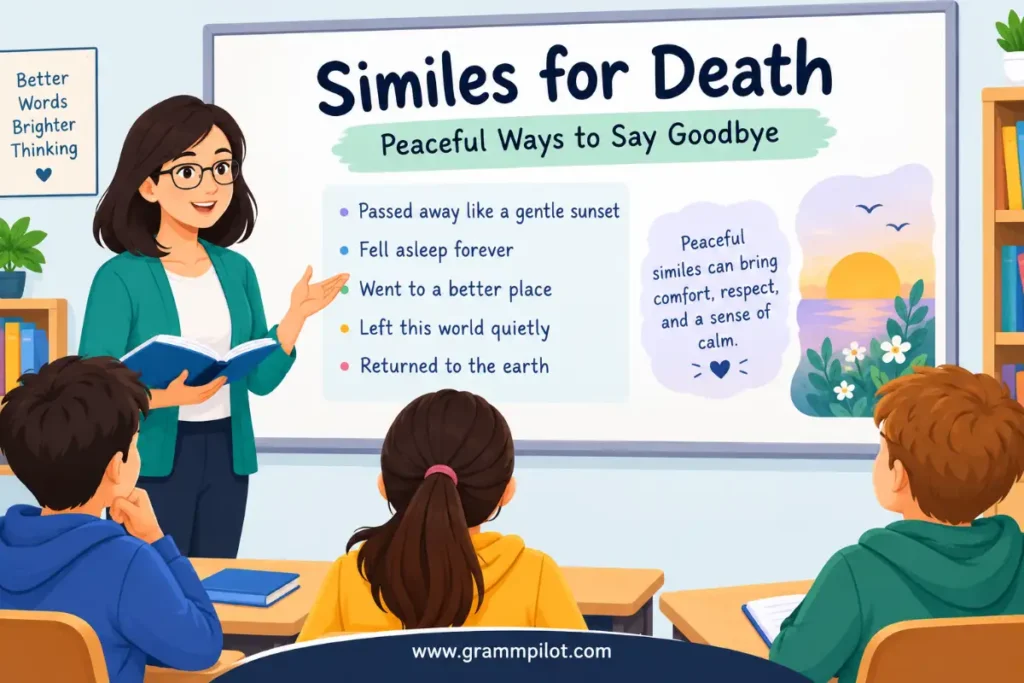
Not every description of death needs to be dark or frightening. In poetry and reflective writing, death is sometimes portrayed as quiet, gentle, or peaceful.
Here are some softer comparisons.
- His passing was like a candle slowly fading at dawn.
- Death came like a quiet breeze through an open window.
- She slipped away like a leaf settling gently onto the ground.
- His final breath was like a soft song ending in the distance.
- Her passing was as quiet as snow falling at midnight.
- Death felt like a long journey finally reaching its destination.
- He disappeared from the world like mist dissolving beneath the morning sun.
- Her life ended like a sunset fading into evening.
- His final moments were as calm as a lake before sunrise.
- The end came like a door closing softly behind him.
These images can work well in:
- Poems
- Memorial writing
- Eulogies
- Reflective essays
- Literary fiction
- Personal narratives
Why peaceful images work
Gentle imagery can help writers discuss death without making the scene unnecessarily frightening. A sunset, for example, can suggest completion. A leaf can represent the natural cycle of life. Snow can create a feeling of stillness. These images are especially useful when the goal is comfort rather than shock.
Dark similes for death
Dark imagery can be useful in horror, gothic fiction, dramatic poetry, and serious literary writing.
- Death crept toward him like a shadow across an empty room.
- The grave waited like a dark doorway at the end of the path.
- The night felt as cold as a forgotten tomb.
- Death surrounded the house like fog swallowing a road.
- His final moments hung over the room like a storm cloud.
- The silence was as deep as a sealed underground chamber.
- Fear followed him like a shadow that refused to disappear.
- The darkness spread like ink through clear water.
- The graveyard stood like a forgotten kingdom beneath the moon.
- Death seemed like a door opening into a place no one could see.
Frightening comparisons for death
Horror writing often depends on anticipation. Instead of describing death directly, a writer can compare its presence to something readers already fear.
- Death approached like footsteps in an empty hallway.
- The silence was like the moment before a scream.
- Fear clung to him like cold fingers around his shoulders.
- The room felt as lifeless as an abandoned hospital.
- The darkness waited like a predator outside the door.
- His final breath disappeared like a voice swallowed by a storm.
- The grave opened before him like a mouth in the earth.
- The fear spread like a warning siren through the night.
These comparisons are useful in suspense because they create tension without explaining everything.
Death as a journey
One of the oldest ways to describe death is as a journey or departure.
This approach can make a difficult subject feel less abrupt.
Examples:
- His passing was like a traveler reaching the end of a long road.
- She left this world like a ship sailing beyond the horizon.
- His life ended like a journey arriving at its final station.
- Death was like a road disappearing into the mist.
- Her final moments were like a train leaving a quiet station.
- He moved beyond life like a boat drifting toward a distant shore.
- His passing felt like watching a familiar traveler disappear around a bend.
- She seemed to leave like a bird flying beyond the edge of sight.
This type of imagery can be especially effective in memorial writing.
Death as sleep
Sleep is another common comparison because both involve stillness and the closing of the day.
Examples:
- His final rest was like a deep sleep after a long journey.
- She lay as still as someone peacefully asleep.
- The night surrounded him like a blanket of quiet sleep.
- His passing was like drifting into a dream from which there was no return.
- The room became as quiet as a bedroom after midnight.
Writers should use this image thoughtfully. Sleep and death are not literally the same thing. The comparison works because sleep suggests stillness, quiet, and rest.
Death as a fading light
Light and darkness are powerful symbols in literature.
A light going out can suggest the end of life, while fading sunlight can represent a gradual transition.
Examples:
- Her life faded like the last light of evening.
- His presence disappeared like a candle flame in the wind.
- The warmth of his life went out like a lamp at midnight.
- Her voice faded like sunlight behind distant clouds.
- His final breath was like the last glow of sunset.
- The room seemed darker like a house after its only lamp goes out.
These comparisons are simple but effective because most readers immediately understand the image.
Death as nature changing
Nature provides countless images for life, loss, and change.
Leaves
Leaves can represent aging, change, and the end of a season.
- His life ended like a leaf falling from an old tree.
- Her passing was like the final leaf leaving a quiet branch.
Winter
Winter can symbolize coldness, silence, and the end of a growing season.
- Grief arrived like winter after a long summer.
- The house felt as cold as a garden in winter.
Sunset
Sunset can suggest completion and transition.
- His life ended like the sun sinking below the horizon.
- Her passing was like daylight slowly becoming night.
Flowers
Flowers can symbolize beauty, life, and temporary existence.
- His life was like a flower blooming brightly before the first frost.
- Her memory remained like a pressed flower inside an old book.
Nature-based imagery works well because it gives readers something familiar to connect with.
Short similes for death
Sometimes you don’t need a long sentence. A short comparison can be powerful in a poem, caption, or creative writing piece.
- Like a candle going out.
- Like a door closing.
- Like a leaf falling.
- Like a shadow disappearing.
- Like the last note of a song.
- Like sunset fading into night.
- Like mist dissolving.
- Like a bird flying beyond sight.
- Like winter arriving.
- Like a river reaching the sea.
- Like a star disappearing at dawn.
- Like a page turning for the last time.
- Like footsteps fading down a hallway.
- Like a flame losing its warmth.
- Like a road vanishing into fog.
Short comparisons are especially useful when you want the surrounding sentence to carry most of the emotion.
Powerful similes for death
Powerful doesn’t always mean frightening. A strong image can be quiet and still leave a lasting impression.
- His death was like a bridge collapsing between two worlds.
- Her absence was like a missing heartbeat in the rhythm of the house.
- The news struck him like thunder breaking through silence.
- His final goodbye was like a door closing on an entire chapter of life.
- Grief entered the family like a storm that changed the landscape.
- Her death left a silence as wide as an empty ocean.
- His memory remained like a lighthouse shining across dark water.
- The loss was like losing a piece of a map that showed the way home.
- Her absence spread through the family like winter through an unheated house.
- His passing changed everything like an earthquake reshaping the ground beneath a city.
The strongest examples connect physical images to emotional meaning.
Poetic similes for death
Poetry often benefits from unusual but understandable comparisons.
Here are some more lyrical options:
- Death was like moonlight slipping through a closing curtain.
- His memory remained like a star caught in the fabric of the night.
- Her final breath drifted away like a feather carried by evening air.
- The silence after her passing was like a garden waiting for rain.
- His life disappeared like a melody carried beyond the hills.
- Grief rested on the family like frost on a field at dawn.
- Her memory returned like sunlight through an old window.
- His name lingered like the final echo inside an empty hall.
- The years after his death passed like clouds across a distant sky.
- Her presence became a memory like perfume lingering after someone leaves a room.
Poetic comparisons can be more abstract, but they should still give readers something they can picture.
Similes for grief after death
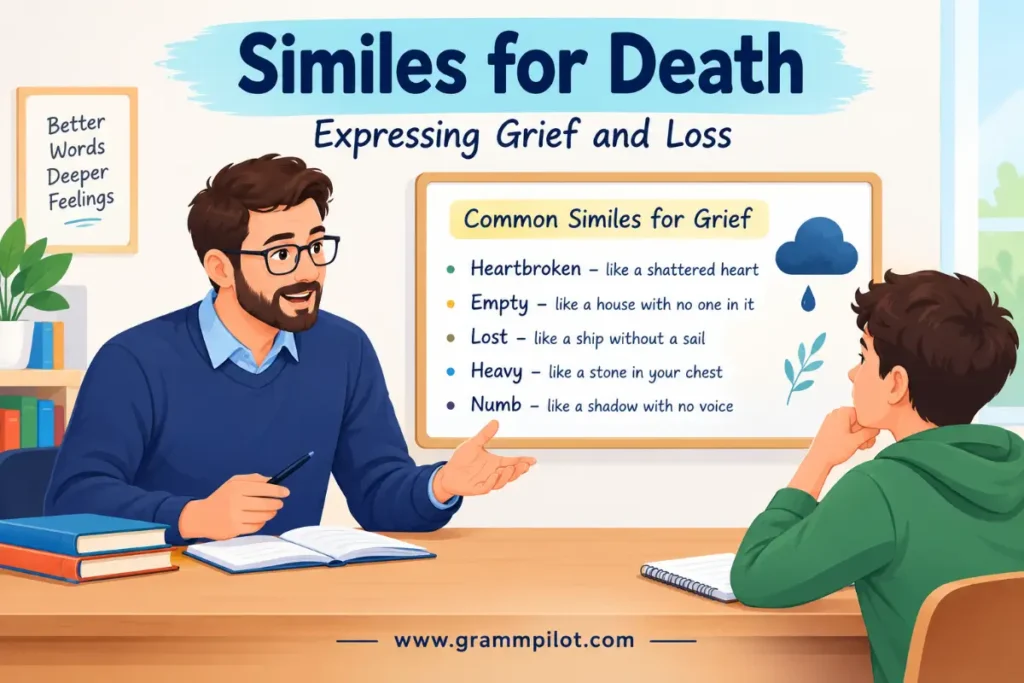
Sometimes the strongest comparison describes the survivor rather than the person who died.
Examples:
- Grief followed her like a shadow she could never outrun.
- His sadness was as heavy as a stone in his chest.
- Her memories returned like waves against the shore.
- The empty house felt like a shell after the tide has gone out.
- His tears fell like rain against a window.
- Grief settled over him like dust after a building collapses.
- Her heart felt like a room with all the furniture removed.
- The memories came back like old songs heard from another room.
- His loneliness was like standing in a crowd and seeing no familiar face.
- The silence followed her like fog through every hallway.
These examples can help writers show grief instead of simply naming it.
Similes for death in an essay
Academic and school essays require more control. A dramatic comparison can work in a literary analysis or personal essay, but avoid overly emotional language when the subject requires an objective tone.
Good choices include:
- Death can be compared to a door closing at the end of a journey.
- The character’s death functions like a sudden winter that changes the story’s emotional landscape.
- His passing is presented like the fading of a once-bright light.
When writing academically, explain the comparison after using it. For example: The author presents death like a fading light, suggesting that the character’s influence is disappearing gradually rather than ending all at once.
The explanation tells the reader why the comparison matters.
How to choose the right comparison for your writing
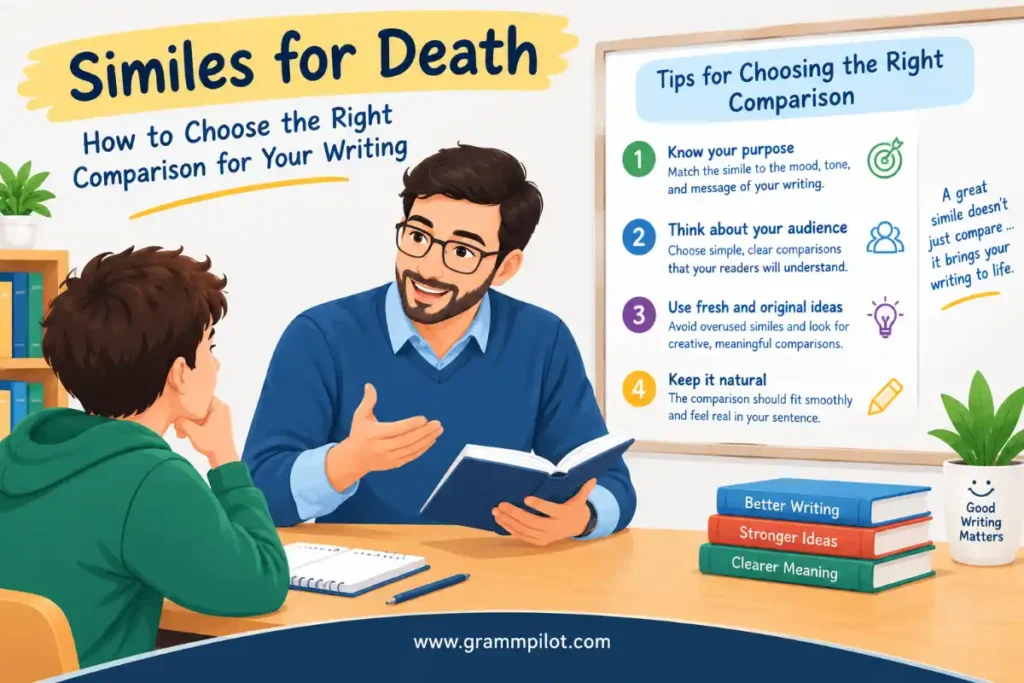
Before choosing a simile, identify the emotion.
If you want peace
Try images of:
- Sunset
- Snow
- Calm water
- Gentle wind
- A fading candle
- A quiet journey
If you want sadness
Try:
- Empty chairs
- Falling leaves
- Winter
- Broken songs
- Empty houses
- Fading photographs
If you want fear
Try:
- Shadows
- Footsteps
- Storms
- Fog
- Dark doorways
- Predators
If you want mystery
Try:
- Fog
- Distant roads
- Hidden doors
- Vanishing stars
- Unseen shores
- Deep water
If you want finality
Try:
- Closing doors
- Last pages
- Sunset
- Finished journeys
- Extinguished candles
- Final notes
Choosing the emotion first makes the writing process much easier.
Common mistakes when writing similes about death
Using clichés too often
Some comparisons are so common that they may feel predictable.
Examples include:
- Death is like sleep.
- Life is like a candle.
- Death is like a journey.
These aren’t wrong. The problem is that readers have seen them many times.
Try adding a fresh detail.
Instead of: His death was like a candle going out.
Try: His death was like the last candle in a house going dark before dawn.
The second version gives the familiar idea a more specific setting.
Mixing unrelated images
Avoid combining images that don’t belong together. There are too many unrelated ideas.
Better: Her death was like a candle going out in a sudden wind.
The image stays focused.
Making every comparison dramatic
Not every sentence needs to sound poetic. If every line contains a dramatic comparison, the writing can become exhausting. Mix figurative language with simple sentences.
For example: He died before sunrise. His passing was like a candle going out in the darkness. The house remained quiet all morning.
The simple sentences give the figurative sentence more impact.
Choosing an image that doesn’t match the mood
A peaceful scene shouldn’t suddenly use violent imagery unless the contrast is intentional.
Always ask about the comparison supports the emotion.
Quick guide to choosing a comparison
| Mood | Useful Images | Example |
|---|---|---|
| Peaceful | Snow, sunset, breeze | Like snow falling at midnight |
| Sad | Empty chair, winter, fading photo | Like an empty chair at the table |
| Frightening | Shadow, footsteps, fog | Like footsteps in an empty hall |
| Mysterious | Mist, distant road, hidden door | Like a road disappearing into fog |
| Final | Closing door, last page, candle | Like the final page of a book |
| Sudden | Lightning, wave, breaking glass | Like lightning from a clear sky |
| Lonely | Empty room, abandoned house | Like an empty house after everyone leaves |
| Hopeful | Sunrise, star, returning light | Like a star appearing before dawn |
| Reflective | River, journey, sunset | Like a river reaching the sea |
Quick tips for better figurative writing
- Start with the emotion you want readers to feel.
- Choose a familiar image.
- Make the comparison specific.
- Use like or as for a true simile.
- Avoid stuffing several images into one sentence.
- Don’t use dramatic language in every line.
- Match the comparison to the setting.
- Think about your audience.
- Explain the comparison in academic writing when needed.
- Prefer a fresh detail over a forced poetic phrase.
- Read the sentence aloud to check its rhythm.
- Make sure the image adds meaning.
How can students use these comparisons in writing?
Students often need figurative language for creative writing assignments.
A useful formula is: Subject + was like + familiar image + meaningful detail.
For example: His death was like a candle going out in a room full of people.
Another pattern is: Emotion + was as + adjective + as + image.
For example: Her grief was as heavy as a stone in her chest.
You can also describe the effect of death: The empty house was like a stage after the final curtain.
Then add a sentence explaining the feeling: No one knew what to say.
This creates a balance between imagery and clear storytelling.
How can writers avoid sounding overly dramatic?
The subject itself is serious, so you don’t need to make every comparison extreme.
Instead of: His death was like the universe collapsing into an endless abyss of unbearable darkness.
Try: His death was like a light going out in a familiar room.
The second sentence is quieter, but it may be more effective because the image is easy to understand. Strong writing often comes from restraint. A simple image can carry a lot of emotion.
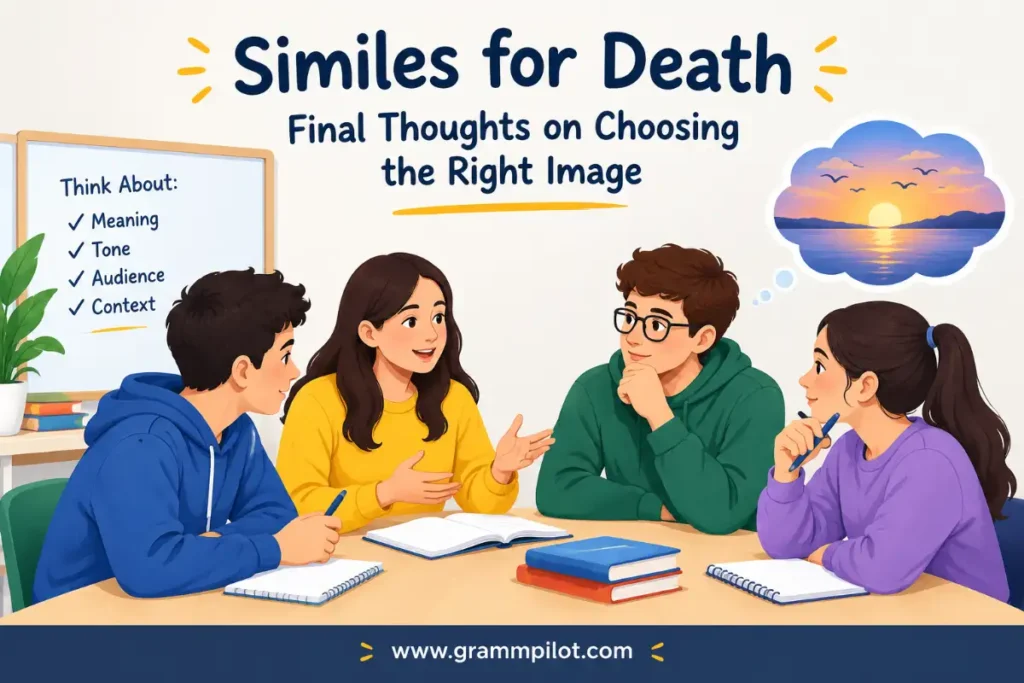
Final thoughts on choosing the right image
There isn’t one accurate comparison for death. The right choice depends on what you want the reader to feel. If you want peace, choose gentle images such as sunset, snow, still water, or a quiet breeze. If you want grief, think about empty spaces, fading memories, falling leaves, and changing seasons. For fear, shadows, footsteps, storms, and darkness can create tension. For mystery, use fog, distant roads, hidden doors, or vanishing lights.
The most effective Similes for Death are not necessarily the most complicated. They are the ones that make readers see something familiar in a new way. Start with the emotion, choose an image that supports it, and keep the comparison clear. A thoughtful, simple image can say more than a page of exaggerated language.
Conclusion
The strongest Similes for Death give readers a way to understand difficult emotions through familiar images. A fading candle can suggest finality, a falling leaf can suggest the natural end of a life, and an empty chair can show the pain of someone’s absence. The image you choose should match the mood and purpose of your writing. Don’t worry about making every comparison sound grand or complicated. A simple image can be more powerful when it feels natural. Think about what you want the reader to feel, choose something they can easily picture, and connect that image to the experience you’re describing. If you’re writing a poem, story, essay, speech, or memorial piece, thoughtful figurative language can make your words more personal, memorable, and meaningful.
Frequently Asked Questions
1. What is a good simile for death?
A good simile for death is “Death was like a candle slowly fading at dawn.” It creates an image of an ending while keeping the tone gentle and reflective.
2. What are some peaceful similes for death?
Peaceful comparisons include death being like a sunset fading into evening, snow falling at midnight, a leaf settling onto the ground, or a long journey reaching its destination.
3. What’s another way to describe death in a poem?
You can describe death through images of fading light, closing doors, falling leaves, distant journeys, winter, silence, or the final note of a song. The best choice depends on the poem’s mood.
4. What is a sad simile for death?
A sad comparison is “Her absence was like a missing star in a familiar night sky.” It focuses on the emptiness left behind rather than describing death directly.
5. How do you describe death in a story without saying it directly?
Use an image that suggests finality, such as a candle going out, a door closing, a road disappearing into fog, or the last note of a song fading away.
6. What is a simile for grief after someone dies?
“Grief was like a shadow she could never outrun” is a clear simile for grief. It suggests that sorrow remains close even when a person tries to move forward.
7. Are similes and metaphors the same thing?
No. A simile usually compares two things using “like” or “as,” while a metaphor makes a direct comparison without those words. For example, “Death was like winter” is a simile, while “Death was winter” is a metaphor.