
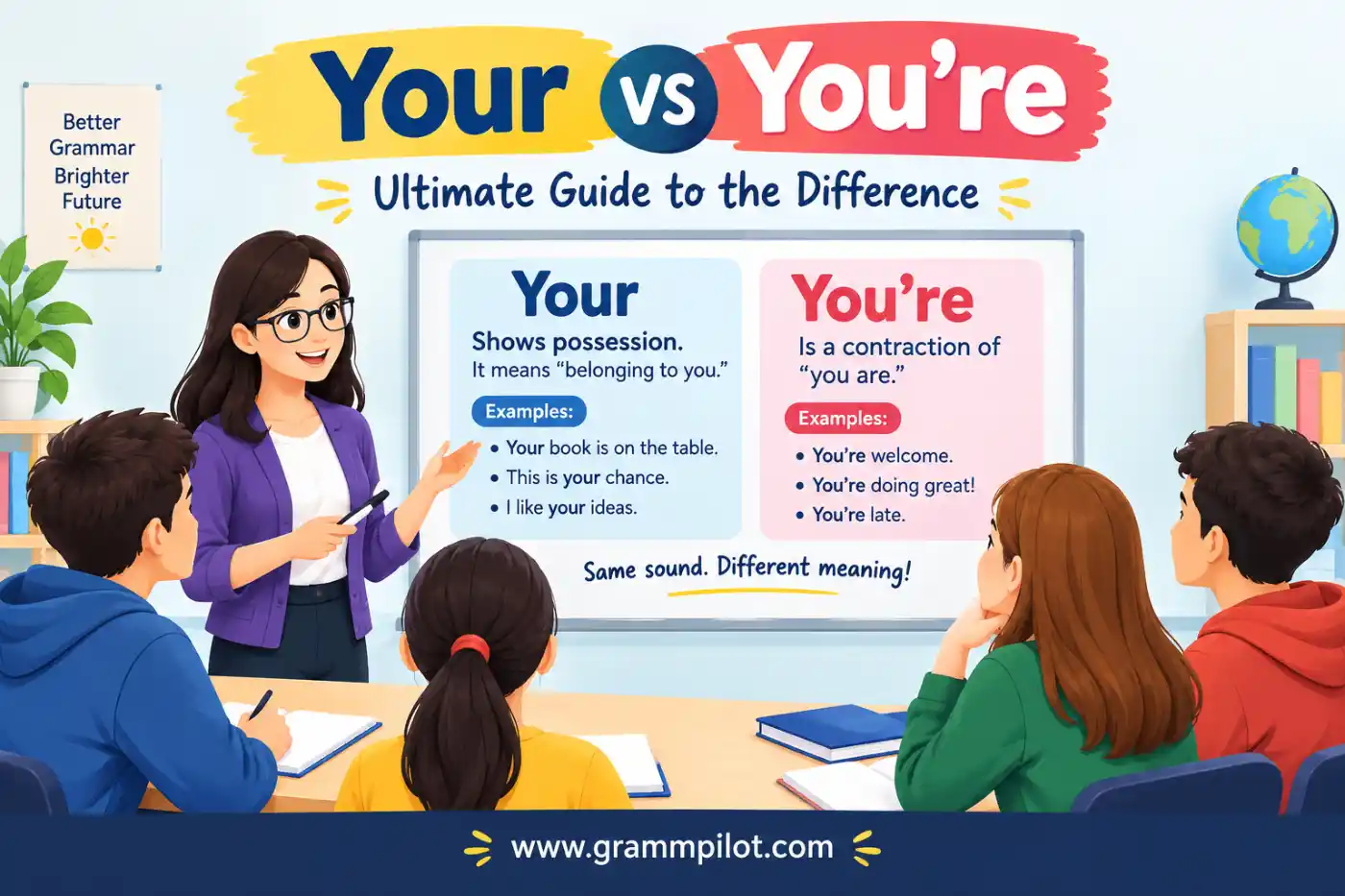
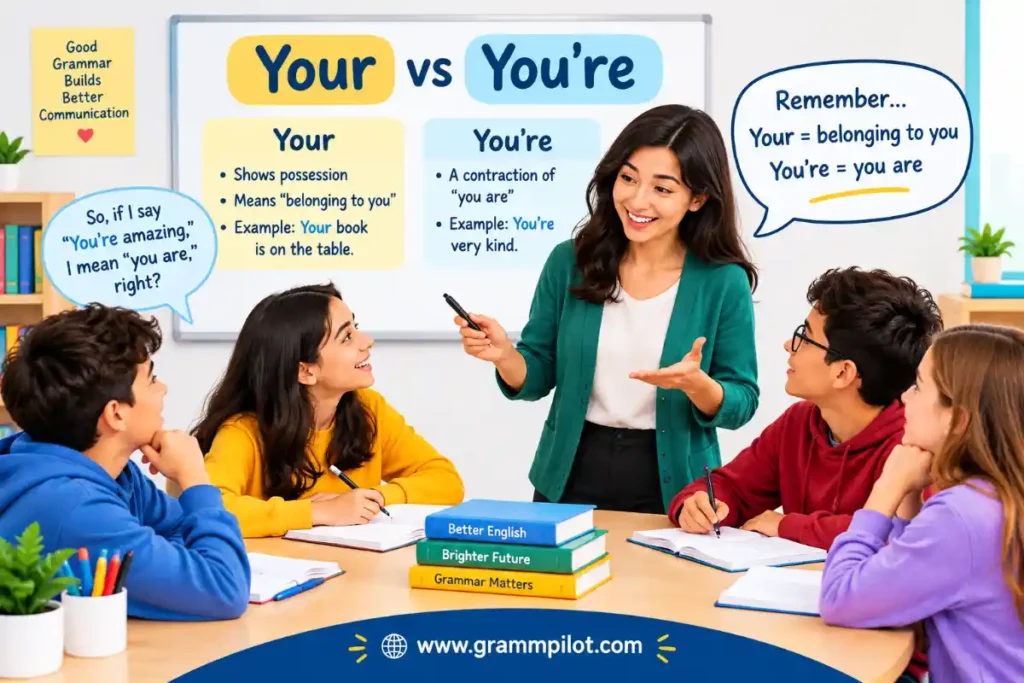
You’re writing a quick text to a friend, replying to an email, or checking an essay before submitting it. Then you stop at a simple sentence: “I hope your doing well.” Something looks wrong, but you’re not sure why. This is one of the most common English mistakes because your and you’re sound exactly alike when spoken. The difference is actually simple. Your shows possession or a connection to someone. You’re is a contraction of you are. The apostrophe changes the word’s job completely.
Quick Answer: Use your to show that something belongs to or is connected with someone. Use you’re when you mean you are. If you can replace the word with “you are,” you’re is correct.
Once you learn that one test, the confusion becomes much easier to avoid. This guide explains the meanings, grammar, word history, real-life examples, common mistakes, formal and casual usage, and simple tricks for choosing the right form.
What is the difference between your and you’re?
The main difference is grammatical.
| Word | Meaning | Function | Example |
|---|---|---|---|
| Your | Belonging to or associated with you | Possessive determiner | Is this your phone? |
| You’re | You are | Contraction | You’re very kind. |
Compare these sentences: Your phone is ringing.
Here, your tells us who the phone belongs to.
You’re using your phone.
Here, you’re means you are. The two words sound alike, but they cannot be used interchangeably.
What does your mean?
Your is a possessive determiner. It shows that something belongs to, relates to, or is associated with the person being addressed.
Examples:
- Your car is outside.
- I like your jacket.
- Where is your brother?
- Please check your email.
- Your idea makes sense.
- I enjoyed your presentation.
In each sentence, your connects something with you. It doesn’t always mean literal ownership.
For example: “Your teacher is here.”
The teacher doesn’t belong to you. The word simply shows a relationship.
Likewise: “Your favorite song is playing.”
The song isn’t physically owned by you. Your indicates that it’s your favorite.
What does you’re mean?
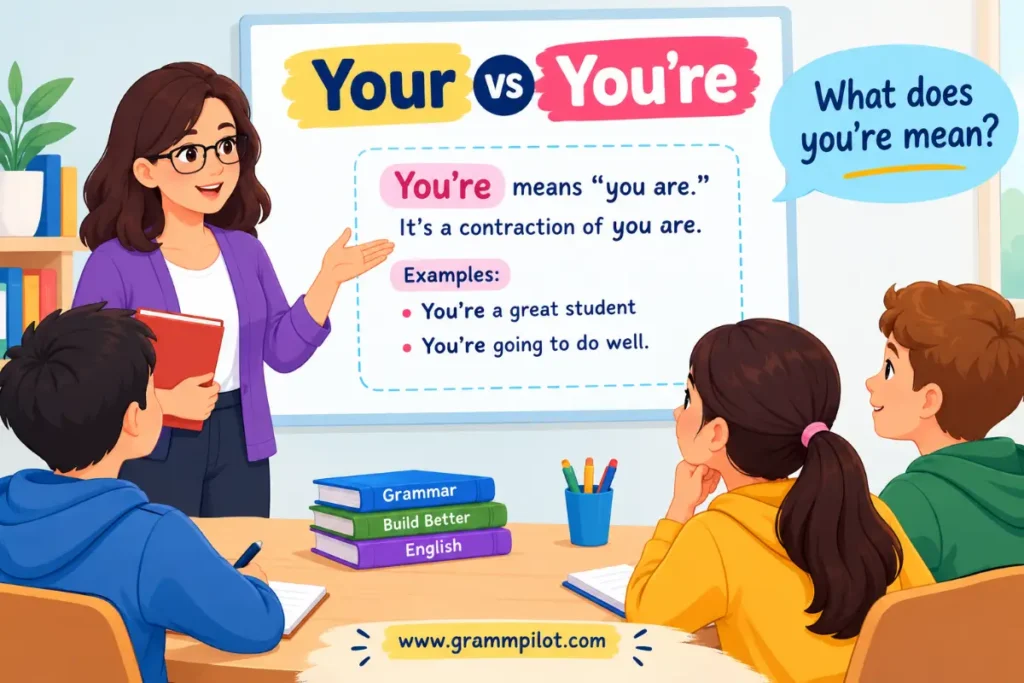
You’re is a contraction of you are. The apostrophe represents letters removed from you are.
You are → you’re
Examples:
- You’re late.
- You’re funny.
- You’re doing great.
- You’re my best friend.
- You’re ready for the test.
- You’re going to love this movie.
Try expanding the contraction:“You’re late.”
becomes: “You are late.”
The sentence still makes sense, so you’re is correct.
What is the easiest way to remember your vs you’re?
Use the you are test. Whenever you’re unsure, replace you’re with you are. If the sentence still makes sense, use you’re.
Example: “I think you’re right.”
Replace it: “I think you are right.”
It works.
Now try: “Is this you’re bag?”
Replace it: “Is this you are bag?”
That doesn’t work.
So the correct sentence is: “Is this your bag?”
This simple test solves most mistakes.
Why do your and you’re sound the same?
They are homophones. Homophones are words that sound alike but have different meanings or spellings.
Other common examples include:
- To / too / two
- Their / there / they’re
- Its / it’s
- Hear / here
- They’re / their
Because your and you’re sound the same, you can’t rely on pronunciation. You have to look at the role of the word in the sentence.
What is the word origin of your?
Your developed from older forms of the English second-person possessive pronoun. Its history is connected to you and earlier forms such as eower in Old English. Over centuries, the form changed as English developed. Today, your is used before nouns to show possession or association.
Examples:
- your house
- your opinion
- your parents
- your job
- your question
The basic idea of connection to the person being addressed has remained.
What is the word origin of you’re?
You’re isn’t an independent word with a separate ancient meaning. It is a shortened form of you are. English has used contractions for centuries.
The apostrophe tells the reader that part of the original phrase has been removed.
You are → you’re
Similar contractions include:
- I am → I’m
- We are → we’re
- They are → they’re
- He is → he’s
- She is → she’s
- It is → it’s
Understanding contractions makes you’re much easier to recognize.
How do you use your before a noun?
Your normally appears before a noun or noun phrase.
Examples:
- your house
- your phone
- your new job
- your favorite book
- your best friend
- your English teacher
- your first attempt
Consider:
“Your answer is correct.”
“Your new shoes look great.”
This is a strong clue. If a noun follows the word and you’re showing a relationship to the listener, your may be the correct choice.
How do you use you’re in a sentence?
Because you’re means you are, it can appear wherever the full phrase you are would work.
Examples:
- You’re welcome.
- You’re correct.
- You’re very patient.
- You’re working hard.
- You’re getting better.
- You’re the person I need.
- You’re not alone.
- You’re going to be fine.
If replacing you’re with you are works, the contraction is grammatically possible.
Your vs you’re in questions
Both words commonly appear in questions.
Your
“Is that your jacket?”
Here, your identifies the jacket’s connection to the listener.
You’re
“Are you sure you’re ready?”
Here, you’re means you are.
Another pair: “Is this your seat?”
“Why are you leaving? You’re already here.”
The meanings are different even though the pronunciation is similar.
Your vs you’re in texting
Texting makes this mistake especially common because people type quickly.
Examples of correct usage:
- “Hope you’re doing well.”
- “Is this your address?”
- “You’re coming tonight, right?”
- “I like your new profile picture.”
- “Don’t forget your keys.”
A quick text might contain: “Your so funny.”
The correct version is: “You’re so funny.”
Why? “You are so funny.”
That sentence makes sense.
Your vs you’re in emails
Professional emails should use the correct form because these mistakes can make writing look careless.
Correct: Thank you for your response.”
Correct: “I hope you’re doing well.”
Incorrect: “I hope your doing well.”
The first sentence uses your before response. The second uses you’re because it means you are.
A useful email check
Before sending an email, search mentally for every your/you’re.
Ask: Does it mean “you are”?
If yes → you’re
If it shows possession or association → your
Your vs you’re in essays
Academic writing also requires the distinction.
Examples:
“Your argument needs more evidence.”
“Your” identifies the reader’s argument.
“You’re expected to provide evidence.”
“You’re” means “you are.”
However, academic writing often avoids directly addressing the reader, depending on the assignment.
Instead of: “You’re expected to explain the result.”
A formal essay might say: “The writer is expected to explain the result.”
Still, when your or you’re is appropriate, the same grammatical rule applies.
Your vs you’re in resumes
A resume generally uses concise phrases rather than direct statements such as “you’re.”
You may see: “Your responsibilities included managing customer accounts.”
But in a resume written about yourself, you’d more likely write: “Managed customer accounts.”
The important point is that your and you’re retain their normal meanings.
Your = connected to you.
You’re = you are.
Your vs you’re in speaking
In speech, there is no pronunciation difference that reliably helps you.
“Your” and “you’re” generally sound the same in ordinary speech.
So a speaker can say: “I hope you’re well.”
and: “I like your work.”
The listener understands the meaning from the sentence structure. The spelling problem mainly appears when you’re writing.
What are 10 common examples with your?
- Your phone is on the table.
- I like your new haircut.
- Please bring your notebook.
- Your answer was correct.
- Did you finish your homework?
- I saw your message.
- Your parents called earlier.
- Where is your car?
- I appreciate your help.
- Your idea could work.
In each sentence, your is connected to a noun.
What are 10 common examples with you’re?
- You’re doing a great job.
- You’re almost finished.
- I think you’re right.
- You’re very helpful.
- You’re going to enjoy this.
- You’re welcome.
- You’re not late.
- I know you’re busy.
- You’re the first person here.
- You’re making good progress.
In every sentence, you’re can be expanded to you are.
Your vs you’re — what’s different?
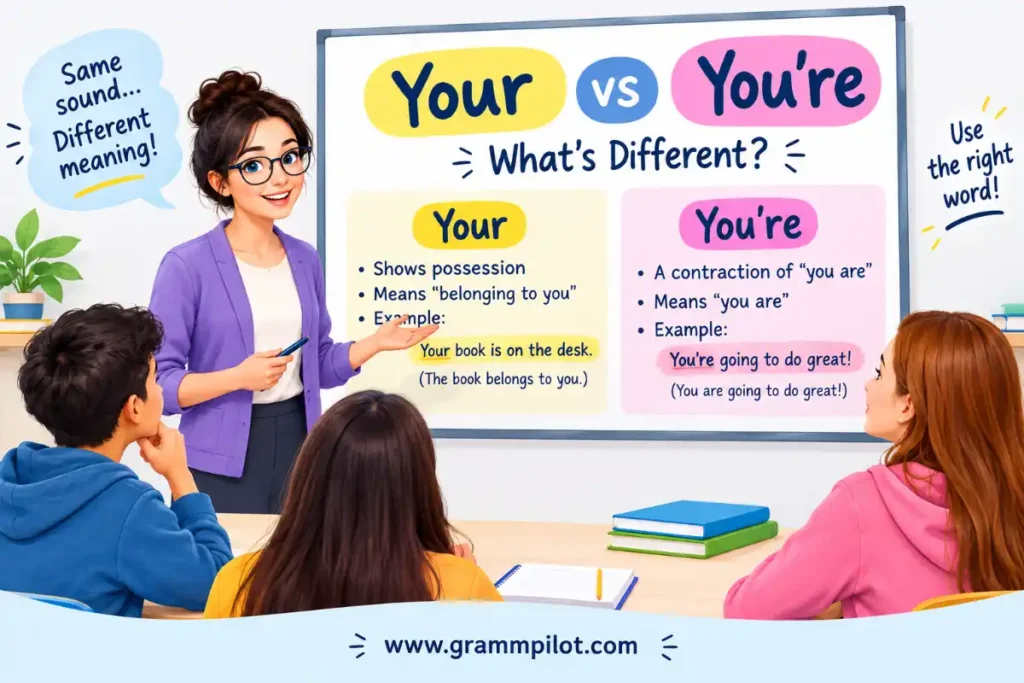
| Feature | Your | You’re |
|---|---|---|
| Meaning | Belonging to or related to you | You are |
| Grammar | Possessive determiner | Contraction |
| Apostrophe | No | Yes |
| Usually followed by noun? | Yes | No special requirement |
| Example | Your book is here. | You’re reading. |
| Full form | No contraction | You are |
The apostrophe is a useful visual clue.
You’re contains an apostrophe because it is shortened from you are.
Your does not.
Your vs yours — what’s different?
This is another common source of confusion.
Your comes before a noun.
“Your coat is wet.”
Yours can stand alone.
“The wet coat is yours.”
Think:
your + thing
thing + yours
Examples:
- your house / the house is yours
- your idea / the idea is yours
- your seat / the seat is yours
- your responsibility / the responsibility is yours
What are the most common mistakes?
Mistake 1: “Your doing great”
Incorrect: “Your doing great.”
Correct: “You’re doing great.”
Why?
“You are doing great.”
Mistake 2: “I like you’re car”
Incorrect: “I like you’re car.”
Correct: “I like your car.”
Why?
The word comes before car and shows a relationship to the listener.
Mistake 3: “Your welcome”
Incorrect: “Your welcome.”
Correct: “You’re welcome.”
The phrase means: “You are welcome.”
Mistake 4: “I hope your okay”
Incorrect: “I hope your okay.”
Correct: “I hope you’re okay.”
Expand it: “I hope you are okay.”
Mistake 5: “Is this you’re book?”
Incorrect: “Is this you’re book?”
Correct: “Is this your book?”
You cannot replace you’re with “you are”:
“Is this you are book?”
That doesn’t work.
When should you not use your?
Don’t use your when the sentence means you are.
Incorrect: “Your going to love it.”
Correct: “You’re going to love it.”
Also avoid using your when you need the independent possessive pronoun yours.
Incorrect: “This phone is your.”
Correct: “This phone is yours.”
When should you not use you’re?
Don’t use you’re to show possession.
Incorrect: “Where is you’re bag?”
Correct: “Where is your bag?”
Also don’t use it simply because the word sounds right when spoken.
Because your and you’re are homophones, pronunciation can’t determine the spelling.
What are the synonyms for your?
Your doesn’t have a accurate synonym in normal English because it is a grammatical determiner.
Depending on the sentence, you might rewrite it with phrases such as:
- belonging to you
- associated with you
- connected to you
- related to you
- owned by you
Example: “Your responsibility”
could be rewritten as: “The responsibility belonging to you.”
The second version is much less natural, which shows why your is so useful.
What are the synonyms for you’re?
Since you’re means you are, the direct equivalent is simply: you are Depending on the sentence, the underlying adjective or verb may change, but there isn’t a separate synonym for the contraction itself.
Examples:
- You’re happy → You are happy.
- You’re correct → You are correct.
- You’re working → You are working.
- You’re my friend → You are my friend.
Are your and you’re different in British and American English?
The basic distinction is the same in both varieties.
American English and British English both use:
your for possession or association
you’re for you are
The pronunciation is also generally similar.
Regional differences don’t change the basic spelling rule.
How do you choose the right word in an essay?
Start by checking the meaning.
Example: “Your conclusion should summarize the main idea.”
Here, your refers to the reader’s conclusion.
Now compare: “You’re expected to explain the evidence.”
Here, you’re means you are.
If you can replace the word with you are, choose you’re. If the word connects a noun to the person being addressed, choose your.
How do you choose the right word in an email?
Professional emails often contain both forms.
Examples:
“Thank you for your email.”
“I’m glad you’re available.”
“I appreciate your time.”
A quick proofreading trick is to expand every you’re.
If the expanded sentence sounds correct, keep you’re.
How do you choose the right word in texting?
Text messages are informal, but correct spelling still helps.
Instead of guessing, use the same test: “Your coming?”
Change it: “You are coming?”
That works, so write: “You’re coming?”
Another example: “Your coming with your brother?”
Correct: “You’re coming with your brother?”
The first word means you are. The second refers to the brother’s relationship to the listener.
How do you choose the right word when speaking?
You don’t need to make a spelling choice when speaking. Both words usually sound alike. However, understanding the difference helps you interpret written messages correctly. When reading, look at the role of the word rather than its pronunciation.
Can “your” show relationships other than ownership?
Yes.
This is an important point.
Your doesn’t always mean something physically belongs to you.
Examples:
- your mother
- your teacher
- your country
- your opinion
- your favorite movie
- your problem
- your idea
You don’t necessarily own these things.
Instead, your shows a relationship or connection.
For example: “Your teacher called.”
This means the teacher is associated with you, such as being the person who teaches you.
Can “you’re” appear before a noun?
Yes, but remember that it means you are.
For example: “You’re a great student.”
Expand it: “You are a great student.”
The noun student follows the verb are.
That’s very different from: “Your student is here.”
Here, your modifies student.
Compare:
You’re a student.
Your student is here.
The first describes you.
The second describes a student connected to you.
What is the fastest proofreading trick?
Search your writing for every occurrence of:
your
you’re
Then ask one question: Can I replace it with “you are”?
If yes: you’re
If no: your
Examples:
“I hope you’re well.”
→ “I hope you are well.”
Correct.
“I received your email.”
→ “I received you are email.”
Incorrect.
Therefore, your is correct.
Quick comparison chart
| Sentence | Correct Form | Why |
|---|---|---|
| ___ very kind. | You’re | You are |
| I like ___ idea. | Your | Shows connection |
| ___ welcome. | You’re | You are |
| Where is ___ phone? | Your | Shows possession |
| I think ___ right. | You’re | You are |
| ___ brother called. | Your | Shows relationship |
| ___ going home. | You’re | You are |
| Please bring ___ ID. | Your | Shows association |
| I hope ___ okay. | You’re | You are |
| Is that ___ car? | Your | Shows possession |
Practice quiz: your or you’re?
Choose the correct form.
- I think ___ doing well.
- Is this ___ notebook?
- ___ going to love this book.
- Please check ___ email.
- I hope ___ feeling better.
- Where is ___ jacket?
- ___ always welcome here.
- I like ___ new shoes.
- ___ one of my best friends.
- Don’t forget ___ keys.
- I know ___ busy.
- Is this ___ seat?
Answers
- You’re
- Your
- You’re
- Your
- You’re
- Your
- You’re
- Your
- You’re
- Your
- You’re
- Your
Notice the pattern: whenever the sentence means you are, choose you’re.
What are the best tips for remembering the difference?
Tip 1: Use the expansion test
Replace you’re with you are.
If it works, use you’re.
Tip 2: Look for a noun
If the word comes before a noun and shows a connection to the listener, your is likely correct.
Examples:
- your house
- your answer
- your friend
- your job
Tip 3: Watch the apostrophe
The apostrophe in you’re signals a contraction.
you’re = you are
Tip 4: Don’t trust pronunciation
Both words sound alike.
Always check the meaning.
Tip 5: Remember “your” and “yours”
If you need the word to stand alone, you may need yours, not your.
A final teacher explanation
The difference between your and you’re comes down to one simple question: Does the word mean “you are”? If yes, use you’re.
“You’re amazing” means “You are amazing.”
If the word shows that something belongs to, relates to, or is associated with the person you’re speaking to, use your.
“Your phone is ringing.”
There’s one more useful distinction. Your usually appears before a noun, while yours can stand alone: “your book” but “the book is yours.” Don’t let pronunciation confuse you. Your and you’re sound alike, so listening won’t tell you which spelling is right. When writing, stop for a second and apply the you are test. It takes only a moment and catches one of the most common errors in English.
Conclusion
The difference between your and you’re is small but important. Your shows possession, connection, or association, as in “your phone” or “your idea.” You’re is simply the shortened form of you are, as in “you’re ready” or “you’re correct.” When you’re unsure, don’t rely on how the word sounds. Use the replacement test: insert you are into the sentence. If the sentence still works, choose you’re. If it doesn’t, your is probably the right choice. With a little practice, this quick check will become automatic, if you’re writing a text, email, school assignment, or professional message.
Frequently Asked Questions
1. What is the simple difference between your and you’re?
Your shows possession or a connection to someone, while you’re means you are.
2. Is it “your welcome” or “you’re welcome”?
The correct phrase is “you’re welcome” because it means “you are welcome.”
3. How can I quickly know about to use your or you’re?
Replace the word with you are. If the sentence still makes sense, use you’re; otherwise, use your.
4. Is “your” a possessive word?
Yes, your is a possessive determiner that shows ownership, association, or a relationship, such as “your house” or “your teacher.”
5. What’s another way to remember you’re?
Remember that you’re contains an apostrophe because it is a contraction of you are.
6. Is “your doing great” correct?
No. The correct sentence is “You’re doing great” because the intended meaning is “You are doing great.”
7. What’s the difference between your and yours?
Your normally comes before a noun, while yours can stand alone. For example, “This is your book” but “This book is your book”