
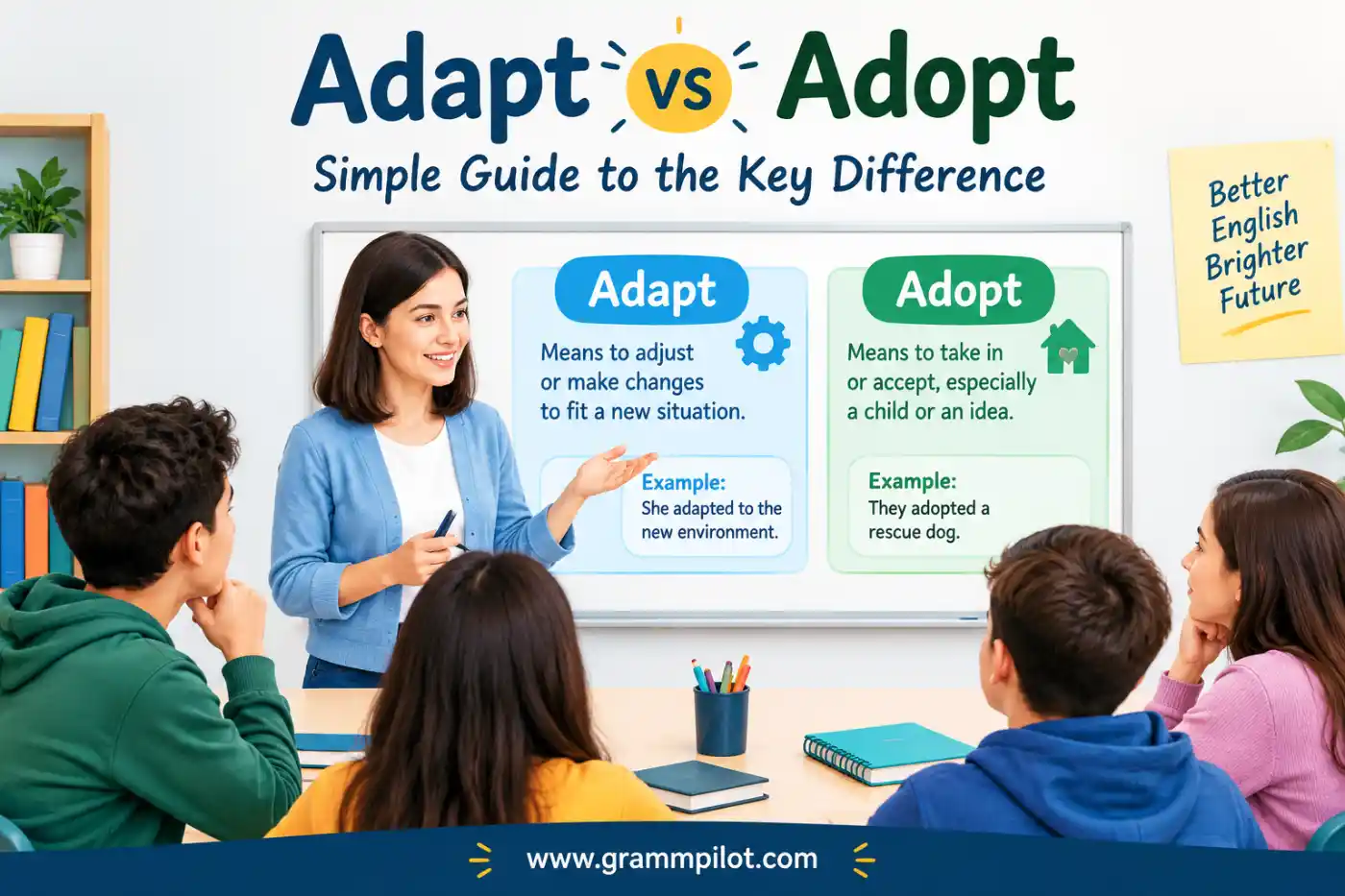
IAdapt vs Adopt: imagine you’re writing an email and want to say that your team needs to change its plan because circumstances have changed. You might type “We need to adopt our strategy” and then wonder if adapt would be the better word. The two verbs look and sound similar, but they describe different actions. Adapt usually means to change something so it works better in a new situation. Adopt means to accept, choose, or take something as your own. That difference is small in spelling but important in meaning.
Quick Answer: Use adapt when something is changed to fit a new situation. Use adopt when a person or group accepts, chooses, or begins using something.
Once you understand the basic idea, the distinction becomes much easier. This guide covers the word origins, practical meanings, examples, common mistakes, close comparisons, context-based choices, and memory tricks.
Another pair that can be easy to confuse is [Your vs You’re].
What is the difference between adapt and adopt?
The simplest distinction is change versus choose.
| Word | Main Meaning | Example |
|---|---|---|
| Adapt | Change something to fit a new situation | We adapted the plan. |
| Adopt | Accept, choose, or take something as your own | We adopted a new plan. |
Think of it this way:
Adapt = adjust.
Adopt = accept.
If you modify an existing idea, method, object, or behavior, adapt is usually the right choice.
If you decide to use, accept, or officially take something, adopt is usually correct.
A simple comparison
Suppose a teacher changes a lesson for younger students.
“She adapted the lesson.”
The lesson already existed. She changed it so it would work better.
Now imagine the school chooses a completely new teaching method.
“The school adopted a new teaching method.”
The school accepted and began using it.
That difference is the heart of these words.
What does adapt mean?
Adapt means to change something so that it works or fits better in a different situation.
It can describe:
- Plans
- Methods
- Behaviors
- Designs
- Stories
- Businesses
- Technology
- People
- Animals
- Strategies
Examples:
- We need to adapt our strategy.
- She adapted the lesson for younger students.
- The company adapted to changing customer needs.
- Animals adapt to their environments.
- He quickly adapted to his new job.
The common idea is adjustment.
Something changes because the circumstances require it.
What does adopt mean?
Adopt has several related meanings, but they all involve accepting, choosing, or taking something as your own.
You can adopt:
- A plan
- A policy
- An idea
- A method
- A habit
- A technology
- A position
- A child
- A name
Examples:
- The company adopted a new policy.
- She adopted a healthier lifestyle.
- The committee adopted the proposal.
- Many schools adopted the new system.
- They adopted a child.
The central idea is acceptance or taking something on.
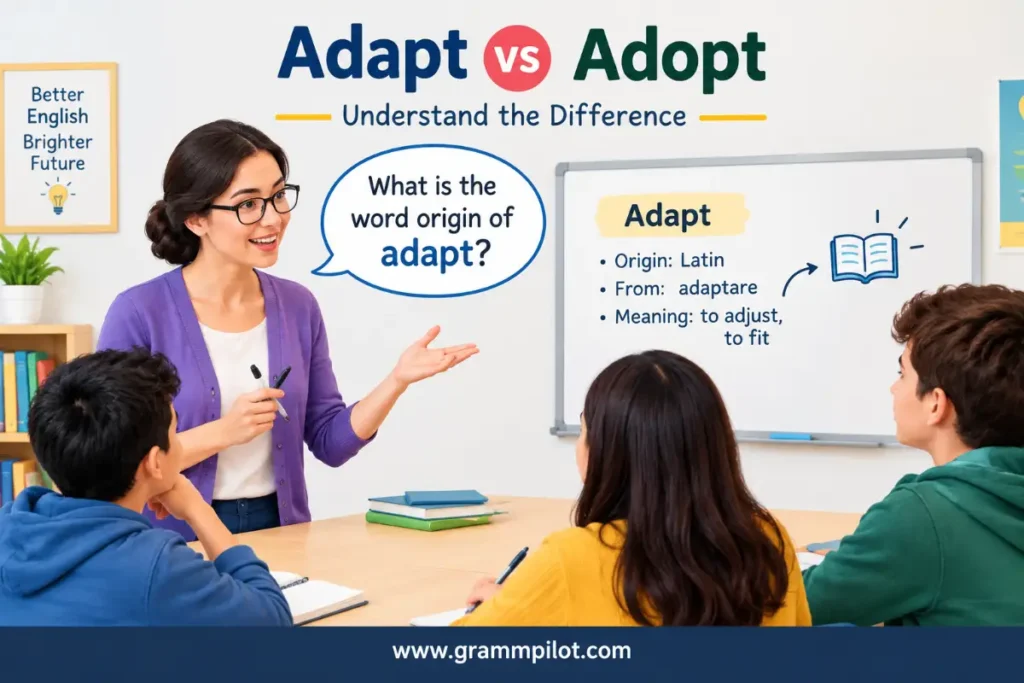
What is the word origin of adapt?
Adapt comes from Latin adaptare, meaning “to fit” or “to adjust.”
That original idea is still visible in modern English.
When you adapt something, you make it fit a particular situation.
For example:
“A writer adapted the story for children.”
The story was changed so it would fit a younger audience.
The word’s history matches its modern meaning closely:
Adapt = make fit.
What is the word origin of adopt?
Adopt comes from Latin adoptare, meaning “to choose” or “to take by choice.”
English eventually developed the modern meanings of accepting something or taking someone into a family.
That explains why we can say:
- Adopt a policy
- Adopt an idea
- Adopt a method
- Adopt a child
In each case, something is being accepted or taken as one’s own.
How do you remember adapt vs adopt?
The easiest memory trick is:
Adapt = adjust.
Both ideas begin with the concept of changing something to fit.
Adopt = accept.
Both suggest choosing or taking something.
Another useful trick is to focus on the vowel:
- Adapt → A for adjust
- Adopt → O for own
The second connection isn’t a formal rule, but it can help you remember the difference.
Does adapt mean change?
Yes, but there’s an important detail. Adapt usually means changing something to fit a new situation or purpose. It doesn’t simply mean “change” in every context.
For example: “The company adapted its website for mobile users.”
The company didn’t change the website randomly. It changed it so the site would work better on phones.
That purpose is important.
Does adopt mean accept?
Often, yes.
When a group adopts a policy, it accepts or officially chooses that policy.
Example:
“The city adopted a new recycling policy.”
The city decided to accept and use the policy.
However, adopt has another major meaning: taking a child into a family legally.
Example: “They adopted a baby.”
So the exact meaning depends on context.
Adapt vs adopt in a business context
Both words are common in business writing.
Adapt in business
Use adapt when a company changes something because conditions have changed.
Examples:
- Businesses must adapt to new technology.
- We adapted our marketing strategy.
- The company adapted its services to customer needs.
- Our team adapted quickly to remote work.
Adopt in business
Use adopt when a business accepts or begins using something.
Examples:
- The company adopted a new accounting system.
- We adopted a flexible work policy.
- The team adopted a new communication tool.
- The board adopted the proposal.
Business comparison
| Situation | Correct Word |
|---|---|
| Change a strategy to fit a new market | Adapt |
| Start using a new strategy | Adopt |
| Change a product for a new audience | Adapt |
| Accept a new company policy | Adopt |
| Adjust to customer demands | Adapt |
| Begin using new technology | Adopt |
A company might actually do both.
Example:
“The company adopted new software and adapted its workflow to use it effectively.”
The business chose the software and then changed its workflow.
Adapt vs adopt in school
Students and teachers encounter both words often.
Adapt
“Teachers adapt lessons for different learning needs.”
The lesson is changed.
Adopt
“The school adopted a new grading policy.”
The school accepted and began using the policy.
Another example: “The teacher adapted the textbook activities after the school adopted a new curriculum.”
Here, the school chooses the curriculum, while the teacher modifies the activities.
Adapt vs adopt in writing
Writers also use both verbs.
Adapt a story
When a story is changed for another format, you can use adapt.
Examples:
- The novel was adapted into a movie.
- She adapted the article for a younger audience.
- The director adapted the play for television.
The original material is changed to fit a new format.
Adopt a writing style
You can adopt a style when you choose to use it.
Example: “The writer adopted a more conversational style.”
The writer chose that style.
You could also say: “The writer adapted her style to suit younger readers.”
Now the emphasis is on changing the style to fit an audience.
Adapt vs adopt in science
Science uses adapt frequently, especially in biology.
Animals and plants can adapt to their environments.
Examples:
- Polar bears have adapted to cold environments.
- Plants adapt to changes in their surroundings.
- Some animals adapt to limited food supplies.
In biology, an adaptation is a trait or feature that helps an organism survive in its environment. Adopt is less common in this biological sense because living organisms don’t usually “adopt” environmental traits in the same way people adopt policies or ideas.
Adapt vs adopt in personal life
Both verbs can describe personal decisions and behavior.
Adapt
“I had to adapt to my new schedule.”
The person changed their behavior or routine to fit new circumstances.
Adopt
“I adopted a healthier routine.”
The person chose and began following a new routine.
Compare:
“She adapted to the new diet.”
“She adopted a new diet.”
The first focuses on adjusting to circumstances.
The second focuses on choosing a particular practice.
What does “adapt to” mean?
The phrase adapt to means to adjust to a new situation.
Examples:
- Children adapt to new schools.
- Employees adapt to new systems.
- Animals adapt to their surroundings.
- I had to adapt to the new schedule.
- She quickly adapted to city life.
A common pattern is: adapt to + noun
or adapt to + -ing form
Examples:
- adapt to change
- adapt to technology
- adapt to working remotely
- adapt to living alone
Common mistake
Don’t write: “I adopted to the new environment.”
The correct sentence is: “I adapted to the new environment.”
Adopt does not normally take to in this meaning.
What does “adopt” take?
Adopt is normally followed directly by the thing being accepted or chosen.
Examples:
- adopt a policy
- adopt a method
- adopt an approach
- adopt a strategy
- adopt a child
- adopt a habit
Correct: “The company adopted a new strategy.”
Not: “The company adopted to a new strategy.”
If you mean adjustment, use adapt to.
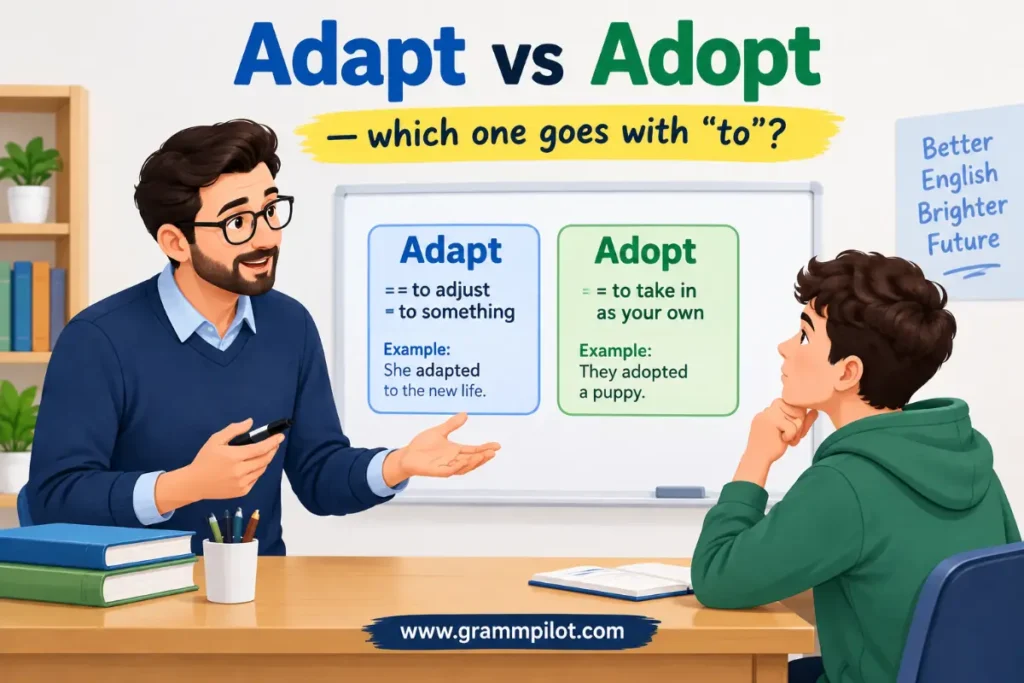
Adapt vs adopt — which one goes with “to”?
This is one of the easiest grammar clues.
Adapt to is a common phrase.
- Adapt to change
- Adapt to pressure
- Adapt to a new environment
- Adapt to technology
Adopt normally does not use to in this way.
- Adopt a policy
- Adopt a method
- Adopt an approach
- Adopt a child
So if you see a sentence that needs ___ to a new situation, adapt is usually the answer.
What are the synonyms for adapt?
The best synonym depends on the context.
| Synonym | Meaning | Tone | Example |
|---|---|---|---|
| Adjust | Change slightly to fit | Everyday | Adjust the plan. |
| Modify | Make changes | Neutral/Formal | Modify the design. |
| Alter | Change something | Neutral | Alter the schedule. |
| Change | Make different | Everyday | Change the method. |
| Revise | Improve or change | Formal | Revise the strategy. |
| Customize | Make suitable for a user | Modern/Business | Customize the software. |
| Tailor | Adjust for a specific purpose | Professional | Tailor the message. |
| Accommodate | Adjust to meet needs | Formal | Accommodate different users. |
| Transform | Change greatly | Strong | Transform the system. |
| Rework | Change substantially | Everyday/Professional | Rework the proposal. |
These aren’t perfect substitutes in every sentence.
For example, adjust often suggests a smaller change, while transform suggests a much bigger one.
What are the synonyms for adopt?
Here are useful alternatives.
| Synonym | Meaning | Tone | Example |
|---|---|---|---|
| Accept | Agree to take or receive | Everyday | Accept the proposal. |
| Choose | Select something | Everyday | Choose a method. |
| Embrace | Accept willingly | Positive | Embrace a new approach. |
| Approve | Officially accept | Formal | Approve the policy. |
| Take on | Begin using or accepting | Casual | Take on a new role. |
| Implement | Put a plan into action | Professional | Implement the policy. |
| Follow | Use or obey | Everyday | Follow the procedure. |
| Select | Choose from options | Formal | Select a strategy. |
| Use | Employ something | Everyday | Use the new system. |
| Incorporate | Include as part of something | Formal | Incorporate the new feature. |
Again, context matters.
Implement is not an exact synonym for adopt. A company may adopt a policy but still need to implement it.
Adapt vs modify — what’s different?
These words overlap, but adapt usually emphasizes making something suitable for a new situation or purpose. Modify simply means making changes.
Compare: “We modified the report.”
This tells us that changes were made.
“We adapted the report for a younger audience.”
This explains the purpose of the changes.
The second sentence gives more information about why the changes happened.
Adopt vs accept — what’s different?
These words are close, but adopt often suggests beginning to use or officially take something as one’s own. Accept can simply mean agreeing to or receiving something.
Compare: “The committee accepted the proposal.”
The committee agreed to it.
Adopt often suggests a stronger commitment.
Adopt vs embrace — what’s different?
Both can describe accepting an idea or approach.
Adopt is often neutral and practical.
“The company adopted a four-day workweek.”
Embrace is more expressive and often suggests enthusiasm.
“The company embraced the four-day workweek.”
The first focuses on the decision. The second can suggest positive enthusiasm toward it.
Adapt vs adjust — what’s different?
These are close synonyms.
Adjust often suggests making a small or practical change.
“I adjusted the chair.”
Adapt often involves changing something so it works in a new environment or situation.
“The business adapted to the changing market.”
You can think of adjust as a general change and adapt as a change made for a particular situation.
What are the different forms of adapt?
Here are the main forms:
- Adapt
- Adapts
- Adapted
- Adapting
- Adaptation
- Adaptable
- Adaptability
Examples:
“The team adapted quickly.”
“She is highly adaptable.”
“Adaptability is useful in a changing workplace.”
Adaptation
An adaptation is a change that helps something fit a new purpose or environment.
Example: “The film is an adaptation of a novel.”
The story was changed for another format.
What are the different forms of adopt?
Common forms include:
- Adopt
- Adopts
- Adopted
- Adopting
- Adoption
- Adoptive
Examples:
“The school adopted a new policy.”
“They are adopting a new approach.”
“The adoption process took several months.”
“Her adoptive parents supported her education.”
What are common mistakes with adapt and adopt?
Mistake 1: “Adopt to change”
Incorrect: “Businesses must adopt to changing markets.”
Correct: “Businesses must adapt to changing markets.”
You are talking about adjustment, so adapt is needed.
Mistake 2: “Adapt a new policy”
Incorrect: “The company adapted a new policy.”
If the company accepted or began using the policy, say: “The company adopted a new policy.”
Mistake 3: “Adopt your strategy”
This can be correct, but the meaning changes.
“Adopt a strategy” means choose or accept a strategy.
“Adapt a strategy” means change the strategy so it fits the situation.
Both are grammatical. Context determines the right word.
Mistake 4: Assuming adopt always refers to children
Adoption can refer to children, but the verb has many other uses.
You can adopt:
- A policy
- An idea
- A method
- A strategy
- A habit
- A technology
Mistake 5: Assuming adapt always means physically change
Adapt can describe ideas, plans, behavior, writing, technology, and organizations.
Example: “We adapted the lesson for online students.”
No physical object needs to change.
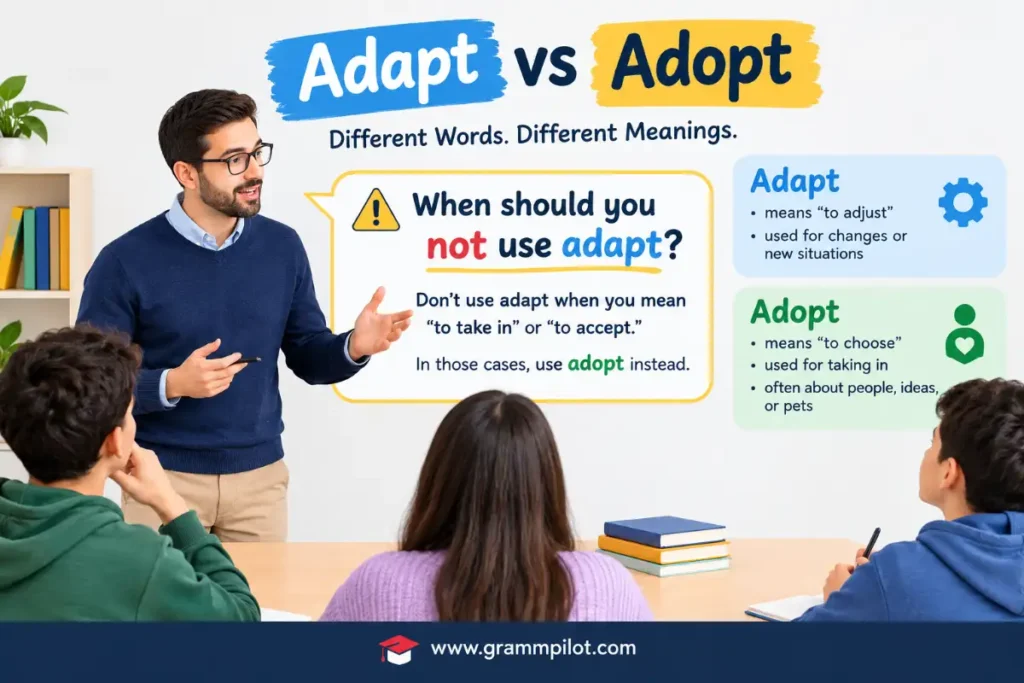
When should you not use adapt?
Don’t use adapt when your meaning is simply to accept or choose something.
Incorrect: “The board adapted the new policy.”
If the board officially chose the policy, use: “The board adopted the new policy.”
Also avoid adapt when the sentence is about legal adoption of a child.
Correct: “They adopted a child.”
Not: “They adapted a child.”
When should you not use adopt?
Don’t use adopt when you mean adjusting to circumstances.
Incorrect: “She adopted to the new environment.”
Correct: “She adapted to the new environment.”
Also don’t use adopt when you’re specifically describing changes made to an existing object or idea.
Example: “The author adapted the story for television.”
The story was modified.
What are the antonyms of adapt?
Possible opposites include:
- Resist
- Maintain
- Preserve
- Ignore
- Remain unchanged
- Stay the same
The exact opposite depends on context.
Example:
“The company adapted to the market.”
“The company refused to change.”
What are the antonyms of adopt?
Possible contrasts include:
- Reject
- Refuse
- Abandon
- Discard
- Decline
- Oppose
Example:
“The committee adopted the proposal.”
“The committee rejected the proposal.”
These are direct contrasts because one involves acceptance and the other involves refusal.
How do you choose the right word in an essay?
In academic writing, focus on what actually happened. Use adapt when something was changed for a specific purpose.
Example: “The researcher adapted the survey for younger participants.”
Use adopt when a person, organization, or group accepted a method, position, or policy.
Example: “The university adopted a new attendance policy.”
A useful question is:
Was it changed, or was it chosen?
Changed → adapt
Chosen → adopt
How do you choose the right word in texting?
Casual messages often use simpler words.
Instead of: “We need to adapt our approach.”
You might text: “We need to change our approach.”
Instead of: “We adopted a new plan.”
You could say: “We decided to use a new plan.”
Still, adapt and adopt are perfectly normal in texts when the context calls for them.
How do you choose the right word when speaking?
Think about whether you’re describing adjustment or acceptance.
“I had to adapt to my new job.”
You adjusted.
“I adopted a new morning routine.”
You chose and began using it.
That distinction works in everyday conversation.
What are 20+ original examples?
Here are examples from different real-world situations.
- The company adapted its website for mobile users.
- The school adopted a new attendance policy.
- I had to adapt to my new schedule.
- The team adopted a different strategy.
- The teacher adapted the lesson for beginners.
- Many workers adapted to remote work.
- The city adopted stricter recycling rules.
- The author adapted the novel for television.
- She adopted a healthier lifestyle.
- The business adapted its services to local customers.
- The committee adopted the proposal.
- The software was adapted for older devices.
- He quickly adapted to life in a new city.
- The hospital adopted a new safety procedure.
- We adapted the plan after the weather changed.
- The company adopted new security technology.
- The designer adapted the logo for smaller screens.
- The family decided to adopt a child.
- The athlete adapted his training after an injury.
- The organization adopted a more flexible schedule.
- The writer adapted her tone for younger readers.
- Employees had to adapt to the new system.
- The board adopted the recommendation.
- We adopted the new process after testing it.
- The product was adapted for international markets.
Notice how adapt usually involves fitting or changing, while adopt involves choosing or accepting.
Adapt vs Adopt: What is the best quick test?
Ask one of these questions:
Did I change it to fit?
Use adapt.
Did I accept or choose it?
Use adopt.
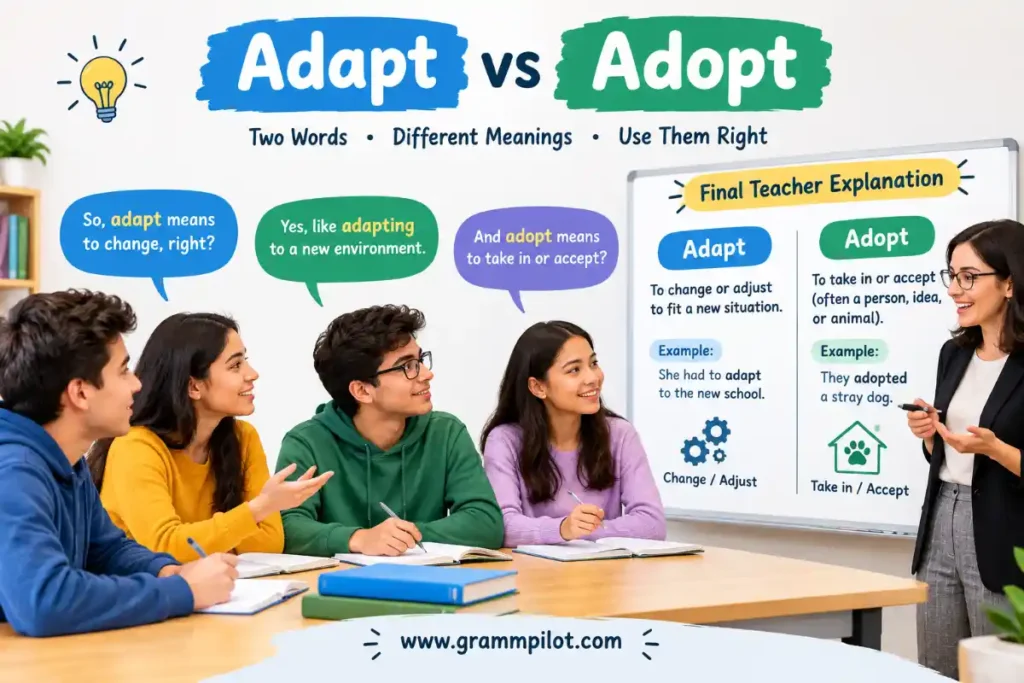
A final teacher explanation “Adapt vs Adopt”
The easiest way to separate these verbs is to remember two words:
Adapt = adjust.
Adopt = accept.
If something already exists and you change it so that it works in a different situation, adapt is the better choice.
“The teacher adapted the lesson.”
If you choose, accept, or begin using something, adopt fits.
“The school adopted a new curriculum.”
The words can appear together because one action may follow the other. A business can adopt new software and then adapt its workflow. A school can adopt a curriculum and adapt its lessons. One more clue is especially useful: adapt to is a common phrase. You adapt to a new environment, schedule, system, or situation. By contrast, you adopt a policy, idea, habit, method, or strategy. When in doubt, ask yourself: Am I changing something to make it fit, or am I choosing something to use? That question will usually give you the answer.
Conclusion
Adapt vs Adopt becomes much easier when you focus on the action behind each word. Adapt describes adjustment: something changes so it can work in a new environment, situation, purpose, or audience. Adopt describes acceptance or choice: a person or group takes an idea, method, policy, habit, or practice as its own.
Remember the shortest version: adapt means adjust, while adopt means accept or choose. Also watch for the useful phrase adapt to, as in “adapt to change.” Once you connect each verb with its core idea, you’ll be able to choose confidently in essays, business writing, emails, conversations, and everyday communication.
Frequently Asked Questions
1. What is the simple difference between adapt and adopt?
Adapt means to change or adjust something to fit a new situation, while adopt means to accept, choose, or begin using something.
2. Is it adapt to change or adopt to change?
The correct phrase is “adapt to change.” You adapt to a new situation because you adjust yourself or your behavior to fit it.
3. Is it adopt a strategy or adapt a strategy?
Both can be correct. Adopt a strategy means choose or begin using one, while adapt a strategy means modify it so it works better in a particular situation.
4. What’s another word for adapt?
Common alternatives include adjust, modify, alter, revise, tailor, and customize, depending on the context.
5. What’s another word for adopt?
Depending on the meaning, alternatives include accept, choose, embrace, approve, use, select, and take on.
6. Can a company adapt and adopt something at the same time?
Yes. A company can adopt a new system and then adapt its processes to work with it. The first action involves choosing; the second involves adjusting.
7. Which word is used for taking a child into a family?
The correct word is adopt. For example, “They decided to adopt a child.”