
Have you ever written an email, essay, resume, or text message and stopped at one tricky sentence? Maybe you wrote, “I don’t want to loose this opportunity,” and suddenly wondered if that spelling was right. Loose vs Lose is a common English confusion because the two words look similar and sound somewhat alike. Still, they have very different meanings and jobs in a sentence.
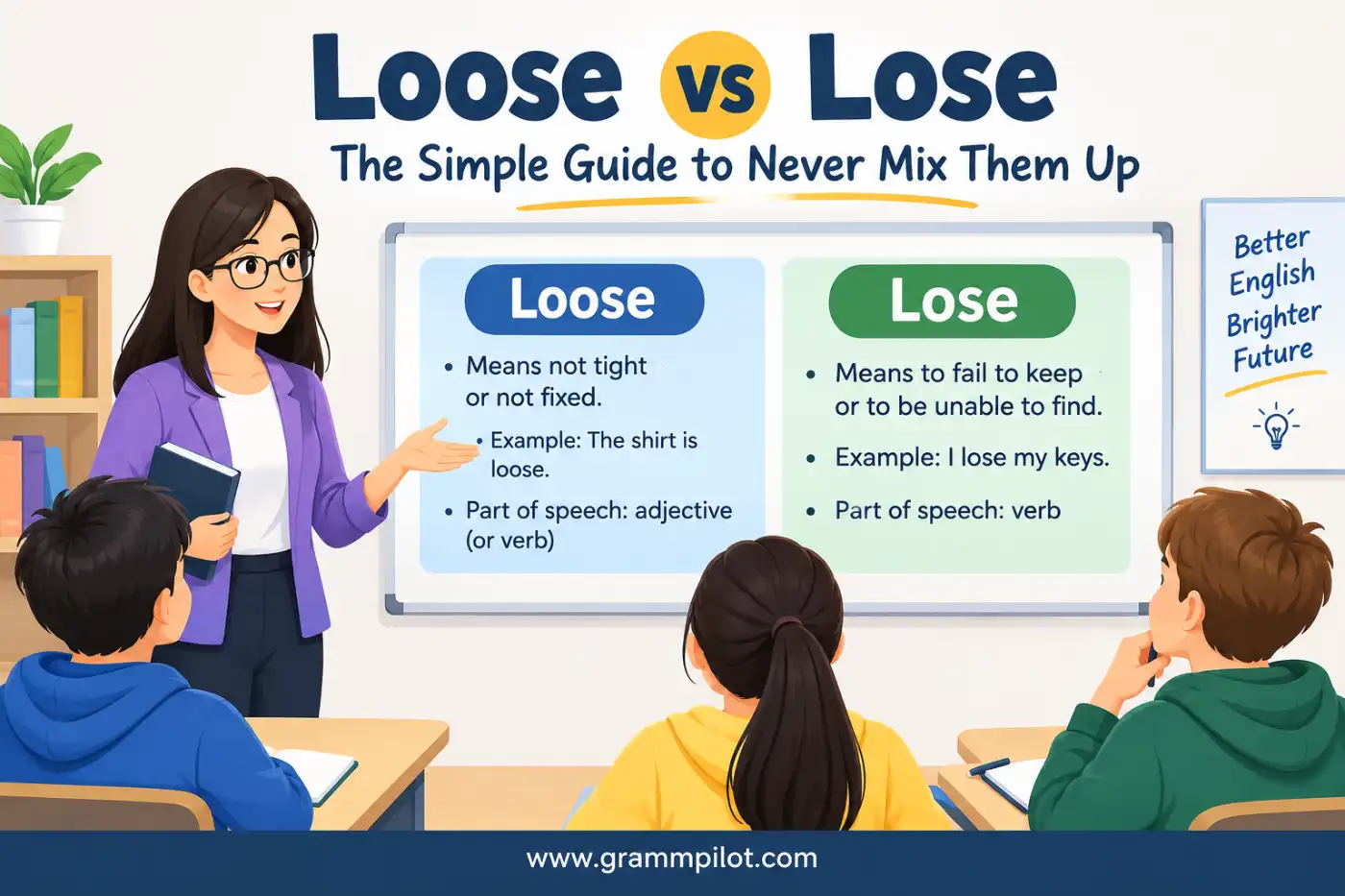
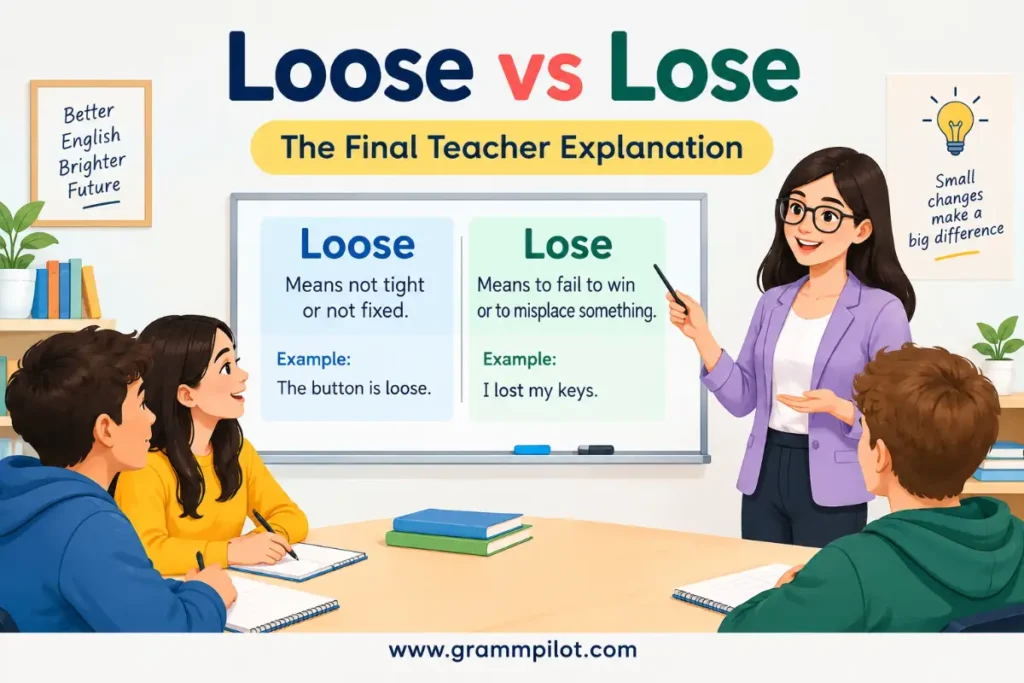
Quick answer: Loose usually means “not tight” or “free.” Lose usually means “to misplace something, fail to win, or no longer have something.” Remember: you can lose a game, but your shoes can be loose.
This guide explains the meaning, history, synonyms, grammar, examples, common mistakes, regional notes, context-based choices, and easy memory tricks that help you use these words correctly every time.
You may also want to learn the difference between [Principal vs Principle].
What do loose and lose mean in plain English?
The easiest way to understand these words is to separate their basic meanings.
What does “loose” mean?
Loose is usually an adjective. It describes something that is not tight, firmly attached, or controlled.
Examples:
- My shirt is too loose.
- There is a loose button on my jacket.
- The dog got loose in the yard.
- Keep the papers loose instead of putting them in a folder.
- His explanation was based on a loose idea rather than clear facts.
The main idea behind loose is a lack of tightness, control, or strong connection.
What does “lose” mean?
Lose is a verb. It describes an action or event in which you no longer have something, fail to keep something, or fail to win.
Examples:
- Don’t lose your keys.
- Our team might lose the game.
- She doesn’t want to lose her job.
- I always lose track of time when I’m reading.
- He may lose money on that investment.
The main idea behind lose is that something is gone, missed, failed, or no longer under your control
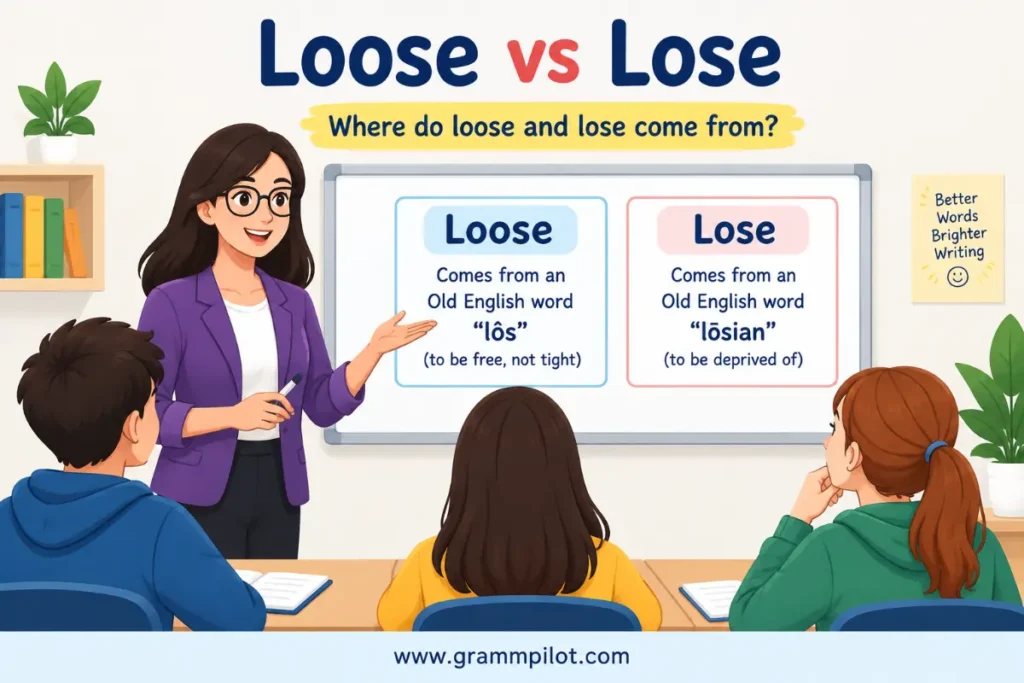
Where do loose and lose come from?
Word history can make a confusing pair easier to understand.
The origin of “loose”
Loose comes from older English and Germanic word forms connected with the idea of being free, released, or not fastened. That original idea still appears in modern English.
Think about these phrases:
- loose clothing
- loose hair
- loose screws
- loose animals
- loose change
- loose papers
In every case, something is free, not firmly attached, or not held tightly in place. The word can also describe ideas that are not exact or strict.
For example:
- a loose plan
- a loose definition
- a loose connection
Here, the meaning is not physical. Instead, it suggests something flexible, general, or not tightly organized.
The origin of “lose”
Lose comes from an older word connected with destruction, loss, or being separated from something. That history fits the modern meaning very well. When you lose something, you may:
- no longer have it
- fail to find it
- fail to win
- give up possession of it
- experience a reduction
Examples include:
- lose your wallet
- lose a game
- lose your job
- lose weight
- lose confidence
- lose interest
Although the words developed differently, their similar spelling now causes confusion for many writers.
Why are loose and lose so easy to confuse?
The biggest reason is spelling. Both words contain:
- l
- o
- s
- e
But loose has two O’s and a different vowel sound.
Compare them aloud:
- loose = rhymes with goose
- lose = rhymes with choose
The words may seem close on paper, but their sentence roles are also different.
For example:
- The rope is loose.
- Don’t lose the rope.
In the first sentence, loose describes the rope.
In the second sentence, lose describes an action.
That grammar difference gives you a powerful clue.
What are the different meanings of “loose”?
The word has more uses than many people realize.
1. Not tight
This is the most common meaning.
- My belt is loose.
- The shirt feels loose around the shoulders.
- These screws are loose.
2. Not firmly attached
Something may be partly connected but not secure.
- There is a loose tile on the floor.
- Check for loose wires.
- The door handle is loose.
3. Free to move
An animal, person, or object may not be controlled or held.
- The horse got loose.
- The dog is loose in the yard.
- Her hair came loose.
4. Not fixed together
This meaning often appears with objects.
- Keep the photos loose.
- The papers were loose inside the box.
- I prefer loose pages to a thick notebook.
5. Relaxed or not strict
The word can also describe rules, plans, or behavior.
- The company has a loose dress code.
- We followed a loose schedule.
- The group had a loose plan for the trip.
6. Approximate
Sometimes loose means not exact.
- That’s a loose estimate.
- We have a loose idea of what happened.
- The story is based on a loose version of real events.
What are the different meanings of “lose”?
The verb also has several important meanings.
1. To misplace something
- I don’t want to lose my passport.
- She lost her keys again.
- Did you lose your phone?
2. To fail to win
- Our team lost the game.
- I hate to lose.
- They may lose the election.
3. To no longer have something
- He lost his job.
- She lost her confidence.
- The company could lose customers.
4. To experience the death of someone
English speakers may say they “lost” a person when talking about death.
- She lost her grandfather last year.
- He lost a close friend.
This use is emotional and sensitive. It does not mean the person was physically misplaced.
5. To reduce something
- She wants to lose weight.
- The business lost money.
- The team lost momentum.
6. To fail to keep someone’s attention
- Don’t lose your audience.
- The speaker lost the crowd’s interest.
- The movie lost me halfway through.
7. To stop being able to see or follow something
- We lost sight of the car.
- I lost track of time.
- The hikers lost the trail.
Master synonym list for loose and lose
Because these two words have several meanings, their synonyms change depending on context. The best replacement is not always the most obvious one.
| Word | Meaning | Tone | Example |
|---|---|---|---|
| Free | Not controlled or held | Simple | The bird was finally free. |
| Unfastened | Not attached securely | Everyday | His jacket was unfastened. |
| Untied | Not tied together | Everyday | Her shoelaces were untied. |
| Slack | Not tight | Everyday | The rope became slack. |
| Relaxed | Not tense or strict | Everyday | The rules are relaxed here. |
| Open | Not closed or secured | Simple | Leave the gate open. |
| Detached | Separated from something | Formal | The piece became detached. |
| Unsecured | Not safely fixed | Formal | The load was unsecured. |
| Flexible | Not rigid or strict | Everyday | We have a flexible schedule. |
| Casual | Informal or relaxed | Everyday | It was a casual meeting. |
| Broad | Not narrow or strict | Formal | They used a broad definition. |
| Unrestricted | Not limited or controlled | Formal | Access is unrestricted. |
| Uncontrolled | Not under control | Formal | The fire became uncontrolled. |
| Released | Allowed to go free | Formal | The animal was released. |
| Unbound | Not tied or restricted | Literary/Formal | The pages were unbound. |
| Floppy | Soft and hanging loosely | Everyday | The hat was floppy. |
| Let go | Release something | Everyday | Let go of the rope. |
| Misplace | Put somewhere and not find | Everyday | I misplaced my glasses. |
| Fail | Not succeed | Formal | The plan may fail. |
| Forfeit | Give up or lose a right | Formal | They forfeited the match. |
| Drop | Fall or decrease | Everyday | Sales dropped last month. |
| Slip away | Gradually disappear | Everyday | The opportunity slipped away. |
A quick warning about synonyms
A synonym is not always a perfect replacement.
For example:
- lose your keys → misplace your keys works well.
- lose a game → misplace a game does not work.
- loose clothing → baggy clothing may work.
- loose rules → baggy rules does not work.
Always choose a synonym based on the exact meaning.
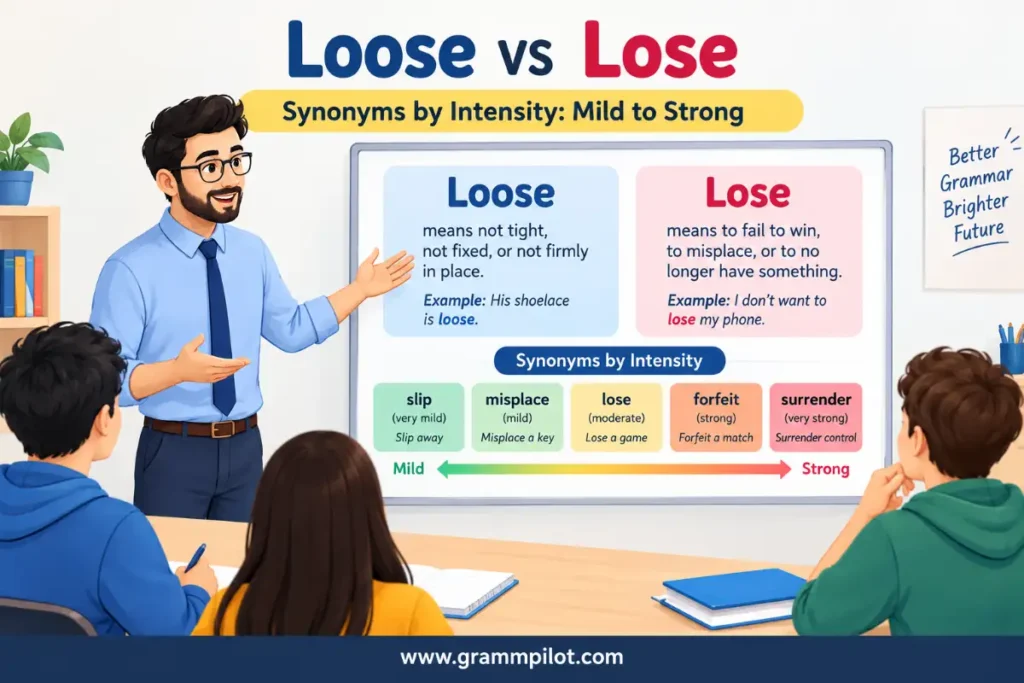
Synonyms by intensity: mild to strong
Some alternatives sound softer, while others suggest a more serious situation.
For something becoming loose
Mild → stronger
- relaxed
- slack
- loose
- unfastened
- detached
- disconnected
Example:
- The knot became relaxed.
- The rope became slack.
- The rope came loose.
- The rope became unfastened.
- One section became detached.
- The entire system became disconnected.
Each word changes the level or type of separation.
For losing something
Mild → stronger
- misplace
- miss
- lose
- forfeit
- surrender
Example:
- I misplaced my pen.
- I missed my chance.
- I lost the contract.
- The player forfeited the match.
- The group surrendered control.
The stronger choices often suggest greater consequences or a deliberate action.
Synonyms by part of speech
Adjective alternatives for “loose”
Depending on meaning, you might use:
- free
- slack
- relaxed
- unfastened
- detached
- unsecured
- flexible
- casual
- approximate
Examples:loose plan → flexible plan
- loose estimate → approximate estimate
Verb alternatives for “lose”
Depending on context, you might use:
- misplace
- miss
- forfeit
- surrender
- drop
- fail
- give up
Examples:
- lose your phone → misplace your phone
- lose the game → be defeated.
Loose vs Lose in American and British English
The core meanings are the same in both American and British English.
A speaker in the United States and a speaker in the United Kingdom would both say:
- The screw is loose.
- Don’t lose your wallet.
- We lost the match.
There is no major spelling difference between American and British English for these two words.
However, some related expressions may differ by region.
For example, lose one’s temper, lose track of time, and come loose are widely understood across English-speaking countries.
Informal vocabulary around these ideas may change from place to place. A British speaker might choose a different casual expression than an American speaker, but the words loose and lose themselves remain stable.
What is the best word for a resume?
For professional documents, precision matters.
Use “lose” carefully and specifically
A resume usually focuses on achievements, skills, and results. You probably won’t often need lose, but it can appear in business contexts.
Less strong: Helped the company avoid losing customers.
Stronger: Helped improve customer retention and reduce customer loss.
Or: Developed strategies that reduced customer churn.
The second versions sound more professional because they focus on measurable outcomes.
Use “loose” when describing flexible or informal systems
You might describe a process as loosely structured, but be careful. In many resumes, words such as flexible, adaptable, or cross-functional may communicate the idea more clearly.
Example: Worked within a flexible project structure to support changing priorities.
That often sounds stronger than: Worked in a loose project structure.
What is the best word for an essay?
Essays require accuracy and clear meaning.
Use “loose” for broad or flexible ideas
Example: The term is often used in a loose sense.
You could also write:
- The term is often used broadly.
- The definition remains flexible.
Use “lose” for decline, failure, or separation
Example:
- The policy could cause the company to lose public trust.
Other strong choices may include:
- weaken public trust
- damage public trust
- reduce public confidence
Choose the verb that best explains what is happening.
What is the best word for texting?
Texting is more casual, so short and natural wording works best.
Examples:
- Don’t lose it.
- My shoelace came loose.
- I always lose my charger.
- This shirt is too loose.
- I don’t want to lose our chat.
In casual writing, you can still use correct spelling without sounding formal.
A simple memory check helps:
Thing not tight? Loose. Something gone? Lose.
What is the best word for an email?
Emails can be casual or professional, so context matters.
Casual email
- I don’t want to lose the document, so I’m attaching another copy.
- The handle on the package seems loose.
Professional email
- Please let me know if the attachment is missing.
- We don’t want to lose important customer information.
- One component appears to be loose and may need inspection.
In formal emails, avoid vague wording when a more exact word is available.
For example:
Instead of: The system lost information.
Consider: The system failed to save the information.
That sentence explains the problem more clearly.
Loose vs Lose: 15 real-life examples
Here are original examples from everyday situations.
- My backpack strap is too loose, so it keeps sliding off my shoulder.
- Don’t lose your boarding pass before you get to the gate.
- One wheel on the office chair feels loose.
- We may lose the customer if we don’t answer quickly.
- Her hair came loose during the game.
- I always lose track of time when I’m talking to my best friend.
- The dog’s collar was too loose, so we adjusted it.
- If you lose your password, use the account recovery page.
- A loose screw can cause a bigger problem later.
- The team refused to give up, even when it looked like they would lose.
- The company’s dress code is fairly loose.
- Be careful not to lose the receipt.
- These jeans are comfortable because they have a loose fit.
- The hikers almost lost the trail after sunset.
- The old photo was loose inside the book.
Loose vs slack: What’s the difference?
These words overlap, but they are not identical.
| Loose | Slack |
|---|---|
| General word for not tight | Often describes reduced tension |
| Can describe clothes, rules, screws, animals, ideas | Common with ropes, muscles, effort, and systems |
| Broad everyday use | More specific in many contexts |
Examples:
- My shirt is loose.
- The rope is slack.
You could sometimes call a rope loose, but slack gives a clearer picture of reduced tension.
Another difference appears in figurative language.
- loose rules = not strict
- slack effort = not enough effort
You would not normally say loose effort when you mean lazy or weak effort.
Lose vs miss: What’s the difference?
These verbs can both involve failure, but they focus on different things.
Use “lose” when something was yours or under your control
- lose money
- lose a game
- lose your job
- lose your keys
Use “miss” when you fail to catch, attend, notice, or experience something
- miss the bus
- miss a meeting
- miss a chance
- miss a call
Compare:
- I lost my job.
- I missed my interview.
The first means the person no longer has the job.
The second means the person failed to attend the interview.
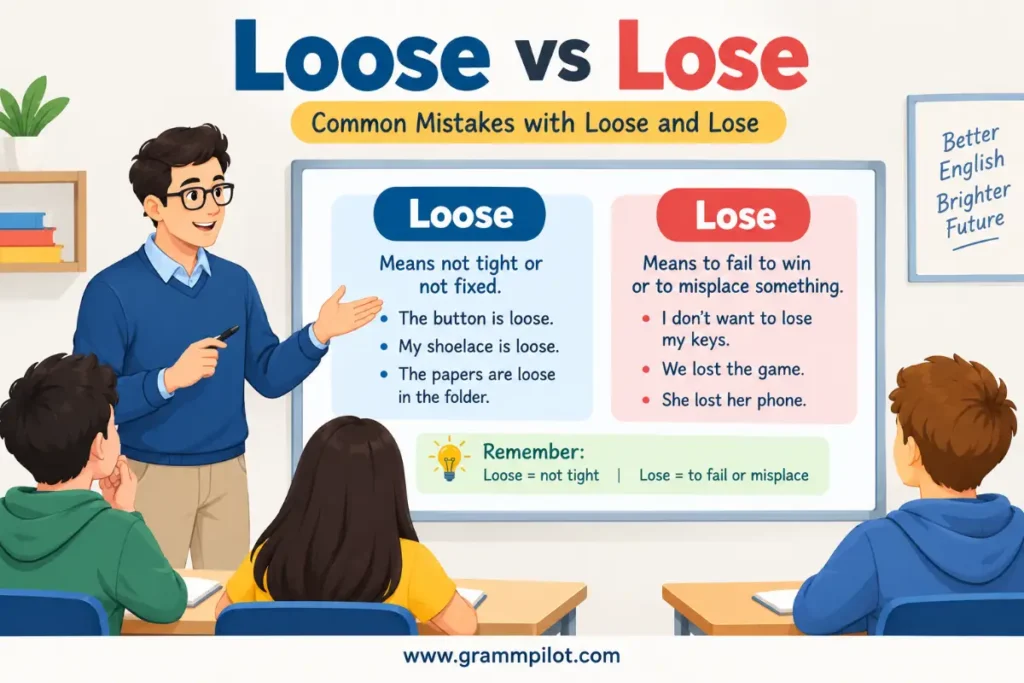
Common mistakes with loose and lose
Mistake 1: Writing “loose” when you mean “lose”
Incorrect: I don’t want to loose this chance.
Correct: I don’t want to lose this chance.
Why? The sentence describes failing to keep an opportunity.
Mistake 2: Writing “lose” when you mean “loose”
Incorrect: My shoes are too lose.
Correct: My shoes are too loose.
Why? The sentence describes the condition of the shoes.
Mistake 3: Forgetting the past tense
The past tense of lose is lost, not “loosed” in this meaning.
Correct: I lost my wallet yesterday.
Not: I loosed my wallet yesterday.
The word loosed exists, but it has a different meaning related to releasing or setting something free. It is uncommon in modern everyday English.
Mistake 4: Using “loose” as a verb when you mean “release”
In some older or formal uses, loose can function as a verb meaning “to release.” However, this is much less common today.
For most modern writing, use:
- release
- let go
- free
- loosen
Example:
- He loosened the knot.
- She released the bird.
These are clearer than using an unusual form of loose.
Mistake 5: Confusing “loose” with “loosen”
This is another common problem.
Loose is usually an adjective.
Loosen is a verb meaning “make less tight.”
Compare:
- The lid is loose.
- Loosen the lid.
Another example:
- My belt is loose.
- Loosen your belt.
What are the antonyms of loose?
The best antonym depends on the meaning.
Common opposites include:
- tight
- secure
- fastened
- attached
- fixed
- controlled
- strict
- exact
Examples:
- loose shirt ↔ tight shirt
- loose screw ↔ secure screw
- loose rules ↔ strict rules
- loose estimate ↔ exact estimate
What are the antonyms of lose?
Possible opposites include:
- find
- win
- keep
- gain
- retain
- recover
- secure
Examples:
- lose keys ↔ find keys
- lose a game ↔ win a game
- lose a job ↔ keep a job
- lose money ↔ gain money
- lose confidence ↔ regain confidence
Again, context matters. There is no single antonym that works for every meaning.
How can you remember the difference between loose and lose?
Try one of these simple tricks.
Memory trick 1: Loose has extra O’s
Loose has two O’s.
Think of the two O’s as giving the word extra room.
Extra room = something is not tight.
Loose = more space
Memory trick 2: Lose is about something going away
When you lose something, it may disappear from your possession.
Think:
- lose your keys
- lose a game
- lose money
Something is gone or no longer yours.
Memory trick 3: Use a rhyme
Loose rhymes with:
- goose
- moose
Lose rhymes with:
- choose
- shoes
Say these sentences aloud:
- The goose got loose.
- Choose not to lose.
They sound different enough to help your memory.
Quick tips for choosing the right word
Use this checklist before you hit send, submit, or publish.
Choose “loose” when:
- something is not tight
- something is not firmly attached
- something is free to move
- rules are not strict
- an idea is broad or approximate
Examples:
- loose clothing
- loose wire
- loose schedule
- loose definition
Choose “lose” when:
- you cannot find something
- you fail to win
- you no longer have something
- something decreases
- you fail to keep attention, control, or an opportunity
Examples:
- lose your phone
- lose the match
- lose your job
- lose money
- lose focus
Ask a grammar question
Can you say:
- lost
- losing
- loses
If yes, you probably need the verb lose.
Example:
- I lose my keys.
- I lost my keys.
- I am losing my keys.
If you are describing a thing or condition, loose may be correct.
- The keys are loose in my pocket.
How does context change the meaning?
Context can completely change what a word suggests.
Consider lose:
- lose your keys = misplace an object
- lose a game = fail to win
- lose weight = reduce body weight
- lose patience = become less patient
- lose a loved one = experience someone’s death
- lose business = experience fewer customers
Now consider loose:
- loose shirt = not tight
- loose tooth = not firmly attached
- loose rules = not strict
- loose plan = flexible
- loose connection = not firmly joined
- loose translation = not exact or literal
That is why memorizing one short definition is not enough. Understanding context gives you better control over the language.
Which word should you use in professional writing?
Professional writing rewards precision.
Here are some stronger alternatives by situation.
| Situation | Basic Word | More Precise Option |
|---|---|---|
| Customer problem | lose customers | experience customer churn |
| Missing object | lose a file | misplace a file |
| Failed process | lose data | fail to save data |
| Flexible plan | loose plan | flexible plan |
| Not strict rules | loose rules | relaxed guidelines |
| Inexact number | loose estimate | approximate estimate |
You do not always need a more formal word. Simple English is often best.
The goal is not to sound complicated. The goal is to be clear.
How do loose and lose work in everyday conversations?
Here are a few natural mini-dialogues.
At home
A: Is the shelf safe?
B: I think one screw is loose.
Before leaving
A: Do you have everything?
B: I hope so. I don’t want to lose my wallet again.
During a game
A: We’re down by two points.
B: Don’t worry. We can still win.
Shopping
A: How do these jeans feel?
B: A little loose around the waist.
At work
A: Why are we checking the report again?
B: We don’t want to lose any important details.
These examples show how natural the words sound when used in the right setting.
Final practice: Can you choose the correct word?
Try these before checking the answers.
- Don’t _ your ticket.
- The chair leg feels _.
- Our team doesn’t want to _.
- Her necklace came _.
- I always _ track of time on weekends.
- The company follows fairly _ guidelines.
- Be careful not to _ the receipt.
- This jacket is too _ for me.
- We could _ the client if we ignore the problem.
- One of the wires is _.
Answers
- lose
- loose
- lose
- loose
- lose
- loose
- lose
- loose
- lose
- loose
If you got a few wrong, don’t worry. This pair becomes much easier with repeated use.
Conclusion
Loose vs Lose becomes simple once you focus on meaning instead of spelling alone. Use loose when something is not tight, firmly attached, or strictly controlled. Use lose when something goes missing, is no longer kept, decreases, or fails to win. The best habit is to pause and ask what your sentence is describing. Is it a condition, such as a loose button? Or is it an action or result, such as losing your keys? That one small check can prevent one of the most common spelling mistakes in English.
Frequently Asked Questions
1. Is it “loose” or “lose” weight?
Use lose weight. Lose is the correct verb because you are reducing or no longer carrying the same amount of weight. “Loose weight” is incorrect in this meaning.
2. Is it “loose” or “lose” a game?
Use lose a game. You lose when you fail to win. A team can lose a match, competition, or race.
3. What’s another way to say “lose” something?
Another common way to say it is misplace, especially when you think the item can still be found. For more serious situations, you might use forfeit, give up, or surrender, depending on context.
4. Why do people confuse Loose vs Lose?
Loose vs Lose is confusing because the words look similar and have related letters, but they have different meanings and grammar roles. Loose is usually an adjective, while lose is a verb.
5. Can “loose” be used as a verb?
Yes, but it is uncommon in modern everyday English. Older or formal usage may use it to mean “release,” but words such as loosen, release, or free are usually clearer.
6. What is the easiest trick to remember loose and lose?
Remember that loose has two O’s and usually describes something with extra space or less tightness. Lose describes something you no longer have, keep, or win.
7. Is Loose vs Lose pronounced differently?
Yes. Loose rhymes with “goose,” while lose sounds like the verb in “choose.” Pronouncing them aloud can help you remember the difference.