

Have you ever been writing an email, essay, resume, or text and stopped because you weren’t sure about to write elicit vs illicit? The two words look and sound similar, but they describe completely different ideas. Choosing the wrong one can change the meaning of a sentence. Elicit vs Illicit is easy to understand once you connect each word with its main idea. Elicit means to draw out a response, reaction, answer, or information. Illicit means illegal, forbidden, or not officially allowed.
Quick answer: Use elicit when you mean “draw out” or “get a response.” Use illicit when you mean “illegal,” “forbidden,” or “unlawful.”
These words appear in professional writing, academic essays, interviews, news reports, conversations, and everyday communication. This guide explains their origins, meanings, synonyms, intensity levels, common mistakes, context-specific uses, and practical examples so you can choose the right word quickly.
If you’re not sure which word belongs in a sentence, our guide to [Farther vs Further] may help.
What is the difference between elicit and illicit?
The basic distinction is straightforward:
Elicit = draw out or obtain something.
Illicit = illegal, forbidden, or unauthorized.
| Word | Part of speech | Main meaning | Example |
|---|---|---|---|
| Elicit | Verb | Draw out a response, answer, reaction, or information | The question elicited an honest response. |
| Illicit | Adjective | Illegal, forbidden, or unauthorized | The police discovered an illicit operation. |
Consider these examples:
The teacher asked a question to elicit discussion.
The teacher wanted to draw discussion out of the students.
The investigation uncovered an illicit business.
The business was illegal or unauthorized.
The words aren’t interchangeable. One describes an action of obtaining or bringing something out; the other describes something that violates a rule or law.
What does elicit mean in plain English?
Elicit means to get something from someone or cause a particular response.
That “something” might be:
- an answer
- a reaction
- a feeling
- information
- a comment
- a memory
- a response
- a laugh
- an explanation
- a confession
For example:
The teacher’s question elicited several thoughtful answers.
The question caused students to give answers.
The photograph elicited an emotional reaction.
The photograph caused people to react emotionally.
The interviewer tried to elicit more information.
The interviewer tried to get more information.
The key idea is bringing something out.
How is elicit used as a verb?
Elicit is a verb, so it describes an action.
Common patterns include:
1.elicit + a response
2.elicit + information
3.elicit + an answer
4.elicit + a reaction
Examples:
The survey elicited useful feedback.
Her question elicited a surprising answer.
The reporter elicited important details from the witness.
Notice that the subject is usually something that causes or draws out the response.
What does illicit mean in plain English?
Illicit is an adjective meaning illegal, forbidden, unauthorized, or not permitted by a particular rule or law.
Examples:
The company was accused of selling illicit products.
Police discovered an illicit operation.
The report described an illicit trade network.
The word usually carries a negative meaning because it refers to conduct or activities that are not allowed. However, illicit doesn’t always mean criminal in exactly the same way. Something can be illicit because it violates a law, rule, agreement, or accepted restriction.
How is illicit used in everyday English?
Common expressions include:
- illicit activity
- illicit trade
- illicit drugs
- illicit payments
- illicit dealings
- illicit transactions
- illicit goods
- illicit behavior
- illicit business
- illicit relationship
The exact meaning depends on the context.
For example: The company was investigated for illicit payments.
The payments were unlawful or prohibited.

Where did elicit come from?
Elicit comes from Latin roots associated with drawing or bringing something out. That history fits its modern meaning very well. When you elicit a response, you’re figuratively pulling that response out.
For example: The question elicited an answer.
The answer was drawn out by the question. This is why elicit often appears with words such as response, reaction, information, and answer. The word has been used in English for centuries and has developed into a useful formal verb for describing the process of obtaining something through questioning, prompting, or stimulation.
Where did illicit come from?
Illicit also has Latin roots. Its history is connected with the idea of something being prohibited or not legally permitted. That meaning remains clear today. If something is illicit, it is outside what is legally or officially allowed.
For example: The authorities investigated illicit trade.
The trade was prohibited. The shared Latin background helps explain why the words look somewhat alike, but their meanings developed along different paths.
Why do elicit and illicit sound so similar?
The pronunciation is one of the main reasons people confuse these words. Both begin with an il-/el- sound, and their endings are similar. In many accents, they can be especially easy to mix up when spoken quickly. Unlike words with completely different sounds, these two require you to understand the sentence.
Compare: The question elicited a response.
versus: The activity was illicit.
The first sentence describes getting something out.
The second describes something forbidden.
When writing, don’t choose based on how the word sounds. Choose based on what you mean.
What is the easiest memory trick for elicit?
Think: Elicit = Extract
Both words begin with an idea of getting something out.
You can also connect:
elicit → answer
elicit → response
If you can replace the word with draw out, obtain, or prompt, elicit is probably correct.
For example: The question elicited a response.
You could say: The question drew out a response.
The meaning stays similar.
What is the easiest memory trick for illicit?
Think:
Illicit = Illegal
Both words begin with il-, which can help you remember that illicit is associated with something not allowed.
You can also connect:
illicit → illegal
illicit → forbidden
For example: The company was involved in illicit activities.
You could replace illicit with: illegal activities
The meaning remains close.
The memory pair is simple:
Elicit = extract a response.
Illicit = illegal or forbidden.
What are the main uses of elicit?
How do you use elicit for answers?
This is one of the most common uses.
The teacher asked a question to elicit an answer.
The teacher wanted students to respond.
Other examples:
The interviewer asked follow-up questions to elicit a clearer answer.
The exam question elicited several different answers.
The manager’s question elicited a detailed explanation.
How do you use elicit for information?
Use elicit when someone is trying to obtain information through questions, conversation, observation, or another method.
Examples:
The detective tried to elicit information from the witness.
The survey was designed to elicit information about customer preferences.
The interviewer elicited useful details during the conversation.
This use is especially common in professional and academic writing.
How do you use elicit for reactions?
Something can elicit a reaction when it causes people to respond emotionally or physically.
Examples:
The joke elicited laughter from the audience.
The announcement elicited surprise.
The photograph elicited an emotional reaction.
The reaction is being brought out by something.
How do you use elicit for emotions?
You can use elicit with feelings such as:
- fear
- anger
- sympathy
- excitement
- sadness
- curiosity
- concern
- laughter
- surprise
Examples:
The story elicited sympathy from readers.
The announcement elicited excitement among the students.
The speech elicited strong emotions.
What are the main uses of illicit?
How do you use illicit for illegal activities?
This is one of the most common uses.
Examples:
The authorities investigated illicit activities.
The organization was accused of illicit dealings.
The report examined illicit trade.
The adjective modifies a noun and tells you that the activity is prohibited.
How do you use illicit for money or payments?
Illicit can describe money obtained or transferred through unlawful means.
Examples:
The investigation uncovered illicit payments.
Officials were accused of accepting illicit funds.
The company was investigated over illicit financial transactions.
This wording is common in journalism, law, and formal reports.
How do you use illicit for goods?
Examples:
Authorities seized illicit goods.
The border agency intercepted an illicit shipment.
The investigation focused on the sale of illicit products.
The word tells the reader that the goods or trade are prohibited. Here, the word does not necessarily identify a specific crime. It indicates that the relationship violates a rule, expectation, or accepted boundary.
What is the master synonym list for elicit and illicit?
Because elicit and illicit have different parts of speech and meanings, their synonyms need to be separated.
| Word | Meaning | Tone | Example |
|---|---|---|---|
| Draw out | Get something from someone | Everyday | The teacher drew out an answer. |
| Obtain | Get something | Formal | Researchers obtained useful data. |
| Get | Receive or acquire | Simple | We got a response. |
| Prompt | Cause a response | Neutral | The question prompted discussion. |
| Produce | Cause something to appear | Neutral | The change produced a reaction. |
| Evoke | Bring a feeling or memory to mind | Formal | The song evoked memories. |
| Inspire | Cause a feeling or action | Positive | The speech inspired confidence. |
| Encourage | Help cause a response or action | Neutral | The question encouraged discussion. |
| Invite | Encourage a response | Neutral | The topic invited debate. |
| Solicit | Ask for or seek | Formal | The company solicited feedback. |
| Extract | Obtain, often with effort | Strong/Formal | The lawyer extracted more details. |
| Uncover | Discover hidden information | Neutral | Investigators uncovered new evidence. |
| Prompt | Cause or encourage | Neutral | The question prompted an answer. |
| Covert | Hidden or secret | Formal | The operation was covert. |
| Contraband | Goods that are prohibited | Formal/Legal | Officials seized contraband. |
| Smuggled | Illegally transported | Neutral | Officers found smuggled goods. |
| Black-market | Related to illegal trade | Everyday/Formal | The goods entered a black-market network. |
| Shady | Suspicious or dishonest | Slang/Informal | The business seemed shady. |
| Bogus | Fake or illegitimate | Informal | The company used bogus documents. |
Not every synonym is a accurate replacement. For example, evoke often relates to memories, feelings, or images, while elicit is broader and can involve answers or information. Similarly, illegal is more directly connected to breaking the law, while illicit can sometimes cover things that are prohibited or unauthorized even when the exact legal status depends on context.

What are synonyms for elicit from mild to strong?
Different verbs suggest different levels of effort or intensity.
What are mild alternatives to elicit?
Use:
- invite
- encourage
- prompt
- inspire
- bring out
Example: The question encouraged discussion.
This sounds gentle.
What are moderate alternatives?
Use:
- obtain
- gather
- generate
- evoke
- solicit
- draw out
Example: The survey solicited feedback from customers.
What are stronger alternatives?
Use:
- provoke
- trigger
- extract
- force out
These can suggest a stronger reaction or greater effort.
For example: The comment provoked an angry response.
The reaction is stronger than a simple response to a neutral question.
What are synonyms for illicit from mild to strong?
The intensity depends on the situation.
What are milder alternatives?
- unauthorized
- unapproved
- improper
- restricted
These can describe violations without directly emphasizing criminal conduct.
What are moderate alternatives?
- prohibited
- forbidden
- unlawful
- banned
These clearly indicate that something isn’t permitted.
What are stronger alternatives?
- illegal
- criminal
- illicit
- unlawful activity
These can carry a strong legal or negative implication. Be careful with criminal because it specifically suggests conduct associated with a crime.
What are the parts of speech for elicit and illicit?
The difference is important.
Elicit is a verb.
Illicit is an adjective.
| Word | Part of Speech | Correct Example |
|---|---|---|
| Elicit | Verb | The question elicited a response. |
| Elicited | Past tense | The question elicited concern. |
| Eliciting | Present participle | She was eliciting information. |
| Illicit | Adjective | The activity was illicit. |
| Illicitly | Adverb | The goods were obtained illicitly. |
You cannot normally use illicit where a verb is required.
Incorrect: The question illicit a response.
Correct: The question elicited a response.
Likewise, elicit doesn’t describe an illegal activity.
Incorrect: The company was involved in elicit trade.
Correct: The company was involved in illicit trade.
What is the difference between elicit and evoke?
These words overlap, but they aren’t always interchangeable.
Elicit often means getting a response, answer, reaction, or information.
Evoke often means bringing a feeling, image, memory, or association to mind.
| Elicit | Evoke |
|---|---|
| The question elicited an answer. | The photograph evoked memories. |
| The survey elicited feedback. | The music evoked sadness. |
| The comment elicited criticism. | The smell evoked childhood memories. |
You can sometimes use either word for an emotional reaction.
The speech elicited emotion.
The speech evoked emotion.
But elicit is more flexible when the response is information or a direct answer.
What is the difference between elicit and provoke?
Provoke usually suggests causing a strong reaction, often negative.
Elicit is more neutral.
Compare:
The question elicited a thoughtful response.
The question simply brought out the response.
The insult provoked an angry reaction.
The insult caused a strong emotional reaction.
Use elicit when you want neutral wording.
Use provoke when the cause-and-effect relationship is stronger or more emotionally charged.
What is the difference between illicit and unauthorized?
Unauthorized means not officially permitted or approved.
It does not necessarily mean that something is illegal.
For example: The employee made an unauthorized purchase.
The purchase wasn’t approved.
That doesn’t automatically tell us if it broke a law.
By contrast: The company was involved in illicit transactions.
This carries a stronger implication that the transactions were unlawful or prohibited.
What is the difference between illicit and unethical?
These words should not be treated as exact synonyms.
Unethical means morally wrong or inconsistent with accepted ethical standards.
Illicit means illegal, forbidden, or unauthorized.
Something can be unethical without being illegal. For example: The manager’s behavior was unethical. That doesn’t necessarily mean the manager committed a crime. Likewise, something can be prohibited by law even when people disagree about its morality.
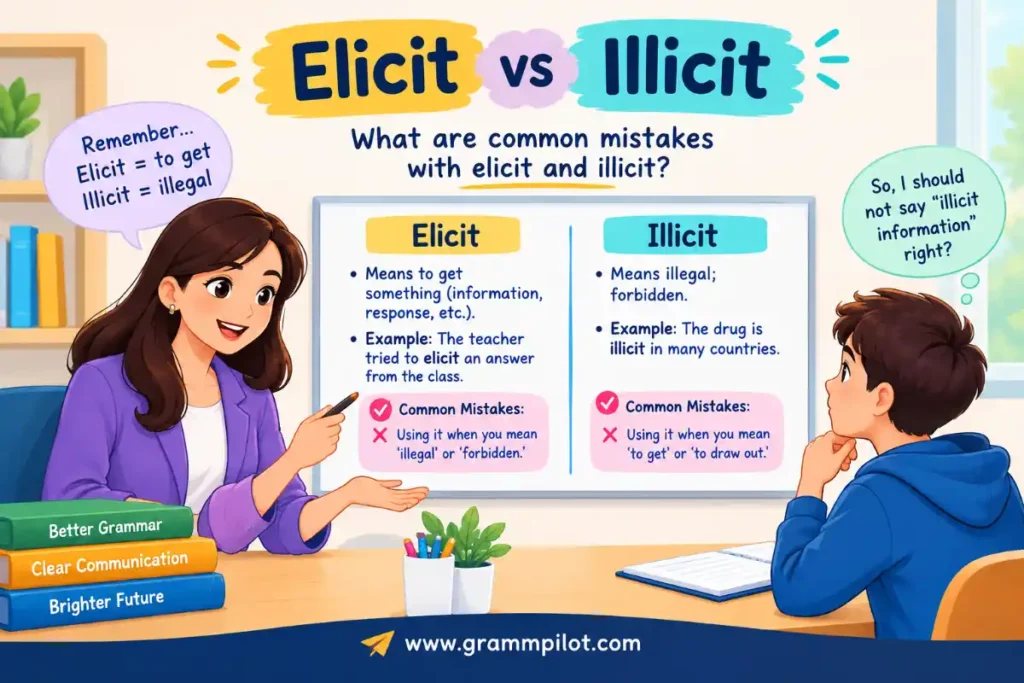
What are common mistakes with elicit and illicit?
Mistake 1: Using illicit when you mean obtain
Incorrect: The survey illicit several responses.
Correct: The survey elicited several responses.
The survey brought the responses out.
Mistake 2: Using elicit for illegal activity
Incorrect: The police investigated elicit trade.
Correct: The police investigated illicit trade.
The trade was prohibited or unlawful.
Mistake 3: Confusing elicited with illicit
These words can be especially confusing in past-tense sentences.
The question elicited a response.
Here, elicited is the past tense of elicit.
The response involved illicit activity.
Here, illicit is an adjective.
The extra -ed in elicited can help you recognize that you’re looking at a verb.
Mistake 4: Assuming illicit always means criminal
Although illicit often relates to illegal activity, it can also describe something prohibited or unauthorized. The exact legal meaning depends on context.
Mistake 5: Using elicit when evoke is more precise
The photograph elicited memories can work, but evoked memories may sound more natural when the focus is on memories coming to mind.The best word depends on the type of response.
When should you not use elicit?
Don’t use elicit simply because something happens afterward. The word suggests that something actively draws out or causes a response.
For example: The meeting elicited a response from the manager.
This suggests the meeting or its discussion brought out the response. If two events merely happened in sequence, another verb may be more accurate. Also, don’t use elicit when you simply mean choose, select, or receive without the idea of drawing something out.
When should you not use illicit?
Don’t use illicit merely to mean unusual, unpopular, or secret. Something can be secret without being illegal.
For example: They planned a surprise party secretly.
The party isn’t illicit.
Likewise, something can be unusual without being prohibited. Use illicit when the context supports the idea of something forbidden, unlawful, or unauthorized.
Are there US and UK differences?
There is no major spelling difference between American and British English for elicit and illicit.
Both varieties use:
elicit = draw out or obtain
illicit = illegal, forbidden, or unauthorized
The pronunciation can vary slightly by speaker or accent, but the spelling distinction remains the same. The words also appear in formal writing in both varieties of English.
Which word should you use in a resume?
Elicit is useful in resumes when describing communication, research, interviewing, or customer-feedback skills.
Examples:
Elicited customer feedback to identify service improvements.
Elicited detailed responses during client interviews.
Used targeted questions to elicit useful information.
Illicit is less common in ordinary resumes unless your work specifically involves law enforcement, compliance, investigations, security, or financial crime. For example: Investigated illicit financial transactions. That sentence makes sense in an investigative or compliance role.
Which word should you use in an essay?
Both words can be useful in academic writing.
Use elicit when discussing responses, research findings, reactions, or information.
The survey elicited different responses from participants.
Use illicit when discussing illegal or prohibited activity.
The study examined the effects of illicit trade on local communities.
Because both words are somewhat formal, they’re especially useful in essays when the meaning fits.
Which word should you use in texting?
Elicit is appropriate when you’re talking about getting a response.
“That question really elicited some funny answers.”
“I was trying to elicit a reaction.”
Illicit is appropriate when discussing something illegal or prohibited.
“The report mentions illicit activity.”
In casual texting, simpler words such as get, cause, or illegal may sound more natural.
For example: “I was trying to get a reaction.”
may be more conversational than: “I was trying to elicit a reaction.”
Which word should you use in an email?
Use elicit when describing the goal of a question, survey, interview, or request.
Example: The survey is designed to elicit feedback from customers.
Use illicit when describing prohibited conduct.
Example: The investigation uncovered evidence of illicit transactions.
In professional communication, accuracy matters because these words can change the seriousness and meaning of a statement.
Which word should you use when speaking?
In speech, the context is especially important because the words sound similar.
If you’re talking about getting an answer:
“The question elicited a response.”
If you’re describing unlawful behavior:
“The activity was illicit.”
If you’re unsure while speaking, use a simpler alternative. For elicit, you might say: get, draw out, or prompt. For illicit, you might say: illegal, forbidden, or unauthorized.
What are 10+ original examples of elicit and illicit?
- The teacher’s question elicited several thoughtful answers.
- The investigation uncovered an illicit trading operation.
- The survey elicited useful feedback from customers.
- The company was accused of making illicit payments.
- Her story elicited laughter from the audience.
- The reporter tried to elicit more information from the official.
- Authorities seized goods believed to be illicit.
- The photograph elicited strong emotional reactions.
- The interviewer used open-ended questions to elicit detailed responses.
- The report examined the effects of illicit trade.
- The announcement elicited concern among employees.
- The investigation focused on illicit financial activity.
- The teacher changed the question to elicit a clearer answer.
- The organization was accused of facilitating illicit transactions.
- The documentary elicited sympathy for the affected families.
- The border officers intercepted an illicit shipment.
What are the antonyms of elicit?
The opposite depends on the context.
Possible contrasts include:
- suppress
- conceal
- withhold
- prevent
- discourage
- silence
- hide
For example:
elicit a response ↔ suppress a response
elicit information ↔ withhold information
There isn’t one universal antonym because elicit can apply to different kinds of responses.
What are the antonyms of illicit?
Possible opposites include:
- legal
- lawful
- permitted
- authorized
- approved
- legitimate
- acceptable
- legitimate
For example:
illicit ↔ legal
illicit ↔ lawful
Again, the best opposite depends on the context.
What quick tips help you choose the right word?
Use this checklist whenever you’re unsure.
Does the word mean “draw out”?
Use elicit.
Does it mean “get a response”?
Use elicit.
Does it mean “prompt a reaction”?
Use elicit.
Does it describe something illegal?
Use illicit.
Does it describe something forbidden?
Use illicit.
Does it describe unauthorized activity?
Usually use illicit.
Can you replace the word with “obtain” or “draw out”?
Choose elicit.
Can you replace it with “illegal” or “forbidden”?
Choose illicit.
A second useful trick is to look at the grammar.
If the word describes an action:
The question elicited…
you probably need elicit.
If the word describes a noun: illicit activity
you probably need illicit.
What should you remember about elicit and illicit?
The central difference is only a few words long:
Elicit means to draw something out.
Illicit means illegal or forbidden.
When a teacher asks a question and gets an answer, the question elicits the answer. When authorities discover prohibited activity, that activity may be illicit. The same rule works in business writing, essays, resumes, emails, journalism, and everyday communication. Don’t let the similar spelling fool you. Ask what the sentence is trying to say.
If you’re trying to get something out, choose elicit.
If you’re describing something not allowed, choose illicit.

Conclusion
Elicit vs Illicit becomes much easier when you focus on the core meanings rather than their similar sounds. Elicit is a verb meaning to draw out, obtain, or bring forth a response, answer, feeling, or piece of information. Illicit is an adjective describing something illegal, forbidden, prohibited, or unauthorized. A quick memory trick is elicit = extract and illicit = illegal. Use elicit when a question brings out an answer or an event causes a reaction. Choose illicit when you’re describing prohibited activity, goods, payments, or conduct. Both words are useful in formal and everyday writing, and neither has a major US-versus-UK spelling difference. Once you connect each word with its meaning, choosing the correct spelling becomes much easier.
Frequently Asked Questions
1. What is the difference between elicit and illicit?
Elicit means to draw out or obtain a response, answer, reaction, or information, while illicit means illegal, forbidden, or unauthorized. They sound similar but have completely different meanings.
2. How can I remember elicit and illicit?
Remember elicit = extract and illicit = illegal. If you’re drawing out a response, use elicit; if you’re describing something prohibited, use illicit.
3. What’s another way to say elicit?
Another way to say elicit is draw out, obtain, prompt, evoke, generate, or bring out, depending on the context.
4. Is illicit the same as illegal?
Illicit often means illegal, but it can also describe something forbidden or unauthorized. Illegal is more specifically connected to violating the law.
5. Should I say elicit a response or illicit a response?
Say elicit a response. The verb elicit means to draw a response out, while illicit is an adjective and cannot be used that way.
6. Can elicit and evoke be used interchangeably?
Sometimes, but not always. Both can describe causing a reaction, but elicit commonly refers to answers, information, and responses, while evoke often refers to feelings, memories, images, or associations.
7. Is illicit always related to crime?
No, illicit can also mean forbidden or unauthorized. Although it frequently appears in contexts involving illegal activity, the exact meaning depends on what rule, law, or restriction has been violated.