
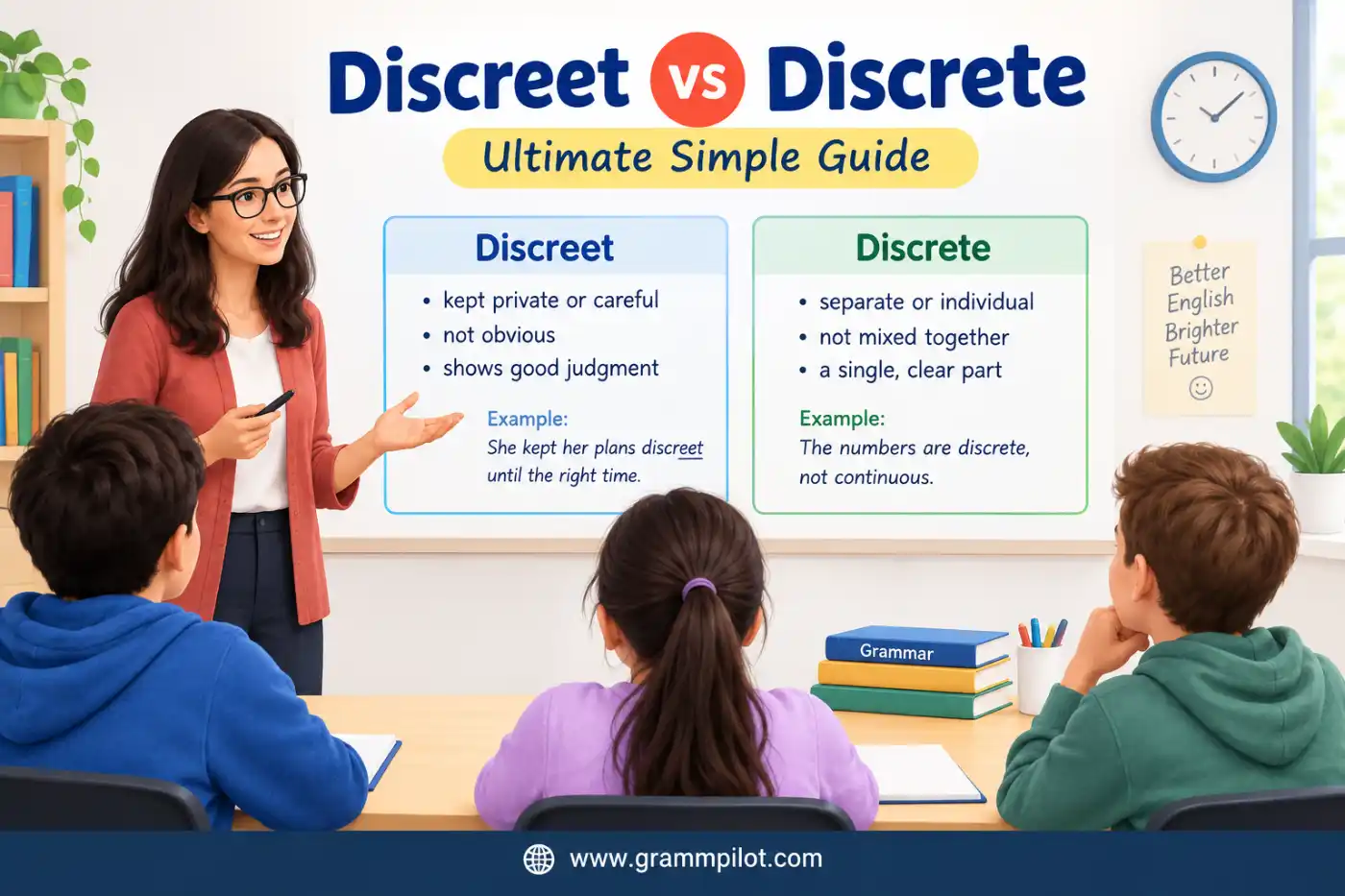
Have you ever been writing an email, essay, resume, or text and paused over discreet vs discrete? They look almost identical, and they sound the same in standard English. Yet their meanings are completely different. One is about being careful and private, while the other is about being separate or distinct. Discreet vs Discrete has a simple distinction: discreet describes someone or something that avoids attracting attention or keeps information private. Discrete describes things that are separate, distinct, or individually identifiable.
Quick answer: Use discreet for privacy, tact, or avoiding attention. Use discrete for separate, distinct, or individually defined things.
The difference matters in everyday conversation as well as professional and academic writing. Below, you’ll find the word origins, plain-English meanings, a large synonym guide, intensity levels, context-based examples, common mistakes, regional notes, and quick memory tricks.
You can also compare this with the words discussed in [Elicit vs Illicit].
What is the difference between discreet vs discrete?
The simplest distinction is:
Discreet = careful and private
Discrete = separate and distinct
| Word | Meaning | Example |
|---|---|---|
| Discreet | Careful about privacy or attention | She was discreet about the sensitive information. |
| Discrete | Separate or individually distinct | The machine has several discrete components. |
Compare these sentences:
The receptionist was discreet about the customer’s situation.
She handled the situation privately and tactfully.
The report contains three discrete sections.
The sections are separate and clearly identifiable. The words are pronounced the same, so spelling alone can cause trouble.
Discreet vs Discrete: What does discreet mean in plain English?
Discreet means careful about what you say or do, especially when privacy, secrecy, or other people’s feelings are involved. A discreet person doesn’t unnecessarily reveal information or draw attention to a sensitive situation.
Examples:
Please be discreet about the meeting.
She asked for a discreet conversation.
He was discreet about his friend’s personal problem.
The word often suggests good judgment and tact.
Discreet vs Discrete: How is discreet used in everyday English?
You might describe someone as discreet when they:
- keep private information private
- avoid embarrassing someone
- don’t attract unnecessary attention
- behave tactfully
- handle sensitive situations carefully
- avoid making something obvious
For example: She gave me a discreet signal to leave.
The signal was subtle and didn’t attract attention.
Can discreet describe an object?
Yes. An object or service can be described as discreet when it is designed to be unobtrusive or not draw attention.
Examples:
The camera has a discreet design.
The security system is discreet.
She chose a discreet piece of jewelry.
Here, discreet means subtle or unobtrusive.
Discreet vs Discrete: What does discrete mean in plain English?
Discrete means separate, distinct, or individually identifiable.
If things are discrete, you can distinguish one from another.
Examples:
The study divided participants into three discrete groups.
The machine has five discrete settings.
The data was divided into discrete categories.
The word is common in mathematics, science, technology, business, and academic writing.
How is discrete different from discreet?
The easiest question is: Are you talking about privacy or separation? If you’re talking about privacy, tact, or avoiding attention: discreet If you’re talking about separate or distinct things: discrete
For example: He was discreet about the company’s plans.
Privacy: The company has discrete departments for sales and support.
Separate departments.
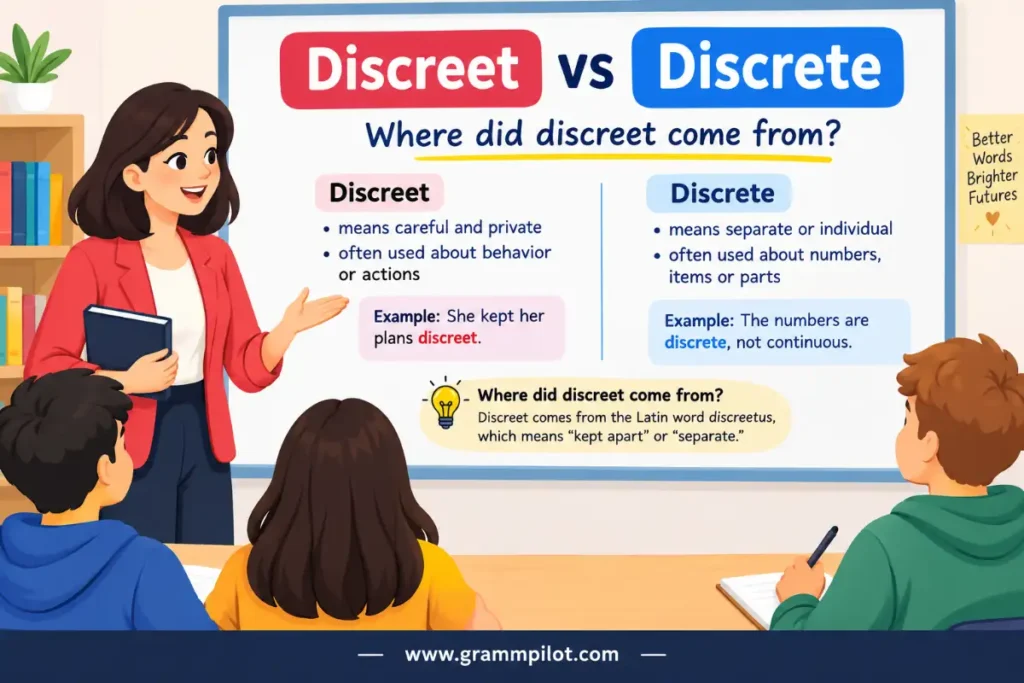
Discreet vs Discrete: Where did discreet come from?
Discreet comes from Old French and Latin roots associated with being discerning, wise, or capable of making good judgments. Its historical meaning developed around the idea of having good sense and knowing what is appropriate. That explains its modern meaning.
A discreet person knows when to speak, when not to speak, and how to handle sensitive matters.
For example: The assistant was discreet when handling confidential documents.
The assistant used good judgment and protected the information.
Discreet vs Discrete: Where did discrete come from?
Discrete comes from the same broad Latin family as discreet, but its meaning developed differently. It is connected to the idea of separating or distinguishing things.
That gives us the modern sense: discrete = separate, distinct, individually identifiable
For example: The researcher identified four discrete categories.
The categories are separate from one another. The two words therefore have related histories but different modern meanings.
Why do discreet and discrete sound the same?
They are homophones in standard English.
Homophones are words that sound alike but have different meanings and spellings.
Other examples include:
- right / write
- flower / flour
- peace / piece
- their / there / they’re
- complement / compliment
- discreet / discrete
Because pronunciation doesn’t help you choose the spelling, context is the key.
Discreet vs Discrete: What is the easiest memory trick for discreet and discrete?
Use this: Discreet = secret
The two words don’t rhyme perfectly in spelling, but secret can remind you of privacy.
Think: Discreet → keep it private.
For discrete, think: Discrete → separate.
You can also remember the -ete ending in discrete as suggesting something that is “distinct.”
Another useful pair:
discreet = tact
discrete = apart
If you’re unsure, ask:
“Am I talking about how carefully someone behaves?”
→ discreet
“Am I talking about separate things?”
→ discrete
What are the main uses of discreet?
How do you use discreet for privacy?
Examples:
Please be discreet about this conversation.
She was discreet about the employee’s personal situation.
The lawyer handled the matter discreetly.
He asked me to keep the discussion discreet.
The idea is protecting information or avoiding unwanted attention.
How do you use discreet for behavior?
Examples:
The waiter was discreet when the couple discussed their finances.
She gave him a discreet warning.
The assistant discreetly left the room.
The person is behaving carefully and tactfully.
How do you use discreet for appearance?
Examples:
She wore a discreet necklace to the formal event.
The security camera was discreet.
The logo is small and discreet.
Here, the word means subtle or unobtrusive.
What are the main uses of discrete?
How do you use discrete for separate groups?
Examples:
The researchers studied three discrete populations.
The students were divided into discrete groups.
The survey contains five discrete categories.
Each group is treated as separate.
How do you use discrete in technology?
Examples:
The device has several discrete operating modes.
The computer contains discrete components.
The system processes the information in discrete units.
The word is useful when individual parts or values can be distinguished.
How do you use discrete in mathematics?
In mathematics, discrete refers to things that are separate or countable rather than continuously varying.
Examples include:
- whole numbers
- individual data points
- separate categories
- countable objects
For example:
The graph represents discrete values.
This means the values occur as separate points rather than as every possible value along a continuous range.
What is the master synonym list for discreet vs discrete?
Because the two words have different meanings, their synonyms should be grouped according to the intended sense.
| Word | Meaning | Tone | Example |
|---|---|---|---|
| Private | Kept from public view | Neutral | They had a private conversation. |
| Tactful | Careful not to offend | Neutral | She gave a tactful response. |
| Careful | Acting with caution | Neutral | He was careful with the information. |
| Quiet | Not attracting attention | Neutral | They held a quiet discussion. |
| Confidential | Intended to remain private | Formal | The document is confidential. |
| Unobtrusive | Not attracting attention | Formal | The camera is unobtrusive. |
| Tactful | Sensitive and diplomatic | Neutral/Formal | Her answer was tactful. |
| Diplomatic | Carefully managing sensitive matters | Formal | He gave a diplomatic response. |
| Reserved | Not openly expressive | Neutral | She is reserved around strangers. |
| Different | Not the same | Neutral | The two groups are different. |
| Isolated | Separated from others | Neutral | The samples were isolated. |
| Separable | Able to be separated | Formal | The components are separable. |
| Individualized | Treated separately | Formal | The program offers individualized plans. |
| Apart | At a distance from something else | Everyday | The chairs were placed apart. |
| Stand-alone | Existing independently | Everyday/Technical | The product is a stand-alone system. |
| Partitioned | Divided into separate sections | Formal/Technical | The database is partitioned. |
| Segmented | Divided into parts | Formal | The market was segmented. |
| Individualized | Designed for separate needs | Formal | Each plan is individualized. |
Not every word is a direct replacement. For example, secretive can suggest that someone is deliberately hiding information, which is not always positive. Discreet is often more positive because it suggests tact and good judgment. Likewise, isolated can imply that something is cut off from others, while discrete simply means separate or distinguishable.
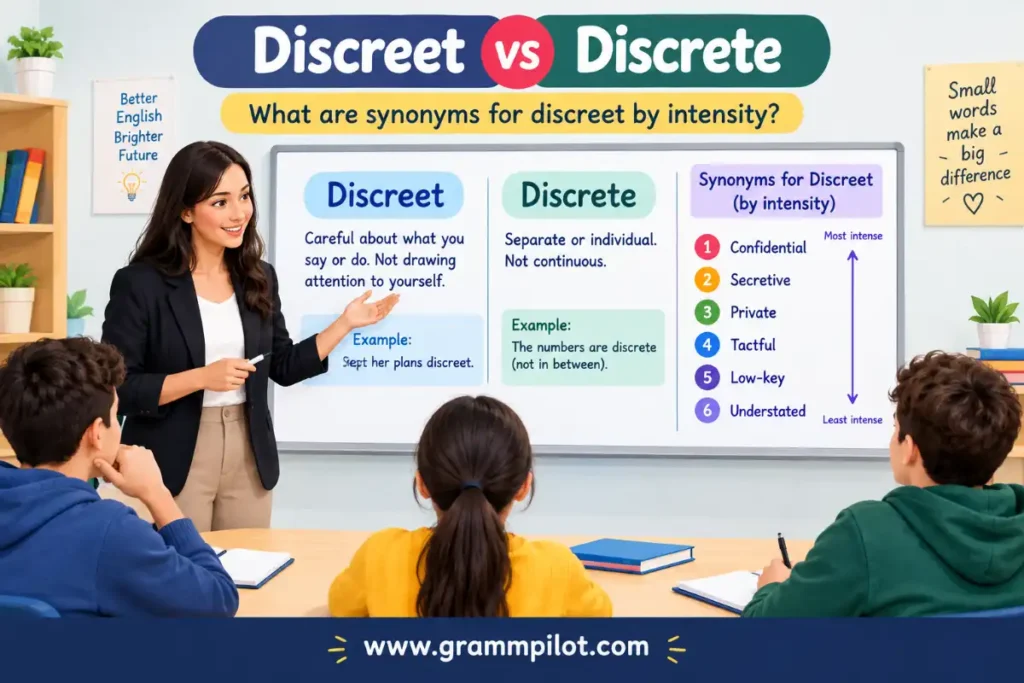
Discreet vs Discrete: What are synonyms for discreet by intensity?
The strength of the word can change depending on context.
What are mild alternatives to discreet?
For a soft, neutral sense, use:
- quiet
- subtle
- private
- reserved
- low-key
- unobtrusive
Example:
She chose a subtle design for the room.
What are moderate alternatives to discreet?
For stronger emphasis on careful behavior:
- tactful
- cautious
- diplomatic
- careful
- circumspect
Example: The manager was tactful when discussing the employee’s mistake.
What are strong alternatives to discreet?
When secrecy or strict privacy is central:
- confidential
- highly private
- secretive
- closely guarded
- concealed
Be careful with secretive. It can sound negative.
What are synonyms for discrete by intensity?
The meaning of discrete is less about emotional intensity and more about how clearly things are separated.
Mild alternatives
- different
- separate
- individual
- distinct
Stronger separation
- isolated
- independent
- disconnected
- self-contained
- autonomous
For example: The project has four separate sections.
This is simple and neutral.
The system contains four independent modules.
This suggests a stronger degree of separation.
What are the related parts of speech?
Both discreet and discrete are primarily adjectives.
| Word | Part of Speech | Related Form | Example |
|---|---|---|---|
| Discreet | Adjective | Discreetly | She handled the issue discreetly. |
| Discreet | Adjective | Discretion | He showed discretion. |
| Discrete | Adjective | Discretely | The components were analyzed discretely. |
| Discrete | Adjective | Discreteness | The system has a degree of discreteness. |
The most common related noun is important: discretion
means good judgment about what to say, do, or reveal.
Example: Please use discretion when sharing this information.
Do not confuse this with discretionary, which means something decided according to judgment or choice.
Discreet vs Discrete: What is the difference between discreet and discretion?
Discreet is an adjective.
Discretion is a noun.
Compare:
She was discreet about the matter.
She handled the matter with discretion.
Both sentences describe careful treatment of sensitive information.
The related adverb is: discreetly
Example: He discreetly left the meeting.
What is the difference between discrete and discretely?
Discrete is the adjective.
Discretely is the adverb.
Examples:
The system has discrete components.
The components were analyzed discretely.
In everyday writing, discrete is much more common.
What is the difference between discreet and secretive?
These words are related but have different tones.
| Discreet | Secretive |
|---|---|
| Usually positive or neutral | Often negative or suspicious |
| Shows tact | Suggests hiding information |
| Avoids unnecessary attention | Deliberately keeps things hidden |
| Can involve professional judgment | Can suggest distrust |
Compare:
She was discreet about the client’s personal information.
This sounds professional.
She was secretive about the client’s personal information.
This may suggest that she was hiding something. Choose discreet when you want to praise careful behavior.
What is the difference between discreet and private?
Private means not public or intended for limited people. Discreet focuses more on how someone behaves or handles something.
Compare:
This is a private conversation.
The conversation isn’t meant for everyone.
She was discreet during the private conversation.
She behaved carefully and did not attract attention.
A person can be private without necessarily being discreet, and someone can act discreetly in a public setting.
What is the difference between discreet and subtle?
Subtle means not obvious, noticeable, or strong.
Discreet often means avoiding attention or handling something tactfully.
Compare:
She gave me a subtle signal.
The signal was difficult to notice.
She gave me a discreet signal.
She gave the signal carefully without attracting attention.
The meanings overlap, but they emphasize different ideas.
What is the difference between discrete and separate?
These words are very close. Separate is a broad everyday word. Discrete is often more precise and formal, especially when individual units or categories are clearly identifiable.
Compare:
The files are stored in separate folders.
Simple everyday language.
The dataset contains several discrete categories.
More technical or academic language.
In many everyday situations, separate is more natural.
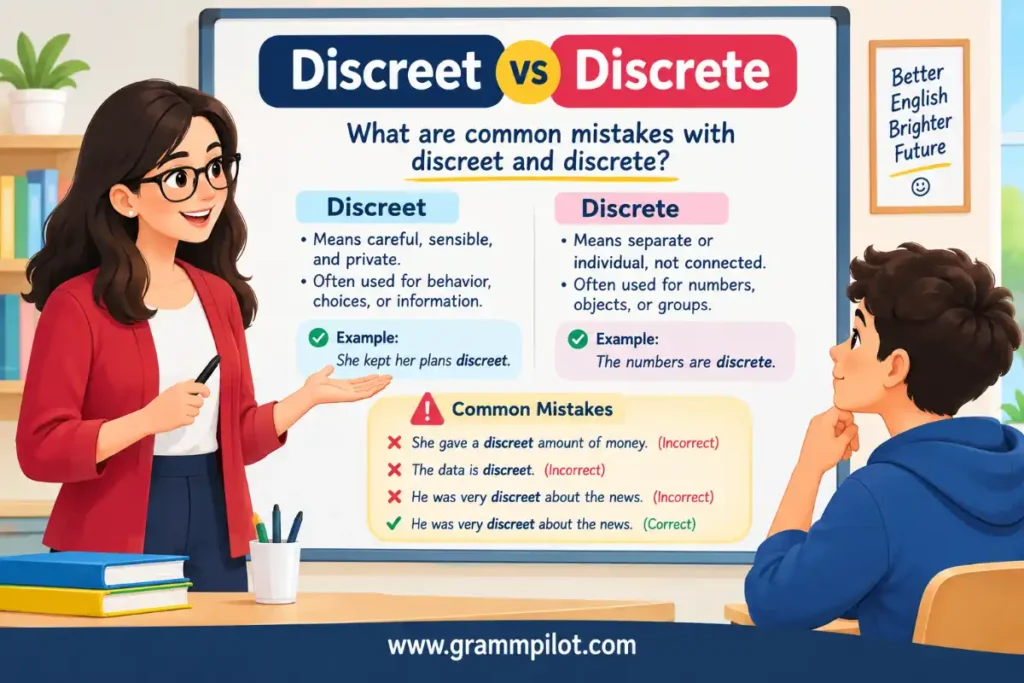
What are common mistakes with discreet and discrete?
Mistake 1: Using discrete for privacy
Incorrect: Please be discrete about my personal information.
If you mean “careful and private,” use: Please be discreet about my personal information.
Mistake 2: Using discreet for separate groups
Incorrect: The experiment used three discreet groups.
If you mean separate groups, write: The experiment used three discrete groups.
Mistake 3: Confusing discretion with discreteness
Discretion is about careful judgment. Discreteness is about being separate or distinct.
Example: She showed discretion when discussing the issue.
versus: The discreteness of the categories made the data easier to analyze.
The second word is much more technical.
Mistake 4: Assuming “secret” always means discreet
A discreet person doesn’t necessarily hide everything.
The word can simply mean that they avoid unnecessary attention.
For example: The receptionist gave a discreet signal.
The signal was subtle, not necessarily secret.
Mistake 5: Thinking discrete means “different in every way”
Discrete things are separate or individually identifiable, but they don’t necessarily have to be completely different.
For example: The survey has five discrete response categories.
The categories are separate even though they may be related.
When should you not use discreet?
Don’t use discreet when you mean that objects or categories are mathematically or physically separate.
For example:
The graph contains four discrete data points.
Here, discrete is correct. Using discreet would incorrectly suggest privacy or tact.
When should you not use discrete?
Don’t use discrete when you’re describing someone’s careful handling of private information.
For example: She was discreet about the customer’s complaint.
Here, discreet is correct. Using discrete would change the meaning completely.
Discreet vs Discrete: Are there US and UK differences?
There is no major American-versus-British spelling difference for discreet and discrete.
Both varieties use:
discreet = tactful, private, unobtrusive
discrete = separate, distinct, individually identifiable
The words are also pronounced alike in standard usage. The main issue is choosing the correct spelling according to meaning.
Which word should you use in a resume?
Discreet can be useful when describing professional handling of confidential matters.
Example: Maintained discreet communication with high-profile clients.
However, you may want a more precise professional phrase: Handled confidential client communications with discretion.
Discrete can appear in technical or analytical resumes.
Example: Analyzed discrete data sets to identify performance trends.
If your work involves separate units, categories, systems, or data points, discrete may be appropriate.
Which word should you use in an essay?
Both words can work in formal writing.
Use discreet when describing tactful behavior: The researcher was discreet when discussing the participant’s personal information.
Use discrete when describing separate categories or units: The researchers divided the results into four discrete categories.
Academic writing often uses discrete in scientific, mathematical, and analytical contexts.
Which word should you use in texting?
Discreet is more likely in everyday texting.
Examples:
“Please be discreet about this.”
“Can you be discreet?”
“She gave me a discreet signal.”
Discrete is less common in casual texting unless you’re discussing school, science, technology, or data.
For example: “The program has three discrete stages.”
That would be perfectly natural in a technical conversation.
Which word should you use in an email?
Use discreet when discussing privacy: Please be discreet when discussing this matter with the client.
Use discrete when describing separate items: The report contains four discrete sections.
In professional emails, confusing these words can create an unintended meaning, especially when discussing confidential information.
Which word should you use when speaking?
Because the words sound the same, your pronunciation won’t distinguish them. The context has to do the work.
If you say: “Please be discreet.”
The listener understands that you mean tactful or private.
If you say: “The categories are discrete.”
The listener understands that the categories are separate. The spelling only becomes visible when you write the words.
What are 10+ original examples of discreet vs discrete?
- Please be discreet about the client’s personal information.
- The researcher divided the participants into three discrete groups.
- She gave me a discreet signal during the meeting.
- The machine has five discrete operating settings.
- The receptionist handled the complaint in a discreet manner.
- The report contains four discrete sections.
- He was discreet when discussing the employee’s situation.
- The data was divided into discrete categories.
- The security camera has a discreet design.
- The system is made up of several discrete components.
- She discreetly left the room after the conversation.
- The experiment measured several discrete outcomes.
- The manager asked the team to be discreet about the upcoming changes.
- Each department operates as a discrete unit.
- He chose a discreet location for the conversation
- The survey offers six discrete response categories.
What are the antonyms of discreet?
Possible opposites include:
- obvious
- conspicuous
- careless
- indiscreet
- tactless
- loud
- attention-seeking
- revealing
For example:
discreet ↔ conspicuous
discreet ↔ indiscreet
The exact opposite depends on what aspect of discreet you mean.
What are the antonyms of discrete?
Possible opposites include:
- continuous
- connected
- combined
- unified
- integrated
- continuous-flow
- inseparable
For example: discrete values ↔ continuous values
This contrast is especially common in mathematics and data analysis.
You might also contrast: discrete components ↔ integrated system
depending on the technical context.
Discreet vs Discrete: What quick tips help you choose the right word?
Use this checklist:
Is it about privacy?
Use discreet.
Is it about tact?
Use discreet.
Is it about avoiding attention?
Use discreet.
Is it about separate things?
Use discrete.
Is it about distinct categories?
Use discrete.
Is it about individual data points or values?
Use discrete.
Can you replace the word with “tactful”?
Use discreet.
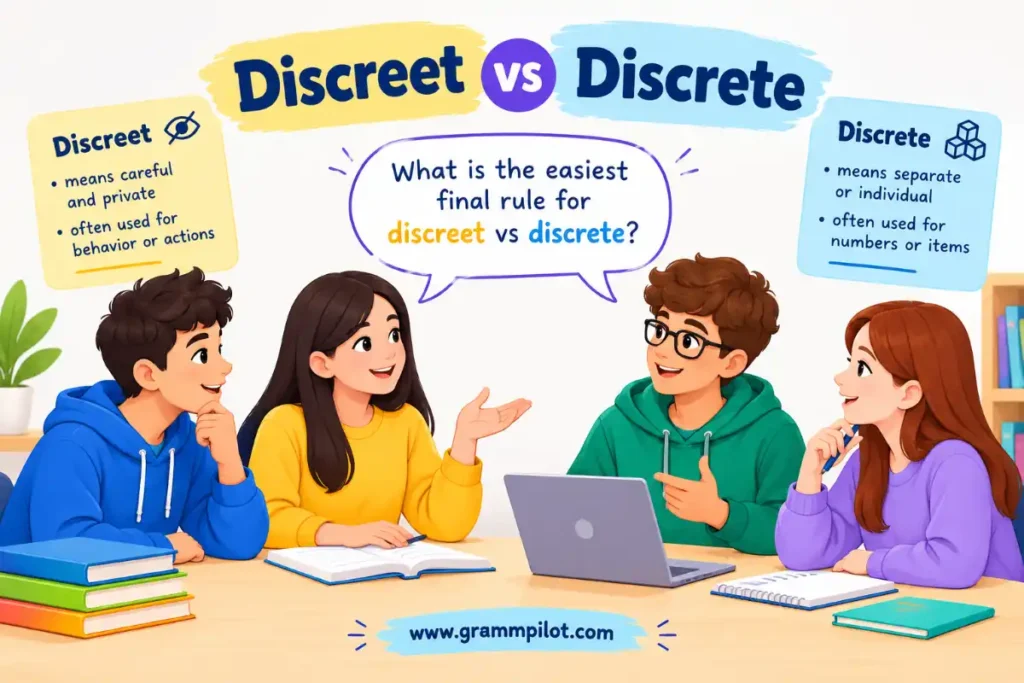
What is the easiest final rule for discreet vs discrete?
Think of two short phrases:
Discreet = keep it quiet.
Discrete = keep it separate.
If someone handles a sensitive issue without attracting attention, they’re discreet. If a system contains individually identifiable parts, those parts are discrete. This distinction works in casual conversation, professional writing, academic papers, technical documents, and everyday emails.
Conclusion
Discreet vs Discrete is easier once you separate the meanings instead of relying on pronunciation. Discreet describes careful, tactful, private, or unobtrusive behavior. Discrete describes things that are separate, distinct, or individually identifiable. A useful memory trick is discreet = keep it quiet and discrete = keep it separate. Use the first word for confidential conversations, subtle actions, and low-profile designs. Choose the second for data categories, independent units, separate groups, and clearly defined components. Both words are standard in American and British English, so the real challenge is meaning rather than regional usage. When you’re unsure, ask whether you’re describing privacy or separation. That quick test will usually give you the right spelling.
Frequently Asked Questions
1. What is the difference between discreet vs discrete?
Discreet means careful, private, tactful, or unobtrusive, while discrete means separate, distinct, or individually identifiable. They sound the same but have different meanings.
2. How do I remember discreet vs discrete?
Remember discreet = keep it quiet and discrete = keep it separate. Privacy and tact point to discreet, while separate groups, categories, or units point to discrete.
3. What’s another way to say discreet?
Another way to say discreet is tactful, private, subtle, careful, diplomatic, or unobtrusive, depending on the context.
4. Is it discreet or discrete information?
Use discreet when you mean information is handled privately or carefully. For example, “She was discreet about the confidential information.”
5. Should I say discrete groups or discreet groups?
Use discrete groups when you mean the groups are separate or distinct. Use discreet only when you’re describing careful or private behavior.
6. Is discreet the same as secretive?
Not exactly. Discreet usually suggests tact and good judgment, while secretive can suggest that someone is deliberately hiding information and may have a negative tone.
7. Is discrete the same as separate?
They are close, but separate is more general and common in everyday English. Discrete often sounds more precise or technical when describing clearly defined units, categories, or values.