

Bring vs Take is one of the most confusing grammar pairs in English. Have you ever written a text like “Should I bring this to your house?” and then wondered if take would be better? These two verbs are easy to mix up because both describe moving something or someone from one place to another. The difference usually depends on direction and viewpoint. Bring generally means moving something or someone toward the speaker, listener, or a place being discussed as the destination. Take generally means moving something or someone away from the speaker or toward another destination.
Quick answer: Use bring when something moves toward the speaker, listener, or relevant destination. Use take when something moves away from the speaker or toward another place.
The distinction becomes clearer with everyday examples, common phrases, travel situations, and conversations. This guide explains the meanings, origins, synonyms, regional notes, common mistakes, and the best choice for texting, emails, resumes, essays, speaking, and everyday English.
You may also want to learn the difference between [Complement vs Compliment].
What is the difference between bring and take?
The basic difference is direction.
| Word | Basic Meaning | Example |
|---|---|---|
| Bring | Move something toward a person or destination | Please bring your laptop to the meeting. |
| Take | Move something away from a person or toward another destination | Please take your laptop home. |
Imagine that you are at home and your friend is at the office.
If you say: “Bring the documents to my house.”
You are describing movement toward your location.
If your friend says: “I’ll take the documents to the client.”
The documents are moving from the current location toward another destination.
A useful memory rule is:
Bring = come here
Take = go there
This is not an absolute rule for every possible sentence, because the viewpoint can change. However, it works very well in everyday English.
What does bring mean in plain English?
Bring means to move, carry, or cause something or someone to come toward a particular person, place, or situation.
Examples:
Bring your book to class tomorrow.
Can you bring some water?
She brought her children to the party.
Please bring the report to my office.
The object moves toward a destination that the speaker or listener considers relevant. Bring can also have meanings that do not involve physical movement.
For example:
The news brought tears to her eyes.
The new policy brought major changes.
Here, bring means to cause something to happen or cause a particular result.
Is bring a verb?
Yes. Bring is a verb.
Its common forms are:
| Form | Word |
|---|---|
| Base form | bring |
| Third-person singular | brings |
| Past tense | brought |
| Past participle | brought |
| Present participle | bringing |
Examples:
I bring lunch to work.
She brings her notebook every day.
He brought the documents yesterday.
Notice that the past tense is brought, not “bringed.”
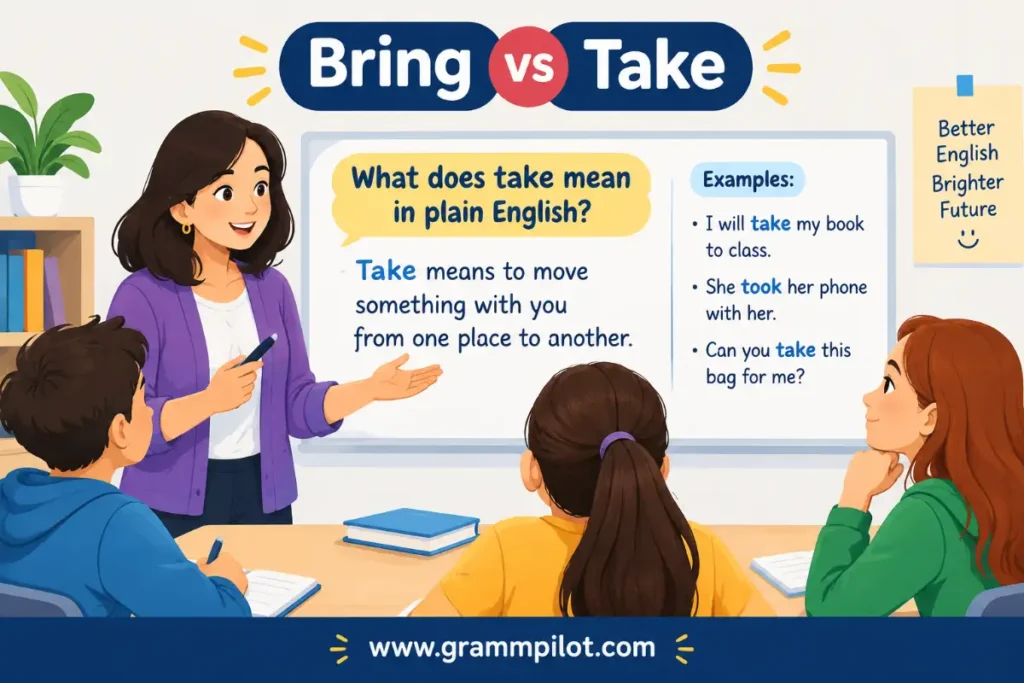
What does take mean in plain English?
Take means to move, carry, or cause something or someone to go from one place toward another destination.
Examples:
Take this package to the post office.
Please take your shoes upstairs.
I’ll take these papers to the manager.
The important idea is movement away from the speaker’s current location or toward another destination.
Like bring, take has several nonphysical meanings.
For example:
This job takes a lot of time.
Her speech took everyone by surprise.
The storm took several lives.
So the words can describe more than carrying objects.
Is take a verb?
Yes. Take is a verb with many meanings.
Its basic forms include:
| Form | Word |
|---|---|
| Base form | take |
| Third-person singular | takes |
| Past tense | took |
| Past participle | taken |
| Present participle | taking |
Examples:
I take the bus every morning.
She takes her children to school.
He took the train yesterday.
A common mistake is using took as the past participle.
Incorrect: I have took the package.
Correct: I have taken the package.
Where did bring come from?
Bring comes from Old English and has long carried the idea of moving or carrying something toward a particular place or person. The modern meaning remains closely connected to that older idea. When you bring something, you generally move it toward a relevant destination.
For example: Bring your passport to the airport.
The airport is the destination that matters in the situation.
The word later developed broader meanings, such as causing results: The decision brought change.
So bring can describe both physical movement and the creation of an outcome.
Where did take come from?
Take also comes from Old English, although its history involves contact with other Germanic languages. Its meaning has developed into a very broad set of uses. It can mean to carry, move, receive, accept, capture, require, choose, understand, or experience something.
For example:
Take this book to Sarah.
Take a seat.
Because take has so many meanings, learners often encounter it more frequently than they expect.
Why are bring and take confusing?
The biggest problem is that both words describe movement.
Compare:
Bring the book to me.
Take the book to her.
The physical action can look almost identical. What changes is the direction relative to the viewpoint.
If the destination is where the speaker or listener is, bring is usually natural. If the destination is somewhere else, take is usually natural.
For example, imagine your friend is visiting your house.
You say: “Bring your camera.”
The camera is moving toward your house.
Now imagine you are leaving your house and going to your friend’s house.
You might say: “Take your camera with you.”
The camera is moving away from your current location.
What is the easiest memory trick?
Remember these two phrases:
Bring it here.
Take it there.
If the movement is toward here, think bring. If the movement is toward there, think take.
Examples:
Bring your homework to school.
Take your homework home.
Bring me a glass of water.
Take this glass to the kitchen.
The words become easier when you picture the destination.
How does the speaker’s viewpoint affect bring and take?
The speaker’s viewpoint can change which verb sounds natural. Suppose you are at school and your mother is at home.
You tell her: “Bring my jacket when you come to school.”
The jacket is moving toward the place where you are.
Now imagine your mother says: “Take your jacket when you leave school.”
The jacket is moving away from the school toward another destination. The same object can therefore be brought in one situation and taken in another. This is why memorizing fixed definitions is less useful than understanding the direction.
What is the difference in conversations?
Imagine two friends are planning a picnic.
Friend A says: “Can you bring some sandwiches?”
Friend B is expected to arrive at the picnic and carry the sandwiches there.
Now imagine Friend A is already at home and says: “Can you take these sandwiches to the picnic?”
The destination is away from the current location. Both sentences can describe the same physical movement in some situations. The choice depends on the speaker’s viewpoint and the destination being emphasized.
Can bring be used for people?
Yes.
Examples:
Bring your sister to the party.
Can you bring your children tomorrow?
Please bring someone who can help.
The person is moving toward the relevant destination.
However, if the movement is away from the relevant location:
Take your sister home.
Take the children to school.
The direction determines the choice.
Can take be used for people?
Yes. In fact, take is extremely common with people.
Examples:
Take your brother to school.
I’ll take you home.
He took the children to the park.
The verb often means accompanying or transporting someone to another destination.
Compare:
Bring me to the airport.
This means come toward the speaker’s relevant destination with the speaker.
Take me to the airport.
This means transport the speaker toward the airport. Both can be correct depending on where the speaker is and what destination is being discussed.
What is the difference between bring and carry?
Bring focuses on movement toward a relevant destination. Carry focuses on physically holding or supporting something while moving.
Compare:
Bring these books to my office.
The important point is the destination.
Carry these books carefully.
The important point is how the books are physically transported.
You can combine the ideas: Carry these boxes and bring them to the garage.
Here, carry describes the physical action, while bring describes the movement toward the destination.
What is the difference between take and carry?
The same distinction applies.
Take focuses on moving something toward another destination. Carry focuses on physically holding or supporting it.
Examples:
Take these boxes upstairs.
Carry these boxes carefully.
You could say: Carry the boxes upstairs.
Now the sentence combines both ideas: the person physically carries the boxes and moves them to another destination.
What are the best synonyms for bring?
The closest synonym depends on the situation.
| Word | Meaning | Tone | Example |
|---|---|---|---|
| Carry | Move while holding something | Neutral | Carry the books to the office. |
| Deliver | Bring something to a person or place | Formal | We will deliver the package tomorrow. |
| Transport | Move something from one place to another | Formal | The company transports goods nationwide. |
| Convey | Carry or communicate something | Formal | The message conveys an important idea. |
| Fetch | Go get something and return with it | Everyday | Can you fetch me some water? |
| Provide | Give something that is needed | Neutral | The hotel provides towels. |
| Supply | Give something needed | Formal | The company supplies equipment. |
| Present | Bring something forward for consideration | Formal | She presented the proposal. |
| Introduce | Bring someone or something into a situation | Neutral | The teacher introduced a new topic. |
| Produce | Bring something forward or create it | Formal | The company produced new evidence. |
| Return with | Come back carrying something | Neutral | She returned with the documents. |
| Add | Bring something into a collection or situation | Neutral | The new member added experience. |
These words are not interchangeable in every sentence. For example, deliver usually emphasizes successfully getting something to a recipient. Fetch emphasizes going to get something and returning with it.
What are the best synonyms for take?
| Word | Meaning | Tone | Example |
|---|---|---|---|
| Carry | Move while holding something | Neutral | Carry the box upstairs. |
| Transport | Move people or things | Formal | They transport goods by truck. |
| Move | Change location | Neutral | Move the chair to the corner. |
| Remove | Take something away | Neutral/Formal | Remove the old equipment. |
| Collect | Go and get something | Neutral | Please collect the package. |
| Fetch | Get something and return | Everyday | Fetch your coat. |
| Lead | Guide someone somewhere | Neutral | She led the group outside. |
| Drive | Transport by car | Everyday | I’ll drive you home. |
| Escort | Accompany someone somewhere | Formal | The officer escorted him outside. |
| Transfer | Move from one place or position to another | Formal | Transfer the files to the new folder. |
| Deliver | Transport something to a recipient | Formal | Take the documents to reception. |
| Remove | Move something away | Neutral | Take the old sign down. |
Again, context matters.
Drive specifically involves transportation by vehicle.
Escort emphasizes accompanying someone.
Remove emphasizes taking something away.
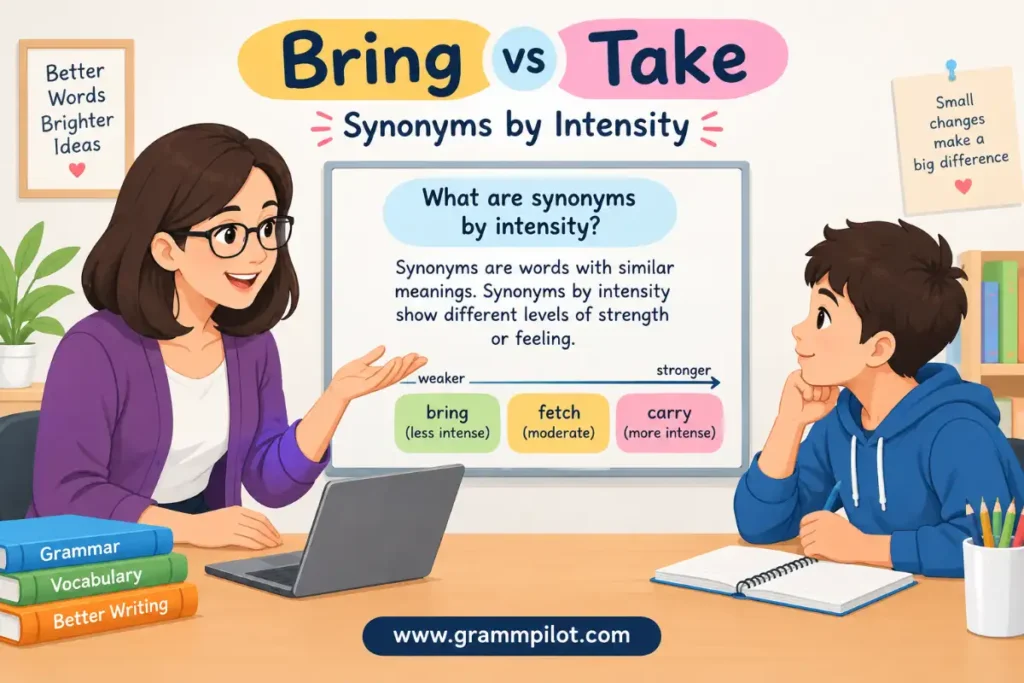
What are the Synonyms the Intensity?
The words bring and take themselves are neutral. Their alternatives can suggest different degrees of action.
For moving something casually:
move → carry → bring/take
For organized transportation:
transport → convey → deliver
For forceful removal:
remove → carry away → haul away
For bringing something to someone:
bring → provide → deliver
The right word depends on the exact action rather than simply how strong the verb sounds.
What are the related parts of speech?
Both bring and take have several related forms and expressions.
| Word | Form | Example |
|---|---|---|
| Bring | Verb | Bring your notebook. |
| Brought | Past tense | She brought lunch. |
| Bringing | Present participle | He is bringing a friend. |
| Take | Verb | Take this package. |
| Took | Past tense | She took the bus. |
| Taken | Past participle | He has taken the documents. |
| Taking | Present participle | They are taking the boxes. |
There are also common noun-related expressions:
takeaway
takeout
bringer is possible but uncommon in ordinary English.
The most useful forms to master are simply bring/brought and take/took/taken.
What is the difference between bring and fetch?
These words overlap, but fetch often includes the idea of going somewhere to get something and then returning.
For example:
Can you bring me a glass of water?
The focus is on getting the water to the speaker.
Can you fetch me a glass of water?
The sentence suggests going to get the water and returning with it.
A dog can also fetch an object:
The dog fetched the ball.
You would not normally use bring to emphasize the complete trip in the same way.
What is the difference between bring and deliver?
Bring is broader and more conversational. Deliver emphasizes transporting something to a particular recipient or destination, often as part of a service.
Compare:
Bring the report to my office.
The courier delivered the report to my office.
The second sentence focuses on successful delivery.
What are common mistakes?
Mistake 1: Thinking bring always means “carry”
Not necessarily. Bring focuses on movement toward a relevant destination.
For example: Bring your coat to the party.
The important idea is getting the coat to the party.
Mistake 2: Thinking take always means “carry”
Again, not necessarily.
Take me home.
You are not necessarily carrying the speaker. You are transporting or accompanying them.
Mistake 3: Choosing based only on the starting point
The destination and viewpoint matter too. Imagine you are at a restaurant and your friend is at home.
You might say: “Bring your jacket when you come.”
The jacket is moving toward the restaurant.
If you are leaving the restaurant and going home: “Take your jacket with you.”
The viewpoint has changed.
Mistake 4: Using brought as the past tense of take
Incorrect: I brought the bus yesterday.
If you mean you traveled by bus: I took the bus yesterday.
The past tense of take is took.
Mistake 5: Using bringed
Incorrect: She bringed the documents.
Correct: She brought the documents.
The past tense of bring is irregular.
When should you not use bring?
Do not use bring simply because something is moving.
Ask where it is going.
For example: Take these documents to the manager.
If you are telling someone to move the documents from their current location to the manager, take may be the natural choice.
But if you are already at the manager’s office and someone is coming there with the documents, bring may be more natural: Bring these documents to the manager. The context determines the correct choice.
When should you not use take?
Do not use take simply because an object is being carried. If the movement is toward the speaker or listener, bring is often better.
For example: Bring the files to me.
Not: Take the files to me.
The listener is being asked to move the files toward the speaker.
How do bring and take work with “here” and “there”?
These adverbs make the distinction easier.
Bring it here.
The object moves toward the speaker.
Take it there.
The object moves toward another place.
Compare:
Can you bring the documents here?
Can you take the documents there?
The words here and there strongly signal the direction.
This is one of the best shortcuts for English learners.
How do bring and take work with home?
Home can be tricky because English speakers use both verbs depending on viewpoint.
Examples:
Take me home.
This means transport me to my home.
Bring it home.
This means move it toward home from the current or relevant location.
For example:
Take the children home after school.
Bring the children home when you’re finished.
Both can be correct because the speaker’s viewpoint and situation differ.
How do bring and take work with school?
Consider these examples:
Bring your homework to school.
The homework moves toward school.
Take your homework home.
The homework moves away from school toward home.
You can also say: Take your child to school.
The child is being transported to school from another place.
But a teacher at school might say: Bring your child to school tomorrow.
The school is the relevant destination from the teacher’s viewpoint.
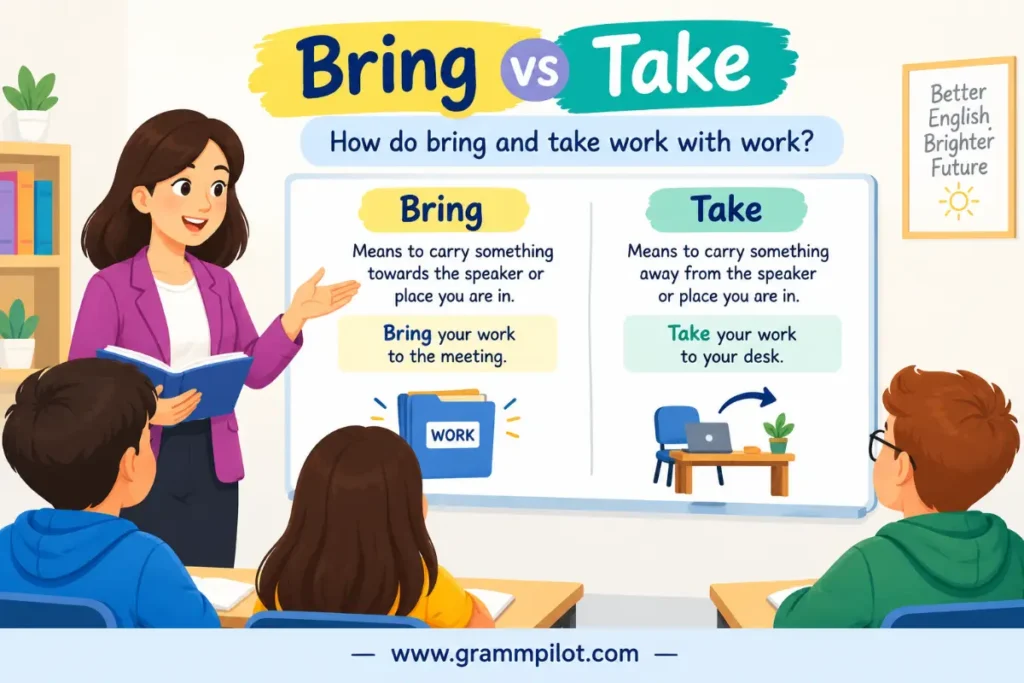
How do bring and take work with work?
Examples:
Bring your laptop to work.
The laptop moves toward the workplace.
Take your laptop home.
The laptop moves away from the workplace.
A manager at work might tell an employee: Bring the signed contract to my office.
The contract is moving toward the manager.
The same employee might later say: I’ll take the contract to the client.
The contract is moving toward another destination.
How do bring and take work in emails?
In professional emails, clarity matters more than complicated rules.
Examples:
Please bring the signed form to the meeting.
Please take the signed form to the accounting department.
If the destination is your office: Please bring the documents to my office.
If the destination is another department: Please take the documents to the finance office.
When the direction could be confusing, simply name the destination. That makes the sentence clearer.
Which word is best for a resume?
Neither bring nor take is automatically better for a resume.
Use the verb that accurately describes your work.
Instead of: I brought new ideas to the team.
A stronger professional version might be: Introduced new ideas that improved team efficiency.
Instead of: I took documents to clients.
You might write: Delivered documents to clients.
Professional writing often benefits from specific verbs such as delivered, transported, introduced, managed, coordinated, or provided.
Which word is best for an essay?
Both words are common in essays.
Use bring when describing an effect or result:
The policy brought significant changes to the community.
Use take when describing movement, action, or a process:
The journey took the travelers across several regions.
In academic writing, you can often replace vague uses with more precise verbs.
For example: The discovery brought new opportunities.
could become: The discovery created new opportunities.
The best word depends on the exact meaning.
Which word is best for texting?
Both are natural.
Bring snacks!
Take an umbrella.
Can you bring your charger?
Take your jacket with you.
Texting often makes the distinction especially clear because people are talking about immediate movement.
If your friend is coming to your location: Bring your charger.
If your friend is leaving your location: Take your charger.
What are examples in everyday situations?
- Bring your notebook to class tomorrow.
- Take your notebook home after class.
- Please bring me a glass of water.
- Please take this glass to the kitchen.
- Can you bring your sister to the party?
- Please take your sister home afterward.
- Bring your passport to the appointment.
- Take your passport with you when you travel.
- She brought flowers to the hospital.
- He took the flowers home.
- Please bring the report to my office.
- Please take these files to the manager.
- They brought food to the picnic.
- We took the leftovers home.
- Can you bring your camera tomorrow?
- Don’t forget to take your camera when you leave.
- She brought her children to school.
- He took his children to the park.
- The decision brought major changes.
- The journey took several hours.
What are the antonyms of bring?
There is no single opposite for every meaning of bring.
For physical movement, possible contrasts include:
- take away
- remove
- carry away
- send away
- leave behind
For example: Bring the box here.
The contrasting instruction might be: Take the box away.
For abstract meanings, the opposite could be prevent, remove, avoid, or eliminate, depending on context.
What are the antonyms of take?
The opposite of take depends on its meaning.
Possible contrasts include:
- bring
- give
- leave
- return
- provide
- add
For example: Take the book away.
The opposite action could be: Bring the book here.
But when take means “accept,” its opposite may be give. When it means “remove,” the opposite may be add.
What quick tips help you choose the right word?
Use this checklist:
Is the object moving toward me?
Use bring.
Is the object moving toward you?
Use bring.
Is the object moving toward the place we are discussing as the destination?
Usually use bring.
Is the object moving away from me?
Usually use take.
Is it going to another destination?
Usually use take.
Can I say “come with it”?
Think bring.
Can I say “go with it”?
Think take.
Am I talking about causing a result?
Bring may be appropriate.
Am I talking about requiring time, effort, or another resource?
Take may be appropriate.
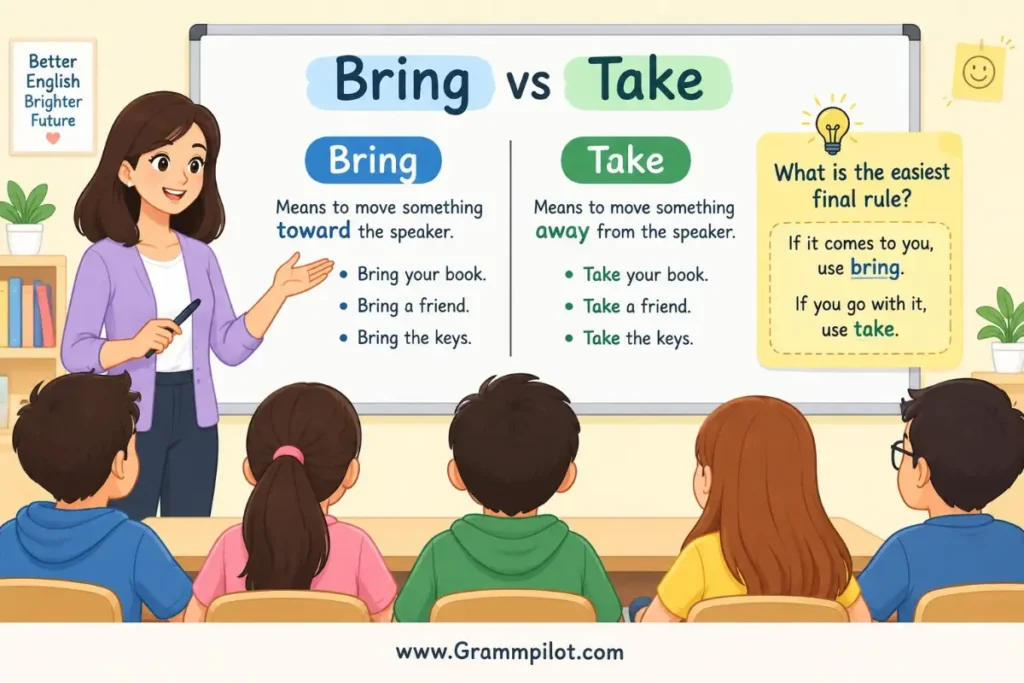
What is the easiest final rule?
Remember:
Bring = movement toward the relevant place or person.
Take = movement away or toward another place.
Picture yourself standing somewhere. If someone is moving something toward you, they bring it. If they are moving it away from you, they take it. Then remember that your viewpoint can change.
A teacher at school may say: “Bring your assignment tomorrow.”
A student leaving school may say: “I’ll take my assignment home.”
The same object can be brought in one situation and taken in another.
The key is not simply the object. The key is where it is going and whose viewpoint matters.
Conclusion
Bring vs Take is mainly about direction and viewpoint. Bring usually describes movement toward the speaker, listener, or another relevant destination, while take usually describes movement away from the speaker or toward a different destination. The easiest memory trick is “bring it here” and “take it there.” Context can change the choice, so don’t rely only on if an object is being carried. Think about where the person or thing is going. Also remember that both verbs have many abstract meanings, such as “bring change” and “take time.” Once you focus on the destination and viewpoint, these two common verbs become much easier to use naturally.
Frequently Asked Questions
1. What is the difference between bring and take?
Bring usually means moving something or someone toward a relevant person or destination, while take usually means moving something or someone away or toward another destination. Think “bring it here” and “take it there.”
2. Should I say “bring it” or “take it”?
Use bring it when the object is moving toward the speaker, listener, or relevant destination. Use take it when the object is moving away or toward another destination.
3. What’s another way to remember bring vs take?
Remember bring = come and take = go. If the object comes toward the relevant location, use bring; if it goes away toward another location, use take.
4. Is “bring” the same as “carry”?
No. Carry describes physically holding or supporting something while moving, while bring focuses on moving something toward a relevant destination. You can carry something and bring it somewhere at the same time.
5. Should I say “bring me home” or “take me home”?
“Take me home” is normally the natural expression when asking someone to transport you to your home. “Bring me home” can occur in contexts where the speaker’s viewpoint makes home the destination toward which the person is being brought.
6. Is “take” the past tense of “bring”?
No. The past tense of bring is brought. The past tense of take is took, while its past participle is taken.
7. Can bring and take both be correct in the same situation?
Yes. The correct choice can change depending on the speaker’s viewpoint and the destination being emphasized. The same object can be brought toward one location and later taken away from it.