
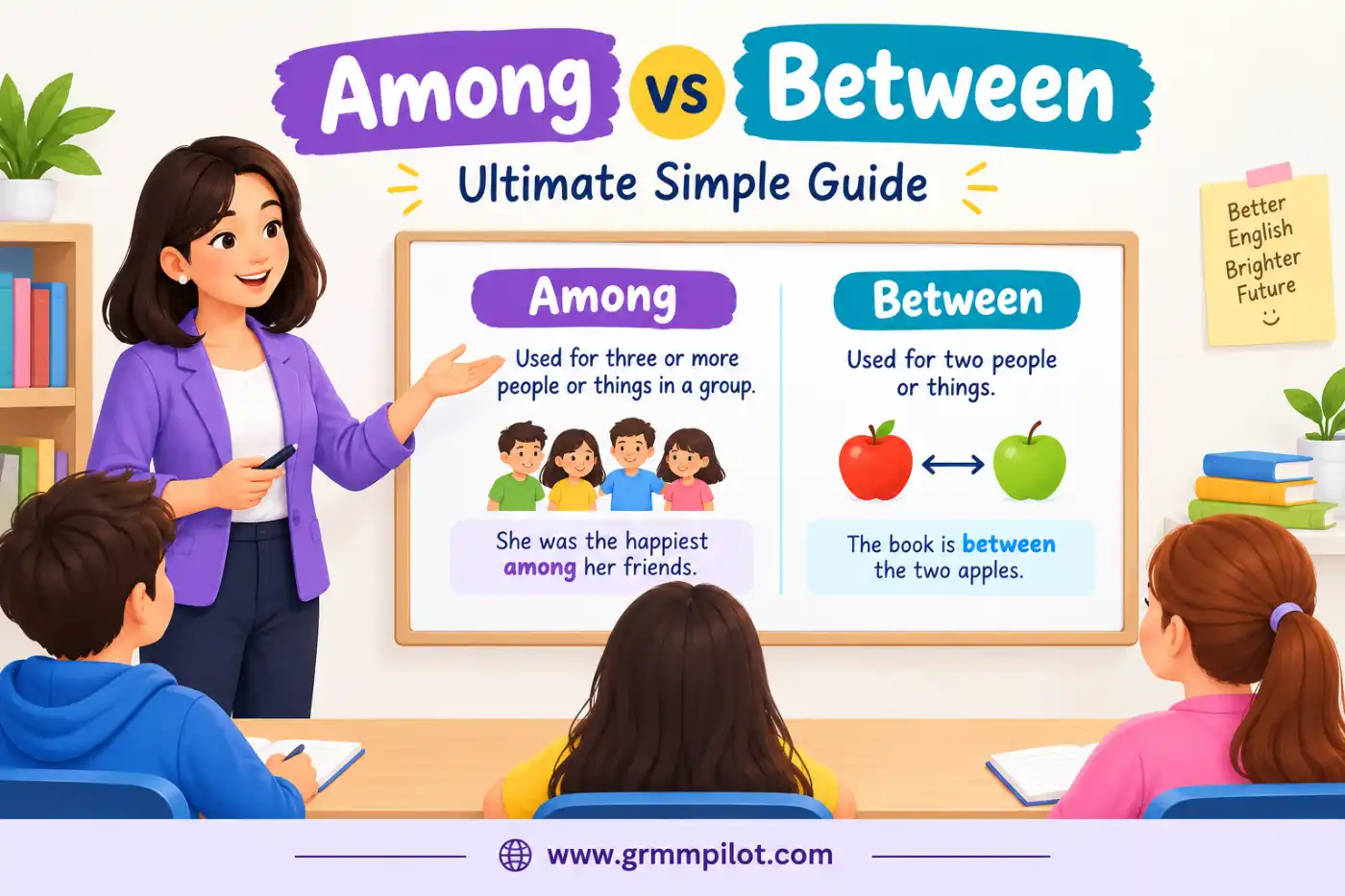
Among vs Between is mainly a question of how things relate to one another. Between often focuses on separate people or things and their individual relationships, while among usually describes something within a group, collection, or surrounding environment. Have you ever paused while writing an email or essay because you weren’t sure about to say “between the two” or “among the three”? The traditional rule seems simple: use between for two things and among for three or more. But real English is a little more flexible than that.
Quick answer: Use between when talking about separate relationships or distinct choices, and use among when talking about something within a group or mixed collection. “Between” can also be used with more than two people or things when the individual relationships are clear.
This guide explains the difference, word origins, synonyms, common patterns, examples, formal and informal usage, common mistakes, and the best choice for essays, emails, resumes, texting, and everyday speech.
For a closer look at another confusing word pair, explore [Bring vs Take].
What does between mean in plain English?
Between usually describes a position, relationship, choice, difference, or connection involving separate and identifiable people or things.
It can describe:
- two people
- two objects
- multiple distinct people
- multiple separate organizations
- two locations
- a range
- a choice
- a relationship
- a difference
- a division
Examples:
The house is between the school and the library.
The disagreement was between Sarah and Mark.
We need to choose between three options.
The agreement was between the four companies.
There is a big difference between the two plans.
The key idea is that the individual elements remain distinct.
Is between a preposition?
Yes. Between is commonly used as a preposition.
Examples:
The ball rolled between the chairs.
She sat between her parents.
The agreement was between the two companies.
It can also function as an adverb or adjective in certain expressions, but its prepositional use is the one English learners encounter most often.
What does among mean in plain English?
Among usually describes something happening within a group or surrounded by several people or things.
Examples:
She was standing among the crowd.
I found the letter among the old documents.
There was a lot of excitement among the students.
He felt comfortable among friends.
The focus is not usually on separate one-to-one relationships. Instead, the group is treated as a surrounding collection or community.
Is among a preposition?
Yes. Among is a preposition.It is commonly followed by a plural noun or a group of people or things.
Examples:
The teacher walked among the students. The rumor spread among the employees. The bird disappeared among the trees. She found the photograph among the old papers.
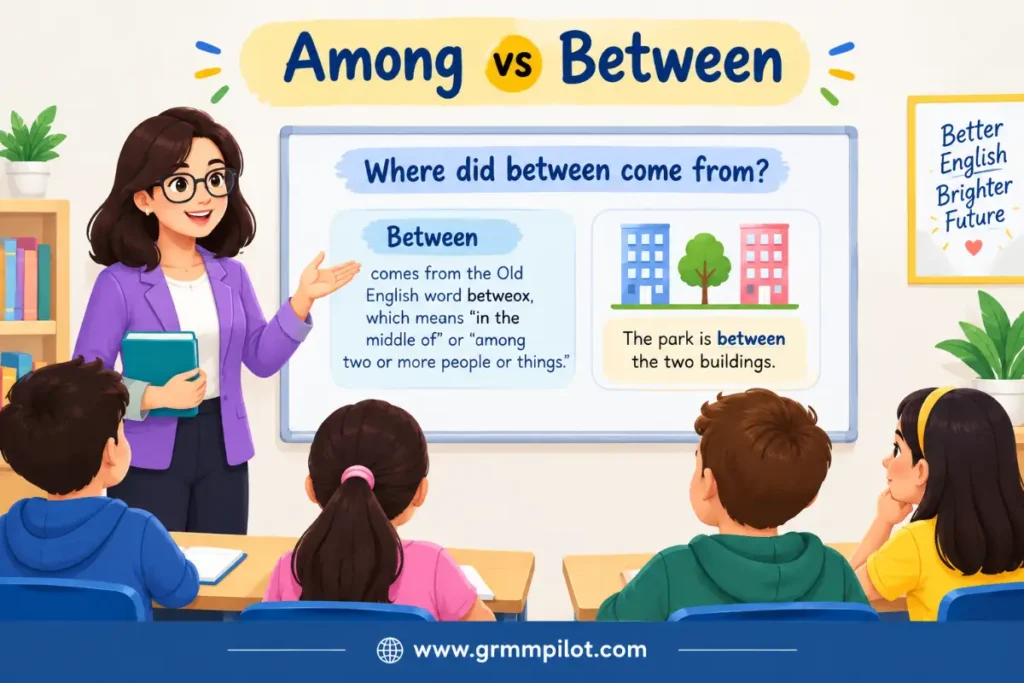
Where did between come from?
Between comes from Old English and has historically carried the idea of being in the space separating two or more things. Its meaning developed from physical separation to broader relationships.
Today, you can use it for physical location: The café is between the bank and the bookstore.
You can also use it for abstract relationships: There is trust between the two friends.
Or for choices: I can’t decide between these options.
The central idea remains one of separation or distinction.
Where did among come from?
Among also comes from Old English. Its historical meaning has long been connected with being in the midst of, or surrounded by, a group. That basic idea remains clear today.
For example: She walked among the trees.
She is surrounded by a collection of trees.
The word can also describe social groups: He felt comfortable among his classmates.
Here, the person is part of or surrounded by a group.
Why do people think between is only for two?
The traditional classroom rule is often taught this way:
Between = two
Among = three or more
That rule is useful for beginners because it works in many common sentences.
For example:
The choice is between tea and coffee.
She divided the candy among the children.
However, the rule becomes too simple when you encounter formal writing.
Consider: The agreement was negotiated between the five participating countries.
The countries are separate parties. The sentence treats their relationships as distinct. You can also say: The negotiations among the five countries lasted several hours. Here, the focus is more on the group as a whole. Both can be correct, but they emphasize different relationships.
Can between be used for more than two?
Yes. Between can be used with more than two people or things when they are considered distinct or separately related.
Examples:
The money was divided between the three partners.
The treaty created new agreements between several nations.
The competition between the four teams was intense.
The negotiations between the six companies continued for weeks.
The important point is not the number. The important point is about the things are being considered as distinct participants in a relationship. This is why the simple “between two, among three or more” rule should not be treated as absolute.
Can among be used for two?
In standard modern English, among is normally associated with groups rather than a simple relationship between two distinct individuals or things.
For example: The secret was shared between the two sisters.
This is more natural than: The secret was shared among the two sisters.
However, language depends on context, and older or specialized usage can sometimes differ. For everyday modern English, if you are describing a direct relationship between two distinct people or things, between is usually the safer choice.
What are the main uses of between?
Between for physical position
Use between when something is physically located in the space separating distinct objects.
Examples:
The lamp is between the two chairs.
The school sits between the park and the library.
She stood between her parents.
The cat hid between the boxes.
Between for relationships
Use it to describe relationships involving separate people or groups.
Examples:
There is trust between the two friends.
The conflict between the teams lasted for years.
The agreement between the companies was renewed.
Between for choices
Use between when choosing from distinct options.
Examples:
I can’t decide between the red dress and the blue one.
She had to choose between studying and working.
Between for differences
Examples:
There is a major difference between the two products.
The difference between theory and practice can be significant.
Between for ranges
Examples:
The store is open between 9 a.m. and 5 p.m.
The temperature remained between 60 and 70 degrees.
The project should take between three and five days.
What are the main uses of among?
Among for being within a group
Examples:
She was sitting among her friends.
The child ran among the trees.
The letter was hidden among the books.
Among for distribution within a group
Examples:
The teacher divided the supplies among the students.
The prize money was shared among the winners.
The food was distributed among the families.
Among for feelings or opinions within a group
Examples:
There was excitement among the fans.
The news caused concern among employees.
The idea became popular among young readers.
Among for being part of a group
Examples:
He was well respected among his colleagues.
She is popular among her classmates.
What are the best synonyms for between?
The right alternative depends on the sentence.
| Word | Meaning | Tone | Example |
|---|---|---|---|
| In the middle of | Located in a central position | Everyday | The café is in the middle of the two buildings. |
| Separating | Dividing two or more things | Neutral | A fence separates the two properties. |
| Connecting | Joining distinct things | Neutral | A bridge connects the two towns. |
| Amid | Surrounded by something | Formal | The house stood amid tall trees. |
| Betwixt | An old-fashioned form of between | Archaic | The village lies betwixt two hills. |
| In the space between | Located in a separating space | Descriptive | The ball was in the space between the chairs. |
| From one to another | Moving between points | Neutral | The message passed from one person to another. |
| In relation to | Describing a relationship | Formal | The study compares differences in relation to age. |
| Shared by | Common to separate parties | Neutral | The responsibility was shared by both teams. |
| Connecting | Establishing a link | Neutral | The road connects the two communities. |
Not every synonym can replace between in every sentence.
For example, amid usually suggests being surrounded by something, so it is often closer to among than between.
What are the best synonyms for among?
| Word | Meaning | Tone | Example |
|---|---|---|---|
| Amid | Surrounded by | Formal | She stood amid the crowd. |
| In the midst of | In the middle of a group or situation | Formal | He was in the midst of the crowd. |
| Within | Inside a group, place, or boundary | Neutral | The tradition exists within the community. |
| Surrounded by | Having things all around | Neutral | She was surrounded by friends. |
| In a group of | As part of a collection | Everyday | He was in a group of students. |
| Throughout | Across an entire group or area | Neutral | The idea spread throughout the organization. |
| Amongst | A variant of among | Formal/Traditional | She walked amongst the trees. |
| In company with | Together with others | Formal | He traveled in company with his colleagues. |
| In the company of | Together with | Formal | She was in the company of friends. |
| Amidst | A variant of amid | Literary/Traditional | The house stood amidst the trees. |
Amid and amidst are especially useful alternatives when you want to emphasize being surrounded by something.
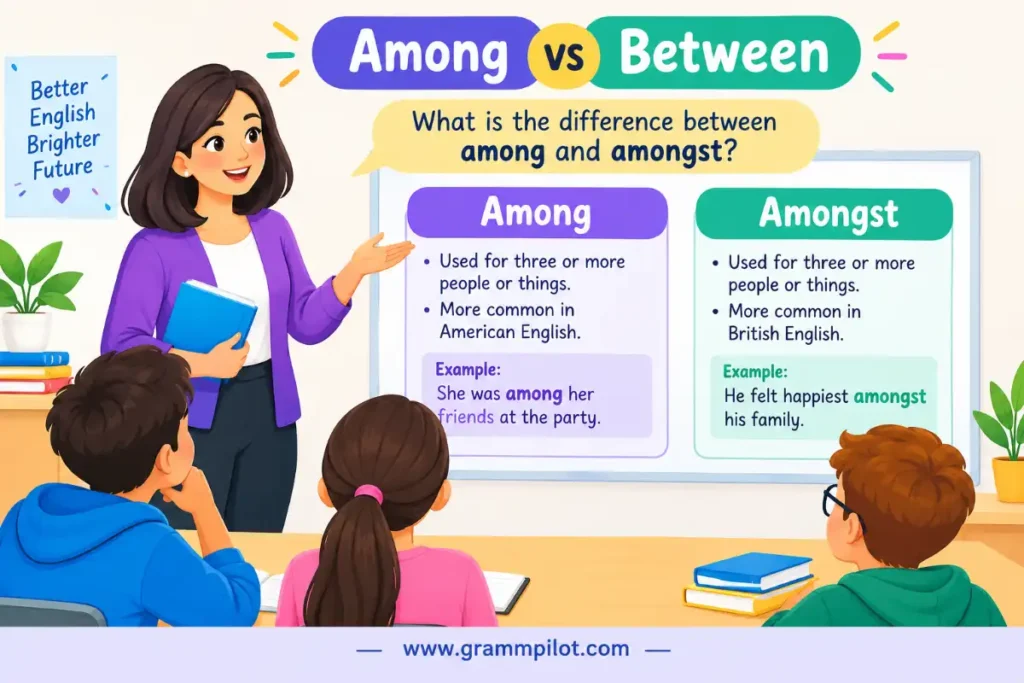
What is the difference between among and amongst?
Among and amongst have essentially the same meaning.
Among is more common in modern American English.
Amongst is more common in British English and can sometimes sound more formal or literary.
Examples:
She walked among the trees.
She walked amongst the trees.
Both are grammatically acceptable.
For most American English writing, among is the simpler and more natural choice.
What is the difference between between and amidst?
Between focuses on separation or a relationship between distinct things.
Amidst focuses on being surrounded by something.
Compare:
The house stood between two mountains.
The mountains are distinct points on either side.
The house stood amidst the mountains.
The house is presented as being surrounded by the mountains.
The difference is subtle but important.
What is the difference between among and amid?
These words are often interchangeable, especially when describing something surrounded by people or things.
Compare:
She stood among the crowd.
She stood amid the crowd.
Both are correct. However, amid can sound slightly more formal or literary.
It is also common with abstract situations:
Amid growing concerns, the company changed its policy.
Among growing concerns would be possible in some contexts, but amid is more natural when describing a surrounding situation or atmosphere.
What is the difference between between and in between?
Between is the standard preposition.
In between often emphasizes an intermediate position.
Examples:
The store is between the bank and the library.
The store is in between the bank and the library.
Both can work in everyday English, although between is usually cleaner and more concise. You can also use in between independently: There are two houses, and the garden is in between. The phrase can also describe an intermediate state: I’m caught in between two choices.
What is the difference between between and among in relationships?
This is one of the most important distinctions.
Use between when you want to highlight distinct relationships.
Use among when you want to highlight a group relationship.
Compare:
There was an agreement between the three partners.
The partners are treated as distinct parties to the agreement.
There was strong cooperation among the three partners.
The emphasis is on the group working together.
Both sentences can be correct.
The choice changes the focus.
What are examples in real-life situations?
Here are practical examples showing how the two words work.
- The agreement was between the two companies.
- She found her phone among the books.
- The road runs between the two villages.
- There was excitement among the fans.
- He had to choose between three apartments.
- The teacher distributed the worksheets among the students.
- The negotiations between the countries lasted several weeks.
- She felt comfortable among her new classmates.
- The difference between the two plans was small.
- The rumor spread quickly among employees.
- The cat slipped between the boxes.
- The bird disappeared among the branches.
- The responsibility was divided between the three managers.
- The news caused concern among residents.
- The store is located between a restaurant and a pharmacy.
These examples show why counting the nouns is not enough.
How is between used with numbers?
Between is commonly used to describe ranges.
Examples:
The temperature stayed between 65 and 70 degrees.
The package should arrive between Monday and Wednesday.
The course takes between two and four weeks.
The child is between five and six years old.
A useful pattern is: between + number/time/point + and + number/time/point
For example:
between 10 and 20
between Monday and Friday
Do not normally replace between with among in these range constructions.
How is among used with numbers?
Among can be used when numbers describe a group.
Examples:
The prize was divided among the five winners.
The money was shared among the ten employees.
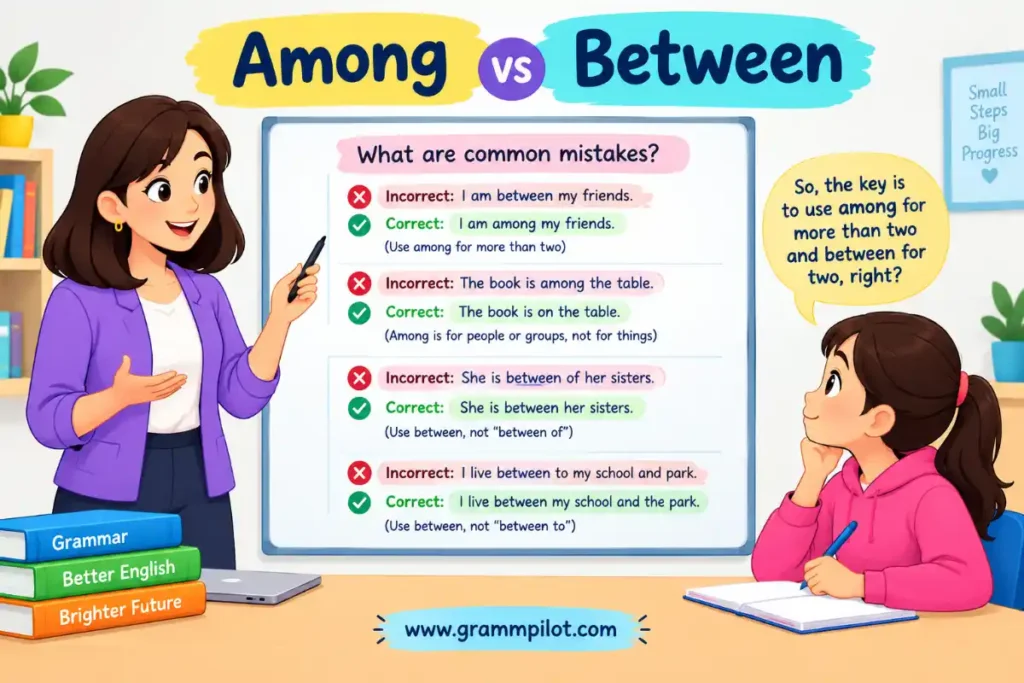
What are common mistakes?
Mistake 1: Thinking between can only be used with two
Incorrect reasoning: “There are three companies, so I must use among.” That is not always true.
Correct: The agreement was between the three companies.
The companies are separate parties in a specific relationship.
Mistake 2: Using among for a simple two-person relationship
Less natural: The disagreement was among John and Mary.
Better: The disagreement was between John and Mary.
The relationship is between two distinct people.
Mistake 3: Using between for something inside a group
Less natural: She searched between the crowd.
Better: She searched among the crowd.
The crowd is treated as a surrounding group.
Mistake 4: Confusing range expressions
Incorrect: The temperature stayed among 60 and 70 degrees.
Correct: The temperature stayed between 60 and 70 degrees.
A numerical range normally uses between … and.
Mistake 5: Believing three always means among
Incorrect rule: “Three things are mentioned, so I must use among.”
Correct: The negotiations between the three governments continued.
The governments are distinct parties.
Mistake 6: Using among when the focus is individual relationships
Compare:
The competition between the four teams was intense.
This emphasizes the teams as distinct competitors.
There was excitement among the four teams.
This treats them more as a group experiencing something.
When should you not use between?
Avoid between when the sentence is clearly about being inside or surrounded by a group.
Less natural: He walked between the crowd.
Better: He walked among the crowd.
Use between when you mean separation, a relationship, a choice, or a range.
When should you not use among?
Avoid among when you are describing a direct relationship between two distinct people or things.
Less natural: The agreement was among the two companies.
Better: The agreement was between the two companies.
Also use between for numerical ranges: between 10 and 20
not: among 10 and 20
What are the antonyms of between?
There is no single accurate antonym for between.
Depending on context, contrasting ideas include:
- outside
- beyond
- alongside
- together
- within
- around
For example, the opposite of being between two objects may be being outside them. Because between has several meanings, its opposite changes with context.
What are the antonyms of among?
There is no single universal opposite of among either.
Possible contrasts include:
- outside
- apart
- alone
- separate
- isolated
- beyond
For example: She felt comfortable among her friends.
The opposite situation might be: She felt isolated from the group.
The exact opposite depends on what among means in the sentence.
Which word is best for a resume?
Both words can appear on a resume, but only when the sentence calls for them.
Use among when describing recognition or trends within a group: Ranked among the top performers in the department.
Use between when describing collaboration or relationships between distinct groups: Managed communication between five regional offices.
Another example : Coordinated projects between multiple departments.
Here, the departments are treated as distinct organizational units.
Which word is best for an essay?
Both are common in academic writing.
Use between for comparisons and relationships: The study examines the difference between rural and urban communities.
Use among for patterns within a group: The survey found strong support among younger participants.
Academic writing often uses both words in the same paragraph.
How should you choose between them in an essay?
Ask what you are emphasizing. If you are comparing distinct items, between is often appropriate. If you are describing something happening within a group, among is often appropriate.
For example:
The study compares differences between the two groups.
The study examines attitudes among the participants.
Both sentences are precise because the prepositions match the relationships being described.
Which word is best for texting?
Both are common in casual messages.
Examples:
I can’t choose between these two.
I found your note among my papers.
In casual texting, people sometimes shorten sentences, but the standard distinction remains useful.
If you’re choosing from several distinct options, between can still be correct: I’m stuck between three restaurants.
You do not need to switch to among simply because there are three choices.
Which word is best for email?
Both words are useful in professional email.
Examples:
We need to decide between the three proposals.
There is strong support among the team members.
For business writing, focus on the relationship you want to describe rather than counting the nouns.
Which word is best for speaking?
In conversation, the same distinction applies.
You might say: I have to choose between three options.
Or: I was walking among the crowd.
Neither sounds unusual in natural speech. The most important thing is to match the preposition to the intended relationship.
What quick tips help you choose the right word?
Use this checklist.
Are you describing a range?
Choose between.
Are you comparing distinct options?
Usually choose between.
Are you describing a direct relationship?
Usually choose between.
Are you describing something inside a group?
Choose among.
Are you describing a feeling shared by a group?
Usually choose among.
Are you distributing something to group members?
Usually choose among.
Are there more than two items?
Do not automatically choose among. Check if the items are distinct participants.
Are you describing something surrounded by several things?
Usually choose among.
Conclusion
Choosing between among and between becomes easier when you stop counting and start looking at the relationship. Between usually emphasizes separate, identifiable people or things, a choice, a comparison, a range, or a relationship. Among usually presents people or things as part of a group or surrounding collection. The traditional rule that says “between for two and among for three or more” is useful for simple examples, but it is not a complete rule. You can use between with three or more distinct parties when their individual relationships matter. When something happens within a group, among is usually the better choice. Focus on the meaning, and the correct preposition becomes much clearer.
Frequently Asked Questions
1. What is the difference between among and between?
Between usually describes separate or distinct relationships, while among usually describes something within a group. The number of people or things is not the only factor.
2. Can I use between for more than two people?
Yes. Between can correctly describe more than two people or things when they are treated as distinct parties or participants, such as “negotiations between the five countries.”
3. Is between only used for two things?
No. That is a useful beginner’s rule, but it is not absolute. The relationship being described matters more than the number of items.
4. What’s another way to remember among vs between?
Think between = distinct and among = group. Use between for separate relationships and among when something is within or surrounded by a group.
5. Should I say “between the three options” or “among the three options”?
“Between the three options” is usually natural when you are choosing or comparing distinct options. The fact that there are three choices does not automatically require among.
6. Is “among the two” grammatically correct?
It can occur in specialized or unusual contexts, but for a straightforward relationship involving two distinct people or things, between is normally the natural choice.
7. Should I use among or between in formal writing?
Use whichever accurately describes the relationship. Between works for distinct relationships and comparisons, while among works for situations involving a group or something within a collection.