
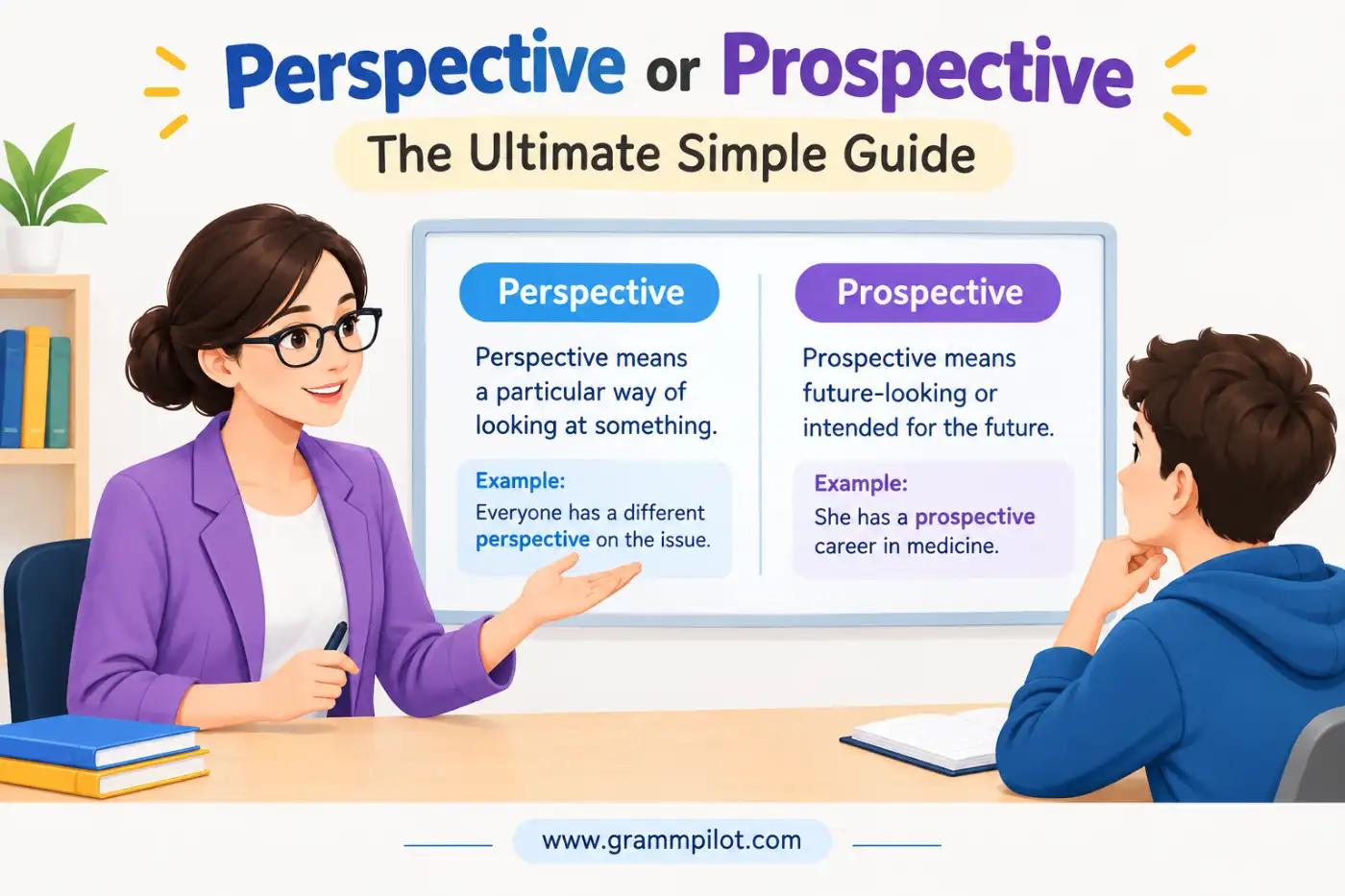
You’re writing an email, finishing an essay, or updating your resume when you suddenly pause over two words that look almost identical: perspective or prospective. Which one belongs in the sentence? The difference is actually simple. Perspective is about a point of view or a way of seeing something. Prospective is about something that may happen in the future or someone who may take on a future role.
Quick answer: Use perspective for a viewpoint, opinion, or way of seeing something. Use prospective for a possible future person, event, change, or situation.
These words are easy to mix up because they share several letters and have similar pronunciations. Their meanings, however, are quite different. Once you connect each word with its main idea, the choice becomes much easier. This guide explains their meanings, origins, synonyms, intensity, grammar, regional usage, common mistakes, and real-world examples. You’ll also learn which word works best in resumes, essays, texts, emails, and everyday speech.
Want to avoid another common word-choice mistake? Read [Advice vs Advise].
What does perspective mean?
Perspective is a noun that means a particular way of looking at, thinking about, or understanding something. If two people experience the same event but understand it differently, they may have different perspectives.
Example: From my perspective, the decision was reasonable.
Here, the speaker is describing a personal point of view. The word can also refer to the way objects are shown in art so that distance and depth look realistic.
Example: The artist used perspective to make the road appear farther away.
So, perspective has two major uses:
- A point of view or way of thinking
- A technique for showing depth and distance in art
The first meaning is much more common in everyday writing and conversation.
What does prospective mean?
Prospective is an adjective that describes something expected, possible, or connected with the future.
Example: The company interviewed several prospective employees.
The people are not employees yet. They are possible future employees.
Another example is:
The realtor met with a prospective buyer.
The person may buy the property, but the purchase hasn’t happened yet.
The main idea is possibility or expectation in the future.
Common combinations include:
- prospective buyer
- prospective customer
- prospective client
- prospective employee
- prospective student
- prospective tenant
- prospective investor
- prospective partner
A useful shortcut is:
Perspective = viewpoint
Prospective = possible future
That distinction will solve most cases.
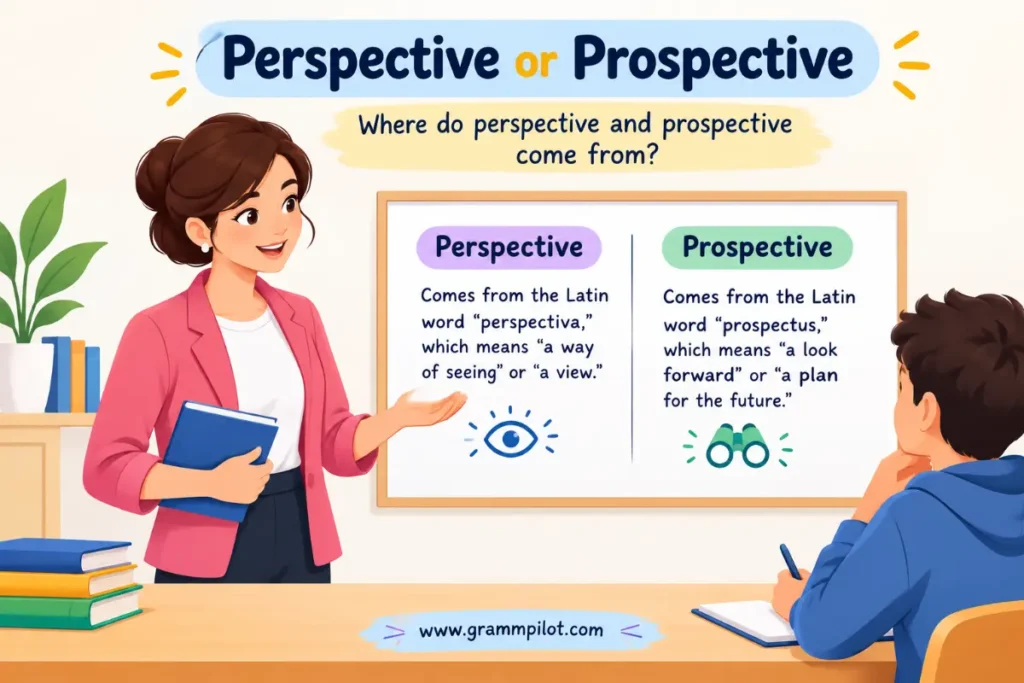
Where do perspective and prospective come from?
The two words look alike partly because both have roots connected with seeing or looking.
Perspective entered English through French from Latin roots associated with seeing through, looking at, or examining something. Over time, the word developed its modern sense of a particular way of viewing something. That history matches its everyday meaning. Your perspective is the position or mental angle from which you view an idea or situation. Prospective comes from Latin prospectus, which is related to looking forward or looking ahead. English later used the word to describe something expected or possible in the future.
This gives you a helpful memory device:
Perspective looks at something from a viewpoint.
Prospective looks toward something ahead.
The spelling may make the words look related, but their modern meanings are separated by this basic difference.
What is the plain-English meaning of perspective?
Think of perspective as your mental window. Your window determines what you can see and how you see it. In the same way, your perspective affects how you understand an experience, argument, person, or problem.
For example: A teacher may have a different perspective on homework than a student.
The teacher and student are looking at the same subject from different positions. Perspective can also mean a broader understanding gained through experience.
Example: Travel gave her a new perspective on other cultures.
The experience changed the way she understood the subject. Another common use appears in discussions and disagreements.
Example: Try to understand his perspective before responding.
This means you should consider how the situation looks from his point of view.
What is the plain-English meaning of prospective?
Think of prospective as pointing toward a possible future.
Example: The company contacted a prospective client.
The person isn’t a client yet. The company hopes or expects that the person could become one.
Another example: The university invited prospective students to an information session.
The students aren’t enrolled yet. They are considering becoming students there. Prospective can also describe possible future events or developments.
Example: The committee discussed prospective changes to the policy.
The changes haven’t happened yet. They are being considered as future possibilities. The word is therefore strongly connected with ideas such as:
- possible
- future
- expected
- anticipated
- considered
- likely
What are the master synonyms for perspective and prospective?
Because the two words have different meanings, their synonyms should not be treated as one interchangeable list. The table below separates them so you can see which alternatives belong to which idea.
Simple and everyday synonyms for perspective
| Word | Meaning | Tone | Example |
|---|---|---|---|
| View | An opinion or way of seeing something | Simple | That’s my view of the situation. |
| Viewpoint | A particular way of looking at something | Neutral | From her viewpoint, the plan works. |
| Opinion | What someone thinks about a subject | Everyday | I respect your opinion. |
| Outlook | A general way of thinking about life or a situation | Everyday | He has a positive outlook. |
| Standpoint | A position from which something is considered | Neutral | From a teacher’s standpoint, practice matters. |
| Take | An informal opinion or interpretation | Casual | What’s your take on the movie? |
| Angle | A particular way of approaching a subject | Casual | That’s an interesting angle. |
| Attitude | A person’s feelings or approach | Everyday | Her attitude toward the problem changed. |
| Position | A stated opinion or belief | Neutral | The group explained its position. |
| Interpretation | A particular understanding of something | Neutral | His interpretation was different. |
| Impression | An opinion formed from experience | Everyday | My first impression was positive. |
| Mindset | A person’s usual way of thinking | Everyday | A flexible mindset can help. |
| Approach | A particular way of dealing with something | Neutral | We need a new approach. |
| Understanding | Knowledge or awareness of something | Neutral | The experience gave him a better understanding. |
| Stance | A firm position on an issue | Stronger | The organization took a clear stance. |
Formal synonyms related to perspective
| Word | Meaning | Tone | Example |
|---|---|---|---|
| Analysis | Detailed examination of an issue | Formal | The analysis offers another view. |
| Assessment | A considered judgment | Formal | Her assessment was carefully prepared. |
| Framework | A structure used to understand an issue | Formal | The study uses a historical framework. |
| Context | Information that helps explain meaning | Formal | The decision makes sense in context. |
| Interpretation | A particular explanation of meaning | Formal | The evidence supports this interpretation. |
| Position | A clearly stated belief or argument | Formal | The report explains the organization’s position. |
| Standpoint | A particular basis for judgment | Formal | The matter should be considered from a legal standpoint. |
Simple and everyday synonyms related to prospective
| Word | Meaning | Tone | Example |
|---|---|---|---|
| Possible | Able to happen or exist | Simple | She is a possible candidate. |
| Potential | Having the possibility of becoming something | Neutral | We found several potential customers. |
| Future | Relating to a later time | Simple | Future plans remain uncertain. |
| Likely | Having a good chance of happening | Neutral | A likely buyer contacted the seller. |
| Expected | Thought likely to happen | Neutral | The expected changes may begin soon. |
| Upcoming | Happening soon | Everyday | The upcoming meeting is important. |
| Candidate | Someone being considered for a role | Neutral | The candidate submitted an application. |
| Anticipated | Expected ahead of time | Formal | The anticipated demand was high. |
| Forthcoming | Expected or about to happen | Formal | The forthcoming report will explain the issue. |
| Considered | Being thought about as an option | Neutral | She is being considered for the position. |
| Promising | Showing signs of future success | Positive | The project has promising results. |
| Imminent | About to happen very soon | Strong | The company warned of imminent changes. |
Notice that these alternatives are not perfect replacements in every sentence. Word choice depends on context, tone, and the exact meaning you want.
What are the synonyms by intensity?
Synonyms can express different levels of strength. A word that sounds mild in one sentence may sound much stronger in another.
For viewpoint-related meanings, consider this scale.
Mild viewpoint words
These are useful when you simply want to describe someone’s way of seeing something.
- view
- opinion
- impression
- take
- outlook
Example: My impression is that the plan needs more work.
The speaker is sharing an idea without making a particularly strong claim.
Moderate viewpoint words
These suggest a clearer or more developed position.
- perspective
- viewpoint
- standpoint
- interpretation
- position
- attitude
Example: From a customer’s standpoint, the process is confusing.
The speaker is identifying a specific basis for judgment.
Strong viewpoint words
These can suggest a firm or deliberate belief.
- stance
- conviction
- principle
- firm position
- strongly held belief
Example: The organization took a firm stance against the proposal.
This goes beyond simply having an opinion.
For future-related language, the intensity scale is different.
Mild future possibility
These show that something might happen but make no strong prediction.
- possible
- potential
- could
- might
- maybe
Example: She could be a potential customer.
The future outcome is uncertain.
Moderate future expectation
These indicate a more realistic or recognized possibility.
- prospective
- expected
- anticipated
- likely
- probable
Example: The company expects several prospective buyers to attend.
Strong future expectation
These suggest much greater certainty.
- imminent
- certain
- confirmed
- guaranteed
- definite
These aren’t exact synonyms for prospective. They simply occupy a stronger position on the scale of future certainty. For instance, a prospective buyer may buy a house, while a confirmed buyer has already committed to the purchase.
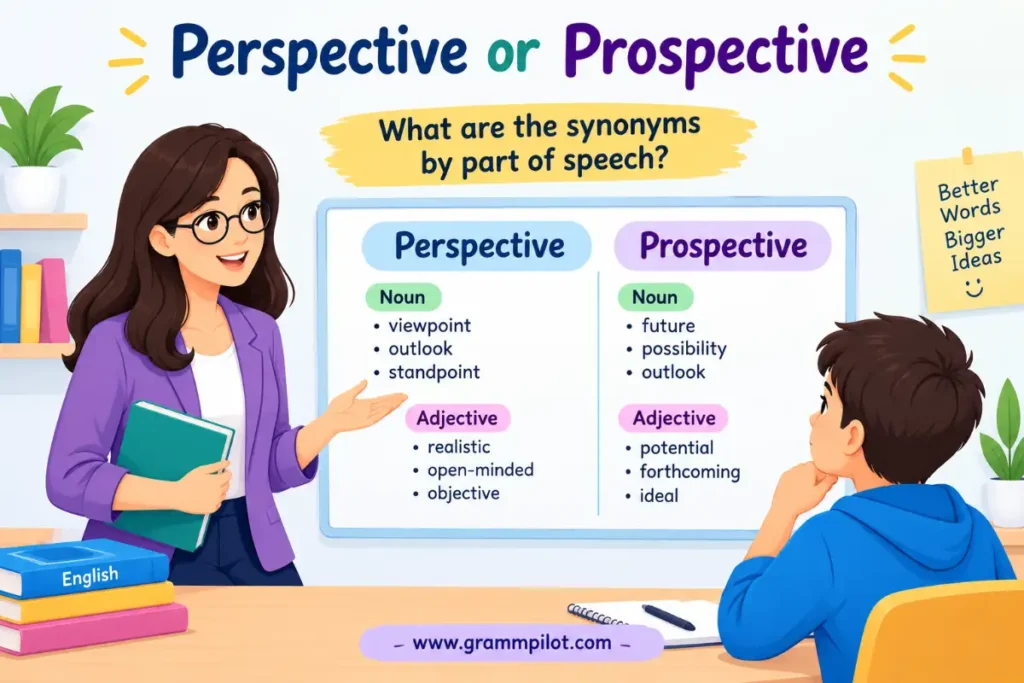
What are the synonyms by part of speech?
This is another useful way to understand the difference.
Perspective is mainly a noun
Common noun alternatives include:
- viewpoint
- opinion
- outlook
- standpoint
- position
- interpretation
- impression
- stance
- attitude
- understanding
- take
- angle
Example: Her perspective helped the team understand the problem.
Here, perspective names a thing: her way of understanding the problem.
Prospective is an adjective
Common adjective alternatives include:
- potential
- possible
- future
- expected
- likely
- anticipated
- upcoming
- forthcoming
Example: The company invited prospective customers to the event.
Here, prospective describes customers. This grammatical difference is important because you generally can’t swap the two words into the same sentence.
Is perspective or prospective different in American and British English?
There is no major difference in the basic meanings of these words between American and British English.
Both varieties use perspective for a viewpoint.
Example: I understand your perspective.
Both varieties also use prospective for possible future people, events, and situations.
Example: The school welcomed prospective students.
Pronunciation may vary slightly depending on the speaker’s accent, but the meanings remain essentially the same. If you’re writing for an American audience, you don’t need to change either word simply because of regional English. The bigger issue is choosing the word that matches your meaning.
Which word is best for a resume?
Should you use perspective or prospective on a resume?
Both can be correct, but they serve very different purposes.
Use perspective when describing the viewpoint or insight you bring to a job.
Example: Bring a customer-focused perspective to product development.
You can use prospective when discussing people, clients, or opportunities that may become part of a business.
Example: Developed relationships with prospective clients.
In a resume, prospective often appears in sales, recruiting, real estate, education, and business development.
Examples:
Communicated with prospective customers about product features.
Scheduled meetings with prospective clients.
Presented services to prospective business partners.
If you mean your ability to understand a situation, use perspective.
Example: Provided a practical perspective during project planning.
Which word is best for an essay?
Should you use perspective or prospective in an essay?
Perspective is much more common in essays because academic writing often discusses viewpoints, interpretations, and ways of understanding an issue.
Example: The novel presents the conflict from the child’s perspective.
Another example: The article offers a historical perspective on the debate.
You might use prospective when discussing future developments.
Example: Prospective changes to the law could affect small businesses.
For literature, history, sociology, psychology, and many other subjects, perspective is especially useful.
Common academic combinations include:
- historical perspective
- cultural perspective
- social perspective
- political perspective
- personal perspective
- different perspective
- broader perspective
- critical perspective
Which word is best for texting?
Should you use perspective or prospective in a text?
Perspective is the more natural choice when you’re discussing someone’s opinion.
Example: I get your perspective.
In casual texting, shorter alternatives can sound more natural.
Example: I get your point.
Another example: That’s one way to look at it.
Prospective is correct in texting, but it can sound formal.
Instead of: He’s a prospective customer.
A casual message might say: He might become a customer.
Both sentences communicate the basic idea, but the second sounds more conversational.
Which word is best for an email?
Should you use perspective or prospective in a professional email?
Both can be useful.
Use perspective when asking for someone’s opinion. Example: I’d appreciate your perspective on the proposal. This sounds professional without being overly formal.
Use prospective when referring to a possible future client, buyer, employee, or partner.
Example: I’ll send the information to the prospective client this afternoon.
Another example: We have a meeting scheduled with a prospective investor.
In professional communication, prospective is especially common before business-related nouns.
Which word is best when speaking?
Should you say perspective or prospective in conversation?
Perspective is extremely common in everyday speech.
Example: I never thought about it from that perspective.
You can also say:
I understand your perspective.
Or:
That’s an interesting perspective.
Prospective is less common in casual speech because it has a more formal tone.
However, it sounds perfectly natural in professional conversations.
Example: We’re meeting with a prospective buyer tomorrow.
In casual speech, you might instead say:
We’re meeting someone who might buy the house tomorrow.
The grammar is different, but the meaning is similar.
What are 12 original examples of perspective in real situations?
Here are examples from work, school, relationships, art, and everyday conversation.
- From my perspective, the deadline is too short.
- The teacher asked students to consider the issue from another perspective.
- Travel gave Maria a broader perspective on different cultures.
- I understand your perspective, even though I disagree with your conclusion.
- The documentary tells the story from a child’s perspective.
- His perspective changed after he experienced the problem himself.
- The manager asked employees for their perspective before making a decision.
- The photograph uses perspective to create a sense of distance.
- Try to look at the situation from the customer’s perspective.
- The book provides a useful historical perspective.
- Her experience gave the team a fresh perspective on the problem.
- From a parent’s perspective, safety is the main concern.
Every example connects the word with a viewpoint, interpretation, or way of seeing something.
What are 12 original examples of prospective in real situations?
Now compare those with future-focused examples.
- The company contacted several prospective customers.
- The university held a tour for prospective students.
- The realtor showed the property to a prospective buyer.
- The manager interviewed a prospective employee.
- We prepared a presentation for prospective investors.
- The sales team followed up with prospective clients.
- A prospective tenant asked about the apartment’s lease terms.
- The company invited prospective partners to the conference.
- The school sent information to prospective applicants.
- The recruiter spoke with several prospective candidates.
- The committee discussed prospective changes to the policy.
- The business created a brochure for prospective customers.
The future connection is clear in each case.
Perspective vs viewpoint: what’s the difference?
Perspective and viewpoint are close synonyms, but there can be a small difference in tone and use.
| Perspective | Viewpoint |
|---|---|
| A way of seeing or understanding something | A particular opinion or position |
| Can suggest broad understanding | Often suggests a specific opinion |
| Common in reflection and analysis | Common in debate and discussion |
| Can describe visual depth | Doesn’t normally have that artistic meaning |
Example with perspective: The experience changed her perspective on education.
Example with viewpoint: The article presents the viewpoint of local residents.
Both can work when discussing opinions, but perspective often feels broader.
Prospective vs potential: what’s the difference?
Prospective and potential overlap heavily, especially in business English.
| Prospective | Potential |
|---|---|
| Often describes a possible future role or relationship | Emphasizes possibility |
| Common before buyer, client, employee, student | Works with many kinds of nouns |
| Often sounds professional | More general |
| Suggests something is being considered | Simply indicates possibility |
Example: prospective client
This suggests a person being considered as a future client.
Example: potential client
This emphasizes that the person could become a client.
In many business contexts, either may work.
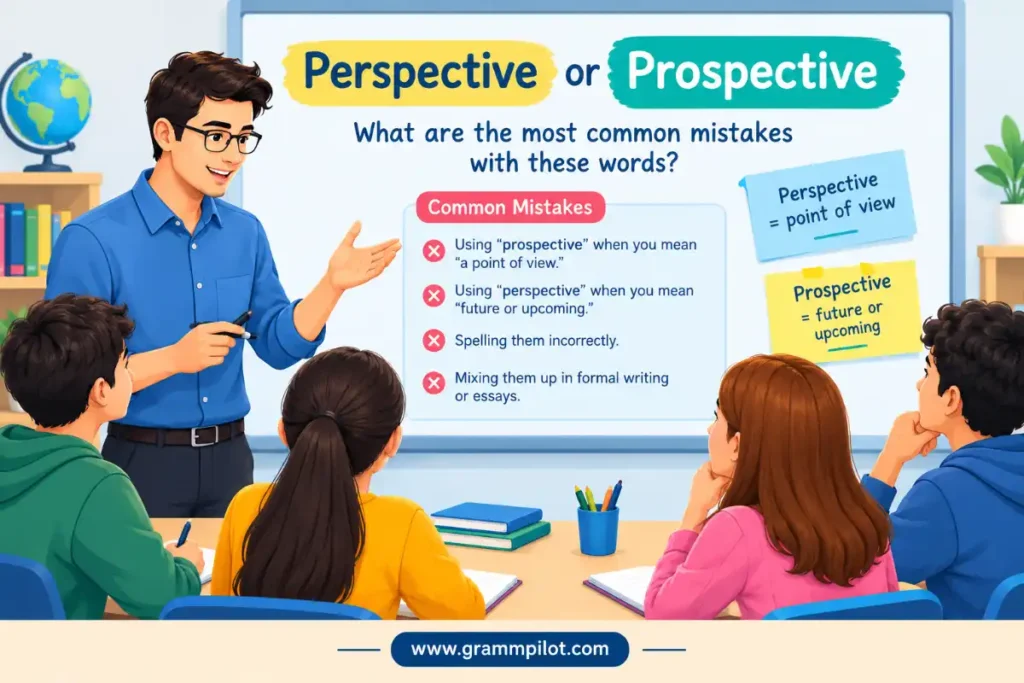
What are the most common mistakes with these words?
Mistake: writing “from my prospective”
Incorrect: From my prospective, the plan is risky.
Correct: From my perspective, the plan is risky.
When you’re giving your viewpoint, use perspective.
Mistake: writing “perspective client”
Incorrect: The salesperson called a perspective client.
Correct: The salesperson called a prospective client.
The client is a possible future customer.
Mistake: using prospective as a noun
Incorrect: The prospective contacted the company.
Correct: The prospective customer contacted the company.
Prospective normally works as an adjective and needs a noun to describe.
Mistake: assuming prospective means certain
Incorrect idea: A prospective buyer will definitely purchase something.
Correct idea: A prospective buyer is someone who may purchase something.
Prospective indicates possibility, not certainty.
Mistake: thinking perspective only means opinion
Perspective can also refer to visual depth.
Example: The artist used linear perspective.
This is a legitimate and important meaning.
Mistake: replacing every opinion word with perspective
Sometimes a more specific word is better.
Example: The company took a firm stance on the issue.
Here, stance communicates a firm position more clearly than perspective.
When should you not use perspective?
Don’t use perspective when you mean a future possibility.
Incorrect: The company is looking for perspective employees.
Correct: The company is looking for prospective employees.
Don’t use perspective when the main idea is simply that something is expected to happen later.
Incorrect: The prospective changes will begin next month.
This sentence may be correct if the changes are being considered as future changes, but if the changes are already confirmed, upcoming, planned, or scheduled may be more precise.
Word choice should match certainty.
When should you not use prospective?
Don’t use prospective when you mean someone’s viewpoint.
Incorrect: I respect your prospective on the issue.
Correct: I respect your perspective on the issue.
Also, don’t use prospective simply because something relates to a future date.
For example: prospective customer
works because the person may become a customer. But if you simply mean a meeting that is scheduled for next week, upcoming meeting is usually more natural.
Example: We discussed the upcoming meeting.
The word prospective isn’t automatically the best choice for every future-related sentence.
What are the antonyms of perspective?
Perspective doesn’t have one perfect opposite in every context.
Possible contrasts include:
- narrowness
- limited understanding
- ignorance
- lack of awareness
- restricted viewpoint
The best opposite depends on what you mean.
For example:
narrow perspective ↔ broad perspective
limited viewpoint ↔ wider viewpoint
If you’re discussing understanding, lack of perspective may be a better contrast than any single antonym.
What are the antonyms of prospective?
The opposite of prospective also depends on context.
Possible contrasting terms include:
- current
- existing
- present
- former
- actual
- confirmed
Consider these examples:
prospective employee ↔ current employee
prospective change ↔ current change
There isn’t one universal antonym because prospective can describe different types of future possibilities.
How can you remember the difference in seconds?
Use the viewpoint versus future test.
Ask yourself: Am I talking about how someone sees something?
If yes, use perspective.
Example: I understand your perspective.
Now ask: Am I talking about someone or something that may become, happen, or exist in the future?
If yes, prospective may be correct.
Example: We met with a prospective customer.
You can also connect the words to two short phrases:
Perspective = point of view
Prospective = possible future
Those phrases are short enough to remember when you’re writing quickly.
What are the best quick tips for choosing the right word?
- Use perspective for a viewpoint.
- Use perspective for an opinion or interpretation.
- Use perspective for a way of understanding an issue.
- Use perspective for visual depth in art.
- Use prospective for a possible future person.
- Use prospective for a possible future role.
- Use prospective for something being considered for the future.
- Remember that perspective is a noun.
- Remember that prospective is an adjective.
- Look for words such as client, buyer, employee, student, tenant, and investor after prospective.
- Look for ideas such as view, opinion, understanding, and way of seeing when choosing perspective.
- Don’t assume similar spelling means similar meaning.
- Don’t use prospective when you mean someone’s opinion.
- Don’t use perspective when you mean a possible future customer.
- If you’re unsure, replace the word mentally with point of view or possible future. The correct choice usually becomes obvious.
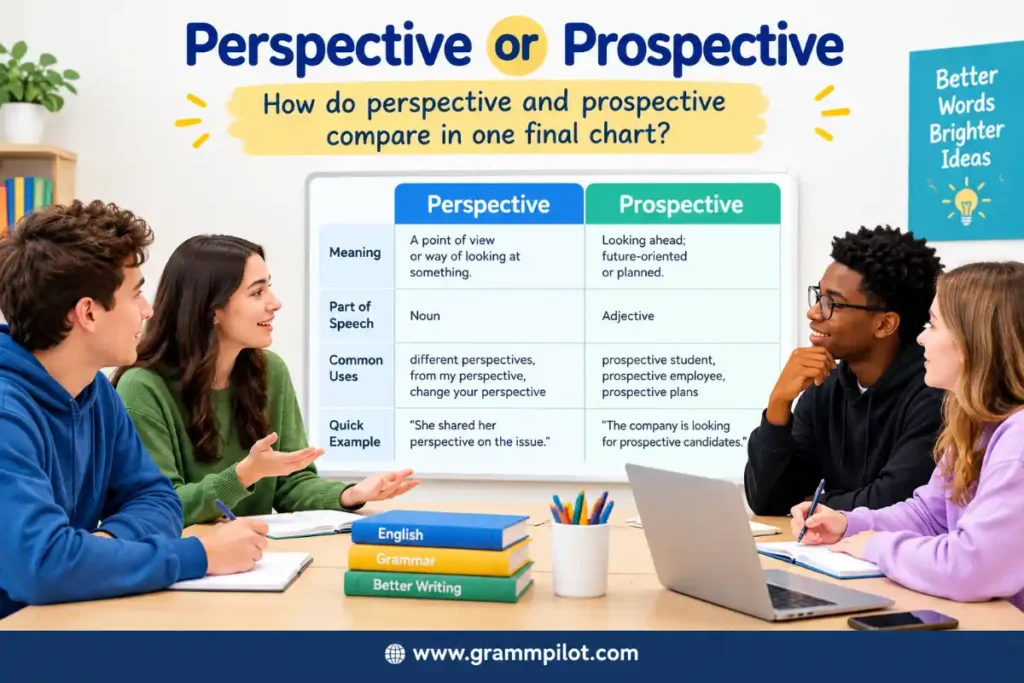
How do perspective and prospective compare in one final chart?
| Feature | Perspective | Prospective |
|---|---|---|
| Main meaning | Point of view | Possible future |
| Part of speech | Noun | Adjective |
| Main idea | Seeing or understanding | Looking ahead |
| Common phrase | Different perspective | Prospective buyer |
| Common use | Opinions and viewpoints | Future possibilities |
| Business example | Customer perspective | Prospective customer |
| Academic example | Historical perspective | Prospective changes |
| Common mistake | “From my prospective” | “Perspective client” |
| Easy synonym | Viewpoint | Potential |
| Memory clue | Point of view | Possible future |
How do you know which word to choose?
Look at the idea before looking at the spelling.
If you’re describing someone’s viewpoint, choose perspective.
Example: The manager wanted my perspective on the project.
If you’re describing a possible future person or situation, choose prospective.
Example: The manager met with a prospective employee.
If you’re discussing artistic depth, choose perspective.
Example: The drawing uses perspective to show distance.
If you’re describing a possible future customer, choose prospective.
Example: The company emailed a prospective customer.
The two words may look like twins, but they have different jobs. Learning their core meanings is much more reliable than trying to memorize every possible sentence.
Conclusion
Perspective or Prospective becomes easy to separate when you focus on the main idea behind each word. Perspective refers to a viewpoint, opinion, interpretation, or way of seeing something. It can also describe a method artists use to create depth and distance. Prospective describes something connected with a possible future, such as a prospective buyer, employee, client, or student. A quick memory trick is to connect perspective with a point of view and prospective with a possible future. If you’re discussing how someone understands a situation, choose perspective. If you’re describing someone or something that may become or happen later, choose prospective. Keep those two ideas in mind, and you’ll avoid one of the most common look-alike word mistakes in English.
Frequently Asked Questions
1. What is the difference between perspective and prospective?
Perspective means a point of view, while prospective describes something possible or expected in the future. For example, you can have a different perspective, but you can meet a prospective customer.
2. Is it “from my perspective” or “from my prospective”?
“From my perspective” is correct when you mean “from my point of view.” “From my prospective” is incorrect for that meaning.
3. Is it “prospective client” or “perspective client”?
“Prospective client” is correct. It describes someone who may become a client in the future.
4. What’s another way to say perspective?
Viewpoint, point of view, outlook, standpoint, opinion, interpretation, and take can replace perspective in suitable contexts. The best choice depends on whether you mean an opinion, attitude, interpretation, or broader understanding.
5. Can prospective mean potential?
Yes, prospective can sometimes mean potential or possible, especially before words such as buyer, client, employee, or student. The two words overlap, but prospective often emphasizes a possible future role or relationship.
6. Is prospective a noun or an adjective?
Prospective is an adjective. It describes a noun, as in “prospective buyer,” “prospective student,” or “prospective employee.”
7. How can I remember perspective vs prospective?
Think “perspective = point of view” and “prospective = possible future.” If you’re talking about how something is seen, choose perspective; if you’re talking about what may happen later, choose prospective.