
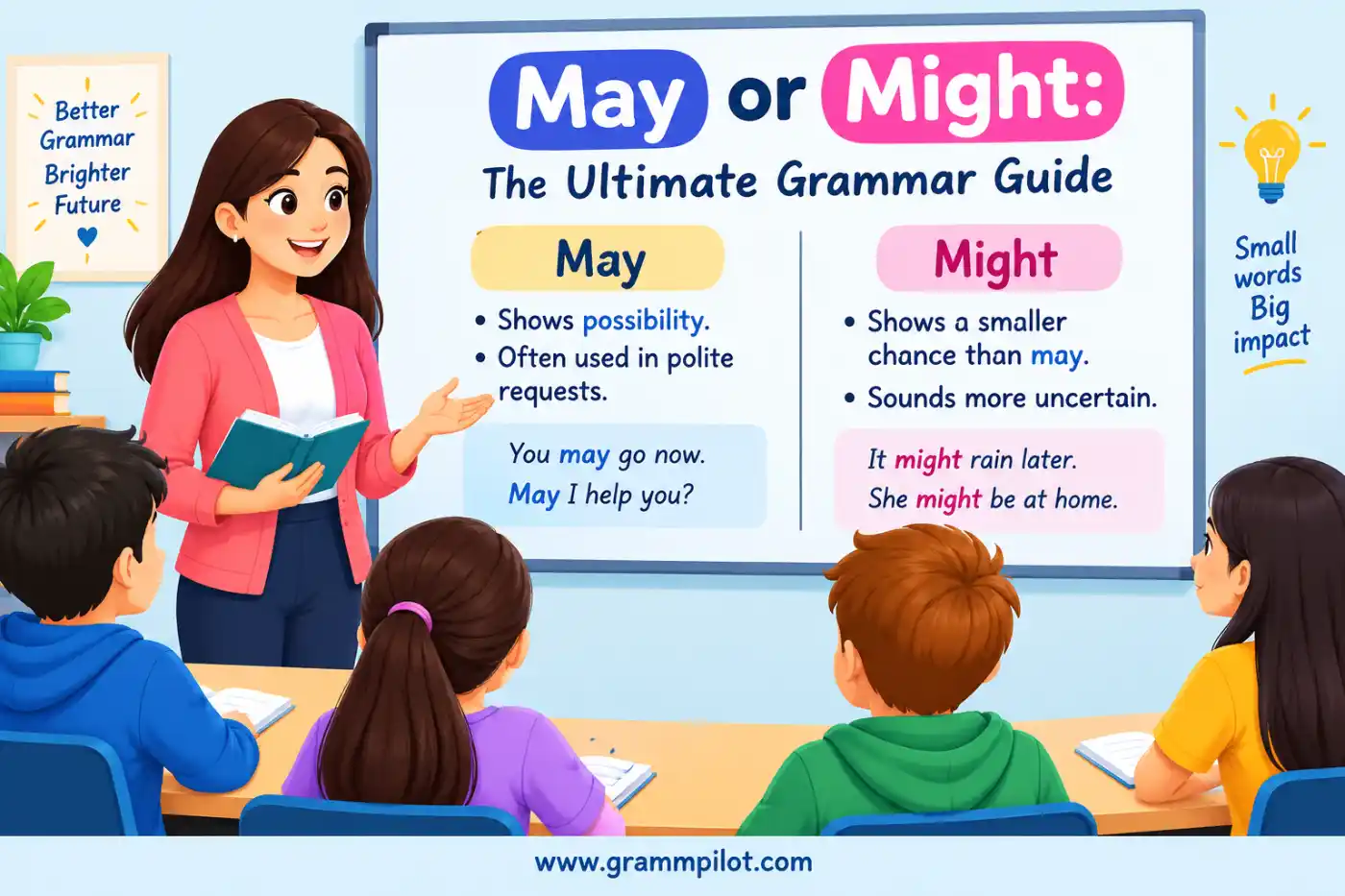
You’re writing an email, finishing an essay, or sending a quick text when you pause over one small choice: May or Might? Both words express possibility, so it can be hard to know which one sounds right. The good news is that you don’t need to memorize a long list of rigid rules. In most cases, may and might can both describe something that is possible. The difference usually comes down to certainty, tone, context, and whether you’re talking about permission.
Answer box: May and might are modal verbs that can express possibility. May often sounds a little more confident or formal, while might usually makes a possibility sound more uncertain or tentative.
The choice becomes clearer when you look at real sentences. May can also ask for or give permission, while might commonly appears in hypothetical situations, reported speech, and uncertain predictions. This guide explains their meanings, history, differences, alternatives, common mistakes, and best uses in everyday and formal writing.
If this rule seems confusing, you may also want to read [May or Can].
What do may or might mean?
May and might are modal auxiliary verbs. They work with another verb to show possibility, permission, uncertainty, or a possible result.
For possibility, consider these two sentences:
The store may close early today.
The store might close early today.
Both sentences tell us that an early closing is possible. The first can sound a little more neutral or confident. The second may suggest that the speaker is less certain. That difference is real, but it isn’t absolute. English speakers often use may and might in the same situation without intending a major difference in probability.
The words become easier to understand when you separate their main jobs:
- May can express possibility.
- May can express permission.
- Might can express possibility.
- Might can express a tentative or hypothetical result.
- Both can describe possible past events when followed by have and a past participle.
- Both can appear in careful, formal writing.
The key is to ask what you actually mean before choosing the modal.
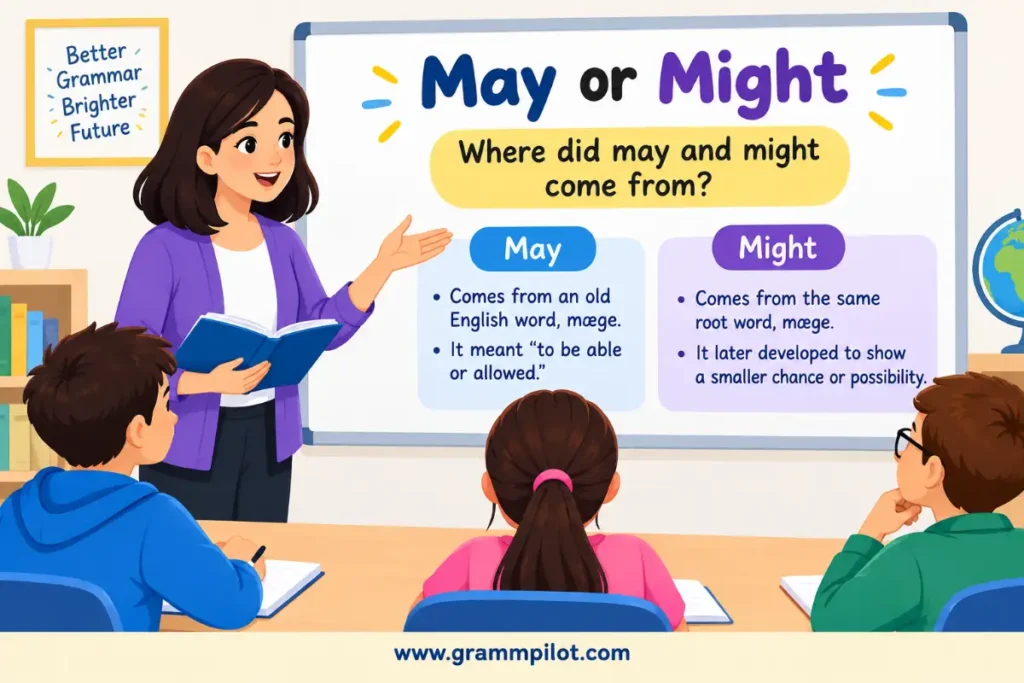
Where did may and might come from?
The history of these two words helps explain why they sometimes behave like related forms and sometimes don’t.
May comes from an Old English verb connected with having the ability or power to do something. Over many centuries, its meaning expanded to include possibility and permission.
Might developed as a past form associated with may. That historical relationship is still visible in some grammar patterns.
For example: She says she may come. When the statement is reported later, we can say: She said she might come. That shift is common in reported speech. However, modern English doesn’t use might only for past situations. Consider: I might visit them tomorrow. Tomorrow is in the future, yet might is completely natural.
You can also say: It might rain tonight.
Again, the event hasn’t happened yet. This is why the rule “may is present and might is past” is too simple for modern English.
How are may and might used in plain English?
Think of may as a way to leave an outcome open.
The package may arrive tomorrow.
You don’t know for sure, but tomorrow is a possible delivery date.
Now consider: The package might arrive tomorrow.
The basic meaning remains similar. The speaker may sound less certain about the prediction. Another useful distinction appears with permission. You may enter the building. Here, may means you have permission. But: You might enter the building. normally means entering is something that could happen. That small change creates a major difference in meaning.
When should you use may for possibility?
Use may when an event is possible and you want to state that possibility in a neutral, measured way.
Examples include:
The weather may improve this afternoon. Your order may arrive before noon. The new schedule may affect several employees. She may join us after work. This method may reduce the amount of time needed.
These statements don’t promise that something will happen. Instead, they identify one possible outcome.
May is especially common in formal and professional writing because it allows the writer to make a careful claim without sounding overly uncertain. For example: The proposed change may reduce operating costs. That sentence is more cautious than: The proposed change will reduce operating costs. If the writer doesn’t have enough evidence to guarantee the result, may is a sensible choice.
When should you use might for possibility?
Use might when you want to present an outcome as uncertain, tentative, or dependent on circumstances. For example: I might go to the concert tonight. The speaker hasn’t made a firm decision. You could also say: We might need another chair.
The need is possible, but it isn’t certain yet.
Here are more examples:
She might call after dinner.
They might change the meeting time.
He might know where the keys are.
The team might win if it plays well.
The word doesn’t automatically mean that the event is unlikely. Someone can say “It might rain” even when rain is quite possible. The speaker is simply avoiding a definite prediction.
Can may and might mean the same thing?
Yes. In many possibility sentences, they can be used interchangeably.
Consider:
Daniel may visit us this weekend.
Daniel might visit us this weekend.
Both sentences say that a visit is possible. The first may sound slightly more neutral. The second may suggest that Daniel hasn’t decided yet.
Another pair:
The road may be closed because of snow.
The road might be closed because of snow.
Both are reasonable if the speaker doesn’t know whether the road is actually closed. When the meaning is already clear from context, native speakers may choose either form based on style or personal preference.
When does may express permission?
One of the clearest uses of may is permission.
Examples:
May I borrow your pen?
May I leave early today?
You may begin the test now.
Guests may use the pool until 9 p.m.
In these sentences, may doesn’t mean possibility. It means someone is allowed to do something. This is an important distinction.
Consider: You may use my computer.
This normally means: You have permission to use my computer. Now change the modal: You might use my computer. This usually means: It is possible that you will use my computer. The meaning is no longer about permission.
Is may formal when asking for permission?
May I…? is polite and somewhat formal, but it is not outdated or incorrect.
For example: May I ask you a question?
works well in a classroom, workplace, customer-service setting, or formal conversation.
In casual American English, can I…? is also extremely common: Can I borrow your charger?
That doesn’t mean the speaker is asking about physical ability. Modern English frequently uses can for permission in everyday speech.
So you can think of the difference this way:
| Expression | Common use |
|---|---|
| May I…? | Polite or formal permission |
| Can I…? | Everyday permission |
| Might I…? | Very formal or unusual request |
Can might ever express permission?
It can appear in very formal or old-fashioned expressions, but it isn’t the normal choice for everyday permission.
For example: Might I make a suggestion?
This is grammatically possible, but it sounds quite formal.
Most modern speakers would choose: May I make a suggestion?
or: Can I make a suggestion?
If you’re writing normal American English, may is the safer choice when permission is the intended meaning.
How does might work in hypothetical situations?
Might is common when discussing something that could happen under certain conditions.
For example: If we leave now, we might catch the earlier train.
Catching the train is possible, but it isn’t guaranteed.
Another example: If she studies tonight, she might pass the test.
The result depends partly on the condition.
You can also use may: If we leave now, we may catch the earlier train.
That is correct too.
The difference is mainly one of tone. Might can make the result sound more tentative.
Common patterns include: If + condition + might + base verb
Examples:
If you hurry, you might catch the bus.
When the weather improves, we might go hiking.
If sales increase, the company might hire more workers.
These structures are useful in both everyday conversation and formal writing.
How do may have and might have work?
Both forms can describe a possible past event.
The structure is: may/might + have + past participle
Examples:
She may have forgotten the appointment.
He might have missed the train.
They may have taken the wrong road.
I might have left my wallet at home.
The speaker is discussing something that may already have happened. You can often use either modal.
For instance: He may have misunderstood the question.
and: He might have misunderstood the question.
Both are correct. The second can sound more tentative.
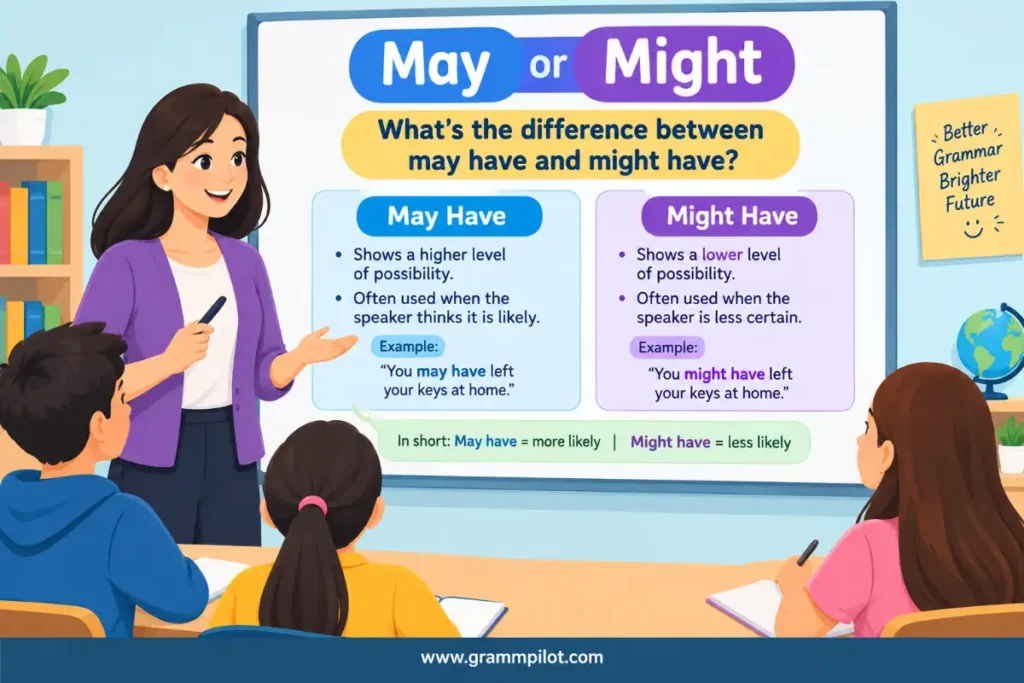
What’s the difference between may have and might have?
The distinction is usually subtle. She may have taken the earlier flight. This presents the earlier flight as a possible explanation. She might have taken the earlier flight. This also presents it as possible, but the speaker may sound less confident. Neither sentence confirms what actually happened.
You can use these structures when:
- Explaining an unknown event
- Guessing about someone’s actions
- Analyzing evidence
- Discussing possible causes
- Talking about a past mistake
For example: The computer may have overheated.
This suggests overheating is one possible cause.
How does reported speech change may to might?
Reported speech is one area where might commonly appears as a backshifted form of may.
Direct speech: Maria said, “I may attend the meeting.”
Reported speech: Maria said that she might attend the meeting.
Another example:
Direct speech: James said, “I may need help.”
Reported speech: James said that he might need help.
The change doesn’t necessarily mean James became less certain. It’s often simply a normal tense shift when one person’s earlier words are reported later. This is one reason the relationship between may and might is more complicated than a simple present-versus-past rule.
How do may not and might not differ?
Both can express negative possibility.
She may not attend the meeting.
This means it is possible that she won’t attend.
She might not attend the meeting.
The same general idea applies, with the second sentence often sounding more tentative.
But may not can also express prohibition.
For example: You may not enter this area.
Here, the meaning is: You are not allowed to enter.
That is very different from: You may not see him today.
The second sentence describes a possible situation rather than a rule. Context is essential.
What are the main synonyms for may and might?
There isn’t one perfect synonym for either modal in every situation. Different words and phrases express different shades of possibility, certainty, tone, or grammatical function.
| Word | Meaning | Tone | Example |
|---|---|---|---|
| Could | Is possible | Neutral | It could rain tonight. |
| Perhaps | Possibly | Neutral | Perhaps we should wait. |
| Possibly | In a possible way | Neutral | He could possibly help. |
| Probably | More likely than not | Neutral | She’ll probably arrive soon. |
| Likely | Has a good chance | Neutral | Rain is likely tomorrow. |
| Conceivably | Possible to imagine | Formal | The plan could conceivably work. |
| Presumably | Probably based on evidence | Formal | She is presumably aware. |
| Apparently | According to what is known | Neutral | Apparently, the train was delayed. |
| It is possible | Possibility exists | Formal | It is possible that he left. |
| It could be | Possible explanation | Neutral | It could be a mistake. |
| Could happen | Possible event | Casual | Anything could happen. |
| I guess | Tentative opinion | Casual | I guess he might come. |
| I think | Tentative belief | Neutral | I think she might agree. |
| Odds are | Probably | Informal | Odds are he’ll win. |
| Maybe so | Possibly true | Casual | Maybe so, but I’m unsure. |
| It seems | Appears likely or true | Neutral | It seems possible. |
| It appears | Appears to be the case | Formal | It appears likely to continue. |
| Expected | Regarded as likely | Formal | Rain is expected tomorrow. |
| Uncertain | Not known | Neutral | The outcome is uncertain. |
| Potential | Possible future outcome | Neutral/Formal | There is potential for growth. |
| Probable | Likely to happen | Formal | A delay is probable. |
| Remote chance | Small possibility | Formal | There is a remote chance. |
These expressions overlap, but they aren’t interchangeable in every sentence. Probably, for example, normally communicates more confidence than might. Maybe has a different grammatical role because it is an adverb rather than a modal verb.
Which words express the weakest possibility?
English doesn’t have a perfect fixed scale, but some expressions commonly sound more tentative than others.
A rough guide is: Certain → very likely → probably → may/could → might → possibly → remote chance
This is only a guide.
For example:
She will come.
sounds definite.
She’ll probably come.
suggests a strong expectation.
She may come.
presents a reasonable possibility.
She might come.
sounds more tentative.
She may possibly come.
can sound unnecessarily wordy because may and possibly already overlap. Good writing usually avoids stacking several uncertainty markers unless there is a clear reason to do so.
May or Might: What are the parts of speech related to may or might?
Understanding grammar categories makes these words easier to use.
Modal verbs
May and might are modal auxiliary verbs.
Example: She might leave early.
The modal might works with the base verb leave.
Adverbs
Words such as maybe, perhaps, possibly, and probably are adverbs.
Examples:
Maybe she will leave early.
Perhaps she will stay.
She will probably arrive soon.
Their positions in a sentence differ from those of modal verbs.
Adjectives
Words such as possible, likely, and probable can function as adjectives.
Examples:
A delay is possible.
Rain is likely.
Nouns
Words such as possibility, chance, and likelihood are nouns.
Examples:
There is a possibility of rain.
There’s a good chance she’ll arrive early.
These alternatives let you express similar ideas while changing the structure of the sentence.
Which word works best on a resume?
A resume usually benefits from confident, evidence-based language.
That means may and might should not be used to weaken achievements that you can state directly.
Weak: I might have improved customer satisfaction.
Stronger: Improved customer satisfaction by 18%.
If you’re describing a possible requirement or future situation, a modal may be appropriate: The position may require occasional weekend work.
That sentence describes a possibility rather than an achievement. A useful resume rule is simple: don’t hedge measurable accomplishments unless the information genuinely isn’t certain.
Which word works best in an essay?
Both forms are useful in academic writing because essays often discuss ideas that aren’t completely certain.
May is especially useful when making a careful claim.
Example: The policy may influence how consumers respond to price changes.
The writer isn’t claiming that the effect is guaranteed. Might can make the statement more tentative:
The policy might influence how consumers respond to price changes.
That can be useful when the evidence is limited. Academic writers often use modal verbs to avoid presenting opinions as proven facts.
Instead of: This policy causes unemployment.
a cautious writer might say: This policy may contribute to unemployment.
The second statement leaves room for other causes.
Which one sounds best in texting?
Might often sounds natural in casual messages because it easily expresses an undecided plan.
For example:
I might come later.
We might order pizza.
She might be busy.
I might skip the party tonight.
Maybe I’ll come is another natural choice.
May isn’t wrong in texting, but it can sound slightly more formal in some situations: I may come later.
That sentence is perfectly grammatical. It simply has a different feel from the more casual I might come later.
Which one should you use in an email?
The best choice depends on what you’re communicating.
For a professional email: The report may be ready by Friday.
sounds neutral and polished.
For a casual email: The report might be ready by Friday.
sounds relaxed and uncertain.
For permission: You may submit the document by Friday.
clearly tells the recipient that submission is allowed. Don’t use might if you’re trying to give official permission.
Which one sounds natural in everyday speech?
Both words are common in spoken English.
I might go out tonight.
sounds very natural.
It may rain later.
also sounds natural.
May I ask you something?
works well as a polite request.
She might know the answer.
is an ordinary way to express uncertainty. The choice isn’t simply about formal versus informal English. Meaning matters first.
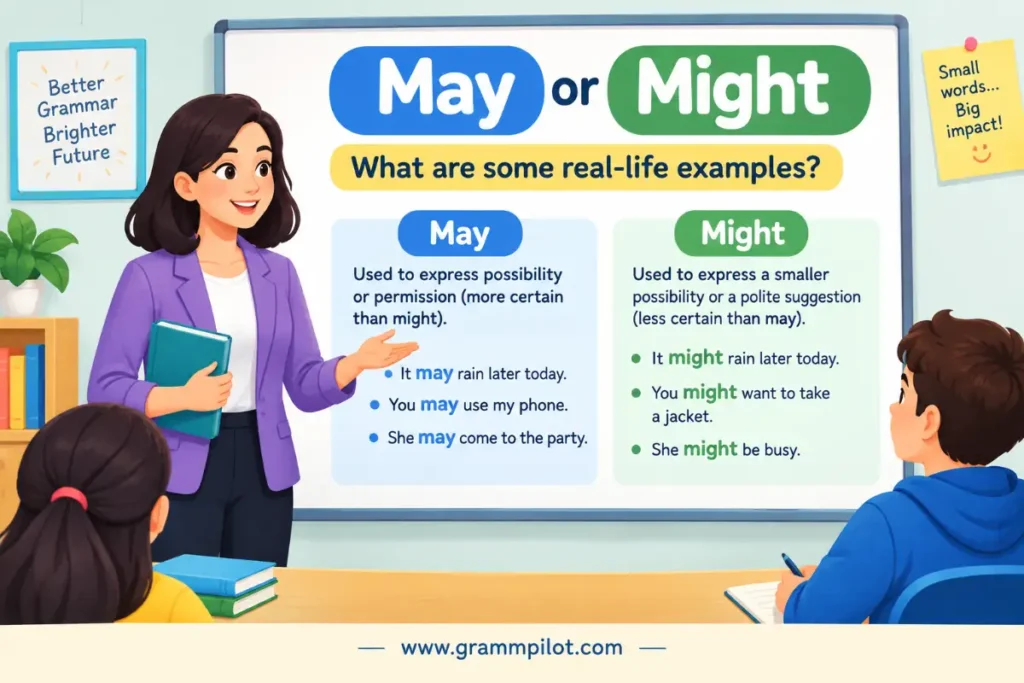
What are some real-life examples?
Example 1: Weather
The temperature may drop tonight.
The speaker is making a measured prediction.
Example 2: Travel
We might take the train instead of driving.
The plan isn’t final.
Example 3: School
Students may use calculators during the final section.
This sentence gives permission.
Example 4: Work
The manager may extend the deadline.
An extension is possible.
Example 5: Family plans
Dad might come with us tomorrow.
The speaker isn’t sure yet.
Example 6: Technology
The update may fix the connection problem.
The writer identifies a possible result.
Example 7: Past event
She might have left her phone in the car.
Leaving the phone there is one possible explanation.
Example 8: Conditional situation
If we leave before six, we might avoid traffic.
Avoiding traffic depends on leaving early.
Example 9: Permission
You may use the guest parking area.
The speaker is granting permission.
Example 10: Professional communication
The appointment may need to be rescheduled.
A change is possible but not certain.
May vs. might: what’s the clearest difference?
| Feature | May | Might |
|---|---|---|
| Basic possibility | Yes | Yes |
| Often sounds tentative | Sometimes | Often |
| Permission | Yes | Usually not |
| Future possibility | Yes | Yes |
| Past possibility with “have” | Yes | Yes |
| Hypothetical situations | Yes | Yes |
| Reported speech | Yes | Very common |
| Formal writing | Common | Common |
| Fixed probability | No | No |
The most useful distinction is not a strict percentage. instead, remember the two major ideas:
May often presents possibility neutrally and can express permission.
Might often presents possibility more tentatively and is common in hypothetical or uncertain situations.
May vs. could: what’s different?
Could overlaps with may when both describe possibility.
Compare:
The meeting may finish early.
The meeting could finish early.
Both suggest an early finish is possible. But could has other meanings.
For example:
When I was younger, I could run five miles. Here, could expresses ability. You can’t replace it with may and keep the same meaning.
When I was younger, I may run five miles.
That doesn’t express past ability. So could is broader in some ways than may.
May vs. maybe: what’s the difference?
May is a modal verb.
Maybe is an adverb.
Compare:
She may arrive soon.
Maybe she will arrive soon.
The meaning is similar, but the sentence structure changes.
You cannot simply use maybe in the same grammatical position as may.
Incorrect: She maybe arrive soon.
Correct: She may arrive soon.
or: Maybe she will arrive soon.
This is a common mistake for English learners.
Might vs. probably: which sounds more certain?
Probably usually sounds more certain than might.
Compare: He might come tonight.
The speaker isn’t sure.
He’ll probably come tonight.
The speaker expects him to come. The difference is about confidence. There is also a grammatical difference.
Might is a modal verb.
Probably is an adverb.
That’s why the surrounding sentence changes.
What are the most common mistakes?
Mistake 1: Thinking might only refers to the past
This isn’t true in modern English.
I might travel next month. The action is future.
Mistake 2: Using might for normal permission
If you mean someone is allowed to do something, use may or everyday can.
You may use the printer.
Mistake 3: Treating may and might as exact probability levels
English doesn’t assign fixed percentages to them. The difference is usually about tone and context.
Mistake 4: Using may when you mean ability
May isn’t normally the word for ability. Use can or could when ability is the intended meaning.
Mistake 5: Confusing maybe with may be
These are different.
Maybe means “perhaps.”
May be is the modal may plus the verb be.
Compare:
Maybe she is tired.
She may be tired.
Both are correct, but their structures differ.
Mistake 6: Adding unnecessary uncertainty
If something is known, you don’t need a modal.
Instead of: The answer might be 10.
when you’re certain, write: The answer is 10.
Good writing matches the strength of the language to the strength of the evidence.
When should you avoid may or might?
Don’t use a modal when you need to make a definite statement.
For example: The Earth may orbit the Sun.
This is technically framed as a possibility, but it is unnecessarily weak.
Better: The Earth orbits the Sun.
Likewise, if a deadline is fixed, avoid unnecessary hedging.
Weak: The application might be due Friday.
if the official deadline is Friday.
Better: The application is due Friday.
Modal verbs are useful when uncertainty is real. They become distracting when the writer already knows the answer.
What are the antonyms of possibility?
There isn’t one perfect opposite for every use of may and might.
Depending on context, contrasting expressions include:
- Will
- Definitely
- Certainly
- Cannot
- Impossible
- Will not
- Definitely won’t
For example: She might come.
A stronger opposite could be: She definitely won’t come.
For permission: You may enter.
The opposite can be: You may not enter.
That last example is especially important because may not can express prohibition rather than simple uncertainty.
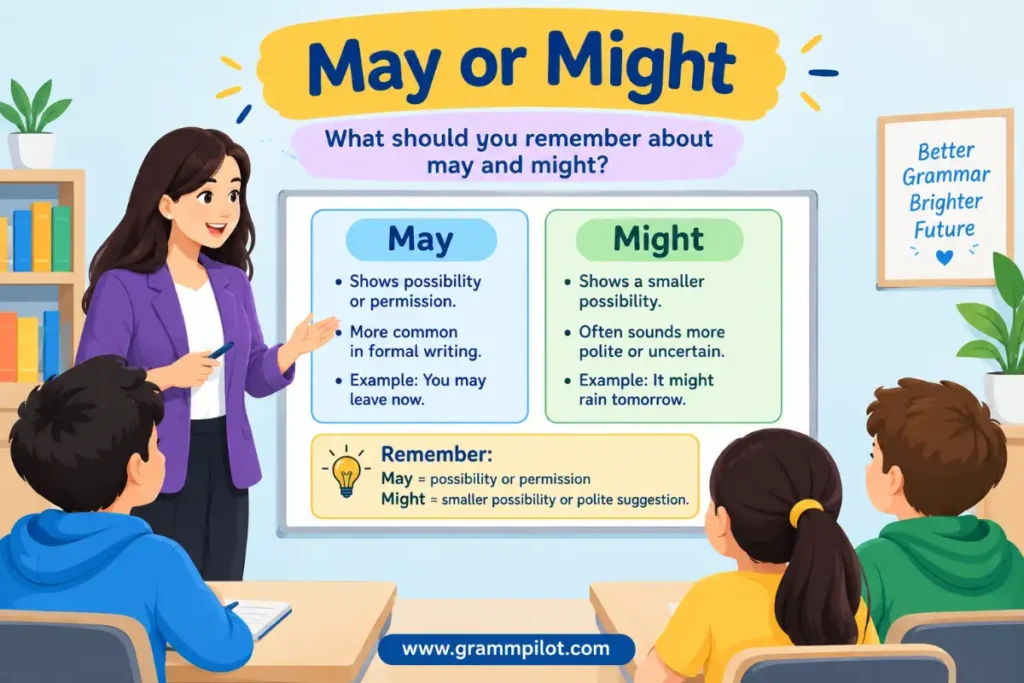
What should you remember about may and might?
Here are the easiest rules to keep in mind:
- Use may for possibility.
- Use might for possibility too.
- Might often sounds more tentative.
- May can sound more formal or neutral.
- Use may to give permission.
- Use May I…? for a polite permission request.
- Don’t assume might only describes the past.
- Use may have or might have for possible past events.
- Use might naturally in hypothetical situations.
- Don’t assign fixed probability percentages to either word.
- Use could when possibility or ability is intended.
- Use maybe as an adverb, not as a replacement for may inside the same verb structure.
- Don’t hedge a statement that is already certain.
Conclusion
Understanding May or Might doesn’t require memorizing complicated formulas. Both words can express possibility, and the difference often comes from how certain or tentative the speaker wants to sound. May has one especially important use that might normally doesn’t: expressing permission. Might is also common when discussing hypothetical results, uncertain plans, and possible past events. Instead of asking which modal is always correct, first decide what your sentence means. Then consider how certain you want to sound. With that approach, your choice will become much more natural in conversation, schoolwork, professional emails, and everyday writing.
Frequently Asked Questions
1. Is may or might better for possibility?
Both are correct for possibility. May often sounds slightly more neutral or confident, while might can sound more tentative.
2. Is might the past tense of may?
Historically, might is related to the past form of may, but modern English also uses it for present and future possibilities.
3. Can I use may to ask for permission?
Yes. May I…? is a standard polite way to ask for permission, especially in formal or respectful situations.
4. What’s another way to say may or might?
Depending on the sentence, you can use could, maybe, perhaps, possibly, or there is a chance. The best alternative depends on the exact meaning and level of certainty.
5. Is may more likely than might?
May can sound more confident than might, but there is no fixed probability difference between the two words.
6. Can might be used for permission?
Usually not in everyday English. Use may or can when you’re asking whether something is allowed.
7. Should I use may or might in formal writing?
Either can work. May is useful for careful claims and permission, while might is useful when you want to emphasize uncertainty or a hypothetical possibility.