
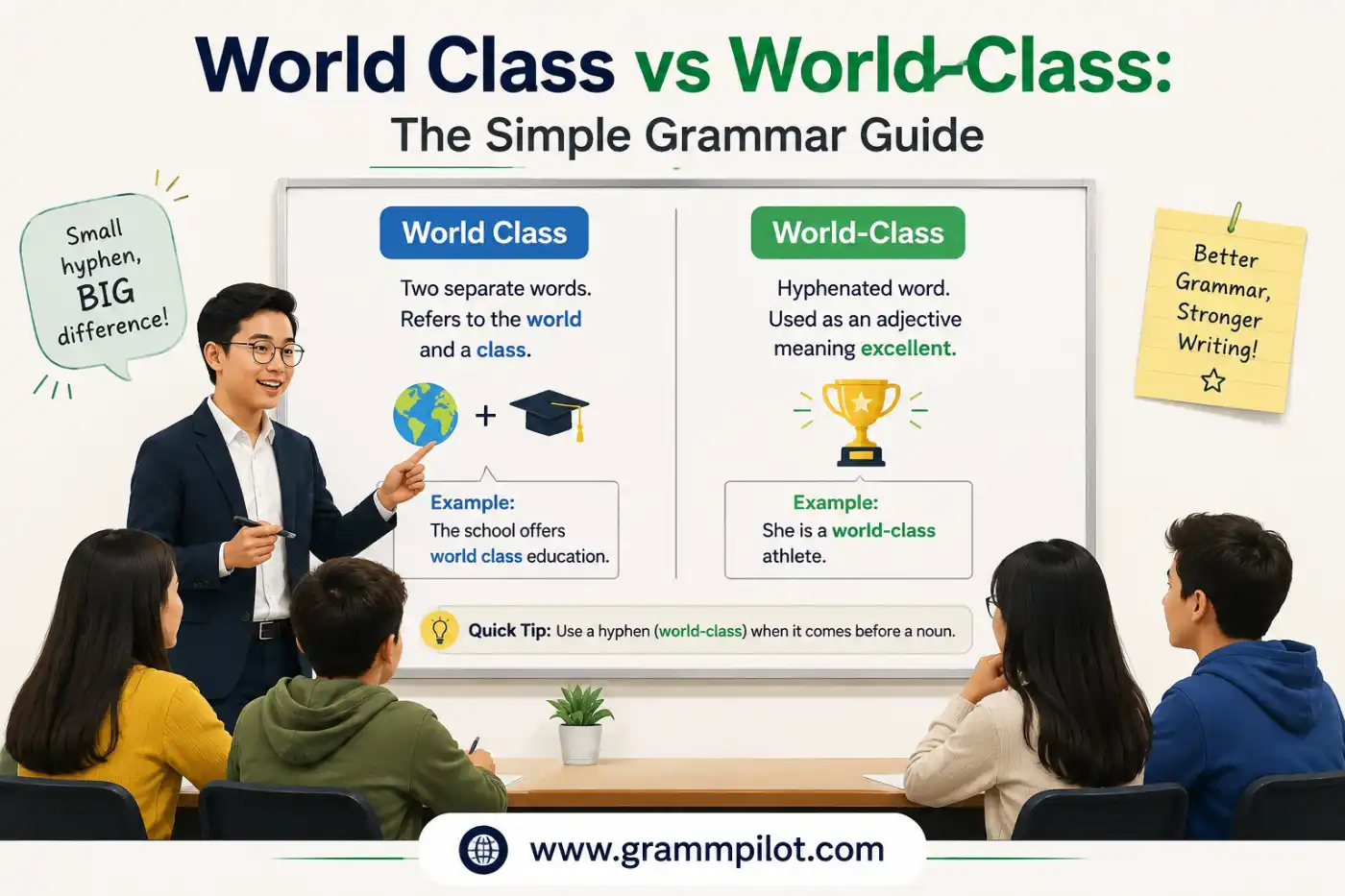
When you’re writing an email, resume, essay, website description, or social media post, you may stop over a small detail: should you write World Class vs World-Class? Both forms appear in English, but they don’t always work in the same place. The difference mainly depends on how the phrase functions in a sentence.
Answer box: Use world-class when the phrase comes directly before a noun as a compound adjective: “a world-class athlete.” Use world class when the words function separately, usually after a linking verb: “The athlete is world class.”
The hyphen isn’t just decoration. It helps readers understand that world-class works as one adjective describing a noun. Once you know where the phrase sits in the sentence, choosing the correct form becomes much easier. This guide explains the meaning, origin, grammar rule, capitalization, common mistakes, examples, regional usage, and the best choice for resumes, essays, emails, websites, and everyday speech.
For more practical grammar examples, explore [Quieter vs More Quiet].
What is the difference between world class and world-class?
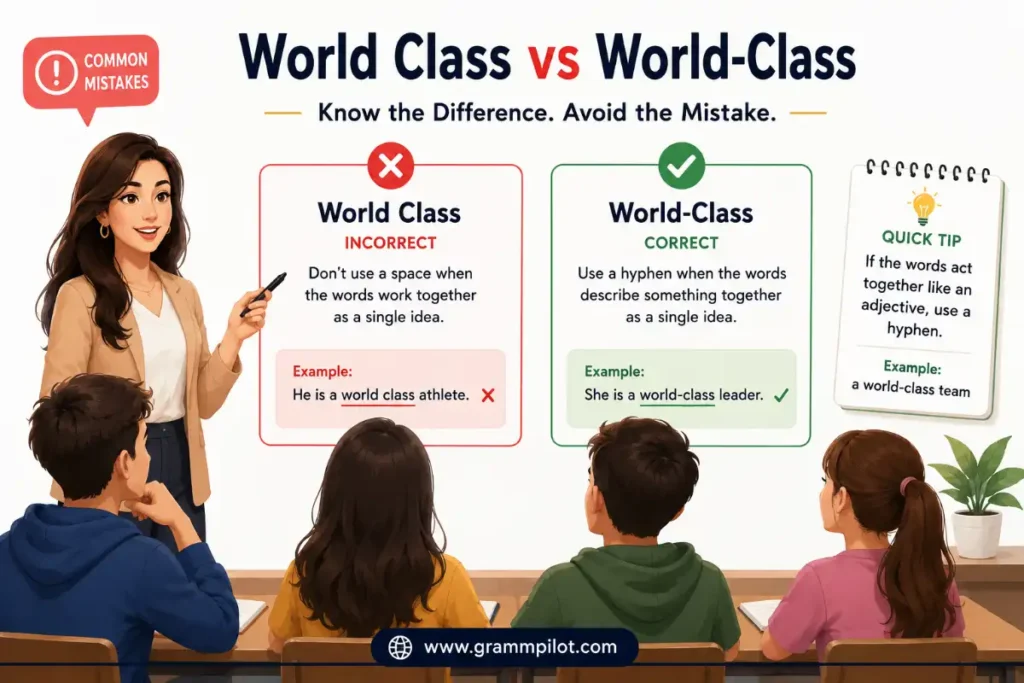
The basic rule is simple: Use “world-class” before a noun.
Example: She is a world-class pianist.
Use “world class” after a linking verb when it describes the subject.
Example: She is world class.
The meaning stays almost the same. The grammatical position changes.
Compare these sentences: The company hired a world-class designer.
Here, world-class comes directly before designer, so the two words work together as a compound adjective.
The designer is world class.
Now the phrase comes after is and describes the designer. The hyphen is normally unnecessary.
Another example:
They built a world-class facility.
The facility is world class.
This pattern explains most everyday uses.
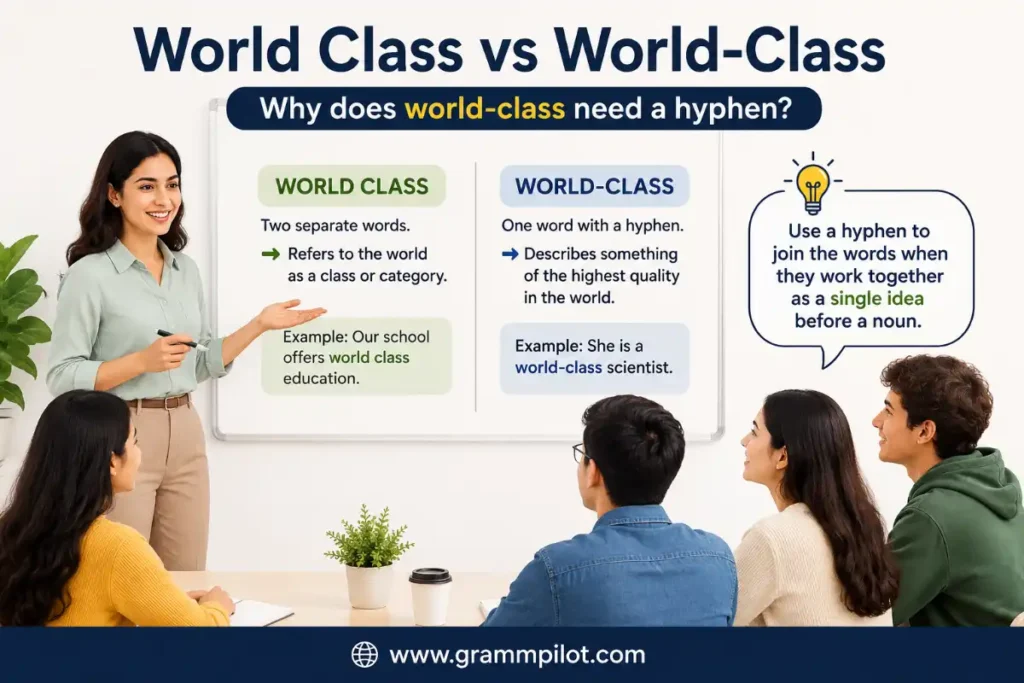
Why does world-class need a hyphen?
A hyphen can connect two words that work together to modify another word.
In: a world-class hospital
the words world and class work together to describe hospital. Without the hyphen, a reader could momentarily interpret the words separately.
The hyphen makes the relationship clear: world-class hospital
Think of the hyphen as a small bridge between the two words. It tells the reader: These words belong together as one descriptive unit. This is called a compound adjective.
Other familiar examples include:
- high-quality product
- well-known author
- full-time employee
- five-year-old child
- state-of-the-art equipment
- user-friendly website
- long-term plan
World-class follows the same basic pattern.
What does world-class mean?
World-class means extremely high in quality, ability, performance, or standard. It usually suggests that something is among the best in the world or is good enough to compete at the highest international level.
Examples: She is a world-class athlete.
This means she performs at an exceptionally high level.
The hotel offers world-class service.
This means the service is presented as being of the highest quality.
They built a world-class research center.
The phrase suggests that the center has an exceptionally high standard.
The expression is often used for:
- athletes
- musicians
- universities
- hospitals
- restaurants
- hotels
- businesses
- facilities
- technology
- performances
- services
- products
- teachers
- researchers
- destinations
World Class vs World-Class:Where did the phrase world-class come from?
The word world comes from Old English weorold, referring broadly to human existence, earthly life, or the inhabited world. Class comes through Latin and French and developed in English to describe groups, categories, ranks, or levels. The modern expression world-class combines these ideas. It describes something that belongs at the highest level when compared with standards across the world.
The phrase became especially useful in modern English as international competition and comparison became more common. Today, calling something world-class often means that it meets a standard associated with the very best examples internationally.
It’s also worth remembering that the expression can be used loosely. A restaurant calling itself “world-class” doesn’t automatically prove that it is among the best restaurants on Earth. The phrase can be a genuine description, but it can also be promotional language.
Is world-class one word or two words?
World-class is normally written as two words joined by a hyphen, not as one word.
Correct: world-class service
Correct: a world-class university
Usually incorrect: worldclass service
The standard spelling is world-class when the phrase functions as a compound adjective.
When the phrase functions as a complement after a linking verb, write: The service is world class.
So there are three forms you may encounter:
| Form | Typical use | Example |
|---|---|---|
| world-class | Compound adjective before a noun | She is a world-class chef. |
| world class | Predicate description | Her cooking is world class. |
| worldclass | Nonstandard spelling in ordinary English | Avoid this form. |
When should you use world-class?
Use world-class when the phrase comes immediately before the noun it describes.
Examples:
a world-class athlete
a world-class education.
The pattern is easy to remember: world-class + noun
World-class athlete
She became a world-class athlete at a young age. The phrase describes athlete, so the hyphen is used.
World-class education
The university provides world-class education. Here, world-class modifies education.
World-class facilities
The hotel has world-class facilities. The compound adjective comes directly before facilities.
World-class performance
The singer delivered a world-class performance. Again, the phrase modifies a noun.
When should you use world class?
Use world class when the phrase appears after a linking verb and functions as a description of the subject.
Common linking verbs include:
- is
- are
- was
- were
- seems
- looks
- remains
- became
- appears
Examples:
Her performance is world class.
Their facilities are world class.
The service was world class.
His talent is world class.
The university remains world class.
The restaurant looks world class.
In these sentences, the phrase isn’t directly placed before a noun. It describes the subject after the verb.
World class vs world-class: side-by-side examples
| Before a noun | After a linking verb |
|---|---|
| She is a world-class athlete. | Her performance is world class. |
| They built a world-class hospital. | The hospital is world class. |
| He received world-class training. | His training was world class. |
| We visited a world-class museum. | The museum was world class. |
| They offer world-class service. | Their service is world class. |
| She gave a world-class performance. | Her performance was world class. |
| It has world-class facilities. | Its facilities are world class. |
| He is a world-class coach. | His coaching is world class. |
The easiest trick is to look at the word immediately after the phrase. If world-class comes before a noun, the hyphen is usually appropriate. If the phrase comes after is, was, are, or another linking verb, the open form world class is usually preferred.
Why position matters
English compound adjectives often change punctuation depending on where they appear.
Compare: a high-quality product
with: The product is high quality.
The same principle applies here: a world-class product
but: The product is world class.
This isn’t unique to this expression.
Consider: a full-time employee
but: The employee works full time.
Or: a long-term solution
but: The solution will work in the long term.
The grammatical position affects the punctuation.
Is world-class always hyphenated before a noun?
In standard usage, yes, when world-class functions as a compound modifier directly before a noun.
Examples:
1.world-class talent
2.world-class athletes
3.world-class schools
4.world-class restaurants
5.world-class opportunities
The hyphen makes the compound relationship clear. There can be exceptions in highly specialized styles or publications, but for normal American English writing, world-class is the safe and standard choice before a noun.
Is world class hyphenated after a verb?
Usually, no.
Write: The restaurant is world class.
Not: The restaurant is world-class.
Some writers still use the hyphen in predicate position, especially in advertising or informal promotional writing. You may see:
Our service is world-class.
This usage exists and is understandable, but many style guides and dictionaries distinguish the compound adjective before a noun from the predicate phrase.
For careful writing, the clearest approach is: a world-class restaurant The restaurant is world class.
Is world-class an adjective?
Yes. World-class commonly functions as a compound adjective.
It describes the quality or standard of a noun.
Examples:
1.world-class player
2.world-class institution
3.world-class facilities
4.world-class research
The phrase answers a question such as:
What kind of player?
A world-class player.
What kind of institution?
A world-class institution.
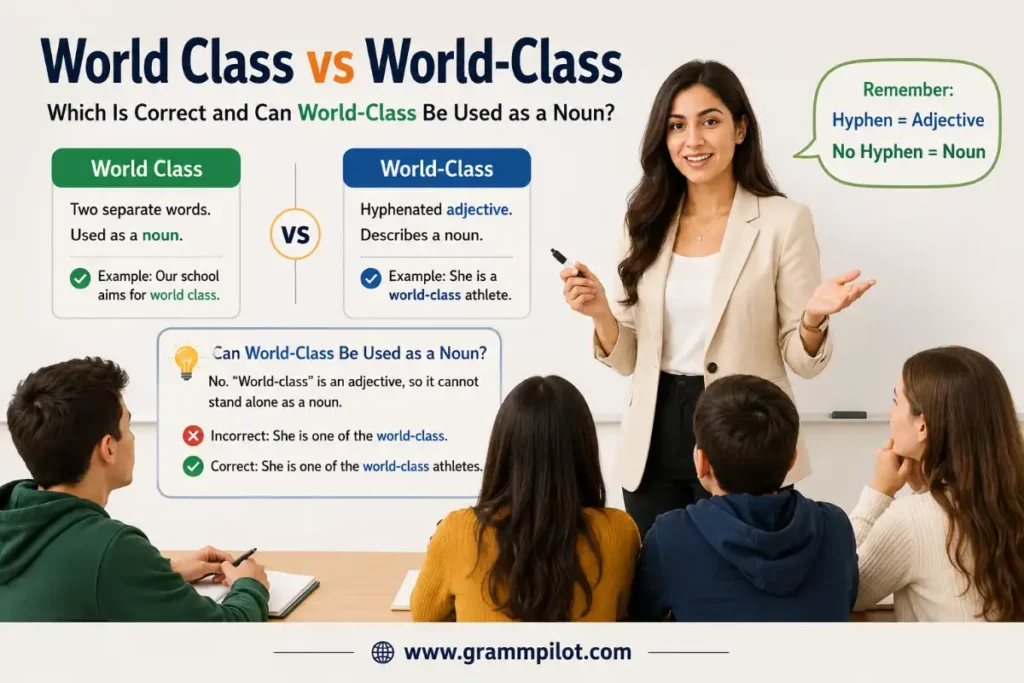
Can world class be used as a noun?
In ordinary modern English, world class is not commonly used as a standalone noun to mean “the best level” in the same way that world-class functions as an adjective. However, related expressions may use class as a noun.
For example:
She competes at world level.
He performs at the highest level.
These are different constructions.
Don’t force world class into a noun role when a clearer phrase such as world level, international standard, or the highest level would work better.
Can world-class describe a person?
Absolutely.
Examples:
- world-class athlete
- world-class musician
- world-class scientist
- world-class writer
- world-class teacher
- world-class coach
- world-class engineer
- world-class chef
- world-class artist
- world-class speaker
Example: The team hired a world-class coach.
The phrase tells us that the coach is considered exceptionally skilled.
After the verb: The coach is world class.
Here, the hyphen is normally dropped.
Can world-class describe a place?
Yes.
Examples:
1.a world-class city
2.a world-class university
3.a world-class hospital
4.a world-class museum
5.a world-class stadium
6.a world-class resort
7.a world-class restaurant
Example: The city has a world-class public transportation system.
After the verb: The city’s transportation system is world class.
Can world-class describe a thing?
Yes. It can describe almost anything that can be judged by quality or performance.
Examples:
1.world-class equipment
2.world-class technology
3.world-class architecture
4. world-class security
5.world-class education
6.world-class service
7.world-class design
8.world-class research
The important question isn’t whether the noun is a person, place, or thing. The important question is how the phrase functions grammatically.
15 examples using world-class correctly
- She is a world-class swimmer.
- The university has a world-class engineering program.
- They built a world-class medical center.
- He received world-class training.
- The restaurant is known for its world-class cuisine.
- The company hired a world-class designer.
- We watched a world-class performance last night.
- The city is developing a world-class sports complex.
- The museum houses a world-class collection.
- They provide world-class customer service.
- The school has world-class teachers.
- The team attracted several world-class players.
- She produced a world-class research paper.
- The resort offers world-class accommodations.
- The laboratory uses world-class equipment.
Notice that the hyphenated form appears before nouns.
15 examples using world class correctly
- Her performance was world class.
- The facilities are world class.
- His coaching is world class.
- The service was world class.
- Their research is world class.
- The food was world class.
- The university is world class.
- Her talent is world class.
- The team’s defense was world class.
- The museum is truly world class.
- Their technology is world class.
- The design looks world class.
- The hospital remains world class.
- His work has become world class.
- The experience was world class from start to finish.
These examples show the open form after linking verbs.
World-class in a resume
A resume is one place where this distinction matters because professional writers frequently use the phrase to describe skills, services, achievements, and experience.
Before a noun:
Provided world-class customer support to international clients.
Led a world-class sales team.
Developed world-class training materials.
Managed a world-class research program.
Here, the hyphenated form is correct because the phrase modifies a noun.
However, be careful with the phrase itself. World-class is a strong claim.
If your resume says: Provided world-class customer service
the reader may wonder what evidence supports that claim. A stronger resume often combines the phrase with measurable results: Delivered world-class customer support, increasing client satisfaction by 22%.
Even better, if the claim isn’t necessary: Delivered customer support that increased client satisfaction by 22%.
Specific evidence usually carries more weight than praise.
World-class in an essay
Academic essays need more caution.
You can use: The university developed a world-class research program.
But don’t repeatedly call everything world-class unless you can support the claim.
For example: The city has world-class facilities.
This is broad.
A more precise sentence might be: The city has research facilities that attract scientists from several countries.
In academic writing, factual evidence is often stronger than promotional language.
Still, when the phrase is appropriate, the grammar remains the same: a world-class institution
but: The institution is world class.
World-class in an email
For a professional email, the hyphenated form works naturally before a noun.
We are proud to offer world-class training to new employees.
Our team provides world-class support to customers.
If you’re describing something after a linking verb: The new system is world class.
For a formal message, you may want to avoid exaggeration unless you can support the claim.
Instead of: We offer world-class service.
you might write: We offer fast, reliable service to clients across the country.
The second sentence gives the reader useful information.
World-class in marketing
Marketing uses world-class frequently.
Examples include:
- world-class service
- world-class quality
- world-class experience
- world-class facilities
- world-class solutions
- world-class technology
The phrase is persuasive because it suggests exceptional quality.
However, repetition can make marketing copy sound generic.
Compare: We offer world-class service.
with: Our support team responds to customer requests within one business day.
The second statement is more specific.
You can combine both: We provide world-class support, with most customer requests answered within one business day.
That gives the promotional phrase some evidence.
World-class in a website headline
Headlines often use the hyphenated form because the phrase appears directly before a noun.
Examples
1. World-Class Care for Every Patient
2. World-Class Tools for Creative Teams
3. World-Class Education, Made Accessible
If the phrase stands alone as a slogan, punctuation can vary according to the site’s style. For ordinary descriptive text, however, the standard compound-adjective rule is the safest choice.
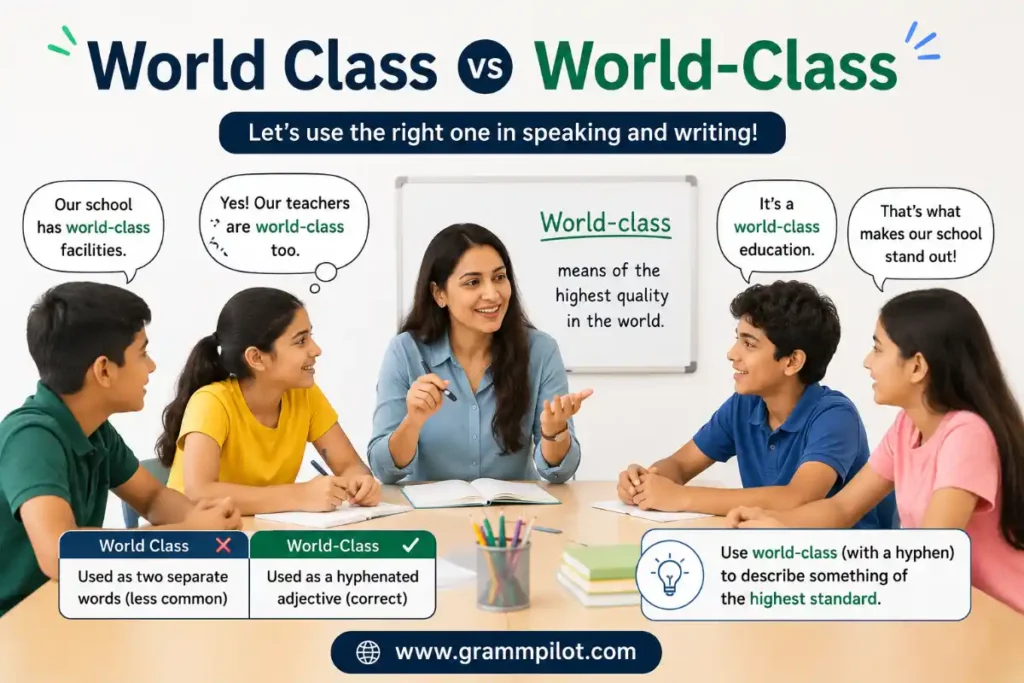
World-class in speaking
In speech, you won’t hear the hyphen.
The listener hears: world class
whether the written version would be world-class or world class.
For example: She’s a world-class athlete.
and: She’s world class.
Sound almost identical. The difference becomes visible in writing. That’s why writers sometimes overlook the distinction.
World class vs world-class in headlines
Headlines can introduce special capitalization rules.
In title case, you may see: World-Class Training Program
The hyphen remains because world-class is still a compound adjective.
In sentence case: World-class training program
The punctuation remains the same, although capitalization changes. If a company uses a particular house style, follow that style consistently.
Should world-class be capitalized?
Usually, world-class is lowercase unless it appears at the beginning of a sentence or in a title where title-case capitalization is required.
Correct in normal prose: The school has a world-class library.
At the beginning of a sentence: World-class facilities attract students from around the country.
In a title: World-Class Facilities for Modern Students
The capitalization rule and the hyphenation rule are separate issues.
US vs UK usage
The basic hyphenation rule is broadly understood in both American and British English.
You can commonly find: world-class athlete
and: The athlete is world class.
The bigger differences between US and UK English often involve spelling, punctuation style, and editorial preferences rather than the basic meaning of this expression. For a US-focused website, world-class before a noun is a safe standard choice.
Is world-class a cliché?
It can be. The phrase is so common in advertising that it may lose some impact.
Consider: We provide world-class solutions.
The sentence sounds positive, but it doesn’t tell the reader much.
Now compare: Our platform processes large datasets in seconds and supports teams in more than 20 countries.
The second sentence gives concrete information.
This doesn’t mean you should never use world-class. It means you should use it where the claim adds value.
A good rule is: If you can prove the quality, the phrase becomes more meaningful.
Common mistakes with world class vs world-class
Mistake 1: Writing worldclass
Incorrect: She is a worldclass athlete.
Correct: She is a world-class athlete.
The standard form uses a hyphen.
Mistake 2: Always adding the hyphen
Some writers write: Her performance was world-class.
For careful standard usage, use: Her performance was world class.
The phrase follows a linking verb, so the open form is generally preferred.
Mistake 3: Removing the hyphen before a noun
Incorrect: He is a world class athlete.
Better: He is a world-class athlete.
The compound adjective comes directly before athlete, so the hyphen helps show that the words function together.
Mistake 4: Confusing meaning with grammar
The meaning doesn’t change dramatically. The punctuation changes because the grammatical role changes. That’s the key idea to remember.
Mistake 5: Using world-class for everything
If every product, employee, service, and feature is “world-class,” the phrase starts to sound like empty marketing.
Use it selectively.
When should you NOT use world-class?
Avoid the phrase when:
- You can’t support the claim.
- A more precise description would be stronger.
- You’re writing highly technical material.
- The wording sounds like exaggerated advertising.
- The quality is simply good, not exceptional.
- The reader needs facts rather than praise.
For example, instead of: We have a world-class support team.
you could write: Our support team responds to most requests within 24 hours.
The second version tells the reader something measurable.
Better alternatives to world-class
Sometimes you need a synonym rather than a stronger adjective.
| Alternative | Meaning | Best use |
|---|---|---|
| Excellent | Very good | General writing |
| Exceptional | Far above average | Formal writing |
| Outstanding | Extremely impressive | Professional writing |
| Elite | Among the best | Sports, performance |
| Premier | High-ranking or leading | Business |
| Top-tier | Among the best | Professional, casual |
| First-rate | Excellent quality | General |
| Superior | Better than average | Formal/business |
| Leading | At the forefront | Business/research |
| Renowned | Widely respected | People/institutions |
| Internationally recognized | Known beyond one country | Academic/professional |
| High-quality | Good standard | General |
| Best-in-class | Among the best in its category | Business/marketing |
| State-of-the-art | Using the latest technology | Technology/facilities |
| Cutting-edge | Highly advanced | Technology/research |
These alternatives don’t all mean exactly the same thing. For example, renowned focuses on reputation, while state-of-the-art focuses on advanced technology or equipment.
World-class vs best-in-class
These expressions are related but not identical.
World-class suggests an exceptionally high standard compared with the world.
Best-in-class usually means the best within a particular category, industry, or group.
Compare: The company has world-class engineers.
This suggests exceptional ability on an international scale.
The company offers best-in-class security software.
This suggests the software is among the best in its particular category. The second phrase is especially common in business and marketing.
World-class vs top-tier
Top-tier is a more flexible modern expression.
World-class suggests an international or extremely high standard.
Top-tier means among the highest level in a particular group.
Examples:
She is a world-class athlete.
She is a top-tier athlete.
Both suggest exceptional ability, but world-class makes the claim more expansive. For professional writing, top-tier can sometimes sound less exaggerated.
World-class vs excellent
Excellent simply means very good.
World-class makes a much stronger claim.
Compare: The restaurant offers excellent food.
This says the food is very good. The restaurant offers world-class food.
This suggests the food is among the best internationally.
If you don’t need the stronger claim, excellent may be the better word.
Antonyms of world-class
The opposite depends on the context.
Possible antonyms include:
- poor
- low-quality
- inferior
- mediocre
- substandard
- ordinary
- amateur
- basic
- inadequate
- below average
Examples:
world-class performance → mediocre performance
world-class facilities → substandard facilities
Not every antonym works in every sentence.
A simple test for choosing the right form
Use this three-step test.
Step 1: Look for a noun immediately after the phrase
If you have: world + noun
ask whether world-class describes that noun.
Example: world-class athlete
Yes. Use the hyphen.
Step 2: Look for a linking verb
If you have: is / are / was / were + world class
the open form is usually correct.
Example: The athlete is world class.
Step 3: Ask whether the phrase acts as one adjective
If two words work together before a noun, a hyphen often makes that relationship clear.
Example: world-class service
The two words form one compound modifier.
Quick reference table
| Sentence | Correct form | Why |
|---|---|---|
| She is a ___ athlete. | world-class | Before a noun |
| Her performance is ___. | world class | After a linking verb |
| They provide ___ service. | world-class | Before a noun |
| Their service is ___. | world class | Predicate description |
| He received ___ training. | world-class | Before a noun |
| His training was ___. | world class | After a linking verb |
| It is a ___ facility. | world-class | Before a noun |
| The facility is ___. | world class | After a linking verb |
Quick tips to remember
1: Before a noun, think world-class.
2: After is, are, was, or were, think world class.
3: Never normally write worldclass.
4: Don’t add a hyphen just because the phrase sounds like one idea.
5: Check whether the phrase is modifying a noun.
6: Remember that the hyphen helps show a compound adjective.
7: Don’t confuse punctuation with meaning. Both forms relate to exceptional quality.
8: In formal writing, avoid using the phrase as empty praise.
9: On a resume, support strong claims with measurable achievements.
10: Keep your usage consistent throughout the same document.
Final teacher explanation
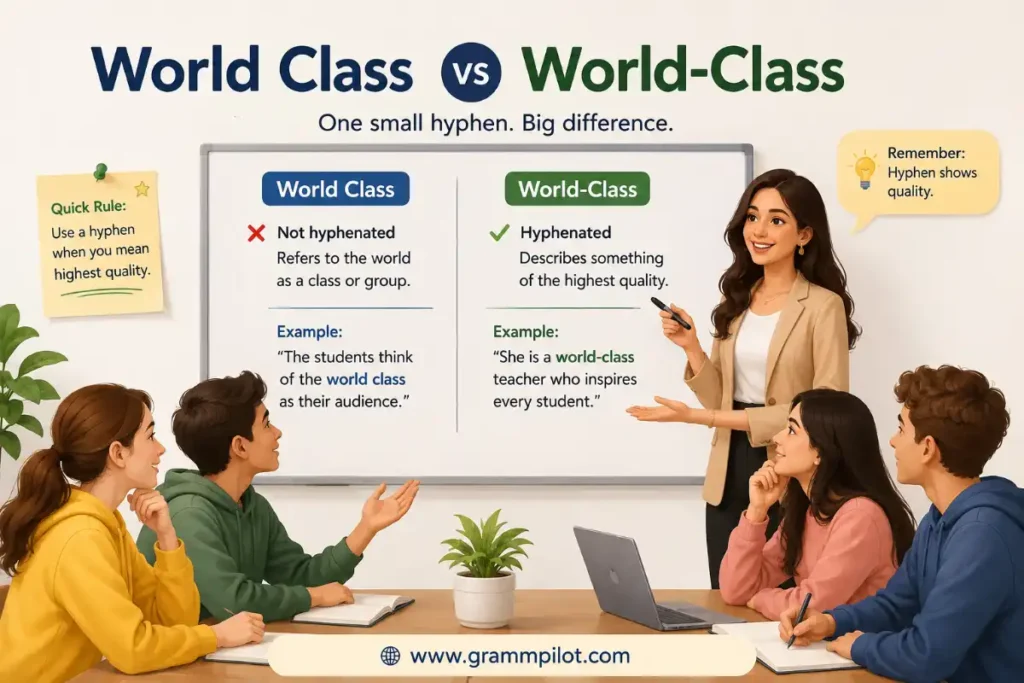
The easiest way to remember the rule for World Class vs World-Class is to look at what comes next. When the phrase comes directly before a noun and describes it, use world-class: a world-class athlete, world-class service, or a world-class university. When the phrase comes after a linking verb and simply describes the subject, use world class: The athlete is world class or The service was world class.
The hyphen connects world and class when they work together as one modifier. It isn’t normally needed when the phrase functions as a description after the verb. Also, avoid writing worldclass as one word. Beyond grammar, think about meaning. World-class is a very strong compliment, so don’t use it automatically. In professional or academic writing, specific evidence can be more convincing than a broad claim. Once you understand both the punctuation rule and the meaning, the choice becomes straightforward.
Conclusion
The key difference between the two forms is grammatical position. Write world-class when the phrase comes before a noun, as in “a world-class teacher.” Write world class when it follows a linking verb, as in “The teacher is world class.” The hyphen signals that the two words are working together as one compound adjective.
Keep the spelling worldclass out of standard writing, and use the expression thoughtfully because it makes a strong claim about quality. For resumes, essays, emails, and websites, the best choice is not only grammatically correct but also meaningful. If a specific fact can show why something deserves a top rating, include that evidence too. Good grammar and precise wording will make your writing sound much more polished.
Frequently Asked Questions
1. Is it world class or world-class?
Use world-class before a noun and world class after a linking verb. For example, write “a world-class athlete” but “The athlete is world class.”
2. Is world-class one word or two words?
It is normally written as two words joined by a hyphen: world-class. The spelling worldclass is not the standard form.
3. Should I write “world-class service” or “world class service”?
Write “world-class service.” The phrase comes directly before the noun service, so the hyphenated compound adjective is appropriate.
4. Should I say “the service is world class” or “the service is world-class”?
For careful standard usage, write “the service is world class.” After a linking verb such as is, the phrase functions as a predicate description rather than a compound modifier before a noun.
5. What’s the difference between world class and world-class?
The meaning is essentially the same, but the grammatical position differs. World-class modifies a noun directly, while world class commonly appears after a linking verb.
6. Can I use world-class on a resume?
Yes. World-class can work on a resume when you are describing an exceptionally high-quality skill, team, service, or achievement. Whenever possible, support the claim with measurable results.
7. Is world-class too informal for an essay?
Not necessarily, but it can sound promotional if overused. In an academic essay, use it when the claim is relevant and supported, or choose a more precise term such as leading, exceptional, or internationally recognized.