
Similes for Autumn help readers picture the season by comparing its colors, weather, sounds, smells, and feelings to familiar things. Instead of simply saying that the leaves are colorful, you can say they are like flames dancing across the trees. Autumn has a special way of changing the world around us. Leaves turn red, orange, and gold. Cool air replaces summer heat, and the days slowly become shorter. If you’re writing about this season, a good comparison can make those changes feel much more vivid. The best similes don’t just make writing prettier. They help readers see, hear, feel, and even imagine the smell of autumn. A strong comparison can turn an ordinary sentence into one that stays in the reader’s mind. This guide covers creative comparisons for leaves, trees, weather, sunsets, mornings, sounds, feelings, and more. You’ll also find examples for poems, stories, essays, captions, and school assignments.
For more examples that bring writing to life, check out [Similes for Easy].
What Is a Simile for Autumn?
A simile compares two different things using words such as like or as. An autumn simile compares something connected with fall to another object, person, place, or experience.
For example: The autumn leaves were like tiny pieces of fire.
The leaves aren’t actually fire. The comparison helps readers imagine their bright red, orange, and yellow colors.
Another example: The autumn wind was as playful as a child.
The wind isn’t a child, but the comparison gives it a lively personality.
A simple autumn simile can describe:
- Leaves
- Trees
- Wind
- Rain
- Clouds
- Sunsets
- Morning air
- Forests
- Pumpkins
- Falling leaves
- Autumn sounds
- Seasonal smells
- Warm drinks
- Autumn feelings
- Shorter days
- Cool evenings
Why Do Autumn Similes Make Writing Better?
Autumn already gives writers plenty of visual material. Similes help turn those observations into stronger images.
Compare these two sentences:
The leaves were red and orange.
The leaves were like little flames scattered across the trees.
The first sentence gives information. The second creates a picture. That’s the main value of figurative language.
A good comparison can also communicate emotion. Consider: The empty trees stood like lonely skeletons against the gray sky.
This sentence doesn’t simply describe trees. It creates a quiet, slightly gloomy feeling.
On the other hand: The golden leaves danced like happy children in the breeze.
This creates a cheerful mood.
So the same season can feel:
- Warm
- Peaceful
- Magical
- Mysterious
- Melancholy
- Cozy
- Energetic
- Lonely
- Beautiful
- Nostalgic
The comparison you choose helps control that mood.
Best Similes for Autumn Leaves
Leaves are one of the easiest parts of autumn to describe because their colors and movement naturally invite comparisons.
Here are some original examples:
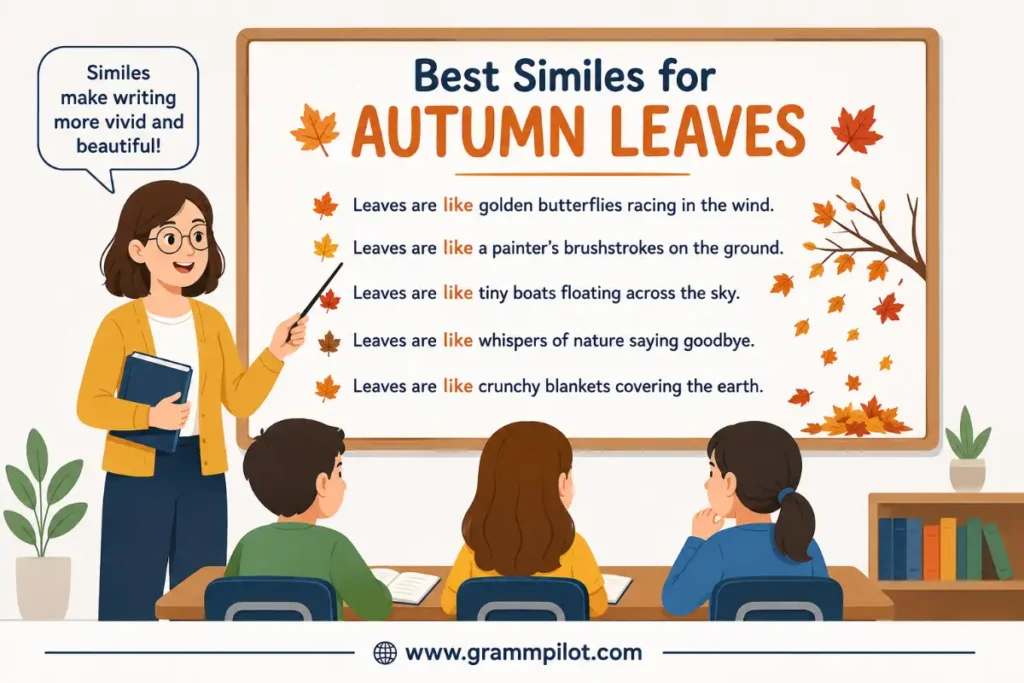
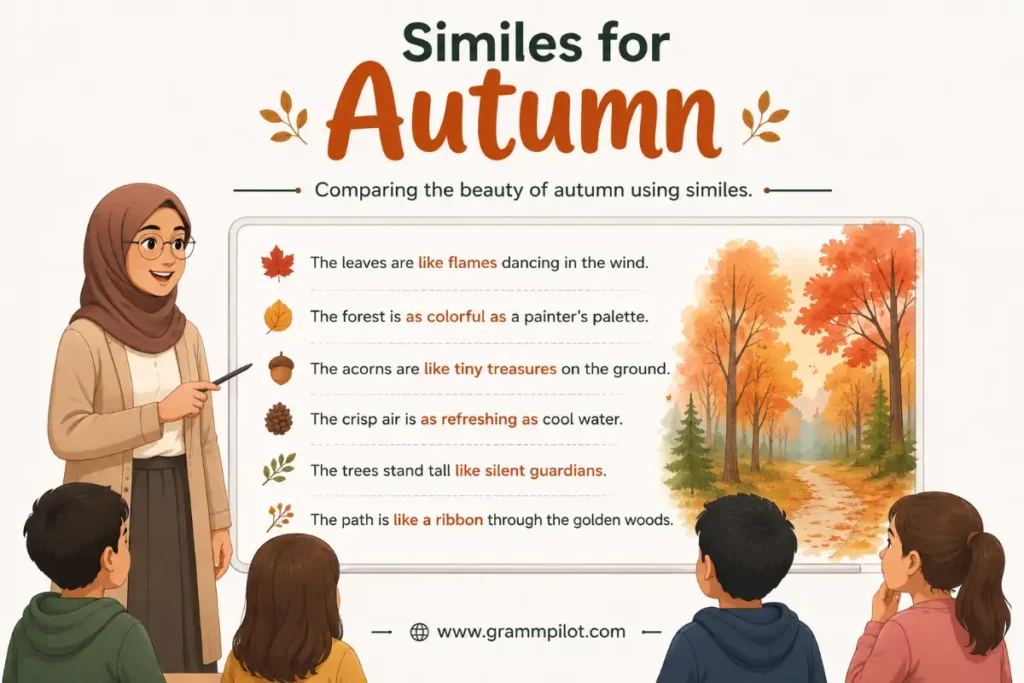
- The autumn leaves were like flames dancing in the trees.
- The red leaves looked like drops of paint scattered across the forest.
- Golden leaves covered the ground like a soft blanket.
- The leaves fluttered like tiny birds searching for a place to land.
- Orange leaves glowed like lanterns beneath the afternoon sun.
- The fallen leaves were as colorful as a painter’s palette.
- The leaves swirled around the sidewalk like confetti at a celebration.
- Yellow leaves drifted down like golden feathers.
- The maple leaves looked like little hands reaching toward the sky.
- The leaves crackled under our shoes like old paper.
- The forest floor was like a carpet stitched with red and gold.
- Leaves floated through the air like colorful butterflies.
- The orange leaves shone like coins in the sunlight.
- The red leaves spread across the lawn like a blanket of rubies.
- The leaves fell as quietly as feathers.
Each comparison focuses on a slightly different feature.
Flames emphasize color.
Confetti emphasizes movement and celebration.
Feathers emphasize softness and quietness.
Old paper emphasizes sound.
That is why choosing the right image matters.
Similes for Red Autumn Leaves
Red leaves can create some of the strongest autumn images.
Try these:
- The red leaves were like sparks glowing among the branches.
- The trees looked as red as burning embers.
- Crimson leaves covered the ground like scattered jewels.
- The maple trees stood like giant torches against the sky.
- Red leaves fluttered like tiny flags in the wind.
- The forest looked like a painting filled with scarlet brushstrokes.
- The leaves glowed like embers in a fading fire.
- The red canopy was as bright as a sunset.
For a peaceful scene, use softer comparisons such as silk, ribbons, or paint.
For an intense scene, comparisons to fire, sparks, or embers create stronger energy.
Similes for Orange Autumn Leaves
Orange leaves often suggest warmth, sunlight, and energy.
Examples:
- The orange leaves glowed like little lanterns.
- The trees were as orange as a sunset.
- Orange leaves covered the path like pieces of warm-colored confetti.
- The leaves shimmered like copper coins in the sunlight.
- The branches looked like they were holding hundreds of tiny flames.
- The forest was as bright as an artist’s orange palette.
- The leaves drifted down like glowing feathers.
Orange works especially well with comparisons involving:
- Fire
- Lanterns
- Copper
- Gold
- Sunset
- Candles
- Paint
- Warm light
Similes for Yellow and Golden Leaves
Yellow leaves can make an autumn scene feel bright, peaceful, or magical.
Try:
- The yellow leaves were like golden stars scattered across the lawn.
- The trees looked as bright as fields of sunlight.
- Golden leaves floated down like tiny pieces of sunshine.
- The forest floor shimmered like a blanket of gold.
- Yellow leaves danced like butterflies in the breeze.
- The branches glowed like candles beneath the evening sky.
- The leaves were as golden as coins in an old treasure chest.
- The path looked like it had been covered with gold dust.
For children’s writing, comparisons with sunshine, stars, and treasure are especially easy to understand.
Similes for Falling Leaves
Falling leaves create movement, so choose comparisons that suggest drifting, dancing, spinning, or floating.
Examples:
- The leaves fell like snowflakes in slow motion.
- Leaves spiraled downward like tiny helicopters.
- The golden leaves floated like feathers through the cool air.
- Leaves danced across the street like little ballerinas.
- The leaves tumbled through the air like colorful confetti.
- One leaf drifted down as gently as a feather.
- The leaves spun around us like dancers on a stage.
- Red leaves dropped from the branches like sparks from a dying fire.
- Leaves raced along the sidewalk like small boats on a river.
- The leaves swirled in circles like birds caught in a gentle breeze.
Notice how each comparison gives the leaves a different kind of movement.
Similes for Autumn Trees
Trees look dramatically different in fall. Some are full of color, while others become bare.
Examples:
- The autumn trees stood like giant towers covered in gold.
- The maple trees looked like enormous flames reaching toward the sky.
- Bare branches stretched upward like thin fingers.
- The old oak stood like a tired giant in the fading light.
- The trees were as colorful as a painter’s masterpiece.
- The forest looked like a sea of red, orange, and gold.
- Bare trees stood like skeletons against the cloudy sky.
- The branches looked like dark veins against the pale morning.
- The golden trees stood like glowing pillars along the road.
- The forest seemed as quiet as an empty cathedral.
The comparison should match your scene.
A cheerful story might use golden pillars.
A spooky story might use skeletons.
A peaceful poem might use dark branches against a pale sky.
Similes for Autumn Weather
Autumn weather can change quickly. One day may be sunny and warm; the next may be cold and rainy.
Try these comparisons:
- The autumn wind was like a playful child tugging at our coats.
- The cold air felt as sharp as a needle against my cheeks.
- The morning breeze was like a cool hand brushing my face.
- The rain fell like silver strings from the sky.
- The autumn drizzle was as soft as a whisper.
- The wind howled like a wolf in the distance.
- The clouds gathered like dark ships on the horizon.
- The chilly air wrapped around us like a cold blanket.
- The storm clouds were as dark as charcoal.
- The autumn breeze moved through the trees like a quiet song.
Strong comparisons can make weather feel almost alive.
Similes for Autumn Wind
Wind is one of the defining sensations of fall.
Here are some choices:
- The autumn wind was like a mischievous child pulling at every leaf.
- The breeze whispered like someone telling a secret.
- The wind rushed through the trees like a speeding train.
- The chilly breeze felt as cold as ice on my skin.
- The wind danced around the house like an excited puppy.
- The autumn air moved like invisible ribbons through the branches.
- The wind howled like a lonely wolf.
- The breeze brushed my face like a cool feather.
- The wind scattered leaves like a child scattering pieces of paper.
- The gusts pushed against the windows like impatient visitors.
You can make the wind friendly, playful, threatening, or mysterious depending on the comparison.
Similes for Autumn Rain
Rain can make autumn feel cozy, gloomy, romantic, or peaceful.
Examples:
- Autumn rain tapped the roof like tiny fingers.
- The rain fell like silver threads from the clouds.
- Raindrops covered the window like beads of glass.
- The drizzle was as gentle as a whisper.
- Rain poured down like a curtain across the street.
- The wet pavement shone like a dark mirror.
- The drops rolled down the glass like tiny tears.
- The rain sounded like soft applause on the roof.
- Puddles spread across the road like small mirrors.
- The storm arrived like a dark curtain being pulled across the sky.
A rain simile can change the entire emotional tone of a paragraph.
Similes for an Autumn Morning
Autumn mornings often feel cool, quiet, and fresh.
Try:
- The morning air was as crisp as a fresh apple.
- The sunrise looked like a golden ribbon across the horizon.
- Mist covered the fields like a soft blanket.
- The grass sparkled like tiny diamonds.
- The morning was as quiet as an empty library.
- The cool air felt like a refreshing splash of water.
- The sun rose like a glowing orange above the trees.
- Frost covered the grass like a layer of sugar.
- The fog moved across the field like a slow-moving cloud.
- The morning light spread like honey across the landscape.
These comparisons work well in descriptive essays and opening paragraphs.
Similes for an Autumn Sunset
Autumn sunsets often have rich reds, oranges, pinks, and golds.
Examples:
- The autumn sunset looked like a sky on fire.
- The horizon glowed like a giant bowl of melted gold.
- The clouds were as pink as cotton candy.
- The setting sun looked like a bright orange lantern.
- The sky stretched above us like a painted canvas.
- Red clouds floated across the horizon like ribbons of fire.
- The sunset was as warm as a glowing fireplace.
- The sky looked like an artist had spilled orange and red paint across it.
- Golden light spread over the trees like honey.
- The sun disappeared like a glowing coin sinking into the horizon.
For poetry, unusual comparisons can make a sunset feel more personal.
Similes for an Autumn Forest
An autumn forest can feel bright, peaceful, mysterious, or even eerie.
Examples:
- The forest looked like a sea of golden leaves.
- The trees stood like silent guards along the path.
- The forest floor felt like a thick carpet beneath my feet.
- The woods were as quiet as a sleeping village.
- Sunlight slipped through the branches like golden ribbons.
- The red and orange canopy looked like a giant painted roof.
- The forest sounded like a soft orchestra of rustling leaves.
- Fog moved between the trees like a ghostly blanket.
- The path curled through the woods like a brown ribbon.
- The trees surrounded us like tall walls.
These examples work especially well in nature writing and fiction.
Similes for Autumn Sounds
Autumn isn’t only about what we see. The season has a distinct soundscape.
Think about:
- Crunching leaves
- Rustling branches
- Rain
- Wind
- Distant birds
- Crackling fires
- Boots on sidewalks
Examples:
- The leaves crackled like old paper beneath my shoes.
- The wind whispered like a secret through the trees.
- Rain tapped the roof like gentle fingertips.
- The branches creaked like an old wooden door.
- The fire popped like tiny fireworks.
- The leaves rustled like pages turning in a book.
- The wind roared like a distant ocean.
- The rain drummed against the window like a quiet song.
- The dry leaves crunched like potato chips underfoot.
- The trees groaned like an old house in a storm.
Sound-based comparisons add another sensory layer to descriptive writing.
Similes for Autumn Smells
Smell is often forgotten in seasonal writing, which makes it a useful way to stand out.
Try these:
- The air smelled like wet earth after a storm.
- The kitchen smelled as warm as a freshly baked pie.
- The scent of cinnamon floated through the room like a warm cloud.
- The forest smelled like damp leaves and rich soil.
- The fireplace smelled like wood warmed by an old summer sun.
- The apple pie smelled as sweet as a bakery on a holiday morning.
- The crisp air carried the scent of leaves like a message from the forest.
- The pumpkin spice aroma spread through the kitchen like an invisible blanket.
Good sensory writing helps readers experience the scene instead of simply looking at it.
Similes for Autumn Feelings
Autumn can bring complicated emotions. It can feel joyful because of the colors and holidays, but it can also remind people that summer is ending.
Examples:
- Autumn felt like a gentle goodbye to summer.
- The season was as comforting as an old sweater.
- The empty trees made me feel like I was standing in a forgotten town.
- The changing leaves were like memories slowly fading.
- The cool evenings felt like a quiet invitation to rest.
- Autumn happiness spread through the town like warm sunlight.
- The season felt like turning the page of an old book.
- The last warm days were like brief visits from an old friend.
- The fading sunlight felt as bittersweet as saying goodbye.
- The quiet forest seemed like a place where time had stopped.
These comparisons are useful when writing about nostalgia, change, or growing older.
Similes for a Cozy Autumn Day
Not every autumn scene needs to be dramatic. Cozy comparisons can create warmth and comfort.
Examples:
- The blanket felt like a warm hug.
- The hot chocolate was as comforting as a crackling fireplace.
- The sweater felt like a soft cloud against my skin.
- The room glowed like a little lantern on a dark evening.
- The fireplace burned like a small sun in the corner.
- The warm mug felt like a tiny heater in my hands.
- The room was as cozy as a cabin in the woods.
- The blanket wrapped around me like a soft cocoon.
- The smell of cinnamon filled the kitchen like a warm memory.
- The quiet evening felt like a peaceful pause in the middle of the year.
Similes for a Dark or Spooky Autumn Scene
Autumn is also a accurate setting for mystery and horror.
Try these:
- The bare branches looked like crooked fingers against the moon.
- The fog moved through the graveyard like a silent ghost.
- The moon hung above the trees like a pale eye.
- The wind howled like a creature hiding in the woods.
- The old house stood like a forgotten giant.
- The trees looked as dark as shadows at midnight.
- The dead leaves covered the path like scraps of old parchment.
- The fog wrapped around the trees like a ghostly cloak.
- The branches scratched the window like sharp fingernails.
- The forest was as silent as an abandoned house.
These are stronger than cheerful autumn comparisons because they use darker imagery.
Similes for Autumn by Intensity
Different writing situations call for different levels of emotion.
Mild and peaceful
Use gentle comparisons when the scene should feel calm.
- as soft as a whisper
- like a quiet blanket
- like drifting feathers
- like warm honey
- like a gentle breeze
- as peaceful as a sleeping town
Example: The autumn rain was as soft as a whisper.
Moderate and vivid
These comparisons create a strong visual image without making the scene dramatic.
- like golden coins
- like colorful confetti
- like a painted canvas
- like a sea of leaves
- like glowing lanterns
- like ribbons of light
Example: Golden leaves covered the path like colorful confetti.
Strong and dramatic
Use these when you want the image to feel powerful.
- like flames
- like sparks
- like a roaring ocean
- like a stormy curtain
- like a giant torch
- as dark as charcoal
Example: The red trees stood like flames against the gray sky.
Dark and mysterious
These comparisons are useful for spooky stories.
- like crooked fingers
- like silent ghosts
- like dark shadows
- like an abandoned house
- like a ghostly cloak
- like a pale eye
Example: Fog wrapped around the trees like a ghostly cloak.
Similes for Autumn by Part of Speech
Understanding the grammatical role of a comparison can help you use it correctly.
Similes describing nouns
These describe a person, place, object, or thing.
The autumn forest was like a golden ocean.
The leaves were like tiny flames.
Similes describing actions
These explain how something happens.
The leaves danced like ballerinas.
The rain fell like silver threads.
Similes describing feelings
These compare an emotion with something familiar.
The ending of summer felt like a quiet goodbye.
The cozy evening felt as comforting as an old sweater.
Similes describing appearance
These focus on what something looks like.
The sunset was like a painting.
The yellow leaves were like golden stars.
How to choose the best comparison for your sentence
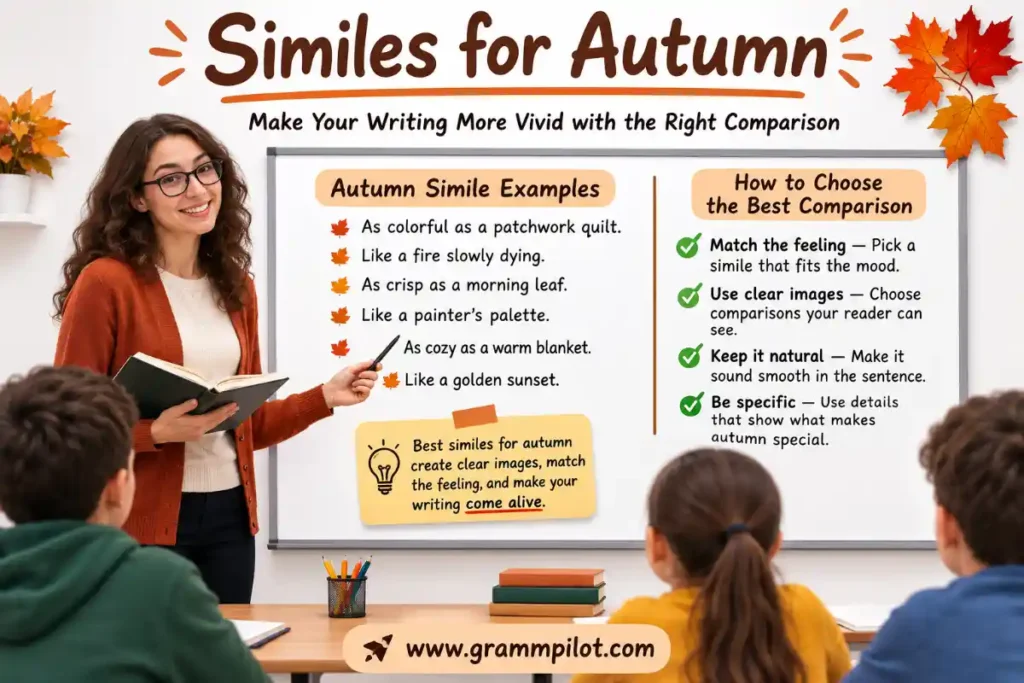
Don’t choose a simile just because it sounds pretty. Think about what you actually want the reader to notice.
Want to show color?
Use:
- flames
- gold
- jewels
- paint
- lanterns
- sunsets
Example: The leaves glowed like tiny lanterns.
Want to show movement?
Use:
- dancers
- butterflies
- confetti
- feathers
- birds
- ribbons
Example: The leaves spun like dancers in the wind.
Want to show sound?
Use:
- paper
- fingers
- drums
- whispers
- fireworks
- old doors
Example: The leaves crackled like old paper.
Want to show coldness?
Use:
- ice
- snow
- cold metal
- a splash of water
Example: The morning air was as sharp as ice.
Want to show sadness?
Use:
- fading memories
- goodbyes
- empty houses
- lonely roads
- fading light
Example: The final warm day felt like saying goodbye to an old friend.
Common mistakes when writing autumn similes
Using a comparison that doesn’t fit
A simile should make sense in context.
Weak: The autumn leaves were like a loud refrigerator.
The two things don’t share an obvious quality.
Better: The autumn leaves were like colorful confetti.
Both involve bright colors and scattered pieces.
Using the same comparison repeatedly
If every paragraph says leaves are like fire, the writing quickly becomes predictable.
Try:
- leaves like flames
- leaves like confetti
- leaves like feathers
- leaves like coins
- leaves like butterflies
Variation keeps your writing fresh.
Mixing too many comparisons
One strong comparison is usually better than five weak ones.
Overloaded: The leaves were like fire, jewels, confetti, feathers, stars, and butterflies.
That creates confusion.
Better: The red leaves glowed like sparks among the dark branches.
Using clichés without adding anything
Some autumn comparisons are extremely common.
That’s not automatically bad. But you can make familiar images more specific.
Basic: The leaves were like fire.
More vivid: The maple leaves glowed like small flames beneath the afternoon sun.
The second sentence gives the reader more information.
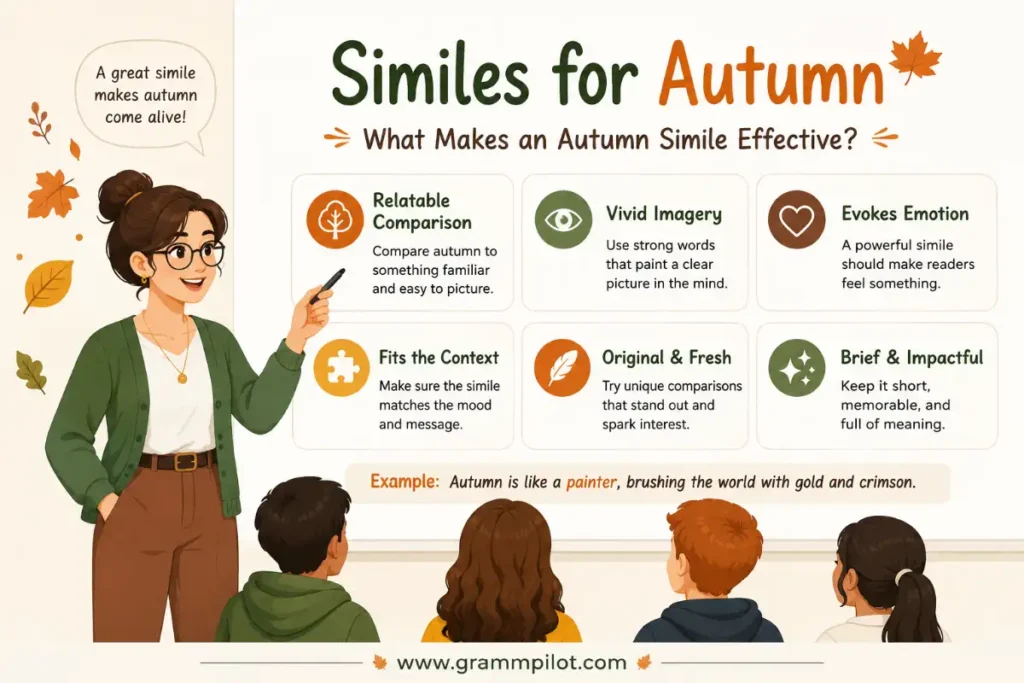
What makes an autumn simile effective?
A strong comparison usually does at least one of these things:
- Creates a clear picture.
- Appeals to the senses.
- Fits the mood.
- Uses familiar imagery.
- Adds information rather than repeating it.
- Sounds natural in the sentence.
- Helps the reader feel something.
For example:
The leaves fell like snow.
This tells us that the leaves are falling gently and continuously.
It’s simple, but effective.
Now:
The leaves fell like golden snow beneath the oak trees.
The added detail makes the image more specific.
Similes for Autumn in Creative Writing
Creative writing gives you more freedom to experiment.
Instead of:
The forest was colorful.
Try:
The forest looked like a painter had spilled red, orange, and gold across the hills.
Instead of:
The wind was strong.
Try:
The wind rushed through the branches like a messenger running late.
Instead of:
It was cold.
Try:
The morning air was as sharp as ice against my cheeks.
These comparisons show rather than simply tell.
Similes for Autumn Poems
Poetry often benefits from shorter, more emotional comparisons.
Examples:
- Leaves like golden stars
- Wind like a whispered song
- Rain like silver thread
- Trees like quiet giants
- Sunset like burning gold
- Fog like a ghostly veil
- Autumn like a soft goodbye
- Night like a dark blanket
- Leaves like dancing flames
- Morning like a cool breath
You can build a poem around one central image rather than forcing a different comparison into every line.
For example:
The autumn leaves danced like flames,
The cool wind whispered through the trees,
And the fading sunlight melted like gold.
The images work together because they share a warm, gentle mood.
Similes for Autumn Essays
School essays usually need clear language rather than overly complicated comparisons.
Good examples include:
- The leaves looked like colorful pieces of paper.
- The forest was like a giant painting.
- The autumn air was as crisp as a fresh apple.
- The leaves fell like soft snow.
- The wind sounded like a whisper through the trees.
- The sunset looked like a ball of fire.
- The ground was covered like a blanket of leaves.
These are easy to understand and still create strong imagery.
Similes for Autumn Captions
Short captions need quick, memorable images.
Try:
- Autumn leaves like little flames.
- Golden trees like sunshine.
- Cool air like a fresh breath.
- Leaves dancing like confetti.
- Autumn skies like painted dreams.
- Crisp mornings like a fresh start.
- Golden leaves like scattered treasure.
- Rainy days like quiet songs.
- Autumn nights like cozy blankets.
- Sunsets like melted gold.
For social media, shorter comparisons usually have more impact than long descriptions.
How to avoid repetitive autumn writing
A common problem with seasonal writing is repeating the same images.
If you’ve already compared leaves to fire, don’t use fire again in every paragraph.
Instead, move through different senses.
Visual: The leaves looked like golden stars.
Sound: The leaves crackled like old paper.
Touch: The wind felt like a cool hand.
Smell: The forest smelled like wet earth after rain.
Emotion: Autumn felt like a gentle goodbye.
Now the reader experiences the entire season instead of seeing the same image repeated.
Quick tips for writing better autumn similes
1. Start with the sense you want to emphasize.
Ask if you want readers to see, hear, smell, taste, or feel the scene.
2. Match the comparison to the mood.
Use flames for intensity and feathers for softness.
3. Keep the image familiar.
Readers should understand the comparison quickly.
4. Avoid unnecessary complexity.
A simple simile can be more powerful than a complicated one.
5. Don’t use a simile in every sentence.
Give your strongest comparisons room to stand out.
6. Mix familiar and original imagery.
“Leaves like flames” is familiar. “Leaves like tiny stained-glass windows” feels more unusual.
7. Think about movement.
Falling leaves can drift, tumble, dance, swirl, or flutter.
8. Use precise nouns.
“Maple leaves like red sparks” is stronger than “things like fire.”
9. Read the sentence aloud.
If it sounds awkward, simplify it.
10. Choose meaning over decoration.
The best comparison adds something to the reader’s understanding.
A quick list of the best comparisons
If you need a fast answer for a writing assignment, these are strong choices:
- Leaves like flames
- Leaves like confetti
- Leaves like golden stars
- Leaves like feathers
- Leaves like butterflies
- Trees like giant torches
- Forest like a painted canvas
- Wind like a whisper
- Rain like silver threads
- Fog like a ghostly blanket
- Sunset like melted gold
- Morning air like a fresh apple
- Leaves like old paper underfoot
- Autumn like a gentle goodbye
- Golden trees like glowing lanterns
- Clouds like dark ships
- Bare branches like crooked fingers
- Fire like a small sun
- Autumn nights like warm blankets
- The forest like a sea of color
Final teacher explanation
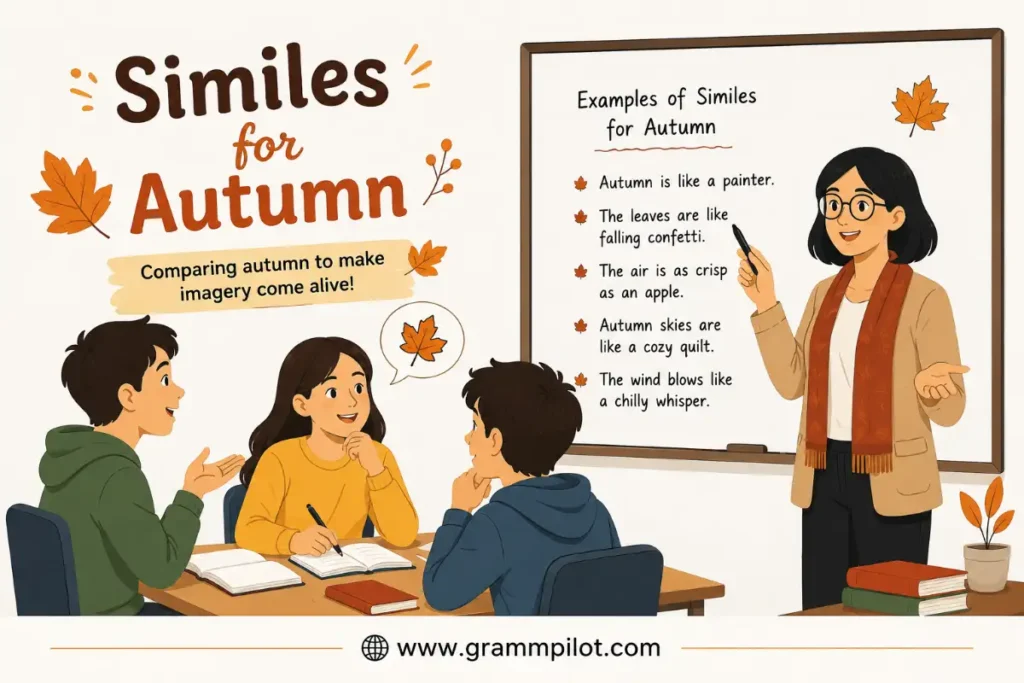
A simile works best when it helps readers experience something they cannot directly see or feel. Autumn gives you many opportunities because the season is full of changing colors, falling leaves, cool air, rain, wind, warm food, and strong emotions. When writing, don’t simply ask, “What does autumn look like?” Ask more specific questions: What does the wind feel like? What do the leaves sound like? What does the forest smell like?
Those questions lead to better comparisons. A strong simile doesn’t need to be complicated. “The leaves fell like feathers” is simple, but it immediately creates an image. The goal isn’t to make every sentence sound poetic. The goal is to choose the one comparison that makes your meaning clearer, stronger, or more memorable.
Conclusion
Similes for Autumn can turn simple seasonal descriptions into vivid scenes that readers can almost see and feel. Instead of only saying that leaves are red, you can compare them to flames, sparks, jewels, or painted brushstrokes. Wind can whisper like a secret, rain can fall like silver threads, and the whole season can feel like a gentle goodbye to summer.
The best comparison depends on the mood and detail you want to show. Use soft images for peaceful scenes, bright images for cheerful writing, and darker comparisons for mysterious stories. Keep your language natural, avoid repeating the same image, and let each simile add something useful. With a few carefully chosen comparisons, your autumn writing can become much more colorful, expressive, and memorable.
Frequently Asked Questions
1. What is a good simile for autumn?
A strong example is “Autumn leaves are like flames dancing in the trees.” It creates a clear picture of the bright red, orange, and yellow colors.
2. What are some similes for autumn leaves?
Good choices include “leaves like flames,” “leaves like golden stars,” “leaves like confetti,” and “leaves like feathers.” Choose one based on if you want to show color, movement, or softness.
3. What’s a simile for an autumn tree?
An autumn tree can be described as “like a giant torch against the sky” or “like a colorful painting.” Bare trees can also be compared to “silent skeletons.”
4. What is a simile for autumn weather?
You could write, “The autumn wind was like a cool hand brushing my face.” For rain, try “The rain fell like silver threads from the clouds.”
5. What is a simile for autumn in a poem?
A poetic example is “Autumn was like a soft goodbye to summer.” It connects the season with the feeling of change and farewell.
6. How do I write a creative simile about autumn?
Choose one autumn detail, decide what quality you want to emphasize, and compare it with something familiar. For example, if you want to show bright leaves, write “The leaves glowed like tiny lanterns.”
7. What are some easy similes for autumn for students?
Simple examples include “The leaves fell like snow,” “The forest looked like a painting,” and “The autumn air was as crisp as a fresh apple.” These are clear, memorable, and easy to use in school writing.