
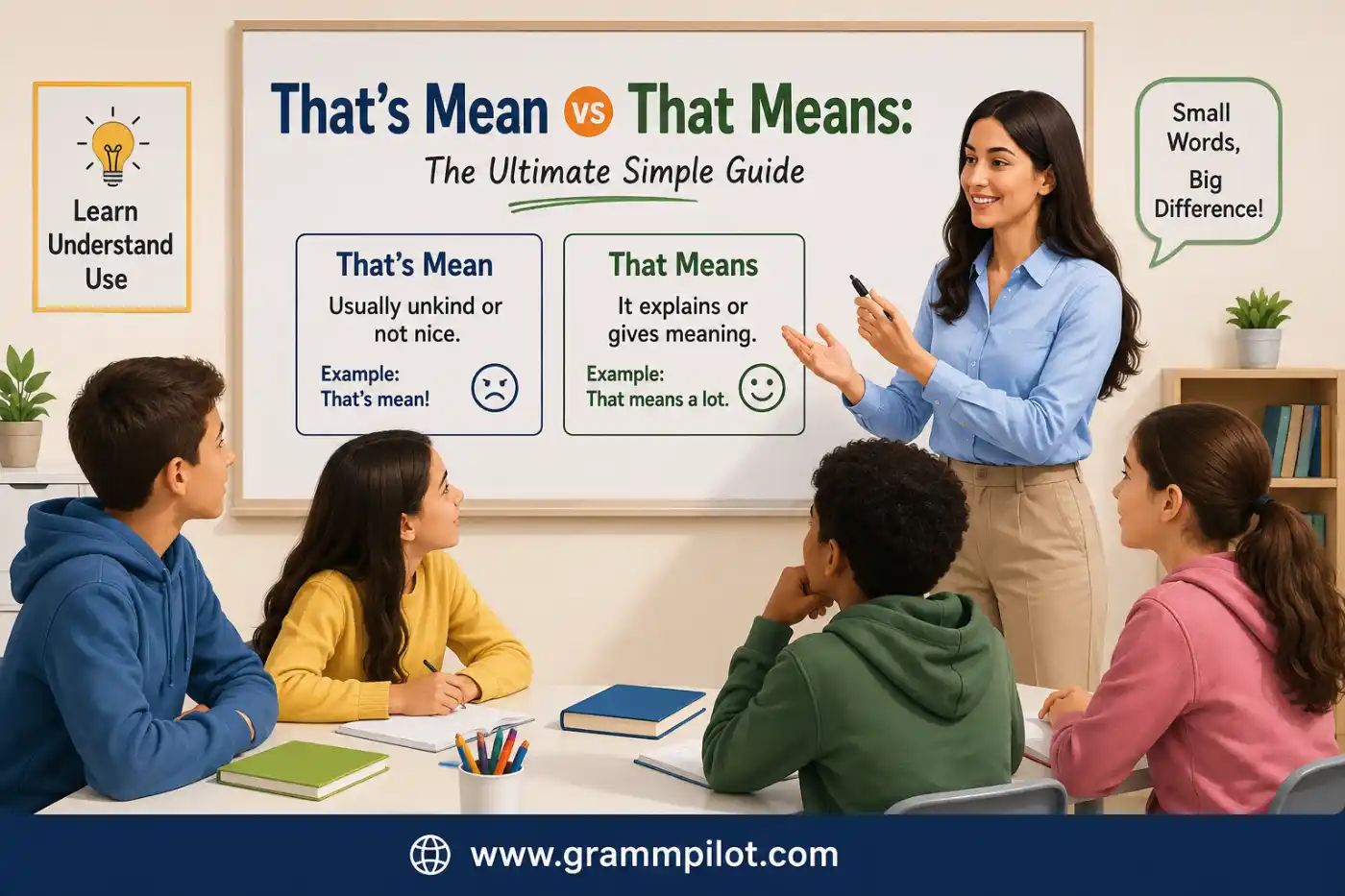
If you’re writing a text, email, essay, or even a resume and stop at “That’s mean” vs “That means,” you may wonder which one is correct. The two expressions look almost the same, but they have different meanings and different grammatical jobs.
Answer box: “That’s mean” means “that is unkind or hurtful.” “That means” means “that signifies, indicates, or leads to something.”
The key is to look at what you are trying to say. If you’re reacting to someone’s behavior and calling it unkind, use that’s mean. If you’re explaining what a fact, action, or statement indicates, use that means. This guide breaks down the difference in plain English. You’ll learn the grammar, word origins, synonyms, intensity levels, parts of speech, real-life examples, common mistakes, and the best wording for texts, emails, essays, resumes, and everyday speech.
For a deeper look at a similar grammar issue, read [Whichever vs Whatever].
What Does “That’s Mean” Mean?
“That’s mean” usually means “That is unkind, hurtful, rude, or unpleasant.” The word that’s is a contraction of that is. The word mean is an adjective describing something.
For example, if someone laughs at another person’s mistake, you might say: That’s mean.
The expanded version is: That is mean.
Here, you’re not explaining what something means. You’re giving your opinion about someone’s behavior.
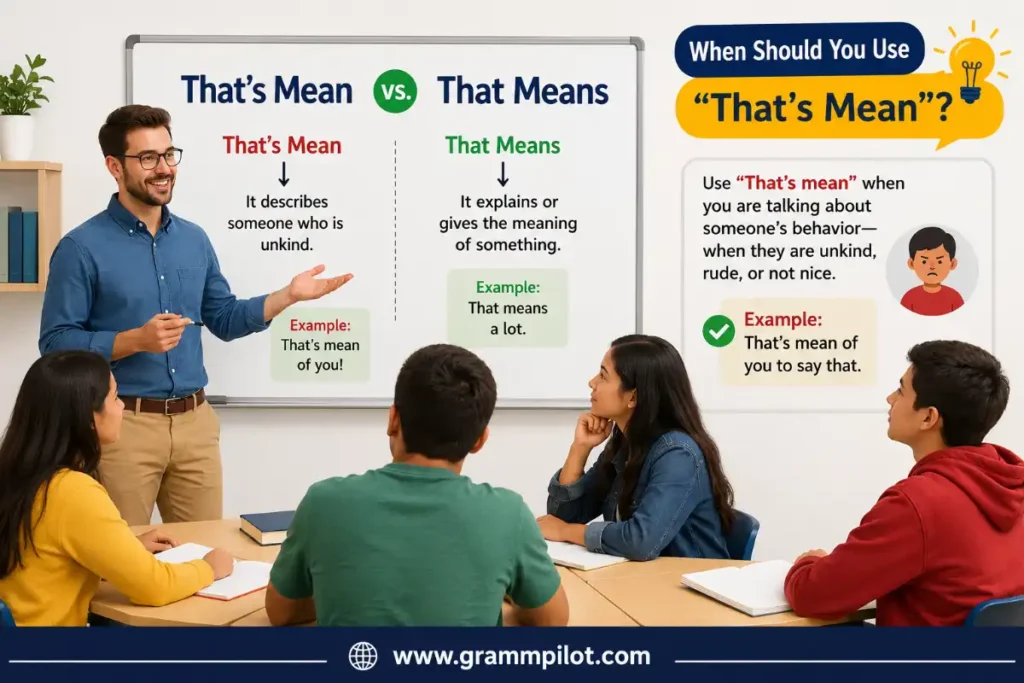
When Should You Use “That’s Mean”?
Use that’s mean when you want to say that something is unkind or hurtful.
It can describe:
- a comment
- a joke
- an action
- someone’s behavior
- a decision
- the way someone treats another person
For example:
- That’s mean of you.
- That was a mean joke.
- Making fun of her was mean.
- That’s mean. He was already upset.
- It was mean to leave him out.
- That comment was really mean.
The phrase is especially common in casual American English. Children use it often, but adults use it too.
What Does “That Means” Mean?
“That means” means “that signifies,” “that indicates,” or “that leads to this result.”
In this structure, means is a verb.
For example:
The store is closed. That means we need to come back tomorrow.
The word that refers to the fact that the store is closed. The verb means explains the result or implication.
You can use that means when you’re explaining:
- a meaning
- a result
- a consequence
- an implication
- an interpretation
- information
More examples include:
- The lights are off. That means nobody is home.
- She didn’t answer. That means she may be busy.
- The test starts at eight. That means we need to leave early.
- He said yes. That means we can continue with the plan.
- The road is closed. That means we’ll need another route.
“That’s Mean” vs “That Means”: What’s the Difference?
The simplest distinction is this:
| Expression | Grammar | Meaning | Example |
|---|---|---|---|
| That’s mean | That is + adjective | That is unkind | That’s mean of you. |
| That means | That + verb | That indicates something | That means we’re late. |
The spelling is similar, but the grammar is different.
“That’s” Means “That Is”
In that’s mean, the apostrophe matters.
That’s = that is
So: That’s mean.
can become: That is mean.
The word mean describes something as unkind.
This is similar to other adjective patterns:
- That’s rude.
- That’s unfair.
- That’s cruel.
- That’s strange.
- That’s helpful.
- That’s important.
In each sentence, that’s means that is. “Means” Is a Verb In that means, the word means is not a contraction. It’s the present-tense form of the verb mean used with a singular third-person subject.
Compare these forms:
- I mean
- You mean
- We mean
- They mean
- He means
- She means
- It means
- That means
This is why the -s is necessary in sentences such as: That means we’re ready.
The subject that is singular, so the verb is means.
That’s Mean vs That Means: Why Are These Two Expressions So Easy to Confuse?
The confusion comes from the word mean itself. English uses mean in several different ways.
As a verb, it can refer to meaning, intention, or significance:
- What does this word mean?
- I mean what I said.
- What do you mean?
- This symbol means danger.
As an adjective, mean can describe someone or something as unkind:
- He is mean.
- That was mean.
- That’s a mean joke.
- She made a mean comment.
So the same word can have different meanings and grammatical roles.
The surrounding sentence tells you which meaning is intended.
Word Origin: Where Does “Mean” Come From?
The English word mean has a long history and developed from different historical sources. The verb mean, in the sense of “intend” or “signify,” is connected to Old English forms related to expressing an intention or indicating something. Over centuries, its meanings expanded into the modern uses we know today. The adjective mean, when it refers to someone who is unkind, has a different history. It developed through senses associated with something common, low, inferior, or lacking distinction. Over time, it also came to describe behavior that was petty, unpleasant, or unkind. That history helps explain why modern English can use mean in several seemingly unrelated ways.
For example:
- What does this word mean?
- I didn’t mean to hurt you.
- She means what she says.
- That was a mean thing to do.
The spelling is the same, but the grammatical role and meaning change according to context.
Why Does “Means” Have an “S”?
The -s in means follows a common English verb pattern.
With most present-tense verbs, a third-person singular subject takes -s or -es.
Compare:
- I work.
- You work.
- They work.
- She works.
The same pattern applies to mean:
- I mean.
- You mean.
- We mean.
- They mean.
- She means.
- It means.
- That means.
So:That mean we should leave.
is incorrect when that is the singular subject.
The correct form is: That means we should leave.
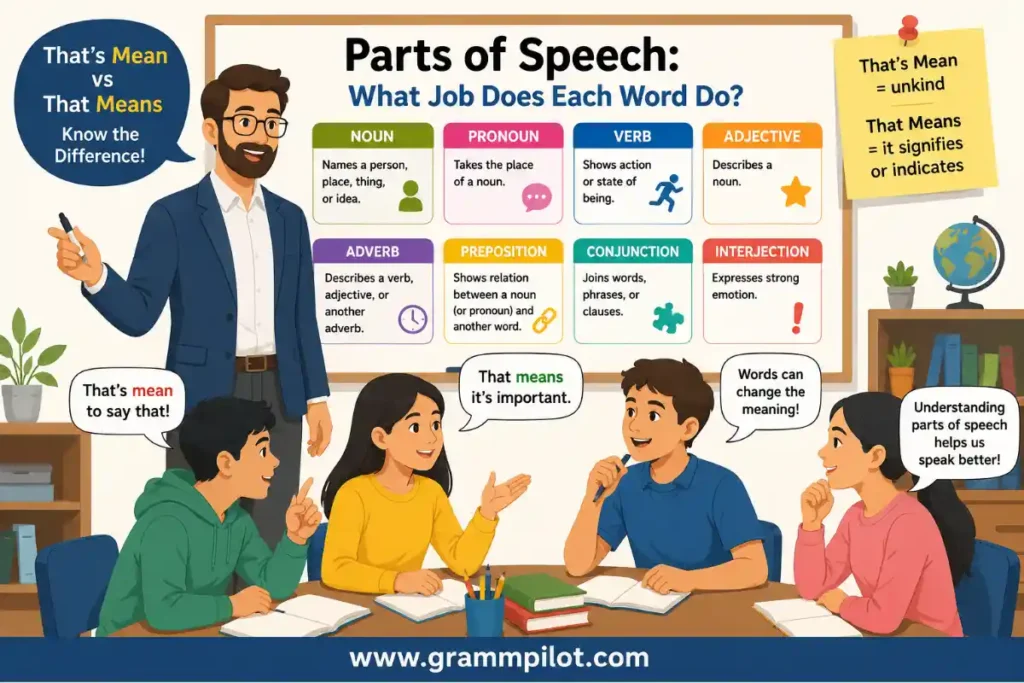
Parts of Speech: What Job Does Each Word Do?
Understanding the parts of speech makes the difference much easier.
“That” as a Pronoun
In many sentences, that refers to an idea, fact, action, statement, or situation.
For example: The bus is late. That means we’ll arrive after nine.
Here, that refers to the fact that the bus is late.
“That’s” as a Contraction
For this topic, that’s normally means: that + is = that’s
Example: That’s mean.
Expanded: That is mean.
“Mean” as an Adjective
In that’s mean, mean is an adjective.
It describes something as unkind or hurtful.
Examples:
- That’s mean.
- That was mean.
- He’s mean.
- It was a mean comment.
“Means” as a Verb
In that means, means is a verb.
It explains what something signifies, indicates, or causes.
Examples:
- That means we’re late.
- That means she knows.
- That means the plan changed.
- That means you were right.
This is the main grammatical distinction you need to remember.
That’s Mean vs That Means: Master Synonym List for “Mean”
The word mean can have different synonyms depending on what you are trying to express. A word that works in one sentence may sound wrong in another.
Simple Synonyms
| Word | Meaning | Tone | Example |
|---|---|---|---|
| Unkind | Not kind or considerate | Simple | That was unkind. |
| Rude | Lacking good manners | Everyday | His comment was rude. |
| Hurtful | Causing emotional pain | Everyday | Her words were hurtful. |
| Unfair | Not treating someone properly | Everyday | That decision seems unfair. |
| Nasty | Unpleasant or spiteful | Casual | That was a nasty comment. |
| Harsh | Too severe or critical | Everyday | His response was harsh. |
| Cruel | Causing pain without concern | Strong | That behavior was cruel. |
| Thoughtless | Showing little care | Everyday | Forgetting her birthday was thoughtless. |
Everyday Synonyms
| Word | Meaning | Tone | Example |
|---|---|---|---|
| Insensitive | Not considering feelings | Neutral | That sounded insensitive. |
| Disrespectful | Showing little respect | Neutral | His behavior was disrespectful. |
| Petty | Focused on small grievances | Casual | That was a petty response. |
| Snarky | Mocking or sarcastic | Casual | Her reply sounded snarky. |
| Cold | Emotionally uncaring | Casual | That was a cold thing to say. |
| Inconsiderate | Not thinking about others | Neutral | That was inconsiderate. |
| Unpleasant | Not enjoyable or agreeable | Neutral | His attitude was unpleasant. |
| Spiteful | Wanting to hurt or annoy | Strong | Her response sounded spiteful. |
Formal Synonyms
| Word | Meaning | Tone | Example |
|---|---|---|---|
| Discourteous | Impolite | Formal | His response was discourteous. |
| Inconsiderate | Showing little thought for others | Formal | The decision was inconsiderate. |
| Offensive | Causing insult or upset | Formal | The remark was offensive. |
| Callous | Showing little concern for others | Strong/Formal | His response seemed callous. |
| Malicious | Intended to cause harm | Strong/Formal | The message appeared malicious. |
| Contemptuous | Showing strong disrespect | Formal | His tone was contemptuous. |
| Uncharitable | Unfairly negative toward someone | Formal | That was an uncharitable judgment. |
| Insensitive | Failing to consider feelings | Formal/Neutral | The wording was insensitive. |
Slang and Casual Synonyms
| Word | Meaning | Tone | Example |
|---|---|---|---|
| Salty | Annoyed or resentful | Slang | Why are you so salty? |
| Savage | Extremely blunt or cutting | Slang | That comeback was savage. |
| Brutal | Very harsh or direct | Casual | That review was brutal. |
| Cold | Uncaring or unsympathetic | Casual | That was cold. |
| Harsh | Excessively critical | Casual | That’s harsh. |
| Petty | Unreasonably focused on something small | Casual | That’s pretty petty. |
| Nasty | Very unpleasant | Casual | That was nasty. |
| Snarky | Mockingly sarcastic | Casual | His answer was snarky. |
These aren’t interchangeable in every situation. Cruel is much stronger than thoughtless, while rude focuses more on manners and insensitive focuses more on a lack of awareness of someone’s feelings.
Synonyms by Intensity: Mild to Strong
Choosing a synonym also means choosing how strong your criticism sounds.
| Intensity | Words | Meaning |
|---|---|---|
| Mild | Thoughtless, insensitive | Lacking awareness or care |
| Mild–Moderate | Unkind, inconsiderate | Not treating someone kindly |
| Moderate | Rude, disrespectful, hurtful | Clearly unpleasant or inappropriate |
| Strong | Nasty, harsh, cruel | Seriously unpleasant or painful |
| Very Strong | Callous, malicious, vicious | Showing serious disregard or intent to harm |
Consider these two sentences:
Forgetting to invite her was thoughtless.
Deliberately embarrassing her in front of everyone was cruel.
The second sentence is much stronger because the behavior involves intentional harm.
Which Intensity Should You Choose?
If you’re writing an essay, unkind, insensitive, inconsiderate, or cruel may provide greater precision.
or if you’re writing a professional email, a neutral word such as insensitive or inappropriate may be better than a strong emotional label.
Synonyms by Part of Speech “That’s Mean vs That Means”
The correct synonym depends on which meaning of mean you’re using.
Verb: Mean = Signify or Indicate
Possible alternatives include:
- indicate
- signify
- show
- represent
- imply
- suggest
- denote
- express
- convey
- communicate
Example: What does this symbol mean?
Possible alternative: What does this symbol indicate?
Verb: Mean = Intend
Possible alternatives include:
- intend
- plan
- aim
- want
- propose
- have in mind
Example: I didn’t mean to hurt you.
Possible alternative: I didn’t intend to hurt you.
Adjective: Mean = Unkind
Possible alternatives include:
- unkind
- rude
- hurtful
- nasty
- harsh
- cruel
- insensitive
- petty
- callous
- disrespectful
Example:
That was mean.
Possible alternative:
That was unkind.
The important point is that mean has more than one sense, so you shouldn’t choose a synonym until you know which sense you’re using.
“That’s Mean” vs “That’s Rude”: What’s the Difference?
Mean and rude overlap, but they don’t mean exactly the same thing. Mean usually focuses on unkindness or the intention or effect of hurting someone. Rude usually focuses on poor manners, disrespect, or inappropriate behavior.
For example:
Laughing at someone’s mistake may be mean because it can hurt their feelings.
Interrupting someone repeatedly may be rude because it breaks normal conversation etiquette.
Sometimes both words work: That was rude and mean. But the words highlight different problems.
When Should You Say “That’s Mean”?
Use it when the main problem is unkindness.
Examples:
- Making fun of someone’s appearance is mean.
- Laughing at a person’s failure can be mean.
- Excluding someone on purpose is mean.
When Should You Say “That’s Rude”?
Use it when the main problem is manners or respect.
Examples:
- Interrupting someone is rude.
- Ignoring a greeting can be rude.
- Speaking loudly during a presentation is rude.
“That Means” vs “That Suggests”: What’s the Difference?
Both expressions can help explain information, but they don’t always show the same level of certainty.
That means usually sounds more direct.
Example:
The store is closed. That means we can’t shop there today.
The speaker sees a clear connection between the fact and the result.
That suggests is more cautious.
Example:
The empty parking lot suggests that the store is closed.
The evidence points toward a conclusion, but it doesn’t necessarily prove it.
This difference is especially useful in essays and academic writing.
Use “That Means” for Clear Results
The train has been canceled. That means we’ll need another way home.
Use “That Suggests” for Interpretations
The character avoids eye contact. That suggests he feels uncomfortable.
The second sentence doesn’t claim certainty. It presents an interpretation.
That’s Mean vs That Means: Best Word for a Resume
A resume should usually avoid casual emotional judgments.
Instead of saying: The manager was mean.
you could describe the situation more professionally: The manager’s communication style was sometimes insensitive.
Or: Handled challenging workplace communication professionally.
Words that may work better in professional writing include:
- inappropriate
- unprofessional
- insensitive
- difficult
- critical
- disrespectful
- challenging
If you’re describing your own work, focus on actions and results rather than labeling another person.
For example: Handled difficult customer interactions calmly and professionally.
This sounds more useful on a resume than: Handled mean customers.
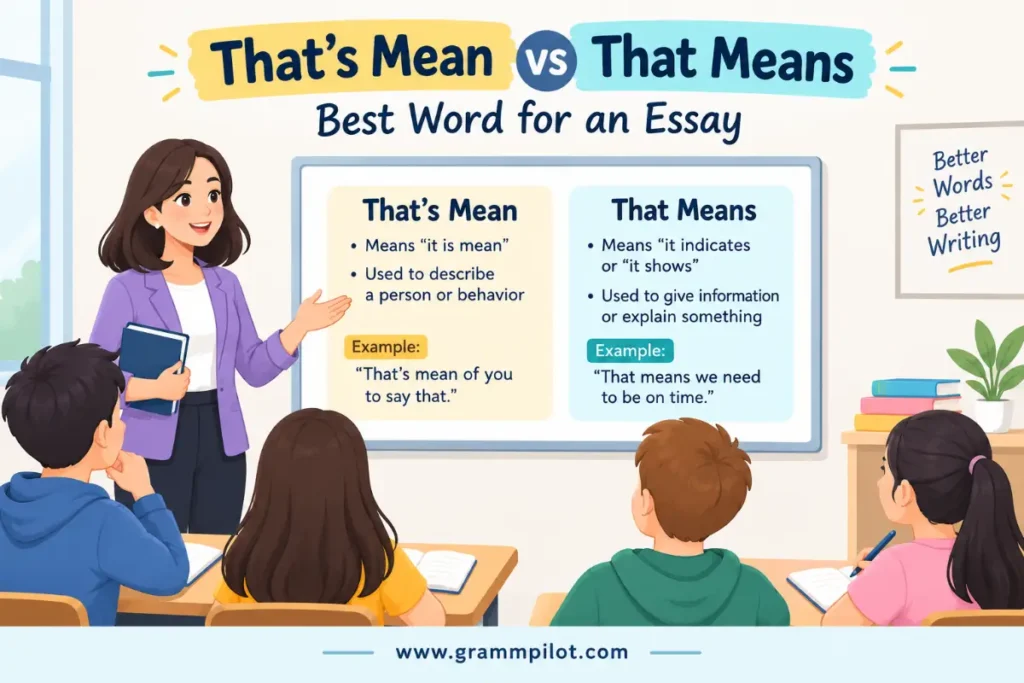
That’s Mean vs That Means: Best Word for an Essay
An essay benefits from precise vocabulary.
Instead of repeatedly using mean, consider the exact behavior you’re describing.
You might use:
- unkind
- insensitive
- cruel
- disrespectful
- inconsiderate
- hostile
- callous
- dismissive
For example: The character’s decision was cruel because he knew it would hurt his friend.
This is more specific than: The character’s decision was mean.
When explaining meaning or symbolism, use means, indicates, suggests, or signifies depending on your level of certainty.
For example: The repeated image of darkness means that the character feels isolated.
A more cautious academic version might be: The repeated image of darkness suggests that the character feels isolated.
That’s Mean vs That Means: Best Word for Texting
Texting is one of the situations where that’s mean sounds very natural.
Examples:
You told everyone my secret? That’s mean!
You didn’t save me any pizza? That’s mean.
That’s mean. She was already upset.
You can also use casual alternatives:
- That’s rude.
- That’s harsh.
- That’s cold.
- That’s pretty petty.
- That’s not nice.
For explaining a result, that means is equally natural:
The bus is running late. That means we’ll be there after eight.
The store closes at six. That means we need to hurry.
That’s Mean vs That Means: Best Word for Email
In a casual email, that’s mean can work, but professional emails usually benefit from more precise language.
Instead of: That’s mean.
consider: That comment came across as insensitive.
Or: I found that response unnecessarily harsh.
For explaining information, that means works perfectly well: The meeting has been moved to Friday. That means we have two extra days to prepare.
This expression isn’t too casual for normal professional communication.
That’s Mean vs That Means: Real-Life Examples in Different Situations
At School
He laughed when she got the answer wrong. That’s mean.
The teacher moved the test to Friday. That means we have more time to study.
At Work
Ignoring his question during the meeting was inconsiderate.
The client canceled the meeting. That means we can finish the report today.
In a Text
You posted that picture without asking me? That’s mean.
The movie starts at seven. That means we should leave now.
In an Email
That response came across as insensitive.
The office will close at noon. That means all documents must be submitted before then.
At Home
You ate the last piece and didn’t save any for me. That’s mean.
Dad is working late. That means we’re having dinner without him.
In Conversation
Calling him stupid was rude.
She hasn’t replied yet. That means she may not have seen the message.
In an Essay
The character’s decision was cruel because he knew it would hurt his friend.
The change in setting means that the story has entered a new stage.
During Travel
Canceling the hotel at the last minute was harsh.
The flight has been delayed. That means we’ll miss the first part of the event.
Common Mistakes With These Expressions “That’s Mean vs That Means”
Mistake 1: Using “That’s Mean” to Explain a Result
A common mistake is to write that’s mean when you actually want to explain what something indicates.
Incorrect: The sign says “Closed.” That’s mean we can’t enter.
Correct: The sign says “Closed.” That means we can’t enter.
The reason is simple: you’re explaining a consequence, not describing something as unkind.
Mistake 2: Writing “That Mean”
Incorrect: That mean we have to leave.
Correct: That means we have to leave.
The subject that is singular, so the present-tense verb needs -s.
Mistake 3: Forgetting the Apostrophe in “That’s”
Incorrect: Thats mean.
Correct: That’s mean.
The apostrophe shows that letters have been removed from that is.
Mistake 4: Mixing the Two Structures
Incorrect: That is means we need to leave.
Correct: That means we need to leave.
Or:That is what it means.
Don’t combine the two patterns.
Mistake 5: Assuming “Mean” Always Has a Negative Meaning
It doesn’t. As a verb, mean can simply refer to meaning or intention.
For example: What does this word mean?
I mean what I said. This sentence doesn’t involve unkindness at all.
That’s Mean vs That Means: When Should You Not Use “That’s Mean”?
Don’t use that’s mean simply because a sentence contains information that needs explanation.
For example: The store is closed. That’s mean we have to wait. This is incorrect because you’re trying to explain a consequence.
Use: The store is closed. That means we have to wait.
On the other hand, if you’re reacting to someone’s behavior, that’s mean works: You knew I was waiting and left without me. That’s mean.
The difference comes down to purpose.
Describing unkindness: That’s mean.
Explaining meaning or consequence: That means.
That’s Mean vs That Means: When Should You Not Use “That Means”?
Don’t use that means when you simply want to call someone’s behavior unkind.
For example:
You laughed at her mistake. That means. This doesn’t express a complete idea. If you mean the behavior was unkind: You laughed at her mistake. That’s mean. If you mean the behavior tells you something about the person: You laughed at her mistake. That means you weren’t taking her feelings seriously. Now means has a clear object or explanation.
Antonyms of “Mean”
When mean describes unkind behavior, common opposites include:
- kind
- nice
- caring
- thoughtful
- considerate
- compassionate
- gentle
- respectful
- generous
Compare: That’s mean.
with: That’s kind.
Or: That was an insensitive comment.
with: That was a thoughtful comment.
The exact opposite depends on the context.
For the verb mean in the sense of “signify,” there isn’t one universal antonym. A possible opposite may depend on the sentence and could involve ideas such as hiding, confusing, misrepresenting, or misleading.
Quick Comparison Chart “That’s Mean vs That Means”
| What you want to express | Correct form | Example |
|---|---|---|
| Something is unkind | That’s mean | That’s mean of you. |
| Something is hurtful | That’s mean | That’s mean to say. |
| Something is rude | That’s mean or “That’s rude” | That’s mean of him. |
| Something indicates a result | That means | That means we’re late. |
| Something has a particular significance | That means | That means something important. |
| A fact leads to a conclusion | That means | That means we need another plan. |
That’s Mean vs That Means: A Simple Editing Test
When proofreading, expand the words.
If you wrote: That’s mean.
Try: That is mean.
If the sentence still expresses your intended meaning, that’s is correct.
For that means, try replacing means with indicates.
For example: The weather is getting worse. That means we should cancel the picnic.
becomes:
The weather is getting worse. That indicates we should cancel the picnic.
The wording changes slightly, but the basic relationship remains.
This test can help you catch mistakes quickly.
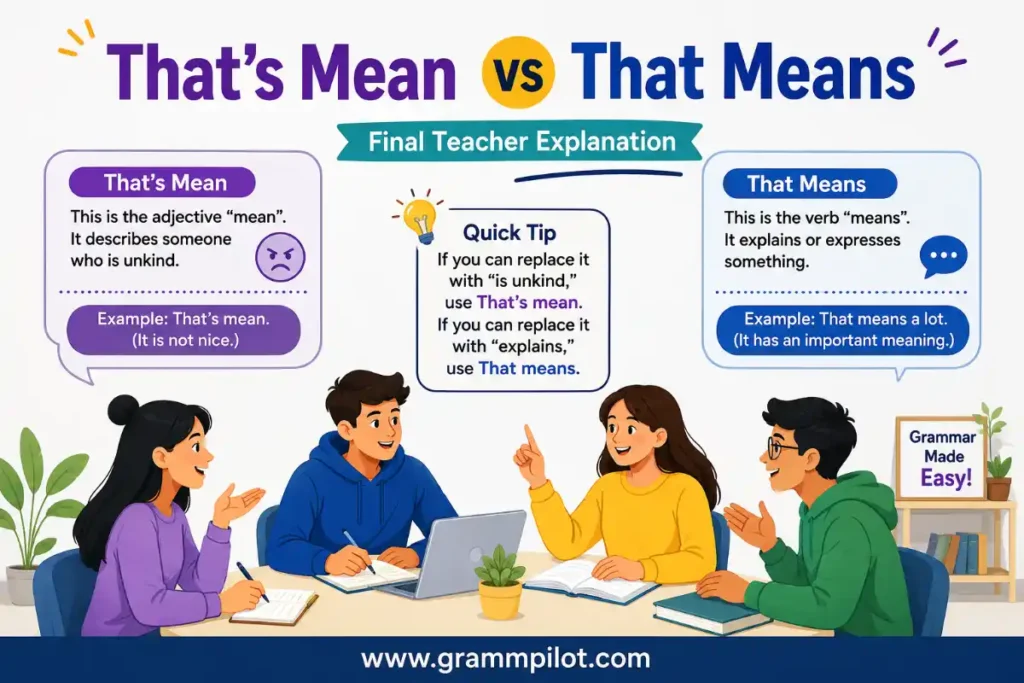
Final Teacher Explanation “That’s Mean vs That Means”
Think of the two forms as answering two different questions.
If someone asks: “What do you think about that behavior?”
You can say: That’s mean.
If someone asks: “What does that fact tell us?”
You can say: That means we need to change our plan.
The first expression evaluates something. The second explains something. One describes behavior as unkind, hurtful, or nasty. The other connects information to a meaning, result, or consequence. Once you notice that difference, the spelling becomes much easier. You don’t have to guess between that’s, that, mean, and means. Just ask what you are trying to communicate.
Conclusion
The difference in That’s Mean vs That Means becomes simple when you focus on grammar. That’s mean is short for “that is mean,” so it describes something as unkind, hurtful, rude, or unpleasant. That means uses means as a verb to explain what a fact, action, or statement indicates or causes.
When you’re reacting to someone’s behavior, choose the adjective pattern. When you’re explaining a result or idea, choose the verb pattern. A quick test is to expand that’s to that is or replace means with indicates. These checks can help you choose the right form in texts, schoolwork, emails, essays, and everyday conversations.
Frequently Asked Questions
1. What is the difference between “that’s mean”vs “that means”?
“That’s mean” describes something as unkind, while “that means” explains what something signifies or leads to. The first uses mean as an adjective, while the second uses means as a verb.
2. Is “that’s mean” grammatically correct?
Yes, “that’s mean” is grammatically correct when that’s means “that is” and mean describes something as unkind or hurtful. For example, “That’s mean of you.”
3. Is “that means” correct English?
Yes, “that means” is correct English when means is the third-person singular form of the verb mean. For example, “The store is closed. That means we have to wait.”
4. Can I say “that mean” instead of “that means”?
Usually, no, when that is the singular subject. The correct form is that means, as in “That means we’re late.”
5. What’s another way to say “that’s mean”?
You can say “that’s unkind,” “that’s rude,” “that’s hurtful,” “that’s insensitive,” or “that’s harsh.” The best alternative depends on the situation and the strength of the criticism.
6. What’s another way to say “that means”?
You can often use “that indicates,” “that suggests,” “that shows,” or “that signifies.” Choose the word that best matches how certain or formal you want to sound.
7. When should I use “that’s mean” in a text?
Use “that’s mean” when you’re reacting to something unkind, hurtful, or unfair. For example, “You didn’t invite her? That’s mean.”