
Have you ever paused while writing an email, essay, resume, or text because you weren’t sure whether to write Simpler vs More Simple? Many English learners and even native speakers ask the same question. Both expressions appear in books and online, but only one is usually the better choice. If you’ve searched for Simpler vs More Simple, you’re probably wondering which form sounds natural, which one is grammatically correct, and when each should be used. The good news is that the rule is easier than it seems.
Answer Box
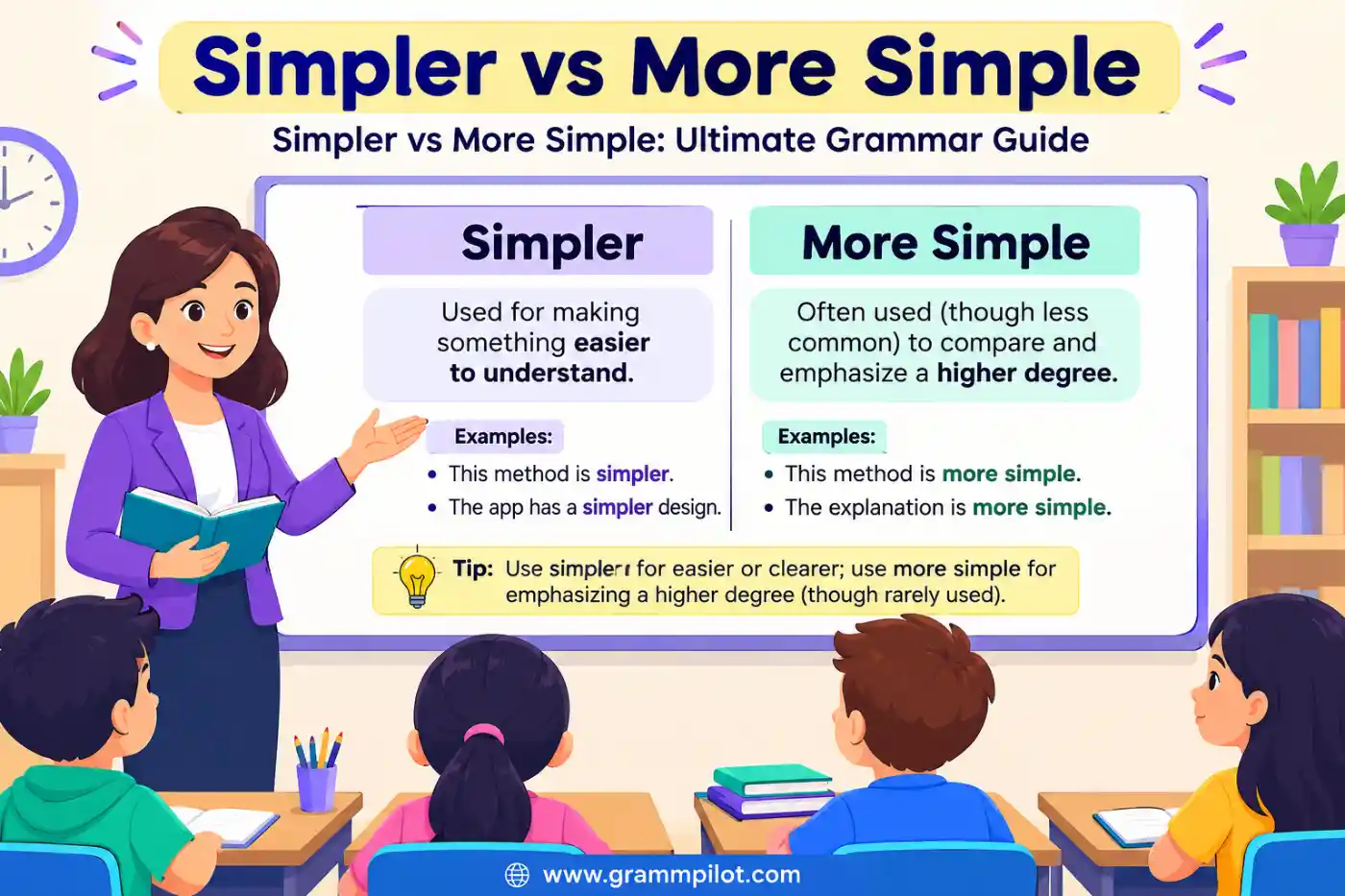
In most situations, “simpler” is the preferred comparative form of “simple.” “More simple” is grammatically correct too, but it is much less common and is usually used only for emphasis or a special style.
In this guide, you’ll learn the grammar rule, the history of the word, why both forms exist, when to choose each one, common mistakes to avoid, and plenty of real examples to help you use the correct expression with confidence.
For a closer look at another tricky spelling pattern, read [Much Needed or Much-Needed].
Simpler vs More Simple: Which One Is Correct?
The short answer is simple. Both simpler and more simple are grammatically correct. However, simpler is the form that native English speakers use most often.
Examples:
- This explanation is simpler.
- We need a simpler solution.
- Her instructions are simpler than mine.
These sentences sound natural in everyday English. Although more simple is also correct, it appears much less often.
Examples:
- We need a more simple design.
- Could you give a more simple explanation?
These examples are acceptable, but many readers would naturally replace more simple with simpler. As a result, simpler is generally the better choice.
Simpler vs More Simple: Why Do People Get Confused?
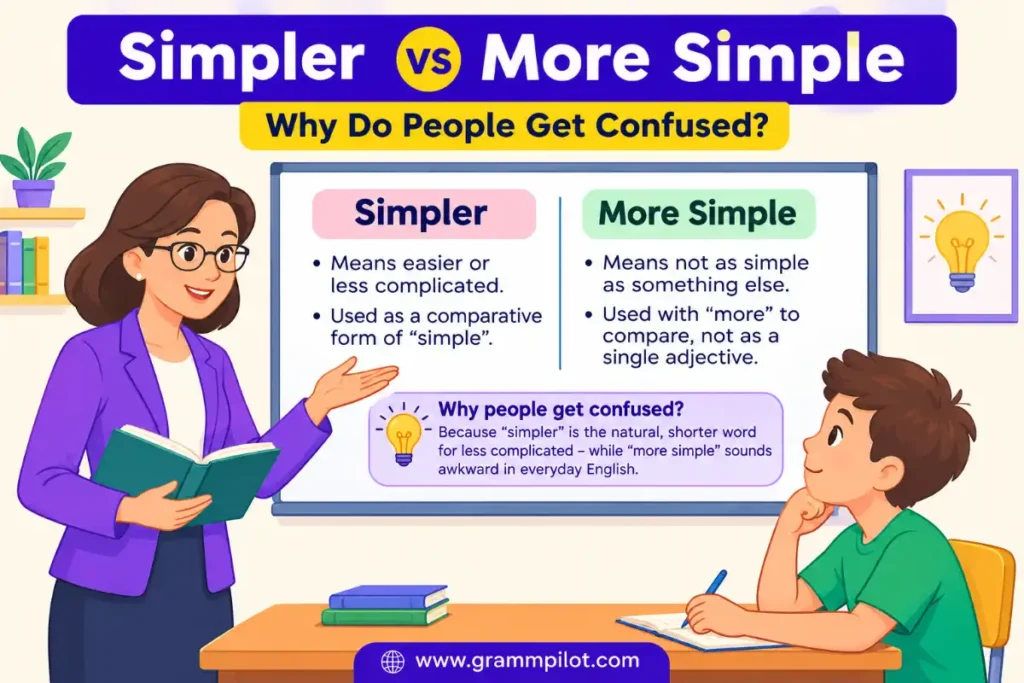
English has two common ways to make comparisons. One method adds -er to an adjective.
Examples:
- small → smaller
- fast → faster
- kind → kinder
- simple → simpler
The other method adds more before the adjective.
Examples:
- more beautiful
- more comfortable
- more important
- more interesting
Since simple has two syllables, many learners wonder whether it belongs in the second group. That creates confusion. The answer is that simple normally follows the -er pattern.
Therefore: ✅ simpler
is usually preferred over ✅ more simple
Both are correct, but one sounds much more natural.
Simpler vs More Simple: The Basic Grammar Rule
The easiest rule to remember is this: Most one-syllable adjectives form the comparative with -er.
Examples:
- tall → taller
- long → longer
- fast → faster
Many two-syllable adjectives ending in:
- -y
- -le
- -ow
- -er
also use -er.
Examples:
- happy → happier
- gentle → gentler
- narrow → narrower
- clever → cleverer
- simple → simpler
That’s why simpler is considered the standard comparative. Meanwhile, more simple is used much less frequently.
Simpler vs More Simple: Word Origin and Plain-English Meaning
Many grammar articles explain the rule but ignore where the word comes from. The word simple comes from the Latin word simplex, meaning single, plain, or not complicated. Later, it entered Old French before becoming part of English.
Today, simple usually means:
- easy to understand
- uncomplicated
- plain
- straightforward
- not difficult
- basic
The comparative form simply compares two things.
Examples:
- This test is simpler than yesterday’s.
- This method is simpler to follow.
- Her explanation is simpler for beginners.
The meaning stays the same. Only the degree changes.
Simpler vs More Simple: What Does “Comparative” Mean?
A comparative adjective compares two people, things, or ideas.
Look at these examples.
Positive: This puzzle is simple.
Comparative: This puzzle is simpler than that one.
Superlative: This is the simplest puzzle.
Notice the pattern.
| Form | Example |
|---|---|
| Positive | simple |
| Comparative | simpler |
| Superlative | simplest |
This pattern follows the normal grammar rule for adjectives ending in -le.
Simpler vs More Simple: Why Does “More Simple” Exist?
If simpler is preferred, why do people still say more simple? There are several reasons. Sometimes writers want extra emphasis.
Example: We need a more simple approach, not a more complicated one.
Sometimes the rhythm of a sentence sounds better with more simple.Writers may also choose it for style or personal preference. In formal grammar, however, simpler remains the standard choice.
Simpler vs More Simple: What Do Native Speakers Usually Say?
If you listen to everyday conversations, you’ll hear simpler much more often.
Examples:
- Can you make this simpler?
- I found a simpler way.
- Let’s use a simpler design.
- This recipe is simpler than the first one.
Native speakers usually prefer shorter comparative forms whenever they sound natural. That’s why simpler appears far more frequently in speech, newspapers, books, and websites.
Simpler vs More Simple: When Should You Use “Simpler”?
Choose simpler in most situations.
Examples include:
- school essays
- business emails
- presentations
- classroom writing
- conversations
- reports
- blogs
- articles
Examples:
- We found a simpler solution.
- Please use simpler language.
- The second design is simpler.
This version sounds smooth and natural.
Simpler vs More Simple: When Can You Use “More Simple”?
Although less common, more simple isn’t wrong.
You may see it:
- in older writing
- in literature
- when emphasizing contrast
- when matching the rhythm of a sentence
- in personal writing styles
Examples:
- The teacher wanted a more simple explanation for younger students.
- We need a more simple plan before moving forward.
Even in these examples, many editors would still recommend simpler.
Simpler vs More Simple: Which Sounds More Natural?
Imagine hearing these sentences.
Version one: We need a simpler answer.
Version two: We need a more simple answer.
Most native speakers naturally choose the first sentence. It flows better. It matches normal English patterns. That doesn’t make the second version incorrect. It simply makes it less common.
Simpler vs More Simple: Is One More Formal?
Not really. Both forms are grammatically correct. However, simpler sounds more natural in both formal and informal English.
You’ll often see it in:
- textbooks
- academic writing
- newspapers
- business communication
- educational websites
Meanwhile, more simple appears occasionally for emphasis or style rather than because grammar requires it.
Simpler vs More Simple: A Quick Memory Trick
Here’s an easy way to remember the rule.
Think about these common comparisons:
- gentle → gentler
- humble → humbler
- noble → nobler
- simple → simpler
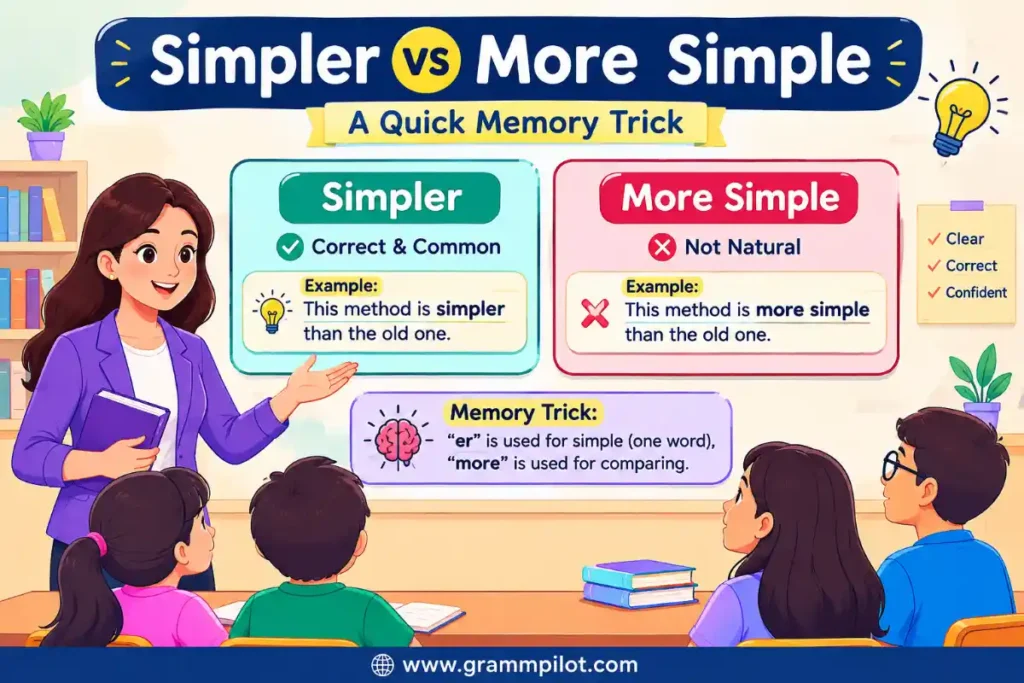
All of these adjectives naturally take -er. If the adjective ends with -le, there’s a good chance the -er form is the best choice.
So remember this sentence: Simple becomes simpler, not usually more simple.
That one rule will help you make the correct choice most of the time.
Simpler vs More Simple: Master Synonym List
When comparing Simpler vs More Simple, it’s also helpful to know related words. Sometimes neither phrase is the best choice. A synonym may sound more natural depending on your sentence.
Simple and Everyday Synonyms
| Word | Meaning | Tone | Example |
|---|---|---|---|
| Easy | Not difficult | Simple | This test is easy. |
| Plain | Not fancy or complicated | Simple | Use plain language. |
| Basic | Having only the main parts | Simple | We started with a basic plan. |
| Clear | Easy to understand | Simple | Her explanation was clear. |
| Straightforward | Direct and simple | Simple | The instructions were straightforward. |
| Uncomplicated | Easy to follow | Simple | The process is uncomplicated. |
| Smooth | Easy to complete | Simple | The transition was smooth. |
| Manageable | Easy to handle | Simple | The task became manageable. |
Everyday Alternatives
| Word | Meaning | Tone | Example |
|---|---|---|---|
| Easygoing | Relaxed and simple | Everyday | He has an easygoing style. |
| User-friendly | Easy to use | Everyday | The website is user-friendly. |
| Simple | Not difficult | Everyday | Keep your answer simple. |
| Easy to follow | Clear to understand | Everyday | The guide is easy to follow. |
| Neat | Organized and simple | Everyday | She gave a neat explanation. |
| Clean | Free from unnecessary details | Everyday | The design looks clean. |
| Practical | Useful and uncomplicated | Everyday | We chose a practical solution. |
| Effortless | Requiring little work | Everyday | The setup felt effortless. |
Formal Synonyms
| Word | Meaning | Tone | Example |
|---|---|---|---|
| Concise | Brief and clear | Formal | Write concise instructions. |
| Efficient | Works well with little waste | Formal | This is a more efficient process. |
| Logical | Easy to understand through reasoning | Formal | The argument is logical. |
| Systematic | Organized step by step | Formal | Use a systematic approach. |
| Accessible | Easy for everyone to understand | Formal | The article is accessible. |
| Coherent | Well organized | Formal | The report is coherent. |
| Understandable | Easy to comprehend | Formal | The explanation is understandable. |
| Organized | Properly arranged | Formal | The presentation is organized. |
Informal and Casual Alternatives
| Word | Meaning | Tone | Example |
|---|---|---|---|
| Piece of cake | Very easy | Slang | The quiz was a piece of cake. |
| No sweat | Not difficult | Slang | Fixing it was no sweat. |
| Easy-peasy | Extremely easy | Slang | That game was easy-peasy. |
| Simple as that | Very clear | Casual | Just click the button. Simple as that. |
| Foolproof | Hard to get wrong | Casual | This method is foolproof. |
| Crystal clear | Extremely easy to understand | Casual | Your directions were crystal clear. |
| Stress-free | Without difficulty | Casual | The trip was stress-free. |
| Breezy | Very easy | Informal | The assignment was breezy. |
These words give you many options besides repeating simple over and over.
Simpler vs More Simple: Synonyms by Intensity
Some words suggest only a small improvement in simplicity, while others mean something is extremely easy to understand.
| Mild | Moderate | Strong |
|---|---|---|
| Plain | Simple | Foolproof |
| Basic | Straightforward | Crystal clear |
| Clear | Easy | Effortless |
| Organized | Uncomplicated | Extremely simple |
| Practical | Accessible | Easy-peasy |
| Understandable | User-friendly | Impossible to misunderstand |
| Logical | Concise | Perfectly clear |
| Neat | Manageable | Exceptionally easy |
Choosing the right word depends on how much emphasis you want.
Simpler vs More Simple: Related Words by Part of Speech
Learning related vocabulary helps you avoid repeating the same adjective.
Adjectives
- Simple
- Easy
- Basic
- Plain
- Straightforward
- Clear
- Logical
- Practical
- Concise
- Uncomplicated
Nouns
- Simplicity
- Clarity
- Ease
- Plainness
- Organization
- Understanding
- Accessibility
- Practicality
- Logic
- Efficiency
Verbs
- Simplify
- Explain
- Clarify
- Organize
- Reduce
- Improve
- Streamline
- Shorten
- Arrange
- Rewrite
Using different parts of speech makes your writing smoother and less repetitive.
Simpler vs More Simple: Is There a Difference Between American and British English?
The good news is that there is almost no difference. Both American and British English usually prefer:
- simpler
Examples:
- This solution is simpler.
- We need a simpler explanation.
Both varieties also recognize more simple, but it is much less common. In newspapers, business writing, education, and everyday conversation, simpler remains the natural choice on both sides of the Atlantic.
Simpler vs More Simple: Which Form Works Best in Different Situations?
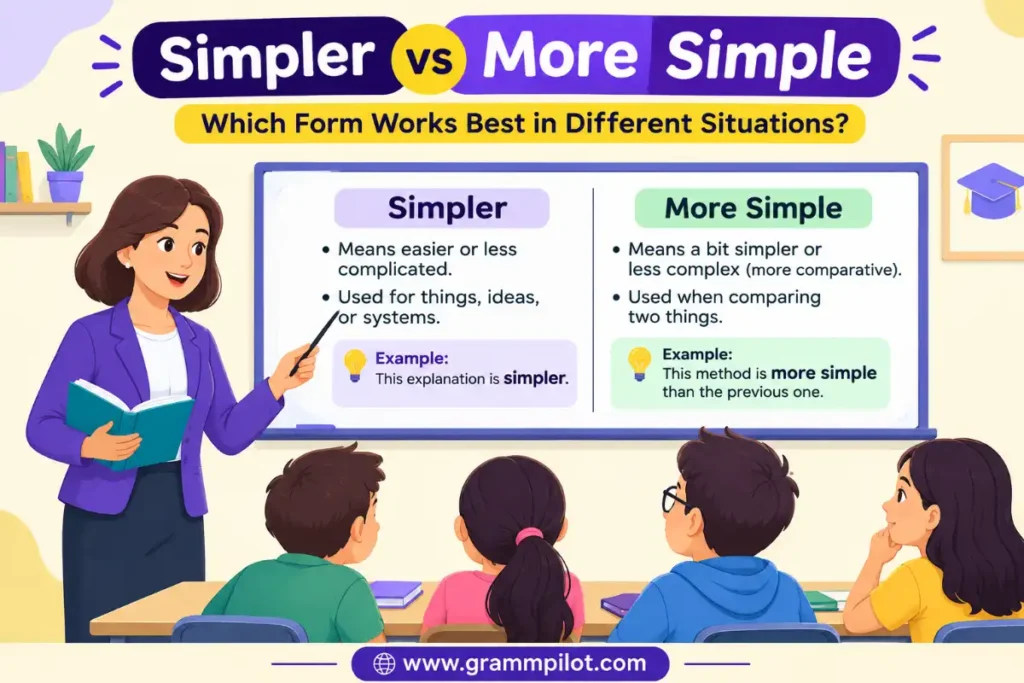
The best choice depends on your audience.
Simpler vs More Simple in a Resume
A resume should sound clear and professional.
Example: I developed a simpler reporting system.
This version sounds polished.
Simpler vs More Simple in an Essay
Teachers usually expect natural grammar.
Examples:
- The author uses simpler language.
- This explanation is simpler than the previous one.
These sentences follow standard English usage.
Simpler vs More Simple in an Email
Business emails should be direct.
Example: Could you send a simpler version of the instructions?
This sounds polite and natural.
Simpler vs More Simple in Text Messages
Texting usually favors shorter words.
Examples:
- Make it simpler.
- Can you explain it in a simpler way?
The shorter form feels more conversational.
Simpler vs More Simple in Speaking
Native speakers almost always choose simpler in everyday conversation.
Examples:
- There’s a simpler way to do this.
- Let’s find a simpler answer.
- I like the simpler design.
These expressions sound smooth and natural.
Simpler vs More Simple: Which Word Should You Choose?
Here’s a quick guide.
| Situation | Best Choice |
|---|---|
| School essay | Simpler |
| Business email | Simpler |
| Resume | Simpler |
| Everyday conversation | Simpler |
| Text message | Simpler |
| Blog article | Simpler |
| Academic writing | Simpler |
| Literature or stylistic emphasis | More simple (occasionally) |
| Strong contrast | More simple (sometimes) |
| Nearly every other situation | Simpler |
For most learners, the safest rule is easy to remember: Use “simpler” unless you have a specific reason to choose “more simple.”
Simpler vs More Simple: Original Example Sentences
The best way to understand Simpler vs More Simple is to see both forms used in real situations. Most of these examples show why simpler is usually the better choice.
- This math problem is simpler than the last one.
- We found a simpler solution after the meeting.
- Her explanation made the lesson much simpler to understand.
- The updated website has a simpler design.
- Please write your answer in simpler language.
- This recipe is simpler than my grandmother’s version.
- Our teacher gave us a simpler example.
- The second route is simpler to follow.
- I prefer a simpler schedule during busy weeks.
- The new software offers a simpler way to organize files.
- He explained the rules in a simpler manner.
- The revised report is simpler and easier to read.
- This game becomes simpler after a few rounds.
- We need a simpler plan before we begin.
- The updated instructions are simpler for beginners.
Now look at examples using more simple.
- The editor asked for a more simple explanation.
- We wanted a more simple layout for younger readers.
- The speaker tried to use more simple words.
These sentences are grammatically correct.
Even so, many editors would rewrite them like this:
- The editor asked for a simpler explanation.
- We wanted a simpler layout for younger readers.
- The speaker tried to use simpler words.
The revised versions sound more natural in modern English.
Simpler vs More Simple: Before-and-After Examples
Small grammar changes can make a sentence sound smoother.
| Less Natural | Better Choice |
|---|---|
| We need a more simple answer. | We need a simpler answer. |
| Can you write a more simple report? | Can you write a simpler report? |
| This method is more simple. | This method is simpler. |
| I prefer more simple instructions. | I prefer simpler instructions. |
| The teacher used more simple examples. | The teacher used simpler examples. |
| Give me a more simple explanation. | Give me a simpler explanation. |
| The second design is more simple. | The second design is simpler. |
| This approach feels more simple. | This approach feels simpler. |
Notice that the right-hand column sounds shorter and more natural.
Simpler vs More Simple: What’s the Difference?
Both expressions compare two things.
The difference is mainly one of style and frequency.
| Simpler | More Simple |
|---|---|
| Preferred in modern English | Grammatically correct but less common |
| Shorter and smoother | Longer expression |
| Used by most native speakers | Used mainly for emphasis or style |
| Recommended in school writing | Seen occasionally in literature |
| Best choice in most situations | Best used only when needed |
Examples:
- This explanation is simpler than the first one.
- We wanted a more simple style for dramatic effect.
The second sentence works, but the first pattern is far more common.
Simpler vs More Simple: Simple vs Simpler
Many learners confuse these two words.
| Simple | Simpler |
|---|---|
| Describes one thing | Compares two things |
| Positive form | Comparative form |
| No comparison | Shows one is easier than another |
Examples:
- This lesson is simple.
- This lesson is simpler than yesterday’s lesson.
Use simple when there is no comparison.
Use simpler when comparing two ideas, objects, or situations.
Simpler vs More Simple: Common Mistakes
Here are mistakes learners often make.
Mistake 1: Using “More Simpler”
❌ This method is more simpler.
✅ This method is simpler.
Never use more and -er together.
Mistake 2: Using “Simpler” Without a Comparison
❌ This book is simpler.
✅ This book is simple.
or
✅ This book is simpler than the first one.
A comparative form should usually compare two things.
Mistake 3: Choosing “More Simple” Every Time
Some learners think every two-syllable adjective needs more.
That’s not true.
Words like:
- simple
- gentle
- narrow
- clever
normally take -er.
Mistake 4: Forgetting the Superlative Form
Positive: simple
Comparative: simpler
Superlative: simplest
Don’t write: ❌ most simplest
Correct: ✅ simplest
Mistake 5: Copying Literal Translations
Some languages always use a word meaning more to make comparisons. English does not. Always follow English grammar patterns instead of translating directly.
Simpler vs More Simple: When Should You Avoid Each Form?
Avoid simpler when no comparison exists.
Incorrect: This guide is simpler.
Correct: This guide is simple.
or This guide is simpler than the previous one.
Avoid more simple unless you have a good stylistic reason. Most readers expect simpler.
Simpler vs More Simple: Antonyms
Learning opposite words makes comparisons easier.
| Word | Meaning |
|---|---|
| Complex | Having many parts |
| Complicated | Difficult to understand |
| Difficult | Not easy |
| Hard | Requiring effort |
| Confusing | Difficult to follow |
| Advanced | More detailed or challenging |
| Sophisticated | Highly developed or complex |
| Intricate | Full of small details |
| Elaborate | Highly detailed |
| Challenging | Demanding skill or effort |
These words help you describe the opposite of something simple.
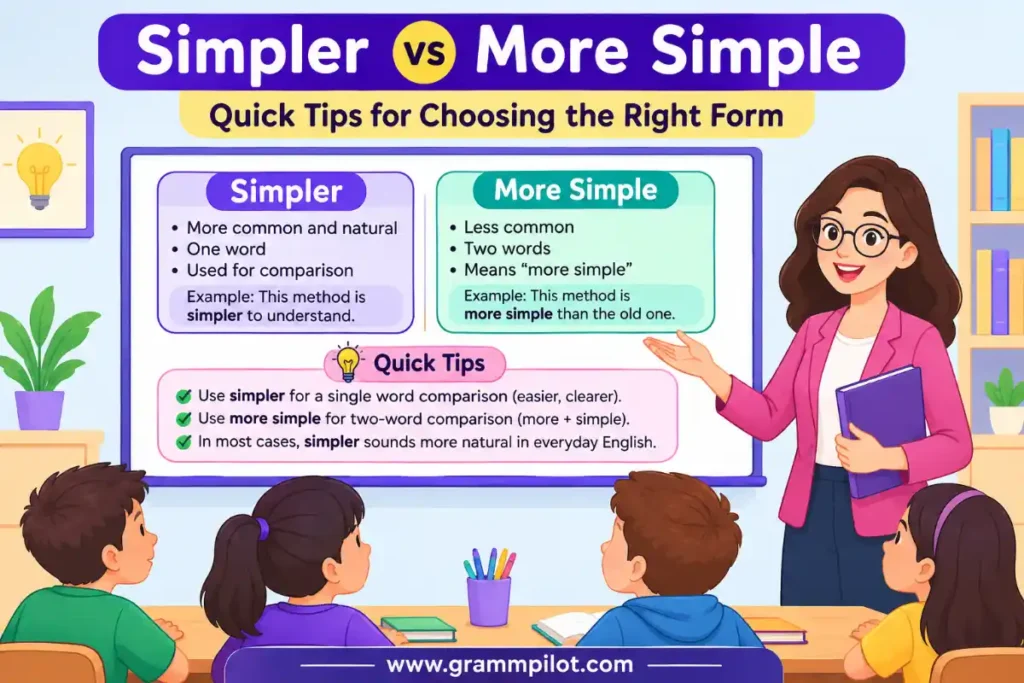
Simpler vs More Simple: Quick Tips for Choosing the Right Form
Remember these practical tips.
- Use simpler in most situations.
- Compare two things before using a comparative.
- Avoid more simpler.
- Choose shorter forms when they sound natural.
- Read your sentence aloud.
- If simpler sounds smooth, it’s probably the best choice.
- Use more simple only when you have a stylistic reason.
- Follow common English usage instead of direct translation.
- Keep your writing clear and concise.
- Practice by comparing everyday objects.
Conclusion
Understanding Simpler vs More Simple doesn’t have to be difficult. Both forms are grammatically correct, but simpler is the form that native English speakers use most often in everyday conversation, school assignments, business writing, and professional communication. It sounds smoother, follows the normal comparative pattern for the adjective simple, and is usually the best choice in modern English.
Whenever you’re comparing two ideas, explanations, designs, or methods, choose simpler unless you have a specific stylistic reason to use more simple. Reading your sentence aloud is also a helpful way to check which version sounds more natural. With a little practice, you’ll use the correct comparative confidently and make your writing clearer and more effective.
Frequently Asked Questions
1. Is Simpler vs More Simple grammatically correct?
Yes. Both simpler and more simple are grammatically correct. However, simpler is the preferred and more natural comparative form in most situations.
2. Which is better: simpler or more simple?
In everyday English, simpler is usually the better choice. It is shorter, more natural, and more commonly used by native speakers.
3. Can I say “more simple” in formal writing?
Yes, you can. It is grammatically acceptable, but most editors and style guides recommend using simpler unless you need more simple for emphasis or sentence rhythm.
4. What’s another way to say “simpler”?
You can use words such as easier, clearer, more straightforward, less complicated, more basic, or more understandable, depending on the context.
5. Why do native speakers usually say “simpler”?
Native speakers generally prefer shorter comparative forms for adjectives like simple, gentle, and narrow because they sound smoother and follow common English grammar patterns.
6. Is “more simpler” correct?
No. More simpler is incorrect because it uses two comparative markers at the same time. Use simpler instead.
7. How can I remember the difference between Simpler vs More Simple?
A simple memory trick is to think of similar words like gentle → gentler and humble → humbler. Since simple follows the same pattern, simpler is almost always the best choice.