
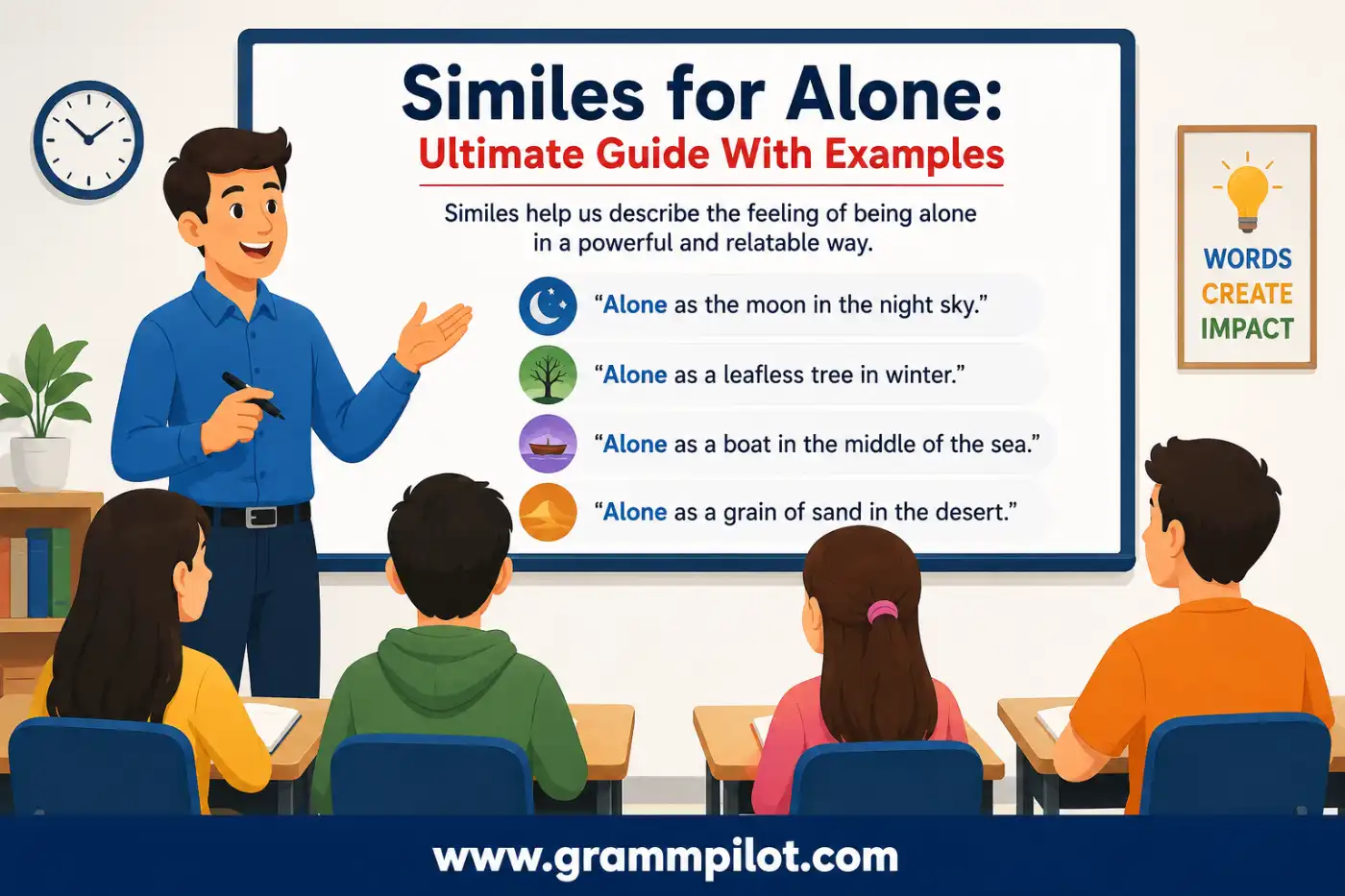
Have you ever written an essay, email, story, or text and wanted a better way to describe someone who was by themselves? That’s where Similes for Alone can make your writing stronger and more memorable. Instead of repeating the word alone, you can use creative comparisons that help readers picture the feeling more clearly. Many students, writers, and English learners search for Similes for Alone because they want fresh ways to describe loneliness, independence, quiet moments, or peaceful solitude. A good simile adds emotion and makes your writing more engaging.
Answer Box
Similes for Alone compare a person or thing that is by itself to another familiar image using the words “like” or “as.” They help readers clearly imagine feelings such as solitude, independence, or loneliness.
Whether you’re writing a school assignment, poem, speech, novel, or social media post, the right comparison can make your description more vivid. This guide explains what these similes mean, where they came from, how to use them correctly, and how to choose the best one for every situation.
To improve your spelling accuracy, take a look at [Similes for Slow].
Similes for Alone: What Are They?
Similes for Alone are comparisons that describe someone or something as being by itself through the words like or as.
Instead of saying: He was alone.
You could write:
- He was as lonely as a cloud in an empty sky.
- She stood like a tree in an open field.
- The traveler felt as isolated as an island.
These comparisons help readers picture the situation instead of simply reading the word alone. A simile compares two different things to make an idea easier to understand.
Examples include:
- as alone as an island
- like the last leaf on a tree
- as quiet as an empty house
- like a single star in the night sky
Each one creates a stronger image than using alone by itself.
Similes for Alone: What Does “Alone” Really Mean?
Before learning different comparisons, it’s useful to understand the word itself.
Alone usually means:
- by yourself
- without other people
- separated from others
- independent
- isolated
- without company
However, being alone doesn’t always mean feeling lonely.
Sometimes people enjoy being alone because they want:
- peace
- quiet
- privacy
- time to think
- personal space
- relaxation
In other situations, being alone may describe sadness or isolation. The meaning depends on the context. That’s why choosing the right simile matters.
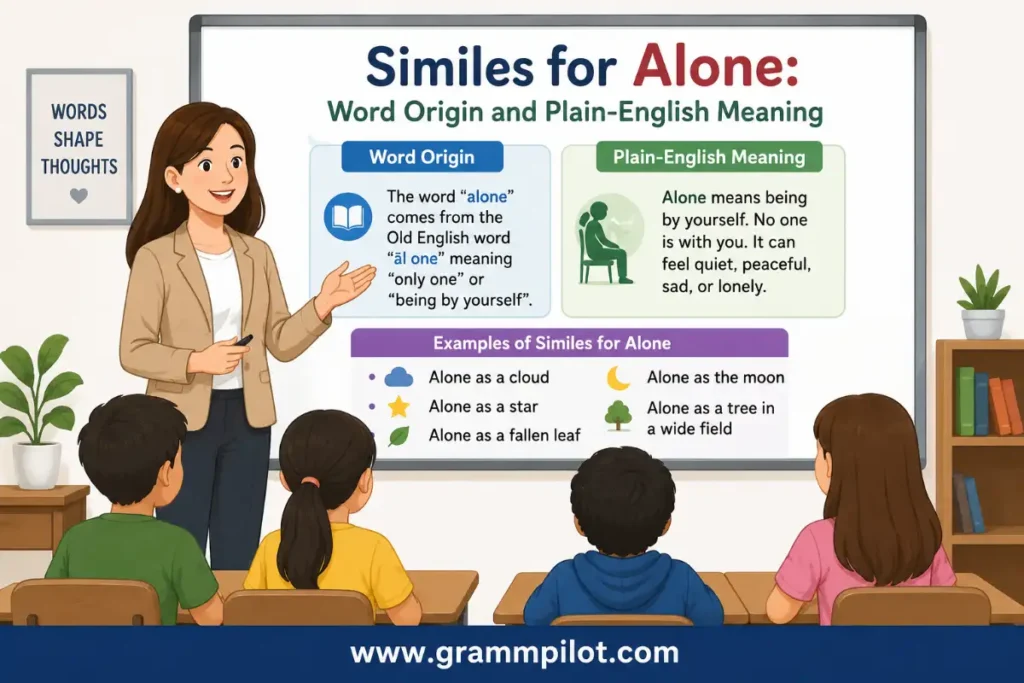
Similes for Alone: Word Origin and Plain-English Meaning
Many articles skip the history of the word, but knowing its origin makes it easier to understand. The word alone comes from the combination of all and one in early English. Originally, it meant entirely by oneself or without anyone else. Over time, the meaning expanded.
Today, it can describe:
- physical separation
- emotional loneliness
- peaceful solitude
- independence
- self-reliance
The word simile comes from the Latin word similis, meaning similar or like. That is why similes always compare one thing with another.
Examples include:
- as lonely as a deserted island
- like a single candle in the dark
- as quiet as falling snow
- like the only bird in the sky
Each comparison helps readers imagine a different kind of being alone.
Similes for Alone: Why Do Writers Use Them?
Readers remember pictures more easily than simple statements.
Compare these two examples.
Plain sentence
- The boy was alone.
With a simile
- The boy was as lonely as the last tree standing after a storm.
The second sentence creates a stronger emotional picture. Writers use similes because they:
- add emotion
- improve storytelling
- make descriptions memorable
- help readers imagine scenes
- avoid repeating the same words
- create stronger characters
You’ll find similes in:
- novels
- poems
- speeches
- songs
- classroom essays
- children’s books
- movies
- everyday conversations
Similes for Alone: How Does a Simile Work?
Every simile has three simple parts.
| Part | Example |
|---|---|
| Person or thing | The traveler |
| Comparison word | as |
| Image | as lonely as an island |
Another example:
| Part | Example |
|---|---|
| Person | My grandfather |
| Comparison word | like |
| Image | like a lighthouse standing by itself |
The comparison helps readers imagine the feeling more clearly.
Similes for Alone: Why Are Similes Better Than Simply Saying “Alone”?
Imagine describing someone sitting quietly.
Version one: She was alone.
Version two: She sat like the last star shining before sunrise.
The second sentence gives readers a picture instead of only information.
Good similes:
- create emotion
- improve creative writing
- strengthen storytelling
- make essays more interesting
- help readers remember your description
That’s why teachers often encourage students to use similes in descriptive writing.
Similes for Alone: When Should You Use Them?
These comparisons work well in many kinds of writing.
Examples include:
- school essays
- stories
- speeches
- poems
- journals
- personal letters
- novels
- creative writing assignments
- social media captions
Examples:
- The cabin stood like a lone tree on a snowy hill.
- The child felt as lonely as a lost balloon.
- The old lighthouse remained as silent as an empty church.
Each comparison creates a stronger mental image.
Similes for Alone: Can You Create Your Own Similes?
Yes. Many of the best comparisons are original. Think about things people naturally connect with being alone.
Ideas include:
- islands
- stars
- clouds
- empty roads
- abandoned houses
- mountains
- trees
- candles
- birds
- boats
Then connect your idea with as or like.
Examples:
- as quiet as a forgotten cabin
- like a single boat on the ocean
- as lonely as an unopened letter
- like one flower in a wide field
- as peaceful as an empty beach at sunrise
Creative comparisons often make your writing more memorable.
Similes for Alone: What Makes a Good Simile?
Not every comparison works well.
A strong simile should be:
- easy to understand
- meaningful
- natural
- memorable
- appropriate for the situation
Compare these examples.
Good: She was as lonely as an island.
Better: He stood like the only lighthouse watching over a silent sea.
Poor: She was as alone as a calculator.
The last example feels confusing because calculators are not naturally connected with loneliness or solitude.
Readers understand comparisons better when they use familiar images.
Similes for Alone: Common Themes Used in Comparisons
Writers often choose images that naturally suggest solitude or quietness.
Nature
- islands
- mountains
- forests
- stars
- clouds
- rivers
- deserts
- oceans
Weather
- falling snow
- quiet rain
- morning fog
- evening sky
Animals
- lone wolves
- eagles
- owls
- deer
- birds flying alone
Places
- empty roads
- abandoned houses
- quiet beaches
- silent libraries
- lonely cabins
Objects
- candles
- chairs
- boats
- lanterns
- single flowers
These images help readers immediately understand the feeling being described.
Similes for Alone: Why Do They Improve Your Writing?
Readers connect more deeply with pictures than plain statements.
Compare these examples.
- The old house stood alone.
- The old house stood like a forgotten castle at the edge of the world.
Another example:
- He walked alone.
- He walked as quietly as a single leaf drifting through the wind.
The second sentence in each pair creates a stronger emotional connection and helps readers imagine the scene more clearly. That’s why Similes for Alone appear so often in novels, poems, speeches, stories, and descriptive essays.
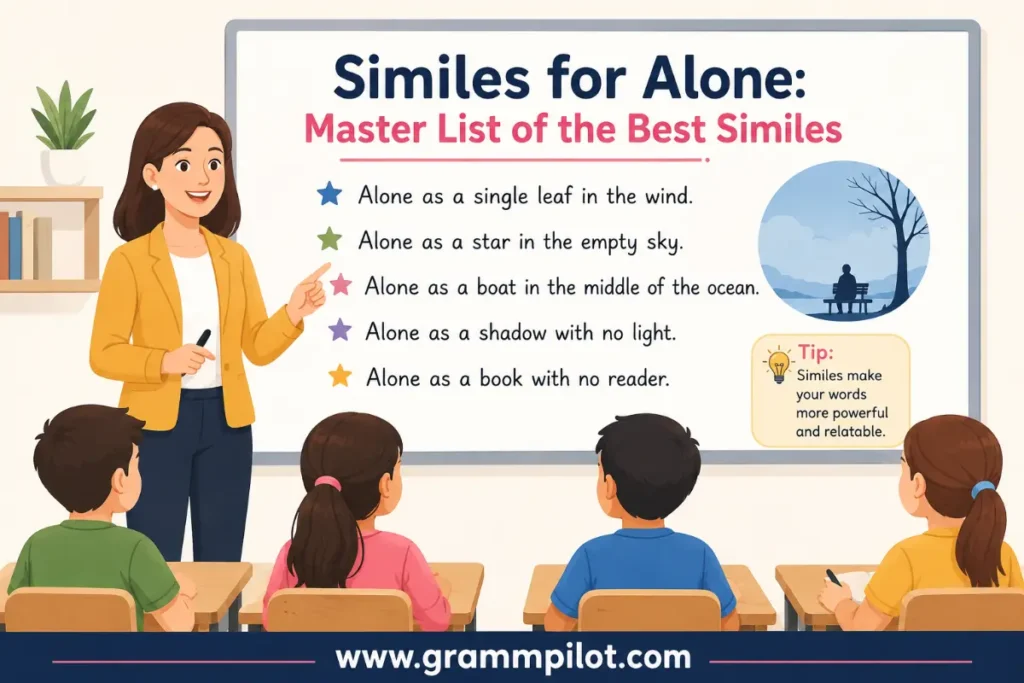
Similes for Alone: Master List of the Best Similes
Learning Similes for Alone becomes much easier when you have a collection of ready-to-use comparisons. Some express peaceful solitude, while others describe deep loneliness or quiet independence.
Simple Similes for Alone
| Simile | Meaning | Tone | Example |
|---|---|---|---|
| As alone as an island | Completely by yourself | Simple | He felt as alone as an island after moving away. |
| Like a lone wolf | Independent or isolated | Simple | She worked like a lone wolf on the project. |
| As quiet as an empty room | Silent and peaceful | Simple | The library was as quiet as an empty room. |
| Like the last leaf on a tree | One remaining | Simple | He stood like the last leaf on a tree. |
| As lonely as a stray dog | Feeling abandoned | Simple | The child looked as lonely as a stray dog. |
| Like a single candle | Standing alone | Simple | Her light shined like a single candle in the darkness. |
| As silent as the moon | Quiet and still | Simple | The village became as silent as the moon. |
| Like one star in the sky | Standing apart | Simple | She felt like one star in the sky. |
Everyday Similes for Alone
| Simile | Meaning | Tone | Example |
|---|---|---|---|
| Like a boat without a harbor | Lacking support | Everyday | He wandered like a boat without a harbor. |
| As peaceful as an empty beach | Calm and relaxing | Everyday | The morning felt as peaceful as an empty beach. |
| Like a forgotten book | Ignored or unnoticed | Everyday | She sat like a forgotten book on the shelf. |
| As still as falling snow | Quiet and calm | Everyday | The forest remained as still as falling snow. |
| Like a chair in an empty classroom | Completely by itself | Everyday | The old desk stood like a chair in an empty classroom. |
| As quiet as sunrise | Peaceful | Everyday | The campsite was as quiet as sunrise. |
| Like one flower in a field | Standing alone | Everyday | The house looked like one flower in a wide field. |
| As distant as the horizon | Far away from others | Everyday | He felt as distant as the horizon. |
Formal Similes for Alone
| Simile | Meaning | Tone | Example |
|---|---|---|---|
| Like a lighthouse in the sea | Standing by itself | Formal | The castle stood like a lighthouse in the sea. |
| As solitary as a mountain peak | Completely isolated | Formal | The cabin was as solitary as a mountain peak. |
| Like a traveler without companions | Alone on a journey | Formal | The explorer walked like a traveler without companions. |
| As isolated as a desert island | Far from everyone | Formal | She felt as isolated as a desert island. |
| Like an echo in a canyon | Existing without company | Formal | His voice faded like an echo in a canyon. |
| As still as an ancient statue | Quiet and unmoving | Formal | The guard remained as still as an ancient statue. |
| Like the final note of a song | Left by itself | Formal | The memory stayed like the final note of a song. |
| As silent as a forgotten temple | Completely quiet | Formal | The valley became as silent as a forgotten temple. |
Creative and Informal Similes for Alone
| Simile | Meaning | Tone | Example |
|---|---|---|---|
| Like the last cookie in the jar | The only one left | Casual | I felt like the last cookie in the jar after everyone left. |
| As lonely as an unplugged phone | Without connection | Casual | He joked that he was as lonely as an unplugged phone. |
| Like one sock without its pair | Missing company | Casual | The glove looked like one sock without its pair. |
| As forgotten as yesterday’s newspaper | Ignored | Casual | The old toy was as forgotten as yesterday’s newspaper. |
| Like one balloon floating away | Separated from others | Casual | The child watched it drift like one balloon floating away. |
| As quiet as a closed bookstore | Peaceful | Casual | The hallway was as quiet as a closed bookstore. |
| Like a single puzzle piece | Waiting to belong | Casual | He felt like a single puzzle piece. |
| As calm as an empty park at dawn | Peaceful solitude | Casual | The neighborhood was as calm as an empty park at dawn. |
These examples show that Similes for Alone can describe loneliness, peaceful solitude, independence, and quiet reflection.
Similes for Alone: Similar Words by Intensity
Some words describe simply being by yourself, while others suggest deeper loneliness or isolation.
| Mild | Moderate | Strong |
|---|---|---|
| Alone | Solitary | Isolated |
| Quiet | Lonely | Abandoned |
| Independent | Secluded | Desolate |
| Separate | Remote | Forsaken |
| Single | Withdrawn | Despairing |
| By yourself | Detached | Cut off |
| Calm | Isolated | Deserted |
| Private | Friendless | Completely alone |
Choosing the right word helps match the feeling you want to express.
Similes for Alone: Related Words by Part of Speech
Using related vocabulary helps avoid repetition.
Nouns
- Solitude
- Isolation
- Loneliness
- Privacy
- Silence
- Independence
- Separation
- Seclusion
- Quietness
- Distance
Verbs
- Isolate
- Separate
- Wander
- Stand
- Wait
- Remain
- Travel
- Retreat
- Rest
- Reflect
Adjectives
- Alone
- Lonely
- Solitary
- Quiet
- Isolated
- Peaceful
- Independent
- Secluded
- Silent
- Remote
These words pair naturally with Similes for Alone in both creative and descriptive writing.
Similes for Alone: Are They Different in American and British English?
Most Similes for Alone are understood the same way in both American and British English because they rely on universal images.
Examples used naturally in both include:
- As alone as an island.
- Like a lone wolf.
- As quiet as falling snow.
- Like a single star.
- As solitary as a mountain peak.
Some comparisons may reflect local scenery.
For example, American writers may compare solitude to a lonely highway across the desert, while British writers might describe a quiet country lane or a remote cottage.
The meaning stays the same even when the images change.
Similes for Alone: Which Simile Works Best in Different Situations?
Choosing the right comparison depends on your audience and purpose.
Similes for Alone in a School Essay
Use familiar and easy-to-understand comparisons.
Examples:
- He was as alone as an island.
- She stood like a single tree in an open field.
These similes are simple and effective.
Similes for Alone in a Story
Creative writing allows more detailed images.
Examples:
- The old sailor drifted like a forgotten ship on a silent sea.
- The cabin stood as solitary as a mountain peak.
These comparisons help readers imagine the scene.
Similes for Alone in an Email
Professional emails usually need direct language. If a comparison fits naturally, keep it simple.
Example: Working remotely sometimes feels like a lone wolf finding its own path.
Similes for Alone in a Speech
Speeches benefit from emotional imagery.
Examples:
- No one should feel like a single candle in endless darkness.
- We must never leave anyone as isolated as a deserted island.
These comparisons connect with listeners.
Similes for Alone in Everyday Conversation
Simple comparisons sound the most natural.
Examples:
- I felt like the last leaf on a tree.
- He’s as quiet as an empty room today.
- She likes spending time like a lone wolf.
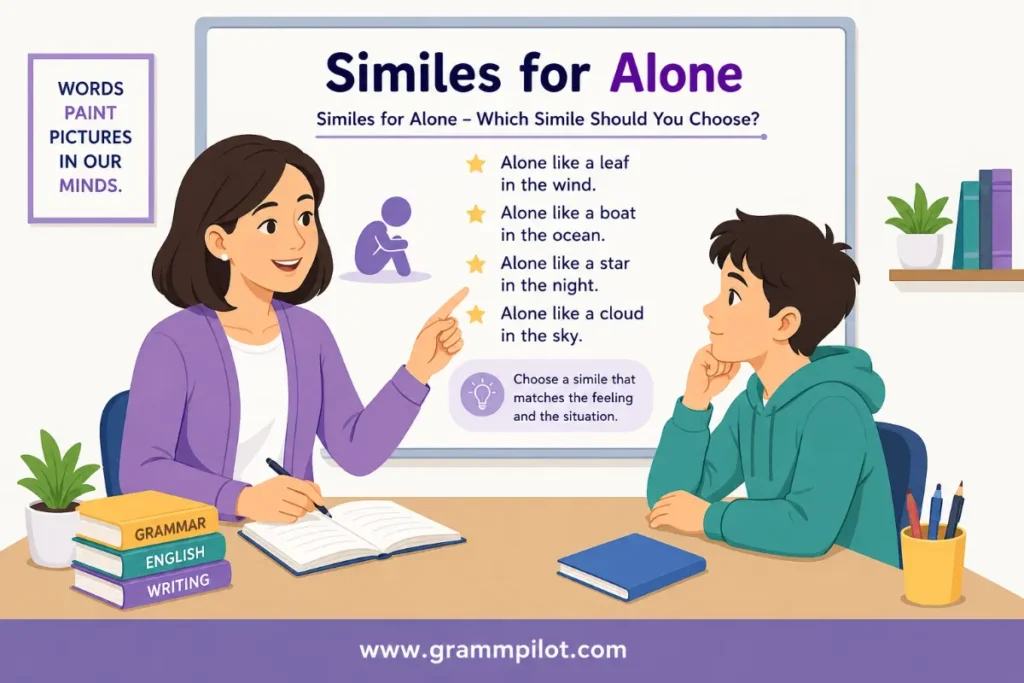
Similes for Alone: Which Simile Should You Choose?
The best simile depends on the idea you want to express.
| Situation | Best Simile |
|---|---|
| Feeling lonely | As alone as an island |
| Enjoying quiet time | As peaceful as an empty beach |
| Independent person | Like a lone wolf |
| Empty place | As quiet as an empty room |
| Standing apart | Like one star in the sky |
| Forgotten object | Like a forgotten book |
| Isolated building | As solitary as a mountain peak |
| Emotional separation | Like a boat without a harbor |
| Calm reflection | As still as falling snow |
| Waiting to belong | Like a single puzzle piece |
By choosing the right comparison, you can express different shades of solitude instead of simply repeating the word alone.
Similes for Alone: Original Example Sentences
The easiest way to understand Similes for Alone is by seeing them in everyday situations. These examples show how a simple comparison can create a stronger picture and express different kinds of solitude.
- He stood as alone as an island after everyone left the party.
- She felt like the last leaf on a tree when her friends moved away.
- The old cabin rested as solitary as a mountain peak.
- My grandfather sat like a lighthouse watching the sea.
- The child looked as lonely as a stray puppy in the crowded park.
- The traveler wandered like a boat without a harbor.
- The classroom became as quiet as an empty room after school ended.
- She walked like a single bird crossing the sky.
- The old house stood as silent as a forgotten church.
- He felt like one flower blooming in a desert.
- The fisherman waited as patiently as a lone tree facing the wind.
- Her voice echoed like a single note in a silent hall.
- The runner crossed the finish line like a lone wolf returning home.
- The campsite looked as peaceful as an empty beach at sunrise.
- His desk sat like a forgotten book on a dusty shelf.
- She smiled like the first star appearing after sunset.
- The balloon floated away like one bird leaving the flock.
- The small village rested as still as falling snow.
- He remained like the final candle burning at night.
- The old bridge stood as lonely as an abandoned road.
Each sentence uses a familiar image to help readers picture what being alone looks or feels like.
Similes for Alone: Before-and-After Examples
Notice how a simile makes an ordinary sentence much more interesting.
| Plain Sentence | Improved with a Simile |
|---|---|
| He was alone. | He was as alone as an island. |
| She felt lonely. | She felt like the last leaf on a tree. |
| The cabin was isolated. | The cabin stood as solitary as a mountain peak. |
| The room was quiet. | The room was as quiet as an empty library. |
| The traveler walked alone. | The traveler walked like a boat without a harbor. |
| The child sat quietly. | The child sat like a single bird on a wire. |
| The house looked empty. | The house stood like a forgotten castle. |
| He waited by himself. | He waited as patiently as a lighthouse in the sea. |
The second sentence in each pair paints a clearer picture and creates stronger emotion.
Similes for Alone: “As Alone as an Island” vs. “Like a Lone Wolf”
Both similes describe being by yourself, but they have different meanings.
| As Alone as an Island | Like a Lone Wolf |
|---|---|
| Suggests isolation or loneliness. | Suggests independence and self-reliance. |
| Often carries a sad feeling. | Usually has a confident or determined tone. |
| Focuses on separation. | Focuses on choosing to work alone. |
Examples:
- After moving to a new city, she felt as alone as an island.
- He prefers solving problems like a lone wolf.
Choose the comparison that matches the emotion you want to express.
Similes for Alone: “As Quiet as an Empty Room” vs. “As Peaceful as an Empty Beach”
These comparisons also describe different kinds of solitude.
| As Quiet as an Empty Room | As Peaceful as an Empty Beach |
|---|---|
| Focuses on silence. | Focuses on calmness and relaxation. |
| May sound lonely. | Usually has a positive feeling. |
| Often describes places. | Often describes enjoyable solitude. |
Examples:
- The school hallway was as quiet as an empty room.
- Early mornings at the lake felt as peaceful as an empty beach.
Using the right comparison makes your writing more accurate.
Similes for Alone: Common Mistakes
Many writers make small mistakes when creating similes.
Mistake 1: Choosing an Unrelated Image
❌ He was as alone as a calculator.
✅ He was as alone as an island.
The comparison should naturally remind readers of solitude.
Mistake 2: Mixing Too Many Images
❌ She was like a lone wolf, as quiet as snow, and like a lighthouse all at once.
✅ She was like a lone wolf.
One strong comparison is usually enough.
Mistake 3: Using Similes Too Often
Adding a simile to every sentence makes writing feel repetitive. Mix simple descriptions with creative comparisons.
Mistake 4: Using Similes in Technical Writing
Business reports, scientific papers, and instruction manuals usually need direct language instead of creative comparisons.
Instead of: The machine stood like a lonely soldier.
Write: The machine operated independently.
Mistake 5: Repeating the Same Simile
Avoid using as alone as an island throughout your entire piece.
Try different images to keep your writing fresh.
Similes for Alone: When Should You Avoid Using Them?
Although Similes for Alone improve creative writing, they don’t fit every situation.
Avoid them in:
- legal documents
- scientific research
- technical manuals
- engineering reports
- financial records
- instruction guides
These forms of writing need clear facts instead of imaginative comparisons.
Similes work best in:
- stories
- poems
- speeches
- novels
- classroom essays
- journals
- greeting cards
- social media posts
Similes for Alone: Antonyms
Learning opposite words helps expand your vocabulary.
| Word | Opposite Meaning |
|---|---|
| Together | With other people |
| Connected | Joined with others |
| Social | Enjoying company |
| Friendly | Warm and welcoming |
| United | Acting as one group |
| Surrounded | Having people nearby |
| Included | Made part of a group |
| Companionable | Comfortable with others |
| Supported | Helped by others |
| Accompanied | Not by yourself |
These opposites help you understand different shades of solitude and companionship.
Similes for Alone: Quick Tips for Choosing the Best Simile
Keep these simple ideas in mind whenever you write.
- Match the comparison to the emotion.
- Use familiar images readers recognize.
- Keep your simile short and natural.
- Avoid combining several comparisons in one sentence.
- Don’t repeat the same simile too often.
- Choose positive images for peaceful solitude.
- Choose stronger images for sadness or loneliness.
- Read your sentence aloud to see if it sounds natural.
- Pick comparisons that fit your audience.
- Save your most creative similes for stories and speeches.
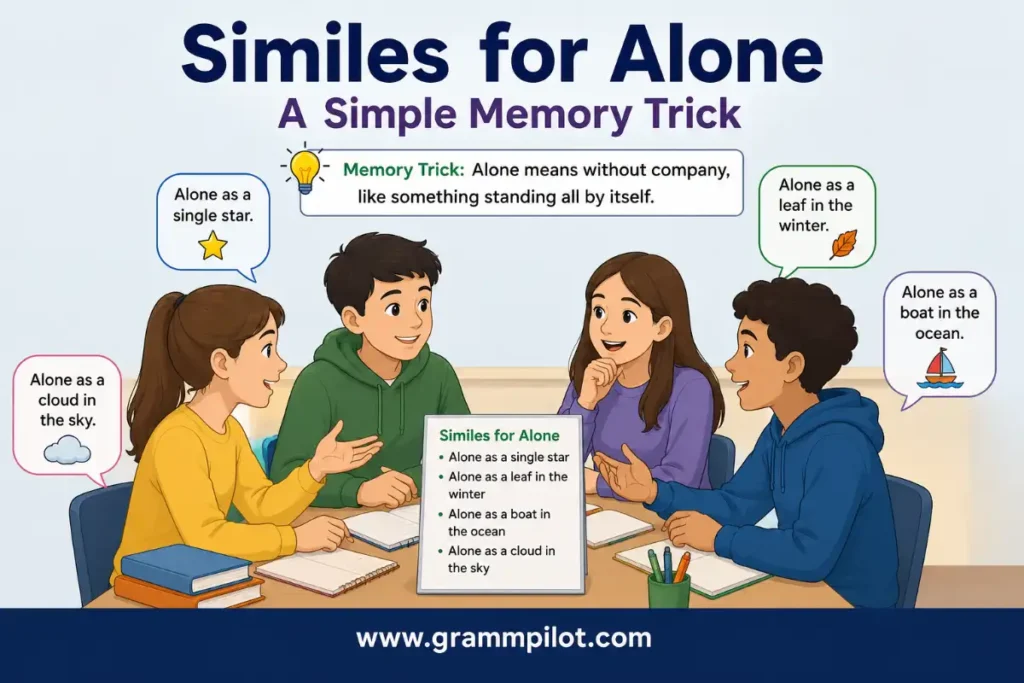
Similes for Alone: A Simple Memory Trick
Think about the different meanings of alone. Sometimes it means peace and quiet. often it means loneliness. Sometimes it means independence.
Ask yourself one simple question: What image best matches the feeling I want readers to imagine?
If the feeling is peaceful, choose some like:
- an empty beach
- calm water
- falling snow
- a quiet forest
If the feeling is lonely, choose content like:
- an island
- the last leaf
- a forgotten house
- a single star
Using this simple method will help you create original Similes for Alone that sound natural, meaningful, and memorable.
Conclusion
Using Similes for Alone is a simple way to make your writing more vivid, emotional, and memorable. Instead of repeating the word alone, you can create stronger images with comparisons such as as alone as an island, like a lone wolf, or as peaceful as an empty beach. The best similes match the feeling you want to express, whether it’s loneliness, quiet reflection, or confident independence.
Whether you’re writing a school essay, story, poem, speech, or social media caption, the right comparison helps readers picture your message and connect with it. Keep your similes natural, avoid overusing them, and choose images that fit the situation. With regular practice, Similes for Alone will become an easy and effective tool for making your writing more expressive and engaging.
Frequently Asked Questions
1. What are Similes for Alone?
Similes for Alone are comparisons that describe someone or something by itself using the words like or as. They help readers imagine feelings such as solitude, loneliness, or peaceful independence.
2. What is the best simile for being alone?
There isn’t one perfect simile for every situation. Popular choices include as alone as an island, like a lone wolf, as quiet as an empty room, and like the last leaf on a tree.
3. What’s another way to say someone is alone?
You can use words such as solitary, isolated, secluded, independent, by yourself, or on your own. A well-chosen simile can make the description even more vivid.
4. Can I use similes in school essays?
Yes. Similes make essays more interesting when they support your ideas naturally. Choose familiar comparisons that are easy for your readers to understand.
5. Are similes and metaphors the same?
No. A simile compares two things using like or as, while a metaphor describes one thing as another without using those comparison words.
6. Can I create my own similes?
Absolutely. Think of images that remind people of solitude, peace, or isolation, then connect them with like or as. Original similes often make your writing more memorable.
7. Why do writers use Similes for Alone?
Writers use Similes for Alone because they create stronger mental images, express emotions more clearly, and make stories, essays, and speeches more engaging.
–