
Have you ever paused while writing an email, school assignment, or craft tutorial because you weren’t sure about to write Gluing vs Glueing? You’re not alone. Many English learners and even native speakers wonder which spelling is correct. Since both words look reasonable, it’s easy to second-guess yourself. The good news is that the answer is simple. Understanding Gluing vs Glueing isn’t just about memorizing a spelling rule. It’s about learning how English forms verbs ending in -e before adding -ing. Once you know the pattern, you’ll be able to spell many similar words with confidence.
Answer Box:
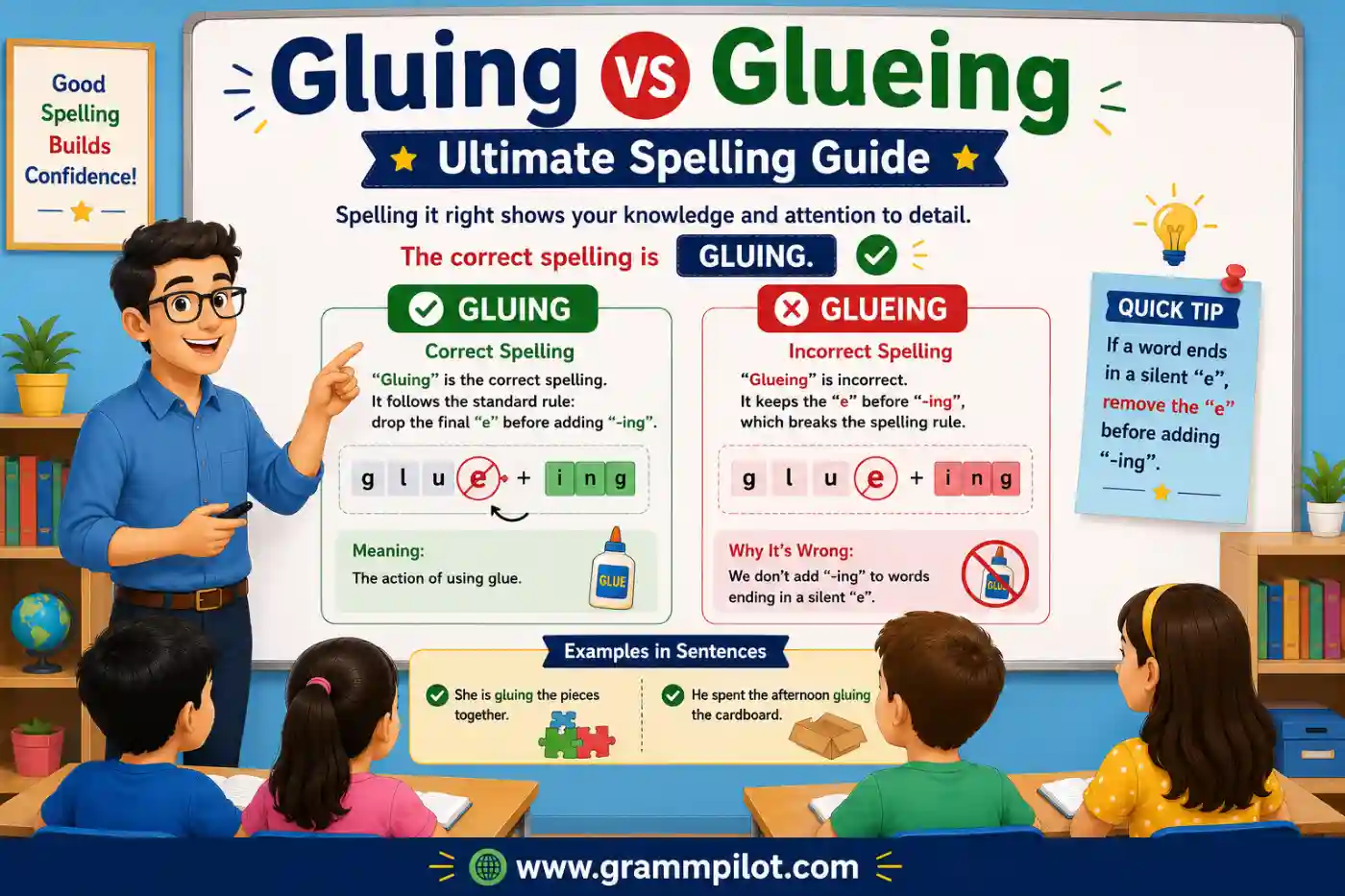
Gluing vs Glueing — gluing is the standard and correct spelling in modern English. Glueing is an older variant that appears occasionally but is rarely used today. In most writing, dictionaries and style guides recommend gluing.
In this complete guide, you’ll learn the meaning of both spellings, their word origin, why gluing became the preferred form, grammar rules, common mistakes, real-life examples, helpful comparison tables, and practical tips for choosing the correct spelling every time.
For a closer look at another confusing word pair, explore [Segway or Segue].
What Does “Gluing” Mean?
Before comparing Gluing vs Glueing, let’s understand the meaning of the word. Gluing is the present participle and gerund form of the verb glue. It means joining two or more objects together by using glue or another adhesive.
Examples:
- She is gluing the broken vase together.
- We spent the afternoon gluing pieces of cardboard for our science project.
- Dad is gluing the loose chair leg back into place.
The word can also be used figuratively.
Examples:
- Good communication is gluing the team together.
- Shared goals are gluing the community into a stronger group.
In both literal and figurative uses, gluing suggests bringing things together.
What Does “Glueing” Mean?
When discussing Gluing vs Glueing, many people assume glueing must be wrong because it looks unusual. In reality, glueing is an older spelling that appeared in some British publications and historical dictionaries. Today, however, it is much less common than gluing. Modern dictionaries generally list gluing as the preferred spelling, while glueing may appear as an alternative or historical form. For everyday writing, academic work, professional documents, and online content, gluing is the spelling most readers expect.
Quick Answer: Gluing vs Glueing
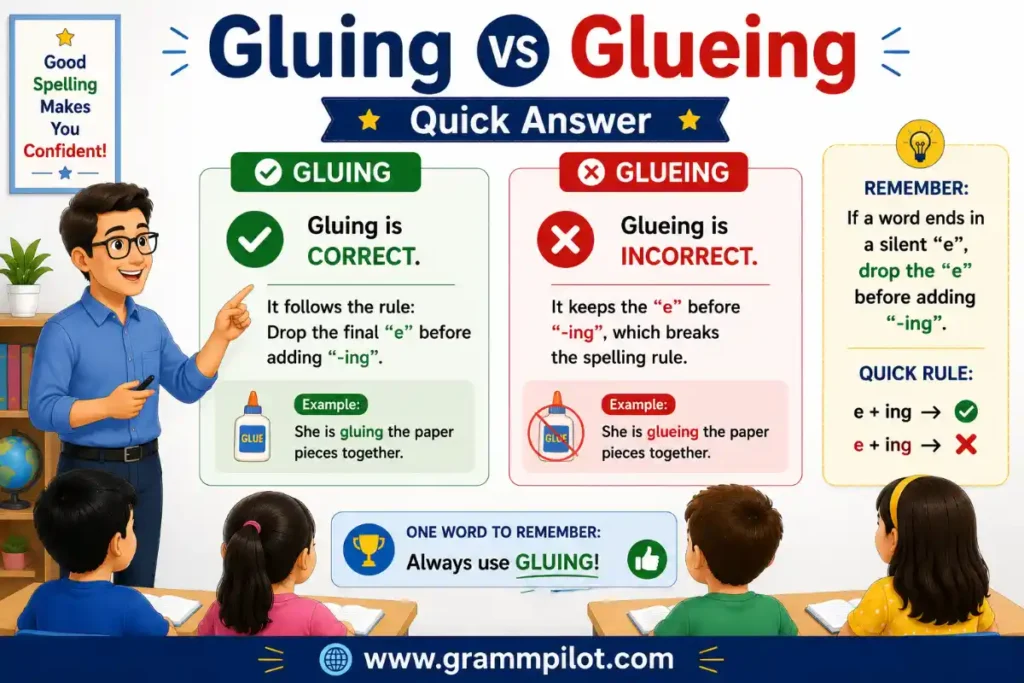
If you’re choosing between Gluing vs Glueing, here’s the simple answer.
| Spelling | Correct Today? | Notes |
|---|---|---|
| Gluing | ✅ Yes | Standard spelling in American and modern British English |
| Glueing | Less common | Older or alternative spelling seen occasionally |
For almost every situation, gluing is the safest and most widely accepted choice.
Word Origin of “Glue”
Understanding the history behind the word makes Gluing vs Glueing easier to remember. The noun glue comes from the Old French word glu, which referred to a sticky substance used for joining materials. That word traces back even further to the Latin word glus, meaning sticky matter. For centuries, glue was made from natural materials such as animal collagen before modern synthetic adhesives became common. As English developed, glue became both a noun and a verb.
Examples:
- I bought a bottle of glue. (noun)
- Please glue these papers together. (verb)
When English speakers needed the -ing form, the spelling gradually settled on gluing, although glueing continued to appear in some publications for many years.
Why Is “Gluing” Preferred?
Many learners ask why English drops the extra e in gluing but keeps it in other words. The answer comes from standard spelling patterns. Most verbs ending in a silent e drop that e before adding -ing.
Examples:
| Base Verb | Correct -ing Form |
|---|---|
| make | making |
| bake | baking |
| smile | smiling |
| dance | dancing |
| move | moving |
| glue | gluing |
Because glue follows this same pattern, gluing naturally became the standard spelling.
The older spelling glueing survives in limited historical use, but it no longer matches the preferred modern convention.
Why Do People Write “Glueing”?
The confusion behind Gluing vs Glueing usually comes from pronunciation. When people see gluing, they sometimes worry that readers may pronounce it incorrectly. Adding the extra e makes the word look closer to its pronunciation, which explains why glueing appeared in older texts. Another reason is that English spelling isn’t always accurately consistent. Some verbs ending in -e have unusual forms, causing learners to wonder if glue follows the same rule. Fortunately, modern dictionaries have made the choice much clearer. Today, gluing is overwhelmingly preferred in books, newspapers, educational materials, websites, and professional writing.
Is There a Difference in Meaning?
One of the biggest questions about Gluing vs Glueing is if the two spellings have different meanings. The answer is no.
Both spellings refer to exactly the same action:
- Joining materials with glue.
- Attaching objects using adhesive.
- Figuratively bringing people or ideas together.
The only real difference is spelling preference.
This means these sentences express the same idea.
- She is gluing the model airplane.
- She is glueing the model airplane.
Although both communicate the same meaning, the first sentence follows modern standard English.
When Should You Use “Gluing”?
In nearly every writing situation, choose gluing. It is the preferred spelling for:
- School assignments
- College essays
- Business emails
- Professional reports
- Books
- Newspapers
- Blogs
- Technical manuals
- Craft instructions
- Online articles
Using gluing helps your writing match modern English expectations and avoids distracting readers with an uncommon spelling.
Gluing vs Glueing: Side-by-Side Comparison
When comparing Gluing vs Glueing, the easiest way to understand the difference is to look at both spellings side by side.
| Feature | Gluing | Glueing |
|---|---|---|
| Modern spelling | ✅ Yes | Rarely used |
| American English | ✅ Standard | Uncommon |
| British English | ✅ Preferred | Occasionally seen in older texts |
| Recommended by modern dictionaries | ✅ Yes | Sometimes listed as a variant |
| Suitable for school writing | ✅ Yes | Not recommended |
| Suitable for business writing | ✅ Yes | Avoid if possible |
| Common online usage | Very common | Very rare |
| Meaning | Joining with glue | Same meaning |
The table shows that the debate over Gluing vs Glueing is about spelling preference rather than meaning. Both forms describe the same action, but gluing is the spelling readers expect today.
Grammar Rule Behind Gluing vs Glueing
The easiest way to remember Gluing vs Glueing is to understand the spelling rule. Many English verbs ending with a silent e drop that e before adding -ing.
Examples include:
| Base Verb | Correct -ing Form |
|---|---|
| bake | baking |
| make | making |
| smile | smiling |
| move | moving |
| dance | dancing |
| glue | gluing |
Following this rule makes gluing the standard spelling. Although glueing appeared in older writing, modern English generally follows the simpler form.
Why Does “Glueing” Still Appear?
Some people become confused about Gluing vs Glueing because they still see glueing from time to time. There are several reasons.
Older Books
Older dictionaries and printed books sometimes used glueing before spelling became more standardized.
Personal Preference
Some writers continue using glueing because they learned it years ago or prefer how it looks.
Historical Documents
Historical newspapers, manuals, and archived publications may contain the older spelling.
Internet Content
Some websites copy information from older sources, allowing glueing to continue appearing online. Even though you may still find it occasionally, gluing remains the better choice for modern writing.
Gluing vs Glueing in American and British English
Many spelling differences exist between American and British English, so people often wonder if this is another example. Here’s the answer.
American English
American English strongly prefers gluing. You’ll see this spelling in schools, newspapers, books, business documents, and style guides.
British English
Modern British English also prefers gluing. Although glueing appeared more often in older British publications, today’s dictionaries and publishers generally recommend gluing. This means Gluing vs Glueing is not really a US-versus-UK spelling difference anymore.
Gluing vs Glueing in Different Writing Situations
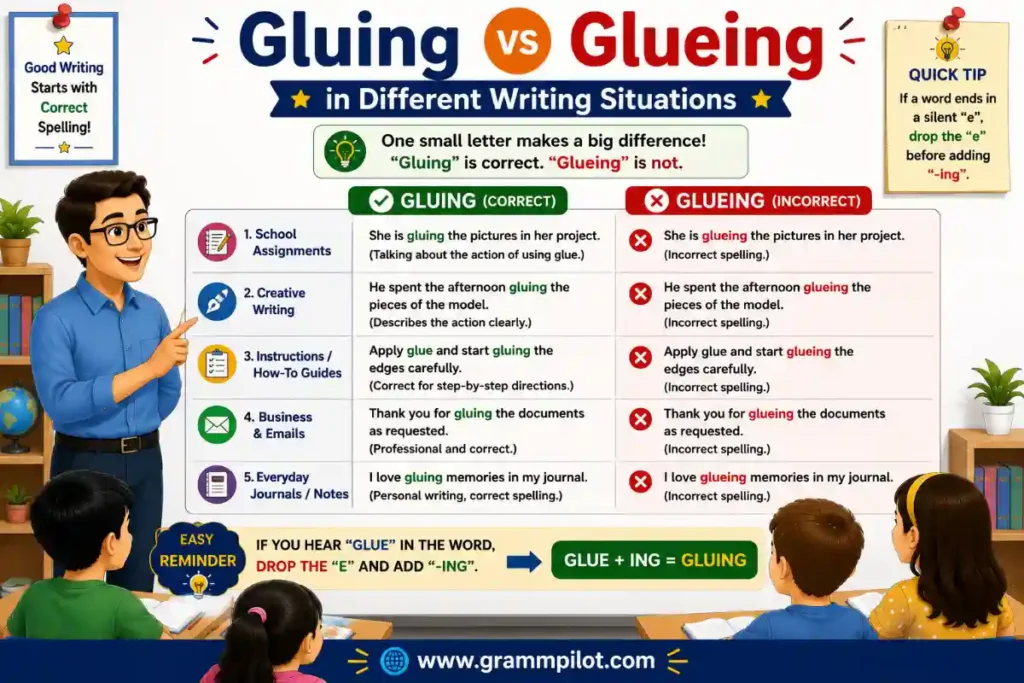
Choosing the correct spelling becomes easier when you think about your audience.
School Assignments
Always write gluing.
Example: The students are gluing colorful paper onto the poster board.
Business Emails
Professional writing should use gluing.
Example: The technician is gluing the damaged panel before painting it.
Craft Instructions
DIY articles and craft blogs almost always use gluing.
Example: Start by gluing the wooden pieces together.
Technical Manuals
Manufacturing and engineering documents also prefer gluing.
Example: Allow the adhesive to dry completely before gluing the next component.
Everyday Conversation
Most people naturally write gluing in text messages, emails, and social media posts.
Gluing vs Glueing: Real-Life Example Sentences
Reading complete sentences helps you understand Gluing vs Glueing more naturally.
Examples Using Gluing
- Olivia is gluing family photos into her scrapbook.
- Dad spent the afternoon gluing the broken chair together.
- We are gluing decorations onto the classroom wall.
- The children enjoyed gluing colorful shapes onto paper.
- He is gluing the model airplane before painting it.
- Mia finished gluing the puzzle pieces to the board.
- The repair shop is gluing the cracked plastic panel.
- She learned the proper way of gluing fabric to wood.
- They are gluing labels onto the storage boxes.
- Careful gluing makes the project stronger.
Examples Using Glueing
These examples show historical or less common usage.
- The old instruction manual described glueing wooden joints.
- An older newspaper mentioned workers glueing labels onto bottles.
- Some archived craft books discuss glueing paper decorations.
Although these sentences are understandable, modern writers would usually replace glueing with gluing.
Common Mistakes in Gluing vs Glueing
Many learners make similar mistakes when choosing between these spellings.
Mistake 1: Thinking Both Are Equally Common
While both spellings exist, they are not equally popular.
Correct: The children are gluing paper flowers together.
Mistake 2: Assuming “Glueing” Is More Correct
Some people believe adding the extra e makes the spelling more logical. Modern English disagrees. The preferred spelling is gluing.
Mistake 3: Mixing Both Spellings
Avoid switching between gluing and glueing in the same document. Choose one spelling and stay consistent. For modern writing, that spelling should almost always be gluing.
Quick Tips to Remember Gluing vs Glueing
These simple tricks make Gluing vs Glueing much easier to remember.
- Most verbs ending in silent e drop the e before adding -ing.
- Think of make → making and move → moving.
- Treat glue → gluing exactly the same way.
- If you’re writing for school, work, or publishing, always choose gluing.
- When in doubt, remember that modern dictionaries recommend gluing.
By following these tips, you’ll avoid one of the most common spelling mistakes involving the verb glue.
Gluing vs Glueing: Dictionary Guidance
If you’re still unsure about Gluing vs Glueing, the easiest solution is to check modern dictionaries. Most major dictionaries list gluing as the standard spelling used in current English. Some dictionaries also mention glueing as an alternative or historical variant, but they rarely recommend it for everyday writing. If you’re writing an academic paper, a business report, or a blog post, dictionaries and style guides consistently point to gluing as the preferred choice.
Gluing vs Glueing in Search Results
Many people search for Gluing vs Glueing because both spellings appear online. This can make it seem as though they are equally correct. In reality, most modern websites, educational resources, publishing companies, and grammar guides use gluing. The older spelling appears much less often and is usually found in archived material, scanned books, or older documents. If your goal is clear and modern English, gluing is the spelling your readers expect.
Gluing vs Glueing in Everyday Situations
Understanding how the word is used in real life makes the spelling easier to remember.
School Projects
Students spend hours gluing paper, cardboard, fabric, and craft materials.
Example: The class is gluing colorful stars onto the bulletin board.
Home Repairs
People often use glue for small repairs around the house.
Example: Dad is gluing the broken picture frame back together.
Arts and Crafts
Craft projects frequently include the verb gluing.
Example: She enjoys gluing beads onto handmade greeting cards.
Woodworking
Woodworkers depend on careful gluing to build strong furniture.
Example: The carpenter is gluing the table legs before attaching the screws.
Model Building
Many hobbyists spend hours gluing tiny plastic parts together.
Example: Leo is gluing the model train before painting it.
These everyday examples show why gluing appears much more often than glueing in modern writing.
Similar Spelling Rules
One of the best ways to master Gluing vs Glueing is to compare it with other English verbs.
| Base Verb | Correct Form |
|---|---|
| argue | arguing |
| value | valuing |
| continue | continuing |
| rescue | rescuing |
| queue | queueing / queuing* |
| glue | gluing |
Notice that glue follows the normal pattern by becoming gluing.
*Some words, such as queue, have accepted spelling variations because of pronunciation and historical usage. That exception often causes confusion, but it doesn’t change the preferred spelling of gluing.
Gluing vs Glueing: Common Questions
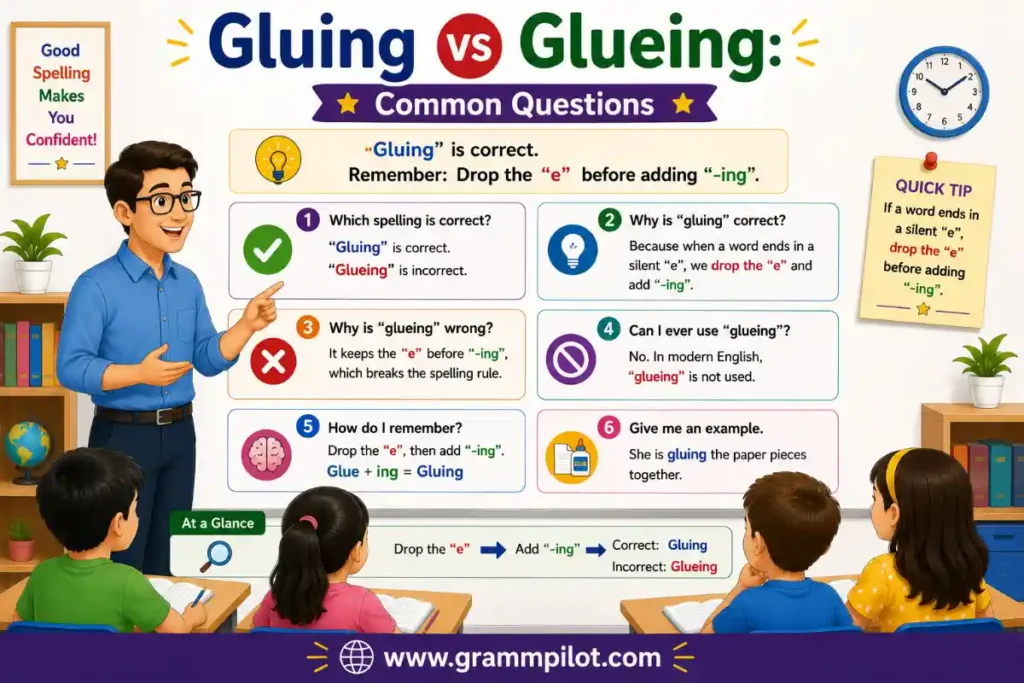
Many English learners ask the same questions when comparing Gluing vs Glueing.
Is “glueing” wrong?
Not completely. It has appeared in older publications and may still be recognized by some dictionaries. However, it isn’t the preferred spelling in modern English.
Will readers understand “glueing”?
Yes. Most readers will understand it because the meaning is obvious. Even so, many people may think it’s a spelling mistake because gluing is much more common.
Should students write “glueing”?
No. Students should normally use gluing, since that’s the spelling accepted by teachers, textbooks, and modern dictionaries.
Is “gluing” accepted worldwide?
Yes. Modern American English and modern British English both accept gluing as the standard spelling.
Gluing vs Glueing: Common Mistakes Writers Make
When discussing Gluing vs Glueing, several mistakes appear repeatedly.
Forgetting the Silent “E” Rule
Many learners remember the rule for words like making and baking, but forget to apply it to glue.
Remember:
- Make → Making
- Bake → Baking
- Smile → Smiling
- Glue → Gluing
Trusting Every Website
Some older websites still use glueing. Always check trusted dictionaries and reputable grammar resources before assuming an uncommon spelling is preferred.
Using Both Spellings Together
Don’t write one paragraph with gluing and another with glueing. Stay consistent throughout your document. For modern writing, consistency means using gluing every time.
Practice Exercise
Choose the correct answer.
1. Gluing vs Glueing: Which spelling is preferred in modern English?
A. Gluing
B. Glueing
Answer: A
2.Gluing vs Glueing: Which sentence is correct?
A. She is glueing the broken cup.
B. She is gluing the broken cup.
Answer: B
3. Which spelling should you use in a business report?
A. Glueing
B. Gluing
Answer: B
4. Which rule explains the preferred spelling “Gluing vs Glueing”?
A. Add -ing without changing the word.
B. Drop the silent e before adding -ing.
Answer: B
Memory Trick for Gluing vs Glueing
A simple memory trick can help you remember the correct spelling every time.
Think about these familiar words:
- Make → Making
- Bake → Baking
- Smile → Smiling
- Move → Moving
Now apply the same rule:
Glue → Gluing
If you remember one of these common verbs, you’ll also remember the correct answer to Gluing vs Glueing.
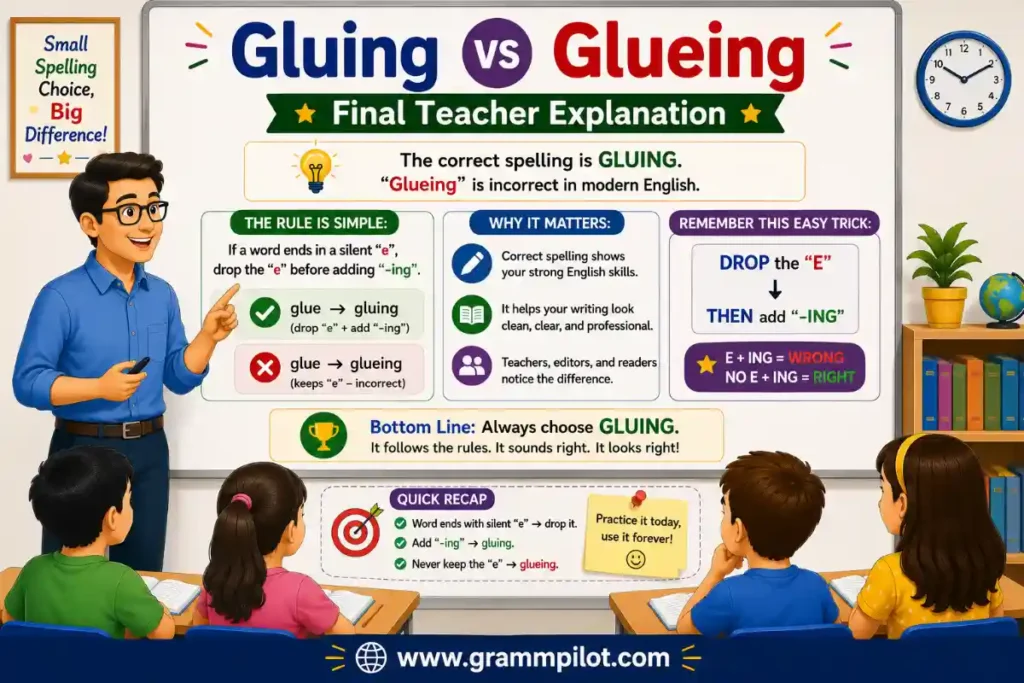
Final Teacher Explanation “Gluing vs Glueing”
The confusion around Gluing vs Glueing is understandable because both spellings have existed in English. However, language changes over time, and modern spelling conventions have become more consistent. Today, gluing is the spelling recommended for nearly every type of writing, from school assignments and business emails to books and websites.
When you learn the silent e rule instead of memorizing one word, you’ll improve your spelling across many other verbs as well. That’s a much more effective way to build confidence in English writing.
Final Answer
If you’re deciding between Gluing vs Glueing, the correct choice for modern English is gluing. It follows the standard spelling rule of dropping the silent e before adding -ing. Although glueing has appeared in older books and may still be listed as a historical or alternative spelling in some dictionaries, it is rarely used today. For school assignments, business writing, websites, blogs, and professional communication, gluing is the spelling you should use.
Conclusion
Understanding Gluing vs Glueing becomes much easier once you know the basic spelling rule. Most English verbs ending in a silent e drop that e before adding -ing, which is why gluing is the standard form. Instead of memorizing one word, remember the general pattern. It will help you spell many other English words correctly as well.
Whenever you write about crafts, home repairs, woodworking, school projects, or anything involving adhesive, choose gluing with confidence. It’s the spelling preferred by modern dictionaries, style guides, publishers, and teachers. By following this simple rule, you’ll avoid a common spelling mistake and make your writing look more polished and professional.
Frequently Asked Questions
1. Which is correct: gluing or glueing?
Gluing is the correct and preferred spelling in modern English. While glueing has been used in older publications, it is now considered an uncommon or historical variant.
2. Why is gluing spelled without the extra e?
The verb glue follows the standard English spelling rule that drops the silent e before adding -ing, just like make → making and smile → smiling.
3. Is glueing ever correct?
Yes, glueing has appeared in older books and may still be recognized by some dictionaries as a variant spelling. However, it is rarely recommended for modern writing.
4. Should I use gluing in school and professional writing?
Yes. Teachers, editors, publishers, and style guides recommend gluing for academic, business, and professional communication.
5. Is there a difference in meaning between gluing and glueing?
No. Both spellings describe the action of joining things together with glue. The difference is only in spelling preference.
6. Do American and British English use different spellings?
No. Modern American English and modern British English both generally prefer gluing over glueing.
7. How can I remember the correct spelling?
Think of similar verbs like make → making, move → moving, and smile → smiling. The same pattern gives you glue → gluing.