
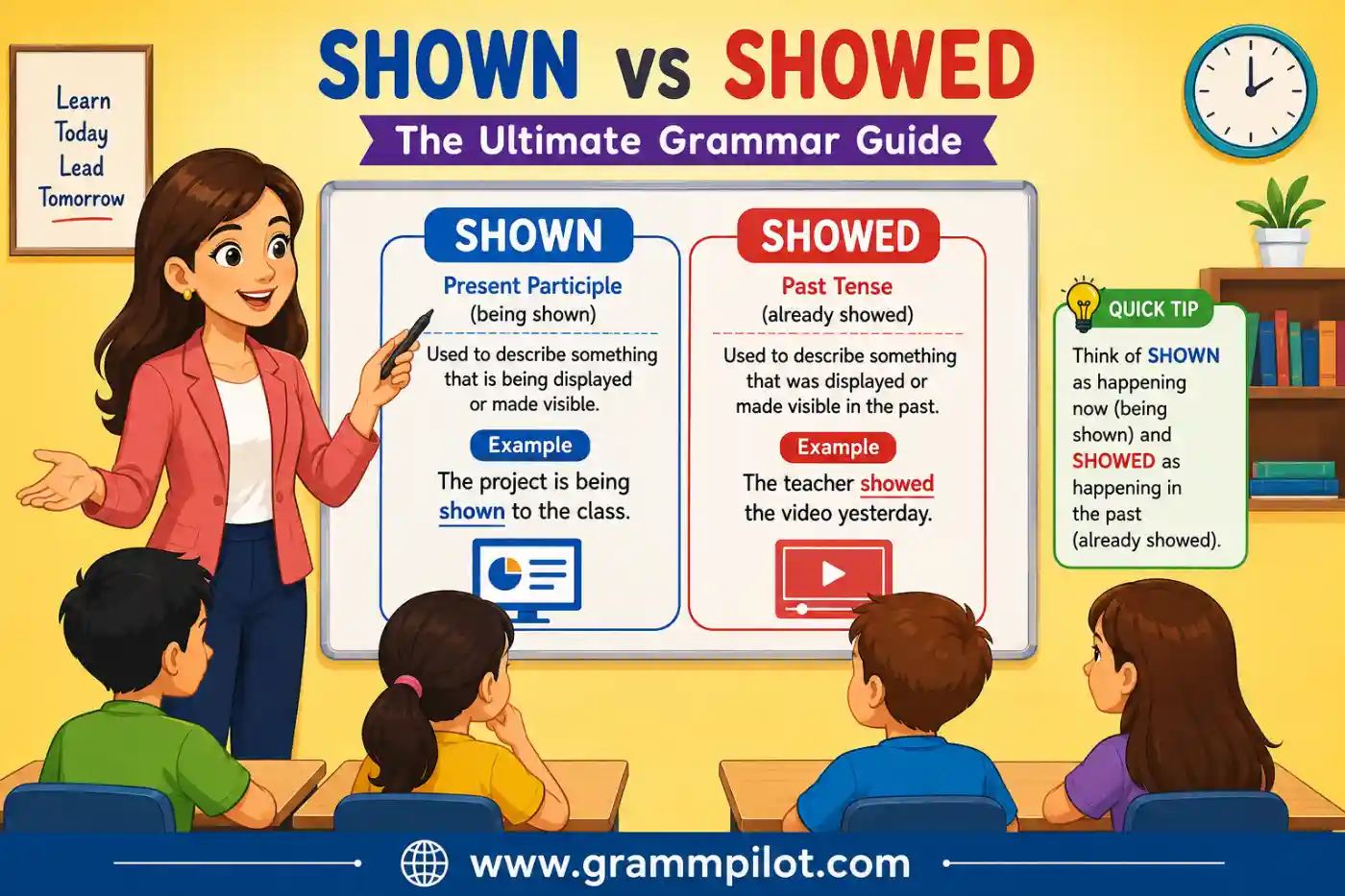
vvvHave you ever written an email, school essay, or text message and stopped because you weren’t sure about to use Shown vs Showed? This is one of the most common grammar questions because both words come from the verb show, but they are not used in the same way. Many English learners think these words can replace each other in every sentence. That’s understandable because they are closely related. However, English grammar gives each word a different job. Once you learn that rule, choosing the correct one becomes much easier.
Answer Box:
Showed is the simple past tense of show. Shown is the past participle and must be used with helping verbs like has, have, had, was, were, or been.
In this guide, you’ll learn the difference through easy grammar rules, word origins, comparison tables, real-life examples, common mistakes, and practical tips that help you use both forms correctly.
For another collection of creative expressions, explore [Similes for Crying].
What Is the Difference Between Shown vs Showed?
The difference depends on the verb tense.
| Word | Grammar Role | Correct Use |
|---|---|---|
| Showed | Simple past tense | ✅ Yes |
| Shown | Past participle | ✅ Yes (with a helping verb) |
Examples:
Correct:
- She showed me her new laptop.
- He has shown great improvement.
- They had shown the results before the meeting.
- The teacher has shown us the answer.
Incorrect:
- She has showed me the report.
- He had showed the documents.
After has, have, or had, always use shown, not showed.
Shown vs Showed Meaning in Plain English
Before studying grammar, let’s understand what these words mean. Both words come from the verb show, which means:
- to let someone see something
- to display
- to explain
- to guide
- to prove something
The meaning stays the same. Only the grammar changes.
What Does “Showed” Mean?
Showed describes an action that happened and finished in the past.
Examples:
- My friend showed me a funny video.
- The guide showed us the museum.
- Sarah showed her artwork yesterday.
- The coach showed the team a new strategy.
Each sentence talks about a completed past action.
What Does “Shown” Mean?
Shown is the past participle. It needs a helping verb.
Examples:
- She has shown great kindness.
- The results have shown steady growth.
- The movie had shown before we arrived.
- The documents were shown to the manager.
Without a helping verb, shown cannot stand alone as the main verb.
Word Origin of “Show”
Learning where the word comes from makes its grammar easier to remember. The verb show comes from Old English sceawian, meaning:
- to look at
- to inspect
- to display
- to reveal
Over time, English developed three principal forms.
| Verb Form | Word |
|---|---|
| Base form | show |
| Simple past | showed |
| Past participle | shown |
These three forms are still used in modern English. Unlike many regular verbs, show has an irregular past participle.
Compare these examples.
| Base | Past | Past Participle |
|---|---|---|
| write | wrote | written |
| drive | drove | driven |
| break | broke | broken |
| show | showed | shown |
This pattern explains why learners often confuse the two forms.
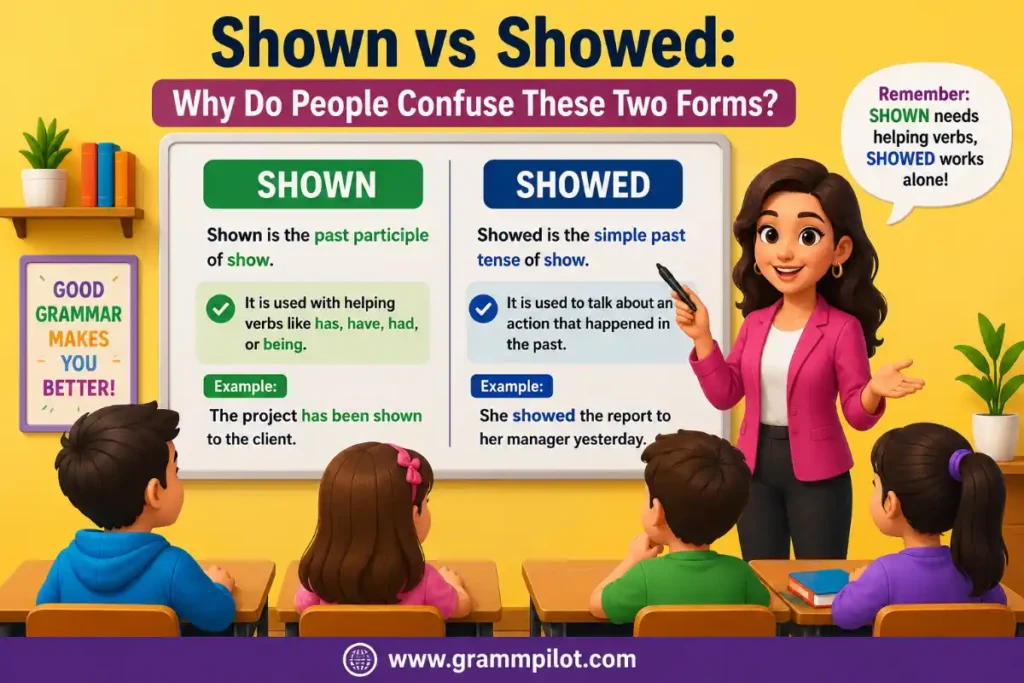
Shown vs Showed: Why Do People Confuse These Two Forms?
Several reasons make this grammar point difficult.
The Words Look Similar
Both words come from the same verb. Many learners naturally assume they work the same way. They don’t. Each belongs to a different tense.
Many English Verbs Are Irregular
Some verbs keep the same past and past participle.
Examples:
- worked
- played
- watched
Others change completely.
Examples:
- go → went → gone
- see → saw → seen
- show → showed → shown
That variety causes confusion.
Direct Translation Creates Errors
Some languages don’t have separate past participles. When learners translate directly into English, they often choose showed after has, which creates a grammar mistake.
Informal Writing Can Be Misleading
Social media posts sometimes contain sentences like: He has showed me. Although readers understand the meaning, standard English grammar requires: He has shown me.
Shown vs Showed: One Simple Rule to Remember
Here’s the easiest classroom rule.
If the sentence includes:
- has
- have
- had
- was
- were
- been
Use: shown
If there is no helping verb and the action simply happened in the past, use: showed
Examples:
- She showed me the letter.
- She has shown me the letter.
- They had shown the evidence.
- The teacher showed us the answer yesterday.
That one rule solves most grammar questions.
Understanding the Grammar Rule”Shown vs Showed”
The simple past and present accurate follow different sentence patterns.
Simple Past
Formula: Subject + showed + object
Examples:
- John showed me his passport.
- Emma showed her drawing.
- Dad showed us how to fish.
Present Perfect
Formula: Subject + has/have + shown
Examples:
- John has shown remarkable progress.
- Emma has shown great patience.
- Dad has shown us many useful skills.
Notice how shown always follows a helping verb.
Simple Past vs Present Perfect
Many learners mix these tenses.
| Simple Past | Present Perfect |
|---|---|
| showed | has shown |
| finished action | action connected to the present |
| often includes yesterday, last week, last year | often has no specific finished time |
Examples:
Simple past: She showed me the picture yesterday.
Present perfect: She has shown me that picture before.
The first sentence refers to a specific past time. The second connects the experience with the present.
Shown vs Showed: Quick Comparison Table
| Feature | Showed | Shown |
|---|---|---|
| Simple past | ✅ Yes | ❌ No |
| Past participle | ❌ No | ✅ Yes |
| Used after has/have/had | ❌ No | ✅ Yes |
| Used alone as the main verb | ✅ Yes | ❌ No |
| Accepted in formal writing | ✅ Yes | ✅ Yes (correct context) |
Keeping this table in mind makes the difference much easier to remember.
American English vs British English
Both American and British English follow exactly the same grammar rule.
American English
Correct:
- She showed me the receipt.
- She has shown me the receipt.
Incorrect: She has showed me the receipt.
British English
British English follows the same pattern.
Examples:
- The teacher showed us the experiment.
- The teacher has shown excellent teaching skills.
There is no regional difference between these two forms.
Related Words for “Show”
Learning related words helps expand your vocabulary while reducing repetition.
Everyday Alternatives
| Word | Meaning | Tone | Example |
|---|---|---|---|
| display | Put something on view | Everyday | The museum displayed old coins. |
| reveal | Make known | Everyday | The report revealed the truth. |
| present | Give or introduce | Everyday | She presented the award. |
| explain | Make something clear | Everyday | He explained the lesson. |
| demonstrate | Teach by showing | Everyday | The coach demonstrated the exercise. |
| point out | Direct attention to | Everyday | She pointed out the mistake. |
| introduce | Present someone | Everyday | He introduced his friend. |
| guide | Lead someone | Everyday | The volunteer guided visitors. |
Formal Alternatives
| Word | Meaning | Tone | Example |
|---|---|---|---|
| illustrate | Explain with examples | Formal | The graph illustrates the trend. |
| indicate | Point to something | Formal | The data indicates improvement. |
| exhibit | Display publicly | Formal | The gallery exhibited new artwork. |
| disclose | Reveal information | Formal | The company disclosed the results. |
| clarify | Make easier to understand | Formal | The speaker clarified the issue. |
| outline | Present the main points | Formal | She outlined the proposal. |
| verify | Confirm with evidence | Formal | The records verified the claim. |
| highlight | Draw attention to | Formal | The report highlighted the risks. |
More Related Words Grouped by Everyday Use
Learning similar words helps you write more naturally. While showed and shown have specific grammar roles, these related words can often express a similar idea depending on the sentence.
Simple and Everyday Alternatives
| Word | Meaning | Tone | Example |
|---|---|---|---|
| tell | Give information | Everyday | She told me the answer. |
| share | Let others see or know | Everyday | He shared his notes. |
| reveal | Make something known | Everyday | The photo revealed the damage. |
| uncover | Bring into view | Everyday | The report uncovered new facts. |
| expose | Make visible | Everyday | The sunlight exposed the colors. |
| teach | Help someone learn | Everyday | My dad taught me to drive. |
| guide | Lead someone | Everyday | The volunteer guided visitors. |
| prove | Show with evidence | Everyday | The results proved the idea. |
Formal Alternatives
| Word | Meaning | Tone | Example |
|---|---|---|---|
| demonstrate | Explain by example | Formal | The instructor demonstrated the process. |
| illustrate | Explain visually or with examples | Formal | The chart illustrates the difference. |
| present | Introduce formally | Formal | She presented the proposal. |
| exhibit | Display publicly | Formal | The museum exhibited rare paintings. |
| disclose | Reveal officially | Formal | The company disclosed its earnings. |
| communicate | Share information | Formal | The manager communicated the plan. |
| document | Record as evidence | Formal | The scientist documented each result. |
| emphasize | Give special importance | Formal | The teacher emphasized grammar rules. |
Informal Alternatives
| Word | Meaning | Tone | Example |
|---|---|---|---|
| flash | Show quickly | Informal | He flashed his ID card. |
| hand over | Give something to someone | Informal | She handed over the tickets. |
| bring out | Reveal or display | Informal | The discussion brought out new ideas. |
| put on display | Show publicly | Informal | The trophies were put on display. |
| let someone see | Allow viewing | Informal | She let me see the photos. |
| pull out | Take out to show | Informal | He pulled out his phone. |
| hold up | Raise so others can see | Informal | The student held up the poster. |
| pass around | Share with a group | Informal | The teacher passed around the worksheet. |
Related Words by Strength
Some words simply let people see something, while others suggest strong proof or clear evidence.
Mild
- tell
- share
- point out
- mention
- explain
Example: The teacher explained the homework.
Moderate
- show
- display
- present
- reveal
- demonstrate
Example: The scientist demonstrated the experiment.
Strong
- prove
- establish
- confirm
- verify
- disclose
Example: The new evidence proved his claim.
Selecting the right word makes your writing more accurate.
Related Words by Part of Speech “Shown vs Showed”
Understanding the grammar behind show helps you avoid tense mistakes.
| Part of Speech | Examples |
|---|---|
| Verb | show, reveal, display, demonstrate |
| Noun | display, presentation, proof, example |
| Adjective | visible, clear, obvious, demonstrated |
| Adverb | clearly, openly, publicly, visibly |
Remember these verb forms:
| Form | Word |
|---|---|
| Base | show |
| Present | show / shows |
| Past | showed |
| Past Participle | shown |
| Present Participle | showing |
Learning all five forms together makes grammar much easier.
Shown vs Showed: Which Form Works Best in Different Situations?
The correct choice depends on the tense, not the place where you’re writing.
In a Resume
Resumes often describe completed achievements.
Examples:
- Has shown strong leadership skills.
- Has shown consistent improvement in customer service.
- Has shown excellent communication abilities.
Avoid: Has showed leadership skills.
In School Essays
Academic writing should always use standard grammar.
Examples:
- The research showed positive results.
- The experiment has shown consistent improvement.
- The evidence has shown that exercise improves health.
Essays should use the correct tense based on the meaning.
In Business Emails
Professional communication should sound polished.
Examples:
- The report showed a steady increase in sales.
- Our data has shown positive customer feedback.
- The presentation showed the project timeline clearly.
- The survey has shown areas for improvement.
Choosing the correct verb form builds credibility.
In Text Messages
Casual writing often uses contractions but still follows standard grammar.
Examples:
- You’ve shown me this before.
- She showed me that yesterday.
- He’s shown amazing progress.
- They showed us the photos.
Even in informal messages, native speakers naturally distinguish between showed and shown.
In Everyday Conversation
Both forms are common because they serve different purposes.
Examples:
- My sister showed me her new bicycle yesterday.
- She’s shown great patience lately.
- The coach showed us a better technique.
- He’s shown real confidence this season.
Pay attention to the helping verb. If you hear has, have, or had, the next word should normally be shown.
Real-Life Examples
These examples show how the two forms work in different situations.
- My teacher showed us a new grammar rule yesterday.
- The guide showed visitors around the museum.
- Sarah has shown great improvement this year.
- The report has shown a steady rise in sales.
- Our coach showed us how to warm up properly.
- The movie has shown in several countries. (Better: has been shown when referring to screenings.)
- The doctor showed me the X-ray.
- The results have shown that practice improves performance.
- My grandfather showed me old family photographs.
- The company has shown strong financial growth.
- Emma showed her artwork to the class.
- The evidence has shown the claim was correct.
- Dad showed me how to change a tire.
- The survey has shown customers prefer online ordering.
- The speaker showed several useful examples during the presentation.
These examples demonstrate that showed usually refers to a completed past event, while shown appears with helping verbs to form accurate or passive constructions.
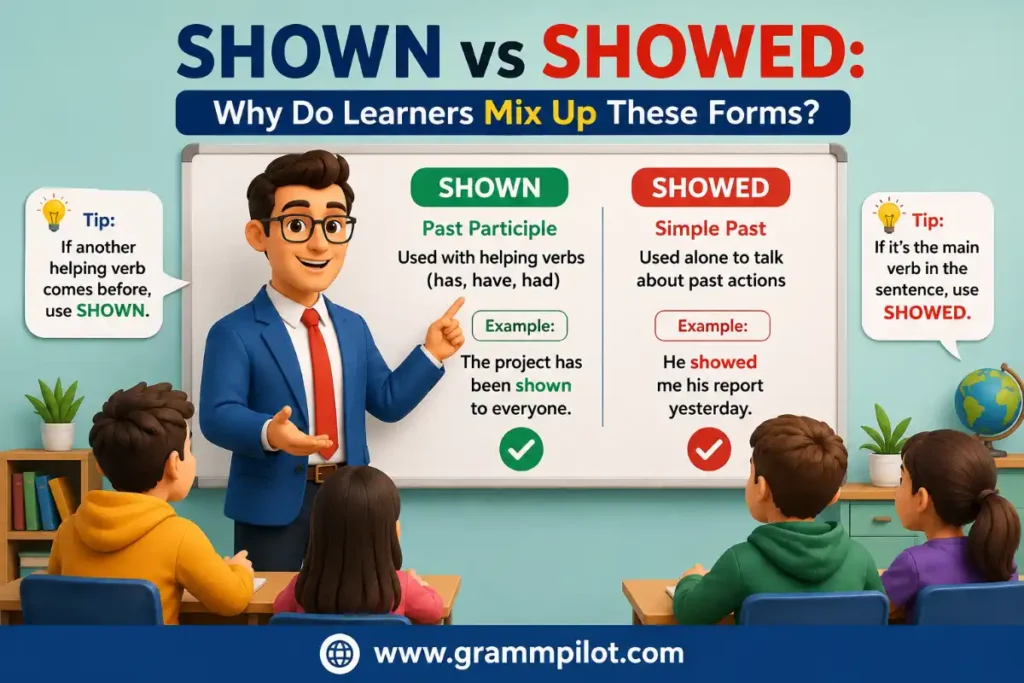
Shown vs Showed: Why Do Learners Mix Up These Forms?
Many English learners search for Shown vs Showed because irregular verbs don’t all follow the same pattern.
Compare these examples.
| Base | Past | Past Participle |
|---|---|---|
| write | wrote | written |
| drive | drove | driven |
| speak | spoke | spoken |
| break | broke | broken |
| show | showed | shown |
Since many regular verbs use the same form for both the past tense and past participle, learners sometimes assume showed should also follow has or have.
The easiest way to remember the correct forms is to memorize them together:
- show
- showed
- shown
Once these three forms become familiar, choosing the correct one becomes much more natural in speaking and writing.
Comparing Similar Verb Forms “Shown vs Showed”
Looking at similar verb patterns makes it much easier to understand when to use showed and when to use shown.
Showed vs Shown
This is the comparison that causes the most confusion.
| Showed | Shown |
|---|---|
| Simple past tense | Past participle |
| Used without a helping verb | Used with a helping verb |
| Describes a completed past action | Forms perfect and passive tenses |
Examples:
- She showed me her passport yesterday.
- She has shown me her passport before.
The first sentence talks about one completed event. The second connects a past action with the present.
Shown vs Been Shown
Both forms are correct, but they have different grammar patterns.
| Shown | Been Shown |
|---|---|
| Used after has, have, or had | Used in passive perfect structures |
| Active voice | Passive voice |
Examples:
- The company has shown steady growth.
- The results have been shown to be accurate.
The second sentence focuses on what happened to the results rather than who performed the action.
Showed vs Was Showing
These forms describe different kinds of past actions.
| Showed | Was Showing |
|---|---|
| Finished past action | Action in progress in the past |
Examples:
- The teacher showed us a map.
- The teacher was showing us a map when the bell rang.
Choose the tense that matches the timeline.
Showed vs Has Demonstrated
Sometimes another verb works better.
| Showed | Has Demonstrated |
|---|---|
| Everyday English | More formal |
| Common in conversation | Common in reports and academic writing |
Examples:
- The coach showed us a new drill.
- The research has demonstrated clear benefits.
The meaning is similar, but the tone is different.
Shown vs Revealed
These words are related but not identical.
| Shown | Revealed |
|---|---|
| Made visible or known | Made previously hidden information known |
| General meaning | Often stronger or more dramatic |
Examples:
- The chart has shown steady progress.
- The investigation revealed new evidence.
Pick the word that best matches your meaning.
Shown vs Showed: Common Grammar Mistakes
Learning the most common mistakes helps you avoid them.
Mistake 1: Using “Showed” After “Has”
Incorrect: She has showed me the report.
Correct: She has shown me the report.
The helping verb requires the past participle.
Mistake 2: Using “Shown” Without a Helping Verb
Incorrect: She shown me the answer yesterday.
Correct: She showed me the answer yesterday.
The simple past does not need a helping verb.
Mistake 3: Mixing Past Tenses
Incorrect: Yesterday he has shown me his project.
Correct: Yesterday he showed me his project.
Or: He has shown me his project before.
A finished time expression like yesterday normally takes the simple past.
Mistake 4: Memorizing Only Two Verb Forms
Many learners remember:
- show
- showed
They forget the third form: shown
Learning all three forms together prevents many grammar errors.
Mistake 5: Copying Incorrect English Online
You may occasionally read sentences like: She has showed me everything. Although this appears on social media, it is not standard English. Formal writing should always use shown after has, have, or had.
Quick Tips for Choosing the Correct Form”Shown vs Showed”
Keep these reminders in mind whenever you write.
- Look for a helping verb first.
- After has, have, or had, choose shown.
- Use showed for completed past actions.
- Learn irregular verbs in all three forms.
- Read your sentence aloud before submitting it.
- Check if the action happened at a specific past time.
- Avoid copying grammar mistakes from informal websites.
- Practice with real sentences instead of isolated word lists.
- Proofread important emails and assignments.
- When unsure, remember the pattern: show – showed – shown.
Shown vs Showed: Practice Sentences
Complete each sentence with the correct form.
1. My teacher ________ us a useful writing tip yesterday.
Correct answer: showed
2. She has ________ excellent leadership throughout the project.
Correct answer: shown
3. The guide ________ visitors around the castle last weekend.
Correct answer: showed
4. The research has ________ positive results over several years.
Correct answer: shown
5. Dad ________ me how to repair the bicycle yesterday.
Correct answer: showed
6. The manager has ________ confidence in the new team.
Correct answer: shown
7. Our coach ________ us a different strategy before the match.
Correct answer: showed
8. The report has ________ a steady increase in customer satisfaction.
Correct answer: shown
9. Emily ________ her science project to the class on Friday.
Correct answer: showed
10. The latest survey has ________ that more people prefer online learning.
Correct answer: shown
Practicing with complete sentences is one of the fastest ways to master these verb forms. Instead of memorizing grammar rules alone, pay attention to if the sentence includes a helping verb or refers to a completed past action. That habit will help you choose the correct form naturally in conversations, school assignments, business writing, and everyday English.
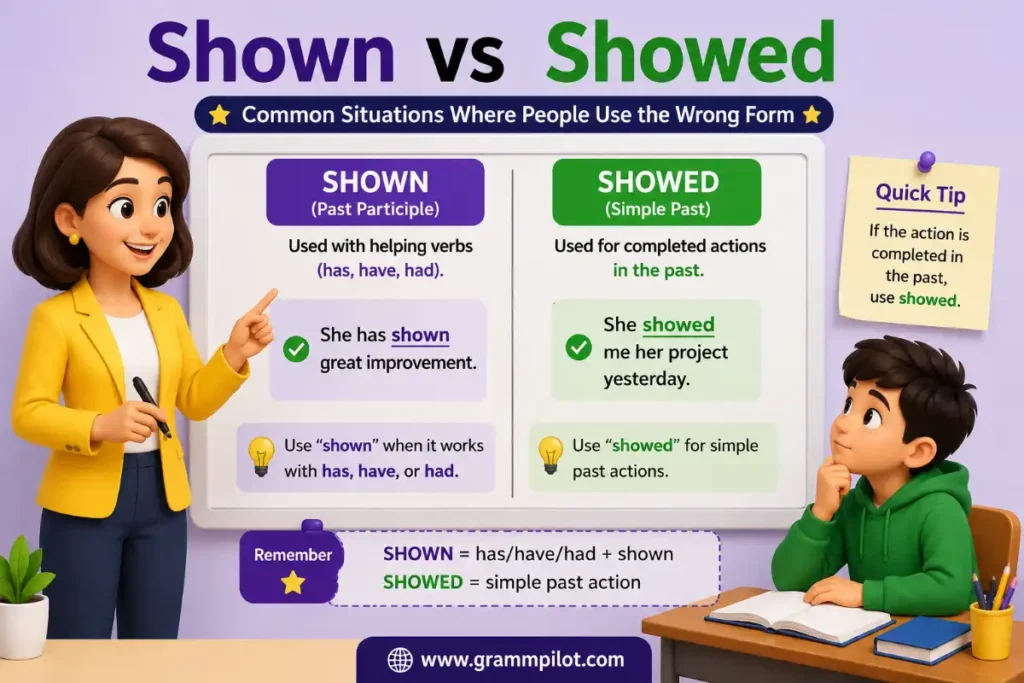
Common Situations Where People Use the Wrong Form
Learning the rule is only the first step. Seeing how these verb forms appear in real situations makes them much easier to remember.
While Writing Emails
Professional emails should use standard grammar.
Correct:
- She showed me the updated schedule yesterday.
- The report has shown positive results.
Incorrect:
- She has showed me the updated schedule.
- The report has showed positive results.
Always use shown after has, have, or had.
During School Assignments
Teachers expect the correct verb tense.
Correct:
- The experiment showed a clear change.
- The research has shown that regular practice improves learning.
Incorrect: The research has showed positive results.
Using the correct verb form makes your writing more accurate and professional.
In Workplace Reports
Reports often describe completed work or ongoing results.
Examples:
- The data showed a seasonal increase.
- The survey has shown consistent customer satisfaction.
- The presentation showed last quarter’s performance.
- The analysis has shown several improvement opportunities.
Choose the tense based on the meaning of the sentence.
In Everyday Conversations
Native speakers naturally switch between the two forms.
Examples:
- My brother showed me his new bicycle.
- She’s shown amazing progress this year.
- Dad showed us an old family photo.
- They’ve shown great teamwork.
Listening to real conversations helps reinforce the pattern.
Related Antonyms
Sometimes you need the opposite meaning instead of a similar one.
| Word or Phrase | Meaning |
|---|---|
| hide | Keep out of sight |
| conceal | Prevent others from seeing |
| cover | Place something over another object |
| withhold | Refuse to share information |
| disguise | Change appearance to avoid recognition |
| obscure | Make difficult to see or understand |
| mask | Hide or cover |
| suppress | Keep something from being revealed |
Opposite Expressions in Context
Depending on the sentence, these expressions may fit better.
- hid the evidence
- concealed the truth
- covered the sign
- withheld the report
- disguised the object
- obscured the view
- masked the problem
- suppressed the information
Choosing the correct opposite helps make your writing more precise.
Shown vs Showed: Quick Tips for Remembering the Difference
These simple reminders can help you avoid mistakes.
- Use showed for the simple past tense.
- Use shown after has, have, or had.
- Learn irregular verbs in all three forms.
- Check if the sentence has a helping verb.
- Read your sentence aloud before submitting it.
- Practice with real examples every day.
- Ignore incorrect grammar you may see online.
- Proofread school assignments and business emails.
- Remember the pattern: show – showed – shown.
- When unsure, look for the helping verb first.
Final Teacher Explanation
Imagine a student asks: “Should I use showed or shown?”
The answer depends on the sentence structure. Use showed when you’re talking about a completed action in the simple past.
Examples:
- The teacher showed us a new lesson.
- My friend showed me a funny video.
Use shown after helping verbs like has, have, or had.
Examples:
- The teacher has shown us many useful techniques.
- My friend has shown great kindness.
The easiest way to remember the rule is to learn the three principal forms together:
- show
- showed
- shown
Once these become familiar, choosing the correct form feels natural.
Final Answer
Here’s the easiest rule to remember:
- Showed ✅ Correct as the simple past tense.
- Shown ✅ Correct as the past participle after has, have, or had.
- Has showed ❌ Incorrect in standard English.
- Has shown ✅ Correct.
Whenever you see a helping verb, choose shown. If you’re describing a completed past action without a helping verb, choose showed.
Conclusion
Understanding Shown vs Showed becomes much easier once you know the role each word plays. Showed is the simple past tense and describes an action that happened at a specific time in the past. Shown is the past participle and must be used with helping verbs such as has, have, had, is, was, or been. Keeping this difference in mind will help you write clearer, more accurate English in every situation.
Instead of memorizing isolated grammar rules, remember the complete verb pattern: show – showed – shown. Then check if your sentence includes a helping verb. With regular practice and careful proofreading, choosing the correct form will soon become automatic in conversations, emails, essays, and professional writing.
Frequently Asked Questions
1. What is the difference between Shown vs Showed?
Showed is the simple past tense, while shown is the past participle. Use shown after helping verbs like has, have, and had.
2. Is “has showed” correct?
No. Standard English uses has shown, not has showed.
3. When should I use “showed”?
Use showed for completed past actions without a helping verb.
Example: She showed me the new design yesterday.
4. When should I use “shown”?
Use shown after helping verbs or in passive constructions.
Example: The results have shown steady improvement.
5. What’s another way to say “show”?
Depending on the context, you can use display, reveal, present, demonstrate, explain, illustrate, indicate, or highlight.
6. Do American and British English use different rules?
No. Both American English and British English follow the same grammar rule for showed and shown.