

Have you ever written an email, school assignment, or social media post and paused because you weren’t sure about to write Has Run vs Has Ran? You’re not alone. Many English learners mix up these two phrases because both include the verb run, but only one is grammatically correct. The confusion usually happens because English verbs can change form in different tenses. Since run and ran look similar, it’s easy to think they can both follow has. However, English grammar follows a clear rule that makes the correct choice simple once you understand it.
Answer Box:
Has run is correct because run is the past participle of run. Has ran is incorrect because ran is the simple past tense, not the past participle.
In this guide, you’ll learn the difference through simple grammar rules, word origins, real-life examples, common mistakes, comparison tables, and practical tips that make choosing the correct form easy.
This rule connects closely with the grammar explained in [Shown vs Showed].
What Is the Difference Between Has Run vs Has Ran?
The main difference is the verb form that follows has.
| Phrase | Grammar | Correct? |
|---|---|---|
| Has run | Present Perfect tense | ✅ Yes |
| Has ran | Incorrect verb form | ❌ No |
Look at these examples.
Correct:
- She has run three marathons.
- My brother has run this business for ten years.
- The dog has run into the yard.
Incorrect:
- She has ran three marathons.
- My brother has ran this business for ten years.
The helping verb has always requires the past participle, not the simple past tense.
Has Run vs Has Ran Meaning in Plain English
Before studying grammar, it’s helpful to understand what these phrases are trying to express.
What Does “Has Run” Mean?
Has run means someone completed an action at an unspecified time in the past or began an action in the past that still matters now.
Examples:
- She has run every morning this week.
- The company has run successfully for many years.
- He has run several charity events.
- My computer has run without problems all day.
Each sentence connects a past action with the present.
What About “Has Ran”?
Many learners use has ran, but it isn’t correct in standard English grammar. English requires the past participle after has.
Correct: He has run five miles.
Incorrect: He has ran five miles.
Although native speakers may occasionally make this mistake in casual speech, it should be avoided in speaking and writing.
Word Origin of “Run”
Learning a little history makes this grammar rule easier to remember. The verb run comes from Old English and has existed for hundreds of years. Over time, English kept three important forms:
| Verb Form | Word |
|---|---|
| Base form | run |
| Simple past | ran |
| Past participle | run |
Notice something important.
The base form and the past participle are the same.
That pattern causes confusion because many English verbs have different endings.
Examples:
| Base | Past | Past Participle |
|---|---|---|
| eat | ate | eaten |
| write | wrote | written |
| drive | drove | driven |
| run | ran | run |
Because run returns as the past participle, learners often mistakenly choose ran after has.
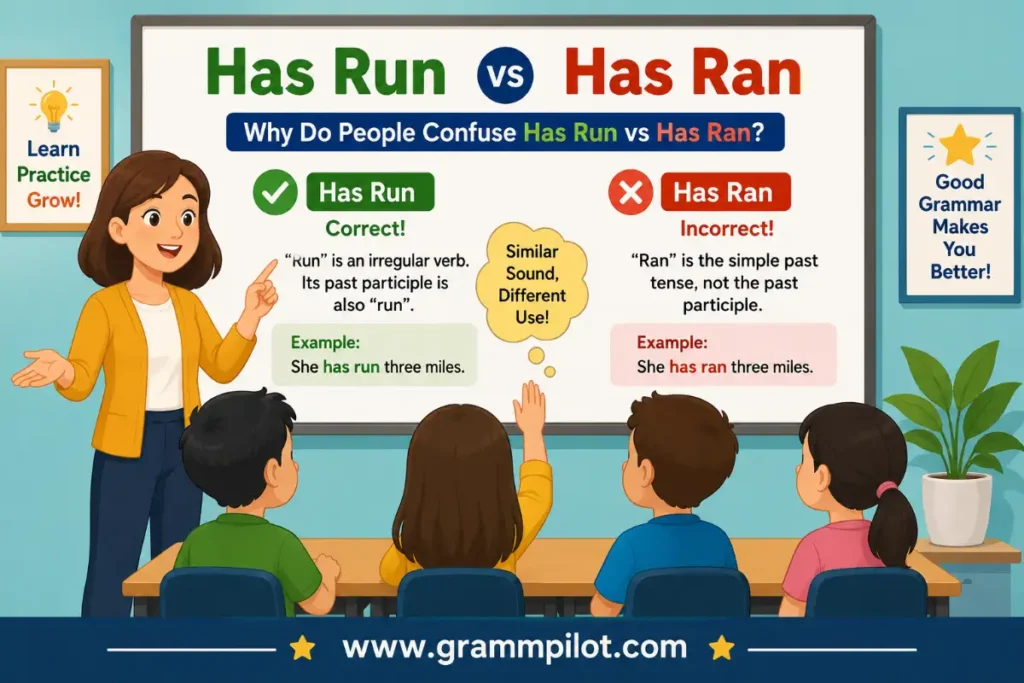
Has Run vs Has Ran: Why Do People Confuse Has Run vs Has Ran?
Several reasons explain why this mistake is so common.
The Past Forms Look Similar
Many learners assume the simple past and the past participle are always identical. That isn’t true.
Examples:
- go → went → gone
- see → saw → seen
- write → wrote → written
- run → ran → run
The third form matters after has, have, and had.
Other Verbs Follow Different Patterns
English verbs don’t all follow one rule. Compare these examples.
- She has eaten breakfast.
- They have written a report.
- He has gone home.
- She has run five miles.
Because every verb changes differently, learners sometimes guess instead of remembering the correct form.
Direct Translation Causes Errors
Some languages don’t use separate past participles. As a result, learners often translate directly into English and accidentally choose ran instead of run.
Informal Speech Can Be Misleading
You may occasionally hear someone say has ran in casual conversation. That doesn’t make it correct. Standard English still requires has run.
Has Run vs Has Ran: The One Simple Rule to Remember
Here’s the easiest classroom rule.
Whenever you see:
- has
- have
- had
Use the past participle.
Examples:
- has run
- have run
- had run
Never write:
- has ran
- have ran
- had ran
This one rule solves the problem almost every time.
Grammar Rule Explained Simply
The present perfect tense has two parts.
- A helping verb.
- A past participle.
Formula: Subject + has/have + past participle
Examples:
- She has finished.
- They have arrived.
- He has written.
- The athlete has run.
Notice that every sentence ends with a past participle.
Present Perfect vs Simple Past
Many learners mix these tenses.
| Present Perfect | Simple Past |
|---|---|
| has run | ran |
| have run | ran |
| action connected to the present | action finished in the past |
Examples:
Present perfect: She has run five races.
Simple past: She ran five races last year.
The second sentence mentions a finished time.
The first sentence does not.
Quick Comparison Table
| Feature | Has Run | Has Ran |
|---|---|---|
| Standard English | ✅ Yes | ❌ No |
| Present perfect | ✅ Yes | ❌ No |
| Uses past participle | ✅ Yes | ❌ No |
| Accepted in formal writing | ✅ Yes | ❌ No |
| Accepted in school essays | ✅ Yes | ❌ No |
| Recommended in business writing | ✅ Yes | ❌ No |
Keeping this table in mind makes the correct choice much easier.
Does American and British English Use Different Rules?
No.
Both American English and British English follow the same grammar rule.
American English
Correct:
- She has run every day this month.
- He has run the company since 2020.
Incorrect: She has ran every day this month.
British English
The rule stays exactly the same.
Correct:
- He has run several successful campaigns.
- The train has run on time today.
Neither variety of English accepts has ran as standard grammar.
Synonyms Related to “Run”
Although run changes meaning depending on the sentence, these related words can sometimes replace it.
Everyday Alternatives
| Word | Meaning | Tone | Example |
|---|---|---|---|
| jog | Run slowly | Everyday | She jogs every morning. |
| sprint | Run very fast | Everyday | He sprinted to the finish line. |
| race | Compete by running | Everyday | They raced home after school. |
| hurry | Move quickly | Everyday | We hurried to catch the bus. |
| dash | Run quickly | Everyday | She dashed across the field. |
| rush | Move fast | Everyday | Everyone rushed outside. |
| travel | Move from place to place | Everyday | The train travels daily. |
| move | Change position | Everyday | The river moves south. |
Formal Alternatives
| Word | Meaning | Tone | Example |
|---|---|---|---|
| operate | Manage or function | Formal | She operates the business. |
| manage | Control or direct | Formal | He manages the department. |
| administer | Direct an organization | Formal | They administer the program. |
| conduct | Carry out | Formal | Scientists conducted research. |
| supervise | Oversee work | Formal | She supervises the team. |
| direct | Lead or control | Formal | He directs the company. |
| coordinate | Organize activities | Formal | They coordinated the event. |
| oversee | Monitor and manage | Formal | She oversees daily operations. |
Synonyms Related to “Run” Grouped by Everyday Use
Expanding your vocabulary helps you avoid repetition while improving your English. Depending on the meaning of run, different words may fit better in different situations.
Simple and Everyday Synonyms
| Word | Meaning | Tone | Example |
|---|---|---|---|
| jog | Run at a slow pace | Everyday | She jogs before breakfast. |
| sprint | Run very fast | Everyday | The athlete sprinted to the finish line. |
| race | Compete by running | Everyday | They raced around the track. |
| hurry | Move quickly | Everyday | We hurried to catch the train. |
| dash | Run suddenly and quickly | Everyday | He dashed across the parking lot. |
| rush | Move with speed | Everyday | Everyone rushed toward the exit. |
| walk quickly | Move faster than normal | Everyday | She walked quickly to school. |
| move | Change position | Everyday | The children moved toward the playground. |
Formal Synonyms
| Word | Meaning | Tone | Example |
|---|---|---|---|
| operate | Function or manage | Formal | She operates the family business. |
| manage | Control or supervise | Formal | He manages two offices. |
| administer | Be responsible for | Formal | They administer the scholarship program. |
| supervise | Oversee work | Formal | She supervises new employees. |
| conduct | Carry out | Formal | The team conducted several tests. |
| direct | Lead an activity | Formal | He directs the marketing department. |
| oversee | Monitor operations | Formal | She oversees daily production. |
| coordinate | Organize tasks | Formal | They coordinated the event successfully. |
Informal Alternatives
| Word | Meaning | Tone | Example |
|---|---|---|---|
| zip | Move very fast | Informal | The kids zipped across the yard. |
| bolt | Run away suddenly | Informal | The dog bolted through the gate. |
| take off | Leave quickly | Informal | He took off after class. |
| speed off | Leave at high speed | Informal | The car sped off immediately. |
| hurry up | Move faster | Informal | Hurry up or we’ll be late. |
| make a run for it | Escape quickly | Informal | They made a run for it. |
| rush over | Come quickly | Informal | She rushed over to help. |
| fly | Move very fast | Informal | Time flies during vacations. |
Related Words by Intensity
Some words describe gentle movement, while others show speed or urgency.
Mild Movement
- walk quickly
- move
- jog
- stroll faster
- travel
Example: She jogged around the neighborhood before work.
Moderate Speed
- run
- hurry
- rush
- race
- trot
Example: The students hurried to class after lunch.
Strong Speed
- sprint
- dash
- bolt
- fly
- speed
Example: The runner sprinted toward the finish line.
Choosing the right word helps readers picture the action more clearly.

Related Words by Part of Speech”Has Run vs Has Ran”
Understanding how run works in grammar makes it easier to use the correct verb form.
| Part of Speech | Examples |
|---|---|
| Verb | run, jog, sprint, race |
| Noun | run, race, sprint, journey |
| Adjective | running, active, fast |
| Adverb | quickly, rapidly, swiftly |
Remember these grammar points.
- Run is the base form.
- Ran is the simple past.
- Run is also the past participle.
- Has always needs the past participle.
Has Run vs Has Ran: Which Form Works Best in Different Situations?
The correct verb tense depends on where you’re writing.
In a Resume
Most resumes describe completed experience.
Examples:
- Has managed a sales team for five years.
- Has led multiple successful projects.
If you use the verb run, write: Has run several community programs.
Never write: Has ran several community programs.
In School Essays
Academic writing follows standard grammar.
Examples:
- The company has run successfully since 2010.
- The experiment has run without interruption.
- She has run every race this season.
Using the correct verb form improves your writing score.
In Business Emails
Professional communication should always use standard English.
Examples:
- The system has run smoothly all week.
- Our team has run several successful campaigns.
- The software has run without errors.
- The meeting has run longer than expected.
Complete grammar creates a professional impression.
In Text Messages
People often use contractions and shorter sentences.
Examples:
- She’s run five miles already.
- He’s run out of time.
- It’s run perfectly today.
- They’ve run into traffic.
Even in casual messages, native speakers still use the correct past participle.
In Everyday Conversation
Native speakers naturally choose has run instead of has ran.
Examples:
- My brother has run three marathons.
- The washing machine has run all morning.
- The store has run out of milk.
- She has run this club for years.
The correct form sounds natural because it follows English grammar rules.
Real-Life Examples”Has Run vs Has Ran”
Seeing the correct form in different situations makes the rule easier to remember.
- She has run every morning this month.
- My father has run his own business since 2015.
- The printer has run without problems today.
- Our school has run this program for years.
- The children have run around the park all afternoon.
- He has run five charity races.
- The engine has run quietly since the repair.
- Sarah has run several successful workshops.
- The company has run online classes since last summer.
- Their team has run many community events.
- My phone has run accurately after the update.
- The coach has run hundreds of training sessions.
- The restaurant has run special discounts this week.
- The volunteers have run food drives every winter.
- The factory has run continuously for decades.
Notice that every example uses the past participle run after has or have.
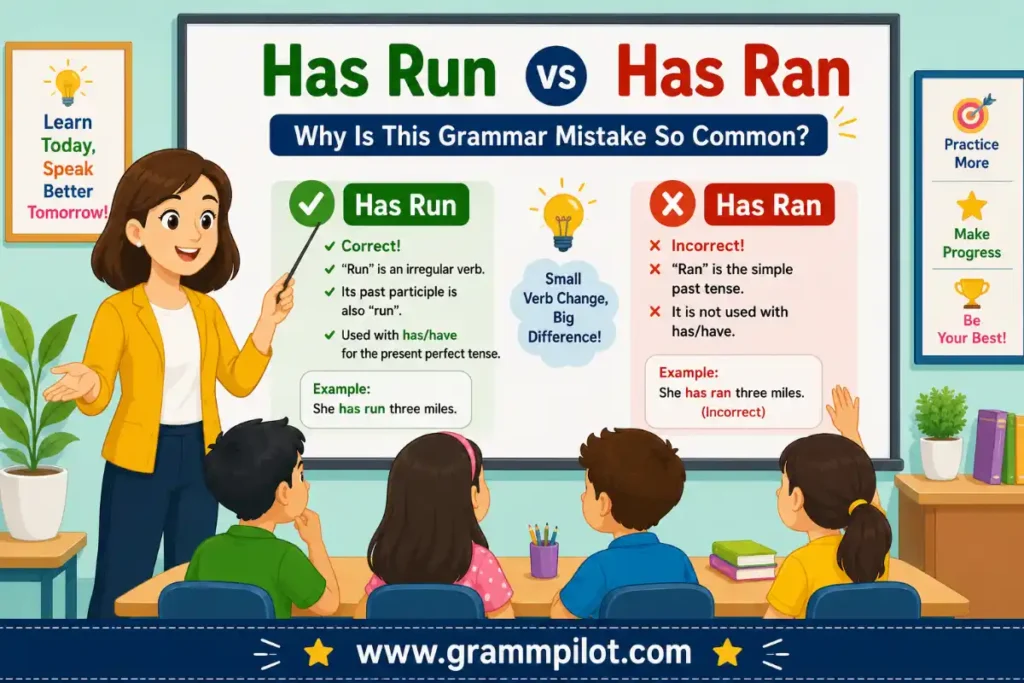
Why Is This Grammar Mistake So Common?
Many learners search for Has Run vs Has Ran because irregular verbs do not follow one simple pattern.
Consider these examples.
| Base | Past | Past Participle |
|---|---|---|
| go | went | gone |
| see | saw | seen |
| break | broke | broken |
| drive | drove | driven |
| run | ran | run |
Since ran is the past tense, some learners mistakenly use it after has. The easiest solution is to memorize the three forms together:
- run
- ran
- run
Once you remember this pattern, choosing the correct form becomes much easier.
Has Run vs Has Ran: Comparing Similar Verb Forms
Many English learners confuse has run with other verb forms because irregular verbs don’t always follow the same pattern. Looking at similar expressions makes the grammar much easier to understand.
Has Run vs Ran
This is the most common comparison.
| Has Run | Ran |
|---|---|
| Present perfect tense | Simple past tense |
| Uses a helping verb | Does not use a helping verb |
| Connects the past with the present | Describes a finished past action |
Examples:
- She has run five races this year.
- She ran five races last year.
The first sentence focuses on experience or a time connected to the present.
The second sentence refers to a completed time in the past.
Has Run vs Have Run
These phrases follow the same grammar rule. The only difference is the subject.
| Has Run | Have Run |
|---|---|
| Used with he, she, it | Used with I, you, we, they |
Examples:
- He has run every morning.
- They have run every morning.
The past participle remains run in both cases.
Has Run vs Had Run
Both are correct, but they describe different time relationships.
| Has Run | Had Run |
|---|---|
| Present perfect | Past perfect |
| Connected to the present | Happened before another past event |
Examples:
- She has run three marathons.
- She had run three marathons before turning twenty-five.
Choose the tense based on the timeline in your sentence.
Has Run vs Has Gone
Learners sometimes compare these because both use the present perfect.
Examples:
- He has run five miles.
- He has gone home.
Although both use has + past participle, the meanings are completely different.
One describes running.
The other describes going somewhere.
Has Run vs Has Walked
Both expressions are grammatically correct.
Examples:
- She has run every morning.
- She has walked every evening.
The grammar pattern stays the same even though the action changes.
Has Run vs Has Ran: Common Mistakes Learners Make
Knowing the most frequent errors helps you avoid them.
Mistake 1: Using the Past Tense After “Has”
Incorrect: He has ran to school.
Correct: He has run to school.
Remember that has always takes the past participle.
Mistake 2: Forgetting the Helping Verb
Incorrect: She run five miles today.
Correct: She has run five miles today.
A complete present perfect sentence needs both parts.
Mistake 3: Mixing Tenses
Incorrect: Yesterday she has run five miles.
Correct: Yesterday she ran five miles.
Or: She has run five miles this week.
Specific finished times usually require the simple past.
Mistake 4: Memorizing Only Two Verb Forms
Many students learn:
- run
- ran
They forget the third form: run
Learning all three forms together prevents many grammar mistakes.
Mistake 5: Copying Incorrect English Online
You may occasionally see has ran on social media or discussion forums. That doesn’t make it standard English. For school, work, exams, and professional writing, always use has run.
Has Run vs Has Ran:Quick Tips for Choosing the Correct Form
Keep these practical reminders in mind.
- Look for helping verbs first.
- After has, have, or had, always use the past participle.
- Memorize irregular verbs in all three forms.
- Read your sentence aloud before submitting it.
- Check if you’re describing a finished past time or a present connection.
- Avoid copying grammar mistakes from informal websites.
- Practice using present perfect sentences every day.
- Review common irregular verbs regularly.
- Proofread important emails and assignments.
- When in doubt, check the verb’s three principal forms.
Has Run vs Has Ran: Practice Sentences
Choose the correct option to complete each sentence.
1. My sister ________ five races this year.
Correct answer:
has run
2. They ________ out of supplies before noon.
Correct answer:
have run
3. Last weekend, David ________ ten kilometers.
Correct answer:
ran
4. The restaurant ________ successfully for more than twenty years.
Correct answer:
has run
5. She ________ across the field yesterday.
Correct answer:
ran
6. The machine ________ accurately since the repair.
Correct answer:
has run
7. Our neighbors ________ this store since 2018.
Correct answer:
have run
8. Before moving overseas, he ________ several successful businesses.
Correct answer:
had run
9. Emily ________ three miles before breakfast today.
Correct answer:
has run
10. During the championship last month, the athlete ________ faster than everyone else.
Correct answer:
ran
Practicing with different tenses helps you recognize the correct verb form automatically. Instead of memorizing isolated rules, focus on the sentence pattern and the time being described. Over time, choosing the right form becomes natural in conversations, school assignments, business emails, and everyday writing.
Common Situations Where People Use the Wrong Form
Knowing the grammar rule is helpful, but recognizing real-life situations where mistakes happen makes it much easier to remember.
While Writing Emails
Business emails should always use standard English.
Correct:
- She has run the project successfully.
- Our team has run several training sessions.
Incorrect:
- She has ran the project successfully.
- Our team has ran several training sessions.
Professional writing should always use the past participle after has.
During School Assignments
Teachers expect correct verb forms.
Correct:
- The athlete has run in three national competitions.
- The school has run this program for many years.
Incorrect: The athlete has ran in three national competitions.
Using the correct verb tense improves both grammar and clarity.
In Workplace Reports
Reports often describe completed work that still matters.
Examples:
- The software has run without errors all week.
- The company has run multiple safety checks.
- Our department has run several customer surveys.
- The system has run efficiently since the update.
These sentences follow the present perfect correctly.
In Everyday Conversations
Native speakers naturally choose the correct form.
Examples:
- He’s run five miles already.
- She’s run this business for years.
- They’ve run out of coffee.
- The kids have run outside.
Notice that contractions still use the past participle run.
Related Antonyms
Sometimes you need the opposite meaning instead of a synonym.
| Word or Phrase | Meaning |
|---|---|
| stopped | No longer operating |
| paused | Temporarily interrupted |
| rested | Stopped moving to recover |
| remained | Stayed in one place |
| stayed | Did not move |
| halted | Came to a stop |
| ceased | Ended completely |
| stood still | Did not move |
Opposite Expressions in Context
Depending on your sentence, these alternatives may work better.
- has stopped
- has paused
- has rested
- has remained
- has stayed
- has halted
- has ceased
- has stood still
Choosing the opposite expression depends on the situation you are describing.
Has Run vs Has Ran: Quick Tips for Choosing the Correct Form
Remember these simple rules whenever you write.
- After has, always use the past participle.
- The past participle of run is run, not ran.
- Use ran only for the simple past tense.
- Learn irregular verbs in all three forms.
- Read your sentence aloud before submitting it.
- Proofread important emails and assignments.
- Ignore incorrect grammar you may see online.
- Practice present perfect sentences regularly.
- Check the timeline before choosing the verb tense.
- When unsure, remember: has + run.
Final Teacher Explanation”Has Run vs Has Ran”
Imagine a student asks: “Should I write has run or has ran?”
The answer comes from one simple grammar rule. The helping verb has must be followed by the past participle. For the verb run, the three forms are:
- Run
- Ran
- Run
Because the past participle is run, the correct expression is: has run
Look at these examples.
- She has run five marathons.
- The business has run successfully for years.
- He ran five miles yesterday.
The first two sentences use the present perfect. The last sentence uses the simple past. Once you remember the three verb forms together, choosing the correct one becomes much easier.
Final Answer
Here’s the easiest rule to remember:
- Has run ✅ Correct because run is the past participle.
- Has ran ❌ Incorrect because ran is the simple past tense.
Whenever you use has, have, or had, choose the past participle. Following this pattern will help your writing sound natural, accurate, and grammatically correct.
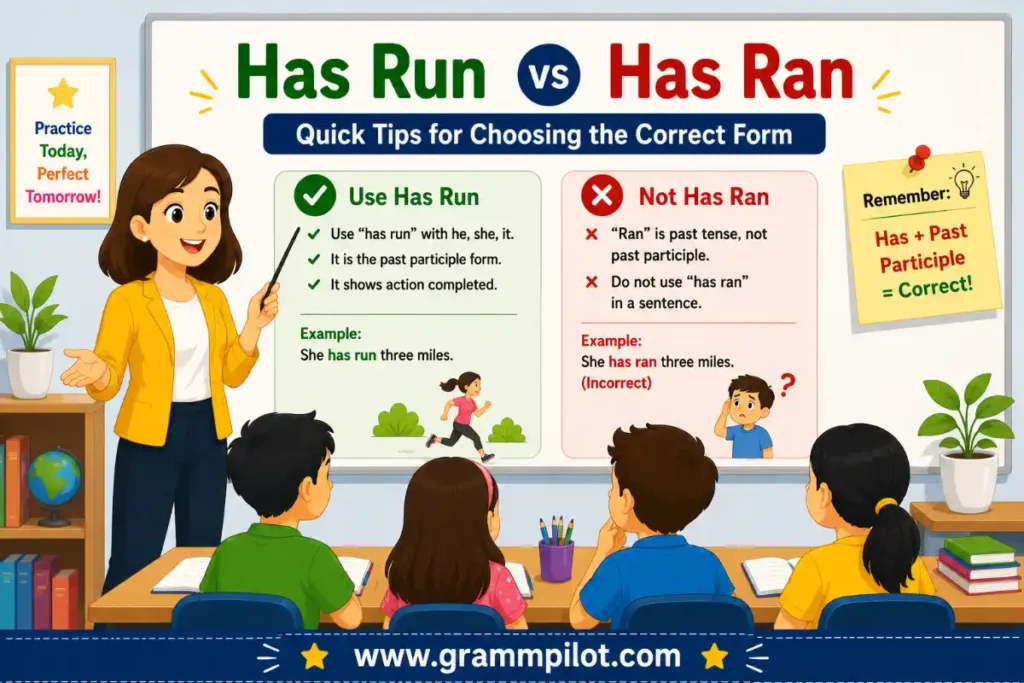
Conclusion
Understanding Has Run vs Has Ran becomes simple once you know the three forms of the verb run: run, ran, run. The helping verbs has, have, and had always require the past participle, which means has run is the correct choice. The form has ran may appear in informal speech or online comments, but it is not accepted in standard English grammar and should be avoided in school, exams, business writing, and professional communication.
The best way to remember the rule is to learn irregular verbs in all three forms instead of memorizing only the past tense. With regular practice, reading, and proofreading, you’ll begin choosing the correct form naturally. A small grammar habit like this can make your English clearer, more confident, and more professional.
Frequently Asked Questions
1. What is the difference between Has Run vs Has Ran?
Has run is the correct present perfect form because run is the past participle. Has ran is incorrect because ran is the simple past tense.
2. Is “has ran” ever correct?
No. In standard English grammar, has ran is considered incorrect. Always write has run after has.
3. Why is “has run” correct?
The helping verb has must be followed by the past participle. For the verb run, the past participle is run.
4. When should I use “ran”?
Use ran for the simple past tense when describing a completed action at a specific time.
Example: She ran five miles yesterday.
5. What’s another way to say “run”?
Depending on the context, you can use jog, sprint, race, hurry, dash, operate, manage, direct, or conduct.
6. Do American and British English use different grammar?
No. Both American English and British English follow the same rule. They use has run, not has ran.
7. How can I remember the correct form?
Memorize the three verb forms together:
- Run (base form)
- Ran (simple past)
- Run (past participle)
Then remember the easy pattern: has + past participle = has run.