
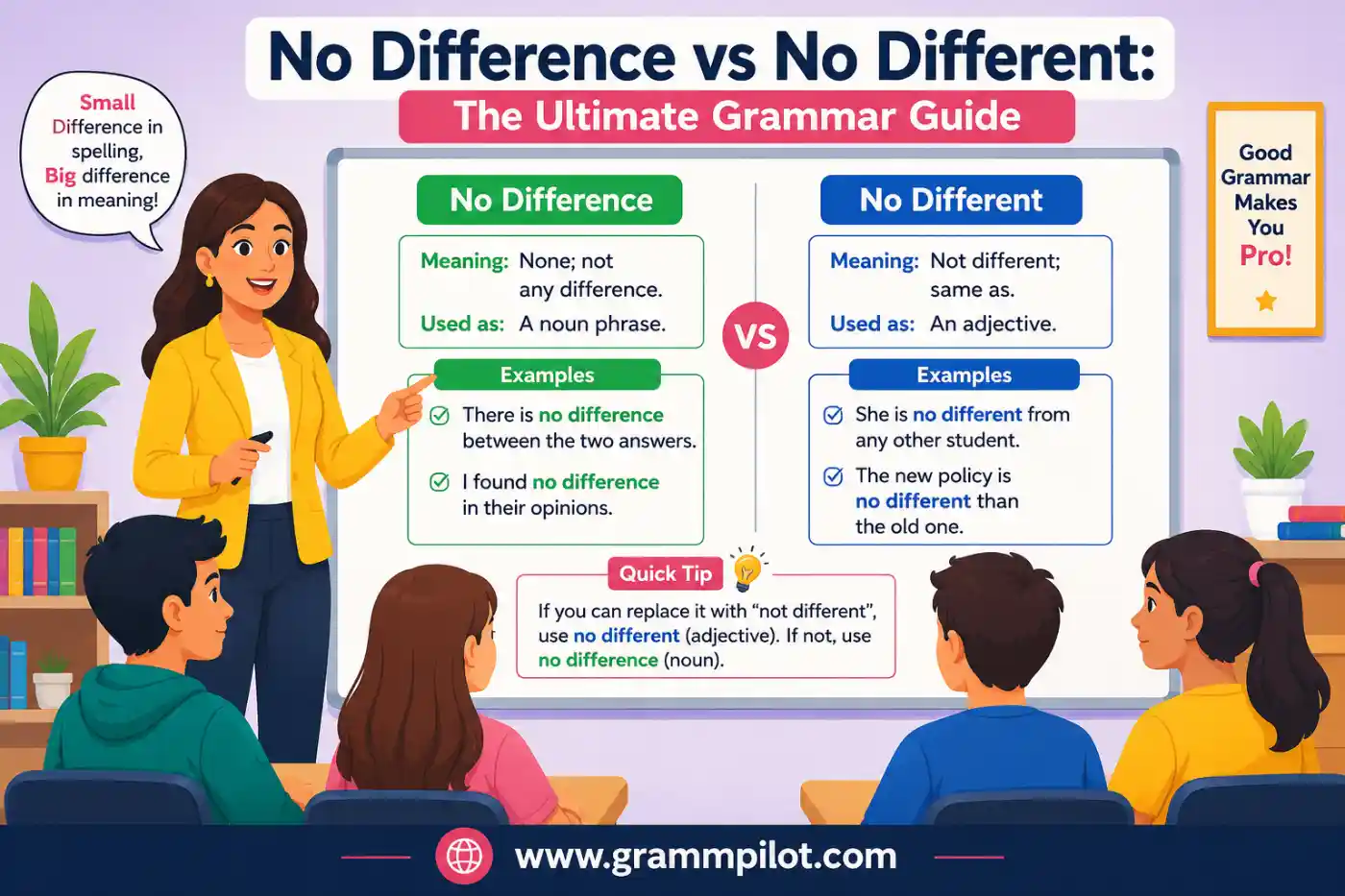
Have you ever paused while writing an email, essay, or text because you weren’t sure about to write No Difference vs No Different? You’re not alone. These two expressions confuse many English learners because they look similar, yet they don’t work the same way in a sentence. Choosing the wrong one can make your writing sound unnatural or grammatically incorrect. The confusion usually happens because both phrases include the word difference, and many people assume they can replace one with the other. In reality, one expression is standard English in most situations, while the other usually needs extra words to be grammatically complete.
Answer Box:
“No difference” is the correct phrase when you mean that two or more things are the same. “No different” is also correct, but it usually needs a comparison, such as “no different from” or “no different than.”
By the end of this guide, you’ll understand No Difference vs No Different, learn where each expression came from, discover when to use each one, explore common mistakes, compare similar phrases, and practice with real-life examples.
To keep improving your English grammar, explore [Did You Had or Did You Have].
What Is the Difference Between No Difference vs No Different?
The easiest way to understand No Difference vs No Different is to look at the job each expression performs.
| Expression | Meaning | Common Use |
|---|---|---|
| No difference | There is no change or distinction. | Very common |
| No different | Similar or the same as something else. | Common when followed by a comparison |
Let’s look at a few examples.
Correct:
- There is no difference between the two phones.
- I noticed no difference after updating the software.
Also correct:
- This recipe is no different from the actual.
- Her opinion is no different than mine. (Common in American English.)
Notice the pattern. The phrase no difference usually stands on its own. The phrase no different usually introduces a comparison.
No Difference vs No Different Meaning in Plain English
Understanding the meaning first makes the grammar much easier.
What Does “No Difference” Mean?
The expression no difference means that two or more things are equal or almost the same.
Examples:
- There’s no difference between the blue shirt and the black one.
- I saw no difference in the test results.
- The new version shows no difference in performance.
- Most users noticed no difference after the update.
In every example, the speaker says that nothing has changed.
What Does “No Different” Mean?
The phrase no different means “just as similar as” or “not different.”
However, it almost always needs another word afterward.
Examples:
- His answer is no different from mine.
- Life today is no different than it was last year.
- Your idea is no different from hers.
- This situation is no different than the previous one.
Without the comparison, the sentence often sounds incomplete.
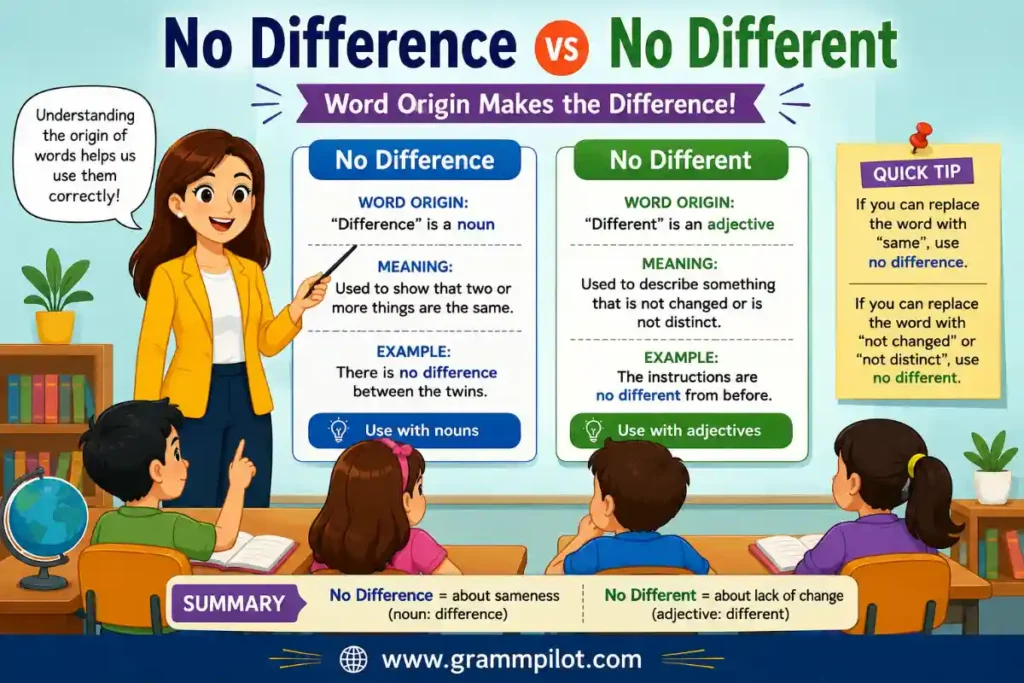
No Difference vs No Different: Word Origin of Makes The Difference
Knowing where words come from makes them easier to remember.
Where Does “Difference” Come From?
The word difference comes from the Latin word differentia, meaning distinction or separation. Later, it entered Middle English and came to describe anything that was unlike something else. Today, it commonly refers to:
- a change
- a distinction
- a contrast
- something that is not the same
Where Does “Different” Come From?
The adjective different comes from the same Latin root. Instead of naming a distinction, it describes something that is unlike another thing.
Examples:
- different colors
- different opinions
- different ideas
- different results
Although the two words share the same history, they play different grammatical roles.
Why Does This Matter?
Here’s the key idea.
Difference is a noun.
Different is an adjective.
That’s why they don’t always fit into the same sentence structure.
Why Do People Confuse No Difference vs No Different?
Several reasons make these expressions difficult.
They Look Almost Identical
Both phrases begin with no and come from the same root word. Because of this, many learners believe they can switch between them freely.
Both Talk About Similarity
Each expression communicates that two things are alike. The grammar—not the meaning—is what changes.
Translation Causes Problems
In many languages, one expression covers both meanings. When translating directly into English, learners often choose the wrong form.
Grammar Checkers Don’t Always Explain Why
Some writing tools suggest corrections without explaining the rule. As a result, people fix the sentence but never understand the reason.
The One Simple Rule for No Difference vs No Different
Here’s an easy classroom trick.
Ask yourself:
Am I naming the lack of a distinction?
If yes, choose no difference.
Examples:
- There’s no difference between these answers.
- We found no difference in quality.
- Scientists observed no difference after the experiment.
Now ask:
Am I comparing one thing with another?
If yes, choose no different followed by from or than.
Examples:
- This cake is no different from the homemade version.
- Her explanation is no different than mine.
- Today’s weather is no different from yesterday’s.
That single question solves most grammar problems involving No Difference vs No Different.
No Difference vs No Different Grammar Rule
A little grammar makes everything clearer.
“Difference” Is a Noun
A noun names a person, place, thing, or idea.
Examples:
- difference
- decision
- result
- opinion
Since difference is a noun, it often follows verbs like:
- is
- was
- makes
- shows
- found
Examples:
- There is no difference.
- We found no difference.
- The report shows no difference.
“Different” Is an Adjective
An adjective describes a noun.
Examples:
- different answer
- different plan
- different opinion
When used with no, it usually forms a comparison.
Examples:
- no different from
- no different than
Because different is an adjective, it normally needs another phrase to complete the comparison.
No Difference vs No Different Quick Comparison
| Feature | No Difference | No Different |
|---|---|---|
| Part of Speech | Noun phrase | Adjective phrase |
| Describes Similarity | Yes | Yes |
| Needs “from” or “than”? | Usually no | Usually yes |
| Common in Everyday English | Very common | Very common |
| Often Used Alone | Yes | Rarely |
Keeping this chart in mind makes the rule much easier to remember.
Is No Difference vs No Different Used Differently in American and British English?
Both American English and British English use these expressions. The biggest difference is the word that follows no different.
American English
You’ll often hear:
- no different than
- no different from
Both are widely accepted in everyday American English.
Examples:
- This version is no different than the old one.
- His performance was no different from last year’s.
British English
British writers generally prefer: no different from
Example: The new policy is no different from the previous one.
Although the preference varies slightly, every English speaker understands both forms.
Master Synonym List for “No Difference”
Choosing different words helps your writing sound more natural while avoiding repetition.
Everyday Synonyms
| Word or Phrase | Meaning | Tone | Example |
|---|---|---|---|
| Same | Identical | Everyday | Both shirts are the same. |
| Equal | Having the same value | Everyday | The scores are equal. |
| Alike | Similar | Everyday | The twins look alike. |
| Similar | Nearly the same | Everyday | Their ideas are similar. |
| Identical | Exactly the same | Neutral | The documents are identical. |
| Matching | Corresponding | Everyday | The colors are matching. |
| Comparable | Similar enough to compare | Neutral | The products are comparable. |
| Even | Balanced or equal | Everyday | The teams were even. |
Formal Synonyms
| Word or Phrase | Meaning | Tone | Example |
|---|---|---|---|
| Equivalent | Equal in value or meaning | Formal | The qualifications are equivalent. |
| Indistinguishable | Impossible to tell apart | Formal | The copies are indistinguishable. |
| Uniform | Consistent throughout | Formal | The results remained uniform. |
| Consistent | Remaining the same | Formal | The measurements were consistent. |
| Corresponding | Matching another thing | Formal | The figures are corresponding. |
| Comparable | Suitable for comparison | Formal | Both reports are comparable. |
| Parallel | Similar in development | Formal | Their experiences were parallel. |
| Equalized | Made equal | Formal | The values were equalized. |
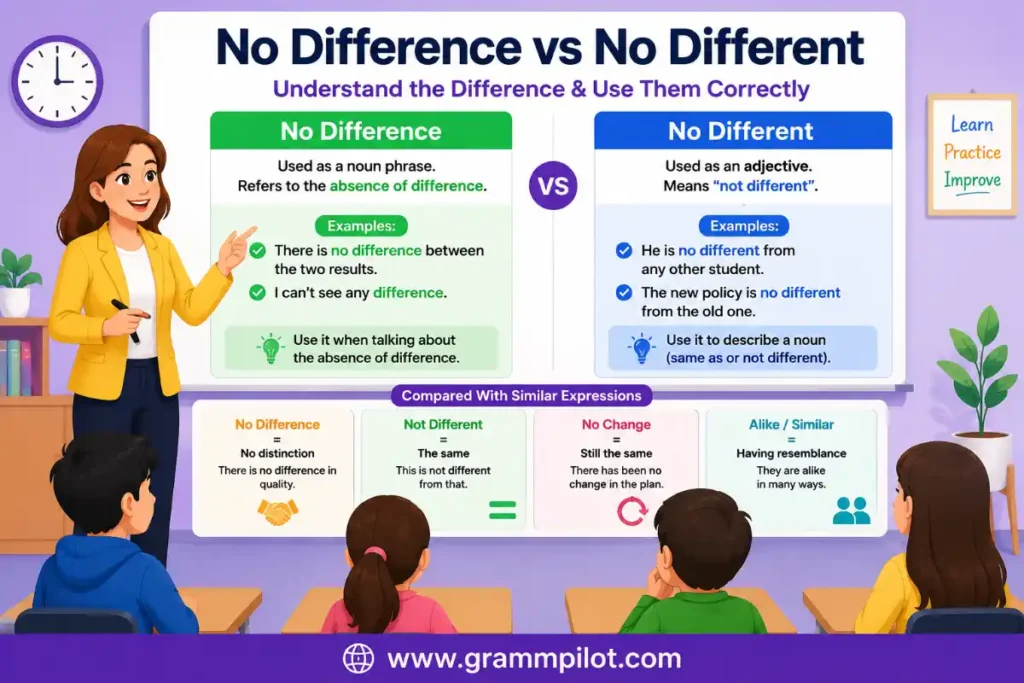
No Difference vs No Different Compared With Similar Expressions
Mastering No Difference vs No Different becomes much easier when you compare these expressions with similar ones. Although they all describe similarity, each has its own purpose and grammar.
No Difference vs Same
These expressions often appear in similar situations, but they are not identical.
| No Difference | Same |
|---|---|
| Focuses on the absence of change or distinction. | Describes two or more things as identical. |
| Usually follows verbs such as is, was, or makes. | Often follows forms of be. |
Examples:
- There is no difference between the two phones.
- Both phones are the same.
The first sentence discusses the lack of a difference, while the second directly describes equality.
No Difference vs Similar
Many learners use these expressions interchangeably, but they don’t mean exactly the same thing.
| No Difference | Similar |
|---|---|
| Means completely alike. | Means nearly alike but not identical. |
Consider these examples:
- The experts found no difference in quality.
- The two designs are similar, but their colors are different.
One expression shows complete equality, whereas the other allows small differences.
No Different vs Similar
Both expressions compare things, but the level of similarity changes.
| No Different | Similar |
|---|---|
| Suggests there is essentially no meaningful distinction. | Suggests several shared features without complete equality. |
Examples:
- Her opinion is no different from mine.
- Our ideas are similar, although we reached them differently.
Using the correct phrase makes your comparison more accurate.
No Difference vs No Change
These expressions may sound alike, but they answer different questions.
| No Difference | No Change |
|---|---|
| Compares two or more things. | Describes something that stayed the same over time. |
Examples:
- We found no difference between the two reports.
- There was no change after the software update.
The first compares two items. The second describes what happened over time.
No Different vs Identical
Some writers believe these expressions always mean the same thing.
| No Different | Identical |
|---|---|
| Indicates that meaningful differences don’t exist. | Means exactly the same in every detail. |
Examples:
- The new policy is no different from the previous one.
- The signatures are identical.
Something can be no different in practice without being perfectly identical.
No Difference vs No Different in Everyday English
Native speakers use both expressions regularly, but the sentence structure changes.
You’ll often hear:
- There’s no difference between the two options.
- I noticed no difference after the update.
- We found no difference in the results.
You’ll also hear:
- This version is no different from the original.
- His explanation is no different than yours.
- Today’s weather is no different from yesterday’s.
Paying attention to the words that follow each expression makes the choice much easier.
No Difference vs No Different in School Writing
Students often lose marks because these expressions are mixed up.
Correct examples include:
- Researchers found no difference between the two groups.
- The second experiment was no different from the first.
Each sentence follows a different grammar pattern, even though both express similarity.
No Difference vs No Different in Business Writing
Business documents should be precise and easy to understand.
Look at these examples:
- Customer surveys showed no difference in satisfaction levels.
- Our revised proposal is no different from last month’s version.
- Testing revealed no difference in product performance.
- The updated procedure is no different from the previous process.
Choosing the right expression makes reports and emails sound more professional.
No Difference vs No Different in Academic Writing
Academic papers frequently use these phrases when discussing research findings.
Here are several examples:
- Scientists observed no difference between the control group and the treatment group.
- The latest results were no different from earlier findings.
- Researchers detected no difference in accuracy.
- Student performance was no different from the previous semester.
Academic writing values precise grammar, making these distinctions especially important.
Common Mistakes With No Difference vs No Different
Even experienced writers occasionally confuse these expressions.
Mistake 1: Using “No Different” Without a Comparison
❌ The results are no different.
✅ The results are no different from last year’s findings.
Most of the time, no different needs a comparison to complete the idea.
Mistake 2: Replacing “No Difference” With “No Different”
❌ We found no different between the two samples.
✅ We found no difference between the two samples.
Since the sentence names the absence of a distinction, the noun difference is required.
Mistake 3: Forgetting the Part of Speech
Remember this simple rule:
- Difference = noun
- Different = adjective
Understanding their grammatical roles prevents many writing mistakes.
Mistake 4: Translating Directly From Another Language
Some languages use one expression where English uses two. Instead of translating word for word, think about if you’re naming a distinction or making a comparison.
Mistake 5: Ignoring Context
Grammar depends on meaning, not just spelling. Before choosing an expression, ask yourself what the sentence is trying to communicate.
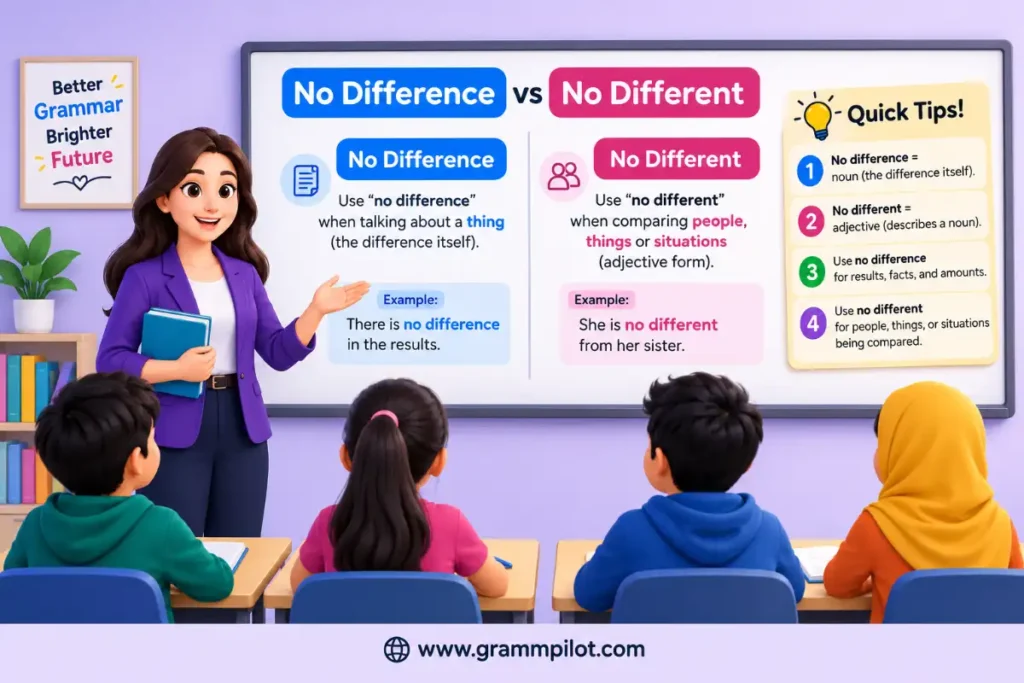
Quick Tips for Choosing Between No Difference vs No Different
Keep these practical reminders nearby whenever you write.
- Ask if you’re naming a difference.
- If yes, choose no difference.
- Decide if you’re comparing one thing with another.
- If so, choose no different, usually followed by from.
- Remember that difference is a noun.
- Keep in mind that different is an adjective.
- Read the complete sentence before deciding.
- Check if a comparison follows the adjective.
- Proofread reports, essays, and emails carefully.
- Practice with real examples instead of memorizing isolated rules.
These habits make the correct choice feel natural over time.
No Difference vs No Different Practice Sentences
Read each sentence carefully before looking at the explanation.
1. There is _____ between the two answers.
Best choice: no difference because the sentence names the lack of a distinction.
2. My opinion is _____ yours.
Correct expression: no different from, since one opinion is being compared with another.
3. Scientists found _____ in the final results.
Choose: no difference because the sentence discusses research findings.
4. Today’s weather is _____ yesterday’s.
Right answer: no different from, as the sentence compares two different days.
5. I noticed _____ after installing the update.
The correct phrase is: no difference because the speaker observed no change between the two situations.
6. Her explanation was _____ the teacher’s.
Use: no different from, since both explanations are being compared.
7. The manager reported _____ in customer satisfaction.
Select: no difference because the report measures results.
8. His performance was _____ last season’s.
The best option is: no different from, because it compares performances.
9. Reviewers saw _____ in picture quality.
Answer: no difference, as the sentence refers to the absence of any measurable distinction.
10. The updated design is _____ the original version.
Final choice: no different from, because one design is being compared with another.
Working through these examples helps you recognize the correct grammar naturally while also building confidence for everyday writing, school assignments, professional communication, and standardized English tests.Common Situations Where People Use No Difference vs No Different Incorrectly .Many writers understand the meanings of these expressions but still choose the wrong one because they focus on the words instead of the sentence structure. Looking at common situations can help you avoid those mistakes.
While Writing Emails
Business emails often compare products, reports, or results.
Incorrect: We found no different between the two reports.
Correct: We found no difference between the two reports.
Now look at another example.
Incorrect: This proposal is no difference from the previous version.
Correct: This proposal is no different from the previous version.
The first sentence names a lack of distinction, while the second compares two proposals.
During School Assignments
Students frequently mix these expressions in essays and research papers.
Incorrect: There was no different in the experiment.
Correct: There was no difference in the experiment.
Another common example is:
Correct: The second experiment was no different from the first one.
Understanding if you’re naming a result or making a comparison makes the choice much easier.
In Business Reports
Professional reports often compare numbers and performance.
Examples:
- Analysts found no difference in customer satisfaction.
- This year’s sales figures are no different from last year’s.
- Auditors noticed no difference in the financial records.
- The revised policy is no different from the earlier version.
Using the correct expression makes reports sound more professional and accurate.
During Everyday Conversations
Native speakers naturally switch between both expressions.
For example:
- I see no difference between these two jackets.
- His attitude is no different from his brother’s.
- There’s no difference in taste.
- Today’s weather feels no different from yesterday’s.
Listening to everyday conversations helps reinforce the grammar pattern.
Antonyms of No Difference
Sometimes you need to express the opposite idea.
Here are useful antonyms.
| Word or Phrase | Meaning |
|---|---|
| Difference | A distinction |
| Contrast | A noticeable variation |
| Change | Something becomes different |
| Variation | A slight difference |
| Distinction | A clear separation |
| Inequality | Lack of equality |
| Diversity | Variety among things |
| Imbalance | Unequal condition |
Opposites of “No Different”
Depending on the context, these expressions work well.
- Completely different
- Entirely different
- Totally unlike
- Distinct
- Unique
- Opposite
- Unrelated
- Dissimilar
Choosing the correct opposite helps make comparisons more meaningful.
Quick Tips for Remembering No Difference vs No Different
Instead of memorizing long grammar rules, remember these simple ideas.
- Difference is a noun.
- Different is an adjective.
- Choose no difference when naming the absence of a distinction.
- Use no different when comparing one thing with another.
- If the sentence naturally ends with between, no difference usually fits.
- If the sentence continues with from, no different is usually correct.
- Read the entire sentence before deciding.
- Proofread important documents carefully.
- Practice with real examples until the pattern feels natural.
Small habits like these make grammar much easier.
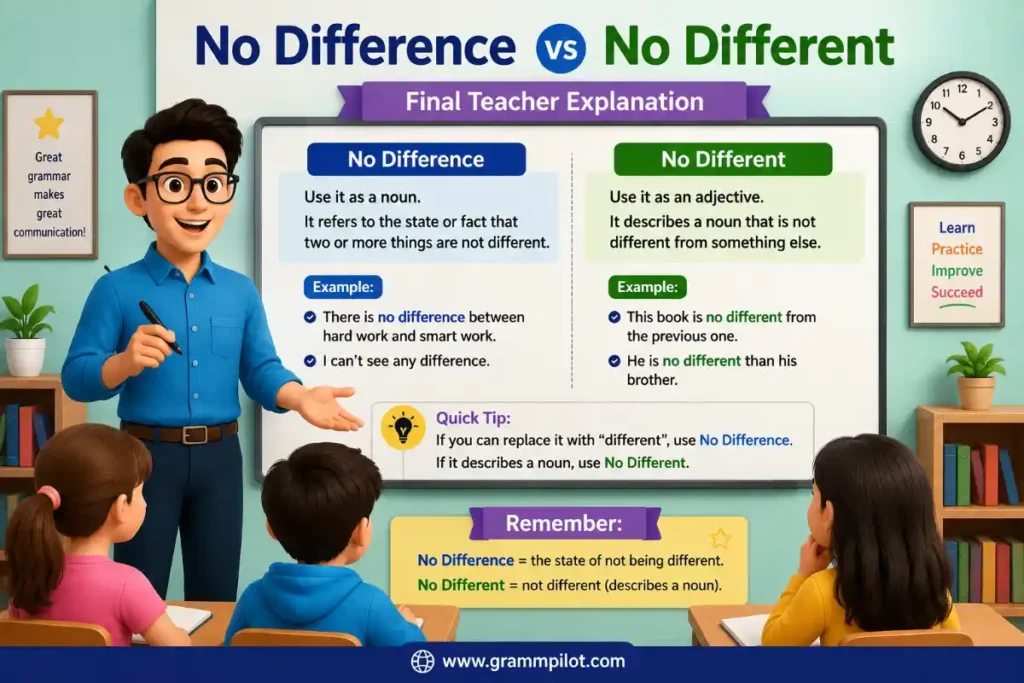
Final Teacher Explanation
Imagine a student asks: “Should I write no difference or no different?”
The answer depends on the sentence.
When you’re talking about the absence of a difference, choose no difference. When you’re saying that one thing is similar to another, choose no different, usually followed by from.
Compare these examples.
- There is no difference between the two answers.
- My answer is no different from yours.
The first sentence names a result. The second sentence compares two things. Once you understand that pattern, No Difference vs No Different becomes much easier to use correctly.
Final Answer
Here’s the easiest rule to remember:
- No difference = no distinction exists.
- No different = one thing is similar to another, usually followed by from.
Whenever you’re unsure, ask yourself if you’re naming a difference or making a comparison. That simple question will help you choose the correct expression every time.
Conclusion
Learning No Difference vs No Different is easier than it first appears. The key is remembering the grammatical role of each expression. No difference uses a noun to describe the absence of any distinction, while no different uses an adjective to compare one thing with another. Once you recognize that pattern, choosing the correct phrase becomes much more natural.
If you’re writing an academic paper, a business email, a social media post, or simply texting a friend, using the correct expression makes your writing clearer and more professional. Keep practicing with real examples, pay attention to the words that follow each phrase, and you’ll soon use No Difference vs No Different confidently without having to stop and think.
Frequently Asked Questions
1. What is the difference between No Difference vs No Different?
No difference names the absence of any distinction, while no different compares one thing with another and is usually followed by from.
2. Is “no different from” grammatically correct?
Yes. No different from is the standard and most widely accepted form in both American and British English.
3. Can I say “no different than”?
Yes. No different than is common in American English, although no different from is generally preferred in formal writing.
4. When should I use “no difference”?
Use no difference when talking about the absence of a distinction, such as “There is no difference between the two products.”
5. What’s another way to say “no difference”?
Depending on the context, you can use identical, the same, equal, equivalent, indistinguishable, or exactly alike.
6. Why do people confuse No Difference vs No Different?
Both expressions come from the same root word and express similarity, but they follow different grammar patterns. That’s why many learners mix them up.
7. How can I remember No Difference vs No Different easily?
Use this simple trick:
- Difference = noun = names the result
- Different = adjective = compares things
If you’re naming a distinction, use no difference. If you’re making a comparison, use no different from.