
Have you ever stopped while writing an email or school essay because you weren’t sure whether to write Due To vs Do To? You’re not alone. These two phrases look and sound similar, but they have completely different meanings. Using the wrong one can make your writing look careless, even if the rest of your sentence is perfect. Many English learners—and even native speakers—mix them up because they are pronounced almost the same. Spell check often won’t catch the mistake either. That’s why it’s important to know when each phrase belongs in a sentence.
Answer Box:
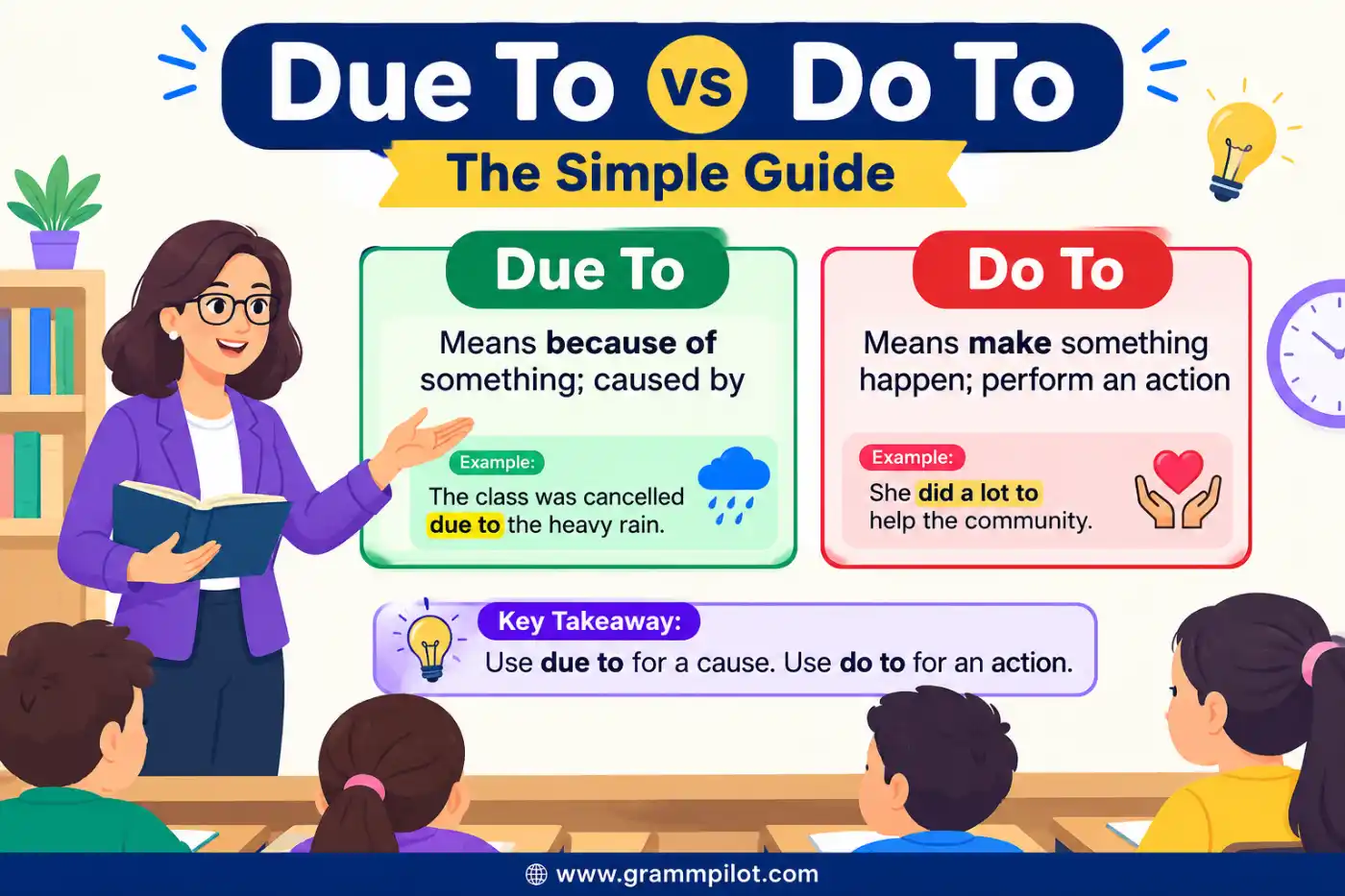
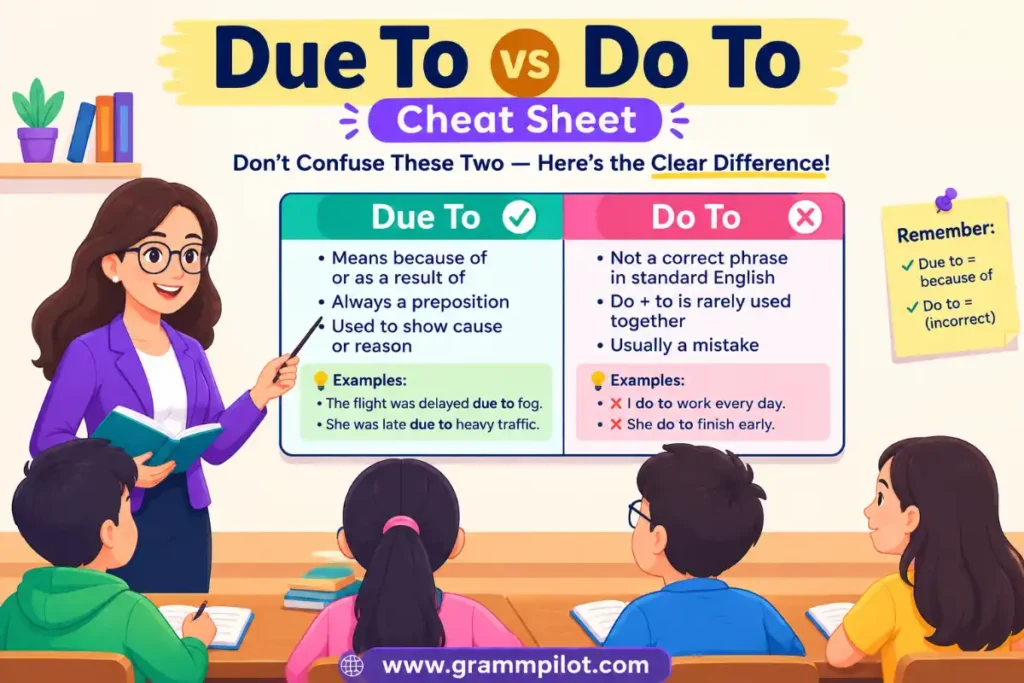
“Due to” means because of or caused by. “Do to” means perform an action to someone or something. They are not interchangeable.
In this guide, you’ll learn what each phrase means, where it came from, how to use it correctly, common mistakes to avoid, and plenty of real-life examples that make the difference easy to remember.
For more examples of tricky plurals, see [Setup vs Set Up].
What Is the Difference Between “Due To” and “Do To”?
The easiest way to remember the difference is this:
| Phrase | Meaning | Correct Use |
|---|---|---|
| Due to | Because of; caused by | Explains the reason for something |
| Do to | Perform an action to someone or something | Describes an action done to a person or object |
Look at these examples.
Due to
- The game was canceled due to heavy rain.
- Flights were delayed due to fog.
- School closed due to snow.
Do to
- Please don’t do that to your little brother.
- What did they do to the old building?
- Never do this to your phone.
Notice something important. “Due to” talks about a reason. “Do to” talks about an action.
Due To vs Do To: Word Origin and Plain-English Meaning
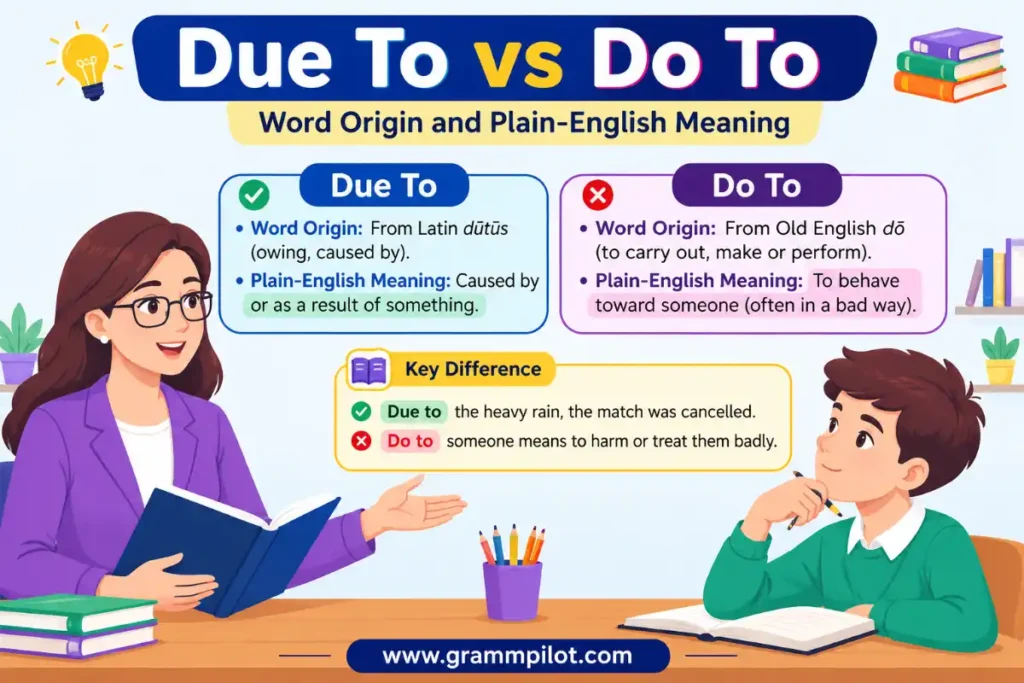
Many people memorize grammar rules without understanding where words come from. Knowing the history makes them much easier to remember.
Where Does “Due To” Come From?
The word due comes from the Latin word debere, meaning “to owe.” Over time, English speakers began using due to mean:
- expected
- proper
- caused by
- resulting from
Eventually, the phrase due to became another way of saying because of.
For example:
- The delay was due to traffic.
- His success was due to years of practice.
In both sentences, the phrase explains the cause.
Where Does “Do To” Come From?
The word do is one of the oldest verbs in English. It comes from Old English don, meaning “perform,” “make,” or “carry out.” When followed by to, it simply means performing an action toward someone or something.
Examples:
- Don’t do that to your friend.
- What did you do to the cake?
- Why would anyone do this to nature?
Unlike due to, this phrase has nothing to do with reasons or causes.
What Does “Due To” Really Mean?
Think of due to as another way to say:
- because of
- caused by
- resulting from
- owing to
Examples:
- The picnic ended early due to rain.
- The concert moved indoors due to bad weather.
- We stayed home due to illness.
- The project succeeded due to teamwork.
Every sentence answers one question: Why did it happen?
What Does “Do To” Really Mean?
Now ask a different question: What action happened?
That’s where do to belongs.
Examples:
- Don’t do that to your dog.
- What did they do to my computer?
- Why would you do this to yourself?
- Never do that to another person.
Instead of giving a reason, these sentences describe an action directed toward someone or something.
Due To vs Do To: A Quick Trick to Remember the Difference
Here’s a simple classroom trick. Replace the phrase with because of. If the sentence still makes sense, use due to.
Example: The match was canceled because of rain.
Correct: The match was canceled due to rain.
Now try another sentence: What did you because of your bike?
That doesn’t make sense.
Correct: What did you do to your bike?
This quick test works most of the time.
Is “Due To” Always the Same as “Because Of”?
Not exactly. In modern English, people often use them the same way, especially in everyday conversation. However, traditional grammar says due to should describe a noun, while because of usually explains a verb or action.
Compare these:
The cancellation was due to heavy rain.
We canceled the trip because of heavy rain.
Today, both forms are widely accepted in everyday writing, although some teachers and editors still prefer the traditional distinction in formal work.
Due To vs Do To: Why People Confuse These Two Phrases
There are several reasons.
They Sound Almost Identical
When spoken quickly, due and do sound nearly the same.
For example:
- due to
- do to
Without seeing the words written down, many people guess the spelling.
Both Use the Word “To”
Each phrase ends with to, making them look even more alike.
Spell Check Usually Misses It
Most grammar tools only check spelling. Since both phrases are real English words, many programs don’t flag the mistake.
Fast Typing Causes Errors
Many people accidentally type:
- do to bad weather
- due to him breaking my phone
One is wrong because the meaning doesn’t fit.
Due To vs Do To: Which Phrase Is More Common?
In everyday English, due to appears much more often than do to. That’s because people frequently explain reasons:
- due to weather
- due to illness
- due to traffic
- due to construction
- due to safety concerns
The phrase do to is less common because it only appears when talking about actions.
Examples include:
- What did you do to the car?
- Don’t do that to me.
- What have they done to the forest?
Both are common enough to know well, but you’ll probably read due to far more often.
Master Synonym List “Due To vs Do To”
Although due to and do to have different meanings, knowing related words helps you choose the clearest expression.
Synonyms for “Due To”
| Word or Phrase | Meaning | Tone | Example |
|---|---|---|---|
| Because of | Reason for something | Everyday | The flight was delayed because of snow. |
| Owing to | Caused by | Formal | The event ended owing to rain. |
| As a result of | Following from | Formal | The change happened as a result of new rules. |
| Thanks to | Because of, often positive | Everyday | We won thanks to teamwork. |
| On account of | Because of | Formal | School closed on account of flooding. |
| By reason of | Because of | Very formal | Access was denied by reason of safety concerns. |
| As a consequence of | Resulting from | Formal | Prices increased as a consequence of demand. |
| Resulting from | Coming from | Formal | Damage resulting from storms was repaired. |
| Caused by | Direct cause | Neutral | The fire was caused by lightning. |
| Attributable to | Able to be explained by | Formal | Growth was attributable to investment. |
| Stemming from | Coming from | Neutral | Problems stemming from poor planning continued. |
| Originating from | Beginning from | Formal | Noise originating from traffic was constant. |
| Triggered by | Started because of | Neutral | The alarm was triggered by smoke. |
| Brought about by | Caused by | Formal | Success was brought about by effort. |
| Linked to | Connected with | Neutral | Illness linked to pollution increased. |
Synonyms for “Do To”
| Word or Phrase | Meaning | Tone | Example |
|---|---|---|---|
| Perform on | Carry out an action | Formal | Doctors performed surgery on the patient. |
| Treat | Act toward someone | Everyday | Always treat others kindly. |
| Harm | Cause damage | Neutral | Don’t harm wild animals. |
| Affect | Influence | Neutral | Stress can affect sleep. |
| Damage | Cause harm | Everyday | Salt can damage metal. |
| Change | Make different | Everyday | Time can change people. |
| Hurt | Cause pain | Everyday | Harsh words hurt feelings. |
| Influence | Have an effect on | Neutral | Friends influence behavior. |
| Modify | Change slightly | Formal | Engineers modified the design. |
| Handle | Deal with | Neutral | Handle the glass carefully. |
| Alter | Make different | Formal | Heat can alter plastic. |
| Transform | Change completely | Formal | Education can transform lives. |
| Impact | Have an effect | Neutral | Weather impacts travel. |
| Fix | Repair | Everyday | I’ll fix the chair tomorrow. |
| Repair | Restore | Neutral | Workers repaired the bridge. |
Due To vs Do To Synonyms Grouped by Everyday Use
Choosing the right phrase becomes much easier when you understand similar expressions. While this word have different meanings, each one has its own group of related words and phrases.
Simple and Everyday Alternatives
| Word or Phrase | Meaning | Tone | Example |
|---|---|---|---|
| Because of | For the reason of | Everyday | We stayed home because of the rain. |
| Thanks to | Because of, often positive | Everyday | We finished early thanks to teamwork. |
| From | Coming from | Everyday | The smell came from the kitchen. |
| After | Following something | Everyday | After the storm, the roads reopened. |
| By | Through an action | Everyday | The room was cleaned by the staff. |
| Treat | Act toward someone | Everyday | Treat others with respect. |
| Hurt | Cause pain | Everyday | Don’t hurt your friend’s feelings. |
| Help | Give support | Everyday | Please help your sister. |
Formal Alternatives
| Word or Phrase | Meaning | Tone | Example |
|---|---|---|---|
| Owing to | Because of | Formal | Flights were canceled owing to fog. |
| As a result of | Caused by | Formal | Sales increased as a result of better service. |
| Attributable to | Able to be explained by | Formal | The growth was attributable to careful planning. |
| Resulting from | Coming from | Formal | Damage resulting from flooding was repaired. |
| Caused by | Direct reason | Neutral | The accident was caused by ice. |
| Stemming from | Originating from | Formal | Complaints stemming from delays continued. |
| Brought about by | Made possible by | Formal | Success was brought about by hard work. |
| Performed on | Action completed | Formal | Surgery was performed on the patient. |
Conversational Alternatives
| Word or Phrase | Meaning | Tone | Example |
|---|---|---|---|
| Mess with | Treat badly | Informal | Don’t mess with your brother. |
| Pick on | Treat unfairly | Informal | Kids shouldn’t pick on classmates. |
| Beat up | Physically hurt | Slang | The movie showed bullies beating someone up. |
| Fix up | Repair | Informal | Dad fixed up the old bike. |
| Work on | Improve something | Everyday | I’ll work on my presentation. |
| Deal with | Handle | Everyday | We need to deal with the problem. |
| Take care of | Look after | Everyday | She takes care of her grandmother. |
| Act toward | Behave toward | Neutral | Always act kindly toward others. |
Due To vs Do To : By Strength of Meaning
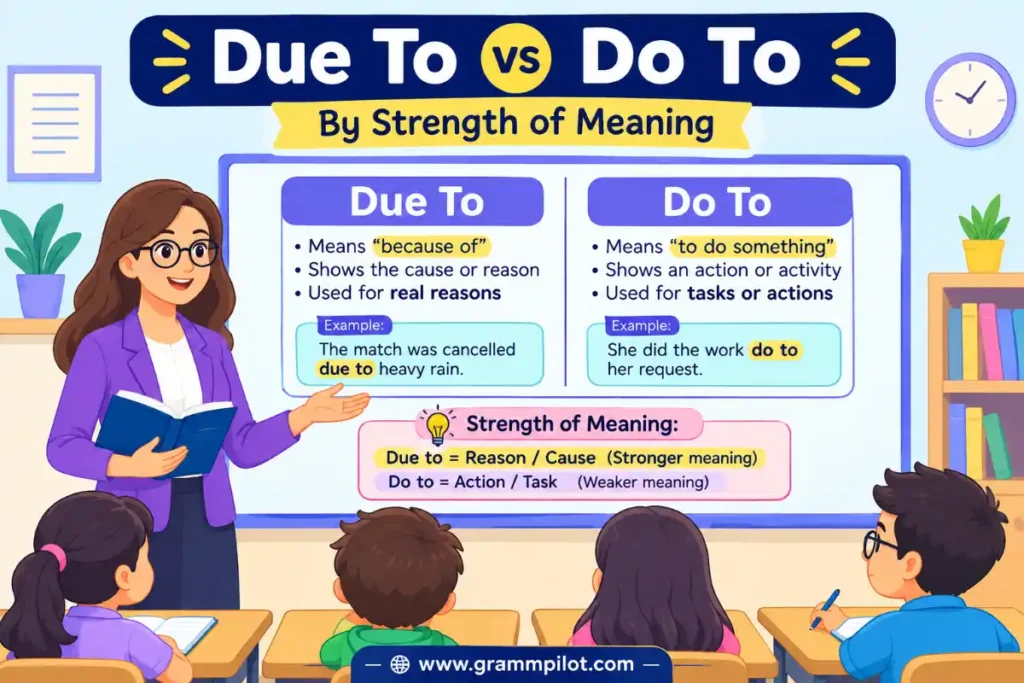
Some expressions sound stronger than others. If you’re choosing between similar words, understanding intensity helps.
Mild
- because of
- thanks to
- owing to
- affected
- treated
Example: The meeting changed because of traffic.
Medium
- caused by
- resulting from
- influenced
- altered
- modified
Example: The delay was caused by construction.
Strong
- triggered by
- brought about by
- transformed
- destroyed
- damaged
Example: The bridge was destroyed by the flood.
Due To vs Do To by Part of Speech
Even though this word are phrases, the words around them can belong to different parts of speech.
| Part of Speech | Examples |
|---|---|
| Verb | do, perform, affect, damage, repair, treat |
| Adjective | due, responsible, expected |
| Noun | reason, cause, action, effect |
| Prepositional Phrase | due to, because of, owing to |
Understanding this helps you build more natural sentences.
Is Due To vs Do To Used Differently in American and British English?
The good news is that both American English and British English follow the same basic rule. Due to always means because of. Do to always means perform an action toward someone or something. The difference is mostly in word choice around the phrase.
American English
Americans often prefer:
- because of
- due to
- thanks to
Examples:
The game was canceled due to rain.
School closed because of snow.
British English
British English sometimes uses:
- owing to
- due to
- as a result of
Example:
The train was delayed owing to signal problems. The meaning stays the same.
When Should You Use Due To vs Do To in a Resume?
A resume should sound professional and direct. When explaining achievements or results, due to often works well.
Examples:
- Sales increased due to improved customer service.
- Production grew due to better planning.
- Customer satisfaction improved due to faster response times.
Avoid using do to unless you’re describing an actual action, which is uncommon in resumes. Better resume sentence: Revenue increased due to strategic marketing efforts.
When Should You Use Due To vs Do To in an Essay?
School essays usually explain reasons. That’s why due to appears much more often.
Examples:
The population increased due to better healthcare.
Many plants died due to the long drought.
Reserve do to for sentences describing actions.
Example:
Scientists studied what pollution can do to rivers.
Notice how the meaning changes completely.
Using this phrase in Emails
Business emails should be clear.
Correct: The meeting has been postponed due to unexpected travel delays.
Incorrect: The meeting has been postponed do to unexpected travel delays.
Another email example: We appreciate your patience due to the temporary system update.
Using the correct spelling makes your email look professional.
Using Due To vs Do To in Text Messages
Texting is casual, but the meaning still matters.
Correct: Sorry I’m late due to traffic.
Correct: What did you do to my headphones?
Even in quick messages, the wrong phrase can confuse readers.
Using it in Everyday Conversation
When speaking, people rarely notice the spelling difference because both phrases sound alike. That becomes a problem only when writing.
Ask yourself one question: Am I giving a reason?
If yes, use due to.
Am I describing an action?
If yes, use do to.
This simple habit prevents most mistakes.
Due To vs Do To Examples in Real-Life Situations
These examples show how the phrases work naturally.
- The flight was canceled due to heavy fog.
- School closed due to icy roads.
- We lost power due to the storm.
- The concert started late due to technical problems.
- His success came due to years of practice.
- What did you do to my bicycle?
- Please don’t do that to your little sister.
- What have they done to this old house?
- Never do this to your computer.
- The puppy looked sad after the children did that to it.
- The restaurant closed early due to a power outage.
- Production stopped due to equipment failure.
- What did the mechanic do to my car?
- She smiled due to the wonderful news.
- Don’t do that to yourself—you deserve better.
These examples cover work, school, family, travel, technology, and daily conversations.
Due To vs Do To: Which Sounds More Natural?
Most native English speakers naturally use due to far more often because people regularly explain why something happened.
For example:
- Due to heavy traffic…
- Due to illness…
- Due to weather…
- Due to safety concerns…
Meanwhile, do to appears only when talking about actions.
For example:
- What did you do to my laptop?
- Don’t do that to your friend.
- What has time done to this building?
Understanding this difference makes choosing between Due To or Do To much easier in every type of writing.
Due To or Do To Compared With Similar Expressions
Many writers understand the basic difference between Due To or Do To, but they still hesitate when similar phrases appear. Knowing these small differences helps you write more naturally and avoid awkward sentences.
Due To vs Because Of
These two phrases are close in meaning, but they are not always used in exactly the same way.
| Due To | Because Of |
|---|---|
| Usually describes the cause of a noun. | Usually explains why an action happened. |
| Slightly more formal. | More common in everyday English. |
| Often seen in business writing. | Common in speech, emails, and conversations. |
Examples:
- The delay was due to heavy rain.
- We stayed home because of heavy rain.
Both sentences are correct, but the second one sounds more conversational.
Due To vs Owing To
Many people think these are identical. In most situations, they are.
| Due To | Owing To |
|---|---|
| Common in American English. | More common in British English and formal writing. |
| Easy to understand. | Sounds slightly more formal. |
Examples:
- The match was canceled due to rain.
- The match was canceled owing to rain.
Both are acceptable.
Do To vs Do For
These two phrases have very different meanings.
| Do To | Do For |
|---|---|
| Perform an action toward someone or something. | Help someone or provide a service. |
Examples:
What did you do to my phone?
What can I do for you today?
Never replace one with the other.
Do To vs Done To
This pair often confuses learners.
Do to is used when talking about an action.
Example: What did you do to the cake?
Change block type or style Move Heading block from position 184 up to position 183 Move Heading block from position 184 down to position 185 Change alignment Change text alignment Displays more block tools
Done to is used after the action has already happened.
Example: What has been done to the building?
The tense changes, but the meaning stays related.
Common Mistakes People Make With Due To vs Do To
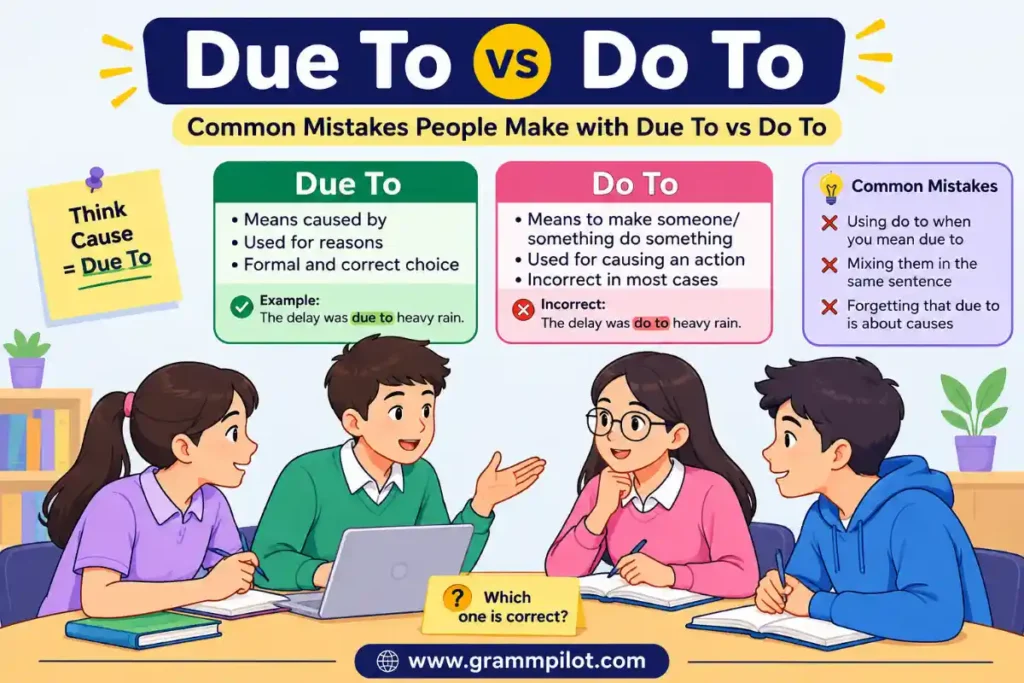
These errors appear every day in emails, homework, blogs, and even business documents.
Mistake 1: Writing “Do To” Instead of “Due To”
Incorrect: The flight was delayed do to weather.
Correct: The flight was delayed due to weather.
This is probably the most common mistake.
Mistake 2: Using “Due To” for an Action
Incorrect: What due to my computer?
Correct: What did you do to my computer?
Remember, do is a verb. Due is not.
Mistake 3: Assuming Spell Check Will Fix It
Spell check often ignores this mistake because both words are spelled correctly. Always read the sentence yourself.
Ask: Am I giving a reason?
Or: Am I describing an action?
Mistake 4: Forgetting the Meaning
Many people simply remember the spelling instead of the meaning.
Instead, remember this:
Due = reason.
Do = action.
That memory trick works almost every time.
Mistake 5: Mixing Formal and Informal Styles
Formal report: Production stopped due to equipment failure. Casual conversation: We stayed home because of the rain. Choosing the right style makes your writing smoother.
Due To vs Do To in School Writing
Teachers often notice this mistake because it changes the meaning of a sentence.
Example: The event was canceled due to bad weather.
This is correct.
Example: What did you do to your science project?
This is also correct.
If you switch the phrases, both sentences become incorrect.
Due To vs Do To in Workplace Writing
Professional writing should be clear.
Correct examples include:
- Deliveries were delayed due to road construction.
- The meeting ended early due to a power outage.
- Sales increased due to customer demand.
- What did the technician do to the printer?
- Please don’t do that to company equipment.
These sentences are simple, accurate, and professional.
Due To vs Do To in Academic Writing
Research papers often explain causes. That means due to appears frequently.
Examples: The experiment failed due to incorrect measurements.
Growth slowed due to limited resources. Meanwhile, do to appears only when describing actions.
Example: Researchers examined what pollution can do to marine life.
Again, the phrase describes an action rather than a reason.
Quick Tips for Choosing Between Due To vs Do To
If you’re in a hurry, these tips can save you from making mistakes.
- Ask whether you’re explaining why something happened.
- If yes, choose due to.
- Ask whether someone is performing an action.
- If yes, choose do to.
- Replace the phrase with because of.
- If the sentence still works, due to is probably correct.
- Read the sentence aloud.
- Think about the meaning, not just the spelling.
- Don’t trust spell check alone.
- Proofread business emails before sending them.
These simple habits quickly become automatic.
Due To or Do To Memory Tricks That Actually Work
People remember stories better than grammar rules. Try these easy memory tricks.
Trick 1: Due Means Debt
Think of money that is due. Something is due because of another reason.
Reason = due.
Trick 2: Do Means Action
The word do is a verb. Verbs show actions. If someone is doing something, use do.
Trick 3: Replace It With “Because Of”
Sentence: School closed because of snow.
Works perfectly.
That means: School closed due to snow.
Now try another. What did you because of the computer?
It doesn’t work.
The correct sentence is: What did you do to the computer?
Due To or Do To Practice Sentences
Choose the correct phrase before reading the answer.
- The train was late _____ heavy rain.
Answer: due to
- What did you _____ my backpack?
Answer: do to
- Our vacation ended early _____ the storm.
Answer: due to
- Please don’t _____ your little brother.
Answer: do that to
- Business slowed _____ rising prices.
Answer: due to
- What has the dog done _____ the garden?
Answer: to
- The road closed _____ flooding.
Answer: due to
- What did the children do _____ the snowman?
Answer: to
- School reopened _____ improved weather.
Answer: due to
- Never do that _____ another person.
Answer: to
Practicing with real sentences is one of the fastest ways to master Due To or Do To.
Due To or Do To Cheat Sheet
| If Your Sentence Means… | Use |
|---|---|
| Because of | Due to |
| Caused by | Due to |
| Resulting from | Due to |
| Why something happened | Due to |
| Perform an action | Do to |
| Affect someone | Do to |
| Change something | Do to |
| Harm someone | Do to |
Keep this chart in mind whenever you’re writing an essay, email, report, or social media post. It helps you choose the correct phrase in seconds.
Conclusion
Learning the difference between Due To or Do To is easier once you focus on the meaning instead of the spelling. If you’re explaining the reason something happened, use due to. If you’re talking about an action performed on a person or thing, use do to. That one simple rule will help you avoid one of the most common English writing mistakes.
The next time you pause while writing an email, essay, report, or text message, ask yourself one question: “Am I giving a reason or describing an action?” If it’s a reason, choose due to. If it’s an action, choose do to. With a little practice, you’ll use both phrases naturally and confidently every time.
Frequently Asked Questions
1. Is “due to” the same as “because of”?
Almost. Both usually explain a reason. In everyday English, they are often interchangeable, although due to is slightly more common in formal writing.
2. Is “do to” a real English phrase?
Yes. Do to is a correct English phrase that means to perform an action toward someone or something. It is much less common than due to because it describes actions rather than causes.
3. How do I remember the difference between Due To or Do To?
Remember this simple rule: due = reason and do = action. If you can replace the phrase with because of, then due to is the correct choice.
4. Can I use “due to” in a business email?
Yes. Due to is widely accepted in professional writing, business emails, reports, and academic documents when explaining the reason something happened.
5. What’s another way to say “due to”?
Common alternatives include because of, owing to, as a result of, thanks to, caused by, resulting from, and on account of. Choose the one that best matches the tone of your writing.
6. Why do people confuse Due To or Do To?
People confuse them because they sound almost identical when spoken. In writing, however, they have completely different meanings. One explains a cause, while the other describes an action.
7. Is “do to” grammatically correct?
Yes. Do to is grammatically correct when you’re talking about an action directed toward someone or something, such as “What did you do to my laptop?” It should never replace due to when explaining a reason.