
When writing an email, filling out a form, or preparing an essay, you might come across two words that look and sound exactly alike: bearer and barer. They can easily cause confusion because both are correctly spelled English words. However, they have completely different meanings. Understanding Bearer vs Barer helps you choose the correct spelling based on what you want to say. One word refers to a person who carries, holds, or presents something. The other describes someone or something that is more exposed, uncovered, or less hidden.
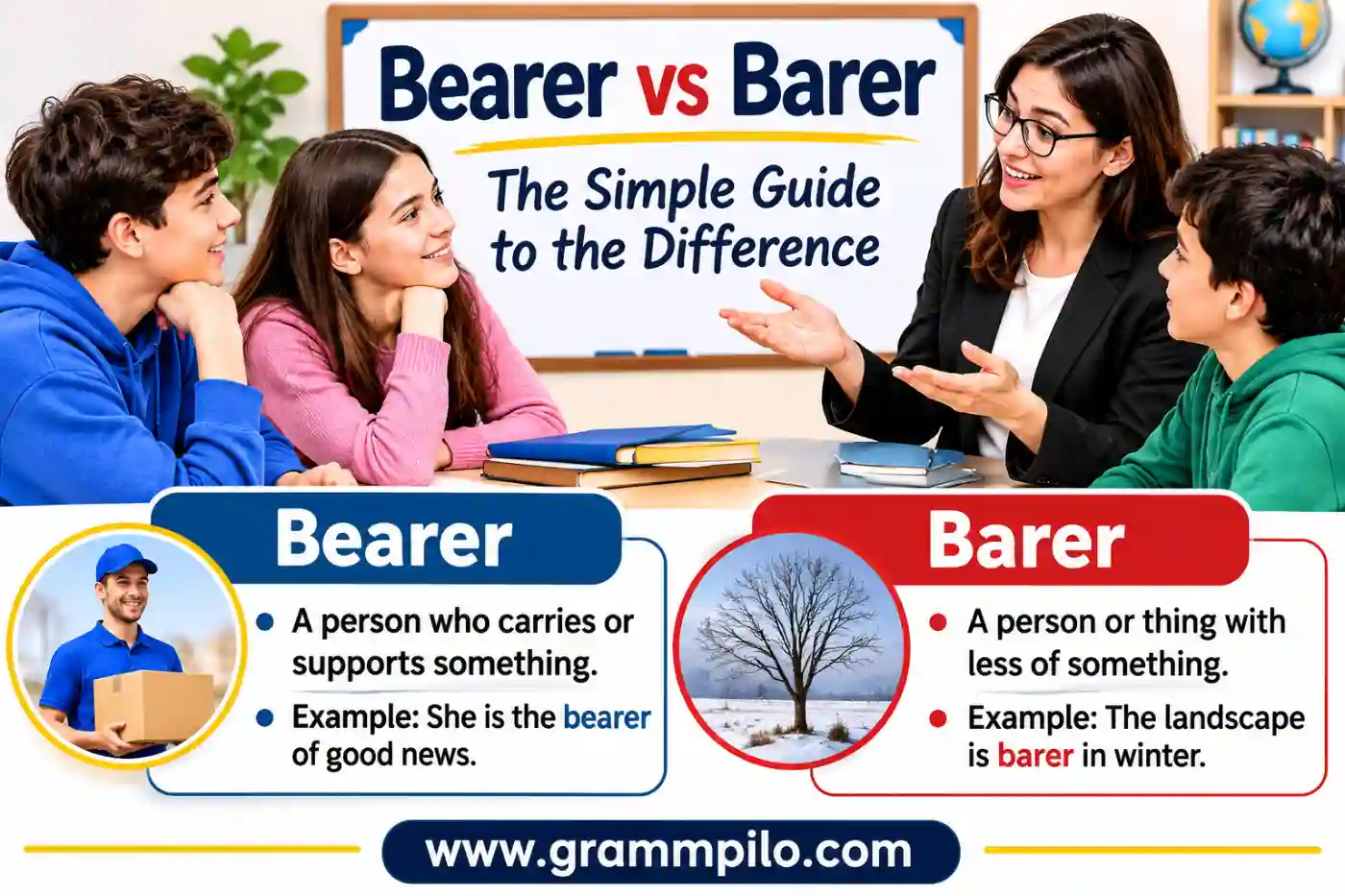
Quick Answer: Bearer means a person who carries or presents something, such as a document, message, or title. Barer is the comparative form of bare, meaning more exposed, uncovered, or less covered.
Although these words sound identical, their meanings and uses are different. Choosing the wrong one can change the meaning of your sentence.
In this guide, you’ll learn their definitions, origins, differences, synonyms, examples, common mistakes, and the best word to use in everyday writing.
What Is the Difference Between Bearer and Barer?
The main difference is that bearer describes someone who carries or presents something, while barer describes something that is more uncovered or exposed. Let’s look at both words separately.
What Does Bearer Mean?
Bearer is a noun that refers to a person who carries, holds, or presents something. It comes from the verb bear, which means to carry, support, hold, or bring something.
For example:
- The bearer of the letter delivered it to the office.
- The ticket bearer entered the concert hall.
- He was the bearer of some wonderful news.
- The document must be signed by its bearer.
In each sentence, the word describes a person who carries, possesses, or presents something.
Common uses of bearer:
- Bearer of a message
- Bearer of good news
- Bearer of a certificate
- Bearer of a ticket
- Bearer of responsibility
- Bearer of a gift
The word also appears in formal and legal language. For example, a bearer bond is a financial document associated with the person who physically holds it.
What Does Barer Mean?
Barer is the comparative form of the adjective bare. The word bare means uncovered, exposed, empty, or without decoration. Adding -er makes it comparative. Therefore, barer means more uncovered or less covered than something else. For example:
- The winter trees looked barer than the summer trees.
- His room became barer after he removed the furniture.
- The walls looked barer without their paintings.
- Her arms were barer than before.
Notice that barer compares two conditions. It tells us that something has less covering, decoration, or protection.
Common uses of barer:
- Barer walls
- Barer branches
- Barer shelves
- Barer rooms
- Barer surfaces
- Barer skin
Remember that barer is not a word for someone who carries something. It describes a comparative condition of being uncovered.
Where Did Bearer and Barer Come From?
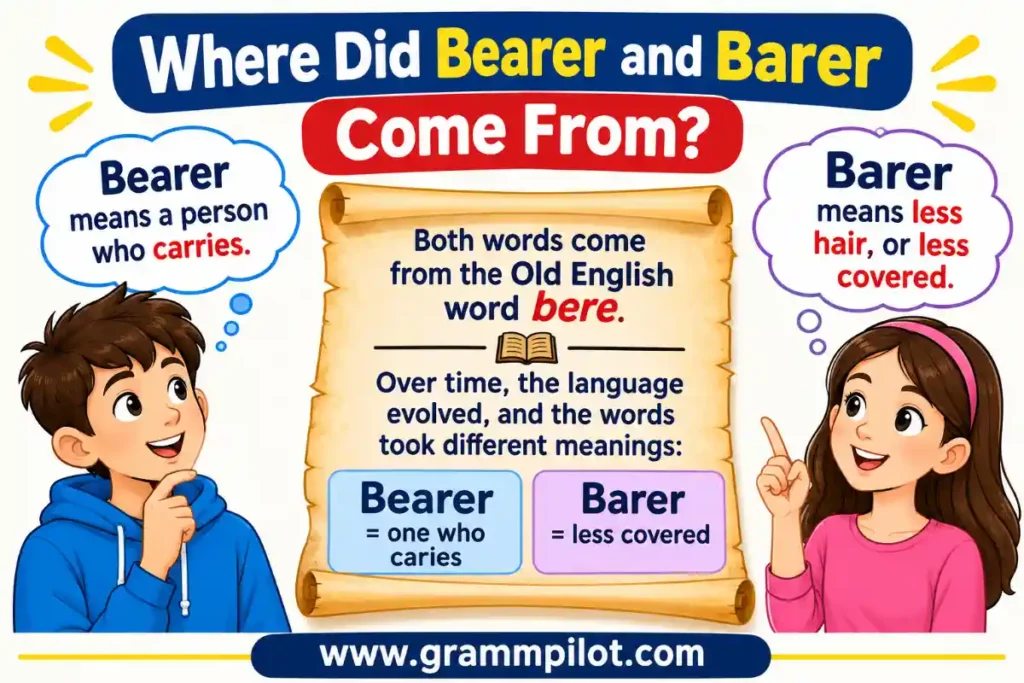
Understanding word origins makes confusing spellings easier to remember. Although these words sound alike, they come from different word families.
What Is the Origin of Bearer?
Bearer comes from the Old English verb beran, which meant to carry, bring, or support. Over time, this word developed into the modern English verb bear. The ending –er is commonly added to verbs to describe someone who performs an action.
For example:
- Teach → Teacher
- Write → Writer
- Drive → Driver
- Bear → Bearer
Therefore, a bearer is someone who bears or carries something. The word has been used for centuries in everyday and formal English.
What Is the Origin of Barer?
Barer comes from the adjective bare, which has Old English roots in the word bær. The original meaning was uncovered, naked, or without covering. English uses the ending -er to form the comparative version of many short adjectives.
For example:
- Large → Larger
- Small → Smaller
- Cold → Colder
- Bare → Barer
This explains why barer means more uncovered or less covered.
Why Do Bearer and Barer Sound the Same?
Both words are homophones. Homophones are words that have the same pronunciation but different meanings and spellings. Other examples include:
| Homophones | Difference |
|---|---|
| Their / There | Possession / Place |
| Right / Write | Correct / To form words |
| Sea / See | Ocean / To look |
| Flower / Flour | Plant / Baking ingredient |
| Bear / Bare | Animal / Uncovered |
| Bearer / Barer | Carrier / More uncovered |
Their pronunciation is the same in standard English, but their meanings depend on context.
What Are the Best Synonyms for Bearer and Barer?
Synonyms can help you express an idea more clearly. However, not every synonym works in every sentence. The best replacement depends on whether you’re describing someone carrying something or something becoming uncovered.
What Are the Best Synonyms for Bearer?
Here are useful alternatives grouped by tone and context.
| Word | Meaning | Tone | Example |
|---|---|---|---|
| Carrier | Someone who carries something | Simple | The carrier delivered the package. |
| Holder | Someone possessing something | Simple | The holder showed the ticket. |
| Messenger | Person delivering information | Everyday | The messenger brought the news. |
| Courier | Person delivering items | Everyday | The courier delivered the letter. |
| Deliverer | Someone who delivers something | Everyday | The deliverer brought the document. |
| Presenter | Someone who presents something | Everyday | The presenter handed over the award. |
| Owner | Person who possesses something | Everyday | The owner showed the certificate. |
| Custodian | Person responsible for something | Formal | The custodian protected the records. |
| Possessor | Someone who owns or holds something | Formal | The possessor presented the document. |
| Conveyer | Someone or something that transfers information | Formal | The speaker was the conveyer of the message. |
| Representative | Person acting for another | Formal | The representative carried the documents. |
| Ambassador | Official representative | Formal | She became an ambassador of peace. |
| Herald | Person announcing important news | Formal | The herald announced the arrival. |
| Emissary | Person sent on a mission | Formal | The emissary delivered the message. |
| Carrier of news | Person bringing information | Everyday | He was the carrier of good news. |
| Token holder | Person possessing a token | Formal | The token holder entered the building. |
| Ticket holder | Person with a ticket | Everyday | Every ticket holder received a seat. |
| Cardholder | Person possessing a card | Formal | The cardholder signed the form. |
| Bearer of bad news | Person bringing unpleasant information | Everyday | Nobody wanted to be the bearer of bad news. |
| News carrier | Person delivering information | Everyday | The news carrier arrived early. |
What Are the Best Synonyms for Barer?
Because barer is a comparative adjective, its alternatives should also express a greater degree of exposure or a lack of covering.
| Word | Meaning | Tone | Example |
|---|---|---|---|
| More exposed | Less protected | Simple | The skin was more exposed. |
| Less covered | Having less covering | Simple | Her shoulders were less covered. |
| More open | Less enclosed | Everyday | The room looked more open. |
| Emptier | Having fewer things | Everyday | The shelves looked emptier. |
| Plainer | Having fewer decorations | Everyday | The walls appeared plainer. |
| Simpler | Less decorated or complex | Everyday | The design became simpler. |
| More visible | Easier to see | Everyday | The roots became more visible. |
| More uncovered | Having less covering | Simple | The surface was more uncovered. |
| More stripped | Having unnecessary parts removed | Everyday | The furniture looked more stripped. |
| Sparsely decorated | Having fewer decorations | Formal | The room was sparsely decorated. |
| More minimal | Having fewer details | Formal | The design became more minimal. |
| More unprotected | Having less protection | Formal | The area became more unprotected. |
| Less concealed | Not hidden as much | Formal | The damage was less concealed. |
| More naked | Without covering | Everyday | The branches looked more naked. |
| More exposed | Open to view | Formal | The roots were more exposed. |
Important: These words are related in meaning, but they aren’t always interchangeable. For example, emptier describes a lack of contents, while barer can describe a lack of covering or decoration.
How Do Bearer and Barer Change With Context?
The easiest way to choose the correct spelling is to identify what you’re describing.
When Should You Use Bearer?
Use bearer when talking about a person who carries, holds, or presents something.
Examples:
- The bearer of the invitation arrived early.
- He became the bearer of important information.
- The bearer must present identification.
- She was the bearer of the family documents.
When Should You Use Barer?
Use barer when comparing two things and explaining that one has less covering or decoration.
Examples:
- The garden looked barer after the flowers disappeared.
- The shelves became barer after the books were removed.
- The walls looked barer than they did last year.
- His head appeared barer after he shaved it.
The key is to check whether the sentence involves carrying something or comparing how uncovered something is.
What Are Bearer and Barer by Part of Speech?
Their grammatical roles are different, which makes them easier to identify.
| Word | Part of Speech | Base Word | Function |
|---|---|---|---|
| Bearer | Noun | Bear | Names a person who carries something |
| Barer | Comparative adjective | Bare | Describes something more uncovered |
Is Bearer a Noun?
Yes. Bearer is a noun because it names a person who carries or presents something.
Examples:
- The bearer delivered the envelope.
- The bearer of the message was waiting outside.
- Every bearer must show the required document.
Is Barer an Adjective?
Yes. Barer is a comparative adjective because it describes a greater degree of being bare.
Examples:
- The garden looks barer now.
- These branches are barer than those branches.
- The room became barer after the renovation.
Is There a Difference Between Bearer and Barer in US and UK English?
There is no major spelling difference between American and British English.
Both varieties use:
- Bearer for someone who carries or presents something.
- Barer for something that is more uncovered or less decorated.
The pronunciation is also generally the same. However, some expressions may be more common in formal or regional contexts. For example, bearer of good news is widely understood in both countries. Similarly, barer branches is grammatically correct in both American and British English. Neither spelling is an American-only or British-only form.
Which Word Should You Use in Different Situations?
The right spelling depends on the message you’re trying to communicate.
Which Word Is Better for a Resume?
Use bearer when describing a person carrying documents or presenting credentials.
Example: “The bearer of the original certificate must attend the verification meeting.”
However, in a resume, you may prefer more direct professional wording. Better alternatives include:
- Document holder
- Certificate holder
- Representative
- Responsible person
Don’t use barer unless you’re describing something that has become less covered or decorated.
Which Word Is Better for an Essay?
Both words can appear in an essay, but they serve different purposes. Use bearer when discussing responsibility, messages, documents, or people.
Example: “The messenger became the bearer of an important announcement.”
Use barer when describing appearance or physical changes.
Example: “After the leaves fell, the trees looked barer than before.”
Which Word Is Better for Texting?
For ordinary texting, use whichever word matches your intended meaning.
Examples:
- “I’m the bearer of some good news!”
- “The room looks barer without the curtains.”
If you’re unsure, replace the word with a simpler expression. For example, write “person carrying the letter” instead of bearer, or “more empty” when that is the intended meaning.
Which Word Is Better for a Formal Email?
Bearer is useful in formal communication involving documents, certificates, invitations, or announcements. Example: “Please ask the bearer of this document to contact our office.” Barer is suitable when discussing an uncovered or less decorated surface. Example: “The office walls appear barer following the removal of the framed pictures.”
Which Word Is Better in Everyday Speaking?
Both words are correct in conversation. However, people often use simpler expressions.
Instead of saying: “He is the bearer of the message.”
You can say: “He is carrying the message.”
Instead of saying: “The walls are barer.”
You can say: “The walls look more empty.”
The choice depends on how formal or descriptive you want to sound.
What Are 12 Examples of Bearer and Barer in Real Situations?
Examples are one of the easiest ways to understand confusing words. Here are original sentences showing how each spelling works.
Bearer Example Sentences
1. The bearer of the invitation was welcomed at the entrance.
2. She became the bearer of good news when she announced the promotion.
3. The ticket bearer was asked to show identification.
4. He was the bearer of an important family document.
5. The messenger acted as the bearer of the king’s letter.
6. Every bearer of the certificate received a special invitation.
Barer Example Sentences
7. The garden looked barer after the colorful flowers were removed.
8. The tree branches became barer during the winter.
9. Her bedroom looked barer after she removed the decorations.
10. The shelves appeared barer once the books were packed away.
11. The walls became barer when the family took down their photographs.
12. The hillside looked barer after the grass dried out.
These examples show why context matters. The first six sentences describe people carrying or presenting something. The remaining sentences compare the appearance of uncovered or less decorated things.
Bearer vs. Carrier: What’s the Difference?
Bearer and carrier are closely related because both can describe someone who carries something.
However, they aren’t always interchangeable.
| Bearer | Carrier |
|---|---|
| Often describes someone presenting or holding something | Usually describes someone or something transporting something |
| Common in formal expressions | Common in everyday English |
| Can refer to possession or responsibility | Often focuses on transportation |
| Example: bearer of good news | Example: package carrier |
Examples:
- He was the bearer of the important letter.
- The carrier delivered the package.
A bearer may bring a message, present a document, or hold an item. A carrier usually transports something from one place to another.
Barer vs. Barren: What’s the Difference?
These words may look similar, but they have different meanings. Barer is the comparative form of bare. Barren describes something unable to produce plants or offspring, or something lacking useful features.
| Barer | Barren |
|---|---|
| Comparative adjective | Adjective |
| Means more uncovered | Means unable to produce or lacking life |
| Compares two conditions | Describes a condition |
| The room looks barer. | The land is barren. |
Examples:
- The trees became barer during winter.
- The barren land had very little vegetation.
Don’t confuse a lack of covering with a lack of fertility or productivity.
What Are the Common Mistakes When Using Bearer and Barer?
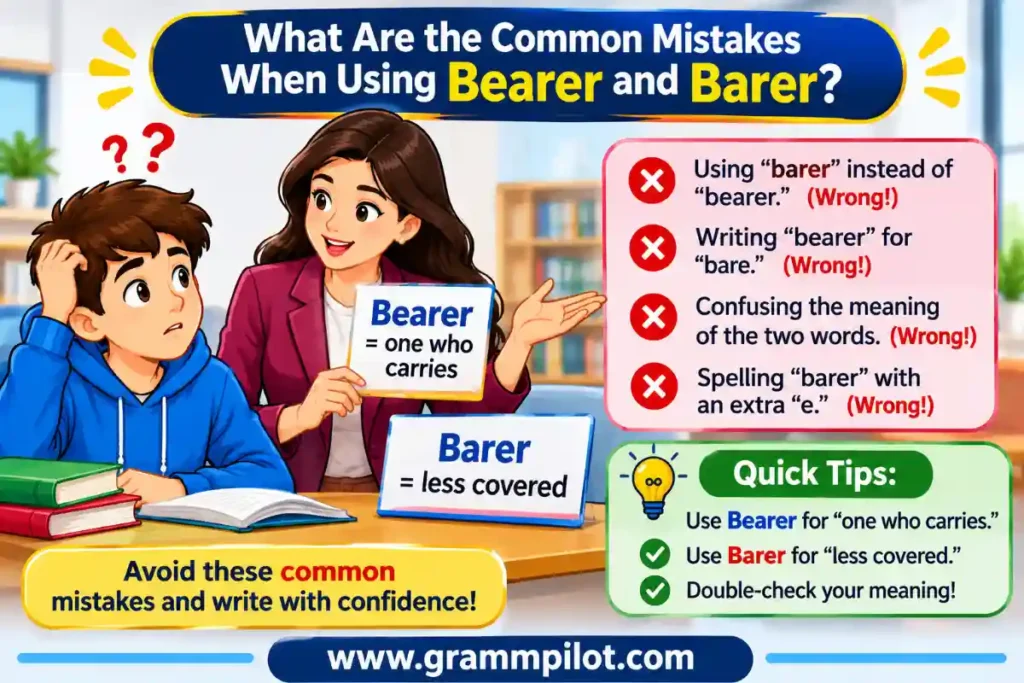
Even experienced writers sometimes confuse homophones. The following mistakes are worth avoiding.
Mistake 1: Using Bearer to Mean More Uncovered
Incorrect: The walls looked bearer after the pictures were removed.
Correct: The walls looked barer after the pictures were removed.
Why? The sentence compares the appearance of the walls. It needs the comparative form of bare.
Mistake 2: Using Barer for Someone Carrying Something
Incorrect: The barer of the letter arrived late.
Correct: The bearer of the letter arrived late.
Why? The sentence refers to a person carrying a letter, so bearer is required.
Mistake 3: Thinking Barer Is Always Incorrect
Some writers assume barer is a spelling mistake.
That’s not true. It is a legitimate comparative adjective.
For example: “The garden looked barer after the leaves fell.”
Mistake 4: Confusing Bearer With the Animal Bear
The word bearer comes from the verb bear, meaning to carry or support. It doesn’t refer to the animal.
For example:
“The bearer carried the certificate.”
Mistake 5: Forgetting That Barer Is Comparative
Barer usually compares two conditions.
For example:
- This room is bare.
- This room is barer than the other room.
The second sentence makes a comparison, which explains the ending -er.
What Are the Antonyms of Bearer and Barer?
Antonyms are words with opposite or contrasting meanings.
The two words need different antonyms because they belong to different word families.
| Word | Possible Opposite | Meaning |
|---|---|---|
| Bearer | Receiver | Person who receives something |
| Bearer | Recipient | Person receiving a message or item |
| Bearer | Non-carrier | Someone who does not carry something |
| Barer | Covered | Having a covering |
| Barer | Decorated | Having ornaments or decoration |
| Barer | Fuller | Having more contents |
| Barer | Concealed | Hidden from view |
| Barer | Protected | Having protection |
Remember that antonyms depend on context. For example, receiver can contrast with bearer when discussing the delivery of a message, but it isn’t an opposite in every situation.
How Can You Remember the Correct Spelling?
Here are five simple tricks to remember the difference.
1. Connect Bearer With Bear
Think of the verb bear, meaning to carry or support. A bearer carries something.
Example: The bearer carried the gift.
2. Connect Barer With Bare
Think of the word bare, meaning uncovered. A barer surface has less covering.
Example: The walls became barer.
3. Remember the Ending -er
The ending -er can create a person who performs an action or a comparative adjective.
- Teach → Teacher
- Drive → Driver
- Bare → Barer
The meaning depends on the base word.
4. Check the Sentence
Ask yourself:
- Is someone carrying or presenting something? Use bearer.
- Is something becoming more uncovered? Use barer.
5. Replace the Word
Try replacing the confusing word with a simpler expression.
If “person carrying something” makes sense, choose bearer.
If “more uncovered” makes sense, choose barer.
Conclusion: Which Spelling Should You Remember?
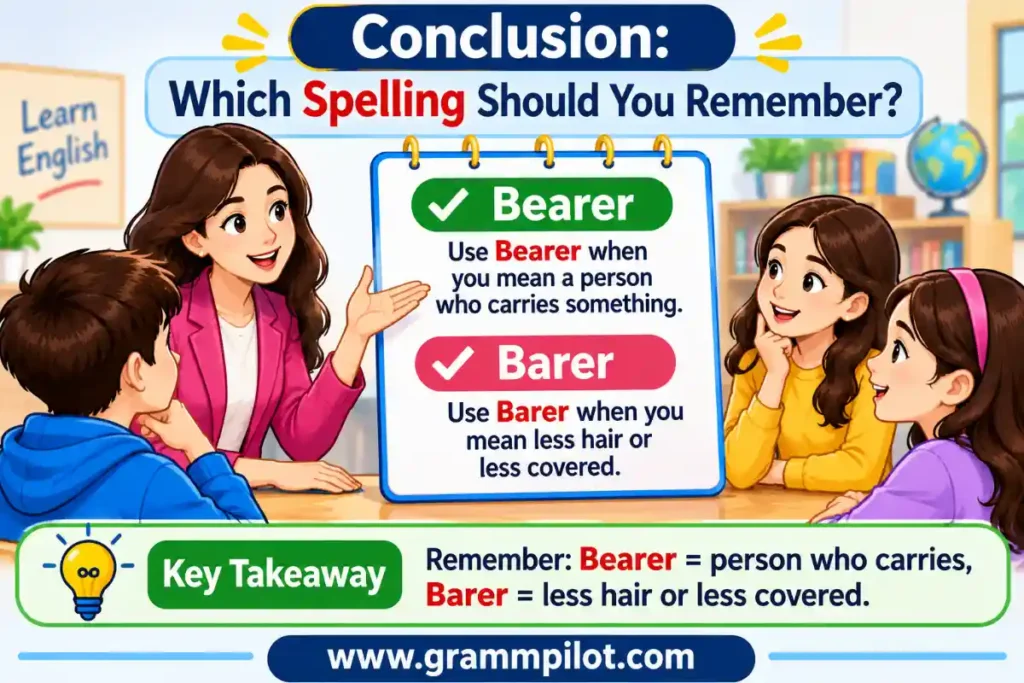
Understanding Bearer vs Barer becomes easy when you remember the meanings of their base words. Bearer comes from bear, meaning to carry, hold, or support something. It is a noun used for someone who carries or presents an item, document, or message. On the other hand, barer comes from bare, meaning uncovered or exposed. It is a comparative adjective used when something has less covering or decoration than before. Both spellings are correct, but they cannot replace each other. Before choosing one, think about the meaning of your sentence. If you’re talking about a person carrying something, choose bearer. If you’re comparing uncovered things, choose barer. A little attention to context will help you write with greater accuracy and confidence.
Frequently Asked Questions
1. What is the difference between bearer and barer?
Bearer means someone who carries or presents something, while barer means more uncovered or exposed. They sound alike but have different grammatical functions.
2. Is barer a real English word?
Yes, barer is a correct English word. It is the comparative form of bare and means more uncovered or less decorated.
3. Is bearer a noun or an adjective?
Bearer is a noun. It refers to a person who carries, holds, or presents something.
4. What’s another way to say bearer?
Other words for bearer include carrier, holder, messenger, courier, and deliverer. The best choice depends on what the person is carrying or presenting.
5. Can I use barer in a sentence?
Yes, you can use barer when comparing two things that have different levels of covering or decoration. For example, “The room looks barer without the furniture.”
6. Are bearer and barer pronounced the same?
Yes, they are homophones in standard American and British English. They have the same pronunciation but different meanings and spellings.
7. Which spelling is correct: bearer or barer?
Both spellings are correct, but they have different meanings. Choose bearer for someone who carries something and barer for something more uncovered.