

Have you ever written a salary, business amount, or property price and wondered about to use lacs or lakhs? For example, should you write 5 lacs, 5 lakhs, or 500,000? This small spelling difference can create confusion, especially when writing for an international audience. Both spellings are commonly seen in South Asian English. However, one form is more widely accepted in standard English writing. Knowing the difference helps you write numbers correctly in emails, financial reports, school assignments, business documents, and everyday conversations. The confusion usually comes from regional spelling habits. People in India, Pakistan, Bangladesh, and other South Asian communities regularly use the word when discussing money, salaries, property, and large amounts.
Quick Answer: Lakhs is the preferred and more widely accepted spelling in South Asian English. Lacs is a common regional spelling variant, but lakhs is generally the safer choice for formal writing. Both refer to the number 100,000.
In this guide, you’ll learn the correct spelling, its origin, meaning, alternatives, regional differences, and how to use the word naturally. You’ll also discover common mistakes and practical examples that make the difference easy to remember.
What Is the Correct Spelling: Lacs or Lakhs?
The preferred spelling is lakhs. A lakh represents 100,000, or one hundred thousand. It is part of the South Asian numbering system, which groups large numbers differently from the commonly used Western system. Although lacs appears in everyday writing, especially in informal South Asian communication, lakhs is the more established spelling in English dictionaries and formal usage.
Consider these examples:
- Correct: The house costs 50 lakhs.
- Common regional variant: The house costs 50 lacs.
- International alternative: The house costs 5 million rupees.
The first example is suitable for most South Asian English writing. The third is often easier for readers who aren’t familiar with the lakh system.
What Does Lakh Mean in Simple English?
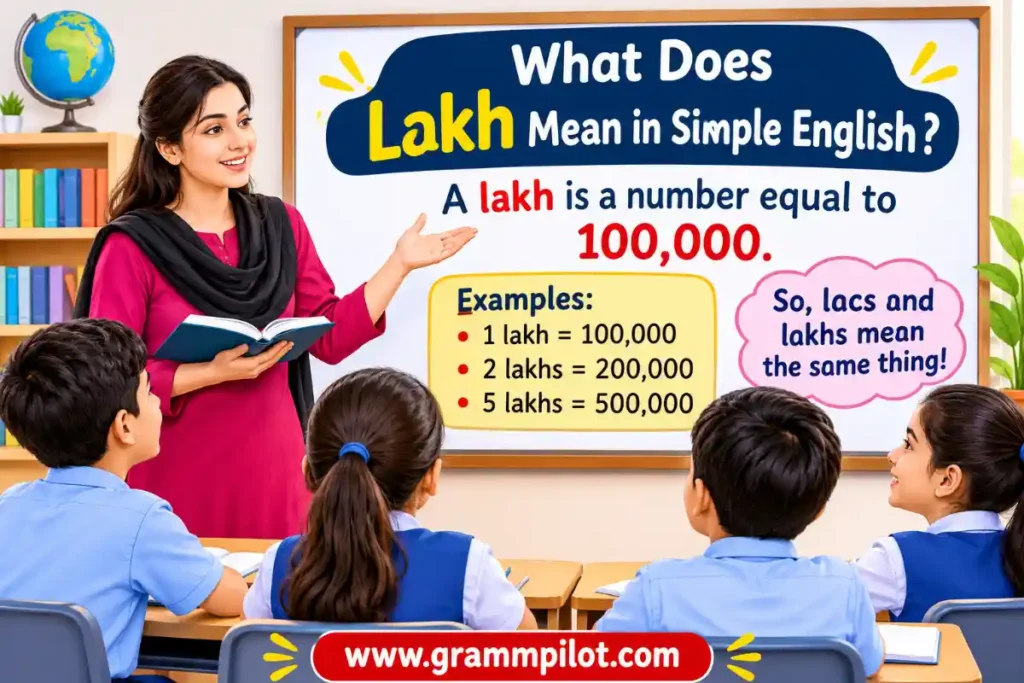
A lakh means 100,000. It is a numerical unit used mainly in South Asia to express large quantities of money, people, products, and other things. Here is a simple breakdown:
- 1 lakh = 100,000
- 2 lakhs = 200,000
- 5 lakhs = 500,000
- 10 lakhs = 1,000,000
- 50 lakhs = 5,000,000
- 100 lakhs = 10,000,000
For example, if someone earns 2 lakhs per month, their monthly income is 200,000 in the relevant currency.
Is Lakh Singular or Plural?
Use lakh for one unit and lakhs when referring to multiple units.
Examples:
- My business earned one lakh rupees.
- The property is worth five lakhs.
- She received ten lakh rupees as compensation.
- The company invested several lakhs in new equipment.
You’ll sometimes see both ten lakh rupees and ten lakhs of rupees. The first is common in standard South Asian English, while the second is also heard in everyday regional speech. For clear formal writing, prefer constructions such as “ten lakh rupees.”
What Is the Origin of the Word Lakh?
The word lakh has an interesting history connected to South Asian languages. It comes from Sanskrit lakṣa, a word historically associated with a large number and used for 100,000. Over time, the word entered several regional languages, including Hindi, Urdu, Bengali, and other languages spoken across South Asia. As English became widely used in the region, people adopted the word into everyday English conversations and writing. That’s why English speakers in India, Pakistan, Bangladesh, and neighboring regions commonly use lakh when discussing large amounts.
Why Are There Two Spellings?
The difference between lakh and lac developed through regional spelling and transliteration practices. The letter combination and pronunciation have been represented differently in English writing. Some people use lac or lacs, while others prefer lakh or lakhs. However, the spelling with kh is the established form in standard South Asian English. The word is also familiar in other languages and communities, but its spelling and grammatical use can vary.
What Are the Best Synonyms and Alternatives for Lakh?
There isn’t always an exact English synonym for lakh because it represents a specific number: 100,000. However, several expressions can replace it depending on the sentence, audience, and writing style. Here are useful alternatives grouped by tone.
Simple and Easy Alternatives
These expressions are helpful in everyday conversations and basic writing.
- One hundred thousand – The exact numerical meaning of one lakh.
- 100,000 – The simplest numerical replacement.
- A hundred thousand – A natural conversational expression.
- A large amount – A general expression for a considerable quantity.
- A big sum – An informal expression for a large amount of money.
- A substantial amount – A relatively large quantity.
- A considerable sum – A significant amount of money.
Examples:
- She saved one hundred thousand rupees.
- The company invested a substantial amount in technology.
- He received a considerable sum from the sale.
Everyday and Conversational Alternatives
These expressions work well when speaking with friends, family, or colleagues.
- A hundred grand – Informal slang for 100,000, especially in money-related conversations.
- A hundred K – A casual numerical expression.
- A big chunk of money – A noticeable amount of money.
- A hefty sum – A large amount of money.
- A good amount – A reasonably large quantity.
- A huge amount – A very large quantity.
- A large figure – A considerable numerical amount.
Examples:
- He spent a hundred grand on his new car.
- The project requires a hefty sum.
- The company reported a large figure in annual sales.
Formal and Professional Alternatives
These expressions are useful in business reports, financial documents, and professional communication.
- One hundred thousand units – A precise numerical expression.
- A significant sum – A considerable amount of money.
- A substantial investment – A large amount invested in something.
- A considerable financial amount – A formal description of money.
- A sizeable sum – A large quantity of money.
- A major financial commitment – A significant financial responsibility.
- A six-figure amount – An amount containing six digits.
Examples:
- The organization made a substantial investment.
- The property requires a significant financial commitment.
- The employee receives a six-figure annual salary.
Informal and Slang Alternatives
These expressions are more relaxed and shouldn’t be used in every professional situation.
- Grand – Slang for one thousand in some English-speaking regions; 100 grand means 100,000.
- K – A short form for thousand; 100K means 100,000.
- A pile of money – An informal description of a large amount.
- Big bucks – Slang for a considerable amount of money.
- A fortune – An informal expression for a very large amount of money.
- Loads of money – A casual expression for a large quantity.
Remember that these alternatives aren’t all interchangeable. Some describe an exact number, while others only suggest that an amount is large.
What Are the Differences Between Lakh, Lac, and Thousand?
These words are related to numbers, but they don’t represent the same quantity.
Understanding their values will help you avoid mistakes.
| Word | Numerical value | Meaning |
|---|---|---|
| Thousand | 1,000 | One thousand |
| Ten thousand | 10,000 | Ten thousand |
| Lakh | 100,000 | One hundred thousand |
| Ten lakhs | 1,000,000 | One million |
| Crore | 10,000,000 | Ten million |
Lakh vs. Thousand: What’s the Difference?
A lakh is equal to 100 thousand.
For example:
- 1 thousand = 1,000
- 10 thousand = 10,000
- 100 thousand = 1 lakh
If someone says they have 3 lakhs, they have 300,000, not 3,000.
Lakh vs. Million: What’s the Difference?
A million is equal to ten lakhs.
For example:
- 1 lakh = 100,000
- 5 lakhs = 500,000
- 10 lakhs = 1,000,000
This conversion is especially useful when communicating with people who use the international numbering system.

How Do You Write Lacs or Lakhs in Different Situations?
The right expression depends on your audience and the type of writing.
Which Spelling Is Best for Formal Writing?
Use lakh or lakhs in formal South Asian English documents.
Examples:
- The annual budget is 25 lakh rupees.
- The company invested 40 lakh rupees.
- The estimated project cost is 75 lakhs.
For international documents, consider writing the full numerical value to prevent confusion.
Which Word Should You Use in a Resume?
If you’re describing a salary, project budget, or business achievement, choose a clear expression that readers can understand.
Examples:
- Managed a project worth 15 million rupees.
- Increased annual sales to 50 lakh rupees.
- Supervised a budget of 5,000,000 rupees.
For international employers, writing the full amount is usually the safest choice.
Which Word Works Best in an Email?
In professional emails, clarity matters more than using regional expressions.
Examples:
- The proposed investment is 20 lakh rupees.
- Our estimated budget is 2,000,000 rupees.
- The annual salary package is 1.2 million rupees.
Choose the version that your recipient will understand immediately.
Which Word Is Best for Texting?
For casual messages, people often use shortened forms.
Examples:
- The car costs 15 lakh.
- He earns 2L per month.
- The property is worth 80L.
These shortened forms are common in some South Asian online communities. However, avoid them when the meaning might be unclear.
Which Word Should You Use in an Essay?
For school and college assignments, use lakh and lakhs consistently when discussing the South Asian numbering system.
Example: “According to the estimate, the city has a population of approximately 25 lakh people.”
If your essay is intended for international readers, you can explain the number as 2.5 million.
What Are 12+ Examples of Lakh in Everyday English?
Examples make numerical expressions easier to understand. Here are original sentences from different situations.
Money and Personal Finance
- She saved five lakhs from her monthly income.
- My brother purchased a motorcycle worth three lakh rupees.
- The bank approved a loan of ten lakh rupees.
- Their family spent 25 lakhs on a new house.
- He wants to save at least one lakh rupees this year.
Business and Employment
- The company invested 50 lakh rupees in new equipment.
- Her annual salary is 12 lakh rupees.
- The business generated profits of 30 lakhs last year.
- The startup raised 75 lakh rupees from investors.
Education and Daily Life
- The university received a donation of 20 lakh rupees.
- More than one lakh students applied for the examination.
- The hospital treated several lakh patients over the years.
- The charity collected five lakh rupees for flood victims.
- The online video received more than ten lakh views.
Notice how the same numerical unit works for money, people, views, and other quantities.

Lakh vs. Lac: What’s the Difference?
The main difference is spelling and standard usage. Lakh is the preferred spelling in standard South Asian English. Lac is a regional spelling variant that appears in some writing.
Consider these examples:
- Preferred: The building costs 20 lakh rupees.
- Regional variant: The building costs 20 lac rupees.
The second form is understandable in some communities, but the first is generally safer for formal English. There is another important point: lac is also the name of a natural resin produced by certain insects. This is a different word with a different meaning. Therefore, don’t assume that every use of lac refers to the number 100,000.
Lakh vs. Lakhs: When Should You Use Each?
The choice between singular and plural depends on how you express the number.
When Should You Use Lakh?
Use lakh when referring to one unit or when a number directly comes before the unit in standard South Asian English.
Examples:
- One lakh rupees
- Five lakh people
- Ten lakh students
- Twenty-five lakh dollars
When Should You Use Lakhs?
Use lakhs when referring to multiple units without a specific number directly modifying the word.
Examples:
- Several lakhs were spent on construction.
- The project earned lakhs in profit.
- Many lakhs of rupees were collected.
A helpful rule is to use “five lakh rupees” rather than “five lakhs rupees” in formal writing.
How Is Lakh Used in the Indian and International Numbering Systems?
South Asian countries often use a different grouping system from the international system. In the international system, commas usually separate groups of three digits from the right. In the Indian numbering system, the first group contains three digits, followed by groups of two digits.
For example:
| Number | International format | Indian format |
|---|---|---|
| One thousand | 1,000 | 1,000 |
| Ten thousand | 10,000 | 10,000 |
| One lakh | 100,000 | 1,00,000 |
| Ten lakhs | 1,000,000 | 10,00,000 |
| One crore | 10,000,000 | 1,00,00,000 |
Why Does the Indian System Use Different Commas?
The Indian system groups large numbers around lakhs and crores. After the first three digits, commas appear after every two digits.
For example:
- 1,00,000 = One lakh
- 10,00,000 = Ten lakhs
- 1,00,00,000 = One crore
This system is widely used in India and is also familiar in Pakistan and Bangladesh.
What Are the Common Mistakes When Using Lakh?
Even though the meaning is simple, people make several mistakes when writing this word.
Mistake 1: Confusing Lakh With Thousand
Incorrect: He earned five lakh rupees, meaning 5,000 rupees.
Correct: Five lakh rupees means 500,000 rupees.
Always remember that one lakh contains five digits after the number 1.
Mistake 2: Writing Lakhs With Every Number
Incorrect: She earns five lakhs rupees.
Better: She earns five lakh rupees.
The singular form is preferred when a specific number directly modifies the unit in standard South Asian English.
Mistake 3: Using Lakh and Million Interchangeably
Incorrect: One lakh means one million.
Correct: One lakh means 100,000, while one million means 1,000,000.
A million is ten times larger than a lakh.
Mistake 4: Mixing Numbering Systems
Avoid writing confusing combinations such as 1,000,000 lakh when you actually mean ten lakhs.
Use one clear system and check the numerical value before publishing a financial document.
Mistake 5: Assuming Lac Is Always the Correct Spelling
Although lac appears in regional writing, lakh is the more widely accepted spelling for the numerical unit.
For formal documents, choose the established spelling.
Mistake 6: Forgetting the Currency
A number can be confusing if readers don’t know which currency you’re discussing.
Instead of writing: “The property costs 50 lakhs.”
Write: “The property costs 50 lakh Pakistani rupees.”
This is especially useful when communicating across countries.
What Are the Antonyms of Lakh?
Lakh is a specific numerical unit, so it doesn’t have a direct antonym. However, you can use expressions that describe smaller amounts when comparing quantities.
Examples include:
- A few thousand
- A small amount
- A minor sum
- A limited quantity
- A handful
- A fraction
For example: “Instead of spending several lakhs, they decided to invest a few thousand rupees first.”
These expressions describe smaller quantities but aren’t exact opposites of lakh.
How Can You Choose the Right Word?
Use these simple tips to make your writing clearer.
- Choose lakhs for standard spelling: Use the established spelling in formal South Asian English.
- Check the numerical value: Remember that one lakh equals 100,000.
- Use lakh after specific numbers: Write five lakh rupees in formal usage.
- Know your audience: International readers may understand 100,000 more easily.
- Avoid unnecessary slang: Expressions such as “hundred grand” are better suited to casual conversations.
- Mention the currency: Specify rupees, dollars, or another currency.
- Stay consistent: Don’t switch between Indian and international number formats without a reason.
- Check singular and plural forms: Use the form that fits the sentence.
Final Teacher Explanation: Which Spelling Should You Remember?
The easiest way to remember this spelling is to connect the word with its numerical meaning. One lakh means 100,000. Ten lakhs mean one million. Although both spellings appear in regional writing, lakh and lakhs are the preferred forms in standard South Asian English. If you’re writing an academic assignment, business report, resume, or professional email, choose the established spelling. If your audience is unfamiliar with the South Asian numbering system, write the complete numerical value instead. You don’t need complicated grammar rules to remember this difference. Just understand the number, choose the appropriate singular or plural form, and keep your writing consistent.

Conclusion: How Can You Remember the Correct Spelling?
Choosing the right spelling becomes easy when you understand its meaning and usage. Lacs or lakhs may both appear in regional writing, but lakhs is the more widely accepted spelling, while lakh is used for a single numerical unit or after a specific number. Remember that one lakh equals 100,000 and ten lakhs equal one million. Use the established spelling in formal writing, and consider the international numerical equivalent when communicating with readers from other countries. The best writing is clear, accurate, and easy to understand. Once you learn these simple rules, you’ll be able to use the word confidently in emails, essays, financial documents, and everyday conversations.
Frequently Asked Questions
1. Is it lacs or lakhs?
Lakhs is the preferred spelling in standard South Asian English. Lacs is a regional spelling variant used by some writers.
2. Does one lakh mean 100,000?
Yes, one lakh means exactly 100,000. It is a common numerical unit in South Asian countries.
3. Is lakh singular or plural?
Lakh is singular, while lakhs is plural. For example, one lakh and five lakhs.
4. Is lacs or lakhs correct in British English?
Lakh and lakhs are established in South Asian English, which has strong connections with British English. Lakh is the preferred spelling for the numerical unit.
5. What is another word for one lakh?
One hundred thousand is the exact English equivalent of one lakh. You can also write 100,000.
6. How many lakhs make one million?
Ten lakhs make one million. In numbers, 10 lakhs equal 1,000,000.
7. Can I write five lakhs rupees?
People commonly say this in regional conversation, but five lakh rupees is generally preferred in standard formal South Asian English.