
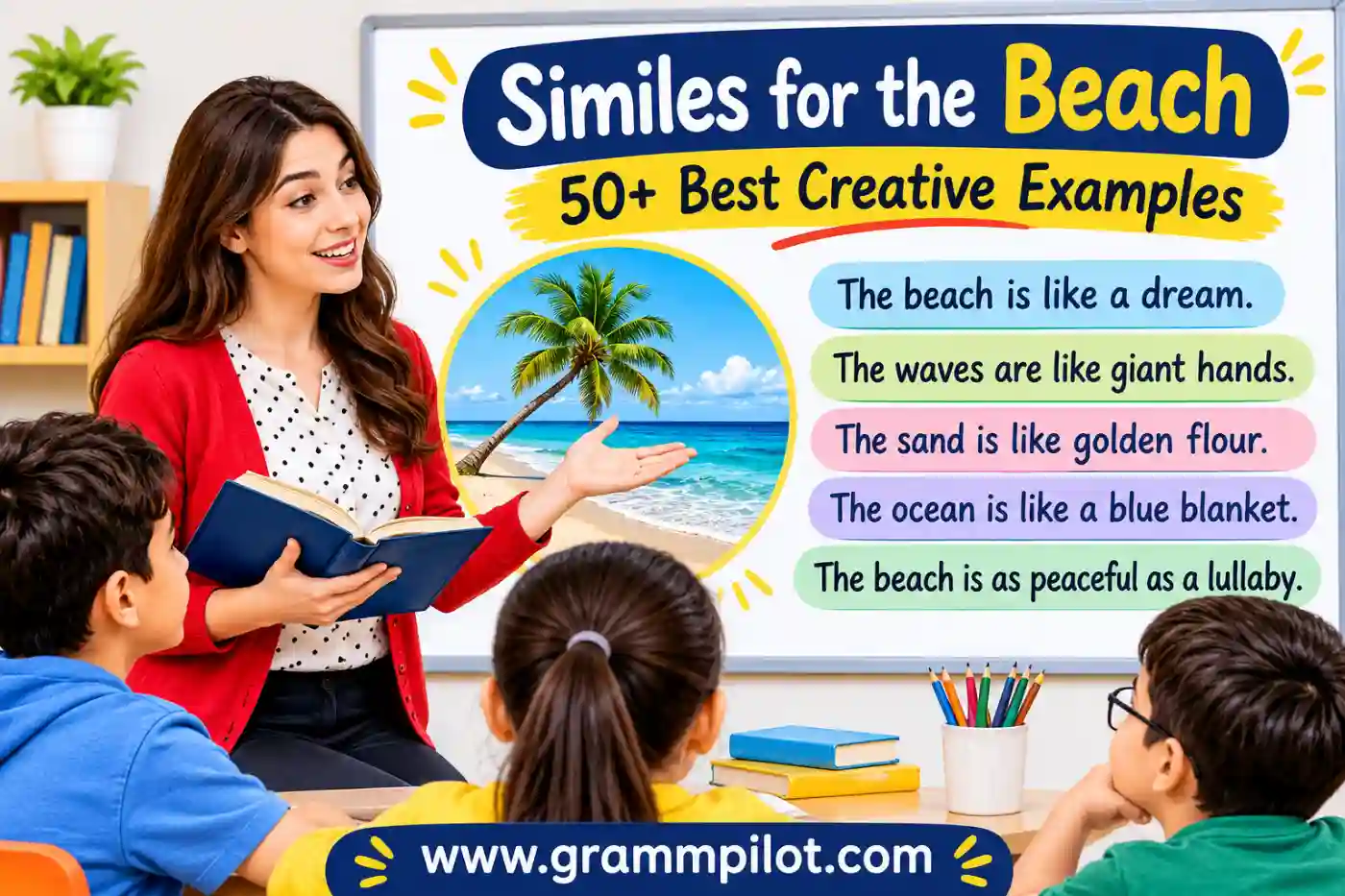
Imagine writing a school essay about your summer vacation. You want to describe the beautiful beach, the soft sand, and the waves moving toward the shore. You could simply say that the beach was beautiful, but that description doesn’t give readers a clear picture. Similes for the Beach make your writing more colorful by comparing beach features with familiar objects, people, animals, and experiences. They help readers imagine the beauty, movement, sounds, and peaceful atmosphere of the seaside. For example, you can describe the sand as soft as cotton, the ocean as blue as sapphire, or the waves as playful as dancing children. What are similes for the beach?
They are creative comparisons that use like or as to describe the beach, ocean, waves, sand, sunshine, and other coastal features. In this guide, you’ll discover more than 50 creative examples, their meanings, different types of beach comparisons, common mistakes, and practical tips for using them in essays, stories, poems, and everyday conversations.You can also explore related examples Similes for Old.
What Is a Simile, and How Does It Describe the Beach?
A simile is a figure of speech that compares two different things using the words like or as. It helps readers understand a description by connecting it with something familiar.
For example:
- The sand was as soft as cotton.
- The waves danced like playful children.
- The ocean sparkled like a field of diamonds.
These sentences don’t mean that sand is actually cotton or that waves are children. They create pictures in the reader’s mind. Beach descriptions often include natural beauty, movement, sounds, and emotions. Similes make these details easier to imagine.
Why Do Writers Use Beach Similes?
Writers use comparisons to make ordinary descriptions more interesting and meaningful. Here are some reasons to use them:
- Describe natural beauty: Show the colors of the ocean, sand, and sunset.
- Express emotions: Communicate feelings of excitement, peace, or happiness.
- Create pictures: Help readers imagine a coastal setting.
- Improve storytelling: Make beach scenes more engaging.
- Add personality: Give ordinary sentences a creative touch.
Where Did the Words Simile and Beach Come From?
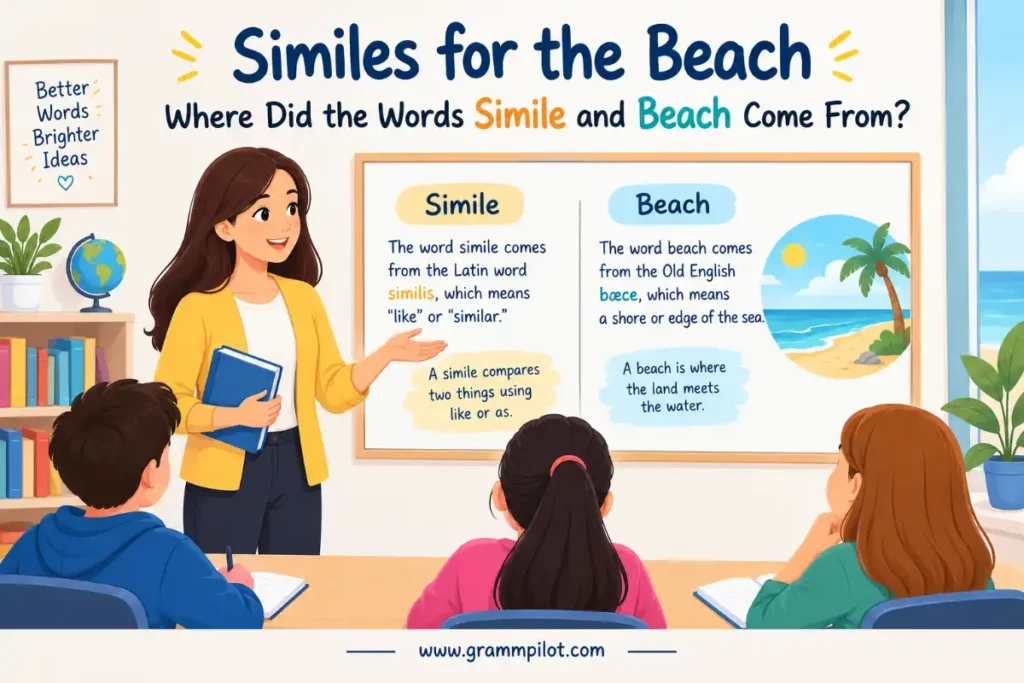
The word simile comes from the Latin word similis, which means similar or alike. It entered English through French and Latin influences. A simile describes a comparison between two different things that share a particular quality. The word beach has older English and Germanic roots. It refers to the shore or land beside a sea, ocean, or lake. When writers combine these ideas, they can compare beach features with familiar things. For example, golden sand can look like honey, while calm water can resemble a giant mirror.
50+ Best Similes for the Beach With Meanings
Below are creative comparisons for describing different beach features. Each group focuses on a particular part of the coastal environment.
1. What Are the Best Similes for Beach Sand?
Sand can be soft, rough, hot, golden, or sparkling. These comparisons help readers imagine its appearance and texture.
| Simile | Meaning | Tone | Example |
|---|---|---|---|
| As soft as cotton | Very gentle | Simple | The sand felt as soft as cotton. |
| Like golden powder | Fine golden grains | Descriptive | The shore looked like golden powder. |
| As hot as an oven | Extremely hot | Everyday | The sand was as hot as an oven. |
| Like tiny diamonds | Shiny grains | Creative | The sand sparkled like tiny diamonds. |
| As smooth as silk | Very smooth | Descriptive | The wet sand felt as smooth as silk. |
| Like warm flour | Fine and powdery | Simple | The sand covered our feet like warm flour. |
| As golden as honey | Rich golden color | Creative | The beach looked as golden as honey. |
More example sentences:
- The soft sand slipped between my toes like fine powder.
- Golden grains covered the shoreline like a beautiful carpet.
- The afternoon sun made the sand shine like thousands of tiny jewels.
2. What Are Some Similes for Ocean Waves?
Waves are always moving. Sometimes they are gentle, while at other times they are powerful and noisy.
| Simile | Meaning | Tone | Example |
|---|---|---|---|
| Like dancing ribbons | Graceful movement | Creative | The waves moved like dancing ribbons. |
| As powerful as a giant | Extremely strong | Strong | The waves were as powerful as a giant. |
| Like rolling hills | Rising and falling | Descriptive | The waves looked like rolling hills. |
| As gentle as a whisper | Very soft movement | Peaceful | The waves touched the shore as gently as a whisper. |
| Like galloping horses | Fast, powerful movement | Strong | The waves rushed forward like galloping horses. |
| As restless as a child | Constant movement | Everyday | The ocean was as restless as a child. |
| Like silver curtains | Shimmering movement | Creative | The waves fell like silver curtains. |
More example sentences:
- Small waves danced toward the shore like playful children.
- Powerful waves crashed against the rocks like galloping horses.
- The gentle water moved like a ribbon in the wind.
3. What Are the Best Similes for the Ocean?
The ocean can look endless, mysterious, colorful, and peaceful. Use these comparisons to describe its appearance.
| Simile | Meaning | Tone | Example |
|---|---|---|---|
| As blue as sapphire | Deep blue color | Creative | The ocean was as blue as sapphire. |
| Like a giant mirror | Reflecting the sky | Descriptive | The sea looked like a giant mirror. |
| As endless as the sky | Seemingly limitless | Creative | The ocean appeared as endless as the sky. |
| Like liquid glass | Clear and smooth | Descriptive | The water looked like liquid glass. |
| As deep as a mystery | Mysterious depth | Creative | The ocean seemed as deep as a mystery. |
| Like a blue blanket | Covering a wide area | Simple | The sea spread like a blue blanket. |
| As sparkling as crystal | Bright and shining | Descriptive | The water was as sparkling as crystal. |
More example sentences:
- The blue ocean stretched toward the horizon like an endless painting.
- The clear water looked like liquid glass beneath the morning sun.
- The sunlight made the sea sparkle like a precious gemstone.
4. What Are Some Similes for Beach Sunsets?
A beach sunset creates a beautiful combination of orange, red, pink, and golden colors.
| Simile | Meaning | Tone | Example |
|---|---|---|---|
| Like a ball of fire | Bright orange sun | Strong | The sun looked like a ball of fire. |
| As golden as honey | Warm golden color | Descriptive | The sunset was as golden as honey. |
| Like a painted canvas | Colorful sky | Creative | The sky looked like a painted canvas. |
| As red as a ruby | Deep red appearance | Descriptive | The horizon became as red as a ruby. |
| Like melted gold | Shining golden light | Creative | Sunlight spread like melted gold. |
| As beautiful as a dream | Extremely beautiful | Emotional | The sunset was as beautiful as a dream. |
More example sentences:
- The setting sun looked like a burning ball of fire.
- Pink clouds floated across the sky like soft cotton candy.
- Golden sunlight spread over the ocean like melted gold.
5. What Are the Best Similes for Beach Breezes?
A sea breeze can make a warm summer day feel fresh and comfortable.
| Simile | Meaning | Tone | Example |
|---|---|---|---|
| As cool as ice | Very refreshing | Simple | The breeze felt as cool as ice. |
| Like a gentle kiss | Soft and pleasant | Emotional | The wind touched my face like a gentle kiss. |
| As light as a feather | Barely noticeable | Descriptive | The breeze was as light as a feather. |
| Like a friendly whisper | Quiet and gentle | Creative | The wind sounded like a friendly whisper. |
| As refreshing as rain | Bringing relief | Everyday | The sea breeze felt as refreshing as rain. |
Example sentences:
- The cool sea breeze brushed my cheeks like a gentle kiss.
- The coastal wind felt as refreshing as rain after a hot afternoon.
6. What Are Some Similes for a Peaceful Beach?
A quiet beach can be a accurate place to relax, think, and enjoy nature.
| Simile | Meaning | Tone | Example |
|---|---|---|---|
| As peaceful as a sleeping baby | Completely calm | Gentle | The beach was as peaceful as a sleeping baby. |
| Like a quiet paradise | Beautiful and relaxing | Creative | The shore felt like a quiet paradise. |
| As still as a painting | Almost motionless | Descriptive | The water was as still as a painting. |
| Like a soothing lullaby | Comforting sound | Emotional | The waves sounded like a soothing lullaby. |
| As calm as a sleeping lake | Very peaceful | Simple | The ocean was as calm as a sleeping lake. |
Example sentences:
- The empty beach was as peaceful as a sleeping baby.
- The gentle waves sounded like a soothing lullaby.
- The quiet shoreline felt like a hidden paradise.
7. What Are the Best Similes for a Busy Beach?
A crowded beach can be full of children, families, games, music, and laughter.
| Simile | Meaning | Tone | Example |
|---|---|---|---|
| Like a busy marketplace | Full of activity | Everyday | The beach was like a busy marketplace. |
| As lively as a festival | Exciting and cheerful | Positive | The shore was as lively as a festival. |
| Like a playground | Full of children | Simple | The beach looked like a playground. |
| As colorful as a rainbow | Full of bright colors | Creative | The beach was as colorful as a rainbow. |
| Like a buzzing beehive | Very busy | Informal | The crowded beach was like a buzzing beehive. |
Example sentences:
- Children played in the water like happy birds in spring.
- Colorful umbrellas made the beach look as bright as a rainbow.
- The summer crowd filled the shoreline like a busy marketplace.
8. What Are Some Similes for Beach Shells and Rocks?
Shells and stones add small but beautiful details to a coastal landscape.
| Simile | Meaning | Tone | Example |
|---|---|---|---|
| Like tiny treasures | Small valuable objects | Creative | The shells looked like tiny treasures. |
| As smooth as glass | Very smooth | Descriptive | The pebbles were as smooth as glass. |
| Like colorful buttons | Small and round | Simple | The shells looked like colorful buttons. |
| As hard as stone | Very firm | Everyday | The rock was as hard as stone. |
| Like nature’s jewelry | Beautiful natural objects | Creative | The shells looked like nature’s jewelry. |
Example sentences:
- Little seashells lay across the sand like tiny treasures.
- Smooth pebbles shone like polished glass.
- Colorful shells looked like nature’s beautiful jewelry.
9. What Are the Best Similes for a Beautiful Beach?
Sometimes, you want to describe the entire beach rather than one particular feature.
- Like a picture from a postcard: Extremely attractive.
- As beautiful as heaven: Exceptionally beautiful.
- Like a hidden paradise: A wonderful and peaceful place.
- As bright as a jewel: Colorful and shining.
- Like a dream come true: A wonderful experience.
Example sentences:
- The tropical beach looked like a picture from a postcard.
- The hidden shore was as beautiful as heaven.
- The turquoise water shone like a precious jewel.
10. What Are Some Similes for Beach Sounds?
The beach has many sounds, including crashing waves, singing birds, blowing wind, and people laughing.
- Like a gentle drumbeat: A repeated rhythmic sound.
- As loud as thunder: Extremely noisy.
- Like a soft song: Pleasant and musical.
- As cheerful as children’s laughter: Happy and lively.
- Like a whispering voice: Very quiet.
Example sentences:
- The waves made a gentle sound like a soft song.
- The crashing water was as loud as thunder.
- The repeated waves sounded like a gentle drumbeat.
20 More Creative Similes for the Beach
If you want more variety for poems, stories, and descriptions, try these original comparisons.
| Simile | Meaning |
|---|---|
| The beach was like a golden carpet. | Wide golden sand |
| The waves were like restless dancers. | Constant movement |
| The sunlight was like warm honey. | Soft golden light |
| The sea was as bright as a polished mirror. | Reflective water |
| The shore was like nature’s playground. | A place for fun |
| The clouds floated like white ships. | Cloud shapes |
| The foam was like whipped cream. | Soft white foam |
| The ocean roared like a hungry lion. | Powerful waves |
| The water was as clear as crystal. | Very transparent |
| The palm trees swayed like graceful dancers. | Gentle movement |
| The beach was as warm as a summer hug. | Comfortable warmth |
| The moon shone like a silver coin. | Bright moonlight |
| The tide moved like a giant breathing. | Repeated movement |
| The seagulls called like cheerful singers. | Bird sounds |
| The horizon looked like a painted line. | Distant scenery |
| The beach umbrella stood like a colorful flower. | Bright appearance |
| The wet sand shone like polished glass. | Smooth and reflective |
| The sea stretched like a blue blanket. | Wide ocean |
| The sunset glowed like a golden lamp. | Warm evening light |
| The ocean breeze felt like a cool drink. | Refreshing air |
What Are the Best Beach Similes by Intensity?
Different beach conditions need different comparisons. A gentle wave doesn’t need the same description as a powerful storm.
| Intensity | Examples | Best Use |
|---|---|---|
| Mild | Like a soft whisper, like a feather | Gentle breeze |
| Moderate | Like dancing ribbons, like a silver curtain | Moving waves |
| Strong | Like galloping horses, like a roaring lion | Powerful waves |
| Extreme | Like a thunderous army, like a violent storm | Rough ocean |
For example:
- Mild: The waves touched the shore like a gentle whisper.
- Moderate: The waves moved like dancing ribbons.
- Strong: The ocean roared like a hungry lion.
- Extreme: The storm waves crashed like an army attacking the shore.
Always match the strength of your comparison to the scene.
What Parts of Speech Are Used in Beach Similes?
A simile is a figure of speech rather than a separate part of speech. However, it often contains adjectives, nouns, and verbs.
| Word Type | Examples | Purpose |
|---|---|---|
| Adjectives | Soft, golden, peaceful, sparkling | Describe qualities |
| Nouns | Cotton, diamonds, mirror, lion | Provide comparisons |
| Verbs | Dancing, crashing, sparkling, rolling | Show actions |
| Adverbs | Gently, quietly, brightly | Explain how something happens |
For example, in “The waves danced like children,” waves is a noun, danced is a verb, and children is a noun used in the comparison.
Are Beach Similes Different in American and British English?
American and British writers use the same basic simile structure. The main differences appear in beach-related vocabulary.
| American English | British English |
|---|---|
| Vacation | Holiday |
| Boardwalk | Promenade |
| Sandbar | Sandbank |
| Flip-flops | Flip-flops |
| Beach towel | Beach towel |
Examples:
- American: The beach was as lively as a summer festival during our vacation.
- British: The beach was as lively as a summer festival during our holiday.
The comparison remains the same. Only some regional vocabulary changes.
Which Beach Similes Work Best in Different Writing Situations?
The right comparison depends on your purpose and audience.
Which Similes Work Best in an Essay?
Choose simple comparisons that help readers imagine the scene.
Examples:
- The sand was as soft as cotton.
- The ocean looked like a giant blue mirror.
- The waves crashed against the shore like galloping horses.
Which Similes Work Best in Texting?
Text messages can be casual and expressive.
Examples:
- The beach was like paradise!
- The water was as blue as sapphire.
- The sunset looked like a painting.
Which Similes Work Best in Emails?
For a travel email, choose natural and clear comparisons. Example: The beach was as peaceful as a quiet garden, making it a accurate place to relax.
Which Similes Work Best in Speaking?
Everyday conversations need expressions that sound natural.
Examples:
- The sand was as hot as fire.
- The waves were like giant dancers.
- The breeze felt as cool as ice.
Which Similes Work Best in Creative Writing?
Stories and poems allow more imaginative comparisons.
Examples:
- The moonlight danced across the sea like silver dust.
- The ocean whispered like an old storyteller.
- The sunset painted the horizon like an artist’s masterpiece.
12 Original Similes for the Beach in Real-Life Situations
Here are additional examples showing how comparisons work in everyday beach scenes.
30. During our family vacation, the beach looked like a colorful playground.
31. My little brother ran across the sand like a happy puppy.
32. The waves followed one another like a line of dancing soldiers.
33. The beach umbrella stood like a colorful flower in the sand.
34. After swimming, the cool breeze felt like a refreshing drink.
35. The sea glittered like thousands of tiny stars.
36. The evening waves whispered like an old storyteller.
37. The wet sand shone like a sheet of polished glass.
38. The seagulls circled above us like white paper airplanes.
39. The storm clouds gathered over the ocean like a dark blanket.
40. The warm sunlight wrapped around us like a soft blanket.
41. The tide moved toward the shore like a giant breathing slowly.
Beach Similes vs. Metaphors: What’s the Difference?
Similes and metaphors both compare different things, but they use different structures.
| Simile | Metaphor |
|---|---|
| The ocean is like a giant mirror. | The ocean is a giant mirror. |
| The sand is as soft as cotton. | The sand is cotton. |
| The waves dance like children. | The waves are dancing children. |
A simile uses like or as to show a comparison. A metaphor describes one thing as another without using these comparison words. Both figures of speech make beach descriptions more interesting.
Calm Beach vs. Rough Beach: What’s the Difference?
A peaceful beach and a rough beach create different feelings. Your comparisons should match the conditions.
| Calm Beach | Rough Beach |
|---|---|
| Like a sleeping baby | Like a roaring lion |
| As still as glass | Like galloping horses |
| Like a gentle song | Like a thunderous drum |
| As peaceful as a dream | Like a battlefield |
| Like dancing ribbons | Like a powerful army |
Use gentle descriptions for quiet scenes and stronger comparisons for storms or rough water.
What Are the Common Mistakes When Writing Beach Similes?
Even creative comparisons can become confusing when they aren’t used correctly.
1. Forgetting Like or As
Incorrect: The waves were dancing children. This is a metaphor, not a simile.
Correct: The waves moved like dancing children.
2. Using Unclear Comparisons
Incorrect: The sand was like a beautiful idea. The reader may not understand the connection.
Better: The sand was as soft as fine flour.
3. Mixing Too Many Comparisons
Incorrect: The ocean was like a mirror, a lion, a blanket, and a mountain. Too many comparisons make the sentence confusing.
Better: The ocean looked like a giant blue mirror.
4. Choosing the Wrong Intensity
A quiet morning beach shouldn’t be described as roaring like a hungry lion. Choose a comparison that matches the actual scene.
5. Repeating the Same Words
Using beautiful, amazing, and wonderful repeatedly makes descriptions less interesting. Try words such as peaceful, sparkling, golden, refreshing, and breathtaking.
What Are the Opposites of Common Beach Descriptions?
Similes don’t always have direct antonyms, but the descriptive words inside them often have opposites.
| Descriptive Word | Opposite |
|---|---|
| Peaceful | Disturbed |
| Calm | Rough |
| Soft | Hard |
| Warm | Cold |
| Bright | Dull |
| Clear | Cloudy |
| Gentle | Harsh |
| Beautiful | Ugly |
| Quiet | Noisy |
| Smooth | Rough |
These words help you describe changing weather, different coastal conditions, and contrasting beach experiences.
What Are the Quick Tips for Choosing the Right Beach Simile?
Use these simple suggestions to make your comparisons more effective.
- Observe nature: Notice the color, movement, sound, and texture of the beach.
- Choose familiar objects: Compare sand with cotton, waves with dancers, or water with glass.
- Match the mood: Use gentle comparisons for peaceful scenes and powerful ones for storms.
- Avoid exaggeration: Make sure the comparison fits the situation.
- Keep sentences natural: Don’t force a comparison into every sentence.
- Use fresh ideas: Create your own expressions instead of depending only on common examples.
- Think about your reader: Choose simple language for school essays and imaginative language for poems.
- Read your sentence aloud: If it sounds confusing, try a clearer comparison.
Final Teacher Explanation: How Can You Describe the Beach Creatively?
Imagine a teacher asking students to describe a beach without using the word beautiful. One student says, “The water was blue.” Another student says, “The water looked like a giant sapphire shining under the sun.” Which sentence creates a clearer picture? The second sentence gives readers something they can imagine. That’s the purpose of a simile. It connects an ordinary description with something familiar. When writing about beaches, think about the waves, sand, wind, shells, sunlight, and sounds. Each detail gives you an opportunity to create an interesting comparison. You don’t need complicated vocabulary to write creatively. Even simple comparisons can make your descriptions more powerful when you choose the right words.
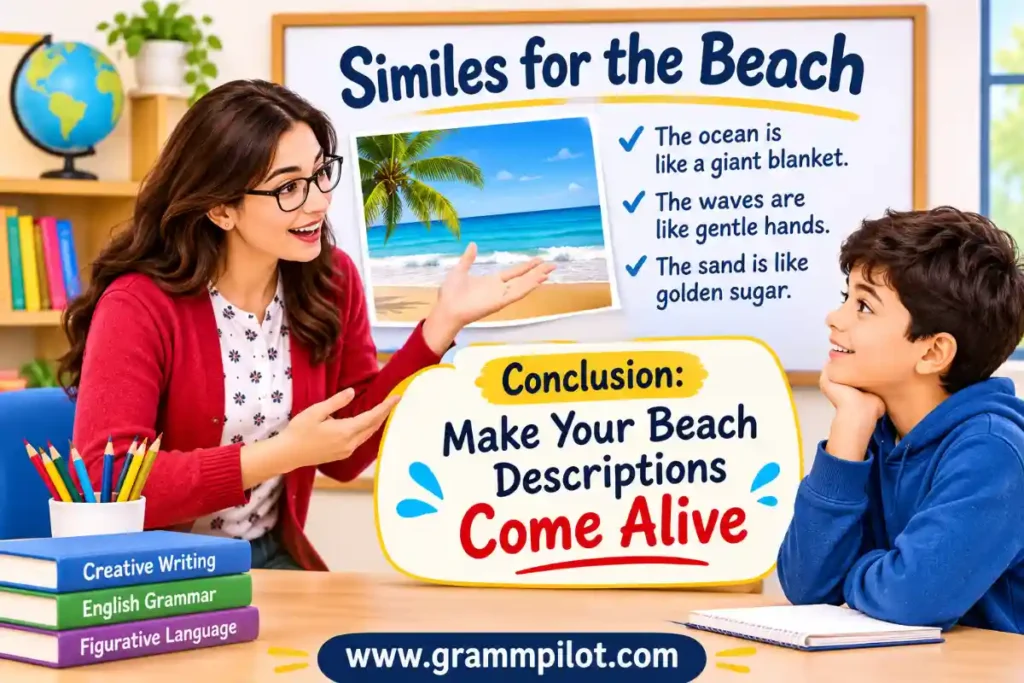
Conclusion: Make Your Beach Descriptions Come Alive
Describing a beach is about more than mentioning sand, water, and sunshine. Good writing helps readers imagine the experience and feel connected to the scene. Comparisons can make this possible by showing how the waves move, how the sand feels, and how the sunset changes the sky. The best Similes for the Beach are those that match the scene and communicate a clear image. A peaceful shoreline might look like a sleeping paradise, while powerful waves might roar like hungry lions. Both comparisons create different feelings. If you’re writing a school essay, a travel story, a poem, or a simple message, experiment with different expressions. Observe nature and use familiar objects to create your own comparisons. With practice, your descriptions will become clearer, more colorful, and more memorable.
Frequently Asked Questions
1. What are the best similes for the beach?
Some popular examples are “as soft as cotton,” “like a golden carpet,” and “as peaceful as a sleeping baby.” They describe the sand, appearance, and atmosphere of a beach.
2. What is a simile for ocean waves?
“The waves danced like ribbons” is a creative simile for ocean waves. It describes their smooth and graceful movement.
3. How can I describe beach sand creatively?
You can describe sand as soft as cotton, golden like honey, or sparkling like tiny diamonds. Choose a comparison that matches its appearance and texture.
4. What is a simile for a beautiful beach?
“A beautiful beach is like a picture from a postcard” is a simple and effective comparison. It suggests that the scenery is attractive and memorable.
5. What’s another way to describe the beach using a simile?
You could say, “The beach was as peaceful as a sleeping baby” or “The ocean glittered like a field of diamonds.” Both comparisons create clear mental pictures.
6. What is the difference between a beach simile and a metaphor?
A simile uses like or as to compare two things, while a metaphor describes one thing as another. For example, “The sea is like a mirror” is a simile, while “The sea is a mirror” is a metaphor.
7. Why do writers use similes when describing beaches?
Writers use similes to make descriptions more colorful and memorable. They help readers imagine the sights, sounds, textures, and feelings of a coastal setting.