
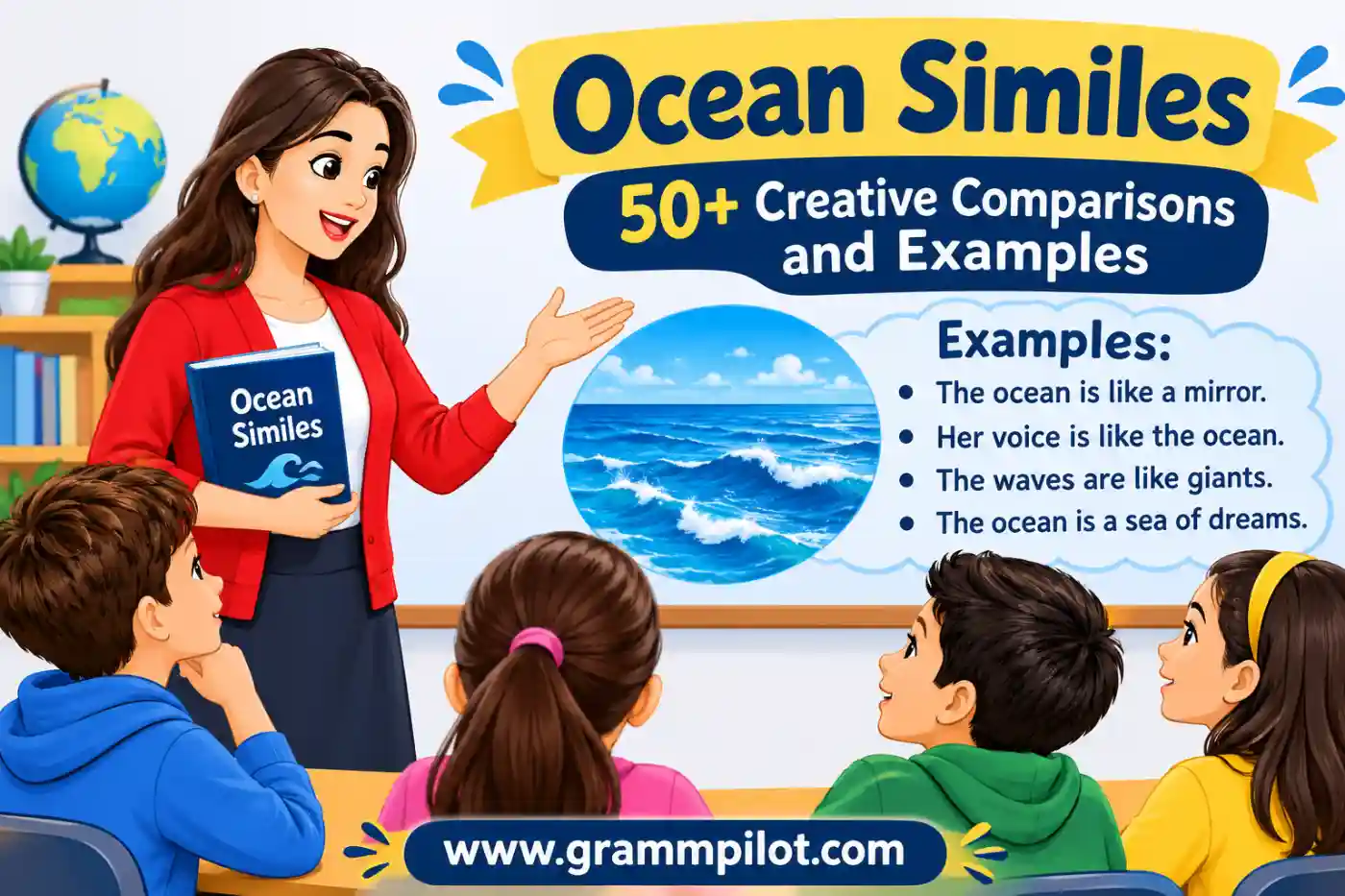
Imagine you’re writing a story about a beach. You describe the ocean as blue and beautiful, but the sentence still feels plain. You want readers to picture the waves, hear the water, and feel the power of the sea. That’s where ocean similes can help. A good simile compares the ocean or its movements to something familiar. It can make a peaceful sea seem as smooth as glass or a stormy ocean sound as fierce as a roaring lion. These comparisons help readers understand not just what the ocean looks like, but also how it feels.
Ocean similes are comparisons that use words such as “like” or “as” to describe the sea, its waves, colors, sounds, and movements. They turn simple descriptions into clear and memorable images.
Whether you’re writing a school essay, poem, short story, or social media caption, the right comparison can make your words more interesting. Below, you’ll find more than 50 examples, grouped by meaning and mood, along with explanations, writing tips, and common mistakes.Another useful figurative-language technique is explained in Similes for Amazing.
1. What Are Ocean Similes?
A simile is a figure of speech that compares two different things using like or as. It helps readers imagine an idea by connecting it to something they already know.
For example: “The ocean was as blue as a sapphire.” This sentence compares the ocean’s color to a sapphire, a bright blue gemstone. It helps readers picture the water more clearly.
Another example:` “The waves crashed like angry giants.” Here, the waves are compared to giants to show their strength and size.
Ocean comparisons can describe several features:
- Color: The ocean looked as blue as a clear summer sky.
- Movement: The waves rolled like hills across the water.
- Sound: The sea roared like a hungry beast.
- Calmness: The water rested like a sleeping child.
- Power: The storm waves struck like a giant hammer.
- Beauty: The sunset shimmered on the ocean like golden dust.
A simile doesn’t mean the ocean is actually a gemstone, giant, or sleeping child. It creates a picture in the reader’s mind.
2. How Did Ocean Similes Develop, and Why Do Writers Use Them?
The word ocean comes from the Latin oceanus, which came from the Greek Okeanos. In ancient Greek stories, Oceanus was the great body of water believed to surround the world. The word simile comes from the Latin similis, meaning “like” or “similar.” This connects directly to the purpose of a simile: showing how one thing is similar to another. People have used comparisons to describe the sea for centuries. Sailors, poets, storytellers, and travelers have compared its waves to mountains, its colors to precious stones, and its sounds to powerful animals. Why are these comparisons useful?
- They make descriptions easier to imagine. Saying “the waves were large” gives basic information. Saying “the waves rose like towering walls” creates a stronger picture.
- They express emotion. A sea that moves like a gentle blanket can suggest peace. A sea that attacks the shore like a wild animal can suggest danger.
- They add personality to writing. Instead of repeating words such as blue, big, and beautiful, writers can create fresh descriptions.
- They help readers connect with nature. Comparing the sea to familiar objects, animals, or experiences makes a huge natural scene easier to understand.
3. What Are the Best Ocean Similes?
Here are 55 creative comparisons for different ocean scenes. Each example includes a short explanation so you can understand when to use it.
Similes for a Calm Ocean
\Use these when describing quiet water, a peaceful beach, or a beautiful morning by the sea.\
- The ocean was as smooth as glass.\
The water was still, with hardly any waves. - The sea rested like a sleeping baby.\
This creates a gentle and peaceful image. - The water stretched like a blue silk blanket.\
It suggests a smooth, wide surface. - The ocean was as quiet as a sleeping village.\
This comparison highlights the silence. - The waves moved like a slow dance.\
It describes soft and graceful movement. - The sea sparkled like a field of tiny diamonds.\
This works when sunlight reflects on the water. - The ocean looked like a peaceful dream.\
It gives the scene a soft, magical feeling. - The water was as gentle as a mother’s touch.\
This comparison suggests warmth and comfort. - The waves whispered like secrets in the wind.\
It describes the soft sound of water. - The sea lay like a giant blue mirror.\
This works when the surface reflects the sky.
Similes for Powerful Ocean Waves
\These comparisons are useful for storm scenes, rough weather, and strong waves hitting the shore.\
- The waves rose like towering mountains.\
It shows how tall and intimidating the waves looked. - The ocean roared like a hungry lion.\
This describes the loud sound of rough water. - The waves crashed like thunder.\
It highlights their sudden and powerful impact. - The sea charged like a wild bull.\
This suggests forceful movement toward the shore. - The waves struck the rocks like giant hammers.\
It creates an image of repeated, heavy blows. - The ocean twisted like a restless snake.\
This describes the twisting movement of rough water. - The waves rolled like giant moving walls.\
It helps readers imagine the size of the water. - The sea fought like a warrior in battle.\
This gives the ocean a fierce and dramatic personality. - The water exploded like a burst of fireworks.\
It describes waves breaking into white spray. - The ocean raged like an angry giant.\
This comparison expresses the power of a stormy sea.
Similes for the Ocean’s Blue Color
\Use these when the color of the water is the main focus of your description.\
- The ocean was as blue as a sapphire.\
It suggests a rich, bright blue color. - The sea looked like a sheet of turquoise glass.\
This works for clear water in a tropical setting. - The water was as deep blue as midnight.\
It describes dark water or an evening scene. - The ocean shimmered like liquid silver.\
This is useful when moonlight or sunlight reflects on the surface. - The sea was as green as an emerald.\
It describes water with a strong green shade. - The water sparkled like blue crystal.\
This suggests clarity and brightness. - The ocean spread like a giant blue canvas.\
It creates an image of a wide, colorful surface. - The sea changed colors like a painter’s palette.\
This works when the water shifts between blue, green, and gray.
Similes for Ocean Waves and Movement
\These examples focus on the way water rises, falls, rolls, and flows.\
- The waves danced like children in a playground.\
This describes playful and lively movement. - The water flowed like a long blue ribbon.\
It suggests smooth, continuous movement. - The waves curled like the pages of an open book.\
This gives a picture of water folding over itself. - The sea moved like a giant breathing creature.\
It suggests the steady rise and fall of the water. - The waves chased each other like playful puppies.\
This works for a lively but gentle sea. - The water rolled like hills under the wind.\
It describes repeated rises and falls. - The waves swept across the shore like a soft broom.\
This suggests water moving over the sand. - The ocean flowed like a never-ending road.\
It highlights the sea’s endless appearance. - The waves folded like sheets of white paper.\
This describes the shape of breaking water.
Similes for the Sound of the Ocean
\Sound-based comparisons help readers imagine what it feels like to stand near the shore.\
- The ocean whispered like a quiet friend.\
This describes soft waves. - The waves clapped like a cheering crowd.\
It works for repeated waves breaking on the beach. - The sea hummed like a distant song.\
This creates a peaceful sound image. - The waves boomed like giant drums.\
It describes loud, heavy crashes. - The water hissed like a hot pan.\
This can describe foam spreading across wet sand. - The ocean rumbled like a passing train.\
It suggests a deep, powerful sound. - The waves sang like a gentle choir.\
This gives the sea a musical quality.
Similes for the Ocean at Sunset and Night
\These comparisons work well in poems, descriptive essays, and stories with dramatic lighting.\
- The ocean glowed like molten gold.\
This describes golden sunlight reflecting on the water. - The sunset painted the sea like an artist’s masterpiece.\
It highlights the changing colors of the evening sky. - The moonlight spread across the ocean like a silver road.\
This creates a clear picture of moonlight on dark water. - The sea looked as dark as a blanket of ink.\
It describes the ocean at night. - The horizon glowed like a burning candle.\
This works when the last light of sunset appears far away. - The stars reflected on the water like scattered diamonds.\
It describes a clear night with visible reflections. - The ocean shimmered like a thousand golden coins.\
This is useful for a bright sunset scene. - The dark waves moved like shadows across the night.\
It creates a mysterious atmosphere.
Similes for a Beautiful Ocean
- The ocean looked like a giant piece of paradise.\
It suggests a beautiful and relaxing place. - The beach shone like a golden carpet beside the sea.\
This describes bright sand next to the water. - The water sparkled like stars scattered across the earth.\
It gives the ocean a magical appearance.
4. What Words Can You Use to Describe the Ocean?
A strong simile often begins with a good descriptive word. Before comparing the sea to something else, decide which feature you want readers to notice.
Here are 28 useful ocean-related words and expressions, grouped by tone.
Simple Words
| Word | Meaning | Tone | Example |
|---|---|---|---|
| Blue | A common ocean color | Simple | The blue water looked beautiful. |
| Calm | Peaceful and quiet | Simple | The calm sea reflected the sky. |
| Deep | Extending far downward | Simple | The deep ocean looked mysterious. |
| Clear | Easy to see through | Simple | Clear water revealed the rocks below. |
| Big | Large in size | Simple | Big waves reached the shore. |
| Cold | Having a low temperature | Simple | Cold water splashed my feet. |
| Warm | Having a comfortable temperature | Simple | Warm water touched the sand. |
Everyday Descriptive Words
| Word | Meaning | Tone | Example |
|---|---|---|---|
| Shimmering | Shining with a soft, moving light | Descriptive | Shimmering water filled the bay. |
| Sparkling | Shining with small bright points | Descriptive | Sparkling waves caught the sunlight. |
| Gentle | Soft and mild | Everyday | Gentle waves reached the beach. |
| Restless | Always moving | Descriptive | Restless water rocked the boat. |
| Rolling | Moving in a series of rises | Everyday | Rolling waves crossed the sea. |
| Foamy | Covered with bubbles | Everyday | Foamy water washed over the sand. |
| Turquoise | Blue-green in color | Descriptive | Turquoise water surrounded the island. |
Formal and Literary Words
| Word | Meaning | Tone | Example |
|---|---|---|---|
| Vast | Extremely wide or large | Formal | The vast ocean stretched beyond sight. |
| Tranquil | Peaceful and quiet | Literary | A tranquil sea welcomed the morning. |
| Majestic | Grand and impressive | Literary | The majestic ocean filled the horizon. |
| Turbulent | Rough and disturbed | Formal | Turbulent water surrounded the rocks. |
| Luminous | Giving off or reflecting light | Literary | Luminous waves glowed beneath the moon. |
| Tempestuous | Violent or stormy | Formal | Tempestuous waves struck the coast. |
| Serene | Calm and peaceful | Literary | The serene bay looked like a painting. |
Informal and Creative Expressions
| Word or Phrase | Meaning | Tone | Example |
|---|---|---|---|
| Wavy | Full of waves | Casual | The water looked wavy today. |
| Glassy | Smooth like glass | Casual | The bay was glassy in the morning. |
| Choppy | Covered with small, rough waves | Everyday | The water became choppy by noon. |
| Wild | Uncontrolled or rough | Casual | The wild sea frightened the sailors. |
| Never-ending | Seemingly without an end | Informal | The never-ending blue stretched ahead. |
| Splashy | Full of splashing water | Playful | Splashy waves reached our feet. |
| Crystal-clear | Extremely clear | Everyday | Crystal-clear water revealed colorful fish. |
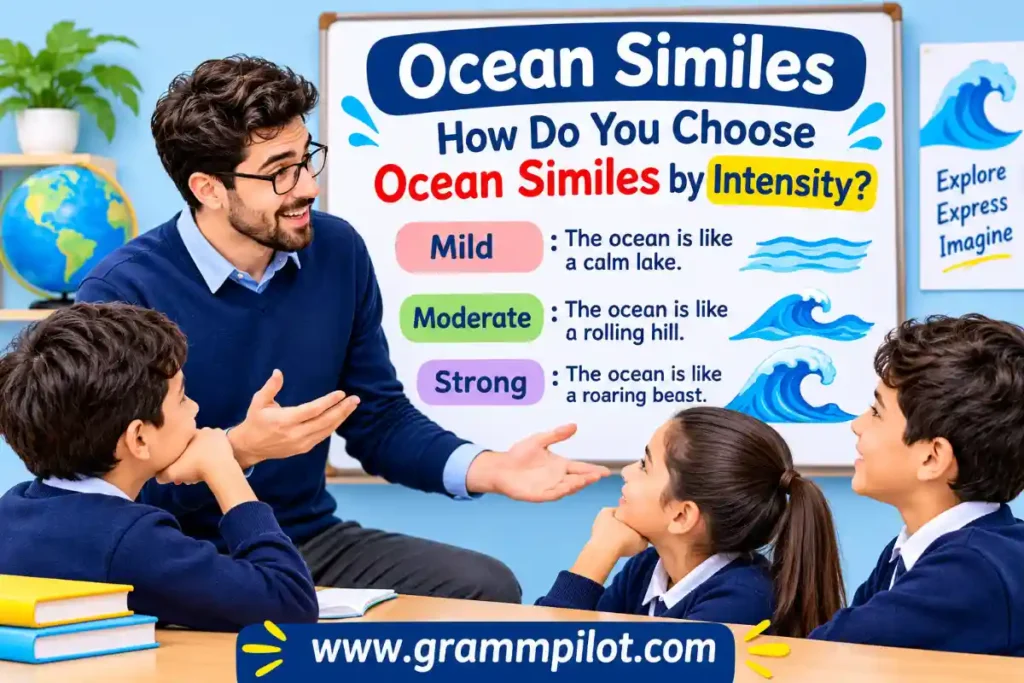
5. How Do You Choose Ocean Similes by Intensity?
The strength of your comparison should match the scene. A peaceful beach doesn’t need the same language as a dangerous storm.
Mild: Gentle and Peaceful
Use these when the water is calm or the scene feels relaxing.
- As smooth as glass
- Like a sleeping baby
- Like a soft blue blanket
- Like a quiet song
- Like a gentle dance
Example: The ocean moved like a gentle dance beneath the morning sun.
Moderate: Lively and Powerful
Use these when the water is moving strongly but isn’t necessarily dangerous.
- Like rolling hills
- Like a flowing ribbon
- Like a playful animal
- Like a moving wall
- Like a rushing river
Example: The waves rolled like hills beneath the afternoon wind.
Strong: Wild and Dramatic
Use these when describing storms, dangerous waves, or powerful natural forces.
- Like an angry giant
- Like a roaring lion
- Like a charging bull
- Like a crashing mountain
- Like a thunderous drum
Example: The storm waves crashed like giant walls against the harbor.
Writing tip: Don’t use the strongest comparison every time. Changing the intensity helps your description feel natural and gives dramatic moments more impact.
6. What Parts of Speech Help You Create Better Ocean Similes?
Ocean similes often combine nouns, adjectives, and verbs. Each part plays a different role.
Nouns for Ocean Comparisons
Nouns name the things you compare the sea to.
Examples:
- Mountain
- Mirror
- Blanket
- Lion
- Ribbon
- Giant
- Crystal
- Drum
- Diamond
- Road
Sentence: The waves rose like mountains beneath the storm clouds.
Adjectives for Ocean Descriptions
Adjectives explain the appearance, mood, or condition of the water.
Examples:
- Calm
- Blue
- Vast
- Sparkling
- Turbulent
- Gentle
- Foamy
- Deep
- Shimmering
- Mysterious
Sentence: The shimmering sea looked like a sheet of silver.
Verbs for Ocean Movement
Verbs show what the water does.
Examples:
- Roll
- Crash
- Rush
- Whisper
- Dance
- Flow
- Rise
- Curl
- Sweep
- Roar
Sentence: The waves danced like children along the shore.
Combining these word types helps you build fresh comparisons instead of repeating the same description.
7. How Do Ocean Similes Differ in American and British English?
The basic rules for similes are the same in American and British English. Both varieties use like and as to make comparisons.
For example:
- American English: The ocean was as blue as a summer sky.
- British English: The sea was as blue as a summer sky.
One small difference is word choice. American speakers often use ocean when talking about a large body of salt water, while British speakers may use sea more often in everyday descriptions.
Both words are correct, but they can have slightly different uses:
- Ocean: Usually refers to one of the world’s major bodies of salt water.
- Sea: Can refer to a smaller area of salt water or a region connected to an ocean.
You may also see regional differences in descriptions. Someone writing about a tropical coast might describe turquoise water, while a writer describing a cold northern coastline may focus on gray waves and dark water.
The simile itself doesn’t need to change. Choose words that fit the location and scene.
8. Which Ocean Similes Work Best for Different Types of Writing?
The best comparison depends on your purpose. A school essay needs clear language, while a poem may use more imaginative descriptions.
What Ocean Similes Work Best in an Essay?
For an essay, choose comparisons that are easy to understand and directly connected to your topic.
Examples:
- The ocean was as wide as the sky.
- The waves moved like long rolling hills.
- The water was as clear as glass.
- The sea looked like a giant blue mirror.
These examples add detail without making the writing confusing.
What Ocean Similes Work Best in a Poem?
Poetry allows more creative and emotional comparisons.
Examples:
- The ocean whispered like an old storyteller.
- The waves danced like silver ribbons.
- The sea glowed like a thousand stars.
- The moonlight stretched across the water like a road to heaven.
These comparisons create rhythm, mood, and strong images.
What Ocean Similes Work Best in a Story?
Stories often need comparisons that help readers picture an action or setting.
Examples:
- The waves attacked the rocks like an army.
- The boat rocked like a cradle in the restless water.
- The ocean stretched before them like an endless road.
- The storm roared like a beast waking from sleep.
Choose the comparison based on what is happening in the scene.

What Ocean Similes Work Best in Texting and Social Media Captions?
Short and familiar comparisons work well in captions.
Examples:
- Blue as a sapphire.
- Smooth as glass.
- Waves dancing like music.
- The sea shining like diamonds.
- A beach as peaceful as a dream.
Keep the wording short so the image or message remains the main focus.
What Ocean Similes Work Best in Emails and Formal Writing?
In a formal email or report, avoid overly dramatic comparisons unless the topic is creative writing or travel promotion.
Examples:
- The water was as clear as glass.
- The waves were unusually rough.
- The sea was calm and smooth during the morning.
- The coastline stretched like a long ribbon.
For business or academic writing, clear descriptions are usually more useful than several decorative comparisons.
9. How Can You Use Ocean Similes in Original Sentences?
Here are 12 examples from different real-life situations. Notice how each comparison supports the scene.
- A family beach trip: The ocean was as warm as a summer blanket, and the children ran into the waves.
- A morning walk: The calm water looked like a giant mirror reflecting the pale morning sky.
- A storm: The waves crashed against the harbor like angry giants fighting over the shore.
- A boat ride: The boat rocked like a cradle as the gentle waves carried it forward.
- A sunset: The ocean glowed like liquid gold while the sun disappeared behind the horizon.
- A school description: The sea stretched like a blue carpet toward the distant sky.
- A fishing trip: The water moved like a restless animal beneath the small fishing boat.
- A quiet evening: The waves whispered like soft voices as they touched the sand.
- A tropical island: The turquoise water sparkled like thousands of tiny jewels.
- A night scene: The moonlight spread over the sea like a silver path.
- A dramatic story: A towering wave rose like a mountain before crashing down near the ship.
- A travel caption: The clear ocean looked like a sheet of blue crystal under the bright sun.
10. What Is the Difference Between an Ocean Simile and a Metaphor?
A simile and a metaphor both compare things, but they do it in different ways.
| Simile | Metaphor |
|---|---|
| Uses like or as | Makes a direct comparison |
| Says one thing is similar to another | Describes one thing as another |
| The ocean was like a mirror. | The ocean was a mirror. |
| The waves roared like lions. | The waves were lions. |
| The sea shone as bright as silver. | The sea was silver. |
A simile makes the comparison clear by using like or as. A metaphor makes the comparison more directly.
Ocean Simile Examples
- The waves were like dancing horses.
- The ocean was as blue as a sapphire.
- The water moved like a flowing ribbon.
Ocean Metaphor Examples
- The ocean was a giant mirror.
- The waves were wild horses.
- The sea was a blanket of blue.
Both techniques can make writing interesting. Use a simile when you want to show a clear resemblance. Use a metaphor when you want a stronger, more direct image.
11. What Common Mistakes Should You Avoid When Writing Ocean Similes?
Even a creative comparison can become confusing if it doesn’t fit the scene.
Mistake 1: Forgetting “Like” or “As”
Incorrect simile: The ocean a mirror.
Correct simile: The ocean was like a mirror.
The first sentence is incomplete as a simile. You can turn it into a metaphor by writing, “The ocean was a mirror.”
Mistake 2: Choosing a Comparison That Doesn’t Match the Scene
Weak example: The peaceful ocean roared like a lion.
This creates a confusing picture because a peaceful sea and a roaring lion suggest different moods.
Better: The peaceful ocean moved like a sleeping child.
Mistake 3: Using Too Many Similes in One Sentence
Overloaded example: The ocean was like a mirror, a mountain, a lion, and a blanket.
This gives readers too many images at once.
Better: The ocean was as smooth as a mirror beneath the morning sun.
Mistake 4: Repeating the Same Comparison
If every paragraph describes the sea as blue as a sapphire, the writing becomes predictable.
Try different features:
- Color: Like a sheet of turquoise glass.
- Sound: Like a distant drum.
- Movement: Like rolling hills.
- Calmness: Like a sleeping child.
Mistake 5: Using a Simile That Doesn’t Make Sense
A comparison should help readers imagine something, not make them stop and wonder what it means.
Unclear: The ocean was like a telephone.
Better: The waves rang against the rocks like distant bells.
When Should You Avoid Ocean Similes?
You don’t need a simile in every sentence. Avoid them when:
- You’re writing a scientific report that needs precise facts.
- A direct description is clearer.
- The comparison distracts from the main idea.
- You’ve already used several similar comparisons nearby.
- The image doesn’t match the mood of the scene.
A simple sentence can be powerful. Use comparisons when they add something meaningful.
12. What Are the Opposite Ideas of Ocean Similes?
Similes don’t have direct antonyms because they are comparisons rather than single descriptive words. However, you can use opposite descriptions to create contrast.
| Ocean Description | Opposite Idea |
|---|---|
| Calm as glass | Rough and choppy |
| Gentle as a whisper | Loud as thunder |
| Bright as silver | Dark as ink |
| Clear as crystal | Cloudy and muddy |
| Smooth as silk | Rough as gravel |
| Warm as sunlight | Cold as ice |
| Peaceful as a dream | Wild as a battlefield |
Writers often use these contrasts to show a change in weather or mood.
For example: “In the morning, the sea was as smooth as glass. By evening, it roared like a furious beast.”
The contrast makes the change in the ocean more dramatic.
13. How Can You Create Your Own Ocean Similes?
You don’t have to copy an existing comparison every time. You can make your own by following a few simple steps.
Step 1: Choose one feature of the ocean.
Decide whether you’re describing its color, sound, movement, size, or mood.
Step 2: Think of something familiar.
For example, a mirror suggests smoothness, a drum suggests sound, and a mountain suggests size.
Step 3: Connect the two ideas using “like” or “as.”
Try these patterns:
- The ocean was as ______ as ______.
- The waves moved like ______.
- The sea sounded like ______.
- The water sparkled like ______.
Step 4: Check whether the comparison makes sense.
Ask yourself: Can readers picture what I’m describing? Does the comparison match the mood?
Step 5: Read the sentence aloud.
If it sounds natural and creates a clear image, it probably works.
Conclusion: How Can You Describe the Ocean More Creatively?
The ocean can be calm, colorful, mysterious, or powerful. The right comparison helps readers see these qualities instead of simply reading a list of descriptions. Use gentle images for quiet water, strong comparisons for stormy waves, and colorful details for sunsets and tropical beaches. Ocean Similes can make essays, poems, stories, and captions more vivid when each comparison fits the scene. Remember to use like or as, avoid repeating the same image, and choose words that match the mood you want to create. Most importantly, don’t add a comparison just to make a sentence longer. Choose one that gives readers a picture worth remembering.
Frequently Asked Questions
1. What is a simple simile for the ocean?
A simple simile is “The ocean was as blue as the sky.” It compares the water’s color to something familiar.
2. What are some creative Ocean Similes for students?
Students can write “The waves danced like playful children” or “The ocean was as smooth as glass.” Both comparisons are easy to understand and help create clear images.
3. How do you describe ocean waves in a simile?
You can describe waves as rolling like hills, crashing like thunder, or dancing like ribbons. Choose a comparison that matches how the water moves.
4. What’s another way to say the ocean is beautiful?
You can say the ocean sparkled like diamonds, shimmered like silver, or looked like a blue paradise. These descriptions add color and feeling.
5. What is a simile for a stormy ocean?
“The stormy ocean roared like an angry lion” is a strong example. It shows the loud sound and wild movement of the waves.
6. What is the difference between an ocean simile and an ocean metaphor?
A simile uses like or as, such as “The ocean is like a mirror.” A metaphor makes a direct comparison: “The ocean is a mirror.”
7. Can I use ocean similes in a school essay?
Yes. Ocean comparisons can make descriptive essays more interesting and help readers imagine the setting. Use clear examples and avoid adding too many to one paragraph.