
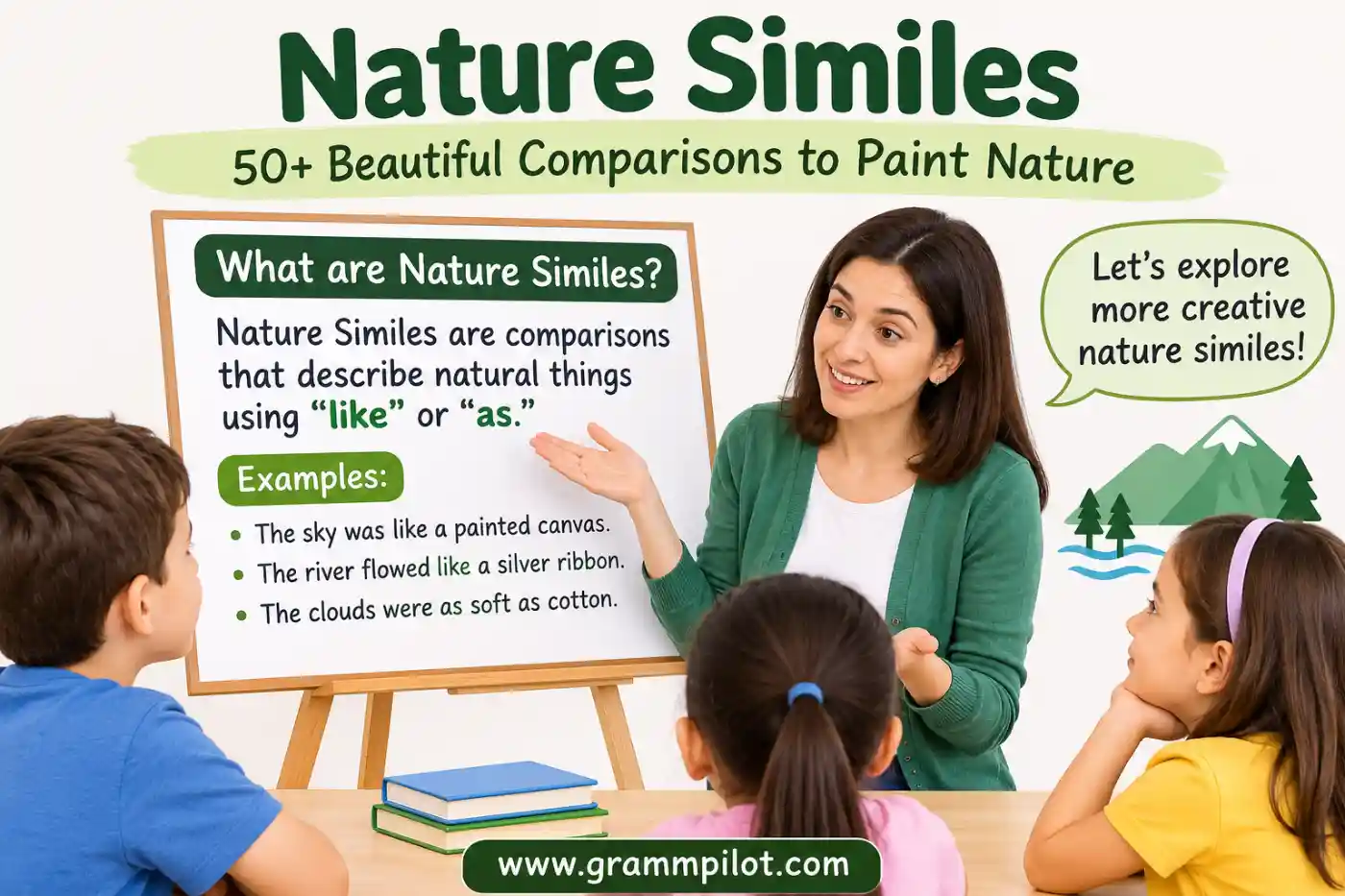
Have you ever looked at a golden sunset, listened to rain tapping against your window, or watched clouds slowly move across a bright blue sky? Sometimes, ordinary words aren’t enough to describe these beautiful moments. You need a comparison that helps readers see, hear, and feel what you’re describe. That’s where Nature Similes can make your writing more interesting. They turn simple descriptions into colorful pictures. Instead of saying, “The wind was strong,” you might write, “The wind roared like a hungry lion.” The second sentence gives readers a much clearer idea of how powerful the wind feels. A simile compares two different things using words such as like or as. Nature offers endless opportunities for these comparisons. You can describe a quiet forest, a sparkling river, a stormy afternoon, a peaceful garden, or a star-filled night with language that feels alive.
Nature similes are creative comparisons that describe natural things, weather, landscapes, plants, animals, and outdoor experiences by showing how they resemble something familiar. They usually use like or as to create a clear mental picture.
In this guide, you’ll discover more than 50 original comparisons, learn how similes work, explore useful nature-related vocabulary, and see how to choose the right expression for stories, essays, poems, emails, and everyday conversations.If you’re building a collection of useful similes and comparisons, don’t miss Similes for Sand.
What Are Nature Similes and Why Do Writers Use Them?
A simile is a figure of speech that compares two different things because they share a particular quality. The comparison helps readers understand an image, feeling, sound, or experience.
For example:
- The moon was like a silver coin in the night sky.
- The river moved as smoothly as silk.
- The trees danced like excited children in the wind.
Each sentence connects something in nature with something familiar. The moon doesn’t actually turn into money. The river isn’t made of fabric, and trees don’t have human bodies. These comparisons help readers imagine what the writer sees.
How Do Similes Make Nature Descriptions Better?
Nature is full of details, but simply naming those details doesn’t always make writing interesting.
Compare these descriptions:
Simple description: The flowers were beautiful.
Creative description: The flowers opened like colorful stars across the garden.
The second sentence gives readers a visual image. They can imagine flowers spreading across the ground and adding color to the landscape.
Similes are useful because they:
- Make descriptions more colorful and memorable.
- Help readers imagine natural scenes.
- Add emotion to creative writing.
- Make poetry more expressive.
- Explain unfamiliar experiences through familiar comparisons.
- Help students develop stronger descriptive vocabulary.
- Make storytelling feel more natural.
A good comparison doesn’t need complicated words. Even a simple expression can create a powerful picture.
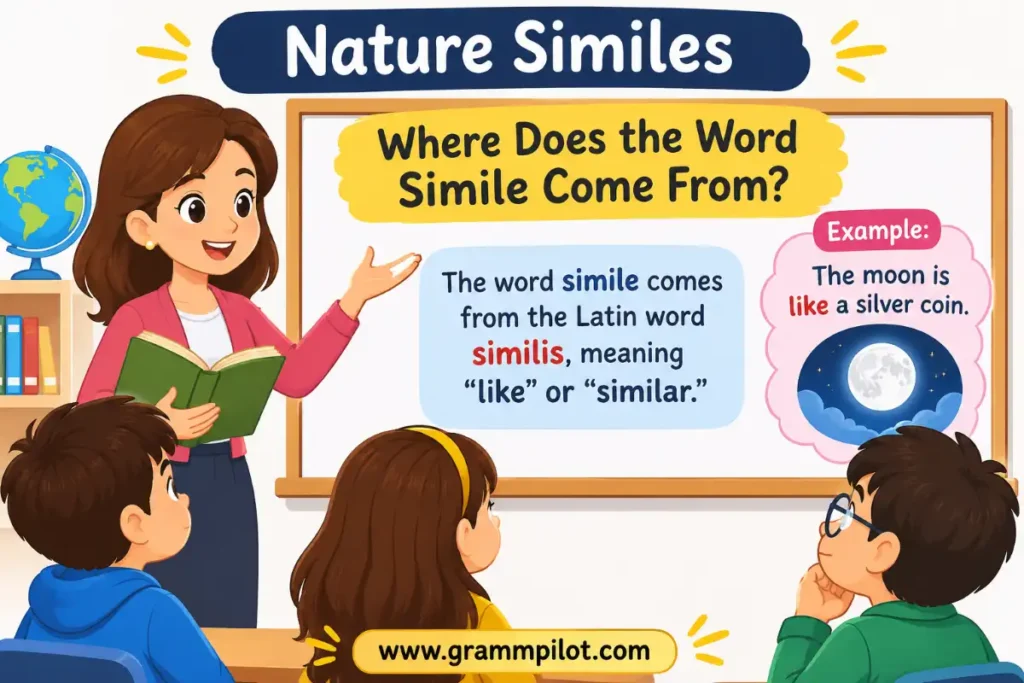
Where Does the Word Simile Come From?
The word simile comes from the Latin word similis, meaning “like” or “similar.” This origin connects directly to how a simile works. It shows that two different things share a particular feature. Writers have used comparisons for centuries. Ancient poets and storytellers used them to describe battles, weather, landscapes, emotions, and everyday experiences. Nature has always been an important source of inspiration because people experience it in so many ways. The warmth of sunlight, the movement of water, the sound of birds, and the changing seasons provide countless opportunities for creative language.
What Is the Difference Between a Simile and a Metaphor?
Both figures of speech compare different things, but they do it differently.
| Simile | Metaphor |
|---|---|
| Uses like or as | Usually makes a direct comparison |
| The stars sparkled like diamonds. | The stars were diamonds in the sky. |
| The wind sounded like a whistle. | The wind was a whistle through the trees. |
| The clouds looked like cotton. | The clouds were cotton in the sky. |
A simile makes the comparison clear through words such as like and as. A metaphor describes one thing as another. Both can improve descriptive writing, but they create slightly different effects.
50+ Best Nature Similes With Meanings and Examples
Here are creative comparisons for different natural scenes. Each expression includes a simple meaning and an example to help you understand how to use it.
1. Similes About the Sun and Sunlight
The sun brings warmth, brightness, and energy. These comparisons work well when describing mornings, summer afternoons, and beautiful outdoor scenes.
- As bright as a golden lampMeaning: Extremely bright and shining.Example: The morning sun was as bright as a golden lamp above the village.
- Like a golden ball in the skyMeaning: Describes the round, glowing appearance of the sun.Example: The sun looked like a golden ball floating above the mountains.
- As warm as a mother’s embraceMeaning: Comforting and pleasantly warm.Example: The afternoon sunlight felt as warm as a mother’s embrace.
- Like liquid goldMeaning: Describes sunlight spreading across a surface.Example: Golden sunlight flowed like liquid gold across the fields.
- As gentle as a summer breezeMeaning: Soft, pleasant, and comforting.Example: The early sunlight felt as gentle as a summer breeze.
2. Similes About the Moon and Stars
The night sky can create peaceful, mysterious, and magical scenes.
- Like a silver coin in the skyMeaning: Describes the moon’s round and shining appearance.Example: The full moon looked like a silver coin hanging above the quiet town.
- As sparkling as diamondsMeaning: Extremely bright and glittering.Example: The stars were as sparkling as diamonds scattered across a dark blanket.
- Like tiny candles in the darknessMeaning: Small points of light shining at night.Example: The distant stars looked like tiny candles in the darkness.
- As peaceful as a sleeping villageMeaning: Very quiet and calm.Example: The moonlit countryside was as peaceful as a sleeping village.
- Like a glowing pearlMeaning: Describes the soft, pale beauty of the moon.Example: The moon appeared like a glowing pearl above the ocean.
3. Similes About Trees and Forests
Trees and forests can represent strength, peace, age, and natural beauty.
- As tall as ancient towersMeaning: Extremely tall.Example: The old pine trees stood as tall as ancient towers.
- Like green umbrellasMeaning: Describes trees with wide, spreading branches.Example: The oak trees stood like green umbrellas over the walking path.
- As strong as an iron pillarMeaning: Very strong and firmly rooted.Example: The ancient tree stood as strong as an iron pillar despite the storm.
- Like dancers in the windMeaning: Describes branches and leaves moving together.Example: The trees swayed like dancers in the wind.
- As quiet as a sleeping forestMeaning: Completely peaceful and still.Example: The woodland was as quiet as a sleeping forest after sunset.
4. Similes About Rivers, Lakes, and Oceans
Water creates beautiful images through movement, reflection, sound, and color.
- As clear as crystalMeaning: Extremely clean and transparent.Example: The mountain stream was as clear as crystal.
- Like a silver ribbonMeaning: Describes a narrow river winding through the landscape.Example: The river stretched like a silver ribbon between the green hills.
- As restless as a wild horseMeaning: Constantly moving and difficult to control.Example: The ocean was as restless as a wild horse during the storm.
- Like a mirror beneath the skyMeaning: Describes calm water reflecting its surroundings.Example: The lake looked like a mirror beneath the sky.
- As powerful as a roaring giantMeaning: Extremely strong and forceful.Example: The waterfall sounded as powerful as a roaring giant.
- Like dancing diamondsMeaning: Describes sunlight sparkling on moving water.Example: Sunlight danced like diamonds across the surface of the lake.
5. Similes About Clouds and the Sky
Clouds and the sky change throughout the day. They can look soft, heavy, colorful, or dramatic.
- As soft as cottonMeaning: Fluffy and gentle in appearance.Example: White clouds floated across the sky as soft as cotton.
- Like mountains of whipped creamMeaning: Describes large, fluffy clouds.Example: The afternoon clouds rose like mountains of whipped cream.
- As dark as charcoalMeaning: Extremely dark and gloomy.Example: Storm clouds gathered above the town as dark as charcoal.
- Like a painted canvasMeaning: Describes a colorful and beautiful sky.Example: The evening sky looked like a painted canvas filled with orange and pink.
- As endless as the oceanMeaning: Appearing to stretch without an end.Example: The clear blue sky seemed as endless as the ocean.
6. Similes About Rain and Storms
Rain can be gentle and relaxing or heavy and frightening. Choose a comparison that matches the weather.
- Like silver threads falling from the skyMeaning: Describes thin, delicate rain.Example: Light rain fell like silver threads across the garden.
- As loud as a thousand drumsMeaning: Extremely noisy.Example: Thunder rolled across the valley as loud as a thousand drums.
- Like a curtain of waterMeaning: Describes very heavy rainfall.Example: Rain poured like a curtain of water over the village.
- As fierce as an angry beastMeaning: Wild, powerful, and frightening.Example: The storm was as fierce as an angry beast moving across the coast.
- Like tiny pearls on a windowMeaning: Describes small drops of rain.Example: Raindrops gathered like tiny pearls on the bedroom window.
7. Similes About Flowers and Gardens
Flowers are useful comparisons for beauty, freshness, color, and delicate details.
- As colorful as a rainbowMeaning: Full of bright and different colors.Example: The spring garden was as colorful as a rainbow.
- Like little stars on the grassMeaning: Describes small flowers scattered across a field.Example: Yellow wildflowers appeared like little stars on the grass.
- As delicate as a butterfly’s wingsMeaning: Extremely soft and fragile.Example: The flower petals were as delicate as a butterfly’s wings.
- Like a colorful carpetMeaning: Describes a large area covered with flowers.Example: Wildflowers spread like a colorful carpet across the meadow.
- As fresh as morning dewMeaning: Clean, fresh, and full of life.Example: The roses looked as fresh as morning dew after the rain.
8. Similes About Wind and Seasons
Wind and changing seasons offer comparisons for movement, temperature, and mood.
- As cold as an icebergMeaning: Extremely cold.Example: The winter wind felt as cold as an iceberg.
- Like a whisper through the treesMeaning: Describes a soft, gentle breeze.Example: The evening breeze moved like a whisper through the trees.
- As wild as a running riverMeaning: Free, energetic, and difficult to control.Example: The autumn wind was as wild as a running river.
- Like a blanket of snowMeaning: Describes snow covering a large area.Example: Fresh snow covered the garden like a blanket of white.
- As refreshing as a cool drinkMeaning: Pleasant and refreshing.Example: The spring breeze felt as refreshing as a cool drink after a long walk.
9. Similes About Mountains, Valleys, and Landscapes
Natural landscapes provide strong visual comparisons for size, height, distance, and beauty.
- As huge as a sleeping giantMeaning: Extremely large and impressive.Example: The mountain stood as huge as a sleeping giant above the village.
- Like waves of greenMeaning: Describes rolling hills covered with grass.Example: The green hills stretched like waves of green across the countryside.
- As steep as a wallMeaning: Extremely steep and difficult to climb.Example: The rocky mountain path was as steep as a wall.
- Like a hidden paradiseMeaning: Describes a beautiful and peaceful place.Example: The quiet valley looked like a hidden paradise surrounded by mountains.
- As rough as a rocky roadMeaning: Uneven and difficult to travel across.Example: The mountain trail was as rough as a rocky road.
10. Similes About Animals and Other Natural Details
Animals and small details help make descriptions more specific.
- As busy as a beeMeaning: Very active and hardworking.Example: Bees moved from flower to flower as busy as a bee in a summer garden.
- Like a bird in the open skyMeaning: Free and unrestricted.Example: The eagle moved like a bird in the open sky above the mountains.
- As quick as a flash of lightningMeaning: Extremely fast.Example: The rabbit disappeared into the bushes as quick as a flash of lightning.
- Like a blanket of greenMeaning: Describes grass covering the ground.Example: Fresh grass spread like a blanket of green across the meadow.
- As delicate as a snowflakeMeaning: Extremely fragile and finely shaped.Example: The first snowflake rested on my glove, as delicate as a tiny piece of lace.
- Like a thousand tiny bellsMeaning: Describes the cheerful sound of birds singing.Example: Birds sang like a thousand tiny bells in the early morning.
- As bright as a summer morningMeaning: Cheerful, clear, and full of light.Example: The landscape looked as bright as a summer morning after the rain.
How Can You Choose Nature Comparisons by Intensity?
Not every natural scene needs a dramatic description. A gentle breeze shouldn’t sound like a hurricane, and a small stream shouldn’t be described like a powerful waterfall.
Choose your words according to the strength of the image.
| Intensity | Useful expressions | Best for |
|---|---|---|
| Mild | Soft as a whisper, calm as a pond | Peaceful scenes |
| Moderate | Bright as sunlight, fresh as morning air | Everyday descriptions |
| Strong | Loud as thunder, fast as lightning | Powerful scenes |
| Extreme | Fierce as a wild beast, powerful as a giant | Dramatic writing |
Mild Comparisons
Use mild expressions when describing quiet moments, soft weather, and peaceful landscapes.
Examples:
- The breeze was as gentle as a lullaby.
- The lake rested like a sleeping baby.
- The morning was as fresh as a new beginning.
Moderate Comparisons
These comparisons work for ordinary descriptions without making them overly dramatic.
Examples:
- The sunlight spread like a golden blanket.
- The clouds looked like floating cotton balls.
- The garden was as colorful as a painter’s palette.
Strong Comparisons
Use stronger expressions when the natural scene has energy or movement.
Examples:
- The waterfall crashed like a thousand falling stones.
- The wind rushed like a speeding train.
- The ocean roared like a giant waking from sleep.
Extreme Comparisons
These are useful in adventure stories, dramatic poems, and descriptions of dangerous weather.
Examples:
- The storm attacked the coast like an army of giants.
- Thunder exploded like a cannon above the mountains.
- The waves rose like enormous walls of water.

What Parts of Speech Help You Describe Nature?
Nature descriptions become stronger when you understand how different parts of speech work together.
Nature Nouns
Nouns name natural things, places, and features.
Examples:
- Forest
- Mountain
- River
- Ocean
- Sunlight
- Rainfall
- Wildlife
- Meadow
- Waterfall
- Landscape
Sentence: The forest looked like a green cathedral.
Nature Adjectives
Adjectives describe the appearance, condition, or quality of something.
Examples:
- Peaceful
- Misty
- Colorful
- Radiant
- Lush
- Stormy
- Golden
- Gentle
- Majestic
- Sparkling
Sentence: The majestic mountains stood like enormous walls.
Nature Verbs
Verbs show what something does or how it moves.
Examples:
- Bloom
- Sway
- Shine
- Flow
- Whisper
- Roar
- Glisten
- Drift
- Flutter
- Sparkle
Sentence: The branches danced like children at a celebration.
Nature Adverbs
Adverbs explain how an action happens.
Examples:
- Gently
- Slowly
- Brightly
- Quietly
- Gracefully
- Rapidly
- Wildly
- Peacefully
Sentence: The river flowed gently like a silver ribbon.
Combining nouns, adjectives, verbs, and adverbs helps you create detailed descriptions without relying on complicated vocabulary.
Are Nature Similes Different in American and British English?
The basic structure of a simile remains the same in American and British English. Both varieties use like and as to make comparisons.
However, regional vocabulary and familiar experiences can change how natural a comparison sounds.
Here are a few differences:
| American English | British English | Difference |
|---|---|---|
| Fall leaves | Autumn leaves | Seasonal vocabulary |
| Sidewalk | Pavement | Walking area |
| Vacation | Holiday | Time away from work |
| Yard | Garden | Outdoor area around a home |
| Highway | Motorway | Main road |
For example:
American English: The fall leaves looked like golden coins scattered across the yard.
British English: The autumn leaves looked like golden coins scattered across the garden.
Both sentences are correct. The vocabulary simply reflects regional preferences.
For international readers, choose comparisons that are easy to understand in either variety.
Which Nature Similes Work Best for Different Types of Writing?
The best comparison depends on what you’re writing and who will read it. A school essay may need simple language, while a poem can use more imaginative descriptions.
Which Comparisons Work Best in a Resume?
A resume usually needs direct, professional language. Similes are rarely necessary in job descriptions because employers want clear information about your skills and achievements. However, nature-inspired comparisons may work in a creative portfolio or personal statement.
Example: “My creative approach grows like a tree, becoming stronger through learning and experience.”
For a standard resume, a more direct sentence is better: “I develop my creative skills through continuous learning and practical experience.”
Which Comparisons Work Best in an Essay?
School essays often benefit from clear, easy-to-understand comparisons.
Examples:
- The river flowed like a silver ribbon through the valley.
- The sun shone as brightly as a golden lamp.
- The forest stood like a natural wall around the village.
These expressions help students make descriptive paragraphs more interesting without confusing readers.
Which Comparisons Work Best in Text Messages?
Text messages can be casual and playful. Short comparisons are usually the best choice.
Examples:
- The sunset looked like a painting!
- The stars were shining like diamonds tonight.
- It’s cold outside like an icebox!
- The rain sounds like a thousand little taps.
You don’t need formal vocabulary to make a memorable comparison.
Which Comparisons Work Best in Emails?
For everyday emails, choose natural expressions that don’t distract from your message.
Example: “The garden looks like a colorful carpet after all the flowers bloomed.”
For a professional environmental or travel email, you might write: “The valley was as peaceful as a quiet countryside retreat.”
Keep the comparison relevant to your message.
Which Comparisons Work Best in Speaking?
When speaking, familiar comparisons are easier to understand and remember.
Examples:
- The water was as clear as glass.
- The wind was cold as ice.
- The sky looked like a painting.
- The mountain was as big as a giant.
Simple expressions work well because listeners can picture them immediately.
12 Original Nature Simile Sentences for Everyday Situations
Learning a comparison is easier when you see how it works in a real sentence. These original examples show how natural descriptions can fit into different situations.
- During a morning walk: The dew-covered grass sparkled like tiny diamonds beneath my feet.
- While describing a beach: The waves rolled toward the shore like white horses running across the sand.
- In a school essay: The forest was as quiet as a library before the birds began singing.
- During a camping trip: The campfire glowed like a small sun in the middle of the dark forest.
- In a travel story: The mountain road twisted like a snake between towering rocks.
- While describing winter: Snow covered the rooftops like thick white frosting on a cake.
- During a rainy afternoon: The raindrops tapped against the roof like impatient fingers.
- In a nature poem: The flowers opened like little smiles beneath the morning sun.
- While describing autumn: Orange leaves floated through the air like tiny paper boats.
- During a summer evening: Fireflies blinked like little lanterns among the bushes.
- In a story about a storm: The thunder rolled across the sky like enormous drums.
- While describing spring: New leaves appeared like green flags welcoming a fresh season.
Notice how each comparison focuses on a particular detail. Some describe appearance, others describe sound, movement, or emotion.
What Is the Difference Between Common Nature Comparisons?
Some comparisons look similar but create different images. Understanding their small differences helps you select the right expression.
As Clear as Crystal vs. As Smooth as Glass
Both expressions describe something that looks or feels pleasant, but they focus on different qualities.
| As Clear as Crystal | As Smooth as Glass |
|---|---|
| Describes transparency | Describes an even surface |
| Focuses on visibility | Focuses on texture |
| The lake was as clear as crystal. | The lake’s surface was as smooth as glass. |
Use the first when you can see through water. Use the second when the water has almost no ripples.
Like a Golden Blanket vs. Like Liquid Gold
Both comparisons describe golden sunlight, but their images are different.
| Like a Golden Blanket | Like Liquid Gold |
|---|---|
| Suggests warmth and coverage | Suggests flowing light |
| Creates a soft image | Creates a rich, glowing image |
| Sunlight covered the garden like a golden blanket. | Sunlight flowed across the field like liquid gold. |
Choose a golden blanket when describing warmth spreading over an area. Choose liquid gold when describing light moving across a landscape.
As Quiet as a Sleeping Forest vs. As Silent as the Night
Both expressions describe a lack of noise, but they create different moods.
- A sleeping forest suggests peaceful natural surroundings.
- A silent night suggests stillness and darkness.
Example: The woodland was as quiet as a sleeping forest after the rain.
Example: The village was as silent as the night after everyone went home.
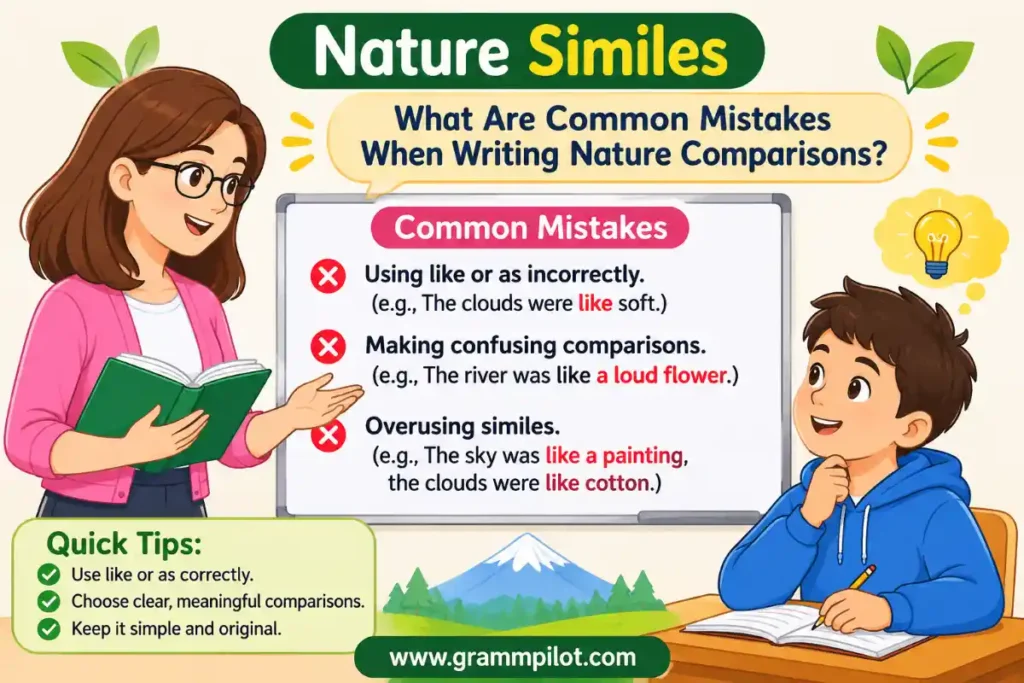
What Are Common Mistakes When Writing Nature Comparisons?
Even creative writers can make mistakes when using figures of speech. A good comparison should be clear, logical, and suitable for the situation.
1. Using Like and As Incorrectly
A simile often uses like or as to connect two ideas.
Incorrect: The clouds were like soft.
Correct: The clouds were as soft as cotton.
Correct: The clouds looked like cotton.
2. Creating Confusing Comparisons
A comparison should help readers imagine something.
Confusing: The river was like a loud flower.
Better: The river roared like a powerful waterfall.
The improved version connects two things that share a recognizable quality.
3. Using Too Many Similes Together
Adding several comparisons to one sentence can make your writing difficult to follow.
Overloaded: The sky was like a painting, the clouds were like cotton, and the sun was like gold shining like a diamond.
Better: The sky looked like a colorful painting, with golden sunlight spreading across the clouds.
Choose one or two strong images instead of forcing too many into a sentence.
4. Repeating the Same Comparison
Using “as bright as the sun” in every paragraph makes your writing predictable.
Try different expressions:
- Bright as a golden lamp.
- Shining like polished silver.
- Glowing like a distant star.
- Radiant as a summer morning.
Choose the one that matches your intended image.
5. Mixing Up Similes and Metaphors
A simile uses an explicit comparison, while a metaphor makes a direct comparison.
Simile: The forest was like a green ocean.
Metaphor: The forest was a green ocean.
Both sentences can work, but they use different figures of speech.
6. Using Comparisons That Don’t Match the Scene
A peaceful lake shouldn’t automatically be described as a raging beast.
Match the comparison to the actual conditions:
- Calm lake: Like a sleeping mirror.
- Rough lake: Like a restless sea.
- Fast river: Like a rushing train.
- Slow river: Like a lazy silver ribbon.
7. Forgetting the Reader
A highly unusual comparison may confuse someone who isn’t familiar with it.
For school essays and everyday writing, familiar images are often more effective. Save unusual and abstract comparisons for situations where they add something meaningful.
What Are the Opposite Ideas of Nature Descriptions?
Antonyms are words with opposite meanings. They can help you describe changes in weather, landscapes, and natural conditions.
| Positive or Calm Word | Opposite Word |
|---|---|
| Bright | Dark |
| Warm | Cold |
| Peaceful | Chaotic |
| Gentle | Fierce |
| Fresh | Stale |
| Clear | Cloudy |
| Lush | Barren |
| Smooth | Rough |
| Quiet | Noisy |
| Blooming | Withered |
| Dry | Wet |
| Calm | Stormy |
These opposite words are useful when describing different conditions in the same story.
For example:
“In the morning, the sky was as bright as a polished mirror. By evening, dark clouds gathered like an army above the mountains.”
The contrast makes the change in weather easier to imagine.
How Can You Choose the Perfect Nature Simile?
A strong comparison doesn’t need to be long or complicated. It needs to match the image you want to create.
Use these quick tips before choosing one.
1. Identify the natural object.
Are you describing the sun, moon, trees, flowers, water, animals, or weather?
2. Think about its main quality.
Is it bright, dark, soft, powerful, quiet, colorful, or fast?
3. Choose something familiar.
Compare the natural object with something readers already understand.
4. Match the mood.
A peaceful garden needs a different comparison from a dangerous storm.
5. Use sensory details.
Think about what someone can see, hear, touch, or feel.
6. Avoid unnecessary complexity.
A short comparison can be more effective than a sentence filled with difficult words.
7. Read your sentence aloud.
If the comparison sounds unnatural, try a simpler expression.
8. Be original when possible.
Familiar expressions are useful, but creating your own comparison can make your writing more memorable. For example, instead of always writing “the stars were like diamonds,” you could say, “The stars blinked like tiny lights on a distant hillside.” The second comparison creates a different picture while keeping the language easy to understand.
Final Teacher Explanation: How Can You Describe Nature More Beautifully?
Think of nature as a collection of pictures waiting to be described. A river can look like a silver ribbon, a forest can stand like a green wall, and a sunset can spread like liquid gold. The secret is to notice one special feature and compare it with something familiar.
- If you’re describing sunlight, think about brightness and war*mth.
- If you’re describing rain, consider its sound and movement.
- If you’re describing mountains, focus on their size, shape, or strength.
Don’t choose a comparison simply because it sounds impressive. Choose it because it helps your reader imagine the scene. The best writing makes readers feel as if they’re standing beside you, watching the same beautiful world.

Conclusion: How Can You Make Nature Descriptions More Creative?
Nature gives writers endless inspiration. From shining stars and colorful flowers to powerful storms and peaceful rivers, every outdoor scene has something worth describing. The right comparison can turn an ordinary sentence into an image that readers remember. The most effective Nature Similes are simple, meaningful, and connected to the scene. You don’t need complicated vocabulary or dramatic expressions to make your writing interesting. Focus on the natural feature, notice its most important quality, and connect it with something familiar. If you’re writing a school assignment, a poem, a travel story, or a personal message, these comparisons can help you express your ideas with greater clarity. Start with familiar examples, experiment with your own descriptions, and let your imagination grow with every sentence.
Frequently Asked Questions
1. What are Nature Similes in simple words?
Nature Similes are comparisons that describe natural things using like or as. For example, “The stars shone like diamonds” compares stars with sparkling gemstones.
2. What is a good simile for nature?
“The forest was as peaceful as a sleeping village” is a good example. It creates a calm picture of a quiet natural place.
3. What is a simile for the beauty of nature?
“Nature is like a beautiful painting filled with colors” is a simple way to describe the beauty of the natural world. It highlights the variety of colors and scenery.
4. What are 5 examples of nature similes?
Five examples include:
- The sky was like a painted canvas.
- The river flowed like a silver ribbon.
- The clouds were as soft as cotton.
- The stars sparkled like diamonds.
- The wind whispered like a gentle voice.
5. What’s another way to describe nature using comparisons?
You can compare natural features with familiar objects, feelings, or experiences. For example, describe a waterfall as loud as a thousand drums or a flower as delicate as a butterfly’s wings.
6. How do you write your own nature simile?
Choose something in nature, identify one of its qualities, and compare it with something familiar using like or as. For example, if a river moves quickly, you could write, “The river rushed like a speeding train.”
7. Why do writers use similes in nature descriptions?
Writers use similes to create clear mental pictures, add emotion, and make descriptions more memorable. They also help readers understand natural scenes through familiar comparisons.