

Have you ever written a sentence such as “The system has a disfunction” and then wondered about the spelling was correct? Perhaps you were writing an essay, preparing a medical report, sending a professional email, or explaining a problem with the way something works. The two spellings can look almost identical, so it’s easy to become confused. The correct spelling in standard English is dysfunction. The spelling disfunction is a common misspelling, not the accepted standard form. Although both may seem logical because of their similar sounds and meanings, only one belongs in formal writing and standard dictionaries. Disfunction or Dysfunction: Which spelling is correct? Dysfunction is the correct spelling. It refers to the failure, poor performance, or abnormal operation of a person, system, organ, relationship, or organization.
Understanding this spelling isn’t just about remembering a few letters. It’s also about knowing what the word means, where it comes from, how to use it naturally, and which alternatives work better in different situations. In this guide, you’ll learn the word’s origin, its meaning, more than 30 useful synonyms, differences between related expressions, common mistakes, and practical examples for everyday communication. You’ll also discover how to choose the right word for academic, professional, medical, and casual writing.
To discover more creative examples, see our guide to Nature Similes.
Disfunction or Dysfunction: Which Spelling Is Correct?
The correct spelling is dysfunction, with a y after the first letter. It is the standard spelling used in American English and British English.
The confusion happens because the prefix dis- appears in many familiar English words. For example:
- Disagreement
- Discomfort
- Disapprove
- Dislike
- Disappear
- Disconnection
Because these words begin with dis-, writers sometimes assume that disfunction follows the same spelling pattern. However, English spelling doesn’t always follow one predictable rule. Dysfunction comes from a different word-building pattern. The prefix dys- means bad, difficult, abnormal, or impaired.
Compare the two spellings:
| Spelling | Status | Explanation |
|---|---|---|
| Dysfunction | Correct | Accepted standard English spelling |
| Disfunction | Incorrect | Common spelling mistake |
For example:
Correct: The company experienced serious dysfunction after its leadership changed.
Incorrect: The company experienced serious disfunction after its leadership changed.
The first sentence uses the accepted spelling.
Why Do People Confuse These Two Spellings?
There are several reasons this mistake occurs.
1. Similar pronunciation
Both spellings look as if they could be pronounced almost the same way. When people learn a word through conversation rather than reading, they may not remember its exact spelling.
2. Familiarity with the prefix dis-
Words such as dislike, distrust, and disagreement make the spelling disfunction seem reasonable.
3. Limited understanding of word origins
Many writers don’t know that dys- is an established prefix with its own meaning. Learning this small detail makes the correct spelling easier to remember.
4. Typing mistakes
When writing quickly, people may type the first spelling that comes to mind. Spell-checking tools don’t always explain why a spelling is wrong, so understanding the word is more helpful than relying entirely on software.
The easiest solution is to remember that dysfunction begins with dys-, not dis-.

Disfunction or Dysfunction: What Does Dysfunction Mean in Simple English?
Dysfunction means that something isn’t working properly or isn’t performing the way it should. The word can describe different kinds of problems. It may refer to a medical condition, a damaged relationship, an ineffective workplace, or a system that doesn’t operate correctly.
Here are some simple explanations:
- In medicine, it means that an organ or body system isn’t working normally.
- In psychology, it can describe unhealthy emotional or behavioral patterns.
- In relationships, it refers to harmful communication or unhealthy patterns between people.
- In workplaces, it describes poor cooperation, unclear responsibilities, or ineffective management.
- In technology, it refers to a system or component that isn’t operating as intended.
For example: “The dysfunction in the department affected the entire company.” This means that problems within the department made it difficult for the company to operate effectively.
Another example: “The doctor identified a dysfunction in the patient’s digestive system.” Here, the word describes a medical problem affecting normal body function. The meaning depends on the situation, but the central idea remains the same: something isn’t functioning as it should.
Is Dysfunction a Positive or Negative Word?
Dysfunction generally has a negative meaning. It suggests that something is damaged, ineffective, unhealthy, or operating abnormally. However, the word itself doesn’t necessarily describe how serious the problem is. For example:
- Minor dysfunction: A small issue affecting how a system works.
- Serious dysfunction: A major problem that interferes with normal operation.
- Complete dysfunction: A situation in which something cannot perform its intended function.
The context helps readers understand the severity.
Where Did the Word Dysfunction Come From?
Understanding the origin of a word can make its spelling easier to remember. The word dysfunction comes from two Greek-derived elements:
- Dys-: A prefix meaning bad, difficult, abnormal, or impaired.
- Function: A word referring to the purpose, activity, or operation of something.
Together, these elements create the meaning of an impaired or abnormal function. The word function has a long history in English and comes through Latin from the verb fungi, meaning to perform or carry out. The prefix dys- is also used in several other English words, especially in medicine and science.
Examples include:
| Word | Meaning |
|---|---|
| Dyslexia | A learning difference that affects reading and related language skills |
| Dyspepsia | Indigestion or digestive discomfort |
| Dysphagia | Difficulty swallowing |
| Dyscalculia | Difficulty with mathematical skills |
| Dysregulation | Difficulty controlling or managing a process |
| Dysplasia | Abnormal development or growth of cells or tissues |
Notice the shared beginning. These words use dys- to suggest something abnormal, impaired, or difficult. This is the main reason the spelling is dysfunction, rather than disfunction.
What Is the Difference Between Dys- and Dis-?
The prefixes dys- and dis- may look similar, but they have different uses.
| Prefix | General meaning | Examples |
|---|---|---|
| Dys- | Abnormal, difficult, impaired, or bad | Dysfunction, dyslexia, dysphagia |
| Dis- | Not, opposite of, apart, or away | Disagree, disconnect, dislike |
The prefix dis- often expresses opposition, separation, or reversal. The prefix dys– usually suggests an abnormal condition or difficulty.
However, these meanings are general guides rather than rules that explain every English word. A useful memory trick is to connect dys- with difficulty and abnormality. That connection can help you remember the spelling whenever you need to write this word.
What Are the Best Synonyms for Dysfunction?
The best synonym depends on what isn’t working properly. For example, a malfunctioning machine may have a mechanical fault, while an unhealthy relationship may involve conflict or instability. A medical condition may require a more specific clinical term. The following alternatives can help you avoid repeating the same word while keeping your meaning clear.
30+ Synonyms for Dysfunction With Meanings and Examples
Here are 32 useful alternatives grouped by tone and everyday use.
| Word | Meaning | Tone | Example |
|---|---|---|---|
| Problem | Something that needs attention | Simple | The team has a communication problem. |
| Issue | A matter causing difficulty | Simple | We need to fix the system issue. |
| Fault | A defect or weakness | Simple | The machine has an electrical fault. |
| Trouble | A condition causing difficulty | Simple | The device is having trouble operating. |
| Malfunction | Failure to work correctly | Everyday | A sensor malfunction stopped the machine. |
| Conflict | A disagreement or clash | Everyday | Their conflict affected teamwork. |
| Instability | A lack of balance or consistency | Everyday | Financial instability created uncertainty. |
| Inefficiency | Poor use of time or resources | Everyday | Inefficiency reduced productivity. |
| Impairment | Reduced ability or function | Formal | The condition caused physical impairment. |
| Dysfunctionality | The state of being dysfunctional | Formal | The report discussed organizational dysfunctionality. |
| Degradation | A decline in quality or performance | Formal | System degradation reduced reliability. |
| Bug | An error in software | Slang | A software bug affected the feature. |
| Hang-up | A personal difficulty or obstacle | Slang | He has a communication hang-up. |
| Snag | An unexpected difficulty | Slang | A scheduling snag delayed the meeting. |
| Glitchiness | A tendency to operate inconsistently | Informal | The app’s glitchiness frustrated users. |
A quick reminder: These alternatives aren’t interchangeable in every sentence. A glitch usually describes a small technical issue, while impairment often describes a reduced physical or mental ability. Choose a synonym based on the exact problem you’re describing.
Simple Synonyms for Everyday Conversations
When speaking with friends, family members, or coworkers, you usually don’t need complicated vocabulary.
These simple words are easy to understand:
- Problem
- Issue
- Trouble
- Fault
- Failure
- Weakness
- Mess
- Breakdown
Examples:
- “The computer has a problem.”
- “The team is having trouble working together.”
- “There’s a fault in the electrical system.”
These sentences communicate the problem without using technical language.
Formal Synonyms for Academic and Professional Writing
Formal writing often requires more precise vocabulary.
Consider these alternatives:
- Impairment
- Deficiency
- Inefficiency
- Instability
- Deterioration
- Disintegration
- Maladjustment
- Irregularity
For example: “The organization experienced significant operational inefficiency.”
This sentence sounds more specific in a business report than saying the organization had a problem.However, don’t choose a formal word just because it sounds impressive. The replacement should communicate the same meaning.
Informal and Slang Alternatives
In casual conversations, people often use simpler expressions.
Examples include:
- Glitch
- Bug
- Mess
- Snag
- Hiccup
- Hang-up
For example:
- “There’s a little glitch in the app.”
- “We had a small hiccup during the presentation.”
These expressions work well in casual communication, but they may not be suitable for a medical report or formal research paper.

Disfunction or Dysfunction: Which Synonyms Describe Different Levels of Dysfunction?
Not every problem has the same level of seriousness. Sometimes something works but performs poorly. In other situations, it stops working completely. Choosing a word that matches the severity makes your writing more accurate.
Mild Problems
Use these words when something is still working but has a small issue.
- Hiccup
- Glitch
- Irregularity
- Minor fault
- Small issue
- Inconsistency
Examples:
- “The website experienced a minor glitch.”
- “There was a small issue with the payment system.”
- “The team noticed an inconsistency in the report.”
These expressions suggest that the problem may be limited or temporary.
Moderate Problems
Use these words when an issue affects normal performance.
- Inefficiency
- Instability
- Impairment
- Disruption
- Miscommunication
- Malfunction
Examples:
- “Poor communication created instability within the department.”
- “The malfunction affected the machine’s performance.”
- “An impairment in the process slowed down production.”
These terms suggest that the problem has a noticeable effect.
Serious Problems
Use stronger expressions when something is significantly damaged or unable to operate properly.
- Breakdown
- Failure
- Deterioration
- Disintegration
- Severe impairment
- Systemic failure
Examples:
- “The company experienced a serious breakdown in internal communication.”
- “Years of neglect led to the deterioration of the system.”
- “The investigation revealed a systemic failure in management.”
These expressions communicate more serious consequences.
Complete Failure
When something can no longer perform its intended purpose, use stronger terms such as:
- Total failure
- Complete breakdown
- Collapse
- Loss of function
- Operational failure
Example: “The complete breakdown of the network prevented employees from accessing company files.”
Remember that a serious-sounding synonym should only be used when the situation supports it.
What Part of Speech Is Dysfunction?
The word dysfunction is primarily a noun. It names a condition or state in which something doesn’t work properly.
Example: “The dysfunction affected the entire department.”
Here, dysfunction identifies the problem. However, related forms of the word can perform different grammatical roles.
| Word | Part of Speech | Meaning | Example |
|---|---|---|---|
| Dysfunction | Noun | An impaired or abnormal condition | The system has a dysfunction. |
| Dysfunctional | Adjective | Not working or operating properly | They work in a dysfunctional environment. |
| Dysfunctionally | Adverb | In a dysfunctional manner | The organization operated dysfunctionally. |
| Dysfunctionality | Noun | The state or quality of being dysfunctional | The report examined organizational dysfunctionality. |
| Function | Noun/Verb | A purpose or the act of working | The device functions correctly. |
| Functional | Adjective | Working or operating properly | The new system is functional. |
| Functionally | Adverb | In terms of operation or practical use | The building is functionally designed. |
How Do You Use Dysfunction in a Sentence?
Because it’s a noun, you can use it in several sentence patterns.
As the subject: “Dysfunction can affect the performance of an organization.”
As the object: “The investigation revealed dysfunction within the department.”
After an adjective: “The company experienced severe dysfunction.”
After a preposition: “The report focused on dysfunction in family relationships.”
With a possessive expression:
“The team’s dysfunction affected its productivity.”
The related adjective dysfunctional is useful when you want to describe something directly.
For example:
“The company has a dysfunctional management structure.”
Both forms are correct, but they serve different grammatical purposes.
Is Dysfunction Spelled the Same in American and British English?
Yes. Dysfunction is the standard spelling in both American and British English. Unlike certain English words that have different regional spellings, this word doesn’t change between the two major varieties.
| English Variety | Correct Spelling |
|---|---|
| American English | Dysfunction |
| British English | Dysfunction |
| Canadian English | Dysfunction |
| Australian English | Dysfunction |
You don’t need to change the spelling when writing for readers in the United Kingdom, Canada, or Australia. The same spelling is used in academic writing, professional documents, medical publications, and everyday communication. The incorrect form disfunction doesn’t become correct simply because someone is using British or American English.
Which Word Should You Use in Different Situations?
The best word depends on your audience, purpose, and writing style. A term that works in a casual text message may sound unsuitable in a research paper. Likewise, a medical expression may confuse readers in an ordinary conversation. Here are practical ways to choose the right alternative.
1. What Should You Write in a Resume?
In a resume, avoid describing a previous workplace as dysfunctional unless you’re explaining a situation that genuinely requires it. Professional writing should focus on measurable problems and solutions.
Better alternatives include:
- Operational inefficiency
- Communication challenges
- Workflow problems
- Organizational instability
- Process limitations
Example: “Identified workflow inefficiencies and introduced changes that improved team productivity.”
This sounds more professional than: “Worked in a dysfunctional office.”
The first sentence also highlights your ability to solve problems.
2. What Is the Best Word for an Academic Essay?
Academic writing benefits from precise vocabulary.
Depending on the subject, you might use:
- Impairment
- Malfunction
- Inefficiency
- Abnormality
- Systemic failure
- Deterioration
Example: “The study examined the effects of communication dysfunction on organizational performance.”
You could also write: “The study examined how ineffective communication reduced organizational performance.”
The second version is easier to understand and more direct. If you’re discussing a specific medical or scientific condition, use its established terminology.
3. What Should You Say in a Text Message?
Text messages usually work best with simple expressions.
You can use:
- Something isn’t working.
- There’s a problem.
- It’s not functioning properly.
- The system has a glitch.
- Things aren’t working out.
Example: “The app isn’t working properly. I think there’s a glitch.”
This sounds more natural in casual conversation than using technical language.
4. What Is the Best Alternative in a Professional Email?
In workplace emails, choose neutral and solution-focused language.
Useful alternatives include:
- Technical issue
- Operational problem
- Communication gap
- Process failure
- System malfunction
Example: “We’ve identified a technical issue affecting the payment process and are working to resolve it.”
Another example: “There appears to be a communication gap between the two departments.”
These expressions explain the problem without sounding unnecessarily critical.
5. What Word Should You Use When Speaking?
In everyday speech, clarity matters more than complicated vocabulary.
Use expressions such as:
- Something is wrong.
- It’s not working properly.
- There’s a problem.
- The system has broken down.
- We’re having communication problems.
Example: “Something isn’t working properly with the new software.”
You don’t need to use a technical term when a simple explanation communicates your meaning, medical terminology should match the actual diagnosis and clinical findings. A writer shouldn’t replace a doctor’s specific diagnosis with a loosely related word.
12+ Original Example Sentences Using Dysfunction
Seeing a word in different situations is one of the best ways to understand how it works.
Here are 16 original examples from everyday life, education, business, technology, health, and relationships.
Everyday Life
- The dysfunction in their daily routine made it difficult to manage household responsibilities.
- A lack of communication created dysfunction within the family.
- The old television developed a technical dysfunction that affected its picture quality.
Workplace and Business
- Poor leadership contributed to dysfunction throughout the organization.
- The manager recognized the team’s dysfunction and introduced clearer responsibilities.
- Workplace dysfunction reduced employee motivation and affected productivity.
- The company hired a consultant to identify the causes of organizational dysfunction.
Education and Academic Writing
- The research paper examined how social dysfunction can affect community development.
- The teacher noticed dysfunction in the classroom’s group activities.
- Students discussed the effects of family dysfunction on children’s learning environments.
Technology
- A software dysfunction prevented users from completing their online payments.
- The technician identified the source of the system dysfunction.
Health and Relationships
- The doctor explained how thyroid dysfunction could affect the patient’s energy levels.
- Their unhealthy communication patterns created dysfunction in the relationship.
- The medical team investigated possible respiratory dysfunction.
- Years of unresolved conflict contributed to serious family dysfunction.
What Do These Examples Teach Us?
These sentences show that the word can describe different kinds of problems. However, it doesn’t always mean that something has completely stopped working. A person may still communicate despite unhealthy communication patterns. A company may continue operating despite organizational dysfunction. A body system may still function even when its performance is impaired.
This distinction helps you avoid exaggerating a problem.
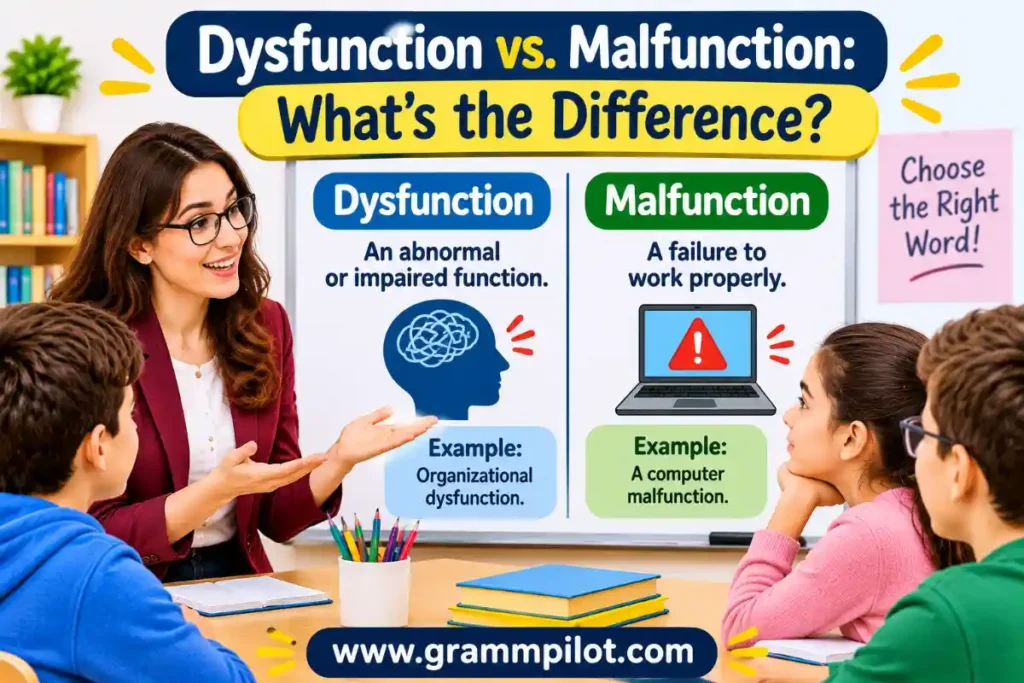
Dysfunction vs. Malfunction: What’s the Difference?
Both words describe something that isn’t working properly, but their meanings aren’t exactly the same.
Dysfunction usually refers to impaired or abnormal functioning. It can describe people, relationships, organizations, organs, and systems.
Malfunction generally refers to a failure or fault in the operation of a machine, device, system, or component.
| Comparison | Dysfunction | Malfunction |
|---|---|---|
| Main meaning | Impaired or abnormal functioning | Failure to operate correctly |
| Common use | Health, relationships, organizations, systems | Machines, equipment, technology |
| Tone | Often formal or technical | Technical or everyday |
| Example | The department has serious dysfunction. | The printer has a malfunction. |
Compare these sentences:
“The organization suffered from management dysfunction.”
This suggests deeper problems in the way the organization operates.
“The computer experienced a malfunction.”
This suggests a technical problem with the computer.
Can you use them interchangeably?
Sometimes, but not always. A machine can malfunction because of a broken component. An organization may experience dysfunction because of poor leadership, unclear responsibilities, or unhealthy workplace behavior. Choose the word that describes the actual situation.
Dysfunction vs. Dysfunctional: What’s the Difference?
These words share the same root, but they have different grammatical functions.
Dysfunction is a noun. It names a problem or condition.
Dysfunctional is an adjective. It describes something that isn’t working properly.
Compare:
| Dysfunction | Dysfunctional |
|---|---|
| Noun | Adjective |
| Names a condition | Describes something |
| The dysfunction affected the team. | The team had a dysfunctional structure. |
| The system showed dysfunction. | The system was dysfunctional. |
More examples:
Correct: The relationship experienced serious dysfunction.
Correct: They had a dysfunctional relationship.
Incorrect: The relationship was dysfunction.
Incorrect: The company experienced dysfunctional.
The difference is simple: use the noun when naming the problem and the adjective when describing something.
Dysfunction vs. Disorder: Are They the Same?
No. Although the words can overlap, they don’t have exactly the same meaning.
Dysfunction focuses on impaired or abnormal functioning.
Disorder generally refers to a condition that affects normal physical, mental, or organizational functioning.
Examples:
- A digestive dysfunction may affect how the digestive system works.
- A digestive disorder is a medical condition affecting the digestive system.
- Organizational dysfunction may involve poor communication and ineffective management.
- Organizational disorder may suggest a lack of structure, control, or proper arrangement.
In medicine, the terms aren’t automatically interchangeable. A specific disorder may cause dysfunction, but dysfunction doesn’t always indicate a particular diagnosed disorder.
For example, a person can experience temporary digestive dysfunction without having a formally diagnosed digestive disorder.
Use the more specific medical term when the context requires it.
Common Mistakes to Avoid When Using Dysfunction
Even after learning the correct spelling, writers can make mistakes with grammar and meaning.
Here are some common problems to watch for.
Mistake 1: Writing Disfunction Instead of Dysfunction
Incorrect: The company experienced disfunction.
Correct: The company experienced dysfunction.
Remember the dys- prefix.
Mistake 2: Using Dysfunctional as a Noun
Incorrect: The dysfunctional affected the team.
Correct: The dysfunction affected the team.
Dysfunctional is an adjective, not the standard noun form.
Mistake 3: Using Dysfunction When You Mean a Small Problem
Incorrect: The entire computer system has serious dysfunction because one button is slow.
Better: The computer has a minor technical issue.
A small issue doesn’t always require a strong term.
Mistake 4: Confusing Dysfunction With Total Failure
Dysfunction doesn’t always mean complete failure.
For example: “The patient’s kidney function is impaired.”
This doesn’t automatically mean the kidneys have stopped working.
Choose wording that accurately describes the condition.
Mistake 5: Using Medical Terms Without Understanding Them
Medical language has specific meanings.
For example, erectile dysfunction, kidney dysfunction, and respiratory dysfunction describe different concerns.
Don’t use a medical expression simply because it sounds more professional.
Mistake 6: Repeating the Same Word Too Often
Repeated words can make writing sound unnatural.
Instead of writing: “The dysfunction affected the team. The dysfunction also affected communication. The dysfunction reduced productivity.”
Try: “The team’s communication problems reduced productivity. These organizational issues also affected cooperation between departments.”
The revised version is easier to read.
Mistake 7: Choosing an Unrelated Synonym
Words such as conflict, malfunction, impairment, and breakdown describe different kinds of problems. They shouldn’t be treated as identical replacements. For example, a disagreement between two employees is a conflict, not necessarily a technical malfunction. Always check the meaning before replacing a word.
When Should You Avoid Using Dysfunction?
Although this word is useful, it isn’t always the best choice.
There are several situations where a simpler or more specific expression works better.
1. When describing a small technical issue
Use glitch, minor issue, or technical fault instead.
Example: “The website has a small glitch.”
2. When describing a disagreement
Use conflict, argument, or disagreement.
Example: “The disagreement between the managers delayed the project.”
3. When explaining a simple mistake
Use error or mistake.
Example: “A typing error changed the meaning of the sentence.”
4. When describing a temporary interruption
Use disruption or interruption.
Example: “The power interruption stopped the presentation.”
5. When explaining a specific medical condition
Use the established medical term when it is known and appropriate.
Example: Instead of using a vague description, identify the specific condition supported by the medical information.
The goal isn’t to use the most sophisticated word. It’s to choose the clearest and most accurate one.
What Is the Opposite of Dysfunction?
The opposite of dysfunction is generally proper functioning, normal function, or effective operation.
Other useful antonyms include:
| Antonym | Meaning | Example |
|---|---|---|
| Functionality | The ability to perform a purpose | The functionality of the device improved. |
| Efficiency | Working well without wasting resources | The team improved its efficiency. |
| Stability | A steady and reliable condition | The organization regained stability. |
| Harmony | A state of agreement and cooperation | The team worked in harmony. |
| Order | A properly arranged condition | The department restored order. |
| Effectiveness | The ability to produce the desired result | The new process improved effectiveness. |
| Coordination | Organized cooperation | Better coordination improved performance. |
| Normality | A condition considered normal | The system returned to normality. |
Examples:
- “Dysfunction affected the organization.”
- “Effective management improved the organization.”
These sentences communicate contrasting situations. Remember that the best antonym depends on the context. Harmony may oppose relationship dysfunction, while functionality may oppose technical dysfunction.
How Can You Remember the Correct Spelling?
If you often confuse the two forms, try these simple memory techniques.
1. Remember the Dys- Prefix
Connect dys- with difficulty, abnormality, and impaired functioning.
Dysfunction = difficulty with normal function.
This is the most useful spelling clue.
2. Learn Related Words
Remember a few words that share the same prefix:
- Dyslexia
- Dysphagia
- Dyspepsia
- Dyscalculia
- Dysfunction
When you recognize the pattern, the correct spelling becomes easier to recall.
3. Break the Word Into Parts
Think of the word as:
Dys + Function = Dysfunction
The prefix describes the problem, while the second part refers to normal operation or purpose.
4. Use It in Your Own Sentence
Writing a word in context helps you remember it.
Try:
- “The dysfunction in the system needs immediate attention.”
- “The organization addressed its communication dysfunction.”
- “The doctor explained the possible effects of thyroid dysfunction.”
5. Check the Word Before Publishing
If you’re writing an article, assignment, business report, or professional email, proofread the spelling. A dictionary or reliable spell-checking tool can help identify mistakes. However, learning the prefix is better than depending entirely on automatic corrections.
Here are five additional tips:
- Think about the subject: Are you describing a person, machine, relationship, or organization?
- Consider the seriousness: Is the problem minor, moderate, or severe?
- Know your audience: Casual readers usually prefer simple language.
- Check the grammar: Decide if you need a noun or adjective.
- Be precise: Don’t exaggerate a small problem by using an overly strong term.
The most effective writing doesn’t use difficult words unnecessarily. It uses accurate words that readers can understand.
Final Teacher Explanation: Which Spelling Should You Remember?
The easiest way to settle the spelling question is to remember the meaning of the prefix dys-. It refers to something abnormal, difficult, or impaired. When combined with function, it creates the word that describes an abnormal or impaired way of working. That’s why dysfunction is the correct spelling. The incorrect form disfunction may look reasonable because English contains many familiar words beginning with dis-. However, this particular word follows the dys- pattern. Also remember the difference between the noun and adjective. Dysfunction names a condition, while dysfunctional describes something affected by that condition.
For example:
- “The organization has dysfunction.”
- “The organization is dysfunctional.”
Both constructions can be correct when used in suitable contexts. Once you understand the prefix, word meaning, and grammar, you won’t need to guess between the two spellings.

Conclusion: What’s the Correct Spelling to Use?
When deciding between Disfunction or Dysfunction, remember that dysfunction is the only accepted standard spelling. It describes an abnormal, impaired, or ineffective way of functioning and can refer to health, relationships, technology, workplaces, and organizations. The key to remembering it is the prefix dys-, which is also found in words such as dyslexia and dysphagia. Understanding this word-building pattern makes the spelling easier to recognize. You should also choose alternatives carefully. A malfunction, impairment, conflict, and breakdown may describe related problems, but they don’t always mean the same thing. Keep your writing clear, use the correct grammatical form, and select words that match the situation. A little attention to spelling and meaning can make your everyday and professional writing much stronger.
Frequently Asked Questions
1. Is it disfunction or dysfunction?
Dysfunction is the correct spelling in standard English. Disfunction is a common misspelling and should be avoided in formal and everyday writing.
2. Why is dysfunction spelled with a Y?
Dysfunction uses the Greek-derived prefix dys-, which means abnormal, difficult, or impaired. This prefix is also found in words such as dyslexia and dysphagia.
3. What does dysfunction mean in simple words?
Dysfunction means that something isn’t working properly. It can describe problems involving the human body, relationships, organizations, or technical systems.
4. Is dysfunction one word or two?
Dysfunction is written as one word without a space or hyphen. It is a standard English noun.
5. What’s another way to say dysfunction?
Other ways to describe dysfunction include impairment, malfunction, inefficiency, breakdown, and poor functioning. The best alternative depends on the situation.
6. Is dysfunctional the same as dysfunction?
No. Dysfunction is a noun that names an impaired condition, while dysfunctional is an adjective that describes something that isn’t working properly.
7. Is dysfunction correct in both American and British English?
Yes. Dysfunction is the standard spelling in both American and British English. The spelling doesn’t change between these varieties.