
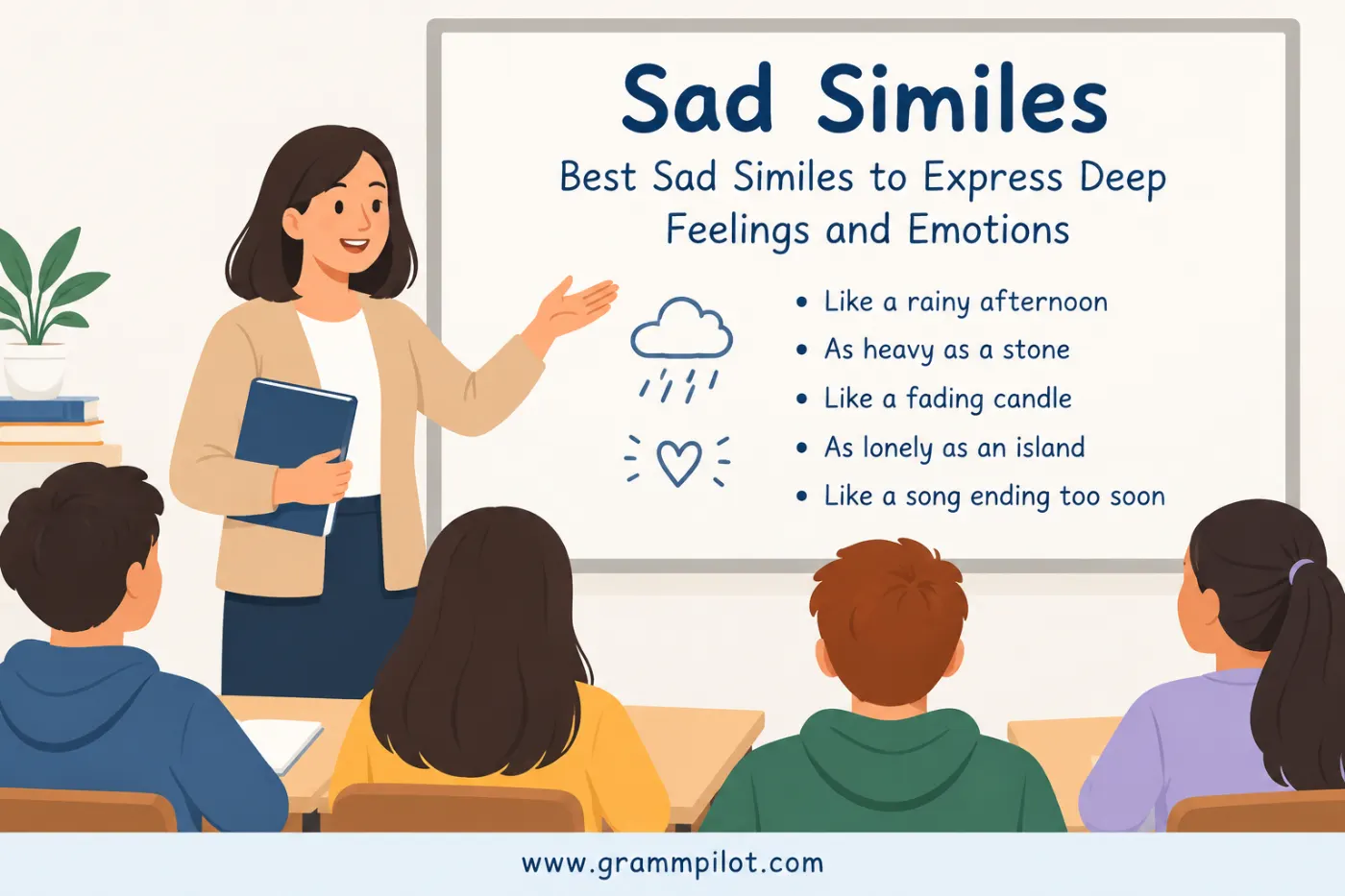
Sadness can be hard to explain. You might feel it after losing someone, missing a friend, receiving disappointing news, or remembering a happier time. When you write a text, essay, poem, or personal message, the word sad may not express everything you want to say. A thoughtful comparison can help readers understand the feeling more clearly. Sad Similes use words such as like or as to compare sadness with something familiar, such as cold rain, a cloudy sky, an empty room, or a fading light. These comparisons turn an invisible emotion into a picture that readers can imagine.
For example, saying “I felt sad” tells readers how you feel. Saying “My heart felt as heavy as a stone” helps them picture the weight of that feeling. The second sentence creates a stronger emotional connection without needing a long explanation.
The best comparison depends on the situation. A quiet feeling of disappointment needs different language from deep grief or loneliness. Below, you’ll find original examples, useful comparisons by emotional intensity, writing tips, and practical ways to choose the right expression for essays, stories, emails, and everyday conversations.
What Are Sad Similes, and What Do They Mean?
A sad simile is a figure of speech that compares sadness or a related emotion with another thing using like or as. It helps readers imagine how an emotional experience feels.
Consider these examples:
- Her sadness was like a rainy afternoon.
- His heart felt as heavy as a mountain.
- I felt as lonely as a single star in the night sky.
- The news hit me like a sudden winter wind.
- Her smile faded like a flower without sunlight.
Each comparison connects an emotion to a familiar image. Rain can suggest gloom, a mountain can suggest emotional weight, and a lonely star can suggest isolation. A simile doesn’t mean that sadness literally weighs as much as a mountain or that a person becomes a flower. The comparison creates a mental picture that communicates a feeling.
Why Do Writers Use Comparisons to Describe Sadness?
Writers use comparisons because emotions can be difficult to explain directly. A person might feel disappointed, lonely, heartbroken, or emotionally exhausted without knowing exactly how to describe the experience.
A good comparison gives that feeling a shape.
For example:
- Direct statement: I missed my grandmother.
- With a simile: Missing my grandmother felt like hearing a familiar song from another room.
- Direct statement: He felt disappointed.
- With a simile: His disappointment settled over him like a gray blanket.
The comparisons add details that help readers connect with the people in the writing. They can also establish mood. A cold, empty street may create a feeling of loneliness, while a fading sunset may suggest an ending or a painful memory. However, a comparison works best when it fits the emotion. Not every sad moment needs dramatic language. Sometimes a small, quiet image says more than an elaborate description.
Where Does the Word Simile Come From?
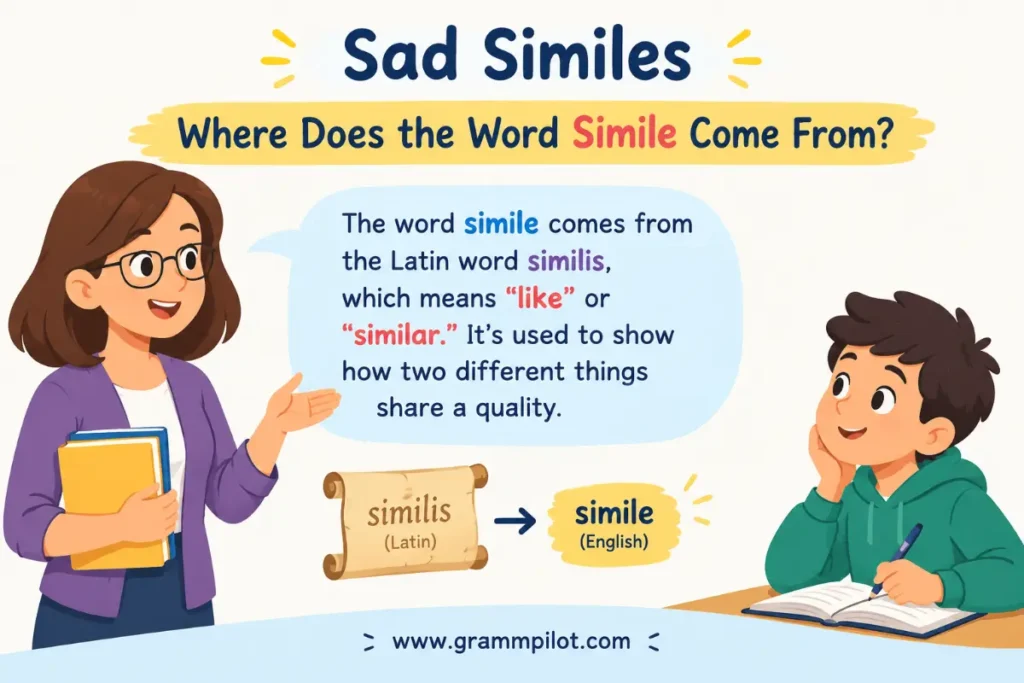
The word simile comes from the Latin word similis, meaning “like” or “similar.” This origin reflects the main purpose of a simile: showing how two different things share a quality. The word sad has a different history. It comes from Old English sæd, which originally carried meanings connected with being satisfied, full, or weary before developing toward its modern meaning of sorrowful or unhappy. Today, sad is a common adjective used to describe an unhappy feeling or a situation that causes sorrow. When the two ideas come together, a simile compares sadness with something that helps communicate its emotional quality.
For example, “Her sadness was like a fading candle” connects an emotional state with a light that is growing weaker. The image may suggest fading hope, exhaustion, or the end of something meaningful.
Understanding this background can help you use comparisons more thoughtfully. The goal isn’t to make a sentence sound complicated. It’s to make the intended feeling easier to understand.
What Are the Best Sad Similes for Different Feelings?
Different comparisons communicate different kinds of sadness. Some suggest disappointment, while others express grief, loneliness, regret, or emotional exhaustion.
Here are original examples grouped by the feelings they describe.
Similes for Loneliness
These comparisons focus on isolation, distance, and the desire for connection.
1. As lonely as a lighthouse on a deserted shore. This suggests being alone while hoping someone will notice you.
2. Like a single leaf drifting across an empty road. This creates an image of separation and uncertainty.
3. As quiet as a house after everyone has left. This describes the silence that follows the departure of loved ones.
4. Like a star hidden behind thick clouds. This suggests feeling unnoticed or disconnected from others.
5. As isolated as an island surrounded by endless water. This conveys a strong sense of separation.
6. Like an unanswered letter sitting in a drawer. This suggests waiting for a response that never comes.
7. As empty as a playground after sunset. This captures the feeling of missing company and activity.
Best use: Stories about isolation, personal essays, reflective journal entries, and poems about missing someone.
Similes for Heartbreak
These examples describe emotional pain after a breakup, rejection, or the loss of a close relationship.
8. Like a glass ornament falling onto stone. This suggests something beautiful breaking suddenly.
9. As fragile as a paper boat in a storm. This describes a relationship or hope that feels unable to withstand emotional pressure.
10. Like a song ending before the final note. This suggests an unfinished relationship or an unexpected goodbye.
11. As painful as salt in an open wound. This expresses pain that becomes stronger when something reminds a person of the loss.
12. Like a photograph fading in the sunlight. This suggests memories changing as time passes.
13. As broken as a mirror after a fall. This can suggest a shattered sense of trust or emotional security.
14. Like a door closing on a familiar room. This describes the pain of leaving a relationship or a shared life behind.
Best use: Fiction, poetry, breakup messages, and personal writing about the end of a relationship.
Similes for Grief and Loss
These comparisons suit serious loss and the lasting ache of missing someone.
15. As heavy as a stone carried uphill. This describes the effort of moving through a painful day.
16. Like a chair left empty at the dinner table. This suggests the absence of someone who once belonged there.
17. As endless as waves returning to the shore. This shows how sorrow can return again and again.
18. Like an old house filled with echoes. This connects grief with memories that remain after someone is gone.
19. As deep as a well with no visible bottom. This suggests sorrow that feels difficult to measure.
20. Like a familiar voice disappearing into the wind. This captures the pain of losing a comforting presence.
21. As cold as a winter morning without sunlight. This communicates the emptiness that can follow a major loss.
Best use: Memorial writing, stories about bereavement, reflective essays, and respectful descriptions of loss.
Similes for Disappointment
These comparisons work for failed plans, missed opportunities, and expectations that weren’t met.
22. Like a balloon losing air before the party begins. This suggests excitement slowly disappearing.
23. As disappointing as rain on a long-awaited picnic. This compares an unwanted outcome with a ruined plan.
24. Like a runner stopping just before the finish line. This suggests coming close to success but falling short.
25. As dull as a celebration without music. This describes an occasion that doesn’t meet expectations.
26. Like a letter arriving after the deadline. This communicates the frustration of receiving something useful too late.
27. As flat as a cake that never rises. This creates a simple image of effort that doesn’t produce the hoped-for result.
Best use: School essays, personal reflections, stories about failure, and everyday conversations.
Similes for Emotional Exhaustion
These comparisons describe feeling drained, discouraged, or unable to keep up with emotional demands.
28. Like a candle burning down to its last inch. This suggests that energy or hope is running low.
29. As tired as a traveler at the end of a long road. This conveys weariness after a difficult experience.
30. Like a phone battery flashing its final warning. This offers a modern comparison for feeling mentally drained.
31. As worn as an old coat exposed to years of rain. This suggests the effects of repeated hardship.
32. Like a boat drifting without a sail. This communicates uncertainty and a lack of direction.
33. As dim as a lamp about to go out. This can suggest fading motivation or hope.
Best use: Character development, personal journals, reflective writing, and descriptions of burnout-like feelings without making a medical diagnosis.
Similes for Quiet Sadness
Not all sadness is dramatic. Sometimes a person continues with everyday activities while carrying an unspoken feeling.
34. Like a soft rain tapping against the window. This suggests gentle, persistent sadness.
35. As quiet as snow falling at midnight. This describes a still, private kind of sorrow.
36. Like a shadow following someone home. This suggests sadness that remains even after a difficult event has passed.
37. As gentle as the last light of evening. This creates a subdued, reflective mood.
38. Like a book closed before its final chapter. This suggests unfinished feelings or an ending without closure.
39. As faint as music heard from a distant room. This communicates an emotion that is present but difficult to express.
40. Like mist settling over a familiar garden. This creates an image of ordinary life appearing less bright or clear.
Best use: Literary fiction, quiet scenes, personal essays, and descriptions of memories or unresolved feelings.
What Words Describe Sadness Best? A Master Synonym List
A simile is a comparison, while a synonym is a word with the same or a similar meaning as another word. If you’re describing sadness, choosing a precise synonym before adding a comparison can make your sentence clearer.
The table below groups useful alternatives by tone. The examples show how each word might appear in everyday writing.
| Word | Meaning | Tone | Example |
|---|---|---|---|
| Unhappy | Not feeling happy | Simple | She felt unhappy after the argument. |
| Blue | Sad or low in spirits | Everyday, informal | He felt blue after his friends left. |
| Lonely | Feeling alone or disconnected | Everyday | She felt lonely in the new town. |
| Discouraged | Losing confidence or hope | Everyday | He felt discouraged after failing. |
| Dejected | Low in spirits after disappointment | Formal | The dejected player left the field. |
| Woeful | Very sad or unfortunate | Literary, formal | He gave a woeful account of the loss. |
| Morose | Gloomy and withdrawn | Formal | He grew morose during the long winter. |
| Downhearted | Discouraged or sad | Everyday | She felt downhearted about the rejection. |
| Crushed | Overwhelmed by disappointment or hurt | Everyday | He was crushed when the plan failed. |
| Inconsolable | Unable to be comforted | Formal, strong | The child was inconsolable after the loss. |
| Wretched | Extremely unhappy or distressed | Strong, formal | He felt wretched after the mistake. |
| Bereaved | Having lost a loved one through death | Formal | The bereaved family received support. |
A few distinctions matter. Bereaved describes someone who has lost a loved one, rather than sadness in general. Melancholy often suggests thoughtful or lingering sadness, while miserable usually communicates more intense unhappiness. Also, not every word in this list can replace sad in every sentence. A person may be disappointed without being heartbroken, and someone who is bereaved may experience many emotions beyond sadness.
How Do You Choose a Simile by the Intensity of Sadness?
The intensity of your language should match the emotion you want to communicate. Using an extreme comparison for a small disappointment can make your writing sound unnatural.
Mild Sadness
Mild sadness may come from a small disappointment, a quiet memory, or a temporary change in mood.
Useful comparisons include:
- Like a cloudy morning.
- As soft as a passing shower.
- Like the last song at a party.
- As quiet as a room after a conversation ends.
Example: I felt a little sad, like a cloudy morning waiting for sunlight.
These images communicate a low mood without suggesting overwhelming pain.
Moderate Sadness
Moderate sadness may involve loneliness, regret, disappointment, or missing someone important.
Useful comparisons include:
- Like a long road on a rainy day.
- As heavy as a backpack filled with stones.
- Like a letter that never receives a reply.
- As cold as an empty room in winter.
Example: Her disappointment followed her like a shadow on a cloudy afternoon.
These comparisons give the emotion more weight while remaining suitable for ordinary personal writing.
Deep Sadness
Deep sadness may be appropriate to describe grief, heartbreak, or a major personal loss. Use strong comparisons only when the context supports them.
Useful comparisons include:
- Like a lighthouse surrounded by a storm.
- As heavy as a mountain resting on the heart.
- Like a home emptied of every familiar sound.
- As endless as waves returning to a dark shore.
Example: After the funeral, the house felt like a familiar song played in an empty hall.
This image suggests absence and memory without claiming that every grieving person feels the same way.
Which Parts of Speech Help You Describe Sadness?
The word sad is an adjective. It describes a person, feeling, or situation. Related nouns, verbs, and adverbs let you express sadness in different ways.
| Part of speech | Useful words | Example |
|---|---|---|
| Adjective | Sad, gloomy, sorrowful, melancholy | The room felt gloomy. |
| Noun | Sadness, grief, sorrow, disappointment | Her sadness was difficult to hide. |
| Verb | Mourn, grieve, regret, lament | He continued to grieve the loss. |
| Adverb | Sadly, mournfully, sorrowfully | She smiled sadly. |
These forms aren’t always interchangeable. For example, sad describes a feeling, but sadly describes how an action happens or introduces a statement. Grief usually refers to deep sorrow associated with loss, while disappointment often concerns expectations that weren’t met.
You can combine these words with a comparison to make the sentence more precise.
- Adjective: He looked as gloomy as a rain-soaked street.
- Noun: Her grief was like an ocean with no visible shore.
- Verb: He mourned like a musician playing a song for someone who would never return.
- Adverb: She smiled sadly, like someone remembering a distant summer.
Use the part of speech that fits the sentence structure instead of forcing a favorite word into the wrong place.
How Does American English Differ From British English When Describing Sadness?
Most common words for sadness are understood in both American and British English. Words such as sad, upset, lonely, miserable, heartbroken, and disappointed work naturally in both varieties. The main differences often involve informal expressions, spelling conventions, and how people use certain phrases.
| Expression | Common usage | Example |
|---|---|---|
| Bummed | Informal, especially common in American English | I’m bummed about the canceled trip. |
| Gutted | Informal, strongly associated with British English | She was gutted when her team lost. |
| Down in the dumps | Understood in both varieties | He’s been down in the dumps lately. |
| Feeling blue | Understood in both varieties | I feel blue when summer ends. |
| Fed up | Common in both, often expresses frustration more than sadness | I’m fed up with these delays. |
| Chuffed | British English, usually means pleased rather than sad | He was chuffed with his result. |
Regional usage changes over time, and these aren’t strict national boundaries. Americans may understand gutted, and British speakers may use bummed. For formal writing, the safest approach is to choose clear words such as disappointed, sorrowful, or deeply upset. For casual dialogue, use expressions that fit the character’s background and personality. The comparison itself doesn’t need to change between regions. A cloudy sky, an empty chair, or a fading candle can communicate sadness to readers on either side of the Atlantic.
What Is the Best Way to Express Sadness in Different Situations?
The right expression depends on your audience and purpose. A resume needs a different tone from a poem, and a text to a friend doesn’t follow the same rules as an academic essay.
How Should You Describe Sadness in a Resume?
A resume usually shouldn’t focus on sadness. Employers want to understand your skills, experience, and professional value. If you’re explaining a difficult experience in an interview or cover letter, use measured language and focus on what you learned. Avoid dramatic comparisons such as “My career felt like a ship sinking in a storm.” That may work in a personal story, but it doesn’t communicate professional strengths clearly. If you need to discuss a setback, words such as challenging, disappointing, or difficult are often more useful than miserable or heartbroken.
How Do You Express Sadness in a Text Message?
Text messages are usually short, direct, and personal. You don’t need elaborate imagery unless you and the other person enjoy expressive language.
Examples:
- I’m feeling a little low today, like a cloudy sky that won’t clear.
- I miss you. The house feels so empty without you.
- I’m really bummed that we couldn’t meet.
- Today feels like one of those rainy afternoons when everything moves slowly.
If you’re comforting someone, avoid assuming that you know exactly how they feel. A supportive message such as “I’m here if you want to talk” may be more helpful than a dramatic comparison.
How Should You Write About Sadness in an Email?
In a personal email, a gentle comparison can communicate emotion while keeping the message natural. Example: It’s been a difficult week, and I’ve felt a little like a plant waiting for sunlight. I’m hoping things will feel easier soon.
For a professional email, keep the focus on the issue and the next step. Example: I’m disappointed that the meeting had to be postponed, but I’m happy to arrange another time. The second sentence expresses the feeling without adding unnecessary emotional detail.
How Can You Describe Sadness When Speaking?
Spoken language usually works best when it sounds natural. Choose familiar images and avoid expressions that are difficult to say or understand quickly.
Examples:
- “I feel like a rainy day today.”
- “I’m a bit down after that conversation.”
- “It felt like a door closing on an important opportunity.”
- “I miss them so much that the house feels empty.”
Tone matters as much as wording. A quiet voice and a simple sentence can communicate sadness more effectively than an elaborate comparison.
What Are 9 Original Examples of Sadness in Everyday Situations?
Here are additional examples showing how comparisons can fit different settings. Each sentence gives the reader a concrete image instead of relying only on the word sad.
1. After receiving disappointing exam results: My confidence sank like a stone dropped into a deep pond.
2. When a friend moved away: The neighborhood felt like a playground after all the children had gone home.
3. After a family argument: Silence settled between us like snow covering an old path.
4. When an important plan was canceled: My excitement disappeared like a candle in a strong wind.
5. While remembering childhood: The old photograph felt like a window opening onto a summer I couldn’t revisit.
6. After a breakup: Every familiar place seemed like a song missing its melody.
7. When waiting for an apology: My hope sat like a letter waiting beside an unopened door.
8. After losing a pet: The quiet corner where she used to sleep felt like a garden after the flowers had faded.
9. When feeling left out at a gathering: I stood among the crowd like a distant island surrounded by voices.
What Is the Difference Between Sadness, Sorrow, Grief, and Melancholy?
These words overlap, but they carry different shades of meaning. Understanding those differences helps you choose a comparison that fits your subject.
| Word | Main meaning | Typical context | Example |
|---|---|---|---|
| Sadness | General unhappiness | Everyday disappointment or low mood | Her sadness was like a passing cloud. |
| Sorrow | Deep unhappiness or distress | Serious loss or regret | His sorrow was like a long winter. |
| Grief | Deep distress, often after a death or major loss | Bereavement and significant loss | Grief came in waves like the tide. |
| Melancholy | A reflective or lingering sadness | Memories, art, and quiet moods | Melancholy hung over the garden like morning mist. |
Sadness vs. Sorrow: What’s the Difference?
Sadness is a broad term for unhappiness. Sorrow often sounds deeper, more serious, or more formal.
For example, “I felt sad when the trip ended” is natural for a disappointing day. “She carried her sorrow like a stone she could never put down” suggests a more lasting emotional burden.
The difference isn’t absolute. Context determines how strong either word feels.
Grief vs. Melancholy: What’s the Difference?
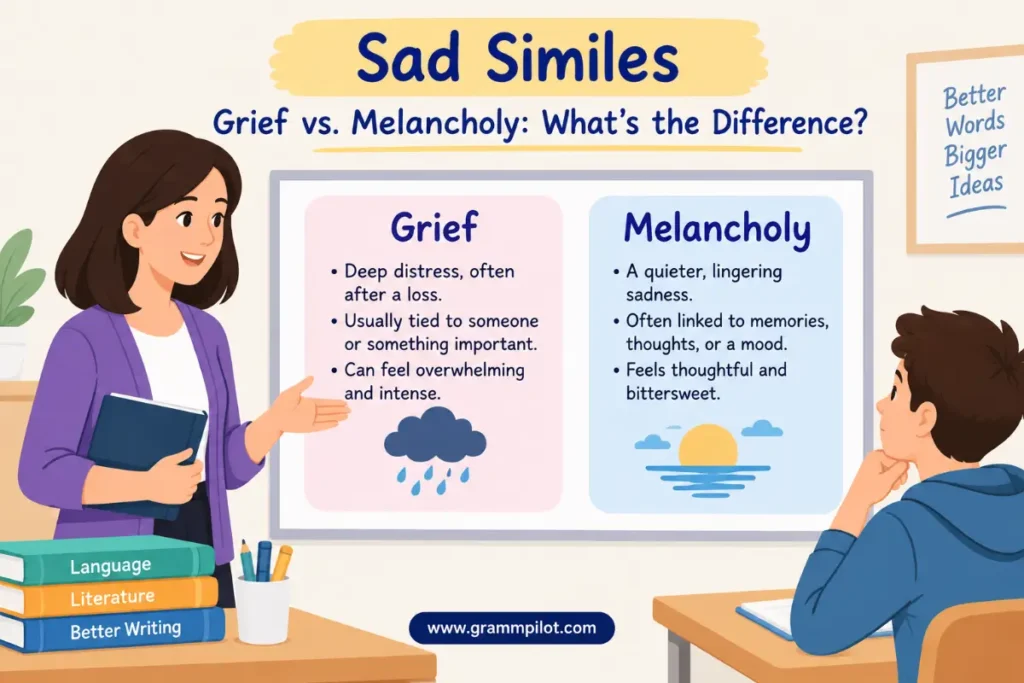
Grief often describes a response to a significant loss. Melancholy describes a lingering, thoughtful sadness that may not have one clear cause. A person might experience grief after losing a family member. Another person might feel melancholy while looking through old photographs or listening to a song associated with the past.
For example:
- Grief: His grief returned like waves crashing against the shore.
- Melancholy: A gentle melancholy drifted through the room like distant music.
Avoid treating these words as exact replacements. The distinction can help you communicate the situation more accurately.
What Are Common Mistakes When Writing Sad Similes?
A comparison can make emotional writing stronger, but a poorly chosen one can confuse the reader or make a sentence sound forced.
1. Using a Metaphor Instead of a Simile
A simile uses like or as to compare two things. A metaphor describes one thing as another without that explicit comparison.
- Simile: Her sadness was like a dark cloud.
- Metaphor: Her sadness was a dark cloud.
Both can be effective. Just make sure you understand which figure of speech you’re using when an assignment specifically asks for a simile.
2. Choosing an Image That Doesn’t Fit the Emotion
A cheerful image may not communicate sadness unless you’re deliberately showing contrast.
Unclear example: His sorrow was like a bright birthday cake.
More fitting example: His sorrow was like a birthday party after everyone had gone home.
The second image connects the setting with absence and disappointment.
3. Using Too Many Comparisons in One Sentence
Too many images can distract readers from the emotion.
Overloaded example: Her sadness was like a storm, a broken mirror, a sinking ship, and a dark forest.
Clearer example: Her sadness was like a storm moving slowly across the sea.
Choose one main image and develop it if necessary.
4. Repeating the Same Words and Images
If every sentence uses rain, darkness, tears, and storms, the writing may become predictable.
Try a wider range of images:
- Silence for unspoken feelings.
- An empty chair for absence.
- A fading photograph for memory.
- A closed door for separation.
- A long road for an ongoing struggle.
Use variety to match different emotional experiences, not simply to avoid repetition.
5. Confusing Sadness With Anger
Sadness and anger can occur together, but they aren’t the same emotion.
“His sadness was like a cold rain” suggests sorrow. “His anger was like a fire spreading through dry grass” suggests rising frustration or rage.
Choose an image based on what the person feels most strongly in that moment.
6. Making Every Sad Feeling Sound Extreme
Words such as devastated, inconsolable, and shattered express strong emotions. They aren’t always suitable for a minor disappointment.
Forgetting a favorite snack might make someone disappointed. Losing a loved one may bring profound grief. Matching the language to the situation makes your writing more believable.
What Are the Opposites of Sadness?
Antonyms can help you create contrast, show a change in mood, or describe a character moving from sorrow toward hope.
| Antonym | Meaning | Example |
|---|---|---|
| Happy | Feeling pleasure or joy | She felt as happy as a child on a sunny morning. |
| Cheerful | Showing happiness | His cheerful mood brightened the room. |
| Joyful | Full of joy | The family felt joyful after the reunion. |
| Hopeful | Expecting a better outcome | Hope rose like sunlight after a storm. |
| Content | Satisfied with a situation | He felt as peaceful as a lake at dawn. |
| Relieved | Free from worry after a difficulty | Her relief came like fresh air after a long wait. |
| Optimistic | Expecting positive results | Their optimism grew like flowers in spring. |
| Elated | Extremely happy | She was as elated as a runner crossing the finish line. |
Some opposites describe different aspects of sadness rather than exact opposites in every situation. For example, relieved is especially useful when sadness or worry lifts after a problem is solved.
Contrast can also strengthen storytelling. A character may begin feeling as lonely as an empty island and later feel connected to others like a garden waking after winter.
How Can You Choose the Right Comparison for Sadness?
Use these quick tips when writing your own examples.
- Identify the feeling first. Decide if you’re describing loneliness, regret, grief, heartbreak, or disappointment.
- Choose a familiar image. Readers should understand the comparison without needing a long explanation.
- Match the intensity. A cloudy afternoon may suit mild sadness, while a storm may fit a more painful experience.
- Consider the audience. Keep texts conversational, essays focused, and poems open to more imaginative language.
- Avoid clichés when possible. Instead of automatically choosing a broken heart, consider an empty chair, a fading voice, or an unfinished letter.
- Keep the sentence clear. One strong comparison is often better than several competing images.
- Make the image personal. A specific memory or object can reveal more than a generic description.
- Read it aloud. If the sentence sounds unnatural when spoken, simplify it.
- Don’t force a simile into every paragraph. Direct language can be just as powerful.
- Check the meaning. Make sure the image communicates the emotion you intend.
A simple exercise can help you improve. Start with “I felt sad because my friend moved away.” Then ask what the feeling reminds you of. Perhaps it resembles an empty classroom, a song played too slowly, or a road leading away from home.
Write three comparisons and choose the one that best fits the situation. The goal is clarity and emotional honesty, not complexity.
Conclusion: How Can You Express Sadness More Clearly?
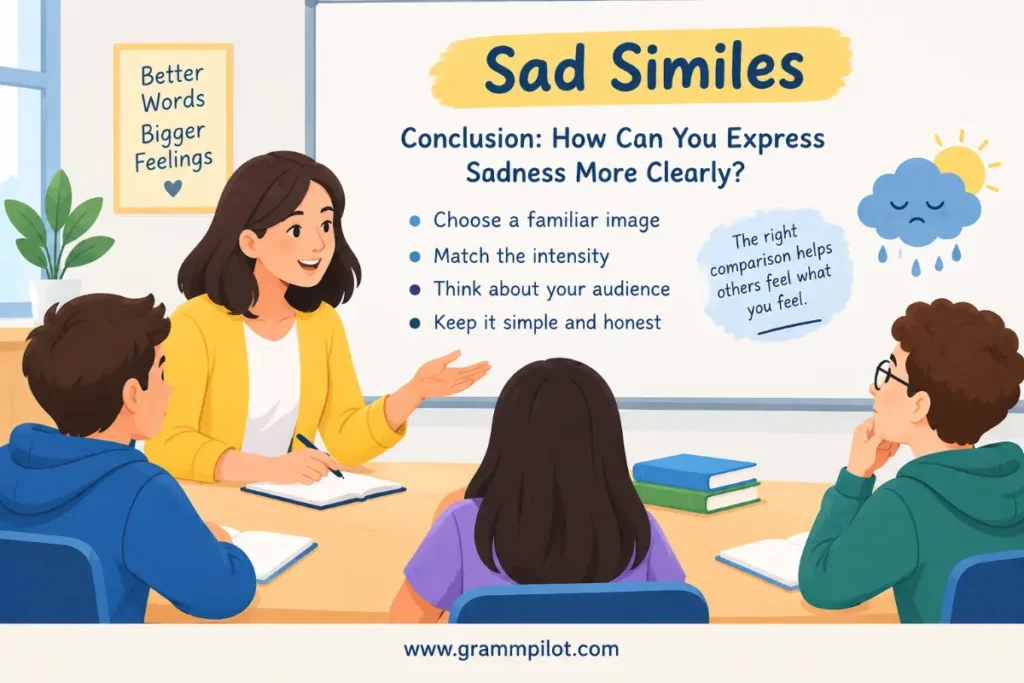
Sadness takes many forms. It can be a passing disappointment, a quiet feeling of loneliness, a painful memory, or deep grief after a major loss. Choosing the right comparison helps readers understand which kind of emotion you mean. The most effective Sad Similes connect feelings with familiar experiences. An empty chair can suggest absence, a fading photograph can suggest memory, and a cloudy morning can communicate a low mood without exaggerating it. The image should fit the person, situation, and purpose of the writing. When writing an essay, keep the comparison relevant to your point. In a story, use sensory details to reveal a character’s feelings. In a text message, choose natural words that sound like you.
Most importantly, don’t worry about making every sentence poetic. Start with the feeling, find an image that fits, and keep the wording clear. A simple, honest comparison can leave a stronger impression than a complicated one.
Frequently Asked Questions
1. What are Sad Similes in simple words?
Sad similes compare sadness with another thing using like or as. For example, “Her sadness was like rain falling on an empty street” helps readers picture a lonely mood.
2. What’s another way to say someone is sad?
You can say someone feels unhappy, down, gloomy, upset, sorrowful, or heartbroken. Choose the word that matches the intensity and cause of the feeling.
3. What is a good simile for feeling lonely?
“As lonely as a lighthouse on a deserted shore” is a useful comparison for loneliness. It suggests being alone while remaining visible to the world around you.
4. How do you describe deep sadness in creative writing?
Use a clear image connected to loss, absence, or emotional weight. For example, “His grief was like a house filled with echoes” suggests memories lingering after someone is gone.
5. What is the difference between a sad simile and a sad metaphor?
A simile uses like or as to make a comparison, while a metaphor describes one thing as another. “Her sadness was like a storm” is a simile; “Her sadness was a storm” is a metaphor.
6. Can I use sadness comparisons in a school essay?
Yes, if the comparison supports your topic and suits the assignment. Use clear language, explain the meaning when needed, and avoid adding imagery that distracts from your main point.
7. What are some short similes for sadness?
Examples include “sad as a rainy day,” “like a fading candle,” “as lonely as an island,” and “like a song ending too soon.” These short comparisons work well in poems, stories, and personal messages.