
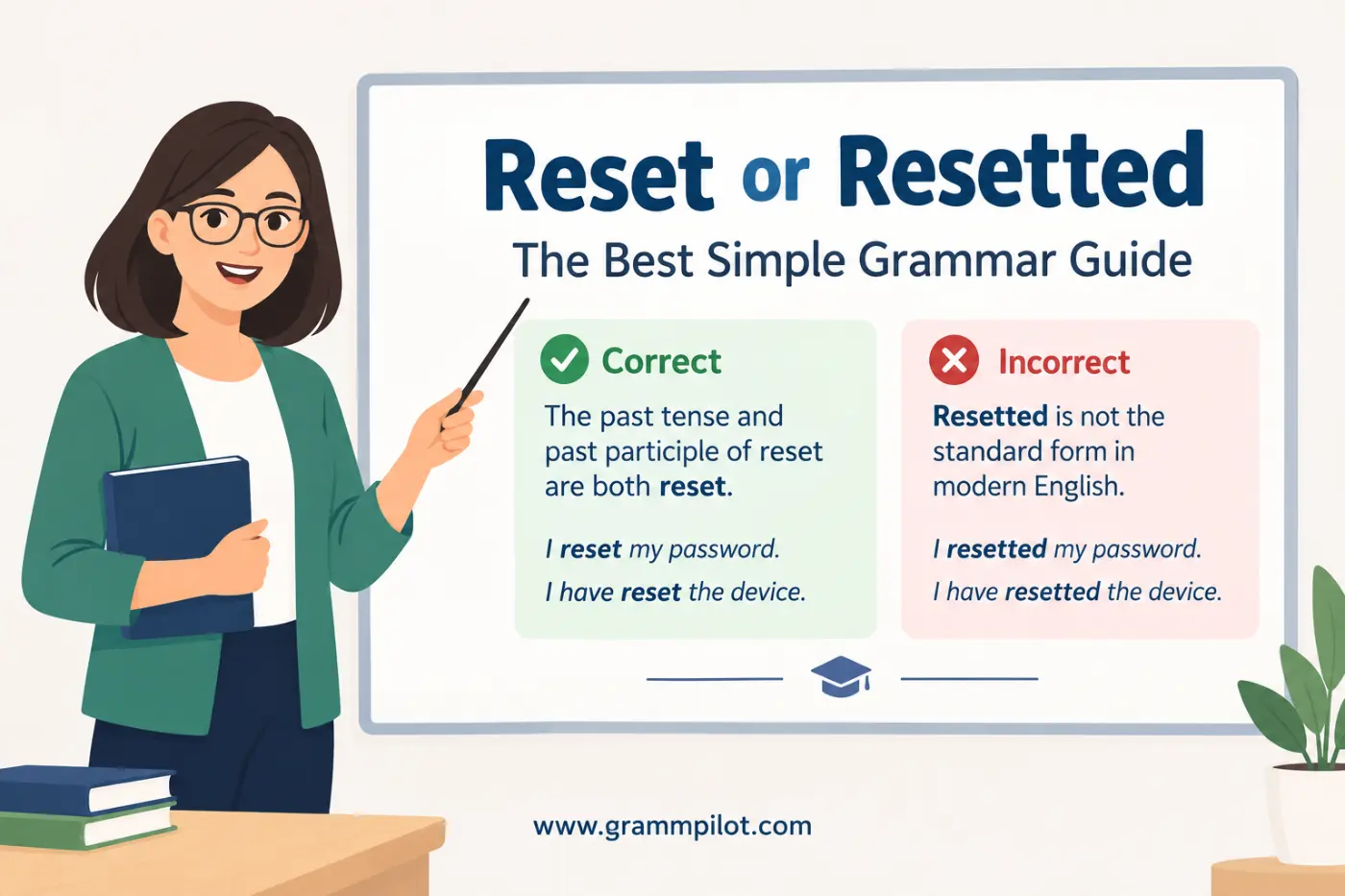
When you write an email, update your resume, or explain a technical problem, choosing the correct verb form matters. You might write, “I resetted my password,” and then wonder whether the sentence is grammatically correct. This is a common question because English verbs do not all form their past tense in the same way. The confusion around Reset or Resetted comes from the fact that reset already ends in the letters -et. Some English verbs add -ed to form the past tense, so adding another ending may seem logical. However, standard English follows a different pattern for this verb.The correct past tense and past participle of “reset” are “reset,” not “resetted.” For example, write “I reset my password yesterday,” not “I resetted my password yesterday.”
The good news is that the rule is easy to remember. Once you understand how reset works, you can use it correctly in conversations, professional emails, essays, text messages, and technical instructions. This guide explains the word’s origin, its different meanings, useful synonyms, common mistakes, and practical examples to help you choose the right expression every time.
You can also compare this with the words discussed in Serpent vs Snake.
What Is the Difference Between Reset and Resetted?
The main difference is that reset is the standard spelling for the present tense, simple past tense, and past participle. Resetted is generally considered nonstandard in modern English.
The verb reset means to set something again, return it to an earlier state, or change it back to a starting point.
Consider these examples:
- Present tense: I reset my alarm every evening.
- Simple past tense: I reset my alarm last night.
- Present perfect: I have reset my alarm.
- Past perfect: I had reset my alarm before leaving home.
- Future tense: I will reset my alarm tomorrow.
Notice that the spelling stays the same even when the time changes.
| Verb form | Correct example | Incorrect example |
|---|---|---|
| Present | I reset the router. | I resett the router. |
| Simple past | I reset the router yesterday. | I resetted the router yesterday. |
| Present perfect | I have reset the router. | I have resetted the router. |
| Past perfect | I had reset the router. | I had resetted the router. |
| Future | I will reset the router. | I will resetted the router. |
The most important point is that reset does not follow the regular pattern used by verbs such as walk and clean.
You say “walked” and “cleaned,” but you say “reset” when describing an action that already happened.
Where Does the Word Reset Come From?
Understanding the origin of a word can make its spelling easier to remember.
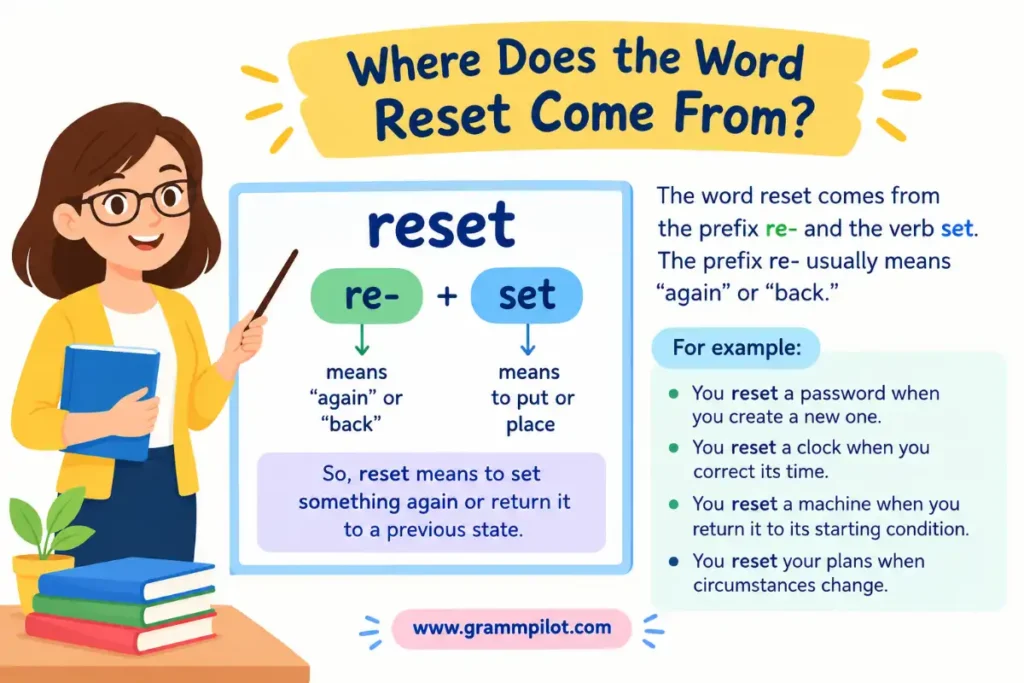
The word reset combines the prefix re- with the verb set. The prefix re- usually means “again” or “back.” Therefore, reset means to set something again or return it to a previous setting.
For example:
- You reset a password when you create a new one.
- You reset a clock when you correct its time.
- You reset a machine when you return it to its starting condition.
- You reset your plans when circumstances change.
The word follows the same basic spelling pattern as set. Since the past tense of set is also set, the past tense of reset remains reset.
Why Doesn’t Reset Become Resetted?
Many English verbs form their past tense by adding -ed.
For example:
- Work → worked
- Clean → cleaned
- Open → opened
- Restart → restarted
However, set is an irregular verb. Its present form, past form, and past participle have the same spelling.
| Verb form | Present | Past | Past participle |
|---|---|---|---|
| Set | Set | Set | Set |
| Reset | Reset | Reset | Reset |
| Put | Put | Put | Put |
| Cut | Cut | Cut | Cut |
| Hit | Hit | Hit | Hit |
This pattern explains why resetted is not the standard choice. The base verb reset preserves the spelling of set rather than adding another past-tense ending.
What Does Reset Mean in Plain English?
In simple English, reset means to start something again, restore an earlier condition, or adjust something to a new starting point.
Its exact meaning depends on the situation.
1. Reset Means to Start Again
You can use reset when you want to begin an activity again from the start.
Examples:
- The game froze, so I reset it.
- She reset the timer before starting the test.
- We reset the exercise after making a mistake.
2. Reset Means to Restore Settings
In technology, reset often means returning a device or program to its original or default settings.
Examples:
- I reset my phone because it was running slowly.
- The technician reset the router.
- You may need to reset your account settings.
A factory reset can erase personal information, so check the device instructions before using that option.
3. Reset Means to Adjust Something
The verb can also describe changing a setting or position.
Examples:
- The teacher reset the classroom clock.
- I reset the thermostat to a lower temperature.
- The technician reset the machine’s controls.
4. Reset Means to Start Fresh
In everyday conversation, reset can describe a fresh start after a difficult period or an unproductive routine.
Examples:
- I took a short walk to reset my mind.
- We decided to reset our plans after the delay.
- A quiet weekend helped me reset my routine.
This meaning is often figurative rather than technical.
What Are the Best Synonyms for Reset?
The best synonym depends on what you are changing or trying to accomplish. You might restart a computer, restore a setting, adjust a schedule, or begin an activity again.
The following table groups useful alternatives by tone and purpose.
| Word | Meaning | Tone | Example |
|---|---|---|---|
| Restart | Start again | Everyday | I restarted the computer. |
| Reboot | Restart a computer or device | Technical | I rebooted the laptop. |
| Restore | Bring back an earlier state | Neutral | I restored the original settings. |
| Reinitialize | Prepare a system again | Technical | The engineer reinitialized the system. |
| Recalibrate | Adjust for accuracy | Technical | I recalibrated the instrument. |
| Renew | Make fresh or active again | Formal | They renewed the agreement. |
| Revise | Change or improve | Academic | I revised my study plan. |
| Reconsider | Think about again | Formal | I reconsidered my decision. |
| Resume | Continue after a pause | Formal | We resumed the lesson. |
| Reestablish | Establish again | Formal | They reestablished contact. |
| Rebuild | Build again | Everyday | We rebuilt the damaged structure. |
| Clear | Remove stored information | Everyday | I cleared the saved settings. |
| Erase | Remove information | Direct | I erased the old data. |
| Reboot | Start a system again | Technical | The server rebooted overnight. |
| Reopen | Open again | Everyday | She reopened the document. |
| Recheck | Check again | Everyday | I rechecked the configuration. |
| Begin again | Start over | Simple | We began again after the error. |
| Start over | Begin from the beginning | Everyday | I started over with a new draft. |
| Reconnect | Connect again | Technical | I reconnected the device. |
| Recalculate | Calculate again | Technical | We recalculated the total. |
| Reassess | Evaluate again | Formal | The manager reassessed the plan. |
| Reboot mentally | Refresh your thinking | Informal | I took a break to reboot mentally. |
| Return to default | Restore original settings | Technical | Return the controls to default. |
These alternatives are not interchangeable in every sentence. For example, erase can mean removing information permanently, while reset may simply change settings. Choose the word that matches the action.
Which Synonyms for Reset Match Different Levels of Intensity?
Some alternatives describe a small adjustment, while others suggest a complete restart or major change.
Mild Changes
Use these words when the change is limited.
- Readjust: Make a small adjustment.
- Refresh: Update or renew something.
- Recheck: Examine something again.
- Reposition: Change a position.
- Reconsider: Think about a decision again.
Example: “I readjusted the meeting time by fifteen minutes.”
Moderate Changes
These words suggest a more noticeable change or a fresh attempt.
- Restart: Begin an activity or process again.
- Reorganize: Change how something is arranged.
- Reconfigure: Change a system’s settings.
- Revise: Improve or alter existing content.
- Recalculate: Work out a result again.
Example: “The team reconfigured the network after the connection problem.”
Strong or Complete Changes
Use these expressions when something returns to its original state or undergoes a major restart.
- Restore factory settings: Return a device to its factory configuration.
- Reinitialize: Prepare a system for operation again.
- Rebuild: Construct something again.
- Start from scratch: Begin without using the previous work.
- Wipe and reinstall: Remove existing data or software and install it again.
Example: “The technician restored the device to factory settings after troubleshooting failed.”
Be careful with expressions such as wipe, erase, and start from scratch. They can suggest losing existing work or information, which may not be what you intend.
How Does Reset Work as Different Parts of Speech?
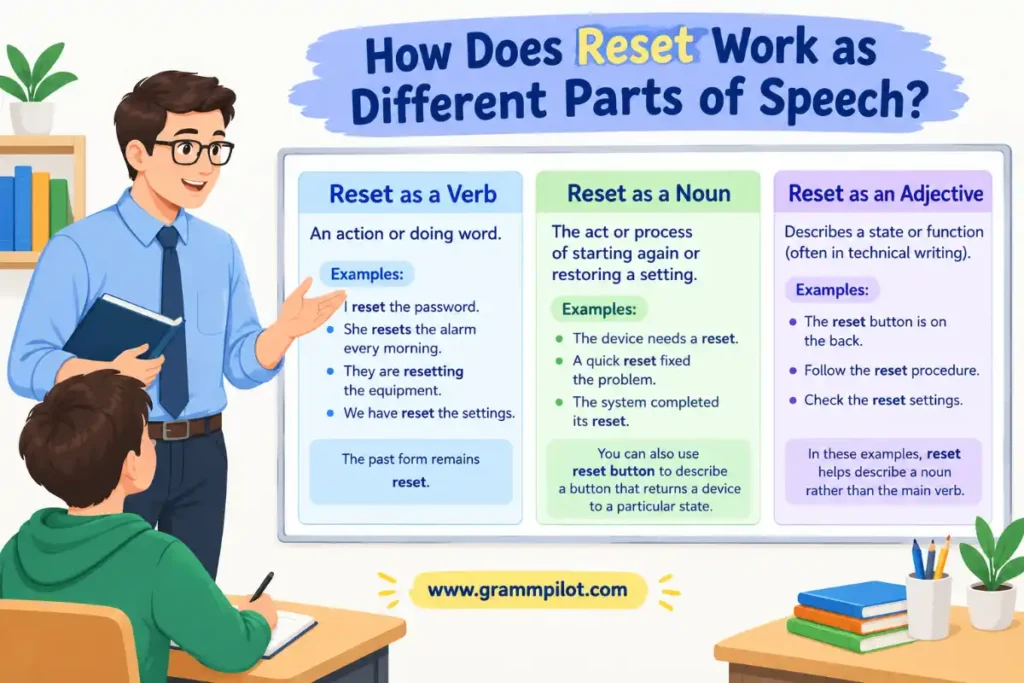
The word reset can function as a verb or a noun. Its grammatical role determines how it fits into a sentence.
Reset as a Verb
A verb describes an action.
Examples:
- I reset the password.
- She resets the alarm every morning.
- They are resetting the equipment.
- We have reset the settings.
The past form remains reset.
Reset as a Noun
As a noun, reset refers to the act or process of starting again or restoring a setting.
Examples:
- The device needs a reset.
- A quick reset fixed the problem.
- The system completed its reset.
You can also use reset button to describe a button that returns a device or process to a particular state.
Reset as an Adjective
In informal or technical writing, reset may describe a state or function.
Examples:
- The reset button is on the back.
- Follow the reset procedure.
- Check the reset settings.
In these examples, reset helps describe a noun rather than functioning as the main verb.
Is Reset or Resetted Correct in American and British English?
In standard American English and standard British English, reset is the accepted past tense and past participle.
There is no general US-versus-UK rule that makes resetted correct in one variety and incorrect in the other.
| Context | Standard usage | Example |
|---|---|---|
| American English | Reset | I reset my password yesterday. |
| British English | Reset | I reset my password yesterday. |
| Australian English | Reset | I reset the device this morning. |
| Formal international English | Reset | The administrator has reset the account. |
People may occasionally say or write resetted by analogy with regular verbs. However, that form is not recommended in professional writing, academic work, or edited publications.
If you are writing for an international audience, use reset for the past tense and past participle.
Which Word Should You Use in a Resume?
A resume should use clear, professional language that highlights actions and results. If you are describing a technical task, use reset when it accurately explains what you did.
Resume Examples
Correct:
“Reset employee passwords and maintained account access.”
Correct:
“Reset network devices to restore connectivity.”
Correct:
“Troubleshot equipment and reset system configurations.”
Incorrect: “Resetted employee passwords and maintained account access.”
If you want a stronger action verb, consider whether a more specific term better describes your contribution.
- Reconfigured: You changed settings.
- Restored: You returned something to a working condition.
- Reinitialized: You prepared a system for operation again.
- Recalibrated: You adjusted equipment for accuracy.
- Rebooted: You restarted a computer or system.
For example, “Reconfigured network settings to resolve recurring connection errors” gives more detail than “Reset the network.”
Choose the most accurate description. Do not replace reset with a more impressive-sounding word if you did not perform that specific action.
Which Word Should You Use in an Essay?
In an academic essay, use standard grammar and precise wording. The word reset is appropriate when you mean to restore something to an earlier state or establish a new starting point.
Examples:
- The researcher reset the experimental equipment before the next trial.
- The committee reset its priorities after reviewing the findings.
- The software automatically reset the system after the update.
If you are discussing a broader change, another verb may communicate your meaning more accurately.
For example:
- “The government revised the policy” means that it changed the policy.
- “The government restored the previous policy” means that it brought back an earlier version.
- “The government reset its priorities” means that it established a different starting point for its priorities.
Avoid resetted in essays because it does not follow standard English usage.
Should You Write Reset or Resetted in an Email?
Use reset in both casual and professional emails.
Examples:
Technical support email: “I reset my password, but I still cannot access my account.”
Workplace email: “I reset the meeting room display before the presentation.”
Customer service email: “We have reset your account settings. Please try signing in again.”
School email: “I reset the online quiz so students can attempt it again.”
When writing to a customer or colleague, keep the sentence direct. If the action could affect stored information, explain what the reset does and whether the person needs to take any further steps.
What Should You Say in a Text Message?
In text messages, short and natural sentences usually work best. You do not need a special informal form of the past tense.
Examples:
- “I reset my password.”
- “Just reset the router.”
- “I reset the timer. Try now.”
- “My phone froze, so I reset it.”
- “I needed a break to reset.”
Although texting is informal, the standard past tense is still reset. The spelling resetted is unnecessary.
What Are 12 Correct Example Sentences With Reset?
These examples show how the verb works in everyday life, education, work, and technology.
- I reset my password after receiving the security alert.
- She reset her alarm before going to bed.
- The teacher reset the classroom clock after the power outage.
- We reset the router to fix the internet connection.
- He reset the scoreboard before the next game.
- The technician has reset the machine’s controls.
- I had reset the timer before the students entered the room.
- The application reset its settings after the update.
- They reset the meeting schedule because two members were unavailable.
- The engineer reset the instrument before taking another measurement.
- I took a short walk to reset my mind after a stressful day.
- The team reset its goals at the beginning of the new quarter.
In every example, the spelling remains unchanged when the action takes place in the past.
How Can You Use Reset in Questions?
Questions often use did or have with the base or past participle form.
Correct examples:
- Did you reset the password?
- When did she reset the clock?
- Have you reset the device?
- Has the technician reset the machine?
- Why had they reset the schedule?
Do not add another past-tense ending after did. The auxiliary verb already marks the past tense.
Incorrect: “Did you resetted the password?”
Correct: “Did you reset the password?”
Reset vs. Restart: What’s the Difference?
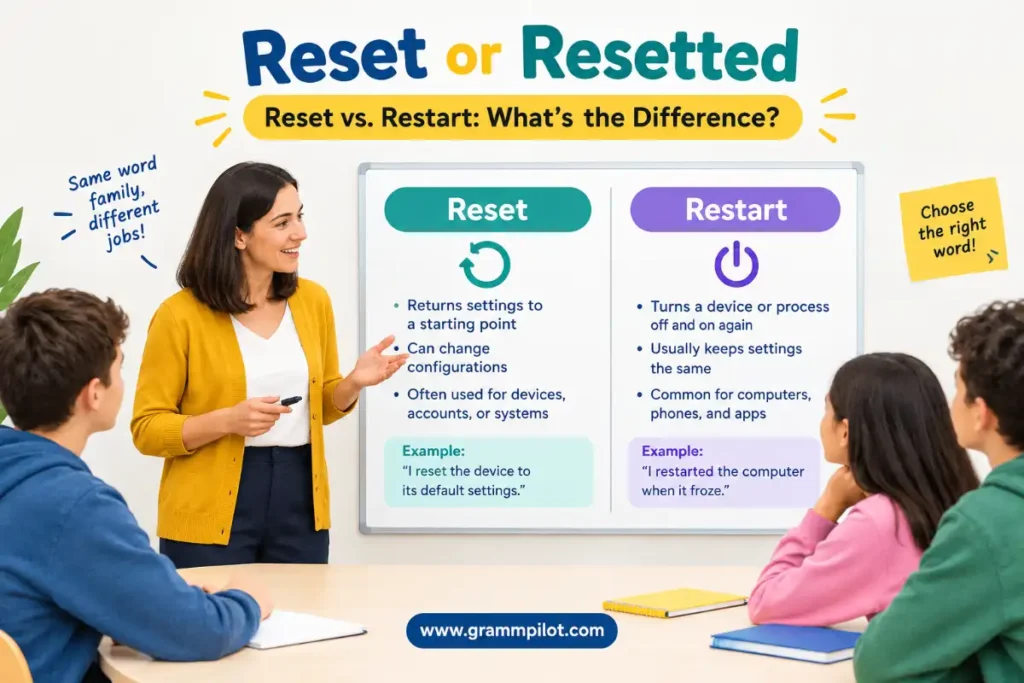
Reset and restart are closely related, but they do not always describe the same action.
| Reset | Restart |
|---|---|
| Can restore settings or return something to a starting state | Usually means starting a process or device again |
| May change stored settings | Does not necessarily change settings |
| Can describe a figurative fresh start | Often describes repeating or relaunching an activity |
| Example: I reset the device to its default settings. | Example: I restarted the device after it froze. |
A simple restart may leave your settings and personal files unchanged. A reset, depending on the device and option, may alter settings or remove information.
For example, restarting a phone usually turns it off and back on. A factory reset can erase personal data and restore the phone’s original configuration.
Check the instructions for your device before choosing either action.
Reset vs. Restore: What’s Different?
Both words can describe returning something to an earlier state, but their meanings differ.
| Reset | Restore |
|---|---|
| Establishes a starting point or returns something to a selected state | Brings back a previous condition, version, or item |
| Often used for controls, passwords, and settings | Often used for files, backups, and damaged items |
| Example: I reset the account settings. | Example: I restored the deleted files from a backup. |
You might reset an application to its default settings and restore a document from a backup. The first action changes the application’s configuration; the second brings back an earlier version of the document.
Choose the word that describes the actual action.
What Are the Most Common Mistakes With Reset?
Several errors occur because people apply familiar grammar patterns to an irregular verb.
Mistake 1: Adding -ed to Reset
Incorrect: “I resetted the password.”
Correct: “I reset the password.”
The verb does not need another past-tense ending.
Mistake 2: Using Resetted After Have or Has
Incorrect: “She has resetted the device.”
Correct: “She has reset the device.”
The past participle is also reset.
Mistake 3: Using Resetted After Did
Incorrect: “Did you resetted the settings?”
Correct: “Did you reset the settings?”
After did, use the base form of the main verb.
Mistake 4: Confusing Reset With Restart
Incorrect usage is not always a spelling problem. Sometimes the word simply fails to describe the intended action.
If you only turned a computer off and on, restarted may be more precise than reset.
Mistake 5: Assuming Every Past Verb Needs -ed
English includes both regular and irregular verbs. For example, played is the past tense of play, while put is the past tense of put.
Learning common irregular verbs helps prevent errors like resetted.
What Are the Antonyms of Reset?
An antonym is a word with an opposite or contrasting meaning. The best opposite of reset depends on the context.
| Word or phrase | Meaning | Example |
|---|---|---|
| Preserve | Keep something as it is | Preserve the original settings. |
| Maintain | Keep in the same condition | Maintain the current configuration. |
| Retain | Keep rather than remove | Retain the saved information. |
| Continue | Carry on without starting over | Continue the existing process. |
| Leave unchanged | Make no adjustment | Leave the settings unchanged. |
| Keep as configured | Preserve the current setup | Keep the device as configured. |
These are contextual opposites, not exact antonyms in every situation. For example, continue contrasts with resetting an activity, while preserve contrasts with changing existing settings.
What Are the Quickest Tips for Choosing the Right Form?
Remember these simple rules whenever you are unsure about the verb.
- For the present: “I reset the clock every morning.”
- For the past: “I reset the clock yesterday.”
- For the present perfect: “I have reset the clock.”
- After did: “Did you reset the clock?”
- For a device restart: Use restart when you mean turning a device off and on again.
- For a settings change: Use reset when you mean returning something to a starting or default state.
- For a previous version: Use restore when you mean bringing back an earlier version or condition.
A helpful memory trick is to remember the base verb set. You say “set,” not “setted,” when describing the past. Adding re- gives you reset, whose spelling also stays the same.
Final Conclusion: Which Form Should You Choose?
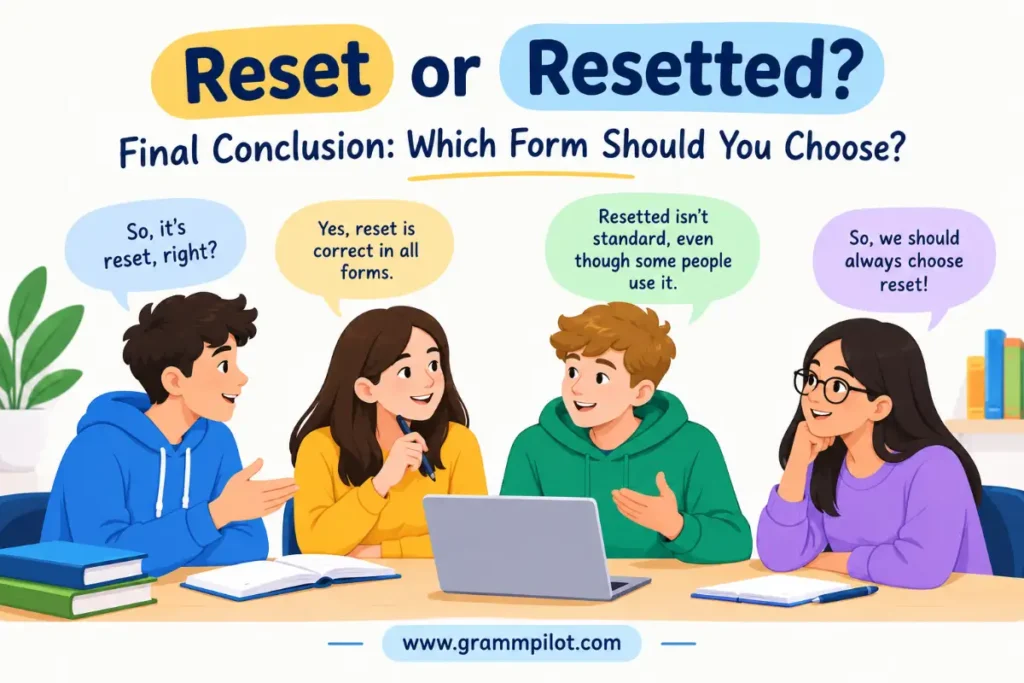
When deciding between Reset or Resetted, choose reset in standard English. It is the correct form for the present tense, simple past tense, and past participle. You can write “I reset the settings yesterday,” “I have reset the device,” and “Did you reset the password?” without changing the spelling. The key is to remember that reset follows the pattern of set, an irregular verb that does not take an extra -ed ending. Although you may encounter resetted in informal writing, it is best to avoid it in professional emails, school assignments, resumes, and published content. Also, choose related words carefully. Restart means to start again, while restore often means to bring something back to an earlier condition. With these distinctions in mind, you can write more clearly and confidently.
Frequently Asked Questions
1. Is Reset or Resetted Correct?
Reset is correct in standard English. It serves as the present tense, past tense, and past participle.
2. Is Resetted a Real Word?
Resetted appears occasionally in informal usage, but it is generally considered nonstandard. Use reset in formal and everyday writing.
3. What Is the Past Tense of Reset?
The past tense is reset. For example, “I reset my password yesterday.”
4. What Is the Past Participle of Reset?
The past participle is also reset. Say “I have reset the device,” not “I have resetted the device.”
5. What’s Another Way to Say Reset?
You can use restart, restore, reconfigure, readjust, or reinitialize, depending on the context. For example, restart often fits a computer that needs to start again.
6. Why Do People Say Resetted Instead of Reset?
People may add -ed because many English verbs form the past tense that way. However, reset follows the irregular verb set, so its spelling stays the same.
7. Should I Use Reset or Restart for a Computer?
Use restart when you mean turning the computer off and on again. Use reset when you mean returning its settings or configuration to a starting state; check the specific option because some resets erase data.