
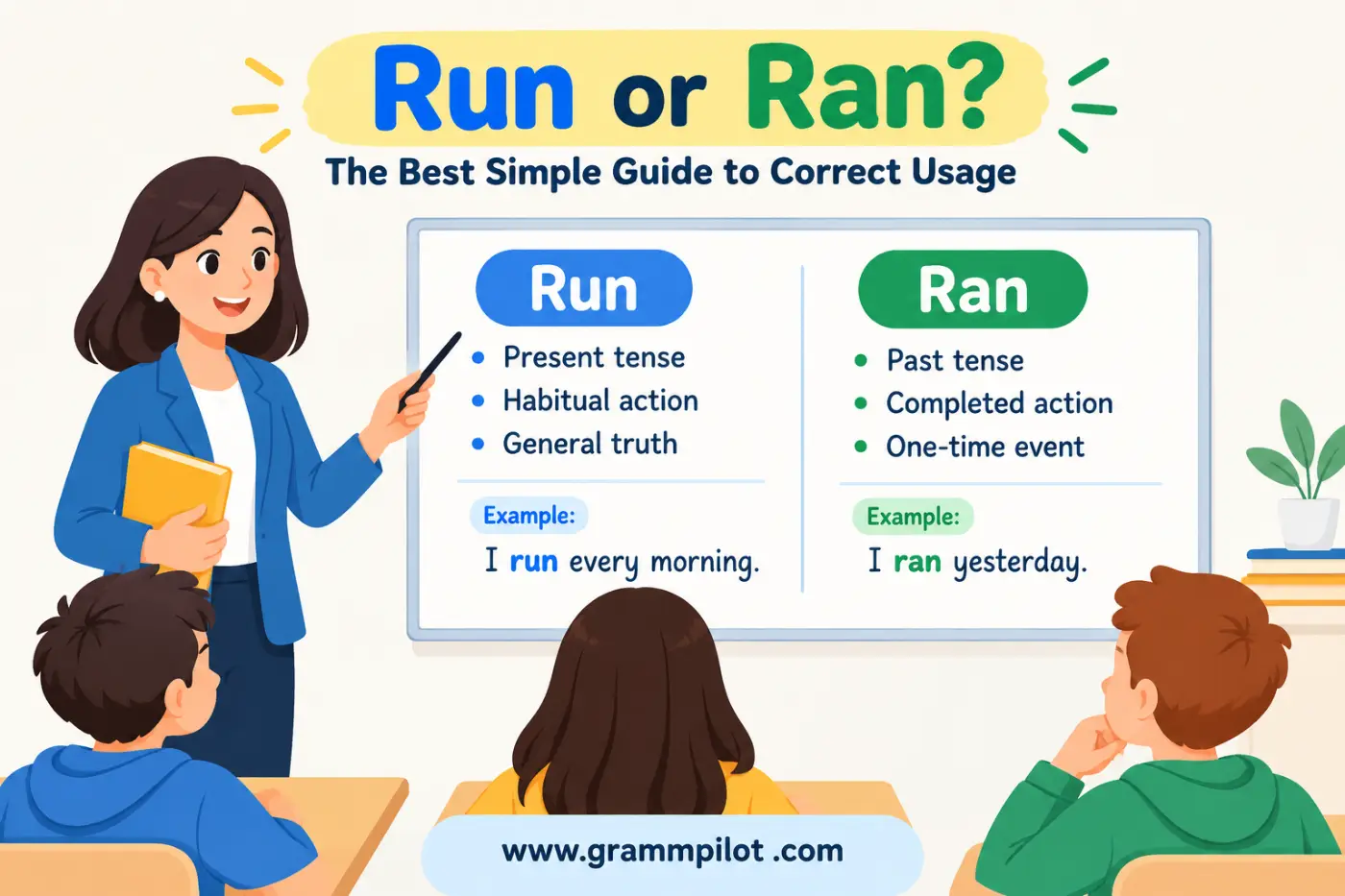
You’re writing an email, finishing an essay, or sending a quick text, and suddenly you stop: should you write “I run yesterday” or “I ran yesterday”? Both words come from the same verb, but they don’t work the same way. Run is the base form and present-tense form of the verb. Ran is the simple past form. The right choice depends mainly on when the action happened and how the sentence is structured.
Answer box: Use run for the present, after helping verbs such as “did” and “have,” and in certain other verb forms. Use ran for a completed action in the simple past.
This guide explains the meaning and history of both forms, gives practical examples, compares close alternatives, and shows which word works best in emails, essays, resumes, texts, and everyday speech.
Want to explorIf you liked these examples, you may also enjoy [Similes for Time].
What is the difference between run and ran?
The basic difference is time and verb structure.
Run can describe something happening now or something that happens regularly:
- I run every morning.
- She runs a small business.
- They run five miles on Saturdays.
Ran describes a completed action in the simple past:
- I ran yesterday.
- She ran to the store.
- They ran five miles last Saturday.
There is one useful detail to remember: run is also the past participle of “run,” so it appears after forms of “have.”
- I have run three miles.
- She had run the company for ten years.
- They have run this event before.
So the three main forms are:
- Base form: run
- Simple past: ran
- Past participle: run
That makes “run” an unusual verb because its base form and past participle are identical.
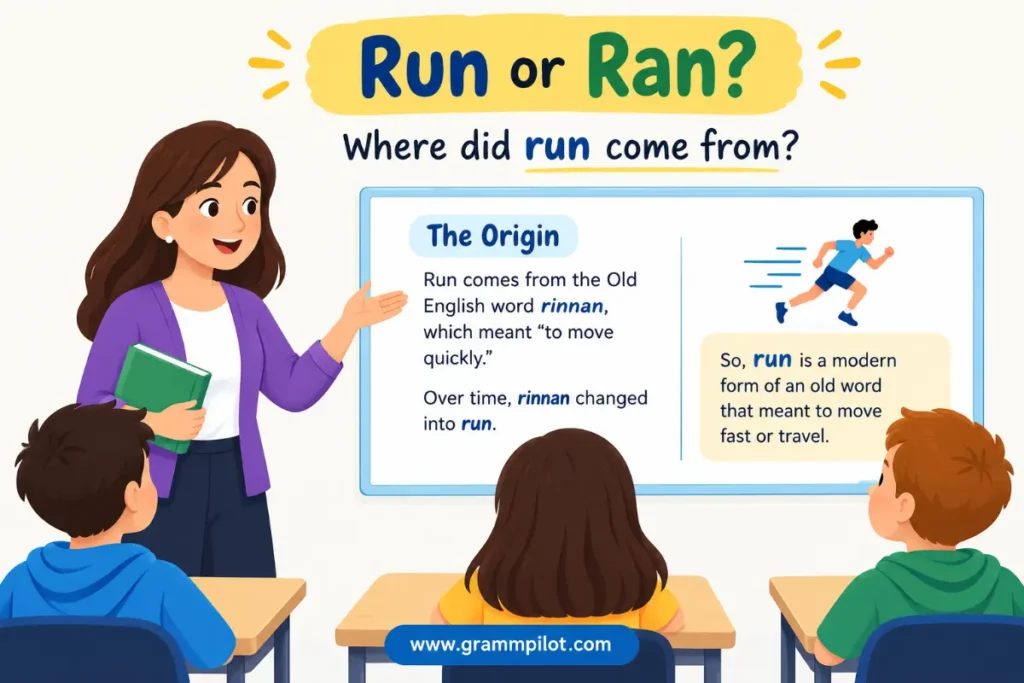
Where did run come from?
The verb run is an old English word with Germanic roots. It has been used for centuries to describe moving quickly on foot, but its meaning has expanded far beyond physical movement. Today, you can run a race, run a business, run a program, run a meeting, run an experiment, or run out of time. The past form ran developed as the historical past-tense form of the verb. Like many common English verbs, it doesn’t form its past tense by simply adding -ed.
For example:
- walk → walked
- talk → talked
- jump → jumped
But:
- run → ran
- go → went
- see → saw
- take → took
These are called irregular verbs because their past forms don’t follow the usual -ed pattern.
What does run mean in plain English?
The most basic meaning of run is to move quickly on foot.
Example: I run in the park every morning.
But English uses run in many other ways.
It can mean to operate:
The machine runs all day.
It can mean to manage:
She runs a small restaurant.
It can mean to continue:
The meeting ran for two hours.
It can mean to flow:
Water runs down the hill.
It can mean to compete:
He plans to run for office.
It can also mean to experience or reach something:
- We ran into traffic.
- The car ran out of gas.
Because run has so many meanings, context matters.
What does ran mean in plain English?
Ran usually tells readers that an action happened and finished in the past.
Examples:
- I ran home after school.
- She ran three miles yesterday.
- We ran into an old friend last weekend.
- The machine ran accurately yesterday.
Think of ran as the simple past form of run.
A helpful question is:
Did the action happen and finish in the past?
If yes, ran may be the correct choice.
What are synonyms for run?
The best synonym depends on what run means in the sentence. You can’t replace every use of “run” with the same word.
For physical movement, possible alternatives include jog, sprint, race, dash, hurry, rush, trot, and gallop.
When managing something, alternatives include manage, operate, direct, lead, control, oversee, administer, and handle.
For continuing or operating, words such as function, operate, continue, flow, and work may fit.
Here is a broader synonym guide:
Not every synonym has the same meaning. Jog, for example, means slow running for exercise, while sprint suggests very fast running over a short distance.
Which synonyms are mild or strong?
Synonyms can also be grouped by intensity.
Mild movement
- walk
- stroll
- trot
- jog
These words suggest controlled or relatively slow movement.
Moderate movement
- run
- hurry
- race
- dash
These suggest faster movement, but the exact speed depends on context.
Strong or urgent movement
- rush
- sprint
- bolt
- flee
- charge
These words often suggest speed, urgency, danger, or strong emotion.
For example:
- He walked to the door.
- He hurried to the door.
- He ran to the door.
- He sprinted to the door.
- He dashed to the door.
The basic action is similar, but the intensity changes.
What are the different parts of speech for run?
Run is most commonly used as a verb, but it can also be a noun.
As a verb:
- I run every morning.
- She runs the company.
As a noun:
- I went for a run.
- The team scored a home run.
- There was a long run of successful shows.
The noun run can refer to a period, series, attempt, or physical activity depending on context.
The word ran, however, is a verb form. It is not normally used as a noun.
Run or ran: which one should you use in an email?
In a professional email, choose the form based on the time of the action.
Use run for a current or regular activity:
I run the weekly report every Monday.
Use ran for a completed past action:
I ran the report yesterday.
Use run after have or has:
I have run the report and attached the results.
Avoid: I have ran the report.
That sentence mixes the wrong past form with have.

Run or ran: which one works best in a resume?
A resume often uses strong action verbs, so run and ran depend on if the responsibility is current or from a previous position.
For a current role:
- Run daily operations for a team of 15 employees.
- Run weekly training sessions.
- Run quality-control checks.
For a previous role:
- Ran daily operations for a team of 15 employees.
- Ran weekly training sessions.
- Ran quality-control checks.
If you still perform the responsibility, present-tense run may be appropriate. If the role is finished, ran may fit better.
For a resume, stronger alternatives can sometimes make the achievement more specific:
- Managed a team of 15 employees.
- Directed weekly training sessions.
- Oversaw quality-control checks.
These verbs tell the reader exactly what you did.
Run or ran: which one is better in an essay?
In an essay, grammar and time consistency matter more than trying to use a fancy synonym.
Use ran when describing a completed historical or personal event:
- The athlete ran across the field and scored.
Use run for general facts or repeated actions:
- Many athletes run several miles during training.
When writing about literature, the correct tense can depend on the style and purpose of the discussion.
For a summary of a story, writers often use the present tense:
- The character runs toward the house.
For a past event in a personal narrative:
- I ran toward the house.
The important thing is to keep your tense consistent.
Run or ran: which one should you use in texting?
Texting is usually more relaxed, but the grammar distinction remains the same.
- I ran to the store.
- I run there every Friday.
- I have run five miles today.
You might also see informal expressions such as:
- I gotta run.
- I ran out of time.
- I’ll run over there.
The casual setting doesn’t change the basic verb forms.
Run or ran: which one sounds natural when speaking?
Both are common in everyday speech.
Use ran when talking about a completed past event:
- I ran into Sarah yesterday.
Use run with accurate constructions:
- I’ve run this race three times.
In conversation, contractions are especially common:
- I’ve run there before.
- She’s run the same route.
- We’ve run out of milk.
What are some real-life examples of run and ran?
Here are examples from different situations.
- ExerciseI run three miles every morning.
- Yesterday’s activityI ran three miles yesterday.
- BusinessShe runs a small online store.
- Past business roleHe ran the company before retiring.
- TechnologyThis program runs on most computers.
- Past technology problemThe program ran slowly yesterday.
- A meetingThe meeting runs from 9:00 to 10:00.
- A past meetingThe meeting ran for three hours.
- Running into someoneI ran into my teacher at the grocery store.
- Running out of something
We ran out of coffee this morning.
- A regular activity
They run every weekend.
- A completed race
They ran the race last Saturday.
- A machine
The engine runs quietly.
- A past condition
The engine ran smoothly during the test.
- A current responsibility
I run the department.
These examples show why context is more useful than memorizing one isolated rule.
Run vs jog: what’s the difference?
Run is a broad word for moving quickly on foot. Jog usually means running at a slow or moderate pace, often for exercise.
Compare:
- I run every morning.
- I jog every morning.
Both can be correct, but jog specifically suggests a lighter pace.
You can also say:
- She ran a marathon.
- She jogged a marathon.
The first sentence is more natural when talking about completing a marathon as a race.
Run vs sprint: what’s the difference?
Run describes the general activity. Sprint emphasizes very high speed over a short distance.
Compare:
- He ran toward the finish line.
- He sprinted toward the finish line.
The second sentence creates a stronger sense of speed.
You shouldn’t automatically replace run with sprint because sprinting is a specific type of running.
Run vs manage: what’s the difference?
When run means “manage,” it is usually less formal than manage, direct, or administer.
Compare:
- She runs the department.
- She manages the department.
- She directs the department.
All three can be correct, but they can carry slightly different shades of meaning.
Run sounds natural and direct.
Manage emphasizes responsibility and day-to-day control.
Direct can suggest leadership or guidance.
Administer sounds more formal and is often used for programs, systems, or organizations.
When should you not use ran?
Don’t use ran after have, has, or had when you mean the past participle.
Incorrect:
- I have ran five miles.
Correct:
- I have run five miles.
Incorrect:
- She has ran the business for years.
Correct:
- She has run the business for years.
Incorrect:
- They had ran out of food.
Correct:
- They had run out of food.
Remember:
have/has/had + run
But: simple past + ran
Examples:
- I ran yesterday.
- I have run before.
- I had run before the race began.
When should you not use run?
Don’t use the base form run by itself when a simple past form is required.
Incorrect:
- Yesterday, I run five miles.
Correct:
- Yesterday, I ran five miles.
Incorrect:
- She run to the store last night.
Correct:
- She ran to the store last night.
The time marker often gives you a strong clue.
Words such as:
- yesterday
- last night
- last week
- two days ago
- earlier
- in 2024
often point toward the simple past.
But remember that context matters. A time expression doesn’t always mechanically determine the verb form in every sentence.

What are the most common mistakes with run and ran?
Mistake 1: Using run for a completed past action
Incorrect:
- I run five miles yesterday.
Correct:
- I ran five miles yesterday.
Mistake 2: Using ran after have
Incorrect:
- I have ran five miles.
Correct:
- I have run five miles.
Mistake 3: Using ran after did
After did, use the base form run, not ran.
Incorrect:
- Did you ran yesterday?
Correct:
- Did you run yesterday?
This happens because did already carries the past tense.
Mistake 4: Using ran after will
Incorrect:
- I will ran tomorrow.
Correct:
- I will run tomorrow.
After will, use the base form.
Mistake 5: Mixing tenses
Incorrect:
- Yesterday I run to the store, and then I buy some food.
Better:
- Yesterday I ran to the store, and then I bought some food.
The verbs should normally agree with the time frame being described.
Mistake 6: Choosing a synonym that changes the meaning
If you replace run with sprint, you may accidentally suggest much faster movement.
If you replace run a company with operate a company, the sentence becomes more formal and may sound different in tone.
A synonym should fit both the meaning and the situation.
What happens after did, does, and will?
This is one of the easiest rules to remember.
After did, use run:
- Did you run?
- Did she run?
- Did they run?
After does, use run:
- Does he run every morning?
- Does she run the store?
When will, use run:
- I will run tomorrow.
- She will run the meeting.
The helping verb carries the grammatical information, so the main verb stays in its base form.
What are the antonyms of run?
There is no single opposite for every meaning of run.
For physical movement, possible opposites include:
- walk
- stop
- stand
- stay
- remain
When consider operating:
- stop
- shut down
- fail
For managing:
- relinquish
- surrender control
- hand over
Context determines the best antonym.
For example:
- The machine is running.
- The machine is stopped.
Here, stopped is the natural opposite.
But:
- She runs the company.
The opposite idea might be that she doesn’t manage or no longer controls the company.
How can you choose the right word quickly?
Use these questions before choosing between run and ran:
- Did the action happen in the past and finish?
- Use ran.
- Is the action happening regularly or generally?
- Use run.
- Does the sentence contain did?
- Use run.
- Does the sentence contain have, has, or had?
- Use run.
- Does the sentence contain will?
- Use run.
- Is the subject he, she, or it in the simple present?
- Use runs.
- Are you describing an action happening now with be + -ing?
- Use running.
A compact pattern is:
- Present: I run.
- Past: I ran.
- Accurate: I have run.
- Continuous: I am running.
- Future: I will run.
Is run or ran more formal?
Neither word is inherently more formal.
Both are ordinary English words used in professional, academic, and casual settings.
The context determines the tone.
For example:
- She ran the department.
This is accuratey acceptable in professional writing.
However, if you want a more specific or formal verb, you might write:
- She managed the department.
- She directed the department.
- She oversaw the department.
The goal isn’t to replace simple words with complicated ones. The goal is to choose the word that communicates your meaning precisely.
Are there US and UK differences?
There is no major US-versus-UK difference in the basic forms run and ran.
American and British English both use:
- run
- ran
- running
The pronunciation and some surrounding expressions can vary by region, but the core grammar is the same.
For learners, there is no need to memorize separate American and British past forms for this verb.
What is the easiest memory trick for run and ran?
Think of a simple timeline:
NOW → run
PAST → ran
HAVE/HAS/HAD → run
For example:
- Today: I run.
- Yesterday: I ran.
- Before now: I have run.
Then remember one extra rule:
After did, use run.
So:
- Did you run?
- I ran.
- I have run.
This three-part pattern catches many common mistakes.
Final quick tips for choosing the right word
- Use run for the base form.
- Use ran for simple past.
- Use run after did.
- Use run after will.
- Use run after have, has, and had.
- Use runs with he, she, and it in the simple present.
- Use running with forms of “be” for continuous actions.
- Don’t write runned in standard English.
- Don’t automatically replace run with a synonym.
- Choose a synonym based on the exact meaning you need.
- Keep verb tense consistent within your writing.
- Look for time clues such as “yesterday” or “last week.”
- In professional writing, use more specific alternatives such as manage, direct, or oversee when they communicate your role more clearly.

Conclusion
Understanding Run or Ran becomes much easier when you focus on verb form instead of trying to memorize isolated sentences. Run is the base form and is also used as the past participle after words such as “have,” while ran is the simple past form for a completed action.
The most useful patterns are simple: “I run,” “I ran,” and “I have run.” Also remember that did, will, and other helping verbs can change which form belongs in the sentence. Once you recognize these patterns, you can use the verb naturally in texts, emails, essays, conversations, and professional writing. When you’re unsure, identify the time of the action and look for a helping verb. That small check can prevent most errors.
Frequently Asked Questions
1. Is it correct to say I run yesterday?
No. For a completed action yesterday, say “I ran yesterday.”
2. Is it I ran or I run?
Use “I ran” for a completed past action and “I run” for the present or a regular activity.
3. Can I say I have ran?
No. The correct form is “I have run” because “have” takes the past participle.
4. Did you run or did you ran?
The correct form is “Did you run?” After “did,” use the base form run.
5. What’s another way to say run?
Depending on the meaning, alternatives include jog, sprint, dash, hurry, rush, manage, operate, and oversee.
6. What is the past tense of run?
The simple past tense of run is ran.
7. Is ran a past participle?
No. Ran is the simple past form. The past participle is run, as in “I have run five miles.”