
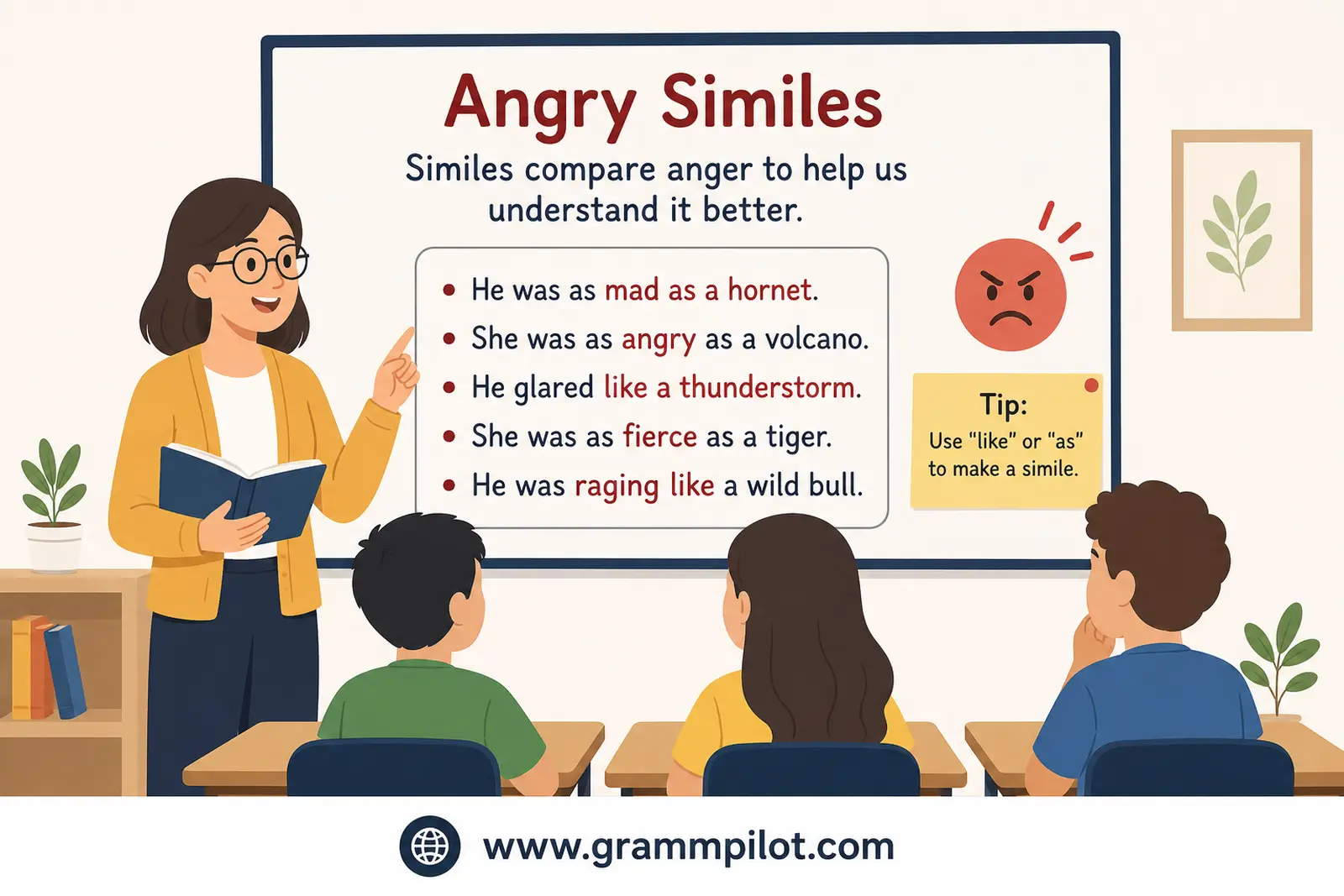
Have you ever been writing an essay, story, email, or even a text message and wanted to describe someone’s anger without simply saying they were “very angry”? That’s where Angry Similes can make your writing stronger and more interesting. Many students, writers, and English learners search for Angry Similes because comparisons help readers picture emotions instead of just reading about them. A good simile can make a character’s anger feel real and memorable.
Quick Answer
Angry similes compare anger to something else using words like “like” or “as.” They help describe how strong, sudden, or intense someone’s anger is in a clear and vivid way.
In this guide, you’ll learn what angry similes are, where they came from, dozens of creative examples, related words, common mistakes, and practical tips for choosing the best comparison in any writing situation.
Want to make your writing more vivid? Check out [Similes for Being Happy].
What Are Angry Similes?
A simile compares one thing to another using the words like or as. An angry simile helps readers understand how someone feels by comparing their anger to something familiar.
Instead of saying: He was angry.
You can write: He was as angry as a hornet.
Or: She exploded like a volcano.
These comparisons create a much stronger picture in the reader’s mind.
Simple Definition
Angry similes compare anger to people, animals, objects, or natural events using “like” or “as.” They make emotions easier to imagine and more interesting to read.
Why Do Writers Use Angry Similes?
Angry similes help writers:
- Show emotions instead of simply naming them.
- Make characters feel more realistic.
- Add excitement to stories.
- Help readers picture a scene.
- Make writing more memorable.
You’ll find them in:
- Stories
- Novels
- Essays
- Poems
- Speeches
- Movies
- Song lyrics
- Everyday conversations
Everyday Examples
- He was as mad as a hornet.
- She was like a volcano ready to erupt.
- His face turned as red as fire.
- The coach shouted like roaring thunder.
- She glared like an angry tiger.
- He stormed out like a hurricane.
- The customer looked as fierce as a lion.
- Her words hit like lightning.
- He growled like a bear protecting its cubs.
- They argued like two cats fighting over food.
These comparisons make anger easier to picture than simply saying someone was upset.
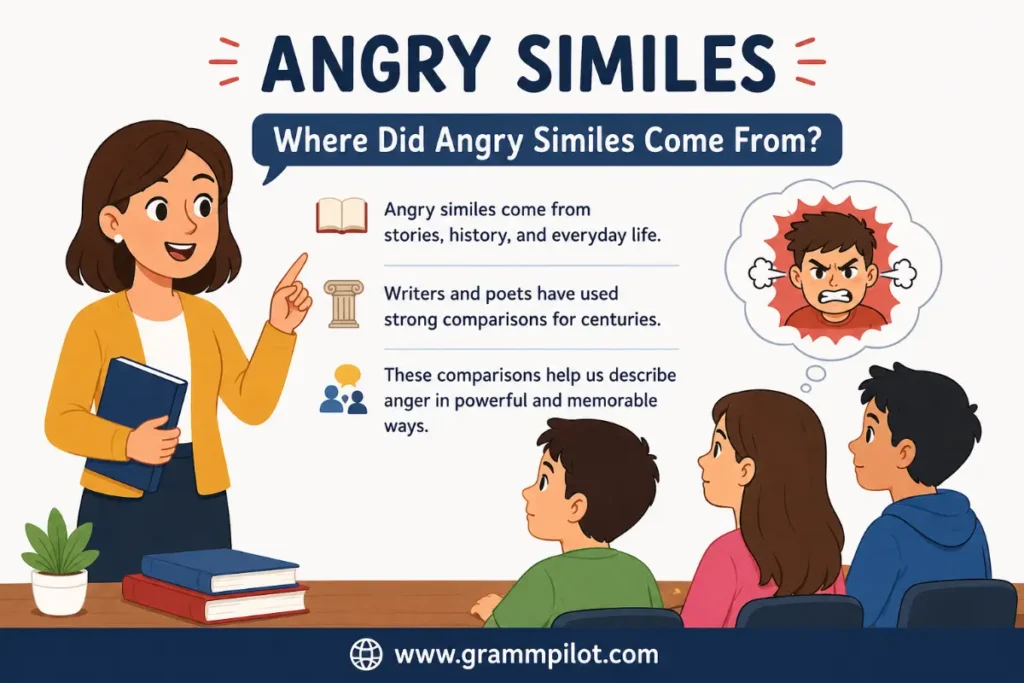
Angry Similes: Where Did Angry Similes Come From?
People have compared emotions to nature and animals for thousands of years. The word simile comes from the Latin word similis, meaning similar or alike. Long before modern books existed, storytellers used comparisons to help listeners imagine emotions.
Instead of saying someone was angry, they might compare that person’s temper to:
- a roaring lion
- a crashing storm
- a burning fire
- an erupting volcano
- a wild bull
These images were easy for listeners to understand because everyone had seen storms, animals, or fire. Today, writers still use these comparisons because they quickly create strong mental pictures.
Plain-English Meaning
When people search for Angry Similes, they’re usually looking for creative ways to describe different kinds of anger, including:
- Mild frustration
- Annoyance
- Irritation
- Rage
- Fury
- Explosive anger
- Quiet anger
- Hidden anger
- Sudden anger
- Uncontrollable anger
Different similes fit different situations. Someone who is slightly annoyed shouldn’t be compared to an erupting volcano.
Master List of Words Related to Anger
Although similes are comparisons rather than synonyms, these words help describe different levels of anger.
Simple Words
| Word | Meaning | Tone | Example |
|---|---|---|---|
| angry | upset or mad | Neutral | She looked angry. |
| mad | very angry | Everyday | He got mad quickly. |
| upset | emotionally bothered | Everyday | I’m upset about the mistake. |
| annoyed | slightly angry | Neutral | She seemed annoyed. |
| irritated | mildly angry | Neutral | The noise irritated him. |
| cross | a little angry | Casual | Dad was cross with us. |
| unhappy | not pleased | Neutral | He looked unhappy after the meeting. |
| frustrated | unable to succeed | Neutral | She felt frustrated by the delay. |
Everyday Words
| Word | Meaning | Tone | Example |
|---|---|---|---|
| furious | extremely angry | Everyday | She was furious after the accident. |
| offended | hurt by words or actions | Neutral | He felt offended. |
| grumpy | easily annoyed | Casual | Grandpa is grumpy before coffee. |
| cranky | in a bad mood | Casual | The baby is cranky today. |
| impatient | unable to wait calmly | Everyday | Drivers became impatient. |
| bitter | holding anger for a long time | Neutral | He sounded bitter. |
| heated | emotionally intense | Neutral | They had a heated discussion. |
| hostile | unfriendly and angry | Neutral | The crowd became hostile. |
Formal Words
| Word | Meaning | Tone | Example |
|---|---|---|---|
| enraged | filled with rage | Formal | The citizens were enraged. |
| indignant | angry because something is unfair | Formal | She felt indignant about the decision. |
| outraged | extremely shocked and angry | Formal | Many people were outraged. |
| resentful | holding lasting anger | Formal | He remained resentful for years. |
| exasperated | extremely frustrated | Formal | The teacher looked exasperated. |
| incensed | very angry | Formal | The manager was incensed. |
| agitated | emotionally disturbed | Formal | The speaker became agitated. |
| wrathful | full of great anger | Literary | The king looked wrathful. |
Slang and Informal Words About “Angry Similes”
| Word | Meaning | Tone | Example |
|---|---|---|---|
| ticked off | annoyed | Informal | I’m ticked off today. |
| steamed | angry | Informal | She was steamed after work. |
| fired up | excited or angry | Casual | The coach was fired up. |
| losing it | unable to stay calm | Slang | He was losing it. |
| fuming | very angry | Casual | Dad came home fuming. |
| hot under the collar | becoming angry | Idiom | He got hot under the collar. |
| bent out of shape | overly upset | Informal | Don’t get bent out of shape. |
| seeing red | extremely angry | Idiom | She was seeing red after hearing the news. |
These descriptive words can help you create your own similes.
For example:
- She was as furious as a trapped tiger.
- His anger spread like wildfire.
- The argument grew like a storm gathering strength.
- He stood there as still as a volcano before an eruption.
50 Creative Angry Similes
Here are real angry similes you can use in essays, stories, speeches, poems, and everyday writing.
| Simile | Best Used For |
|---|---|
| As angry as a hornet | Sudden anger |
| Like a volcano ready to erupt | Explosive anger |
| As fierce as a lion | Powerful anger |
| Like a raging wildfire | Fast-growing anger |
| Like thunder before a storm | Building anger |
| As red as fire | Visible anger |
| Like a charging bull | Aggressive behavior |
| As wild as a hurricane | Uncontrolled anger |
| Like a shaken soda bottle | Holding anger inside |
| As sharp as broken glass | Angry words |
| As loud as thunder | Shouting |
| Like boiling water | Growing frustration |
| Like an earthquake | Sudden emotional outburst |
| As fierce as a wolf | Protective anger |
| Like lightning striking a tree | Instant anger |
| As dangerous as a storm | Serious conflict |
| Like a barking guard dog | Defensive anger |
| As restless as a caged tiger | Frustrated anger |
| Like smoke before a fire | Anger building slowly |
| As explosive as fireworks | Dramatic reaction |
| As rough as crashing waves | Harsh emotions |
| Like a roaring engine | Powerful temper |
| As intense as the summer sun | Strong irritation |
| As hard as stone | Cold anger |
| Like a cracked dam | Anger finally released |
| As stormy as the ocean | Emotional conflict |
| Like sparks from a fire | Quick bursts of anger |
| Like a pressure cooker | Anger ready to explode |
| Like a boiling kettle | Growing frustration |
| As dark as storm clouds | Silent anger |
| As loud as a siren | Angry shouting |
| Like a cannon blast | Sudden outburst |
| As stubborn as a bull | Refusing to calm down |
| Like a blazing furnace | Intense rage |
| As fierce as a dragon | Fantasy writing |
| Like a roaring fire | Powerful emotion |
| As violent as crashing thunder | Dramatic scenes |
| As blazing as the desert sun | Extreme anger |
Angry Similes by Intensity (Mild → Strong)
Not all anger feels the same. Sometimes a person is only slightly annoyed. Other times, they’re completely furious. These similes are grouped from the weakest feeling to the strongest.
| Intensity | Simile | Best For |
|---|---|---|
| Very Mild | As annoyed as a buzzing fly | Small irritation |
| Very Mild | Like a child who missed dessert | Minor disappointment |
| Mild | As grumpy as a bear woken too early | Bad mood |
| Mild | Like a cat with its tail stepped on | Sudden annoyance |
| Medium | As hot as a summer sidewalk | Growing frustration |
| Medium | Like boiling water in a pot | Anger building |
| Medium | As tense as a stretched rubber band | Hidden anger |
| Strong | Like thunder before a storm | Serious anger |
| Strong | As fierce as a hungry lion | Powerful emotion |
| Very Strong | Like a volcano erupting | Explosive rage |
| Very Strong | As unstoppable as an avalanche | Uncontrollable anger |
| Extreme | Like wildfire in a dry forest | Anger spreading rapidly |
Choosing the right level makes your writing feel more realistic. A small disagreement doesn’t need the same comparison as an explosive argument.
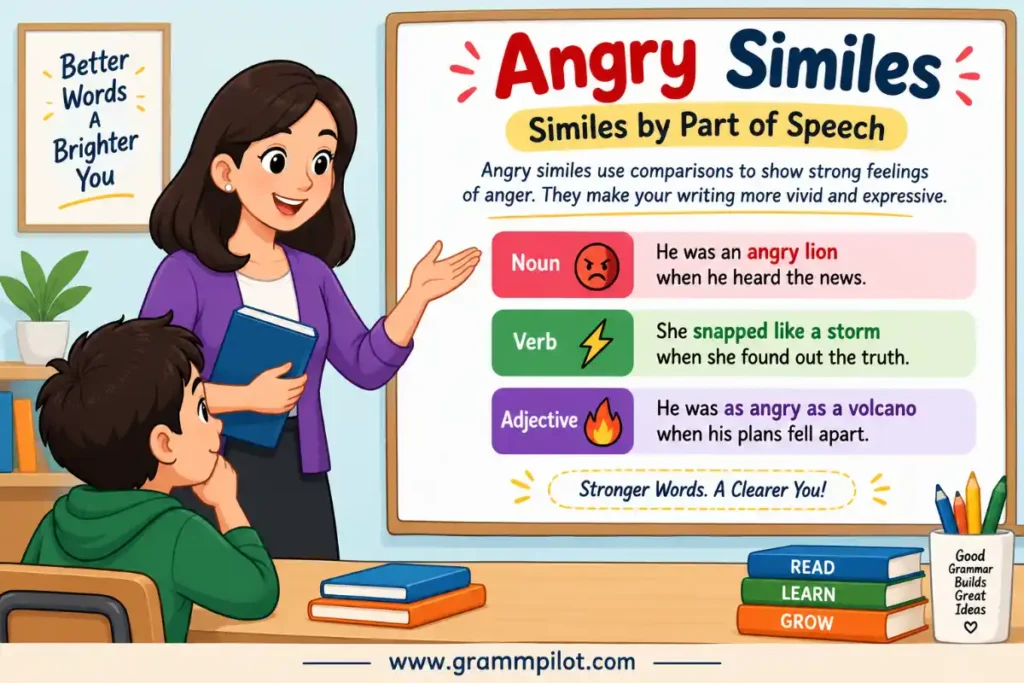
Angry Similes: Similes by Part of Speech
Similes are comparisons, but they’re usually built around adjectives, verbs, or nouns.
Adjectives That Describe Anger
These words describe how someone feels.
- angry
- annoyed
- irritated
- frustrated
- furious
- enraged
- hostile
- bitter
- resentful
- indignant
- exasperated
- wrathful
Example:She was as furious as a storm at sea.
Verbs That Work Well with Angry Similes
These action words help create vivid comparisons.
- roared
- shouted
- snapped
- growled
- exploded
- stormed
- glared
- scowled
- barked
- argued
- slammed
- fumed
Example:He roared like thunder across the room.
Nouns Commonly Used in Angry Similes
Many comparisons use familiar objects, animals, or natural events.
- volcano
- fire
- wildfire
- thunder
- lightning
- storm
- hurricane
- tornado
- lion
- tiger
- bear
- bull
- wolf
- dragon
- furnace
These images quickly help readers imagine the strength of someone’s emotions.
Are Angry Similes Different in American and British English?
Not very much. Both American and British English use many of the same classic similes.
Examples used in both countries include:
- As angry as a hornet.
- Like a volcano ready to erupt.
- As fierce as a lion.
- Like thunder before a storm.
The biggest difference is in everyday vocabulary, not the similes themselves.
American English
- Mad
- Ticked off
- Fired up
Example: He was as mad as a hornet.
British English
- Cross
- Fed up
- Livid
Example: She was as cross as a wasp.
The comparisons still work the same way. Only some of the surrounding words change.
Which Angry Simile Should You Use?
The best comparison depends on what you’re writing.
Best Angry Similes for Essays
School essays usually sound best with clear and believable comparisons.
Examples:
- His temper rose like a storm gathering over the hills.
- She became as angry as a trapped animal.
These sound descriptive without being exaggerated.
Best Angry Similes for Stories
Stories give you more freedom to create vivid pictures.
Examples:
- His voice crashed like thunder across the valley.
- Her anger spread like wildfire through the forest.
- He stood as still as a volcano before it erupted.
These comparisons help readers feel the emotion instead of simply reading about it.
Best Angry Similes for Text Messages
Keep them short and natural.
Examples:
- I’m mad like a hornet today.
- Dad is like a volcano right now.
- She’s fuming like a kettle.
Best Angry Similes for Emails
Professional writing usually needs softer comparisons.
Examples:
- The customer became as frustrated as someone stuck in heavy traffic.
- The discussion grew like a storm slowly building.
Avoid overly dramatic images in workplace emails.
Best Angry Similes for Speaking
Everyday conversations often use simple comparisons.
Examples:
- He was as mad as a hornet.
- She looked ready to explode like a volcano.
- Dad was fuming like a kettle.
- The coach sounded like roaring thunder.
Simple similes are usually easier for listeners to understand.
Original Example Sentences “Angry Similes”
Here are original examples showing angry similes in real situations.
- The coach shouted like thunder rolling through the stadium.
- She was as angry as a hornet after hearing the news.
- His face became as red as burning coals.
- The manager exploded like a volcano during the meeting.
- My brother stormed upstairs like a hurricane.
- The customer glared like a hungry tiger.
- Their argument spread like wildfire through the office.
- He stood there as tense as a stretched rope.
- Her voice cracked like lightning across the sky.
- The teacher looked as fierce as a lion protecting its pride.
- Dad was fuming like a boiling kettle after the delay.
- The crowd roared like crashing ocean waves.
- She slammed the door like thunder striking nearby.
- His temper rose like floodwater after heavy rain.
- The siblings argued like two storms meeting in the same sky.
These examples show that similes make emotional scenes much more vivid than simply saying someone was angry.
Angry Similes vs Metaphors: What’s the Difference?
Many people confuse similes and metaphors because both compare one thing with another. The difference is simple.
| Simile | Metaphor |
|---|---|
| Uses like or as | Doesn’t use like or as |
| Makes a comparison | Says one thing is another |
| “He was like a volcano.” | “He was a volcano.” |
| Easier for beginners | Often sounds more poetic |
Both make writing stronger, but similes are usually easier for readers to understand.
Examples
Simile
- She was as angry as a hornet.
- His voice boomed like thunder.
- They argued like two wild animals.
Metaphor
- She was a volcano waiting to erupt.
- His voice was thunder.
- Their argument was a raging storm.
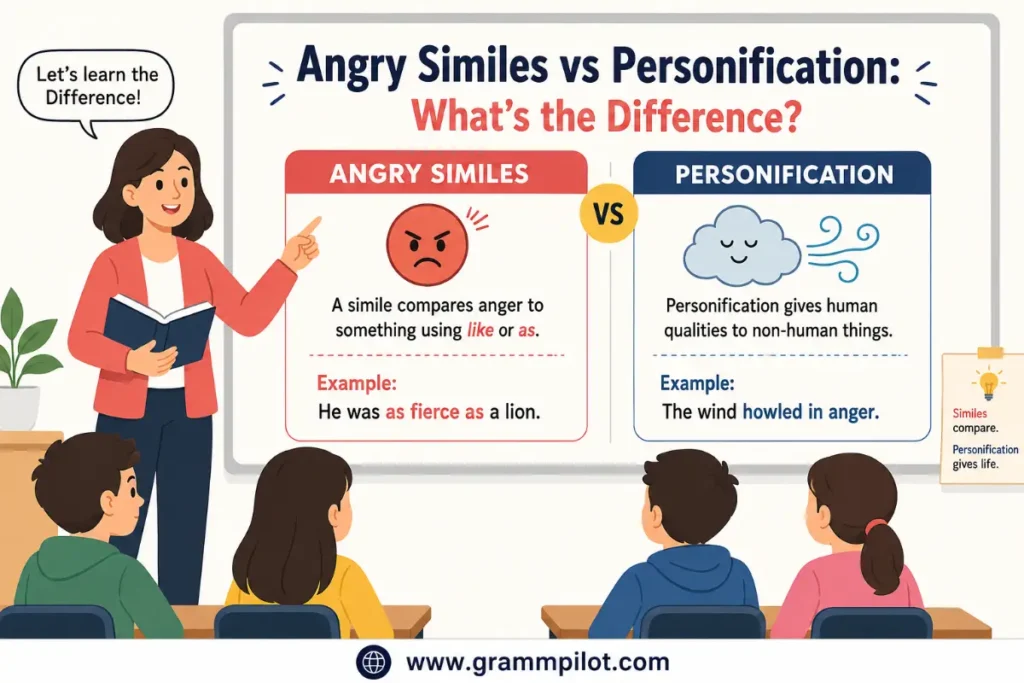
Angry Similes vs Personification: What’s the Difference?
Personification gives human qualities to things that aren’t human.
| Angry Simile | Personification |
|---|---|
| Compares two things | Gives human actions or feelings to objects |
| Uses like or as | Doesn’t need comparison words |
| “His anger spread like wildfire.” | “Anger knocked on the door.” |
Example using both: His anger spread like wildfire, and the walls seemed to tremble with fear.
Common Mistakes (And How to Avoid Them)
These are some of the most common mistakes students and writers make.
Mistake 1: Forgetting “Like” or “As”
❌ He was a roaring lion.
That’s a metaphor.
✅ He was like a roaring lion.
Now it’s a simile.
Mistake 2: Choosing a Comparison That Doesn’t Match
❌ She was as angry as a sleepy kitten.
A sleepy kitten usually doesn’t suggest anger.
Better choices include:
- as angry as a hornet
- like a volcano
- as fierce as a tiger
Mistake 3: Using the Same Simile Too Often
Don’t repeat as angry as a hornet in every paragraph.
Mix it with fresh comparisons like:
- like wildfire
- as fierce as a lion
- like boiling water
- as tense as a stretched rope
- like thunder before a storm
Variety keeps your writing interesting.
Mistake 4: Mixing Different Images
❌ His anger was like thunder floating through flowers.
The images don’t fit together. Choose one clear picture.
✅ His anger rolled like thunder across the hills.
Mistake 5: Making Similes Too Long
A good simile is easy to understand. Instead of writing a long comparison, keep it short and vivid.
For example: ✅ Her temper exploded like a volcano.
This creates a stronger image than a long, confusing sentence.
When Should You NOT Use Angry Similes?
Angry similes are powerful, but they aren’t the best choice in every situation.
Avoid using them when:
- You’re writing technical or scientific documents.
- A simple description is clearer.
- The comparison doesn’t match the situation.
- The simile sounds exaggerated for a small disagreement.
- Formal business writing requires neutral language.
For example, instead of writing: The employee was like an exploding volcano during the meeting.
A workplace report would sound more professional with: The employee became visibly upset during the meeting.
Always match your language to your audience.
Antonyms (Brief)
These words describe emotions opposite to anger.
| Angry Word | Opposite |
|---|---|
| angry | calm |
| furious | peaceful |
| enraged | relaxed |
| irritated | patient |
| hostile | friendly |
| bitter | forgiving |
| aggressive | gentle |
| wrathful | kind |
| annoyed | pleased |
| upset | content |
These opposite words can also inspire positive similes.
Examples:
- As calm as a quiet lake.
- Like a gentle breeze.
- As peaceful as fresh snowfall.
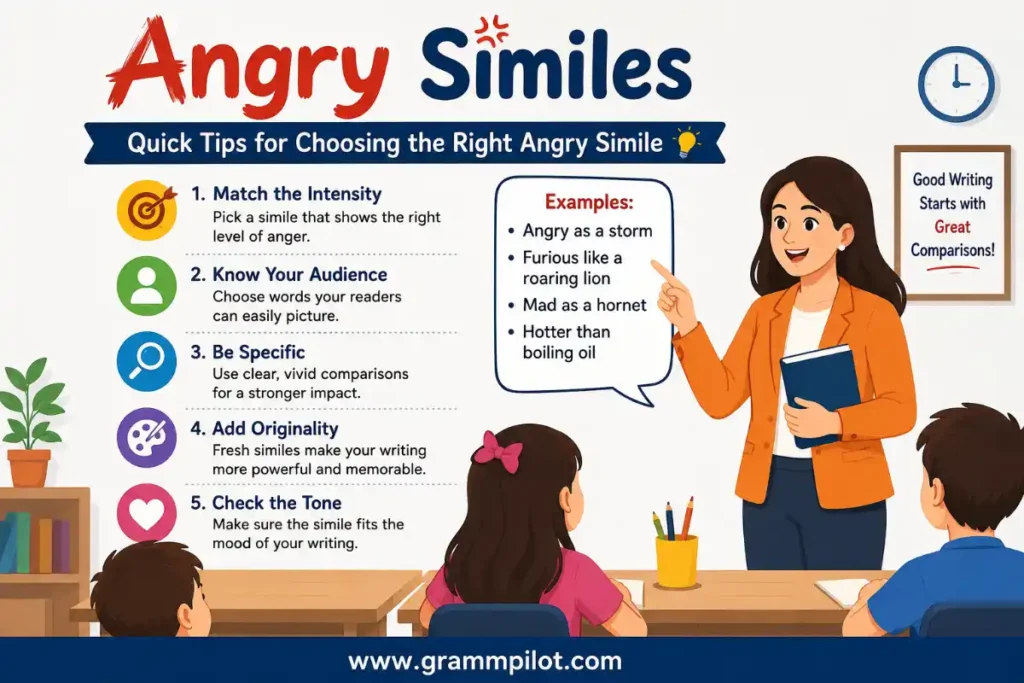
Quick Tips for Choosing the Right Angry Simile
Keep these tips in mind whenever you describe anger.
- Match the simile to the level of anger.
- Compare anger to familiar things people can picture.
- Use animals and nature for vivid imagery.
- Avoid using the same comparison repeatedly.
- Keep your similes short and natural.
- Don’t mix unrelated images in one sentence.
- Read your sentence aloud to see if it sounds realistic.
Conclusion
Learning Angry Similes can make your writing much more expressive. Instead of simply saying someone was angry, you can compare their emotions to a volcano, thunder, wildfire, a roaring lion, or countless other vivid images. These comparisons help readers see and feel the emotion rather than just read about it.
The best similes are clear, natural, and appropriate for the situation. If you’re writing a school essay, short story, poem, speech, or even a text message, choosing the right comparison will make your writing stronger and more memorable. Practice using different similes, and you’ll soon find it much easier to describe emotions in a way that captures your reader’s attention.
Frequently Asked Questions
1. What are angry similes?
Angry similes compare anger to another person, animal, object, or natural event using like or as. They help readers picture emotions more clearly.
2. What’s another way to describe someone who’s angry?
You can use similes such as as angry as a hornet, like a volcano ready to erupt, as fierce as a lion, or like wildfire spreading through a forest.
3. Can I use angry similes in school essays?
Yes. Angry similes can make essays and stories more descriptive as long as the comparison fits the situation and isn’t overused.
4. What’s the difference between a simile and a metaphor?
A simile uses like or as to compare two things, while a metaphor says one thing is another without using comparison words.
5. How do I create my own angry simile?
Think about how strong the anger is, then compare it to something familiar. For example, mild anger could be like a buzzing bee, while intense rage could be like an erupting volcano.
6. Are Angry Similes useful in creative writing?
Yes. Angry Similes help writers create stronger characters, more vivid scenes, and emotions that readers can easily imagine.
7. Can angry similes be used in everyday conversations?
Absolutely. Common comparisons like as mad as a hornet or fuming like a kettle are easy to understand and sound natural in everyday speech.