
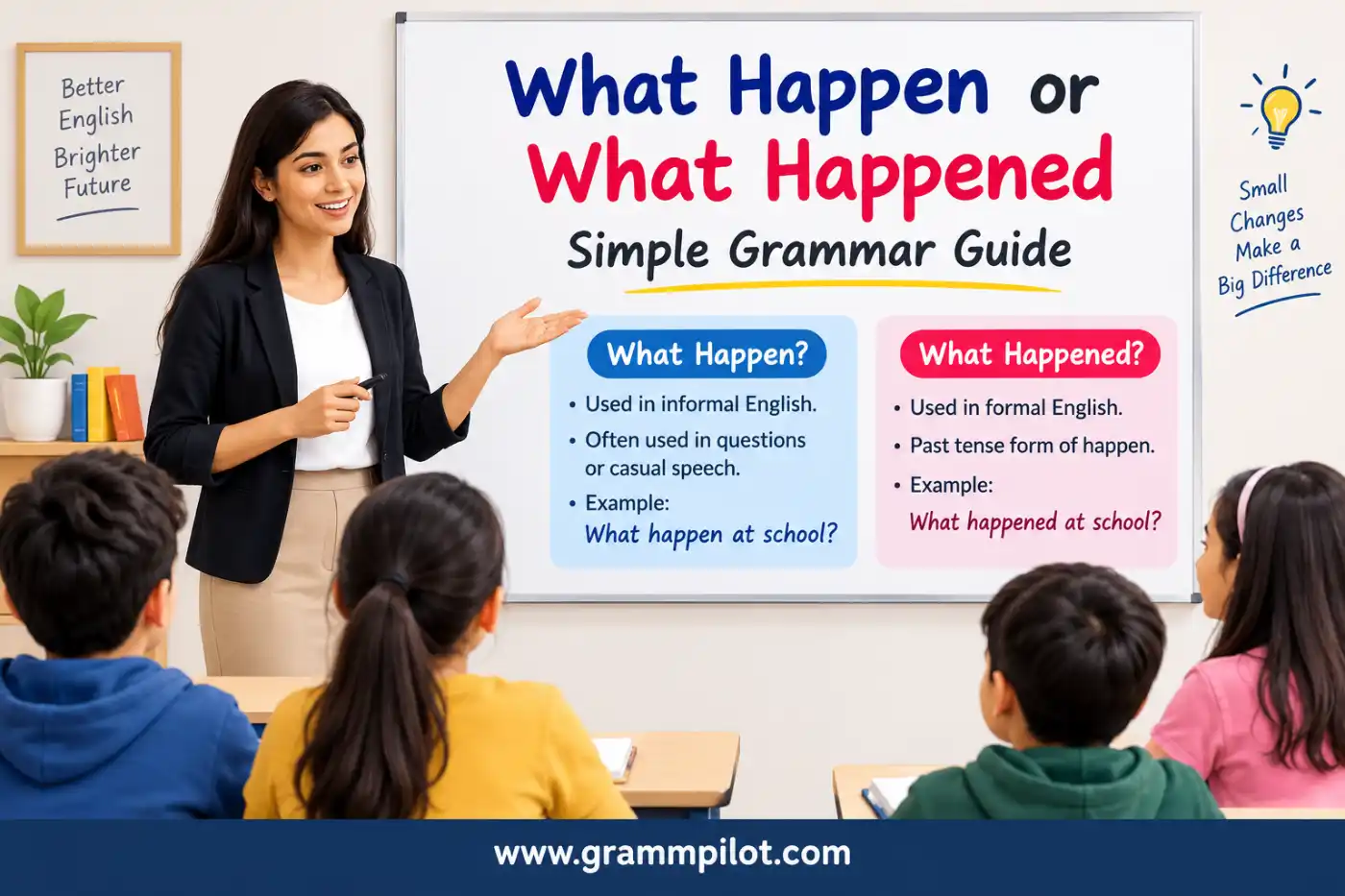
Have you ever written a text, email, or school assignment and stopped to wonder about you should write “What happen” or “What happened”? It’s an easy mistake to make because both forms contain the same main verb. The correct choice depends on when the action occurs and on the helping verb used in the sentence. In most situations, “What happened?” is the correct question when you’re asking about something that already occurred. “What happen?” is usually incorrect when it stands alone because happen is the base form and normally needs a helping verb such as does, did, or will in a question.
Quick answer: Use “What happened?” to ask about a past event. Use “what happens,” “what will happen,” or “what did happen” when the grammar requires a helping verb.
This guide explains the difference in plain English. You’ll learn the grammar rule, verb forms, common mistakes, everyday examples, formal and informal usage, and how to choose the right form quickly.
You can also learn about common plural forms in [Unaccessible or Inaccessible].
What does “happened” mean?
Happened is the simple past form of the verb happen. The verb happen means that something takes place or occurs.
For example:
- Something happened yesterday.
- An accident happened on the highway.
- What happened at school?
- She explained what happened after lunch.
The word happened tells us that the event is in the past.
What does “happen” mean?
Happen is the base form of the verb. It can be used after certain helping verbs and in the present tense with plural subjects or I/you/we/they.
Examples:
- What will happen next?
- What did happen?
- What can happen if we ignore the warning?
- Things happen for different reasons.
- What does happen after the meeting?
Notice that happen doesn’t normally stand alone in a past-tense question.
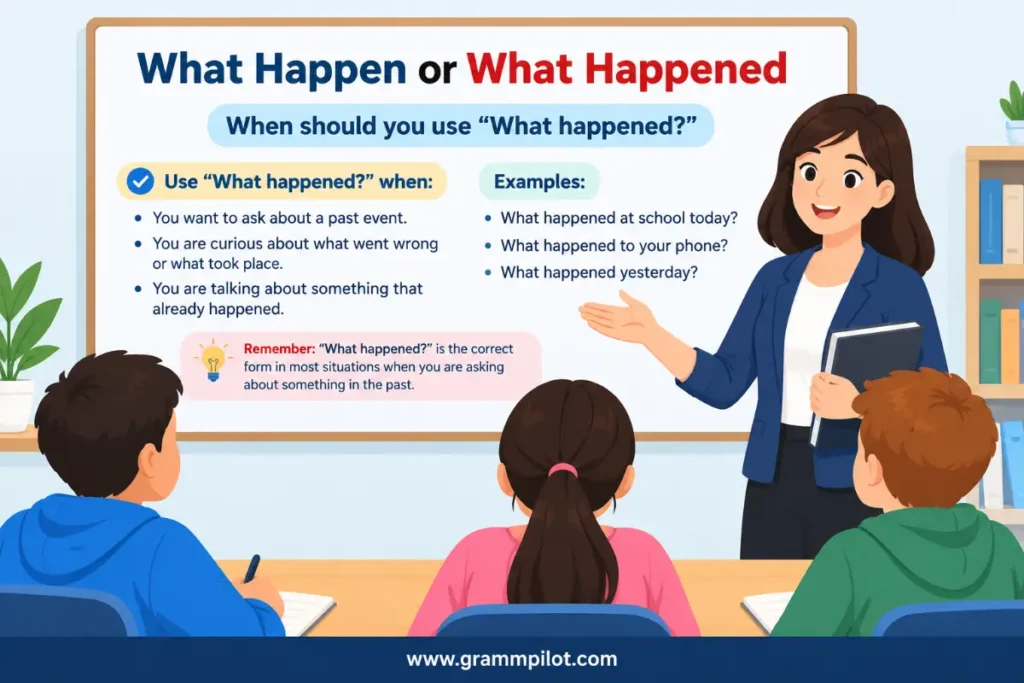
When should you use “What happened?”
Use “What happened?” when you’re asking about an event that took place in the past.
Examples:
- What happened at the party?
- What happened to your phone?
- What happened yesterday?
- What happened after the meeting?
- What happened between the two teams?
- What happened when you opened the door?
This is one of the most common questions in everyday English. Imagine your friend calls you and sounds upset.
You might ask: “What happened?”
You are asking about something that has already occurred.
Why is “happened” correct here?
English questions about the past often use did, but there is an important exception. When who or what is the subject of the question, you don’t normally use did in the same way.
Compare:
- What happened?
- What did you see?
In the first sentence, what is the subject. In the second sentence, you is the subject, and what is the object.
This difference is one of the main reasons learners get confused.
Why isn’t “What happen?” usually correct?
“What happen?” is generally incorrect as a standalone question in standard English. The problem is that happen is the base form. It doesn’t show past tense by itself.
If you’re asking about a past event, you need: What happened?
Not: What happen?
For example:
❌ What happen yesterday?
✅ What happened yesterday?
❌ What happen to your car?
✅ What happened to your car?
❌ What happen at the meeting?
✅ What happened at the meeting?
The correct form is especially important in writing because the error can make your sentence sound incomplete.
When can “happen” be correct?
The word happen is not wrong. It simply needs the right grammatical environment.
You can use it after helping verbs such as:
- Do
- Does
- Did
- Will
- Can
- Could
- May
- Might
- Should
- Would
Examples:
- What does happen next?
- What did happen?
- What will happen tomorrow?
- What can happen if we leave now?
- What might happen later?
In ordinary conversation, some of these forms are more natural than others.
For instance, people commonly say: “What will happen next?”
But “What does happen next?” can sound emphatic or contrastive.
What is the difference between “What happen” and “What happened”?
The main difference is verb form and time.
| Form | Grammar | Typical use | Example |
|---|---|---|---|
| happen | Base form | After helping verbs or with certain subjects | What will happen? |
| happens | Present singular | Regular present events | What happens next? |
| happened | Simple past | Completed past events | What happened yesterday? |
| happening | -ing form | Ongoing event | What is happening? |
This table makes the pattern easier to remember.
If you’re asking about something occurring now, use happening.
If you’re asking about a future event, use will happen.
“What happened?” vs. “What is happening?”
These questions look similar but refer to different times.
What happened?
This asks about a completed event.
- What happened at school?
- What happened last night?
- What happened to the computer?
What is happening?
This asks about something happening now or around now.
- What is happening outside?
- What is happening in the meeting?
- What is happening with the project?
Compare:
What happened in the office?
You want information about a past event.
What is happening in the office?
You want information about something currently taking place.
The tense changes the meaning.
“What happened?” vs. “What did happen?”
Both can be correct, but they have different structures and emphasis.
What happened?
This is the natural, neutral question.
- What happened at the restaurant?
What did happen?
This usually adds emphasis or corrects an assumption.
- I know you said nothing happened, but what did happen?
The helping verb did takes the past tense, so the main verb returns to its base form: did + happen
Not: ❌ did + happened
Correct: ✅ did + happen
This is a key rule.
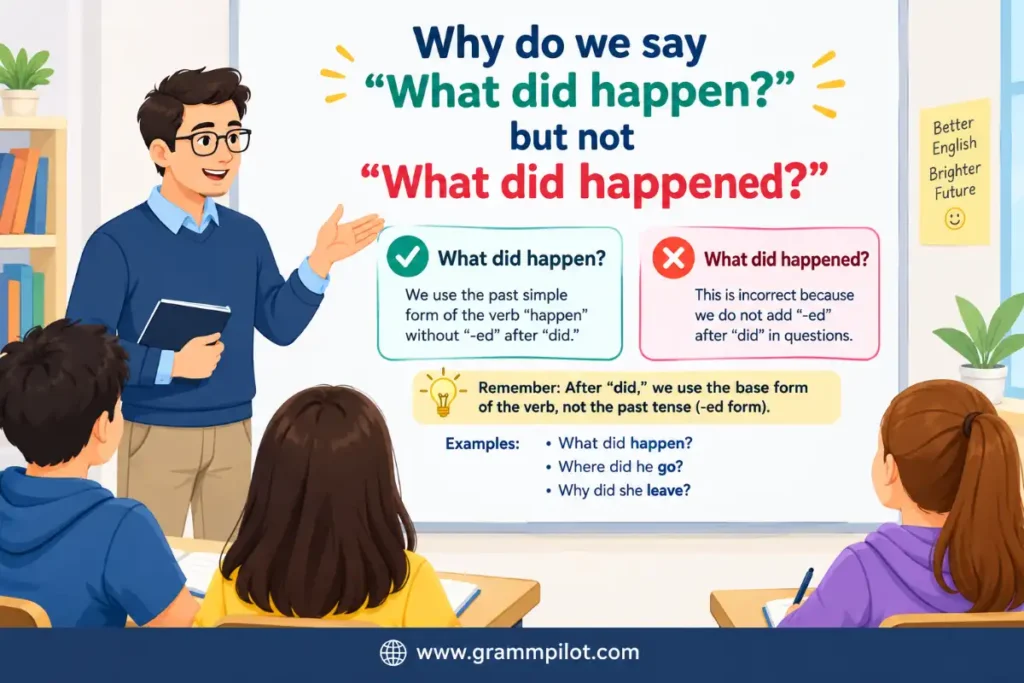
Why do we say “What did happen?” but not “What did happened?”
When did is used as a past-tense helping verb, the main verb stays in its base form.
So:
- Did you go?
- Did she call?
- Did they leave?
- What did he say?
- What did happen?
Not:
- ❌ Did you went?
- ❌ Did she called?
- ❌ Did they left?
- ❌ What did he said?
- ❌ What did happened?
The same rule applies to happen.
Did already carries the past tense. Therefore, happen stays in its base form.
What happens vs. what happened
This is another important distinction.
What happens?
Use this for present situations, routines, facts, or expected processes.
- What happens if we press this button?
- What happens after the class ends?
- What happens when water freezes?
What happened?
Use this for a past event.
- What happened when you pressed the button?
- What happened after class ended?
- What happened during the storm?
A useful question to ask yourself is: Has the event already occurred?
If yes, happened is likely correct.
What will happen vs. what happened
Use will happen for the future.
Examples:
- What will happen tomorrow?
- What will happen if we miss the train?
- What will happen after graduation?
- What will happen next year?
Use happened for the past:
- What happened yesterday?
- What happened after graduation?
- What happened last year?
The time expression can help you decide.
| Time | Correct form | Example |
|---|---|---|
| Yesterday | happened | What happened yesterday? |
| Last night | happened | What happened last night? |
| Right now | is happening | What is happening right now? |
| Every day | happens | What happens every day? |
| Tomorrow | will happen | What will happen tomorrow? |
| Next week | will happen | What will happen next week? |
What happened to vs. what happened with
These expressions are common, but they can carry slightly different meanings.
What happened to…?
Use this when asking about a person or thing and what became of it.
- What happened to your old car?
- What happened to Sarah?
- What happened to the documents?
- What happened to the money?
It can suggest that something changed, disappeared, was damaged, or is no longer where expected.
What happened with…?
This is often used when asking about a situation, arrangement, or issue.
- What happened with the meeting?
- What happened with your application?
- What happened with the project?
Both forms are common, but what happened to usually focuses more directly on the person or thing affected.
“What happened?” in texting
In texts and chats, “What happened?” is extremely common.
For example:
Friend: I can’t believe that happened.
You: What happened?
Or:
Friend: I’m at the hospital.
You: What happened?
The phrase is short, natural, and conversational.
You don’t need to make it more complicated.
Informal alternatives
Depending on the situation, you might also say:
- What happened?
- What went on?
- What’s going on?
- What happened there?
- What happened with that?
- What went wrong?
- What happened to you?
The choice depends on the context.
“What happened?” in emails
In a professional email, “What happened?” can be acceptable, but the tone matters. A direct question can sometimes sound abrupt.
Instead of: What happened?
you might write: Could you please let me know what happened?
Or: Could you explain what happened with the order?
Or: Can you clarify what happened during the meeting?
These versions sound more professional and less confrontational.
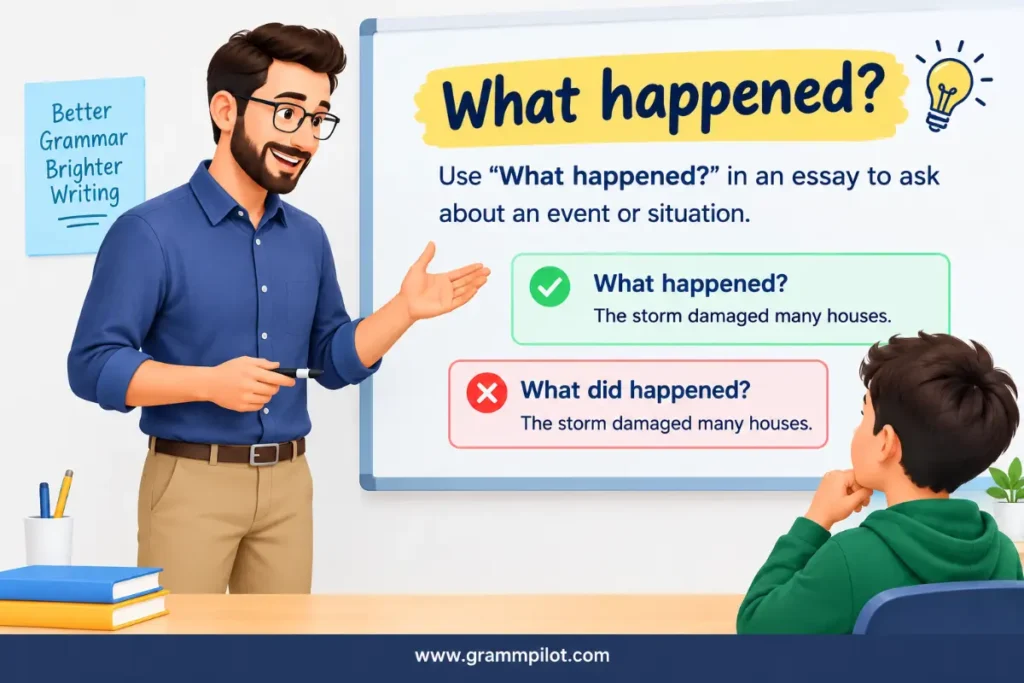
“What happened?” in an essay
In formal writing, the phrase can be accurately correct when the context requires a question.
For example: The reader may wonder, “What happened after the character left the town?”
You can also use happened inside statements:
- The researchers described what happened during the experiment.
- The article explains what happened after the policy changed.
- The narrator reveals what happened to the main character.
Notice that what happened can appear inside a longer sentence.
“What happened” as part of a statement
A common mistake is to think that what happened only works as a direct question.
It doesn’t.
It can be part of a statement.
Examples:
- I know what happened.
- She explained what happened.
- Nobody understands what happened.
- Tell me what happened.
- We discussed what happened after the accident.
- He remembers what happened that morning.
Here, what happened acts as a clause inside the larger sentence.
“What happened” vs. “what had happened”
Sometimes had happened is more accurate than happened. Use had happened when talking about an event that occurred before another past event.
For example: When I arrived, I asked what had happened.
First, something happened. Then, I arrived. Then, I asked about it. The past accurate had happened makes the sequence clear.
Compare: I asked what happened.
This is normal and often sufficient.
I asked what had happened before I arrived.
This emphasizes that the event occurred earlier than another past event.
Common mistakes with this expression
Mistake 1: “What happen yesterday?”
Incorrect: ❌ What happen yesterday?
Correct: ✅ What happened yesterday?
Yesterday clearly refers to the past.
Mistake 2: “What did happened?”
Incorrect: ❌ What did happened?
Correct: ✅ What did happen?
Remember: did + base verb
Mistake 3: “What happen to you?”
Incorrect when asking about a past event:❌ What happen to you?
Correct: ✅ What happened to you?
Mistake 4: “What does happened?”
Incorrect: ❌ What does happened?
Correct:✅ What does happen?
After does, use the base verb.
Mistake 5: “What will happened?”
Incorrect: ❌ What will happened?
Correct: ✅ What will happen?
After will, use the base form.
Mistake 6: “What is happened?”
This is usually incorrect in standard English when you mean “What is happening?”
Incorrect: ❌ What is happened?
Correct: ✅ What is happening?
However, is happened can appear in rare passive constructions in specialized or archaic contexts, but it isn’t the normal way to ask what is occurring.
A simple verb-form chart
The easiest way to understand the forms is to compare them side by side.
| Form | Example | Meaning |
|---|---|---|
| happen | Things happen. | General/present |
| happens | What happens next? | Present, singular |
| happened | What happened? | Past |
| happening | What is happening? | Happening now |
| will happen | What will happen? | Future |
| did happen | What did happen? | Emphatic past |
| has happened | What has happened? | Past connected to present |
| had happened | What had happened? | Earlier past |
This chart covers most situations you’ll encounter.
Choosing the right form by context
In a text message
Use: What happened?
Example:
You sound upset. What happened?
In an email
Use: Could you tell me what happened?
Example: Could you please explain what happened with the shipment?
In a resume
You normally won’t ask a question using this phrase, but happened may appear when describing past events.
Example: An unexpected system failure happened during testing.
However, a stronger resume style would often use a more precise verb:
An unexpected system failure occurred during testing.
In an essay
Use the form that matches your timeline.
Example: The author explains what happened after the main character left.
In speaking
The simplest form is usually best: What happened?
“Happen” vs. “take place”
Take place is another related expression.
- What happened at the event?
- What took place at the event?
The first sounds more conversational.
The second can sound more formal and often focuses on the event itself.
Example: Several changes took place after the company introduced the new policy.
“What happened?” vs. “What went wrong?”
These questions aren’t always interchangeable. What happened? is broad.
It can ask about any event. What went wrong? specifically asks about a problem or failure.
Compare:
- What happened at the party?
- What went wrong at the party?
The first could ask about anything.
The second suggests something bad occurred.
“What happened?” vs. “What’s wrong?”
These questions also have different meanings.
What happened? asks about an event.
What’s wrong? asks about a problem, condition, or emotional state.
For example: You look worried. What happened?
This asks what caused the situation. You look worried. What’s wrong? This asks about the current problem. Both are natural, but they aren’t identical.
Synonyms for “happen”
Sometimes you don’t need another form of happen. You may simply want a different word.
Everyday alternatives
- Occur
- Take place
- Go on
- Develop
- Come about
- Arise
More formal alternatives
- Occur
- Transpire
- Develop
- Arise
- Emerge
- Result
Informal alternatives
- Go on
- Come up
- Turn out
- Take place
- Go down
These words aren’t always exact replacements.
For example, transpire can sound formal, while go down is strongly informal.
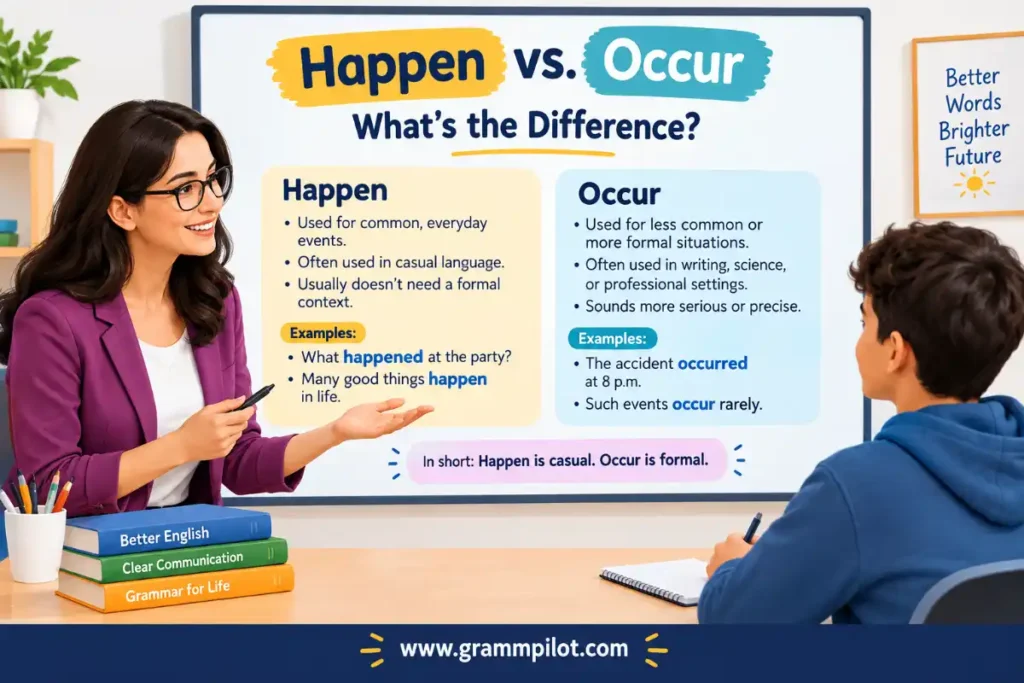
Happen vs. occur — what’s the difference?
Both mean that something takes place, but happen is more common in ordinary speech.
| Happen | Occur |
|---|---|
| Everyday | More formal |
| Natural in conversation | Common in reports |
| What happened? | What occurred? |
| Broad and flexible | Often sounds more precise |
For a text to a friend: What happened?
For a formal report: The incident occurred shortly after midnight.
Happen vs. take place — what’s the difference?
Take place often refers to an event that was planned or organized.
For example:
- The wedding took place on Saturday.
- The conference took place in Chicago.
Happen is broader:
- An accident happened on Saturday.
- Something strange happened at work.
A wedding normally takes place because it is an organized event. An accident simply happens.
What are the antonyms of “happen”?
There isn’t one accurate opposite of happen because the meaning depends on the context.
Possible contrasting expressions include:
- Not occur
- Not take place
- Be prevented
- Be canceled
- Be avoided
- Remain unchanged
For example: The meeting happened.
Possible opposite: The meeting was canceled.
But cancel isn’t a direct dictionary antonym of happen. It describes a situation in which an expected event does not take place.
US vs. UK English
There is no major US-versus-UK difference in the basic grammar of happen and happened.
American and British speakers both commonly say:
- What happened?
- What happens next?
- What will happen?
- What is happening?
Some vocabulary choices may differ by region, but the core verb forms are the same.
The grammar rule is therefore safe to use in both American and British English.
Quick trick to remember the rule
Use this simple timeline:
Past → happened
Present → happens / is happening
Future → will happen
Examples:
- Yesterday → What happened?
- Every day → What happens?
- Right now → What is happening?
- Tomorrow → What will happen?
There is one more useful pattern: did + happen
because did already marks the past.
So:
- What happened?
- What did happen?
Both can be correct, but the first is the normal neutral question.
A quick editing checklist
Before submitting an email, essay, or message, ask:
- Am I talking about the past?
- If yes, should I use happened?
- Is there a helping verb such as did, does, or will?
- If there is a helping verb, did I keep happen in its base form?
- Am I describing something happening now?
- If so, should I use is happening?
- Am I talking about a routine or general result?
- If so, should I use happens?
These questions can catch most errors quickly.
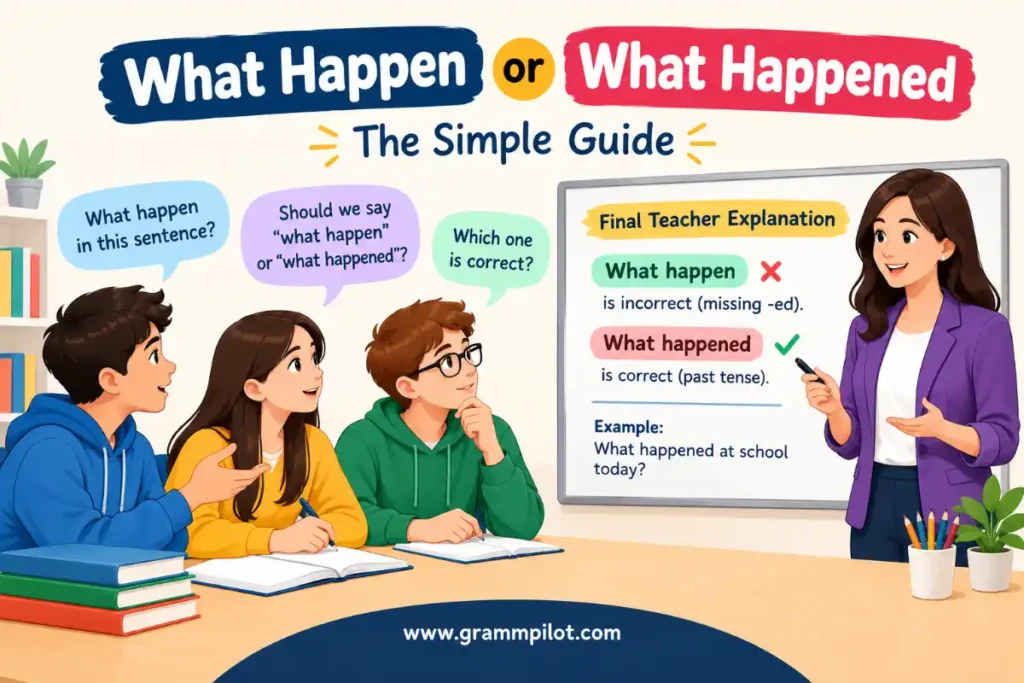
Final teacher explanation
If a student asks which form to use in the simple question about a past event, the answer is straightforward: “What happened?”The word happened is the simple past form of happen, so it naturally describes an event that has already taken place.
The base form happen is still important. You use it after helping verbs such as did, will, can, and does. For example, “What did happen?” is grammatically possible, while “What did happened?” is not. The key is to look at the entire verb phrase rather than one word at a time. English uses helping verbs to carry tense in many questions. Once you understand that pattern, these forms become much easier to choose.
Conclusion
The easiest way to remember the difference is to connect each form with time and sentence structure. Happened is the simple past form, so it works naturally when asking about an event that already occurred. Happen is the base form and commonly follows helping verbs such as did, will, and can. For present routines, use happens, and for something occurring now, use is happening.
Once you stop looking at the two words in isolation, the choice becomes much easier. Look for the helping verb, identify the time of the event, and then choose the correct verb form. That small habit will help you write clearer texts, emails, essays, and everyday questions.
Frequently Asked Questions
1. Is “What happen?” grammatically correct?
No, not as a normal standalone question about a past event. Use “What happened?” for a completed event.
2. Should I say “What happened?” or “What happen?”
Use “What happened?” when you’re asking about something that already occurred. Happen is used after helping verbs such as did, will, and can.
3. Why do we say “What happened?” instead of “What did happened?”
Because did already carries the past tense, the main verb stays in its base form. Therefore, “What did happen?” is correct, while “What did happened?” is incorrect.
4. What’s another way to ask what happened?
You can say “What went on?”, “What took place?”, or “What occurred?” depending on the situation and level of formality.
5. Is “What happens?” correct English?
Yes. “What happens?” is correct when asking about a present routine, general fact, or process. For example, “What happens when the temperature drops?”
6. When should I use “What is happening?”
Use “What is happening?” when you want to know what is taking place now or around the present time. It describes an ongoing situation rather than a completed past event.
7. Can I say “What did happen?”
Yes, but it usually adds emphasis or contrast. For a normal question, “What happened?” sounds more natural