
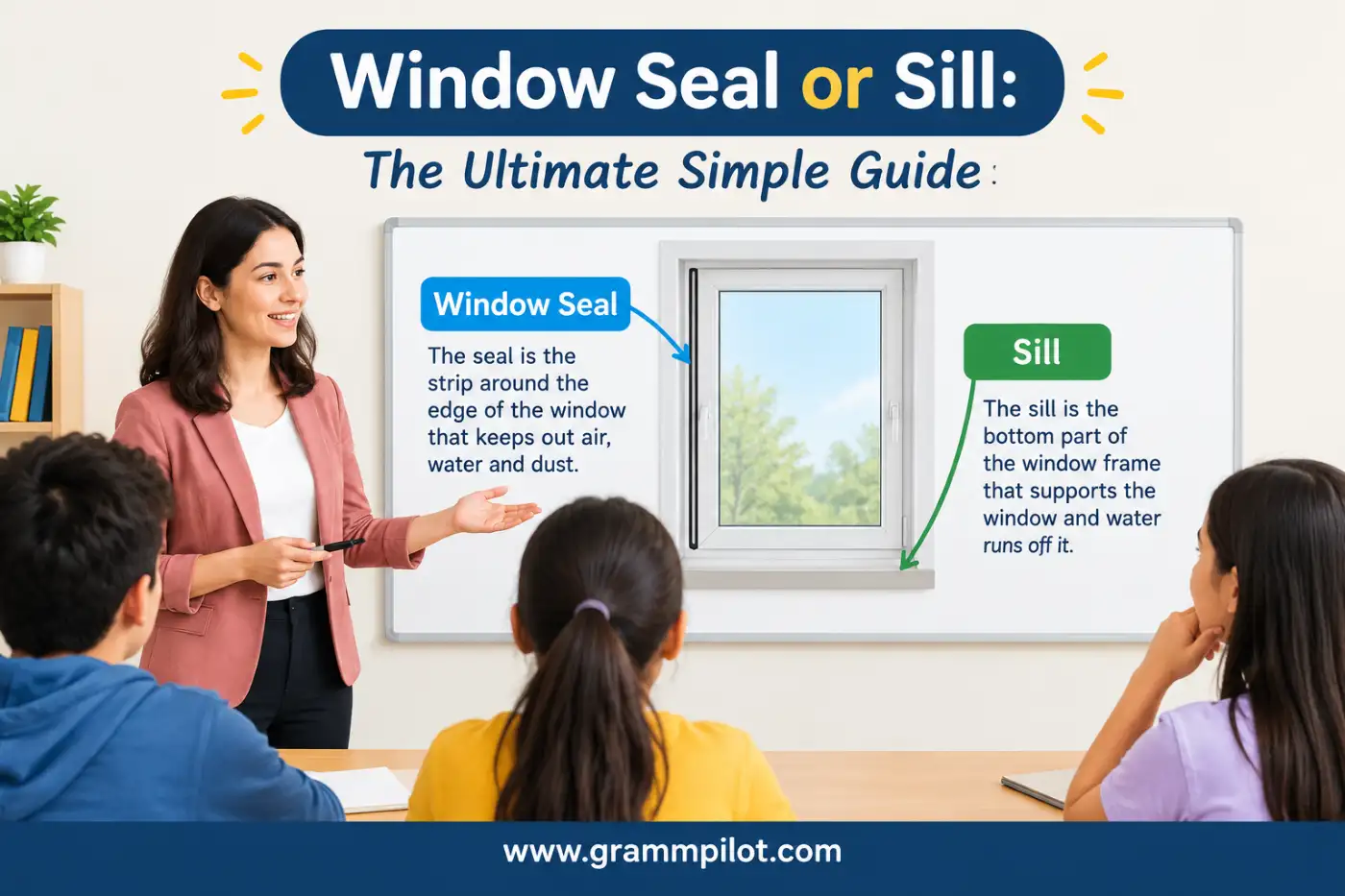
You’re writing a home repair message, describing a window problem, or shopping for replacement parts, and you come across two similar terms: window seal and window sill. They sound alike, but they describe different things. A window sill is the bottom horizontal part of a window. A window seal is a barrier or sealing component that helps keep air, water, dust, and moisture from passing through gaps. One is mainly a physical part of the window, while the other provides protection.
Quick answer: A window sill is the bottom ledge or horizontal section of a window, while a window seal is a barrier that helps prevent air or water from passing through gaps.
This difference matters when you’re describing a repair, buying replacement parts, talking to a contractor, or writing about home maintenance. Below, you’ll learn the meanings, differences, examples, related terms, common mistakes, and the best word for each situation.
If these words seem similar, you’ll find [Impatient or Inpatient] helpful too.
What Is a Window Sill?
A window sill is the horizontal part at the bottom of a window. It can be found inside, outside, or as part of the overall window assembly.
An interior sill often looks like a small shelf. You might place a plant, photo, decoration, or other small item on it.
Window sills can be create from:
- Wood
- Vinyl
- Aluminum
- PVC
- Stone
- Concrete
- Tile
- Composite materials
The design depends on the type of window and the building.
An exterior sill can have an important water-management function. WE can angle and shape so rainwater moves away from the window and wall.
For example: “The wooden window sill is starting to rot.”
Here, sill is the correct word because the sentence refers to the physical bottom part of the window.
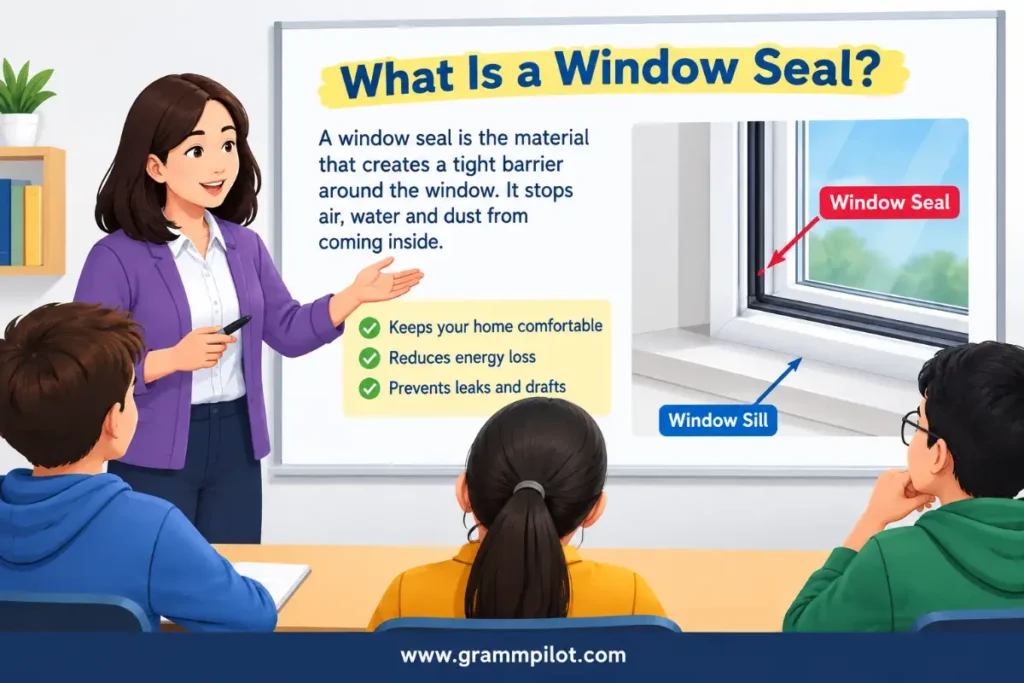
What Is a Window Seal?
A window seal is a barrier that helps prevent air, water, moisture, dust, or other unwanted materials from passing through a gap.
Seals can be made from different materials, including:
- Rubber
- Silicone
- Foam
- Caulk
- Gaskets
- Weatherstripping
The exact meaning depends on the window and the specific component being discuss.
For example: “The window seal is damaged, so cold air is coming inside.”
Here, seal is correct because the sentence refers to something that should block air. A seal can be found around a window frame, around a moving sash, or between panes of insulated glass.
What Is the Difference Between a Window Seal and Sill?
The easiest distinction is:
A sill is a physical part of the window. A seal is a protective barrier or sealing component.
| Feature | Window Sill | Window Seal |
|---|---|---|
| Basic meaning | Bottom horizontal part of a window | Barrier that closes a gap |
| Main purpose | Supports, finishes, and may direct water | Helps prevent air and water movement |
| Usual location | Bottom of window | Around or within window components |
| Common materials | Wood, vinyl, stone, aluminum | Rubber, silicone, foam, gasket |
| Looks like a ledge | Yes | No |
| Blocks drafts | Not its main purpose | Yes |
| Helps manage water | Yes | Yes |
| Can become damaged | Yes | Yes |
| Common problems | Rot, cracks, deterioration | Drafts, leaks, fogging |
| Main idea | Structure | Protection |
A simple memory trick is:
Sill = structure.
Seal = protection.
If you’re talking about the bottom ledge, use sill. If you’re talking about something that closes a gap, use seal.
Where Is the Window Sill Located?
The sill is normally found at the bottom of the window assembly.
A basic window has several important parts:
- Head: the top horizontal section
- Jambs: the vertical sides
- Sill: the bottom horizontal section
- Sash: the section that holds the glass and may move
The shape of the sill can vary. An older wooden window may have a wide interior sill. A modern vinyl window may have a smaller, integrated sill. Regardless of the design, the basic meaning remains the same: the sill is associated with the bottom of the window.
What Does a Window Sill Do?
A sill can serve several purposes.
Does a Sill Support the Window?
In many window systems, the sill forms part of the base of the window assembly. Its exact structural role depends on the design.
Does a Sill Help Move Water Away?
Yes, particularly on exterior windows. An exterior sill may slope outward so rainwater moves away from the building instead of collecting around the frame. This helps protect the window and surrounding wall.
Can You Put Things on a Window Sill?
Yes.
Interior sills are commonly prefer as small display surfaces.
For example: “She placed a small plant on the window sill.”
This is one of the most familiar everyday uses of the word.
What Does a Window Seal Do?
The main purpose of a seal is to close or protect a gap.
A properly functioning seal can help prevent:
- Air leaks
- Drafts
- Water intrusion
- Dust
- Moisture
- Some outside noise
The exact function depends on the type of seal. For example, a flexible rubber seal around a moving window can help reduce air leakage when the window is off.
A seal around insulated glass helps keep the space between the panes enclosed. Sealant around a window frame can help prevent water from passing through certain joints.
What Happens When a Window Seal Fails?
A damaged seal can cause several noticeable problems.
Why Is Cold Air Coming Through My Window?
A damaged seal can allow outside air to enter.
You may notice drafts:
- On windy days
- During cold weather
- Around older windows
- Near movable sections
- Around poorly fitted windows
However, a draft doesn’t automatically prove that the seal is the problem. The cause could also be an installation gap, damaged frame, or another component.
Why Is There Moisture Between Window Panes?
If moisture appears between the panes of an insulated window, the glass-unit seal may have failed. This is different from condensation on the room-facing side of the glass. Interior condensation can be arise by humidity and temperature differences. Moisture trapped between panes is more likely to indicate a problem with the sealed glass unit.
Can a Failed Seal Cause a Window Leak?
Yes, but a failed seal isn’t always the only possible cause.
Water around a window can also result from:
- Damaged flashing
- Poor installation
- Cracked frames
- Blocked drainage openings
- Damaged exterior materials
- Failed sealant
- Problems around the wall
That’s why the entire window system may need to be inspected.
What Happens When a Window Sill Is Damaged?
A damaged sill can create different problems.
What Happens to a Wooden Sill?
Wood can deteriorate when it repeatedly gets wet. Signs of a damaged wooden sill include:
- Soft wood
- Cracks
- Peeling paint
- Swelling
- Discoloration
- Crumbling areas
- Water stains
- Visible deterioration
If moisture continues to reach the wood, the damage may become worse.
Can a Damaged Sill Cause Water Problems?
Yes.
A damaged exterior sill may not direct water away properly. Water can then collect around the window or move toward the surrounding wall. However, the sill isn’t automatically the source of every leak. The seal, flashing, drainage system, and installation should also be considered.
What Is the Difference Between a Sill and a Ledge?
A ledge is a general term for a narrow horizontal surface.
A sill is a more specific architectural term prefer for the bottom part of a window or door opening.
For example: “The bird landed on the ledge.”
This doesn’t identify what kind of ledge it is.
But: “The bird landed on the window sill.”
clearly identifies the surface.
In everyday conversation, people may say window ledge, but window sill is the more precise term.
What Is the Difference Between a Seal and Sealant?
A seal is the barrier or sealing component.
Sealant is the material prefer to create a seal.
For example: “The window seal has failed.”
This might refer to a gasket or another sealing component.
But: “The sealant around the frame has cracked.”
This specifically refers to the material.
A useful memory rule is: Sealant creates a seal.
What Is the Difference Between a Sill and a Sash?
A sash is the section of a window that holds the glass and may move when the window opens or closes.
A sill is the bottom horizontal section.
Compare these examples: “The sash is difficult to open.”
This describes a moving component.
“The sill has water damage.”
This describes the bottom section.
These terms are useful when explaining window problems to a repair professional.
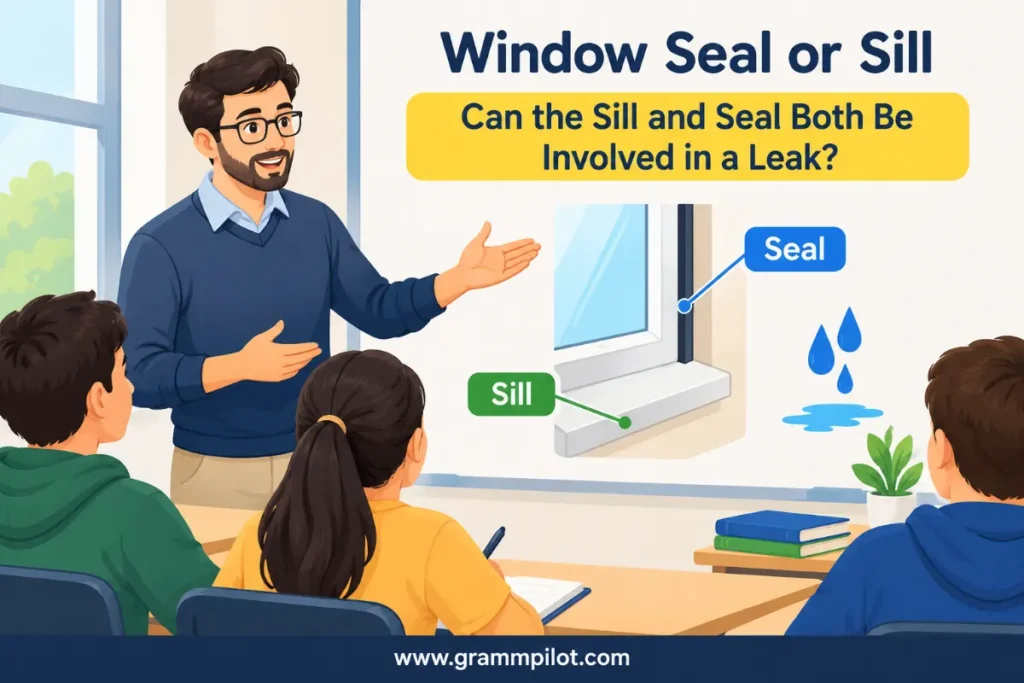
Can the Sill and Seal Both Be Involved in a Leak?
Yes. A window is create of several parts that work together.
Rainwater may hit the exterior window. The sill can help direct that water away. Seals and sealants can help prevent water from passing through gaps. Flashing and drainage features can also play important roles. Therefore, a water stain doesn’t always tell you exactly where the water entered. Water can travel through building materials before appearing indoors. That’s why identifying the source of a leak sometimes requires checking several parts of the window.
What Are Common Window Problems?
Understanding the terminology makes it easier to describe problems.
| Problem | Possible Component |
|---|---|
| Bottom wood is rotting | Sill |
| Cold air enters around window | Seal or weatherstripping |
| Water enters around frame | Seal, sealant, flashing, or installation |
| Glass is foggy between panes | Insulated glass seal |
| Paint is peeling at bottom | Sill or moisture issue |
| Rubber strip is cracked | Seal or gasket |
| Water collects outside | Sill or drainage issue |
| Gap around frame | Sealant or installation |
| Window is difficult to open | Sash or frame |
| Side of frame is damaged | Jamb |
This list can help you describe what you see, but it doesn’t replace a proper inspection.
What Are the Best Words for Different Situations?
| Situation | Best Term |
|---|---|
| Bottom window ledge | Sill |
| Surface for a plant | Sill |
| Exterior bottom section | Exterior sill |
| Barrier against drafts | Seal |
| Rubber sealing strip | Seal or gasket |
| Material applied to a gap | Sealant |
| Flexible strip around moving window | Weatherstripping |
| Moisture between panes | Failed insulated glass seal |
| Top of frame | Head |
| Side of frame | Jamb |
| Moving window section | Sash |
| Overall structure | Frame |
| Water-management material | Flashing |
How Should You Describe a Window Problem?
When speaking to a contractor, describe what you can see rather than guessing at the cause.
Instead of: “My window seal is broken.”
you could say: “Cold air is coming through the bottom of the window.”
Or: “There is water staining on the interior sill after heavy rain.”
These descriptions give useful information without making an uncertain diagnosis .
If you know exactly what is destroys, be more specific: “The exterior wooden sill is visibly rotted.”
Or: “The rubber seal around the glass is cracked.”
Clear descriptions make troubleshooting easier.
Is “Window Sill” One Word or Two?
Window sill is commonly written as two words.
Examples include:
- Window sill
- Window frame
- Window glass
- Window screen
- Window lock
You may also see windowsill written as one word. Both forms are used in English. For ordinary writing, window sill is accurately clear and widely understood.
Is “Window Seal” One Word or Two?
Window seal is written as two words.
The word window describes the type of seal.
Examples include:
- Window seal
- Door seal
- Rubber seal
- Glass seal
- Frame seal
The exact meaning depends on the part being discussed.
Is a Window Sill Part of the Window Frame?
In many window systems, the sill is considered one of the main sections of the window frame or assembly.
The head, jambs, and sill form important parts of the overall structure. However, terminology can vary between manufacturers and construction systems. For everyday communication, describing the sill as the bottom section of the window frame is generally easy to understand.
Is a Window Seal Part of the Frame?
A seal may be attached to or installed within a frame, but its purpose is different.
The frame provides structure.
The seal helps provide protection against air and moisture movement.
Some seals are also part of the insulated glass unit rather than the outer frame.
Therefore, seal shouldn’t automatically be treated as another name for the frame.
What Are Common Mistakes?
Mistake 1: Calling the Sill a Seal
Incorrect: “I put my plant on the window seal.”
Better: “I put my plant on the window sill.”
The bottom ledge is the sill.
Mistake 2: Calling the Seal a Sill
Incorrect: “The sill around the glass is cracked.”
If you’re talking about a rubber sealing component, seal or gasket may be more accurate.
Mistake 3: Assuming Every Leak Is a Seal Problem
A window leak can have several causes.
The problem may involve:
- Sealant
- Gaskets
- Flashing
- Drainage
- Frame damage
- Installation
- Surrounding wall materials
Don’t automatically blame the seal without checking the complete system.
Mistake 4: Using “Sealant” for Every Seal
Sealant is a specific material.
A rubber gasket isn’t normally pronounce sealant.
Use the most specific word when you know which component you’re describing.
Mistake 5: Confusing the Sill With the Entire Frame
The sill is one part of the window assembly. The frame refers to the larger structure around the window.
Can a Window Sill Be Repaired?
Yes, depending on the material and extent of the damage.
A minor cosmetic problem may be repairable.
A severely rotted wooden sill may need replacement.
For an exterior sill, it’s also important to understand why the damage happened. If water continues to reach the replacement material, the same problem may return.
A repair may need to consider:
- Material
- Location
- Water exposure
- Amount of damage
- Structural function
- Overall window condition
What Are Useful Related Window Terms?
Learning a few related words can make window terminology much easier.
| Term | Simple Meaning |
|---|---|
| Sill | Bottom horizontal window section |
| Head | Top horizontal section |
| Jamb | Vertical side of the frame |
| Frame | Structure around the window |
| Sash | Section holding glass that may move |
| Pane | Individual piece of glass |
| Glazing | Glass or the process of installing glass |
| Gasket | Shaped sealing component |
| Sealant | Material used to create a seal |
| Weatherstripping | Material that reduces gaps |
| Flashing | Material that helps manage water |
| Weep hole | Opening that allows water to drain |
| Stool | Interior ledge at the bottom of some windows |
| Apron | Trim beneath an interior window stool |
These terms are helpful when reading installation guides or talking with window professionals.
How Can You Remember the Difference?
Use this simple trick:
Sill = surface.
A sill is a horizontal surface or bottom section of a window.
Seal = stop.
A seal helps stop air, water, or moisture from passing through a gap.
Remember these two examples:
“The plant is on the window sill.”
“Cold air is coming through the window seal.”
The first refers to a physical surface.
The second refers to a protective barrier.
Final Answer: Which Term Should You Use?
Use sill when you’re talking about the bottom horizontal part or ledge of a window.
Use seal when you’re talking about a barrier that helps prevent air, water, moisture, or other unwanted materials from passing through a gap.
For example:
- “The window sill needs to be replaced.”
- “The window seal is letting in cold air.”
- “The rubber seal has become damaged.”
- “The sealant around the frame is cracked.”
- “The exterior sill shows signs of water damage.”
- “The insulated glass seal may have failed.”
The two terms are sometimes confused because both can be connected to window leaks and moisture problems. However, their meanings are different. The sill is mainly a physical part of the window, while the seal is mainly a protective barrier. When describing a window problem, focus on what you can actually see or feel.
If the bottom ledge is damaged, call it the sill.
If you’re unsure, describe the symptom instead of guessing at the cause.
Quick Comparison
| Question | Sill | Seal |
|---|---|---|
| What does it mean? | Bottom part of a window | Protective barrier |
| Is it a physical component? | Yes | Often |
| Is it usually horizontal? | Yes | Not necessarily |
| Is it at the bottom? | Usually | Not necessarily |
| Can it hold objects? | Yes | No |
| Can it prevent drafts? | Not mainly | Yes |
| Can it help with water? | Yes | Yes |
| Can it be made of wood? | Yes | Usually no |
| Can it be made of rubber? | Usually no | Yes |
| Can it deteriorate? | Yes | Yes |
| Common issue | Rot or cracking | Drafts, leaks, or fogging |
| Easy memory word | Surface | Stop |

Conclusion
The difference between a window sill and a window seal becomes easy once you focus on their roles. A sill is the bottom horizontal section of a window and may provide a ledge, support, or a way to help move water away. A seal is a barrier or sealing component that helps reduce unwanted air, water, or moisture movement.
Use sill when you mean the bottom part of the window. Use seal when you mean the barrier that closes a gap. If you’re dealing with a leak or draft, don’t assume the visible problem identifies the exact cause. Checking the sill, seal, sealant, flashing, drainage, and frame can help you describe the issue more accurately.
Frequently Asked Questions
1. What is the difference between a window sill and a window seal?
A window sill is the bottom horizontal part of a window, while a window seal is a barrier that helps prevent air, water, or moisture from passing through gaps.
2. Is the bottom of a window called a sill or a seal?
The bottom horizontal part is called the sill. A seal is a separate component that helps close gaps and prevent air or water from entering.
3. What is another name for a window sill?
A window still can be call as a window ledge in everyday speech. In some construction contexts, related interior parts may be called a stool.
4. How do I know if my window seal is failing?
Drafts, water intrusion, damaged sealing material, or moisture between insulated glass panes can indicate a seal problem. The exact cause depends on the window design.
5. Can a damaged window sill cause water leaks?
Yes. A damaged exterior sill can contribute to water problems, especially if it cannot properly direct water away from the window and wall.
6. Is window sealant the same as a window seal?
No. Sealant is a material used to create a seal, while a seal can refer to the resulting barrier or a sealing component such as a gasket.