

You’re writing an email, essay, resume, or text, and you pause over one small choice: should you call someone beloved or loved? Both words describe strong affection, but they don’t always sound the same. One can feel warm and personal, while the other can sound more emotional, literary, or deeply cherished. The difference becomes clearer when you look at how each word is normally used. Loved is the everyday choice. Beloved often carries a stronger sense of admiration, respect, or lasting affection. It can describe a person, place, object, tradition, or even a fictional character.
Answer: Beloved usually means deeply loved, cherished, or greatly admired, while loved is the more common and flexible word for being cared for or strongly liked.
This guide explains the meanings, origins, tones, synonyms, intensity levels, regional differences, and practical uses of these words. You’ll also see examples for resumes, essays, texts, emails, and everyday speech, plus quick comparisons that make the choice easier.
For a closer look at another confusing word pair, explore [Window Seal or Sill].
What do these words mean in plain English?
The simplest way to understand the distinction is this:
- Loved = cared for deeply or liked very much.
- Beloved = deeply loved and often especially cherished, admired, or respected.
The two words overlap. In many sentences, either one can work.
For example:
- “She is loved by her family.”
The first sentence sounds natural and everyday. The second adds a stronger feeling. It may suggest that she is not only loved but also treasured and held in especially high regard. That extra emotional weight is one of the most useful clues when choosing between the words.
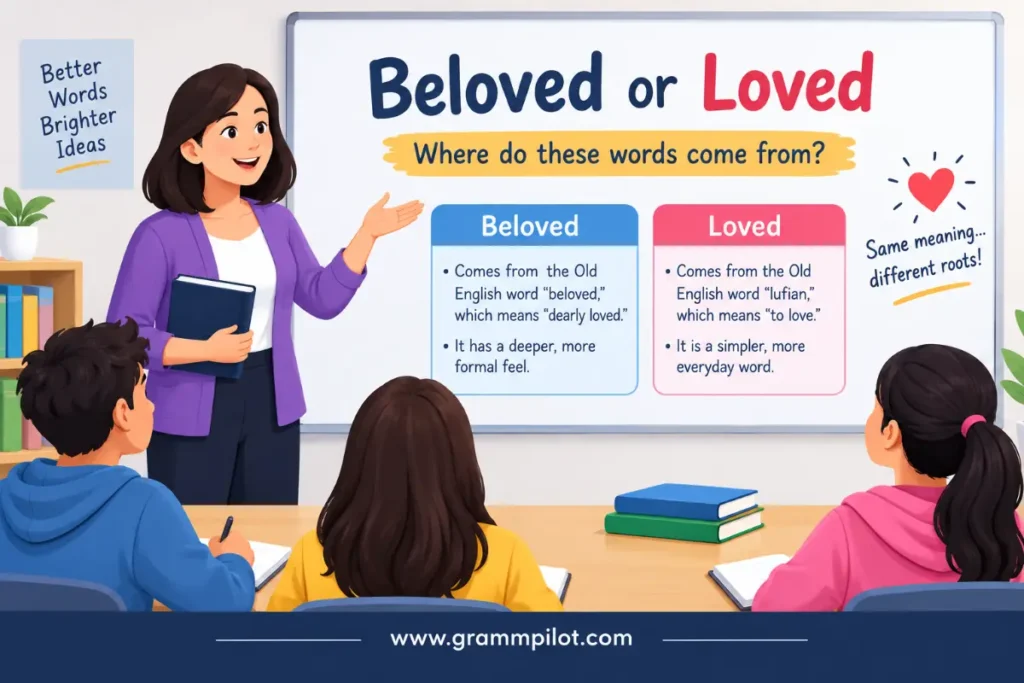
Where do these words come from?
Understanding the history of a word can make its modern meaning easier to remember.
What is the origin of “loved”?
Loved is the past tense and past participle of love. The English word love comes from Old English lufu, related to words in other Germanic languages. Over centuries, it developed into the familiar modern word used for affection, desire, devotion, friendship, and strong enjoyment.
The word has always had a very wide range.
You can love:
- a person
- a family member
- a friend
- a pet
- a hobby
- a song
- a book
- a meal
- a place
- an idea
Because of that broad meaning, loved is one of the most flexible choices in modern English.
What is the origin of “beloved”?
Beloved is form from be- plus loved. Historically, this word is develop as a way of expressing the idea of someone or something that is deeply loved. Its long history in religious writing, literature, poetry, letters, and formal tributes helped give it a special emotional tone. Older texts often use beloved when addressing or describing someone who is deeply cherished. That literary and traditional use still affects how the word feels today.
This is why beloved can sound more elevated than the ordinary word loved, even though their basic meanings overlap.
What is the difference between the two words?
The main difference is tone and degree of emotional emphasis.
| Feature | Loved | Beloved |
|---|---|---|
| Basic meaning | Cared for or liked deeply | Deeply cherished or greatly admired |
| Commonness | Very common | Less common |
| Tone | Everyday and flexible | Warm, emotional, formal, or literary |
| Strength | Broad range | Often suggests especially strong affection |
| Best for casual speech | Yes | Sometimes |
| Best for tributes | Yes | Excellent |
| Best for formal writing | Yes | Often effective |
| Can describe things? | Yes | Yes |
| Can describe people? | Yes | Yes |
A useful rule is: Use “loved” when you want natural everyday English. Use “beloved” when you want to emphasize deep affection, admiration, or special importance.
What are the best synonyms for these words?
There are many ways to express affection. The right synonym depends on the relationship, situation, and level of emotion.
The following list gives you more than 20 useful alternatives instead of treating every synonym as an exact replacement.
Simple synonyms for loved?
| Word | Meaning | Tone | Example |
|---|---|---|---|
| Cared for | Received affection and attention | Neutral | “She was cared for by her family.” |
| Liked | Viewed positively | Mild | “He is liked by his coworkers.” |
| Dear | Important and loved | Warm | “She is very dear to me.” |
| Valued | Considered important | Neutral | “His advice is valued by the team.” |
| Cherished | Loved and treasured | Warm | “They cherished every memory.” |
| Adored | Loved very strongly | Strong | “The children adored their teacher.” |
| Treasured | Considered extremely precious | Warm | “She treasured the old photograph.” |
Everyday alternatives?
| Word | Meaning | Tone | Example |
|---|---|---|---|
| Affectionate | Showing warm feelings | Warm | “He was affectionate toward his family.” |
| Appreciated | Recognized as valuable | Positive | “Her work was appreciated by everyone.” |
| Admired | Respected and liked | Positive | “The coach was admired by his players.” |
| Respected | Held in high regard | Formal-neutral | “She was respected throughout the community.” |
| Fond | Having warm feelings | Gentle | “He was fond of his old neighborhood.” |
| Special | Important in an emotional way | Casual | “She is a special friend.” |
| Favorite | Preferred above others | Casual | “He was my favorite teacher.” |
| Warmly regarded | Viewed with affection or respect | Neutral | “The author was warmly regarded by readers.” |
What are formal and literary alternatives?
| Word | Meaning | Tone | Example |
|---|---|---|---|
| Cherished | Deeply valued and loved | Formal/warm | “Her cherished memories remained.” |
| Esteemed | Highly respected | Formal | “The esteemed professor retired.” |
| Revered | Deeply respected and admired | Formal | “The leader was revered by many.” |
| Adored | Loved intensely | Literary/warm | “The adored artist inspired generations.” |
| Dearly loved | Loved very deeply | Formal/warm | “She was dearly loved by her family.” |
| Devoted | Showing strong loyalty and love | Formal/warm | “He was devoted to his children.” |
| Precious | Extremely valuable emotionally | Warm/literary | “The child was precious to her.” |
| Venerated | Treated with great respect | Very formal | “The venerated figure shaped the tradition.” |
| Esteemed | Highly respected or admired | Formal | “She was an esteemed member of the community.” |
Not every synonym has the same meaning. Respected, for example, does not necessarily mean loved. Someone can be raise without having a close emotional relationship with that person.
Which synonyms show the strongest emotion?
Not all words expressing affection have the same emotional intensity. Think of them as a scale rather than a list of interchangeable words.
What words show mild affection?
These words suggest positive feelings without necessarily showing deep emotional attachment:
- liked
- appreciated
- valued
- fond of
- special
- dear
Example: Her students well liked the new teacher.
This tells us students had positive feelings toward the teacher, but it doesn’t necessarily suggest deep emotional attachment.
What words show moderate affection?
These terms suggest stronger personal warmth:
- cared for
- dear
- affectionate
- admired
- treasured
- cherished
This sounds stronger than simply saying people liked the bookstore.
What words show strong affection?
These words suggest deep emotional attachment:
- loved
- cherished
- adored
- devoted
- dearly loved
- much-loved
Example: “Her children adore her.”
The emotion is clearly strong. is suggesting more than ordinary popularity.
How are these words used by part of speech?
Both words can function in closely related adjective forms, but their grammatical behavior is worth understanding.
How is “loved” used?
Loved is the past tense and past participle of the verb love.
Examples:
- “I loved the movie.”
- “She loved her childhood home.”
- “They have loved this song for years.”
It can also appear as an adjective:
- “my loved ones”
- “a loved teacher”
- “a much-loved tradition”
- “a well-loved character”
How is “beloved” used?
Beloved commonly works as an adjective:
- “a beloved teacher”
- “her beloved grandmother”
- “a beloved family tradition”
- “a beloved childhood home”
It can also function as a noun in certain expressions:
- “He lost his beloved.”
- “She mourned her beloved.”
That noun use is more literary and less common in everyday American English.
Is “belove” commonly used?
No. Belove is not a normal everyday modern English verb.
For ordinary writing, use:
- love
- loved
- loving
- beloved
Avoid trying to create unusual forms from beloved.
Which word should you use on a resume?
Is “loved” good for a resume?
Usually, loved is not the strongest choice for a professional resume.
A resume normally needs precise language about skills, performance, results, and professional relationships.
Instead of: “I was loved by my coworkers.”
Try: “My workers always respect me”
Or: “Built strong relationships with coworkers and clients.”
The problem isn’t that loved is grammatically wrong. It simply focuses on personal emotion rather than professional evidence.
Is “beloved” appropriate on a resume?
Usually, no.
Beloved can sound too emotional or literary for most resume descriptions.
Instead of: “A beloved manager who led a team of 20.”
Try: “A respected manager who led a team of 20.”
If you’re writing a biography, nomination, award description, or personal profile rather than a standard resume, the situation may be different.
Which word works best in an essay?
When should you use “loved” in an essay?
Use loved when you’re describing ordinary affection or making a direct statement.
Example: “The children loved visiting their grandparents during the summer.”
It’s natural, clear, and easy to understand.
When should you use “beloved” in an essay?
Beloved works well when your essay discusses a person, place, tradition, character, or object that has special emotional importance.
Example: “The town’s beloved library became a gathering place for several generations.”
This creates a warmer and more vivid image than simply saying: “The town’s loved library…”
The second version sounds unnatural in this context.
Which word is better for texting?
Should you use “loved” in a text?
Yes. Loved is the natural choice in most texts.
Examples:
“Loved your message!”
“I loved the gift!”
“She loved the surprise.”
These sound relaxed and normal.
Does “beloved” sound strange in texting?
It can, depending on the relationship and your style.
For example:
“Thank you, beloved.”
This could sound romantic, playful, dramatic, or deliberately old-fashioned. With close friends, that may be funny. In a normal casual text, however, it can sound unusually formal. For everyday texting, words such as love, dear, favorite, sweet, or adorable may feel more natural.
Which word is better for an email?
When should you use “loved” in an email?
Use loved when the email is personal or when you’re talking about an experience.
Example: “I loved meeting everyone at the conference.”
This is warm without sounding overly dramatic.
When can “beloved” work in an email?
It can work in a personal, commemorative, or literary email.
For example:
That’s natural because the word highlights a special emotional connection.
For a business email, however, simpler words are usually better.
Instead of: “Your beloved proposal has been reviewed.”
Say: “Your proposal has been carefully reviewed.”
The first sentence sounds strange because the emotional meaning doesn’t fit the context.

What are good examples in real-life situations?
Seeing the words in different situations makes the distinction much easier.
How do you use these words for family?
“My grandmother was loved by everyone in our family.”
“He kept a photograph of his beloved grandmother on his desk.”
The first is simple and direct. The second emphasizes the grandmother’s special emotional importance.
How do you use them for friendship?
“She is loved by all her closest friends.”
“He remained a beloved friend long after he moved away.”
The second sentence suggests lasting affection.
How do you use them for romance?
“She loved him deeply.”
“He wrote a letter to his beloved.”
The second sentence has a poetic or literary feel.
How do you use them for school?
“The students loved their science teacher.”
“The retiring teacher was beloved by generations of students.”
The second example suggests a long-lasting and widespread connection.
How do you use them for holidays?
“Christmas was loved by the children.”
That sentence is grammatically possible, but it isn’t the most natural choice.
A better sentence is:
“Christmas was a beloved holiday in their family.”
Here, beloved emphasizes the tradition and emotional importance of the holiday.
What is the difference between loved and cherished?
Loved vs. cherished — what’s different?
Loved is broader. Cherished usually suggests that someone or something is beautiful as especially precious.
| Loved | Cherished |
|---|---|
| General deep affection | Deep affection plus special value |
| Very common | Less common |
| Works in everyday speech | Often warmer or more sentimental |
| Can describe people and things | Often describes people, memories, objects, and traditions |
| Flexible | More emotionally focused |
Compare:
“She loved the photographs.”
“She cherished the photographs.”
The first says she had strong affection for them. The second suggests that she considered them precious and wanted to preserve them.
If you’re writing a simple sentence, loved is safer. If you’re emphasizing emotional value, cherished may be better.
What is the difference between beloved and respected?
Beloved vs. respected — what’s different?
Beloved is mainly about affection and emotional attachment. Respected is about admiration, trust, reputation, or high regard.
Consider these examples:
The teachers respected the principal.
This tells us teachers held the principal in high regard.
“The principal was beloved by the students.”
This tells us students felt strong affection for the principal.
A person can be respected without being beloved.
without especially respecting him/her in a professional sense
If your sentence is about leadership, expertise, skill, or reputation, respected may be more accurate.
What is the difference between beloved and popular?
Beloved vs. popular — what’s different?
Popular means liked by many people. It doesn’t necessarily express deep emotional attachment.
Beloved suggests a much warmer relationship.
Compare:
“The restaurant is popular with tourists.”
This means many tourists like or choose it.
“The restaurant is a beloved local institution.”
This suggests that local people have a long-standing emotional connection to it.
Use popular when you want an objective description of broad appeal. Use beloved when emotional attachment matters.
How does context change the best word?
A word can be grammatically correct and still be the wrong choice for the situation.
| Situation | Best choice | Why |
|---|---|---|
| Casual text | Loved | Natural and familiar |
| Personal email | Loved | Warm and direct |
| Tribute | Beloved | Emotional and respectful |
| Memorial | Beloved | Shows deep affection |
| Resume | Respected/valued | More professional |
| Academic essay | Loved or cherished | Depends on context |
| Literary analysis | Beloved/cherished | Useful for emotional themes |
| Conversation | Loved | Most natural |
| Community history | Beloved | Suggests lasting public affection |
| Romantic writing | Loved/beloved | Depends on style |
| Business report | Valued/popular | More objective |
| Personal story | Loved | Simple and natural |
The key is not simply choosing the stronger word. It’s choosing the word that matches the relationship and purpose.
What are common mistakes with these words?
Mistake 1: Treating the words as perfect synonyms
They overlap, but they don’t always create the same tone.
“My beloved pizza.”
This is grammatically possible, but it sounds playful or dramatic.
“My favorite pizza.”
That is much more natural in ordinary conversation.
Mistake 2: Using “beloved” everywhere
A stronger word isn’t automatically a better word.
If every person, song, book, meal, and place in your writing is called beloved, the word loses its impact.
Save it for things that genuinely deserve special emotional emphasis.
Mistake 3: Using “loved” before every noun
English has certain combinations that sound more natural than others.
For example:
“a beloved tradition”
sounds natural.
But:
“a loved tradition”
is possible in some contexts but much less idiomatic.
When describing something that a community treasures, beloved often fits better.
Mistake 4: Confusing love with respect
Someone can be respected without being loved.
Someone can also be loved without being widely respected.
For example:
“Students respect the teacher.
This doesn’t tell us that students loved the principal.
Similarly:
“Her little brother was loved by the whole family.”
This tells us about affection, not necessarily admiration or respect.
Mistake 5: Using “beloved” in a professional context without a reason
Consider:
“Our beloved accounting software has been updated.”
Unless you’re being humorous or intentionally emotional, this sounds odd.
A professional alternative would be:
“Our widely used accounting software has been updated.”

When should you not use these words?
There are situations where neither term is the best option.
When you need evidence
If you’re writing a professional report, saying someone is loved doesn’t provide measurable information.
Instead of: “The manager is loved by employees.”
Consider: “The manager has a 95% employee satisfaction rating.”
Specific evidence is stronger.
When you mean popularity only
Popular may be better when people simply enjoy something.
“The restaurant is popular with tourists.”
Calling it beloved suggests deeper emotional attachment.
When you mean respect only
Use respected, esteemed, or trusted when affection isn’t part of the meaning.
“She is a respected expert in the field.”
Calling her beloved changes the emotional message.
When the audience needs neutral language
News reports, academic papers, and business documents often benefit from neutral wording.
Instead of:
“The company’s beloved product was discontinued.”
You might write:
“The company’s popular product was discontinued.”
That gives the reader a more objective statement.
What are the antonyms?
The opposite of affection depends on exactly what you mean.
Useful antonyms include:
- hated
- disliked
- rejected
- unwanted
- despised
- detested
- ignored
- unloved
- neglected
- unpopular
These aren’t perfect opposites in every situation.
For example, unloved is the closest direct opposite when you’re talking about a lack of affection:
“The child felt unloved.”
Hated is much stronger: Public hate this character.
Unpopular focuses on public approval rather than emotional love.
Are there US and UK differences?
There isn’t a major meaning difference between American and British English.
Both varieties use loved and beloved in similar ways.
The bigger difference is style rather than grammar. Beloved is understood in both forms of English and appears in literature, journalism, formal writing, memorials, and everyday descriptions.
You may also see beloved in phrases that have a traditional or literary flavor, regardless of whether the writer is American or British.
For American English, the same practical rule works well:
- Choose loved for ordinary, direct communication.
- Choose beloved when you want warmth, depth, admiration, or a more elevated tone.
Can beloved describe things and places?
Yes. Both words can describe things, but they don’t always sound equally natural.
Loved is very broad:
“This was my most loved toy.”
However, natural English often prefers another form:
“This was my favorite toy.”
Beloved often sounds more natural when an object has a meaningful history:
“She returned to her beloved childhood home.”
Other natural combinations include:
- beloved book
- beloved character
- beloved tradition
- beloved hometown
- beloved restaurant
- beloved pet
- beloved song
- beloved teacher
- beloved family recipe
- beloved holiday
- beloved childhood toy
These combinations work because they suggest something has earned a special emotional place over time.
What does “much-loved” mean?
Much-loved is another useful expression.
It means that someone or something is loved by many people or loved very deeply.
Examples:
“He was a much-loved teacher.”
“The town’s much-loved bookstore closed after 50 years.”
This expression can be a useful middle ground. It sounds warm without always carrying the literary feel of beloved.
You may also see:
- dearly loved
- dearly beloved
- much-loved
- well-loved
- widely loved
- deeply loved
Each has a slightly different emphasis.
Much-loved vs. beloved
Much-loved clearly emphasizes the amount of affection.
Beloved often emphasizes the special status of the person or thing.
Compare:
“A much-loved teacher”
This tells us many students cared about the teacher.
“A beloved teacher”
This suggests the teacher held a special place in the students’ hearts.
The difference is subtle, so either may work depending on your sentence.
What does “dearly beloved” mean?
Dearly beloved is a traditional phrase meaning deeply loved or very dear.
Especially associated with formal, religious, literary, and ceremonial language.
For example:
“Dearly beloved, we are gather here today…
How can you choose the right word quickly?
When you’re stuck, ask yourself five questions.
1. Am I talking about ordinary affection?
Use loved.
“I loved spending time with my cousins.”
2. Do I want to show deep emotional importance?
Consider beloved or cherished.
“Her beloved childhood home stood at the end of the road.”
3. Am I writing professionally?
Consider valued, respected, trusted, or appreciated.
4. Am I writing a tribute?
Beloved, cherished, dearly loved, and adored may work well.
5. Would the stronger word sound dramatic?
If yes, use the simpler word.
Natural writing is usually better than unnecessarily fancy writing.
What should you remember when choosing between them?
The easiest memory trick is:
Loved is ordinary and flexible. Beloved is special and emotionally stronger in tone.
If you are talking to a friend, writing a quick email, or describing something you enjoyed, loved will usually sound right.
If you are writing about a person who has passed away, a community figure, a treasured tradition, or something with deep emotional meaning, beloved may be the better choice.
You should also remember that word choice depends on meaning, not just intensity. Respected may be better than either word when you mean admiration. Valued may be better when you mean importance. Popular may be better when you simply mean many people like something.
The strongest word isn’t always the best word. The most accurate word is.

Conclusion
Beloved or Loved is mainly a question of tone, emphasis, and context. Loved is the everyday choice and works naturally in conversations, texts, personal emails, essays, and descriptions of things you enjoy. Beloved carries a warmer, deeper, or more elevated feeling and is especially useful for tributes, memorials, traditions, treasured places, and people who have a special place in a community or family.
When you’re unsure, start with loved because it is flexible and natural. Choose beloved when you want the reader to feel that the person or thing is especially cherished. If neither word gives you the exact meaning, consider alternatives such as cherished, adored, respected, valued, admired, or dear. Good word choice isn’t about using the fanciest expression. It’s about expressing the exact feeling you mean.
Frequently Asked Questions
1. Is beloved stronger than loved?
Usually, beloved carries a stronger or more elevated emotional tone than loved. It often suggests that someone or something is deeply cherish or widely raise.
2. What’s another way to say “loved”?
Common alternatives include cherished, adored, dear, treasured, valued, appreciated, and admired. The best choice depends on whether you mean affection, respect, popularity, or emotional importance.
3. Is beloved a romantic word?
Not necessarily. Beloved can describe family members, friends, teachers, pets, places, traditions, books, and public figures, as well as romantic partners.
4. Can I use beloved in a professional email?
You can, but it may sound overly emotional or literary. In most professional emails, words such as valued, respected, trusted, or appreciated are more natural.
5. Is beloved or loved better for a memorial?
Beloved is often a strong choice for a memorial because it conveys deep, lasting affection. Loved is also completely appropriate when you want a simpler and more direct tone.
6. Is beloved a synonym for adored?
They overlap, but they aren’t identical. Adored emphasizes very strong affection, while beloved often suggests that someone or something is deeply cherished and has a special place in people’s hearts.