
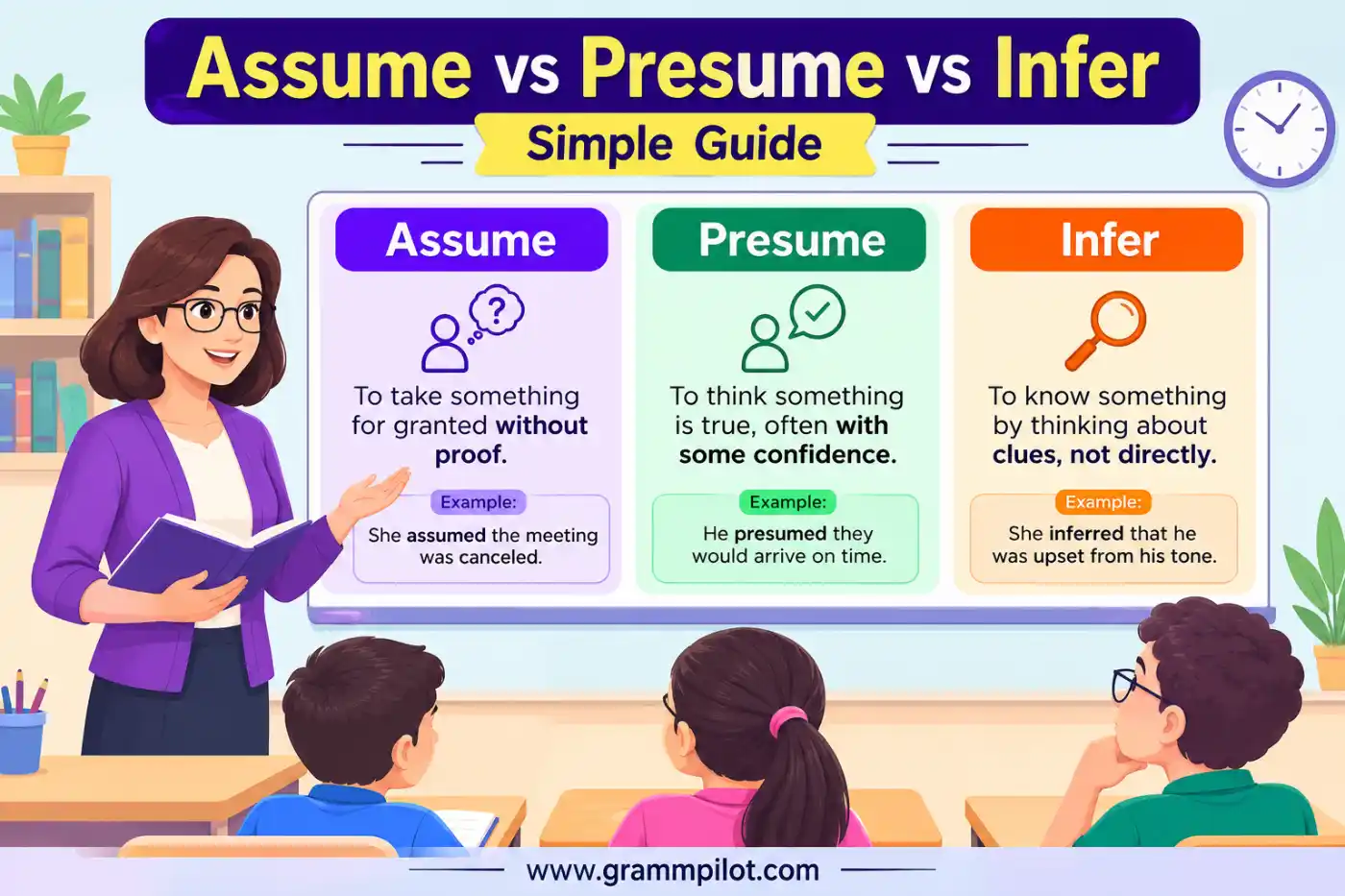
Have you ever written an email, school essay, or text message and stopped because you weren’t sure about to use assume vs presume vs infer? You’re not alone. These three words seem similar, but they don’t mean the same thing. Using the wrong one can confuse your reader or even change the meaning of your sentence. Many English learners and even native speakers search for Assume vs Presume vs Infer because the differences are subtle. They all deal with ideas, beliefs, or conclusions, but each word describes a different way of thinking.
Quick Answer
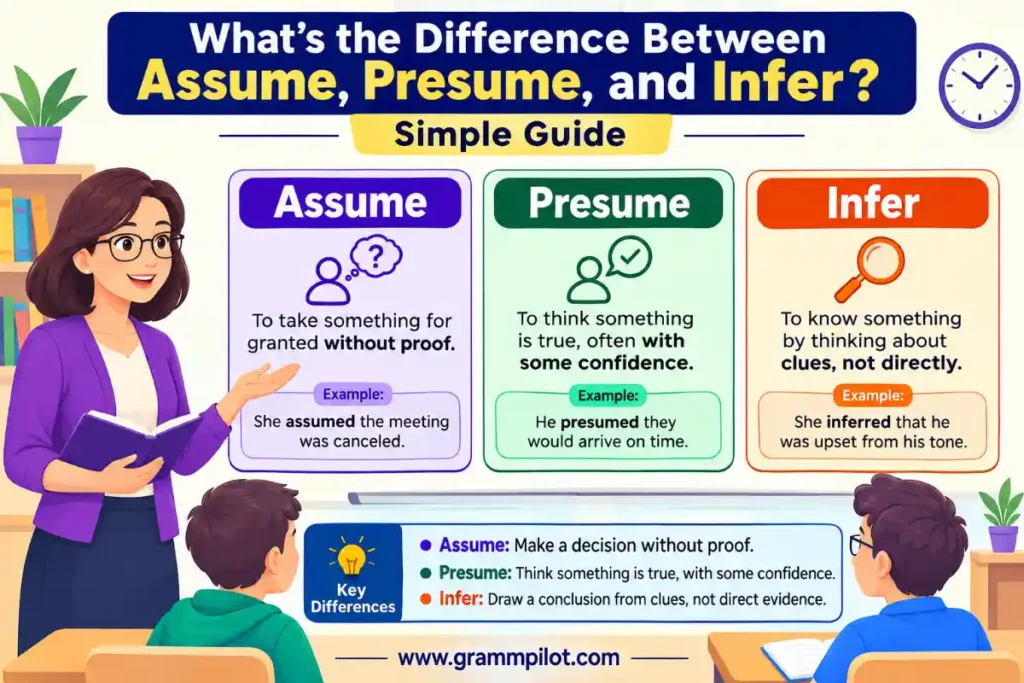
Assume means to believe something without proof. Presume means to believe something because there is some reason or likelihood. Infer means to reach a conclusion by using evidence or clues.
Once you understand these differences, you’ll write more clearly and sound more natural in conversations, emails, essays, and professional writing. In this guide, you’ll learn the meaning of each word, where they came from, when to use them, common mistakes, real-life examples, and practical tips that make choosing the right word much easier.
You can also compare this with the words discussed in [Smoothe vs Smooth].
What Does “Assume vs Presume vs Infer” Really Mean?
At first glance, these three verbs seem almost identical because they all involve thinking or reaching an idea. The key difference is how you arrive at that idea.
| Word | Basic Meaning | Evidence Needed? | Confidence Level |
|---|---|---|---|
| Assume | Accept something as true | No | Low to medium |
| Presume | Believe something is probably true | Some reason or likelihood | Medium to high |
| Infer | Reach a conclusion from evidence | Yes | Based on facts or clues |
Think of them as three different stages of thinking.
- You assume before you know.
- You presume because something makes sense.
- You infer after looking at evidence.
This simple idea explains most situations where these words appear.
What’s the Difference Between Assume, Presume, and Infer?
Imagine you arrive at work and see your coworker’s desk is empty.
Assume
You say: “She isn’t coming today.”
You don’t actually know.
That is an assumption.
Presume
Now imagine you remember she said yesterday that she had a doctor’s appointment.
You still aren’t certain, but your belief has a reasonable basis.
Infer
Later, you notice an email saying she submitted her leave request, and her calendar shows “Medical Appointment.”
Now you say: “I infer that she’s at the clinic.”
Your conclusion comes from evidence. That’s the biggest difference.
A Simple Memory Trick
Remember these three questions.
Assume
Am I guessing?
If yes, you’re probably assuming.
Presume
Do I have a reasonable reason to believe it?
If yes, you’re probably presuming.
Infer
Did I use clues or evidence?
If yes, you’re inferring.
Many English learners remember the words using this simple sequence:
Guess → Reason → Evidence
Assume → Presume → Infer
Word Origins and Plain-English Meaning
Most grammar articles skip this part, but understanding where words come from often makes them easier to remember.
Origin of “Assume”
The word assume comes from the Latin word assumere, meaning to take up or to take for oneself. Over time, English speakers began using it to mean accepting something as true without checking first. Today, that’s still its main meaning.
Plain English: You decide something is true even though you don’t have proof.
Examples:
- I assumed the meeting started at 9.
- Don’t assume everyone agrees.
- She assumed he already knew.
Notice that nobody checked the facts first.
Origin of “Presume”
Presume comes from the Latin word praesumere, meaning to take beforehand. The word developed into the idea of believing something before knowing for certain—but usually because there is some logical reason.
Plain English: You believe something is probably true because it makes sense.
Examples:
- We presume the package will arrive tomorrow.
- I presumed you were busy.
- The court presumes a person is innocent until proven guilty.
Unlike assume, presume often suggests there is some evidence, experience, or expectation behind the belief.
Origin of “Infer”
The word infer comes from the Latin inferre, meaning to bring in or to draw out.
In modern English, it means drawing a conclusion from information you already have.
Plain English: You look at clues and figure something out.
Examples:
- I inferred she was upset from her voice.
- Scientists infer facts from experiments.
- Readers infer meaning from context.
Unlike assuming or presuming, inferring depends on evidence.
Why People Confuse These Words “Assume vs Presume vs Infer “?
There are several reasons these verbs get mixed up.
First, all three involve thinking rather than seeing something directly. Second, they often appear in similar situations.
For example:
- I assumed he left.
- I presumed he left.
- I inferred he left.
The sentence looks almost the same. But the thinking process changes each time.
| Sentence | What Happened? |
|---|---|
| I assumed he left. | I guessed. |
| I presumed he left. | I had a good reason to think so. |
| I inferred he left. | I saw evidence that led me to that conclusion. |
The action is different even though the result sounds similar.
When Should You Use “Assume”?
Use assume when you’re accepting something without enough information. You are filling in the missing details yourself.
Common situations include:
- First impressions
- Quick guesses
- Everyday conversations
- Predictions without proof
- Personal beliefs
Examples:
- I assumed the restaurant was open.
- She assumed everyone understood.
- Never assume people know what you’re thinking.
- He assumed the answer was correct.
- We assumed the train would be on time.
Sometimes assumptions turn out to be correct. Sometimes they don’t.
That’s why people often say: “Never assume.” The warning exists because assumptions can easily be wrong.
When Should You Use “Presume”?
Use presume when you have a logical reason to believe something.
You’re still not certain. However, your belief isn’t random.
Examples:
- I presume they’re already home because their car is outside.
- We presumed the event would continue despite the rain.
- She presumed the email reached me because it didn’t bounce back.
- Most people presumed he accepted the offer.
- I presume you’ve already eaten dinner.
Notice something important. Each example contains some reason behind the belief. That’s what separates presuming from assuming.
When Should You Use “Infer”?
Use infer when you examine facts, clues, or observations before reaching a conclusion.
This word is common in:
- Reading comprehension
- Detective stories
- Scientific reports
- Academic writing
- Business analysis
Examples:
- The teacher inferred the student understood the lesson.
- Police inferred the suspect left through the back door.
- I inferred that she was nervous because her hands were shaking.
- Readers can infer the character’s feelings from the dialogue.
- We inferred the machine had failed after checking the data.
The evidence may not prove the conclusion completely.
But it supports it.
That’s why infer is considered the most evidence-based of the three words.
Is One Word More Formal Than the Others?
Yes.
Although all three are common English words, they aren’t used equally in every situation.
| Word | Formality | Common Places |
|---|---|---|
| Assume | Everyday | Conversation, texting, emails |
| Presume | More formal | Business writing, legal English, reports |
| Infer | Academic and analytical | Schools, research, literature, science |
That doesn’t mean you can’t use them elsewhere.
Instead, it helps explain why you might hear one word more often than another depending on the setting.
For example:
A friend texting you is more likely to say: “I assumed you were asleep.”
A lawyer may say: “The law presumes innocence.”
A teacher may ask: “What can you infer from this paragraph?”
Each word naturally fits its own context.
Assume vs Presume vs Infer: Can These Words Ever Replace Each Other?
Sometimes—but not always.
Consider these examples.
Example 1
“I assumed he forgot my birthday.”
This means you guessed.
“I presumed he forgot my birthday.”
This means you had a reason to think he forgot, perhaps because he had forgotten before.
“I inferred he forgot my birthday.”
This means you reached that conclusion after noticing clues, such as no messages, no calls, and no gift. Each sentence is understandable. Each sentence tells a different story. That’s why choosing the correct word matters.
Master Synonym List for “Assume vs Presume vs Infer”
No synonym is accurate. Some are casual. Others sound formal or fit only certain situations. The table below helps you choose the right word based on tone and meaning.
| Word | Meaning | Tone | Example |
|---|---|---|---|
| Assume | Believe without proof | Neutral | I assumed the store was open. |
| Presume | Believe with some reason | Formal | We presumed the meeting had started. |
| Infer | Reach a conclusion from evidence | Formal | I inferred he was upset from his voice. |
| Guess | Make a quick prediction | Casual | I guessed the answer. |
| Think | Believe something | Everyday | I think she’s home. |
| Believe | Accept as true | Everyday | I believe the story. |
| Suppose | Imagine or consider | Everyday | Suppose it rains tomorrow. |
| Imagine | Form an idea in your mind | Everyday | I imagined he was joking. |
| Expect | Believe something will happen | Neutral | I expected a reply today. |
| Conclude | Decide after thinking | Formal | The report concluded the project succeeded. |
| Reason | Think logically | Formal | She reasoned that the road was closed. |
| Interpret | Explain the meaning | Formal | Readers interpreted the ending differently. |
| Judge | Form an opinion | Neutral | Don’t judge too quickly. |
| Suspect | Believe something may be true | Neutral | I suspect he’s busy. |
| Recognize | Identify correctly | Neutral | I recognized the pattern. |
| Observe | Watch carefully | Formal | We observed several differences. |
| Notice | Become aware | Everyday | I noticed the lights were off. |
| Consider | Think carefully | Neutral | Consider all the facts first. |
| Accept | Treat as true | Neutral | We accepted the explanation. |
| Hypothesize | Suggest a possible explanation | Academic | Researchers hypothesized a new cause. |
| Assume for the sake of argument | Accept temporarily | Formal | Let’s assume that’s correct. |
This list shows why replacing one word with another isn’t always a good idea. Some words focus on guessing, while others require evidence or careful reasoning.
Synonyms Grouped by Tone “Assume vs Presume vs Infer”
Sometimes you don’t just need a synonym. You need one that matches the situation.
Simple Everyday Words
These are common in daily conversations.
- Think
- Guess
- Figure
- Believe
- Suppose
- Imagine
- Notice
- Sense
- Expect
- Understand
Example: “I figured you’d already left.”
This sounds natural in everyday American English.
Professional or Formal Words
These work well in reports, essays, legal writing, and business communication.
- Presume
- Infer
- Deduce
- Conclude
- Reason
- Interpret
- Observe
- Detect
- Recognize
- Hypothesize
- Speculate
- Accept
Example: “The researchers inferred that climate changes affected the results.”
Informal or Slang Alternatives
These are best for conversations and texting.
- Figure
- Guess
- Bet
- Read into
- Have a feeling
- Get the idea
- Pick up on
Example: “I bet he’s still asleep.”
Remember that slang should usually stay out of academic writing.
Synonyms by Intensity “Assume vs Presume vs Infer”
Not every word expresses the same level of certainty.
Here’s a simple scale.
| Strength | Words |
|---|---|
| Very Weak | Guess, Imagine |
| Weak | Assume, Suppose |
| Medium | Think, Believe, Figure |
| Medium-Strong | Presume, Expect, Suspect |
| Strong | Conclude, Deduce, Infer |
| Very Strong | Establish, Confirm, Prove* |
*Notice that prove isn’t a true synonym because proving something means removing doubt. Inferring still allows for uncertainty.
Think of the scale like climbing a ladder. Guessing is near the bottom. Inferring sits much higher because it depends on evidence.
Assume vs Presume vs Infer: Synonyms by Part of Speech
Most people focus only on verbs. However, related nouns and adjectives are useful too.
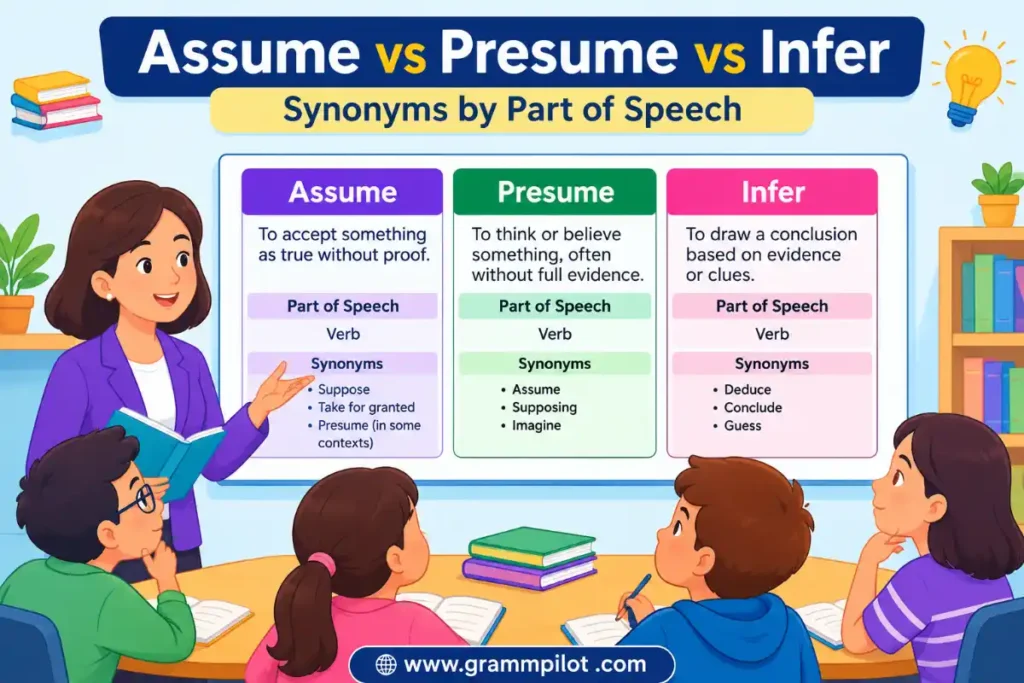
Verbs
- Assume
- Presume
- Infer
- Guess
- Believe
- Deduce
- Conclude
- Interpret
- Suppose
Example: “I inferred the answer.”
Nouns
- Assumption
- Presumption
- Inference
- Conclusion
- Belief
- Guess
- Interpretation
- Observation
Example: “His assumption turned out to be wrong.”
Adjectives
- Assumed
- Presumed
- Inferred
- Logical
- Reasonable
- Probable
- Likely
- Apparent
Example: “It was a reasonable assumption.”
Knowing these related forms makes your writing smoother because you don’t repeat the same verb over and over.
Are These Words Used Differently in American and British English?
The meanings are almost identical in both American and British English.
However, frequency differs slightly.
American English
Americans commonly use:
- Assume
- Think
- Figure
- Guess
In everyday conversation, “figure” appears very often.
Example: “I figured you’d be here.”
British English
British speakers also use assume, but presume appears a little more often in polite conversation.
Example: “I presume you’ve already met.”
This sounds perfectly natural in the UK.
Infer
The word infer is equally common in both countries, especially in education, journalism, research, and literature.
Overall, you don’t need to change these words when writing for either audience.
Which Word Should You Use in Different Situations?
Choosing the best word depends on where you’re writing.
Assume vs Presume vs Infer: Best Word for a Resume
A resume should sound confident and factual. Avoid saying you assumed something. Instead, use evidence-based language.
Good choices include:
- Inferred
- Concluded
- Identified
- Determined
Example: “I inferred customer needs by analyzing survey responses.”
This sounds analytical and professional.
Avoid: “I assumed customers wanted faster delivery.”
That sounds like guessing.
Assume vs Presume vs Infer: Best Word for an Essay
Teachers usually prefer precise language. Choose the word that matches your meaning.
Use assume when discussing an unsupported belief.
Example:
“Many people assume social media causes stress.”
Use infer when discussing evidence.
Example:
“We can infer the author’s opinion from the final paragraph.”
Use presume when discussing reasonable expectations.
Example: “The court presumes innocence until guilt is proven.”
Assume vs Presume vs Infer: Best Word for Emails
Professional emails should avoid unnecessary assumptions.
Instead of writing: “I assumed you received my message.”
Try: “I presumed you had received my message.”
Or even better: “I wanted to check if you received my message.”
This sounds more polite and avoids blame.
Assume vs Presume vs Infer: Best Word for Text Messages
Casual conversations usually favor simple words.
Natural examples include:
- I thought…
- I figured…
- I guessed…
- I assumed…
Example:
“I assumed you’d already left.”
Most people would not naturally text: “I inferred you’d already left.”
While it’s grammatically correct, it sounds unusually formal.
Assume vs Presume vs Infer: Best Word in Everyday Speaking
Conversation usually rewards simple language.
Common choices include:
- Think
- Guess
- Figure
- Assume
Example: “I figured you were working today.”
Although presume is correct, many speakers reserve it for more formal situations.
How Do These Words Change the Meaning of a Sentence?
The smallest word choice can change what readers understand.
Consider this sentence: “I assumed Sarah missed the meeting.”
This tells readers you guessed.
Now change one word. “I presumed Sarah missed the meeting.”
Readers now believe you had some reason. Perhaps her car wasn’t in the parking lot.
Now change it again. “I inferred Sarah missed the meeting.”
Now readers imagine you looked at attendance records, emails, or other clues before reaching your conclusion. The event hasn’t changed. Only your thinking process has. That’s why careful writers choose these verbs so precisely.
Assume vs Presume vs Infer : Which Word Sounds More Polite?
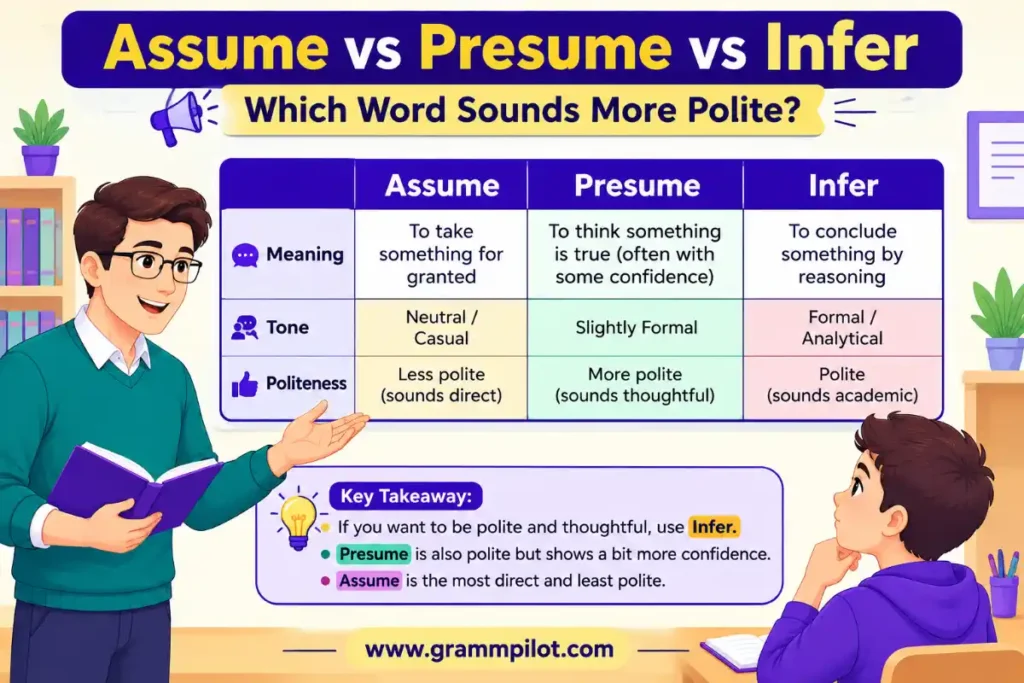
Sometimes tone matters more than grammar.
Compare these sentences.
“I assumed you knew.”
This may sound like you’re blaming someone.
“I presumed you knew.”
This sounds softer and more respectful.
“I inferred that you already knew.”
This sounds analytical and emotionally neutral.
Professional writers often choose presume because it reduces the chance of sounding rude.
Easy Rule to Remember Forever
If you’re ever unsure, ask yourself these three questions.
Did I simply guess?
Use assume.
Did I have a good reason?
Use presume.
Did I examine evidence?
Use infer.
Those three questions solve most situations you’ll encounter in English.
1 Example Sentences in Real Situations
Seeing these words in context is the fastest way to remember them. Notice how each sentence changes based on the amount of evidence behind the speaker’s conclusion.
Everyday Life
- I assumed the grocery store was open because it usually stays open late.
- We presumed the neighbors were on vacation after seeing their packed car.
- I inferred that the movie was popular because every show was sold out.
- Don’t assume everyone has the same opinion as you.
- She presumed I had already finished lunch because my desk was empty.
School
- From the final chapter, students can infer the author’s main message.
- The teacher asked us not to assume the answer before reading the passage.
- We inferred the character was lonely from the way he spoke to others.
Work
- My manager presumed the report was complete because every section had been submitted.
- I assumed today’s meeting would be online.
- The analyst inferred a change in customer behavior after reviewing six months of sales data.
Friends and Family
- My brother assumed I borrowed his headphones.
- My parents presumed I’d arrive late because of heavy traffic.
- We inferred that Grandma was feeling better because she sounded cheerful on the phone.
Travel
- We inferred the train had already left after seeing an empty platform and the departure board.
These examples show a clear pattern:
- Assume = no proof.
- Presume = some reason.
- Infer = evidence and clues.
Assume vs Presume — What’s the Difference?
People often confuse these two because both involve believing something before knowing for certain.
| Assume | Presume |
|---|---|
| Based on little or no evidence | Based on reasonable evidence |
| More casual | Slightly more formal |
| Often a guess | Often an educated belief |
| Common in conversation | Common in professional writing |
Example
❌ I assumed you finished the report because your computer was off.
✔ I presumed you finished the report because you emailed the final draft.
The second sentence explains why the speaker believed it.
Infer vs Imply — What’s the Difference?
This pair causes confusion even for native speakers.
Here’s the simple rule:
The speaker implies.
The listener infers.
Think of it this way:
Someone gives the clue.
Someone else understands the clue.
Example
Teacher: “You may want to study Chapter 8 carefully.”
The teacher implied Chapter 8 would be important. The students inferred that Chapter 8 would probably appear on the test.
One person sends the message. Another person receives and interprets it.
Assume vs Guess — Are They the Same?
Not exactly.
A guess is usually quick and openly uncertain.
An assumption is something you begin treating as true.
Example
Guess: “I guess he’ll arrive around noon.”
Assume: “I assumed he’d arrive at noon, so I didn’t call him.”
An assumption often affects your decisions. A guess may simply express uncertainty.
Common Mistakes to Avoid
Many learners make the same mistakes. Avoiding them will immediately improve your English.
Mistake 1: Using “infer” without evidence
❌ I inferred she likes coffee because I wanted to.
✔ I inferred she likes coffee because she ordered it every morning.
Always ask:
What evidence do I have?
Mistake 2: Using “assume” in formal reports
Business reports should avoid unsupported statements.
Instead of: ❌ We assumed customers preferred the new design.
Write: ✔ Survey results suggest customers preferred the new design.
Or:
✔ We inferred customer preferences from survey responses.
Mistake 3: Confusing infer and imply
Incorrect: ❌ The article inferred that prices would rise.
Correct: ✔ The article implied that prices would rise.
Readers infer. Writers imply.
Mistake 4: Assuming facts in academic writin
Teachers prefer evidence.
Instead of saying: “We assumed…”
Use:
- The data suggests…
- The results indicate…
- We inferred…
- The evidence shows…
Mistake 5: Thinking presume always means assume
Although they’re similar, presume usually carries a stronger reason. If there is absolutely no basis, assume is usually the better choice.
Assume vs Presume vs Infer: When Should You NOT Use These Words?
Sometimes another verb communicates your meaning more clearly.
Avoid assume when you actually know the fact.
Instead of: “I assumed the Earth goes around the Sun.”
Write: “I know the Earth goes around the Sun.”
Avoid presume when you’re only making a random guess.
Avoid infer when there are no clues or evidence.
Choosing the simplest accurate word almost always improves readability.
Antonyms of Assume, Presume, and Infer
These verbs describe the opposite idea.
| Word | Opposite Meaning |
|---|---|
| Verify | Check if something is true |
| Confirm | Prove something is correct |
| Disprove | Show something is false |
| Question | Doubt an idea |
| Reject | Refuse to accept something |
| Doubt | Feel uncertain |
| Clarify | Make something clear |
| Demonstrate | Show with evidence |
| Prove | Establish as true |
Example: Instead of assuming, verify the information first.
That’s usually the best approach in school and at work.
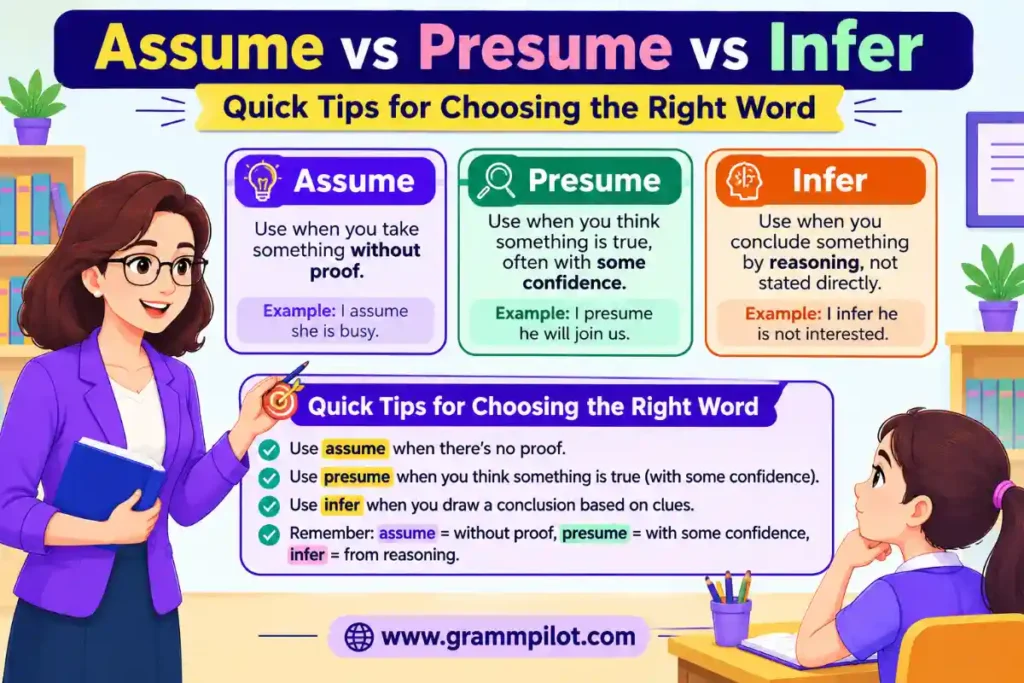
Quick Tips for Choosing the Right Word
Keep these rules in mind whenever you write.
- Assume if you’re guessing.
- Presume if you have a reasonable basis.
- Infer if you’re using evidence.
- Imply if you’re giving the clue.
- Infer if you’re receiving the clue.
- Don’t use infer without facts.
- Don’t use assume when certainty already exists.
- Choose the simplest word that matches your meaning.
- In professional writing, avoid unsupported assumptions.
- When unsure, explain why you reached your conclusion.
A simple memory phrase can help:
Guess → Assume
Reason → Presume
Evidence → Infer
Most English learners remember the difference after using this rule a few times.
Conclusion
Understanding Assume vs Presume vs Infer is less about memorizing dictionary definitions and more about recognizing how each word reflects a different way of thinking. An assumption is a guess without proof. A presumption has a reasonable basis. An inference comes from evidence and careful observation. Once you see that pattern, choosing the correct word becomes much easier.
As you read books, write emails, complete school assignments, or communicate at work, pause for a moment before selecting one of these verbs. Ask yourself if you’re guessing, making a logical expectation, or drawing a conclusion from facts. That simple habit will make your writing clearer, more accurate, and more confident.
Frequently Asked Questions
1. Is assume stronger than presume?
No. Presume usually suggests a stronger reason for believing something. Assume often means believing something without enough evidence.
2. What’s another way to say “assume”?
Some common alternatives are guess, suppose, think, believe, figure, and expect. The best choice depends on how certain you are.
3. Can I use assume and presume interchangeably?
Sometimes, but not always. In Assume vs Presume vs Infer, presume usually implies some logical basis, while assume may be a simple guess.
4. What’s the difference between infer and imply?
A speaker or writer implies a message. A reader or listener infers the meaning from that message.
5. Is infer used in everyday conversation?
Yes, but it appears more often in schools, books, news articles, research, and professional writing than in casual conversation.
6. How do I remember Assume vs Presume vs Infer?
Use this simple rule: Assume means guess, Presume means believe for a reason, and Infer means conclude from evidence. This memory trick works in most situations.
7. Can infer ever be wrong?
Yes. An inference is based on available evidence, but the evidence may be incomplete or misleading. That’s why an inference can still turn out to be incorrect.