
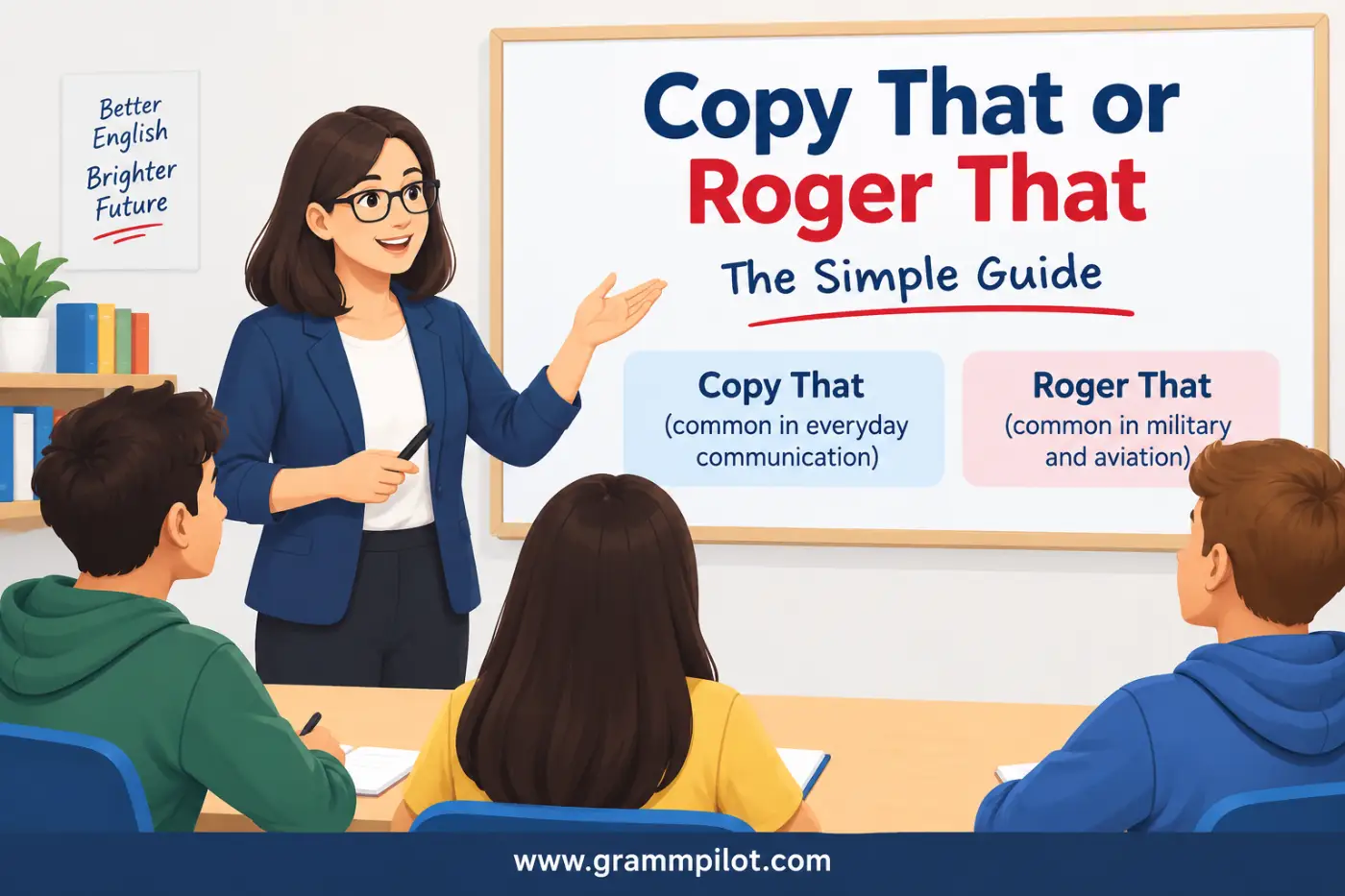
Have you ever been texting a friend, replying to a work message, or listening to someone give instructions and wondered about to say Copy That or Roger That? Both expressions can mean that you received and understood a message, but they have different histories and slightly different uses. Copy that is a direct way to say, “I received and understood your message.” Roger that also means the message was received and understood, but it comes from older radio communication and has a stronger military or radio-communication feel.
Quick Answer: “Copy that” and “Roger that” both confirm that a message was received and understood. “Copy that” sounds more modern and general, while “Roger that” has a stronger radio, military, or old-school communication flavor.
The expressions are useful in different situations. This guide explains their origins, meanings, differences, synonyms, formality, regional use, common mistakes, examples, and the best choice for texting, email, work, essays, and speaking.
To keep improving your English grammar, explore [Appreciate It or Appreciated It].
What Do “Copy That” and “Roger That” Mean?
Both expressions are forms of acknowledgment.
When someone says copy that, they usually mean:
- I heard you.
- I received your message.
- I understood the information.
- I understand the instructions.
When someone says roger that, the basic idea is similar:
- Message received.
- I understand.
- I heard what you said.
- Your information was understood.
For example:
“Meet me at the north entrance at 5.”
“Copy that.”
The second speaker is confirming that the instruction was received.
Another example:
“Keep the door closed until the meeting ends.”
“Roger that.”
Again, the response confirms understanding.
Where Did “Roger That” Come From?
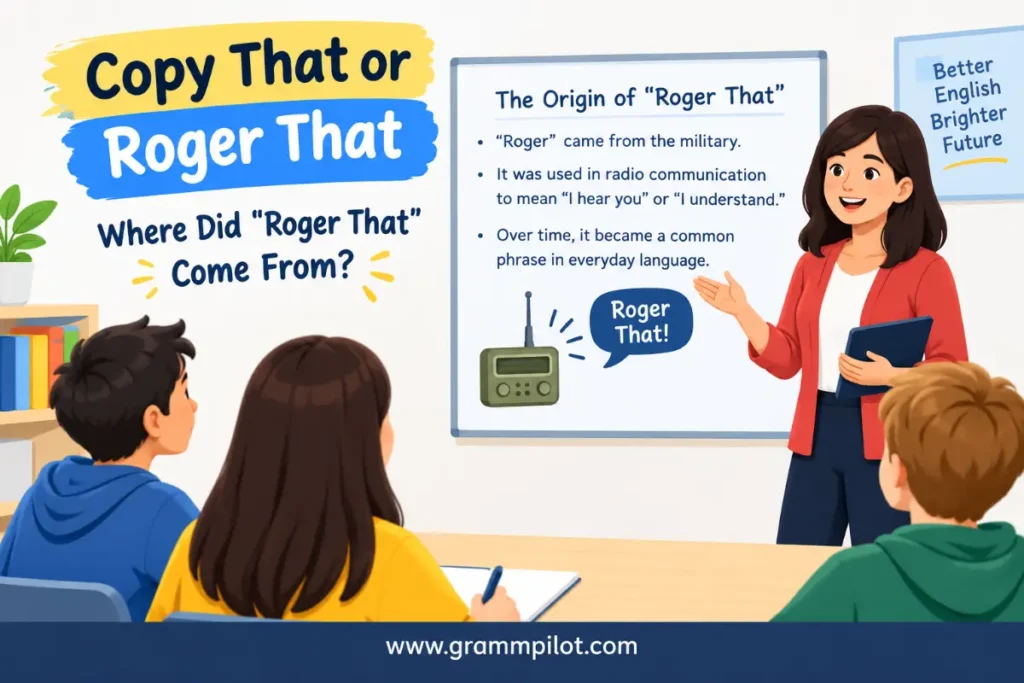
Roger has a long history in radio communication. In older phonetic spelling systems, the letter R was represented by the word “Roger.” In radio communication, R was associated with the idea that a message had been received. Over time, roger developed into a spoken acknowledgment meaning that a message had been received and understood. The expression became strongly associated with military communication, aviation, radio operators, and other forms of two-way communication. Today, people often use roger that outside those settings. Movies, television, video games, and popular culture have helped spread the expression into ordinary conversation. It can sound serious, playful, humorous, or intentionally old-fashioned depending on the situation.
Where Did “Copy That” Come From?
Copy has been used in communication to mean receiving or recording a message. In radio and telecommunications, someone might ask about another person was receiving a transmission clearly. Saying that you copy a message means you received it.
The phrase copy that developed as a concise acknowledgment. It became especially familiar through military, aviation, emergency, trucking, radio, and popular media contexts.
Today, however, copy that has moved beyond radio communication. People may use it casually in text messages, workplace chats, gaming, or everyday conversation.
For example:
“Please send me the revised file before lunch.”
“Copy that.”
The response simply means the instruction has been received.
Copy That or Roger That: What’s the Difference?
The basic meanings overlap, but the tone differs.
| Expression | Basic Meaning | Tone | Common Association |
|---|---|---|---|
| Copy that | I received and understood | Modern, direct | Radio, work, casual speech |
| Roger that | I received and understood | Radio-style, traditional | Military, aviation, movies |
| Got it | I understand | Casual | Everyday conversation |
| Understood | I understand | Neutral/formal | Work and instructions |
| Message received | I received it | Formal | Professional communication |
| Acknowledged | I received and noted it | Formal | Workplace/official settings |
If you’re simply confirming an instruction, copy that often sounds more current.
If you want a radio or military flavor, roger that may fit better.
Master Synonym List for These Expressions
There are many ways to acknowledge a message. The best option depends on your relationship with the speaker and the situation.
| Word or Phrase | Meaning | Tone | Example |
|---|---|---|---|
| Got it | I understand | Casual | Got it. I’ll handle it. |
| Understood | I understand | Neutral | Understood. |
| I understand | I understand the message | Neutral | I understand your instructions. |
| Okay | I received the information | Casual | Okay, I’ll do that. |
| OK | Same as okay | Casual | OK, I’ll be there. |
| Sure | I agree or understand | Casual | Sure, I’ll take care of it. |
| All right | I understand or agree | Casual | All right, I’ll wait. |
| Confirmed | Information is confirmed | Neutral | Confirmed. |
| Roger | Message received | Radio-style | Roger. |
| Roger that | Message understood | Radio-style/casual | Roger that. |
| Copy | Message received | Radio-style | Copy. |
| Copy that | Message understood | Radio-style/casual | Copy that. |
| Loud and clear | I hear you clearly | Radio-style | Loud and clear. |
| Will do | I will do it | Casual | Will do. |
| Gotcha | I understand | Very casual | Gotcha. |
| No problem | I can handle it | Casual | No problem. |
| Duly noted | I have taken note | Formal | Duly noted. |
| I hear you | I understand | Conversational | I hear you. |
| Point taken | I understand your point | Conversational | Point taken. |
| Clear | I understand | Brief | Clear. |
Which Acknowledgment Is Mildest?
If you want a simple, low-pressure response, choose:
- Okay
- Sure
- Got it
- All right
- I understand
These don’t sound overly formal or dramatic.
For example:
“Please call me when you arrive.”
“Got it.”
That’s natural in everyday conversation.
Which Acknowledgment Sounds Stronger?
For a firm confirmation, you can use:
- Understood
- Confirmed
- Acknowledged
- Will do
- Consider it done
These can sound more decisive.
For example:
“Send the report before 4 p.m.”
“Understood.”
The response makes it clear that the instruction was heard.
Which Expression Sounds Most Formal?
For professional or official communication, consider:
- Acknowledged
- Confirmed
- Received
- Noted
- Understood
- Message received
For example:
“The meeting has been moved to Thursday.”
“Confirmed. Thank you.”
These expressions are generally safer in formal communication than a radio-style phrase.
Is “Copy That” Slang?
Copy that is informal communication language, but it isn’t necessarily slang. It comes from radio communication and is now used casually in many settings. Its tone depends on context.
In a serious workplace conversation, it can sound relaxed.
In a text to a friend, it sounds perfectly natural.
The key issue is not about the phrase is wrong. It’s about the tone matches the situation.
Is “Roger That” Slang?
Roger that is informal and conversational in modern English.
It is strongly associated with radio communication and popular culture. It can sound playful or humorous outside its traditional setting.
For example:
“Please remember to bring the tickets.”
“Roger that, captain.”
The word captain makes the playful radio tone obvious. In a formal email, however, “Roger that” may sound too casual.
Copy That or Roger That for Texting
For texting, either expression can work.
Copy that is usually the more neutral modern choice.
Example:
Friend: “I’ll pick you up at 7.”
You: “Copy that.”
You could also say:
“Roger that.”
That may sound more playful.
Other natural texting choices include:
- Got it
- Sounds good
- Okay
- Sure
- Will do
- Yep
- Gotcha
If you’re texting someone you know well, roger that can add personality.
Copy That or Roger That for Email
For a professional email, neither expression is always the best choice. Instead, use a phrase that clearly matches the level of formality.
Examples:
“Understood. I’ll send the report this afternoon.”
“Noted. I’ll make the requested changes.”
“Confirmed. I’ll attend the meeting.”
These sound professional without being stiff. A casual workplace team may comfortably use:
“Copy that. I’ll take care of it.”
But if you’re writing to a client, professor, executive, or unfamiliar professional contact, Understood or Confirmed is usually safer.
Copy That or Roger That for Speaking
Both expressions work in spoken English. Choose based on the tone you want.
Use copy that when you want a concise acknowledgment.
Use roger that when a radio-style or playful tone is appropriate.
For example:
“Take the second exit and meet us near the parking lot.”
“Copy that.”
This sounds direct.
For a playful response:
“Keep your eyes open and stay with the group.”
“Roger that, captain.”
The second response adds humor.
Copy That or Roger That for an Essay
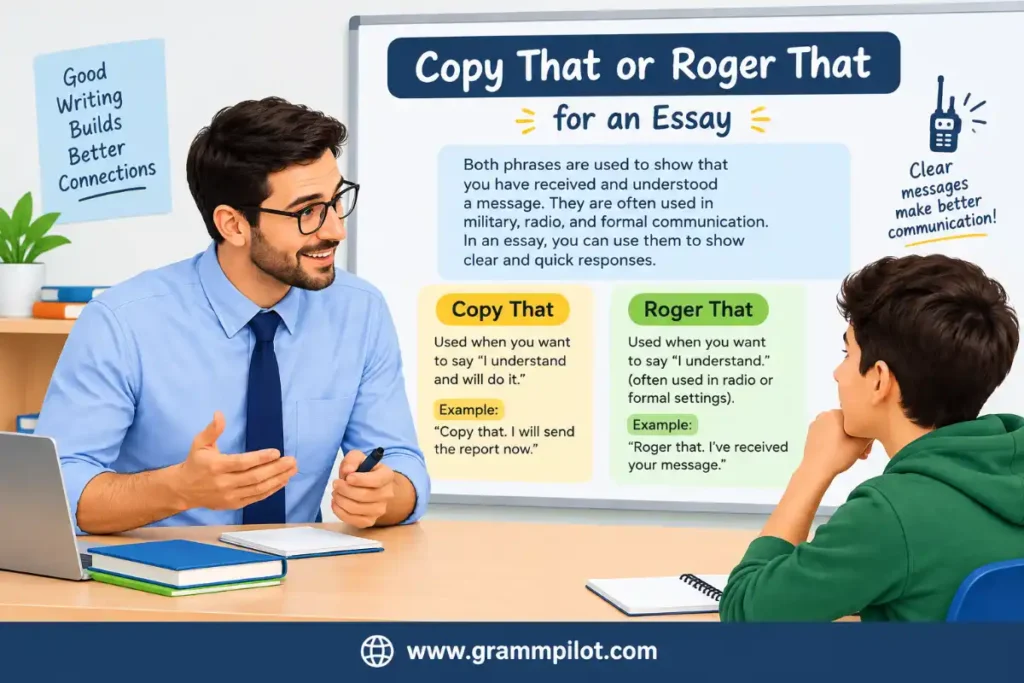
Neither phrase is usually the best choice for an academic essay unless you’re writing dialogue or discussing radio communication.
Instead, use:
- Understood
- Acknowledged
- Confirmed
- Received
- Recognized
For example:
“The operator acknowledged that the message had been received.”
This is more suitable for academic writing than:
“The operator said, ‘Roger that.’”
However, if you’re analyzing a movie, military scene, historical communication system, or character’s speech, the expression may be exactly what you need.
Copy That or Roger That for a Resume
You normally shouldn’t use either expression on a resume.
A resume should describe professional abilities rather than casual acknowledgments.
Instead of writing: “Used ‘copy that’ to confirm instructions.”
You could write: “Confirmed instructions and communicated clearly with team members.”
That focuses on the actual skill.
15 Real-Life Examples of These Expressions
1. Workplace Instruction
“Please send the final presentation by noon.”
“Copy that.”
2. Friend Making Plans
“Meet me outside the theater at 8.”
“Got it.”
3. Military-Style Dialogue
“Stay with your unit until further notice.”
“Roger that.”
4. Classroom
“Submit your assignments before Friday.”
“Understood.”
5. Team Project
“Can you update the spreadsheet?”
“Will do.”
6. Delivery Instructions
“Leave the package at the front desk.”
“Copy that.”
7. Casual Text
“Don’t forget your passport.”
“Gotcha.”
8. Workplace Chat
“Please add the new figures to the report.”
“Noted.”
9. Radio-Style Conversation
“Turn left at the next intersection.”
“Roger.”
10. Customer Service
“Please send the documents to this email address.”
“Certainly. I’ll do that.”
11. Group Activity
“Everyone needs to meet here at 6.”
“Understood.”
12. Friend’s Reminder
“Bring your charger tonight.”
“Sure thing.”
13. Team Leader
“Stay on this task until it’s finished.”
“Copy that.”
14. Formal Meeting
“The appointment has been moved to Monday.”
“Confirmed.”
15. Playful Conversation
“Remember, you’re in charge of snacks.”
“Roger that, boss.”
Copy That vs Got It: What’s Different?
Both can confirm understanding, but got it is more common in ordinary conversation.
| Copy That | Got It |
|---|---|
| Radio-influenced | Everyday English |
| Concise | Very natural |
| Can sound professional-casual | Casual |
| Can sound playful | Usually straightforward |
| Suggests message received | Suggests understanding |
If your coworker gives you a simple instruction, either can work.
“Please update the file.”
“Got it.”
This sounds more ordinary than:
“Copy that.”
Still, copy that is perfectly understandable.
Roger That vs Understood: What’s Different?
Understood is more neutral and professional.
Roger that has a stronger radio flavor.
Compare:
“Please wait here until the manager arrives.”
“Understood.”
This sounds professional.
Now:
“Roger that.”
This sounds more like a radio exchange.
Neither response changes the instruction. The difference is mainly tone and context.
Common Mistakes With These Expressions
Mistake 1: Thinking Roger Is a Person
In roger that, roger isn’t normally someone’s name.
It functions as an acknowledgment.
Mistake 2: Thinking Copy Means Photocopy
In copy that, copy means receive or understand a communication.
It doesn’t mean make a duplicate.
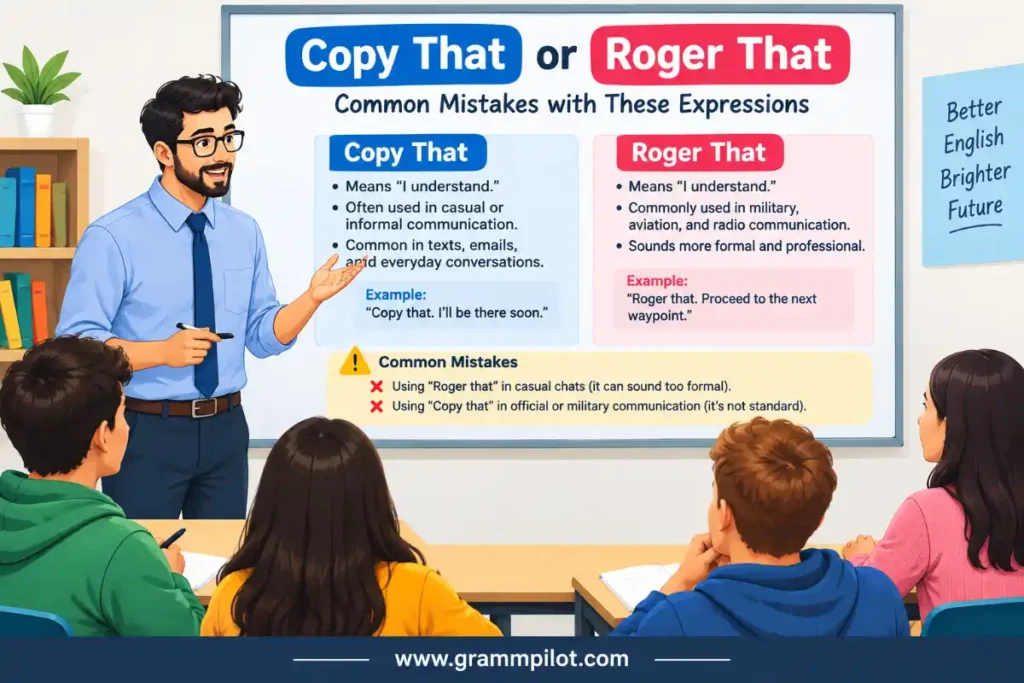
Mistake 3: Using Radio Language in Every Situation
A phrase can be grammatically fine and still be a poor style choice.
For example, replying “Roger that” to a serious legal email may sound strange.
Mistake 4: Assuming They Mean “Yes” to Every Question
These expressions usually confirm receipt or understanding.
They don’t necessarily mean that the speaker agrees with the content.
For example:
“The meeting is canceled.”
“Copy that.”
This means the person received the information. It doesn’t necessarily mean they’re happy about the cancellation.
Mistake 5: Confusing Understanding With Agreement
Understood can also mean “I understand.”
It doesn’t always mean:
“I agree with you.”
That distinction matters in workplace communication.
When Should You Not Use These Expressions?
Avoid them when the situation requires very formal or precise language.
Examples include:
- Legal documents
- Academic research
- Formal reports
- Official applications
- Serious complaints
- Highly formal business letters
Instead, use:
- Acknowledged
- Confirmed
- Received
- Understood
- Noted
You should also avoid using roger that if the radio or military tone might make your response seem unserious.
US vs UK and Regional Notes
Copy that and roger that are widely understood in American English and are familiar in other varieties of English as well.
However, their frequency and tone can vary.
American popular culture has strongly spread both expressions through movies, television, aviation scenes, military dramas, and action stories.
In British and other varieties of English, speakers may understand both expressions easily but may prefer simpler responses such as:
- Okay
- Right
- Understood
- Got it
- All right
Neither expression should be treated as exclusively American, but roger that has a particularly strong association with American military and radio-style speech in popular culture.
What Are the Antonyms?
There isn’t a single direct antonym for copy that or roger that, because they are phrases rather than ordinary adjectives.
If you want to express that a message was not received or understood, you could say:
- I didn’t hear you.
- I don’t understand.
- Please repeat that.
- Say that again.
- I missed that.
- The message wasn’t clear.
- Could you clarify?
- I didn’t catch that.
For example:
“Please take the package to the second office.”
“Sorry, I didn’t catch that. Which office?”
This is better than pretending you understood.
How Do You Choose the Right Expression?
Ask yourself three questions.
1. Is the Conversation Casual?
If yes, try:
- Got it
- Sure
- Okay
- Will do
- Copy that
2. Is the Communication Professional?
Try:
- Understood
- Confirmed
- Noted
- Acknowledged
- Received
3. Do You Want a Radio or Military Feel?
Try:
- Roger that
- Copy that
- Roger
- Copy
- Affirmative
This simple approach helps you match the phrase to the situation.
Quick Tips to Remember the Difference
- Copy that means the message was received and understood.
- Roger that carries the same basic idea but has a stronger radio tradition.
- Copy that often sounds more modern.
- Roger that can sound military, aviation-related, playful, or old-school.
- Got it is one of the most natural everyday alternatives.
- Understood is safer for professional situations.
- Acknowledged sounds formal and official.
- Neither expression necessarily means agreement.
- Don’t use radio-style expressions just because they sound impressive.
- Choose the phrase that fits the relationship and setting.
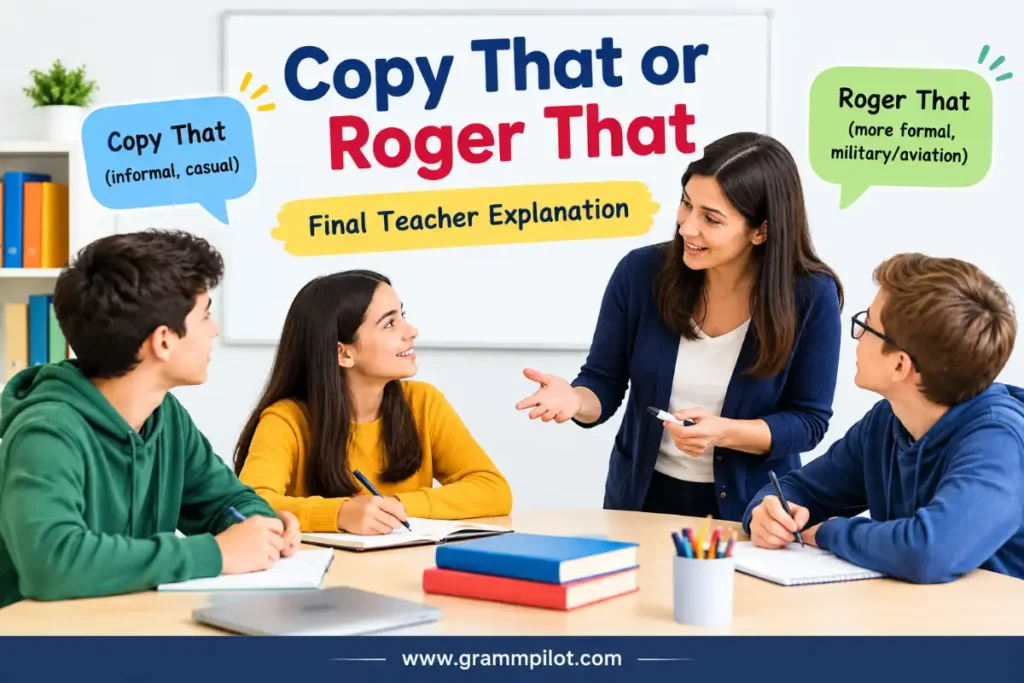
Final Teacher Explanation
The choice between Copy That or Roger That isn’t really about grammar. It’s mainly about meaning, history, and tone.
Both expressions acknowledge a message. Copy that comes from communication language in which copy means that a transmission was received. Roger that has an older radio history and became associated with the word Roger used for the letter R in earlier phonetic systems. In modern conversation, copy that often sounds more current, while roger that can sound more military, aviation-related, or playful. For professional writing, however, a clearer phrase such as understood, confirmed, or noted is often a better choice.
The important thing is to match your acknowledgment to the situation. Good communication isn’t only about saying the right words. It’s also about using the right tone.
Conclusion
When choosing Copy That or Roger That, remember that both expressions confirm that a message has been received and understood. Copy that usually feels more modern and flexible, while roger that carries a stronger radio and military flavor. Neither phrase automatically means agreement; they mainly acknowledge the information that was communicated. For casual conversations, either can work, especially when a short response is useful. In professional or formal situations, words such as understood, confirmed, noted, or acknowledged are often clearer. If you want a playful radio-style tone, roger that can add personality. If you want a simple modern acknowledgment, copy that is a solid choice.
Frequently Asked Questions
1. What does “copy that” mean?
“Copy that” means that you received and understood the message or instruction. It comes from communication and radio language.
2. What does “roger that” mean?
“Roger that” means that a message has been received and understood. It has strong historical connections to radio communication.
3. Which is more modern, copy that or roger that?
Copy that generally sounds more modern and flexible. Roger that often has a more traditional military or radio-style tone.
4. Can I use copy that in a professional email?
Yes, but it may sound informal. For a formal email, understood, confirmed, or noted is usually a better choice.
5. Does “roger that” mean yes?
Not exactly. It usually means the speaker received and understood the message, although it can sometimes function as an informal confirmation.
6. What’s another way to say “copy that”?
Common alternatives include got it, understood, acknowledged, confirmed, noted, received, and will do. The best choice depends on how formal the situation is.
7. Are copy that and roger that the same thing?
They have essentially the same basic purpose: acknowledging a received message. Their main difference is tone, history, and context.