
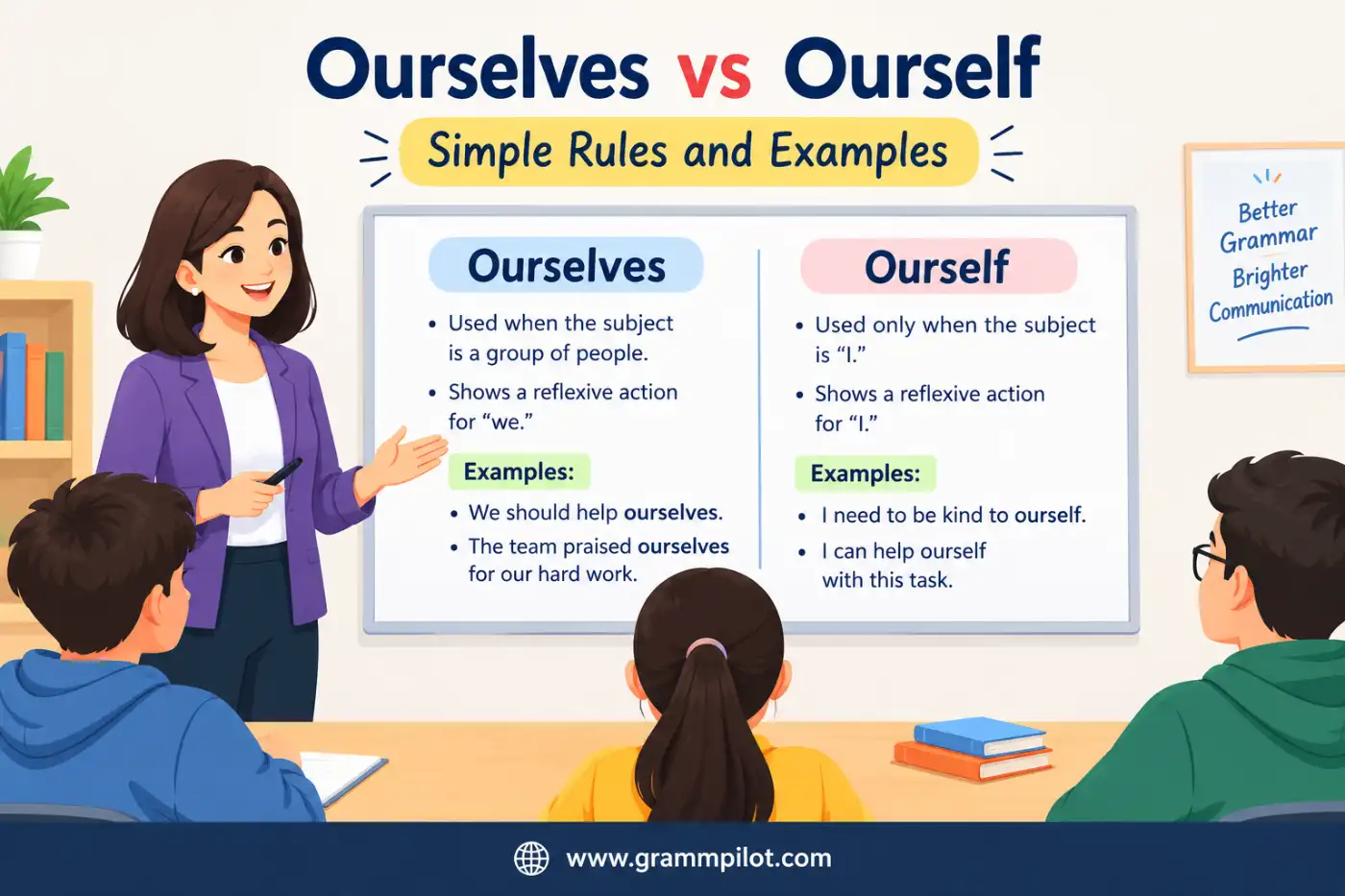
Have you ever paused while writing an email, essay, text message, or social media post and wondered about to write ourselves vs ourself? The words look very similar, but their grammar and meaning are not always the same.
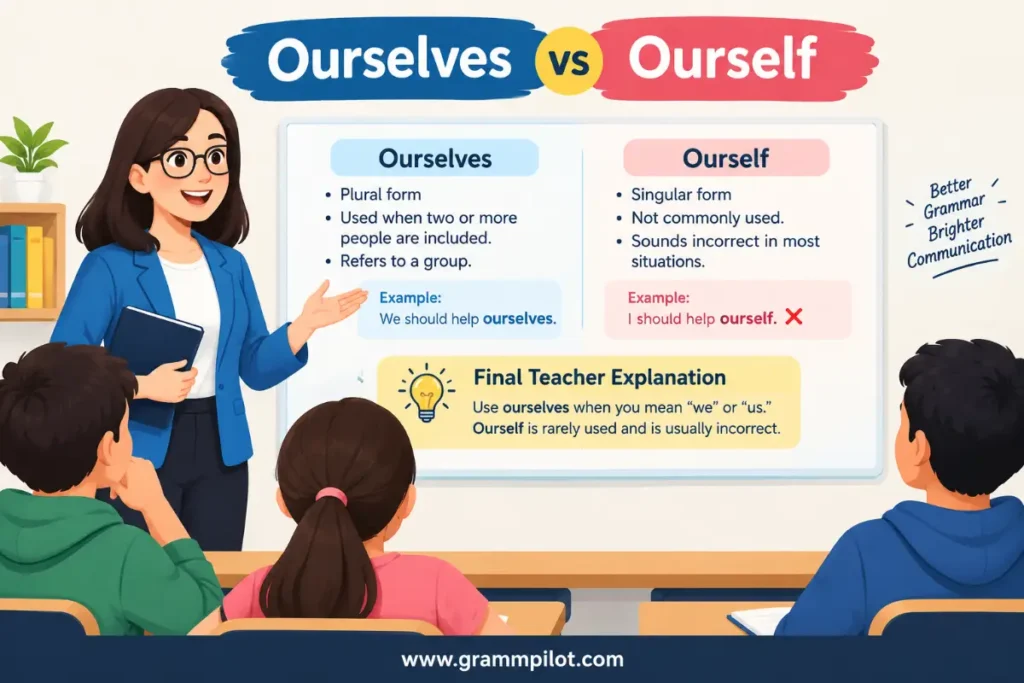
Answer: Ourselves is the standard reflexive pronoun used with we. Ourself is much less common and is mainly used when we refers to one person, such as an author, editor, or royal speaker.
This guide explains the difference between Ourselves vs Ourself, the grammar rules, real examples, common mistakes, formal and informal usage, and the easiest way to choose the correct word.
You can learn more about related grammar rules in [Anyone Has or Anyone Have].
What Is the Difference Between Ourselves and Ourself?
The main difference is simple:
- Ourselves usually refers to more than one person.
- Ourself can refer to one person who uses we instead of I.
For almost all everyday situations, ourselves is the correct choice.
Examples:
- We enjoyed ourselves.
- We should remind ourselves to stay calm.
- We prepared the project by ourselves.
These sentences refer to a group. Ourself is rare in modern everyday English.
Example: We, the editor, have prepared the article ourself.
Here, we refers to one person speaking or writing in an official style.
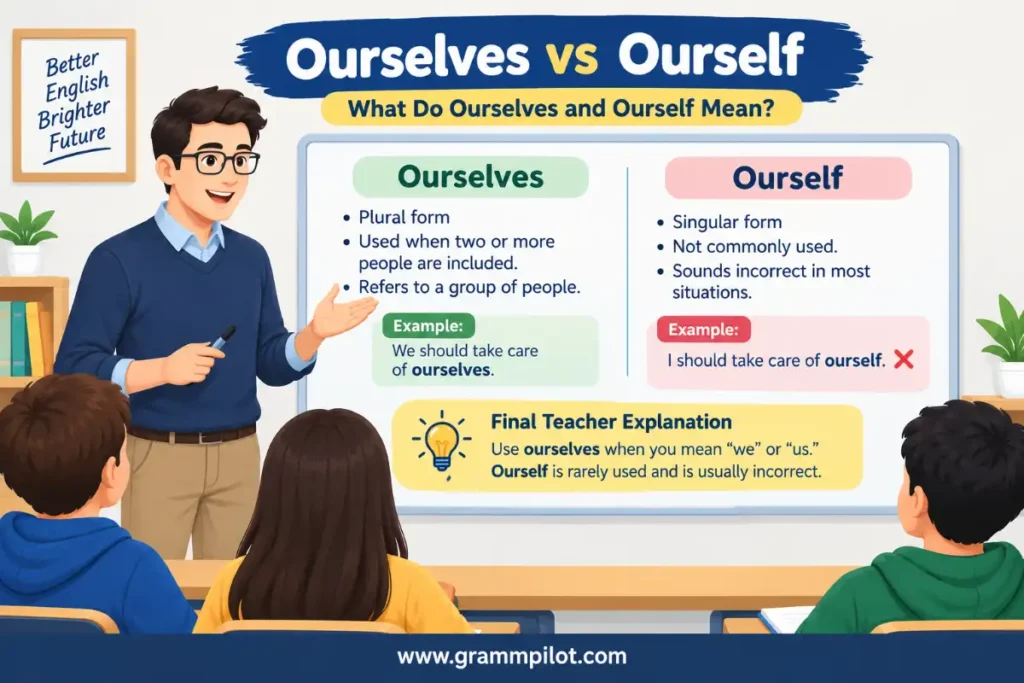
What Do Ourselves and Ourself Mean?
Both words are reflexive pronouns. A reflexive pronoun points back to the subject of the sentence. Look at these common examples:
| Subject | Reflexive Pronoun |
|---|---|
| I | myself |
| You | yourself |
| He | himself |
| She | herself |
| It | itself |
| We | ourselves |
| They | themselves |
Example: We taught ourselves how to use the program.
The subject is we, and the action returns to the same people. That is why we use ourselves.
Where Do These Words Come From?
The words ourselves and ourself developed from older English forms connected to:
- our
- self
- selves
The word self refers to a person’s own identity or person.
When English speakers talk about one person, they usually use the singular form:
- myself
- yourself
- himself
- herself
- itself
When they refer to more than one person, the plural form usually appears:
- ourselves
- yourselves
- themselves
That is why ourselves became the standard form for ordinary use with we.
When Should You Use Ourselves?
Use ourselves when we means two or more people.
Examples:
- We introduced ourselves to the new neighbors.
- We made the dinner ourselves.
- We should give ourselves more time.
- We blamed ourselves for the mistake.
- We enjoyed ourselves at the party.
- We taught ourselves basic Spanish.
- We need to protect ourselves from the rain.
- We saw ourselves in the mirror.
- We reminded ourselves about the deadline.
- We built the website ourselves.
In each sentence, we means multiple people.
When Can You Use Ourself?
Ourself is unusual, but it is not always wrong. It can be used when one person refers to themselves as we. This may happen in certain situations.
The Royal We
Historically, kings and queens sometimes used we instead of I.
Example: We have decided to speak for ourself.
In this situation, the speaker is one person, even though they use we. This style is now rare and often sounds historical or ceremonial.
The Editorial We
Sometimes writers use we when they mean themselves as a single writer. For example, an author might write: In this chapter, we will explain our method. In this type of writing, the author may be speaking as an individual but using we to sound formal or inclusive. The singular ourself may occasionally appear in such situations, although many modern writers still prefer to rewrite the sentence.
Official or Institutional Language
Some official speakers use we to represent a role, office, or institution.
For example: We have examined the matter carefully. If one person is speaking on behalf of an office, the meaning can become complicated. In modern English, rewriting is usually clearer than using ourself.
Ourselves vs Ourself: Quick Comparison
| Feature | Ourselves | Ourself |
|---|---|---|
| Standard in everyday English | Yes | Rare |
| Usually refers to | More than one person | One person using “we” |
| Common in conversation | Very common | Very uncommon |
| Used with normal plural “we” | Yes | No |
| Used in formal modern writing | Yes | Sometimes, but rarely |
| Safe choice for most learners | Yes | Usually no |
For most people, the rule is: If we means more than one person, use ourselves.
Why Is Ourself So Rare?
Modern English strongly connects we with plural meaning. Because of this, English speakers naturally expect: We → ourselves The singular form ourself sounds unusual because most people hear our and assume more than one person is involved. However, grammar does not always follow simple number rules. English also has special uses of we that can refer to one person. That is why ourself exists, even though you may rarely see it.
Is Ourself Grammatically Correct?
Yes, ourself can be grammatically correct in certain special contexts. However, correct does not always mean common. For everyday writing, ourselves is almost always the better choice.
Correct and natural: We completed the work ourselves.
Rare and unusual: We completed the work ourself.
The second sentence would normally sound incorrect because most readers assume we means several people.
Ourselves vs Ourself in Everyday Conversation
In normal speech, use ourselves.
Examples:
- We need to take care of ourselves.
- We enjoyed ourselves.
- Let’s introduce ourselves.
- We should trust ourselves more.
- We prepared everything ourselves.
Using ourself in these sentences would sound strange to most native speakers.
Ourselves vs Ourself in Texting
Texting usually follows the same rule.
Natural: We did it ourselves!
Natural: We should remind ourselves tomorrow.
Unusual: We did it ourself.
Even in casual texting, ourselves is the normal form when talking about a group.
Ourselves vs Ourself in an Email
Professional emails should usually use ourselves when referring to a group.
Example: We would like to introduce ourselves and explain our services.
Example: We have reviewed the report ourselves.
If you are writing alone, do not use we unless there is a specific reason.
Instead of: We completed the report ourself.
Write: I completed the report myself.
This is clearer and more natural.
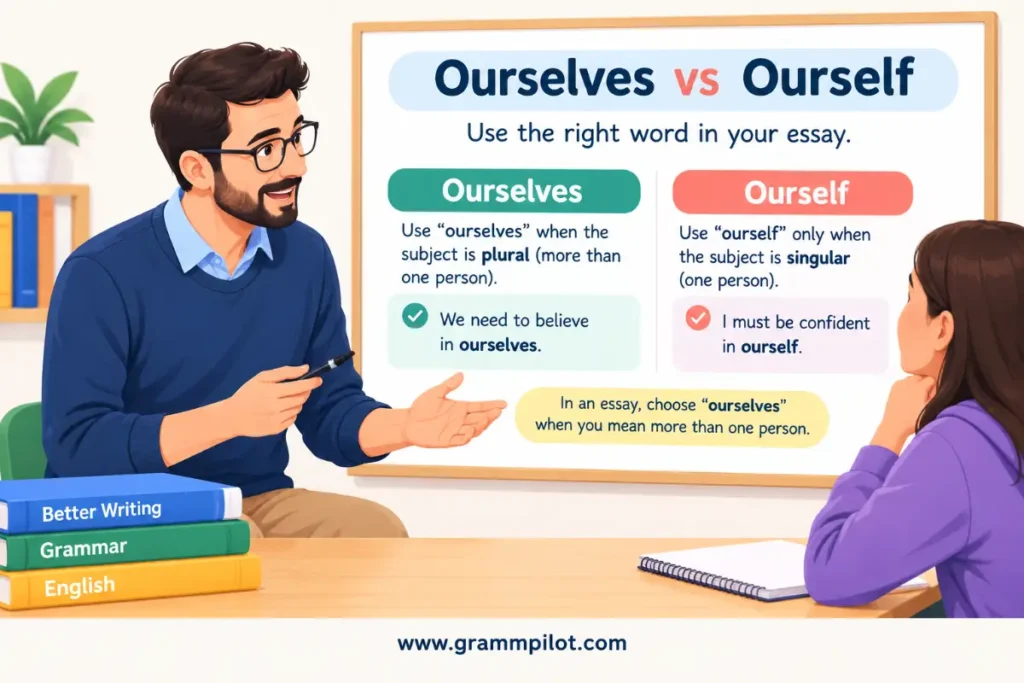
Ourselves vs Ourself in an Essay
In school essays, ourselves is the normal choice when referring to people in general as a group. Example: We often learn more about ourselves through difficult experiences. If you are writing a personal essay about your own experience, use myself rather than ourself.
Example: I challenged myself to become more confident.
Using ourself in a student essay will usually confuse readers unless you are intentionally discussing a special grammatical or historical use.
Ourselves vs Ourself in Speaking
When speaking to others, use ourselves when you mean a group.
Example: We should give ourselves more credit.
If you mean only yourself, say: I should give myself more credit.
Do not switch to ourself simply because the sentence contains the word our.
15 Real-Life Examples of Ourselves
Here are more examples to help you remember the standard form.
- We introduced ourselves before the meeting began.
- We taught ourselves how to cook the recipe.
- We promised ourselves that we would keep trying.
- We saw ourselves in the store window.
- We should prepare ourselves for the exam.
- We enjoyed ourselves during the trip.
- We blamed ourselves for arriving late.
- We reminded ourselves to stay patient.
- We bought ourselves a small gift.
- We asked ourselves an important question.
- We can improve ourselves through practice.
- We found ourselves lost in the old part of town.
- We should protect ourselves from the cold.
- We challenged ourselves to learn something new.
- We made the decorations ourselves.
Notice that all of these sentences use plural we.
10 Examples Where Rewriting Is Better Than Using Ourself
Because ourself is rare, rewriting often produces a clearer sentence.
Instead of: We have decided to represent ourself.
You might write: I have decided to represent myself.
Instead of: We prepared the statement ourself.
Write: I prepared the statement myself.
Instead of: We will explain our position ourself.
Write: I will explain my position myself.
Clear communication is usually more important than using an unusual grammatical form.
Ourselves vs Ourself: Which One Is More Formal?
This question can be confusing.
Ourselves is standard in both formal and informal English.
Examples:
- We conducted the research ourselves.
- We will introduce ourselves at the beginning.
Ourself may appear in formal, historical, royal, or official language, but it is not automatically more professional.
In fact, using it in an ordinary business email may make your writing look like a mistake.
For modern professional writing, choose the form that clearly matches the meaning.
Ourselves vs Ourself in British and American English
Both American and British English recognize the word ourself, but it is uncommon in everyday use.
In both varieties:
- ourselves is the normal reflexive form for plural we
- ourself is rare and used mainly when singular we is intended
The difference is not mainly a US-versus-UK issue.
It is mostly about if we refers to:
- A group of people
- One person using a special form of we
Ourself vs Myself: What’s the Difference?
These words usually refer to different subjects.
| Subject | Reflexive Pronoun |
|---|---|
| I | myself |
| We | ourselves |
| Singular “we” in rare special use | ourself |
Examples:
I taught myself French.
We taught ourselves French.
If one person says we as a special form of speech, ourself may technically fit. But in normal writing, myself is much more common when one person is talking about themselves.
Ourselves vs Themselves: What’s the Difference?
The difference depends on who is doing the action.
Ourselves refers back to we.
We prepared ourselves for the interview.
Themselves refers back to they.
They prepared themselves for the interview.
The meaning changes based on the subject.
Ourselves vs Yourself: What’s the Difference?
Yourself refers to one person. You should believe in yourself.
Ourselves usually refers to a group that includes the speaker. We should believe in ourselves.
The subject tells you which reflexive pronoun to use.
Common Mistakes with Ourselves and Ourself
1. Using Ourself for a Group
Incorrect: We enjoyed ourself.
Correct: We enjoyed ourselves.
If we means multiple people, use ourselves.
2. Using Ourselves When Talking About One Person
Incorrect: I completed the work ourselves.
Correct: I completed the work myself.
Match the reflexive pronoun with the subject.
3. Using a Reflexive Pronoun as the Subject
Incorrect: Ourselves completed the project.
Correct: We completed the project ourselves.
Reflexive pronouns usually point back to the subject. They do not normally replace the subject.
4. Using Myself, Yourself, or Ourselves to Sound More Formal
Incorrect: Please contact John or myself.
More natural: Please contact John or me.
Reflexive pronouns should have a clear subject to refer back to.
Correct: I will contact John myself.
5. Assuming Rare Means Wrong
Some people think ourself is always incorrect. That is not exactly true. It has a recognized use when we refers to one person. Still, for ordinary communication, it is so uncommon that rewriting is often the best choice.
When Should You Use Ourselves for Emphasis?
Sometimes ourselves adds emphasis.
Compare:
We completed the project.
We completed the project ourselves.
The second sentence emphasizes that the group did the work without outside help.
Examples:
- We built the table ourselves.
- We solved the problem ourselves.
- We organized the event ourselves.
- We cooked the meal ourselves.
This use is very common.
What Does “By Ourselves” Mean?
The phrase by ourselves usually means:
- Alone
- Without help
- Without other people
Examples:
The children stayed at home by themselves.
We finished the project by ourselves.
We traveled by ourselves.
The exact meaning depends on the context.
“We finished it ourselves” emphasizes who did the work.
“We finished it by ourselves” often emphasizes that nobody helped.
Both can be correct.
Ourselves vs By Ourselves
Here is a simple comparison.
| Expression | Main Meaning |
|---|---|
| We did it ourselves | We personally did it |
| We did it by ourselves | We did it without help |
| We made it ourselves | We created it |
| We stayed by ourselves | We were alone |
The difference is often small, but context matters.
Can Ourselves Be Used for People in General?
Yes.
English speakers sometimes use we to include themselves and other people generally.
Example:
We often find ourselves worrying about things we cannot control.
This sentence does not refer to one specific group. It refers broadly to people.
The reflexive pronoun is still ourselves because we has plural or collective meaning.
Can Ourself Be Used with Singular They?
No.
Do not confuse ourself with newer discussions about singular pronouns.
Singular they normally uses:
themselves
Example:
Someone should ask themselves what they really want.
Some people also use themself in singular contexts, but that is a separate issue.
Ourself belongs to special uses of singular we, not singular they.
How Do You Choose the Right Word Quickly?
Use this simple test.
Step 1: Find the Subject
Ask: Who is doing the action?
- I?
- We?
- They?
- You?
Step 2: Ask If “We” Means a Group
If yes:
Use ourselves.
Example:
We reminded ourselves about the meeting.
Step 3: Ask If One Person Is Intentionally Using “We”
If yes, ourself may be grammatically possible.
However, ask if rewriting would be clearer.
Example: I reminded myself about the meeting.
For almost all learners and everyday writers, the safest choice is still ourselves when the subject is we.
Quick Tips to Remember the Difference
- We + group = ourselves
- I + one person = myself
- You + one person = yourself
- They + group = themselves
- Ourself = rare special singular we
A useful memory trick is:
Many people = many selves.
So: We → ourselves
Final Teacher Explanation
The difference between these two words becomes easy once you focus on the meaning of we. In normal English, we means more than one person. That is why ourselves is the standard reflexive pronoun. Ourself exists, but it belongs to rare situations where one person uses we to speak about themselves. Most modern speakers and writers do not need it.
When in doubt, check the subject.
If you mean: I
Use: myself
If you mean:
We, meaning several people
Use: ourselves
That simple rule will solve almost every situation.
Antonyms and Related Words
Reflexive pronouns do not have direct antonyms in the usual sense, but related ideas can create contrast.
Examples include:
- Ourselves → others
- By ourselves → with others
- Independently → with help
- Alone → together
- Self-reliance → dependence
Example:
We completed the work ourselves rather than asking others for help.
These are not exact grammatical opposites, but they can help you understand the meaning in context.
Conclusion
The difference between Ourselves vs Ourself is mainly about meaning and number. Ourselves is the normal choice when we refers to two or more people, while ourself is rare and usually appears only when one person uses a special singular form of we.
For everyday writing, texting, emails, essays, and conversation, you will almost always need ourselves. If you are writing about only yourself, myself is usually clearer than using the uncommon word ourself. Remember to match the reflexive pronoun with the subject, and your sentence will sound natural and correct.
Frequently Asked Questions
1. Is it ourselves or ourself?
Use ourselves when we refers to more than one person. Ourself is rare and is mainly used when one person uses we in a special formal or historical sense.
2. Is “we did it ourself” correct?
Usually, no. If we means a group, the correct sentence is: “We did it ourselves.”
3. What’s another way to say “by ourselves”?
You can say “without help,” “alone,” or “on our own,” depending on the situation.
4. Is ourself a real word?
Yes, ourself is a real word, but it is uncommon in modern everyday English. Most people will use ourselves or rewrite the sentence using myself.
5. Can I use ourself in an essay?
Usually, no. In most essays, ourselves is correct for a group, while myself is correct when writing about one person.
6. What is the easiest rule for Ourselves vs Ourself?
If we means more than one person, use ourselves. If you are unsure about the rare singular use of we, rewrite the sentence for clarity.
7. Why does ourself sound strange?
It sounds unusual because modern English speakers strongly connect we with plural meaning. As a result, ourselves is the form most people expect to hear.