
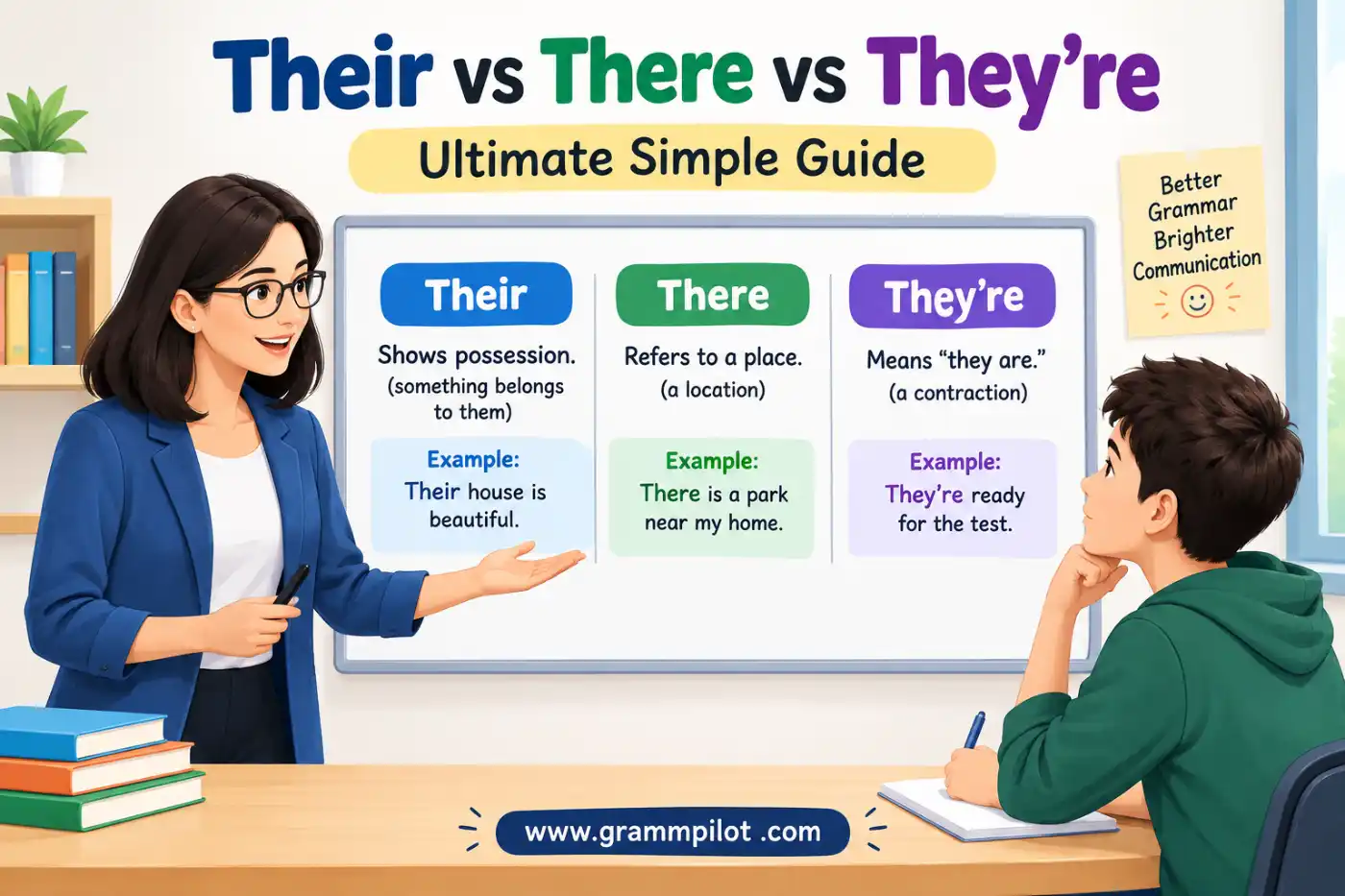
You’re writing an email, finishing an essay, updating your resume, or sending a quick text when you suddenly stop: should it be their, there, or they’re? The three forms sound the same in many accents, so it’s easy to type the wrong one without noticing. The meanings, however, are completely different. Their shows possession or association. There can point to a place or introduce something that exists. They’re is the contraction of they are. Their vs There vs They’re is easy to remember once you connect each spelling with its job: their = belonging to them, there = a place or existence, they’re = they are. This guide goes beyond a basic definition. You’ll learn where these words came from, how they work in sentences, useful alternatives, context-specific choices, common mistakes, regional notes, real-world examples, and quick proofreading tricks.
For more help with commonly confused words, check out [Loose vs Lose].
What do their, there, and they’re mean?
The fastest way to understand these words is to give each one a separate role.
What does “their” mean?
Their is used to show possession, ownership, connection, or association. It normally appears before a noun or noun phrase.
Examples include:
- their house
- their car
- their teacher
- their opinion
- their project
- their responsibilities
- their children
Consider this sentence: Their dog is sleeping.
The word their tells us that the dog belongs to or is associated with them. Possession doesn’t always mean legal ownership. It can describe a relationship or connection.
For example:
- The students shared their ideas.
- The employees discussed their manager.
- The players thanked their coach.
- The children cleaned their room.
In each sentence, their connects the following noun with a particular person or group.
What does “there” mean?
There commonly refers to a place.
Examples:
- Your bag is there.
- We waited there.
- Look over there.
- The restaurant is there.
- Please stand there.
It can also introduce something that exists.
Examples:
- There is a problem.
- There are two chairs outside.
- There was a loud noise.
- There will be another meeting.
In these constructions, there isn’t simply pointing to a physical location. It helps introduce information about something that exists or happens.
What does “they’re” mean?
They’re is a contraction of they are. The apostrophe represents letters that have been removed.
For example:
- They are ready → They’re ready.
- They are coming → They’re coming.
- They are tired → They’re tired.
- They are waiting → They’re waiting.
Whenever you’re uncertain, expand they’re into they are. If the sentence still makes sense, you’ve probably found the correct spelling.
Where did “their” come from?
The history of their goes back to older forms of English and related Germanic languages. Its development involved changes in the way English expressed plural possession. Earlier English had other possessive forms connected with they. Over time, their became the standard possessive form used with the pronoun they. Its modern purpose is straightforward. It identifies something as belonging to, being used by, or being associated with a person or group. For example: Their apartment is downtown. The apartment may legally belong to them, or they may simply be the people who live there. Context determines the exact relationship.
The same idea works with abstract nouns: Their decision surprised everyone.
A decision isn’t something a person physically owns. Here, their shows that the decision was made by or associated with them. Modern English also commonly uses their as a singular, gender-neutral possessive form. For example: Someone forgot their umbrella. The sentence refers to one person, but the person’s gender isn’t specified.
Where did “there” come from?
There has roots in Old English and related Germanic languages. Its early uses were connected with location and position. That basic meaning remains today. The keys are there. The word can identify a location without naming it. English also developed another important use: the existential construction. There is a problem. There are several options. In these examples, there helps introduce something that exists. This explains why the simple rule “there means a place” isn’t complete. It’s useful, but it doesn’t cover every modern use.
Where did “they’re” come from?
The history of they’re is much easier to explain.
It is a contraction formed from: they + are
The apostrophe shows that part of the original wording has been omitted.
Examples:
- they are late → they’re late
- they are working → they’re working
- they are ready → they’re ready
- they are outside → they’re outside
Because it represents they are, it cannot be used to show possession.
That’s one of the most important points to remember.
What are useful alternatives for these words?
These forms don’t have long lists of exact synonyms because they are grammatical words. Still, many words and phrases can express similar meanings when the sentence is rewritten.
Instead of a traditional table with vertical lines, here is a clean grouped reference list.
Possession and association
Theirs
Meaning: Something belongs to them.
Tone: Neutral.
Example: The blue car is theirs.
Belonging to them
Meaning: Shows ownership or connection.
Tone: Neutral.
Example: The documents belonging to them were missing.
Owned by them
Meaning: Clearly expresses ownership.
Tone: Neutral.
Example: The property is owned by them.
Of theirs
Meaning: Describes something associated with them.
Tone: Neutral.
Example: A friend of theirs called yesterday.
Their own
Meaning: Adds emphasis to possession.
Tone: Everyday.
Example: They brought their own equipment.
Someone else’s
Meaning: Belonging to another person.
Tone: Everyday.
Example: That isn’t their bag; it’s someone else’s.
Another person’s
Meaning: Belonging to a different individual.
Tone: Neutral.
Example: That is another person’s responsibility.
Location and position
Here
Meaning: Refers to the current location.
Tone: Everyday.
Example: Please wait here.
Over there
Meaning: Points toward another location.
Tone: Everyday.
Example: Your jacket is over there.
At that place
Meaning: Refers to a particular location.
Tone: Neutral.
Example: We met at that place.
In that location
Meaning: Identifies a specific area or site.
Tone: Formal.
Example: The records remain in that location.
At that spot
Meaning: Refers to a particular position.
Tone: Neutral.
Example: Leave the package at that spot.
In that area
Meaning: Refers to a broader location.
Tone: Neutral.
Example: Several stores are located in that area.
Elsewhere
Meaning: In another place.
Tone: Neutral.
Example: The missing file may be stored elsewhere.
Nowhere
Meaning: In no place.
Tone: Neutral.
Example: The document was nowhere to be found.
Alternatives for “they are”
They are
Meaning: The full form of the contraction.
Tone: Neutral.
Example: They are ready.
They seem to be
Meaning: Suggests an observation rather than certainty.
Tone: Everyday.
Example: They seem to be tired.
They appear to be
Meaning: Indicates an observed condition.
Tone: Formal.
Example: They appear to be prepared.
They happen to be
Meaning: Adds a conversational detail.
Tone: Conversational.
Example: They happen to be nearby.
They remain
Meaning: Shows that a condition continues.
Tone: Formal.
Example: They remain available.
They continue to be
Meaning: Emphasizes an ongoing condition.
Tone: Formal.
Example: They continue to be involved.
Which alternatives work best in everyday conversation?
Conversation tends to favor natural, short expressions.
You might hear:
- They’re coming.
- Their car is outside.
- Your phone is over there.
- That one is theirs.
- They’re waiting over there.
- They are already here.
Contractions are especially common in speech, so they’re sounds perfectly natural in casual conversation.
Which alternatives work best in formal writing?
Formal writing doesn’t require you to avoid their or there. Both are standard words and are perfectly appropriate in academic and professional contexts. You might choose a more formal alternative when you need greater precision.
For example: The records are in that location.
can sound more precise than: The records are there.
Similarly: They appear to be prepared.
can sound more cautious and formal than:
They’re ready. The key is clarity. Don’t make a sentence complicated just because the setting is formal.
What are the differences from mild to strong?
These three forms don’t have intensity levels because they express grammatical meanings rather than emotions or qualities. However, related phrases can add emphasis or precision.
How can possession become stronger?
Compare these examples:
They brought their equipment.
They brought their own equipment.
The first simply identifies the equipment. The second emphasizes that they brought it themselves or that it was specifically theirs. The third makes the ownership relationship even more explicit.
In normal conversation, their own is usually enough.
How can a location become more precise?
Consider these examples:
The store is there.
The store is over there.
Each sentence gives a little more information. Use the shortest version that communicates what the reader needs to know.
How can certainty change?
Compare:
They’re ready.
They appear to be ready.
They seem to be ready.
The first sounds definite. The second and third suggest that the speaker is judging the situation based on what they can see or understand.
What part of speech is “their”?
Their is a possessive determiner. Traditional grammar books may also call it a possessive adjective. It normally appears before a noun.
Examples:
- their house
- their new house
- their answer
- their final decision
- their teacher
- their best option
The important feature is its position and function. Their project won the award. Here, their tells us which group’s project we’re talking about.
How is “their” different from “theirs”?
This distinction is worth learning.
Use their before a noun: Their car is new.
Use theirs when the possessive form stands alone: The car is theirs.
Don’t write: Theirs car is new.
Instead, write: Their car is new.
The two words are related, but their grammatical positions are different.
What part of speech is “there”?
There can perform more than one grammatical role. When it refers to a place, it commonly works as an adverb. We waited there. When it introduces existence, it appears in structures such as: There is a problem. There are five students outside. That second use is sometimes called existential there. Understanding both uses prevents an overly simple definition from causing confusion.
What part of speech is “they’re”?
They’re is a contraction. It combines the pronoun they with the verb are.
They are happy.
They’re happy.
The meaning stays the same. The apostrophe is important because it marks omitted letters.
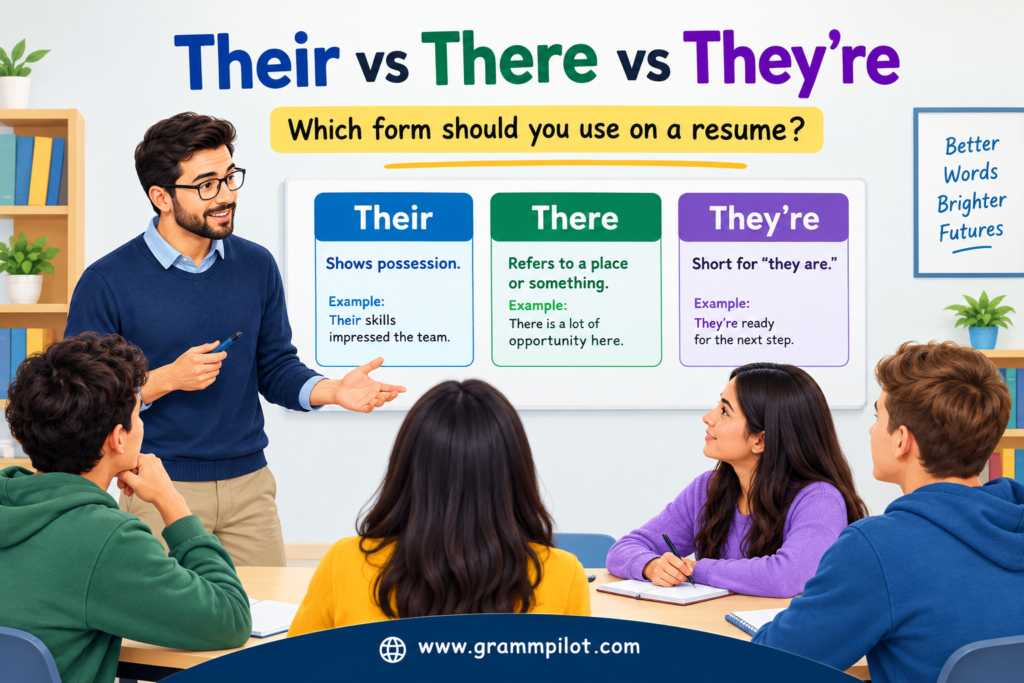
Which form should you use on a resume?
Resumes often favor short, direct language.
Use their when describing responsibilities or work connected with a group.
Example: Team members completed their assigned projects before the deadline.
Use there when referring to a location.
Example: Traveled there regularly to support regional clients.
Use they’re when the meaning genuinely requires they are.
Example: They’re responsible for training new employees.
However, resume bullet points often remove unnecessary subjects and verbs.
Instead of: They’re responsible for training new employees.
you could write: Responsible for training new employees.
That version is more concise. The contraction itself isn’t grammatically wrong.
Which form should you use in an essay?
All three can appear in an essay.
Use their to show possession or association:
Students should evaluate their sources carefully.
Use there to introduce an idea or fact:
There are several factors to consider.
Use they’re when you mean they are:
When students feel prepared, they’re more likely to participate.
In highly formal academic writing, some writers prefer they are instead of they’re. That’s a style preference rather than a grammar requirement.
Which form works best in texting?
Texting is usually informal, so contractions are common.
For example:
They’re already outside.
Their car is parked near the entrance.
Your bag is over there.
You can even use all three forms naturally in one message: They’re bringing their bags, so leave the boxes over there. The setting may be casual, but the spelling rules remain the same.
Are the rules different in American and British English?
The basic distinction is the same in American and British English.
American English:
They’re taking their bags over there.
British English:
They’re taking their bags over there.
The spellings don’t change.
Pronunciation can vary between regions and accents. In many varieties of English, their, there, and they’re are pronounced alike or very similarly. That makes spelling especially important in writing. You can’t reliably decide the correct form by listening to the word alone.
Can “their” refer to one person?
Yes. Modern English commonly uses their as a singular, gender-neutral possessive form.
For example: Someone left their phone on the desk.
Here, someone refers to one person, but the person’s gender isn’t specified.
Another example is: Every student should bring their identification.
The word their can refer to each individual student.
This use is common in everyday, academic, workplace, and professional English.
What are 20 real-life examples?
Learning the words inside complete sentences is often more useful than memorizing isolated definitions.
School examples
- The students finished their science project before Friday.
- There are three books missing from the shelf.
- They’re preparing for the final exam.
- Please put your worksheet over there.
Workplace examples
- The employees submitted their reports on time.
- They’re meeting the director after lunch.
- There is an error in the latest spreadsheet.
- The visitors are waiting over there near reception.
Home examples
- The children left their shoes by the door.
- They’re already asleep upstairs.
- Your keys are right there beside the phone.
- There are clean towels in the bathroom.
Travel examples
- The passengers collected their luggage after landing.
- They’re waiting near the departure gate.
- There is a taxi outside the hotel.
- Our train is over there on platform four.
Everyday conversation examples
- I think they’re coming with us tonight.
- Did you see their new apartment?
- Your glasses are there on the table.
- There seems to be a mistake in the address.
Online communication examples
- They’re posting their updates in the group.
- Their account is still active.
- There are several comments under the post.
- They’re asking for their money back.
These examples show why context matters. The forms may sound alike, but the surrounding words reveal which meaning is required.
What is the difference between their and they’re?
Their expresses possession or association, while they’re means they are.
Compare:
Their manager called yesterday.
They’re calling the manager tomorrow.
In the first sentence, their identifies the manager’s connection with them. In the second sentence, they’re means they are.
Try expanding the second sentence:
They are calling the manager tomorrow. It works.
Now try expanding the first:
They are manager called yesterday. It doesn’t work. That simple test can quickly expose an error.
What is the difference between there and their?
There usually refers to a place or introduces something that exists. Their shows possession or association.
Compare:
The students are waiting there. The students are waiting with their teacher. The first sentence gives a location.
The second identifies the teacher’s relationship with the students.
Another useful comparison is:
There is a new restaurant downtown.
Their restaurant is downtown.
The first sentence introduces the existence of a restaurant. The second tells us that the restaurant belongs to or is associated with them.
Can all three appear in one sentence?
Yes. In fact, using all three together is an excellent memory exercise.
They’re taking their coats over there.
Here is the breakdown:
They’re means they are.
Their shows possession.
There refers to a place.
Try another:
They’re leaving their documents over there before the meeting.
The same three jobs appear again.
Here’s a third example:
They’re planning to meet their friends over there after work.
Each spelling is correct because each one has a different grammatical purpose.
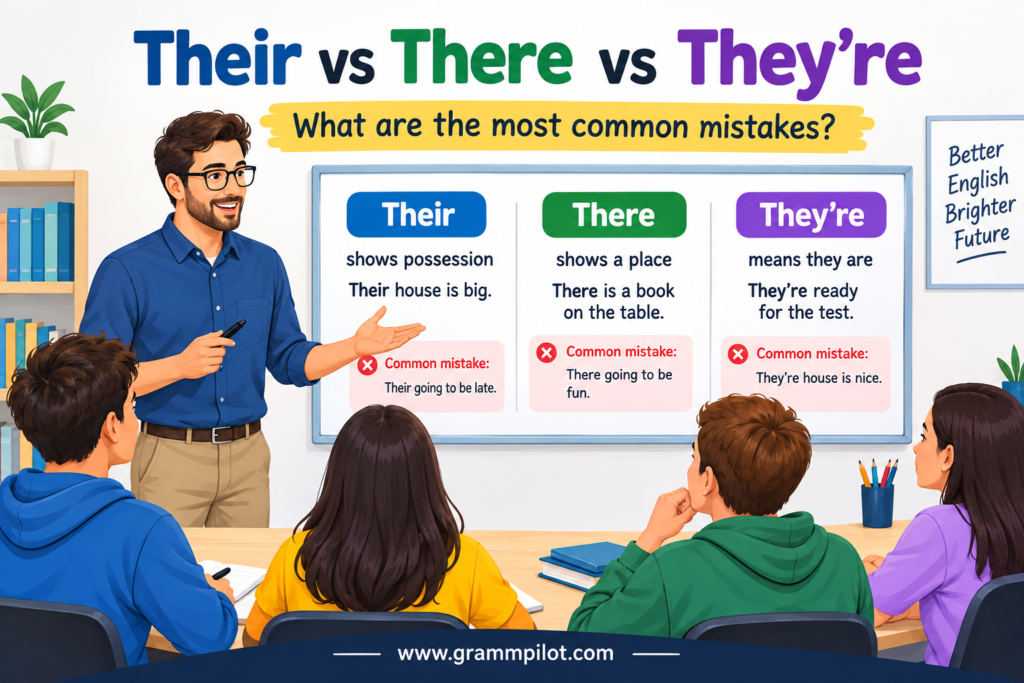
What are the most common mistakes?
Why is “their going home” wrong?
When you mean they are going home, the correct form is they’re.
Incorrect: Their going home.
Correct: They’re going home.
The test is simple: They are going home.
Because the full phrase works, they’re is needed.
Why is “they’re house” wrong?
When you mean that the house belongs to them, use their.
Incorrect: They’re house is beautiful.
Correct: Their house is beautiful.
The word comes before the noun house and identifies whose house it is.
Why is “the store is their” wrong?
When you’re referring to a location, use there.
Incorrect: The store is their.
Correct: The store is there.
Why is “they’re is a problem” wrong?
The correct construction is: There is a problem.
The word there introduces the existence of the problem.
Why is “theirs car” wrong?
Use their before a noun.
Correct: Their car is outside.
Use theirs when it stands alone.
Correct: The car is theirs.
When should you not use “they’re”?
Don’t use they’re simply because the sentence contains they. First determine whether you mean they are. If you mean ownership, choose their.
Incorrect: They’re new apartment is beautiful.
Correct: Their new apartment is beautiful.
If you’re describing a place, choose there.
Incorrect: The office is they’re.
Correct: The office is there.
If you’re introducing something that exists, use there.
The expansion test is especially useful here.
Replace they’re with they are.
If the sentence becomes incorrect, choose another form.
What is the difference between “there’s” and “theirs”?
These two forms create another common spelling trap.
There’s is a contraction of there is. There’s a problem with the computer.
Theirs is a possessive pronoun. The blue bicycle is theirs.
The apostrophe in there’s indicates a contraction. The ending in theirs indicates a possessive form but doesn’t use an apostrophe.
Remember:
There is → there’s
Belonging to them → theirs
What are the antonyms?
These three forms don’t have direct antonyms because they aren’t descriptive words such as happy, large, or strong.
Still, you can express contrasting ideas.
For possession, useful contrasts include:
- someone else’s
- belonging to someone else
- another person’s
- not theirs
- another group’s
If location, possible contrasts include:
- here
- nowhere
- elsewhere
- somewhere else
For they’re, the opposite depends on the sentence.
For example:
They’re ready.
They aren’t ready.
Or:
They’re here.
They’re elsewhere.
So there isn’t one universal opposite for the contraction.
What is the easiest memory trick?
Use three short associations.
THEIR = THEIR belongings
Think about something that belongs to them.
THERE = HERE or THERE
Think about location.
THEY’RE = THEY ARE
Expand the contraction.
You can even remember them as three questions:
Whose? → their
Where? → there
They are? → they’re
That is often enough to solve the problem quickly.
How can you practice the difference?
Start with short sentences.
Choose the correct form:
- ___ going to the store.
- The children left ___ backpacks outside.
- Your shoes are over ___.
- ___ are several reasons for the change.
- The students finished ___ homework.
- I think ___ ready.
- Put the box over ___.
- The workers returned to ___ offices.
Answers:
- They’re
- their
- there
- There
- their
- they’re
- there
- their
Once those feel easy, practice sentences containing two or all three forms.
For example:
They’re taking their bags over there.
That kind of exercise builds recognition quickly.
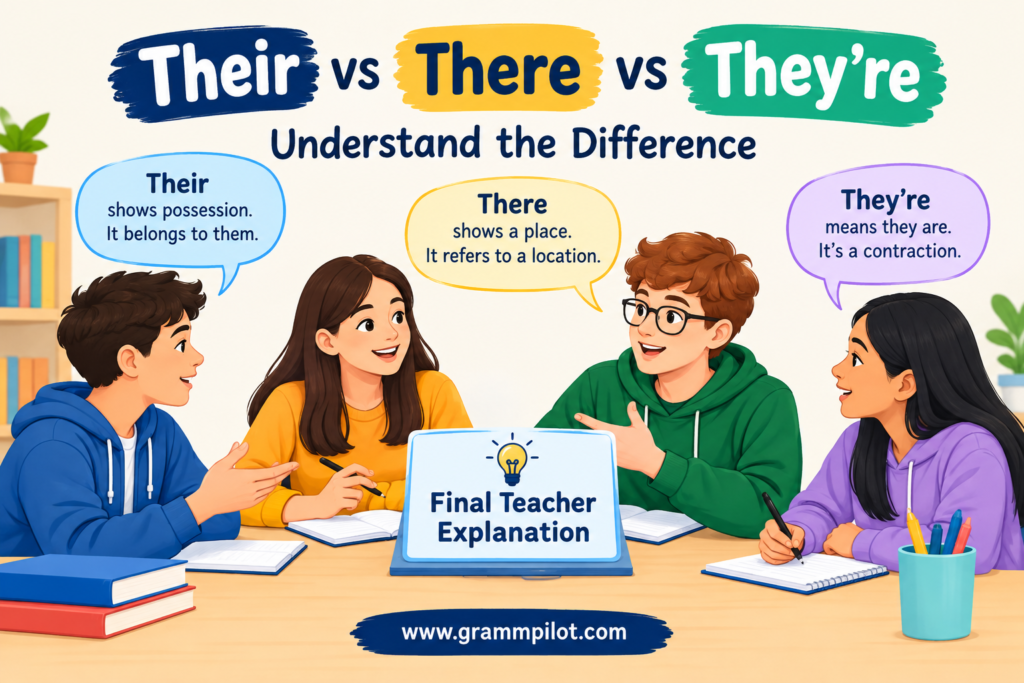
Final Teacher Explanation
Think of these three spellings as three students in a classroom. Each student has a different assignment.
Their handles ownership and association.
Their backpacks are on the floor.
There handles location and existence.
The backpacks are over there.
They’re handles the phrase they are.
They’re looking for their backpacks.
The most useful test is to ask what the sentence means rather than how the word sounds.
If the meaning is belonging to them, choose their.
If the meaning involves a place or something that exists, choose there.
One more distinction is worth keeping in mind. Their normally comes before a noun, while theirs usually stands alone.
Their car is outside.
The car is theirs.
Once you practice these patterns, you won’t need to stop and debate every example. The correct form will become much easier to recognize.
Conclusion
Their vs There vs They’re becomes much simpler when you focus on the job each word performs. Their shows possession or association, there points to a place or introduces something that exists, and they’re is the shortened form of they are.
When proofreading, ask yourself three quick questions: Is something connected with or belonging to them? Are you referring to a place or introducing something that exists? Can the word be replaced with they are? Those checks cover most situations.
Don’t rely on pronunciation because the three forms often sound alike. Look at the meaning, the surrounding words, and the sentence structure instead. With regular practice, these spellings can become automatic in essays, emails, resumes, texts, and everyday writing.
Frequently Asked Questions
1. What is the difference between their, there, and they’re?
Their shows possession, there refers to a place or introduces existence, and they’re means they are. The spellings are different because the grammatical jobs are different.
2. How do I know whether to use their or they’re?
Use their for possession or association and they’re when you can replace it with they are. For example, “Their car is ready” shows possession, while “They’re ready” means “They are ready.”
3. What is an easy trick for remembering these three words?
Think their = belonging to them, there = a place, and they’re = they are. The questions “Whose?”, “Where?”, and “They are?” can help you choose quickly.
4. What’s another way to say “their”?
Depending on the sentence, alternatives include theirs, belonging to them, owned by them, of theirs, and their own. The sentence structure may need to change when you use an alternative.
5. Can I use their, there, and they’re in the same sentence?
Yes. “They’re taking their bags over there” uses all three correctly because each spelling performs a different job.
6. Why do their, there, and they’re sound the same?
They are pronounced the same or very similarly in many varieties of English. Because pronunciation may not reveal the spelling, writers need to use context and grammar to choose the correct form.
7. Is “they’re” the same as “their”?
No, they’re means they are, while their shows possession or association. Replacing they’re with they are is a quick way to check the difference.