
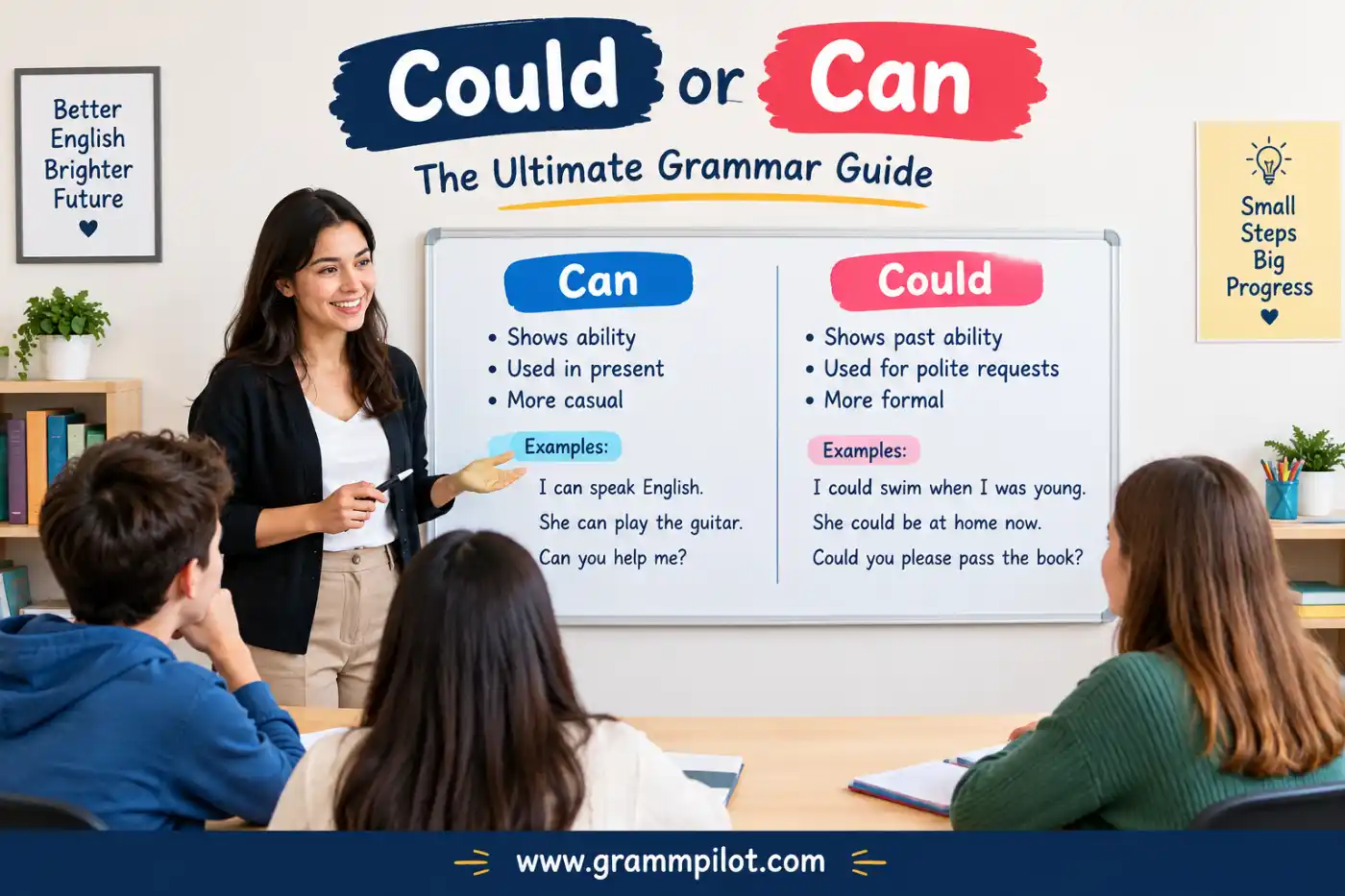
You’re writing an email and want to ask someone for help. You type, “Can you review this?” Then you wonder if “Could you review this?” would sound better. That small choice is where Could or Can can become confusing. Both words can talk about ability, possibility, permission, and requests. The difference often depends on if you’re talking about the present or past, making a direct statement or a softer request, or describing a real possibility versus a hypothetical one.
Quick answer: Use can for present ability, direct requests, everyday permission, and general possibility. Use could for past ability, hypothetical or less certain possibilities, suggestions, and more polite requests.
The good news is that you don’t need to memorize dozens of complicated rules. Once you understand what each modal is doing in a sentence, the choice becomes much easier. This guide covers their meanings, origins, alternatives, intensity, grammar patterns, real-world examples, regional usage, common mistakes, and the best choice for different writing situations.
You may also want to learn the difference between [Perspective or Prospective].
What do can and could mean in English?
Can and could are modal auxiliary verbs. They come before the base form of another verb.
Examples:
- I can swim.
- She can drive.
- We could leave.
- He could help.
Neither word changes to match the subject.
You say:
- I can
- You can
- She can
- They can
You also say:
- I could
- You could
- She could
- They could
The main difference comes from meaning and context.
What does can mean?
Can commonly expresses present ability.
Example: I can solve this problem.
It can also show permission.
Example: You can use my computer.
Another common use is general possibility.
Example: Winter roads can become dangerous.
Finally, can is widely used for direct requests.
Example: Can you help me?
These meanings overlap sometimes, so context matters.
What does could mean?
Could can describe an ability that existed in the past.
Example: I could read simple books when I was five.
It can also express a possible action or result.
Example: We could take the train.
A conditional sentence often uses could as well.
Example: If I had more time, I could help.
The word is also common in polite requests.
Example: Could you send me the file?
So could isn’t limited to past situations.
Where did can and could come from?
The history of these words explains why they are closely connected.
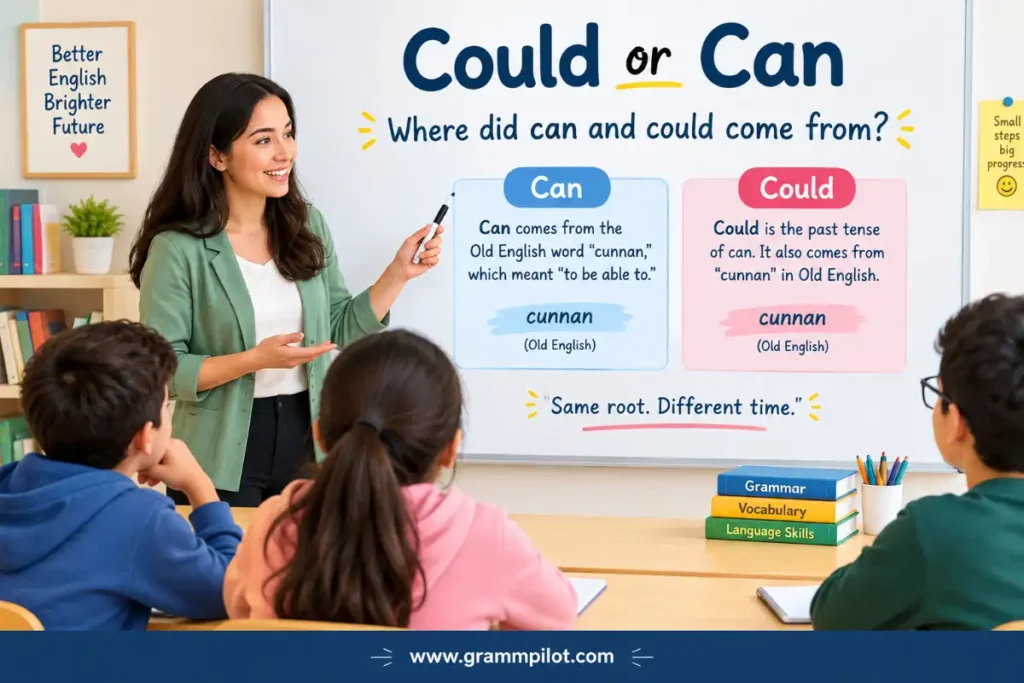
Can developed from an Old English verb related to knowing, understanding, and being able to do something. Over time, its meaning became strongly associated with ability. Could developed as the historical past form of can. That relationship still appears clearly when talking about past ability.
Example:
I can swim now.
I could swim when I was six.
However, modern English expanded the use of could. It can now appear in present requests and future possibilities.
For example: Could you open the door?
This is not a past request.
Likewise: We could visit New York next summer.
This sentence refers to a future possibility. That’s why the rule “could is just the past of can” isn’t enough to explain modern English.
What are the main meanings of can and could?
The easiest way to understand these modals is to separate their major functions.
| Function | Can | Could |
|---|---|---|
| Present ability | Yes | Sometimes, but usually with another meaning |
| Past ability | No | Yes |
| General possibility | Yes | Sometimes |
| Specific possibility | Sometimes | Yes |
| Hypothetical possibility | Rarely | Yes |
| Permission | Very common | Possible and often more polite |
| Direct request | Very common | Common |
| Polite request | Possible | Very common |
| Suggestion | Possible | Very common |
| Conditional result | Usually no | Very common |
This comparison gives you a quick overview, but each function has its own details.
What are the best synonyms and alternatives for can and could?
Strictly speaking, can and could don’t have perfect synonyms. They are grammar words, so their alternatives depend on the meaning they express. For example, when can means ability, be able to is a useful alternative. When it means permission, be allowed to may work better. Here is a broad master list covering the most useful alternatives.
Master synonym list: simple alternatives
| Word or phrase | Meaning | Tone | Example |
|---|---|---|---|
| Able to | Have the ability | Simple | She is able to swim. |
| Know how to | Have a learned skill | Simple | I know how to cook. |
| May | Have permission or possibility | Neutral | You may leave now. |
| Might | Be possible | Neutral | It might rain later. |
| Maybe | Possible | Casual | Maybe we’ll go. |
| Could | Possible or able | Neutral | We could leave early. |
| Can | Able or possible | Neutral | I can help. |
| Allowed to | Have permission | Everyday | You’re allowed to stay. |
| Possible | Able to happen | Neutral | It is possible. |
| Ready to | Prepared or willing | Neutral | I’m ready to help. |
These choices are useful in ordinary conversations and simple writing.
Master synonym list: everyday alternatives
| Word or phrase | Meaning | Tone | Example |
|---|---|---|---|
| Be able to | Have the ability | Everyday | We are able to finish today. |
| Be free to | Have permission | Everyday | You’re free to leave. |
| Be allowed to | Have permission | Everyday | Students are allowed to use calculators. |
| Be capable of | Have the capacity | Everyday | She is capable of leading. |
| Be willing to | Be ready to help | Everyday | I’m willing to help. |
| Be possible | Have a chance of happening | Everyday | It may be possible. |
| Have a chance to | Have an opportunity | Everyday | We have a chance to win. |
| Have an opportunity to | Have a useful option | Everyday | She has an opportunity to study abroad. |
| Manage to | Succeed in doing something | Everyday | He managed to finish early. |
| Be in a position to | Have the ability or opportunity | Everyday | We’re in a position to help. |
These expressions can make writing more specific because they tell the reader exactly what kind of ability or possibility you mean.
Master synonym list: formal alternatives
| Word or phrase | Meaning | Tone | Example |
|---|---|---|---|
| Be capable of | Have the capacity | Formal | The system is capable of processing more data. |
| Be permitted to | Have official permission | Formal | Visitors are permitted to enter. |
| Be authorized to | Have official approval | Formal | Staff are authorized to access the records. |
| Be in a position to | Have the ability or authority | Formal | The company is in a position to expand. |
| Have the capacity to | Have sufficient ability or resources | Formal | The facility has the capacity to serve more patients. |
| Have the ability to | Possess a skill or power | Formal | The software has the ability to detect errors. |
| Be likely to | Have a strong possibility | Formal | Prices are likely to increase. |
| It is possible that | State possibility carefully | Formal | It is possible that demand will rise. |
| It is conceivable that | Present a possible situation | Formal | It is conceivable that the plan could change. |
| Be in a position to | Have the opportunity or authority | Formal | We are in a position to respond. |
Formal alternatives are especially useful in reports, academic writing, business documents, and professional correspondence.
Master synonym list: casual alternatives
English has fewer true slang equivalents for can and could, because these modals are already short and natural. Still, several casual phrases can replace them in informal speech.
| Word or phrase | Meaning | Tone | Example |
|---|---|---|---|
| Wanna | Want to | Very casual | Wanna come with us? |
| Gonna | Going to | Very casual | I’m gonna call him. |
| Maybe | Possible | Casual | Maybe we’ll stay. |
| Sure | Willing or agreeing | Casual | Sure, I can help. |
| No problem | Willingness | Casual | No problem, I can do it. |
| Might | Possible | Casual-neutral | I might go. |
| Give it a shot | Try something | Casual | We could give it a shot. |
| Be up for | Be willing | Casual | Are you up for dinner? |
| Be able to | Have the ability | Casual-neutral | I’ll be able to come. |
| Be okay to | Have permission | Casual | Are you okay to leave? |
Some of these aren’t direct grammatical replacements. They’re alternatives that communicate related ideas in casual conversation.
What are the synonyms by intensity?
Not every synonym has an intensity level. Ability and possibility, however, can be expressed with different levels of confidence or strength.
Mild possibility
These choices leave plenty of room for uncertainty.
- Maybe
- Perhaps
- Might
- Possibly
- Could
- There is a chance
Examples:
Maybe she’ll come.
She might come.
She could come.
The speaker isn’t presenting the event as certain.
Moderate possibility
These expressions give the reader a stronger sense that something may happen.
- Could well
- May
- Likely
- Have a good chance of
- Be possible
- Be expected to
Examples:
The plan could well succeed.
The company may expand next year.
The team is likely to win.
Strong possibility or expectation
These expressions communicate greater confidence.
- Will
- Definitely
- Certainly
- Surely
- Be certain to
- Be very likely to
Examples:
She will arrive tomorrow.
The results will certainly improve.
The difference isn’t simply grammatical. It also reflects how confident the speaker feels.
Can ability be expressed with different levels of strength?
Yes.
A speaker can describe ability in different ways.
Basic ability
I can drive.
This simply states the skill.
Clear capability
I am able to drive.
This sounds slightly more formal.
Strong capability
I am fully capable of driving long distances.
This emphasizes competence.
Limited or conditional capability
I could drive if someone showed me the route.
The ability depends on a condition.
This distinction can be useful in resumes, interviews, reports, and formal writing.
Can and could by part of speech: what should you know?
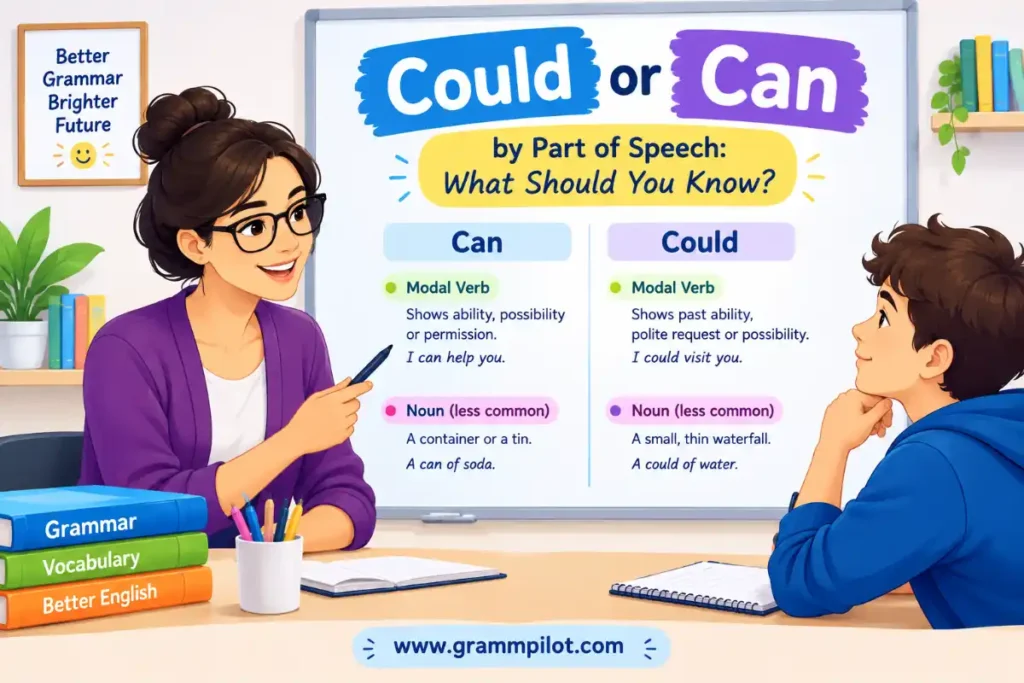
Can and could are modal auxiliary verbs. They don’t function like ordinary nouns, adjectives, or main verbs.
They are followed by a base verb.
Correct: She can swim.
Correct: She could swim.
Incorrect: She can swims.
Incorrect: She could to swim.
After can or could, don’t add to before the main verb.
Say: I can help.
Not: I can to help.
Say: He could finish it.
Not: He could to finish it.
This is one of the most important grammar patterns to remember.
What’s the difference between can and could for past ability?
Could is commonly used for general ability in the past.
Examples:
When I was ten, I could ride a bike without help.
My grandfather could speak four languages.
She could read before starting school.
For a single successful event, however, English often prefers was able to or managed to.
Compare:
Yesterday, I was able to fix the computer.
This emphasizes one successful event.
Yesterday, I could fix the computer.
This may sound less natural if you mean that you actually succeeded on that particular occasion.
A useful rule is:
Could often describes general past ability.
Was able to often describes a specific successful action.
What’s the difference between can and could for possibility?
Can often describes general possibility.
Example:
Too much screen time can cause sleep problems.
This means such a result is possible in general.
Could often presents a particular possibility.
Example:
Too much screen time could affect your sleep tonight.
Now the speaker is considering a specific possible result.
Another pair:
Driving too fast can cause accidents.
General possibility.
Driving this fast could cause an accident.
Specific warning.
The difference can be subtle, but it is useful in careful writing.
Can you use can for future possibility?
Yes, but the meaning needs attention.
Example: We can meet tomorrow.
This often means tomorrow is available or practical.
Now compare: We could meet tomorrow.
This presents tomorrow as one possible option. The first sounds more definite. The second leaves more room for discussion.
Another example:
You can call me tonight.
This can mean the speaker is available.
You could call me tonight.
This sounds more like a suggestion or possible choice.
Can you use could for future plans?
Yes, especially when the plan isn’t definite.
We could go hiking Saturday.
This suggests an option.
We can go hiking Saturday.
This sounds more definite or practical.
If the activity is already firmly planned, you might say:
We’re going hiking Saturday.
The best choice depends on how settled the plan is.
Which word is better for permission?
Can is extremely common for everyday permission.
Can I borrow your pen?
You can leave now.
Can we sit here?
These forms are natural in American English.
Could can also request permission, but it usually sounds more tentative or polite.
Could I borrow your pen?
There is also may:
May I leave early?
This is more formal and traditional.
Is “Can I?” grammatically correct?
Yes.
In everyday English, Can I? is a standard way to ask for permission.
For example:
Can I use your phone?
Can I sit here?
Some grammar lessons teach may as the formal word for permission, but that doesn’t make can incorrect in ordinary conversation.
The three forms can create different tones:
Can I…? = natural and direct
Could I…? = polite and softer
May I…? = formal
Is could more polite than can?
Usually, could sounds softer in requests.
Compare:
Can you send me the report?
Could you send me the report?
The second version creates more distance and often sounds more courteous. Still, can isn’t automatically rude.
A manager might naturally say: Can you send me the report before lunch?
That could be perfectly professional. Tone depends on the rest of the message.
Which word is better in a resume?
For a resume, can is usually more suitable when describing current abilities.
Example: Can analyze large datasets and present clear findings.
However, a stronger resume often removes can completely.
Better: Analyze large datasets and present clear findings.
Or: Skilled in analyzing large datasets and presenting clear findings.
Using could can make a current skill sound uncertain.
Less effective: Could manage multiple projects.
Better: Manage multiple projects simultaneously.
Or: Experienced in managing multiple projects simultaneously.
A resume should show confidence when the skill is real.
Which word is better in an essay?
Both words are useful, but the choice depends on your claim.
Use can for general facts or possibilities.
Example:
Lack of sleep can affect concentration.
Use could for possible outcomes or cautious claims.
Example: The proposed policy could reduce transportation costs.
The second sentence doesn’t promise that the policy will work. It presents a possible result.
That kind of careful wording can be useful in academic writing.
Which word is better in texting?
Both are natural.
For a direct request:
Can you call me?
For a softer request:
Could you call me?
For an option:
We can order pizza.
For a suggestion:
We could order pizza.
Texting is informal, so can is often enough. Use could when you want to soften the message or make an idea sound less definite.
Which word is better in an email?
For professional emails, could is often useful when making requests.
Example: Could you please review the attached document?
It sounds polite without being overly formal.
You can also use can: Can you please review the attached document?
That’s natural too.
For ability: I can complete the report by Friday.
For possibility: The change could improve response times.
The key is to match the modal to your intended meaning.
Which word is better when speaking?
Both are common in everyday speech.
Can you help me?
This is direct and friendly.
Could you help me?
This sounds softer.
I can come at six.
This suggests availability.
I could come at six.
This suggests one possible time.
Spoken tone matters a lot. A sentence that looks direct on paper can sound warm when spoken with a friendly voice.
What are 15 original examples with can?
Here are examples from different real-life situations.
- School: I can finish my homework before dinner.
- Work: We can review the proposal this afternoon.
- Travel: You can catch the next bus from this stop.
- Family: My sister can pick you up after work.
- Technology: This program can detect spelling errors.
- Health: Regular exercise can improve your energy.
- Cooking: You can add more salt if you prefer.
- Shopping: Can I try this jacket on?
- Customer service: Can you check my order number?
- Sports: He can run five miles without stopping.
- Planning: We can meet at the library tomorrow.
- Workplace: I can send the invoice before noon.
- Permission: You can use my notes.
- General possibility: Heavy traffic can cause long delays.
- Conversation: Can you tell me what happened?
Notice that can doesn’t have one fixed meaning. The context determines if it expresses ability, possibility, permission, or a request.
What are 15 original examples with could?
Now consider these examples.
- Past ability: I could ride a bicycle by the time I was five.
- Polite request: Could you check this sentence for me?
- Possibility: The package could arrive tomorrow.
- Suggestion: We could eat at the new restaurant.
- Hypothetical: I could buy the laptop if it were cheaper.
- Past skill: She could speak French when she lived abroad.
- Permission: Could I leave a little early today?
- Future option: We could visit the museum on Saturday.
- Conditional ability: He could finish sooner with more help.
- Possible problem: The update could cause compatibility issues.
- Workplace request: Could you send the figures again?
- Travel option: We could take the train instead.
- Imagined result: A larger budget could improve the project.
- Polite offer: Could I get you something to drink?
- Uncertain outcome: The weather could change by evening.
These examples show the range of meanings that could can carry.
What’s the difference between can and could in conditional sentences?
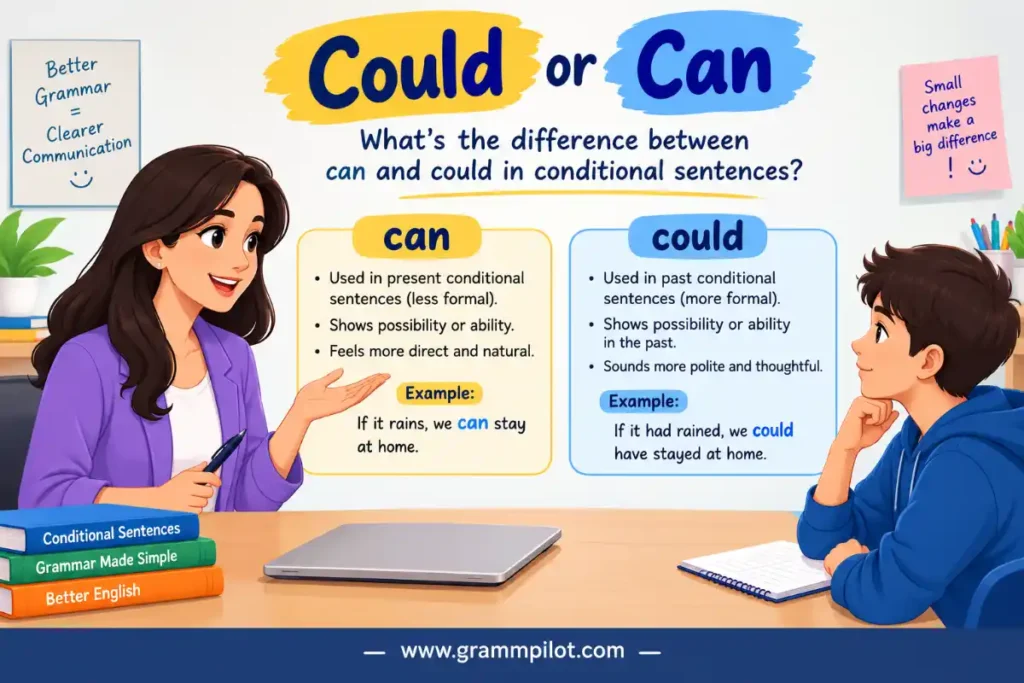
Could is especially common when a sentence describes a hypothetical possibility.
Example:
If I had more time, I could learn another language.
The ability depends on a condition.
Compare:
If I have more time, I can learn another language.
This sounds more like a realistic future plan.
Another pair:
If we save enough money, we can take the trip.
This presents the trip as a realistic possibility.
If we saved enough money, we could take the trip.
This creates more distance and sounds hypothetical.
The verb tense in the if clause helps guide the choice.
What’s the difference between could and might?
Both can express possibility.
It might rain tonight.
It could rain tonight.
The meanings are close.
But could can also suggest an available option:
We could go to the beach.
That doesn’t simply mean the beach visit is possible. It can function as a suggestion.
We might go to the beach.
This focuses more on uncertainty about if the trip will happen.
So:
Could = possible outcome or possible option
Might = uncertain possibility
The distinction isn’t absolute, but it’s useful.
What’s the difference between could and would?
These modals often appear in conditional sentences.
I could help if I had time.
This means helping would be possible.
I would help if I had time.
This emphasizes what the speaker would choose or intend to do.
Another example:
If we had enough money, we could buy the house.
Buying it would be financially possible.
If we had enough money, we would buy the house.
Buying it would be the choice.
That small difference can change the meaning of a conditional sentence.
What’s the difference between can and may?
Can commonly expresses ability.
I can swim.
May does not normally express ability.
It commonly expresses permission or possibility.
You may leave now.
It may rain later.
For permission, both can appear:
Can I leave?
May I leave?
The first sounds more natural in casual conversation. The second sounds more formal.
What are the most common mistakes with can and could?
Mistake 1: Adding “to” after can
Incorrect: I can to swim.
Correct: I can swim.
A modal is followed directly by the base verb.
Mistake 2: Adding “to” after could
Incorrect: She could to help us.
Correct: She could help us.
The same rule applies.
Mistake 3: Using could for every past ability
For general past ability, could works well.
Example: I could swim when I was six.
For one successful event, was able to may be more natural.
Example: I was able to escape before the door closed.
Mistake 4: Assuming can is rude
Can you help me?
is a normal everyday request.
It doesn’t automatically sound impolite.
Mistake 5: Using can in a hypothetical result
Less suitable: If I had more money, I can buy the car.
Better: If I had more money, I could buy the car.
The hypothetical condition calls for could.
Mistake 6: Using could for a definite current skill
Less clear: I could speak English fluently.
If you mean that you have this ability now, say: I can speak English fluently.
When should you not use can?
Avoid can when a sentence clearly describes a hypothetical result.
Example: If I had a car, I could drive to work.
Also avoid using can when you need to express uncertainty about one specific event and could, may, or might would communicate that meaning better.
For example:
The package could arrive tomorrow.
is different from:
The package can arrive tomorrow.
The first suggests a possibility. The second can sound like you’re saying tomorrow is an available or feasible delivery time.
When should you not use could?
Avoid could when you’re trying to make a confident statement about a current ability.
Instead of:
I could manage this project.
if you mean you’re confident in your present ability, write:
I can manage this project.
Likewise, don’t use could simply because you think it always sounds more polite.
Sometimes a direct can statement is clearer and more natural.
What are the antonyms of can and could?
The negative forms are usually the closest grammatical opposites.
For can:
- cannot
- can’t
Example: I can’t swim.
For could:
- could not
- couldn’t
Example: I couldn’t swim when I was young.
The negative can express lack of ability, impossibility, or inability depending on context.
Examples:
I can’t attend the meeting.
We couldn’t find the address.
That can’t be true.
The plan couldn’t work without additional funding.
The exact meaning changes with the situation.
What are the best quick tips for choosing can or could?
Use this checklist before choosing.
- Use can for current ability.
- Use could for general ability in the past.
- Use can for common everyday permission.
- Use could when asking for permission more politely.
- Use can for many general possibilities.
- Use could for specific or less certain possibilities.
- Use could for hypothetical ability or possibility.
- Use can for direct requests.
- Use could for softer requests.
- Use could for suggestions.
- Don’t put to after either modal.
- Remember that could doesn’t always mean past time.
- Use be able to when another modal or tense requires it.
- Check if you’re describing ability, possibility, permission, or politeness.
How can you remember the difference?
A simple memory trick can help.
Think:
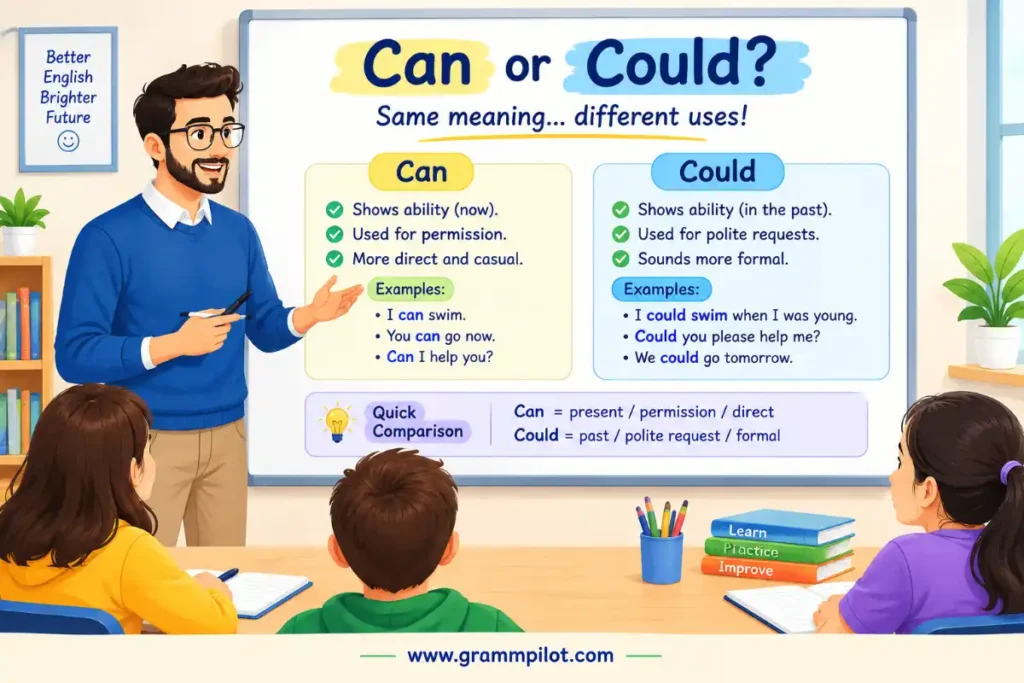
Can = current, clear, direct
Could = past, possible, polite
This isn’t a complete grammar rule, but it captures several of the most common uses.
For example: I can drive.
Current ability. I could drive when I was seventeen.
Past ability. Could you help me?
Polite request. We could go tomorrow.
Possible option.
When you aren’t sure, ask yourself one question: Am I talking about something definite and current, or something past, possible, hypothetical, or softer?
That question will often point you toward the right modal.
Can and could: a final comparison
| Situation | Best choice | Example |
|---|---|---|
| Current ability | Can | I can swim. |
| Past general ability | Could | I could swim at five. |
| Direct request | Can | Can you help? |
| Polite request | Could | Could you help? |
| Everyday permission | Can | You can leave. |
| Polite permission request | Could | Could I leave? |
| General possibility | Can | Mistakes can happen. |
| Specific possibility | Could | A mistake could happen. |
| Hypothetical ability | Could | I could help if I had time. |
| Suggestion | Could | We could take the train. |
| Current skill on resume | Can | I can manage projects. |
| Formal ability statement | Be able to | I am able to manage projects. |
Conclusion
Choosing between Could or Can becomes much easier when you first identify the meaning of the sentence. Can is usually the better choice for present ability, everyday permission, general possibility, and direct requests. Could works naturally for past ability, hypothetical situations, possible outcomes, suggestions, and softer requests. The two words are related, but they create different levels of certainty, time, and distance. Don’t think of could as nothing more than the past form of can, because modern English uses it in many present and future situations. When you pause over the choice, ask if you’re describing something you can do now, something you did in the past, something that might happen, or something you’re asking about politely. That quick check will usually lead you to the right form.
Frequently Asked Questions
1. Is can or could more polite?
Could is usually softer and more polite for requests. “Could you help me?” sounds less direct than “Can you help me?”
2. Is could just the past tense of can?
Could is the historical past form of can, but it also expresses present politeness, hypothetical situations, suggestions, and possible future outcomes.
3. Should I say can I or could I?
Can I is natural for everyday permission, while could I sounds more polite or tentative. Both forms are correct.
4. What’s another way to say can?
Be able to is the most common alternative for ability, while be allowed to works for permission and may can express permission or possibility.
5. Can I use could for present ability?
Could usually isn’t the best choice for a current real ability. Say “I can drive” for a skill you have now.
6. Which is better for a professional email, can or could?
Could is often a good choice for a polite professional request. For example, “Could you please review the attached document?” sounds courteous and natural.
7. Can and could: which one should I use for possibility?
Can often describes general possibility, while could commonly describes a particular or hypothetical possibility. “Too much stress can affect sleep” is general, while “This could affect your sleep tonight” focuses on a specific possibility.